Swimming for Fitness: Why the Pool Might Be the Best Cardio You’ve Been Avoiding
The Day I Accidentally Discovered My Favourite Workout
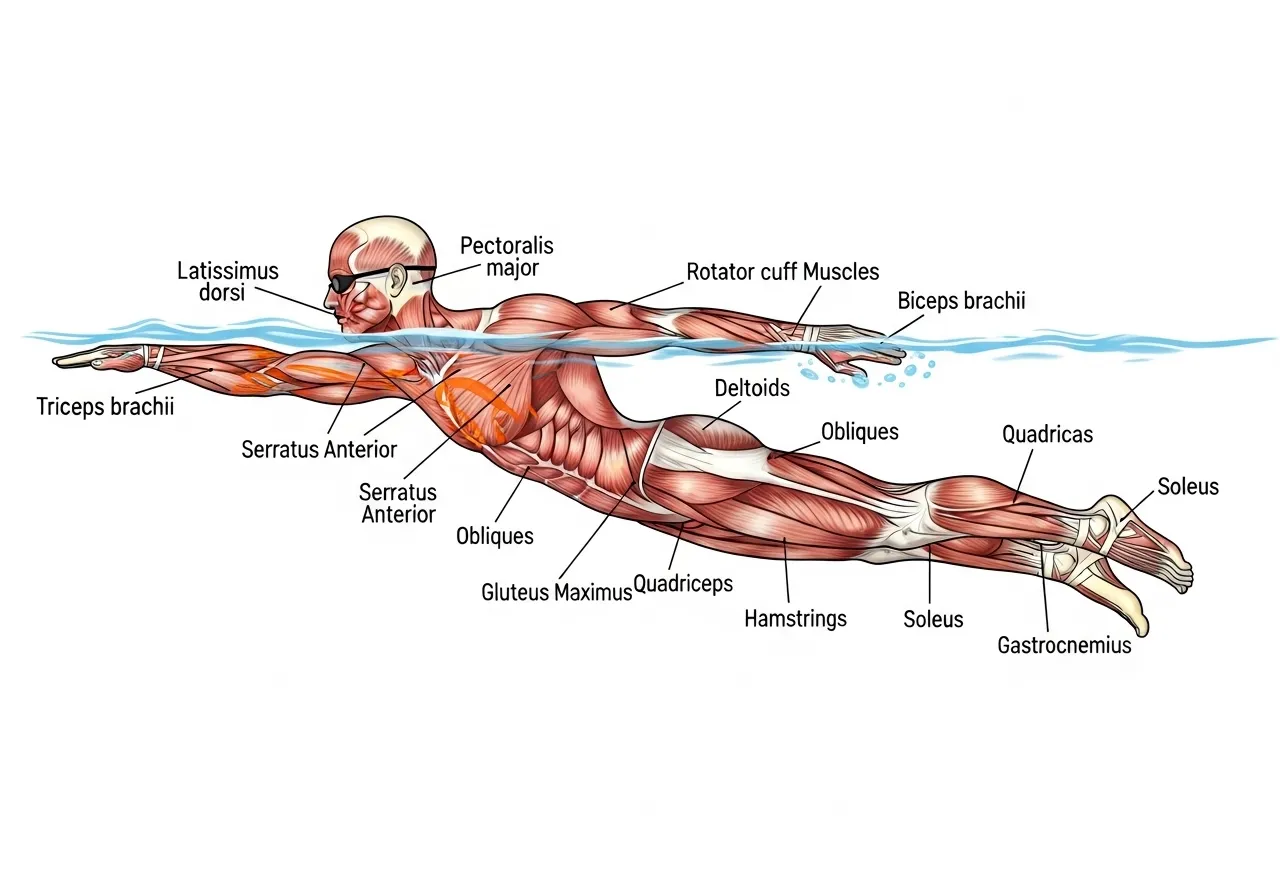
I showed up at the pool for what I thought was open lane swim time and found it occupied by a masters swimming group. I’d swum recreationally since childhood but had never done structured swim training. The coach waved me into the slow lane and handed me a workout card. Forty-five minutes later, I’d done more work than any running session I’d completed that month and discovered muscles in my upper back and lats that apparently didn’t exist in my land-based training.
Swimming is chronically underrated as a fitness modality — partly because adults are intimidated by the technique requirements, partly because pool access requires infrastructure that running doesn’t, and partly because its full-body nature makes it hard to categorize as either cardio or strength training. This guide covers the physiology, the technique essentials, and why the pool might be the most productive fitness environment available to you.
What Swimming Does That No Other Exercise Replicates
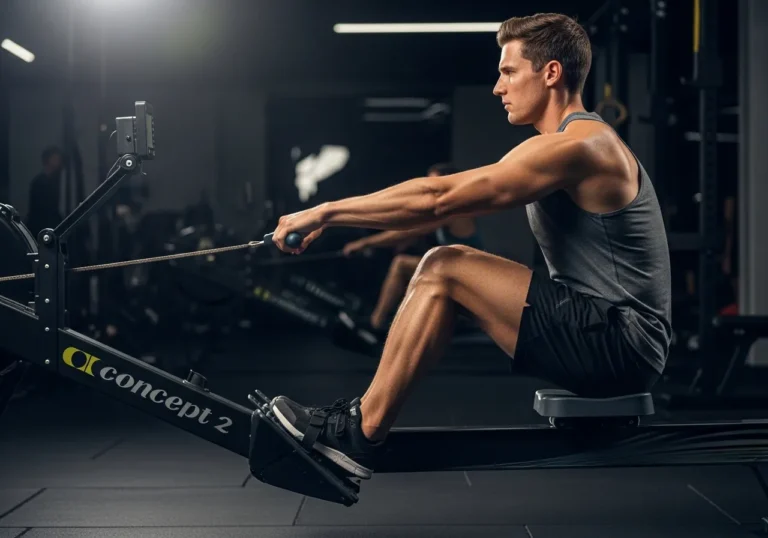
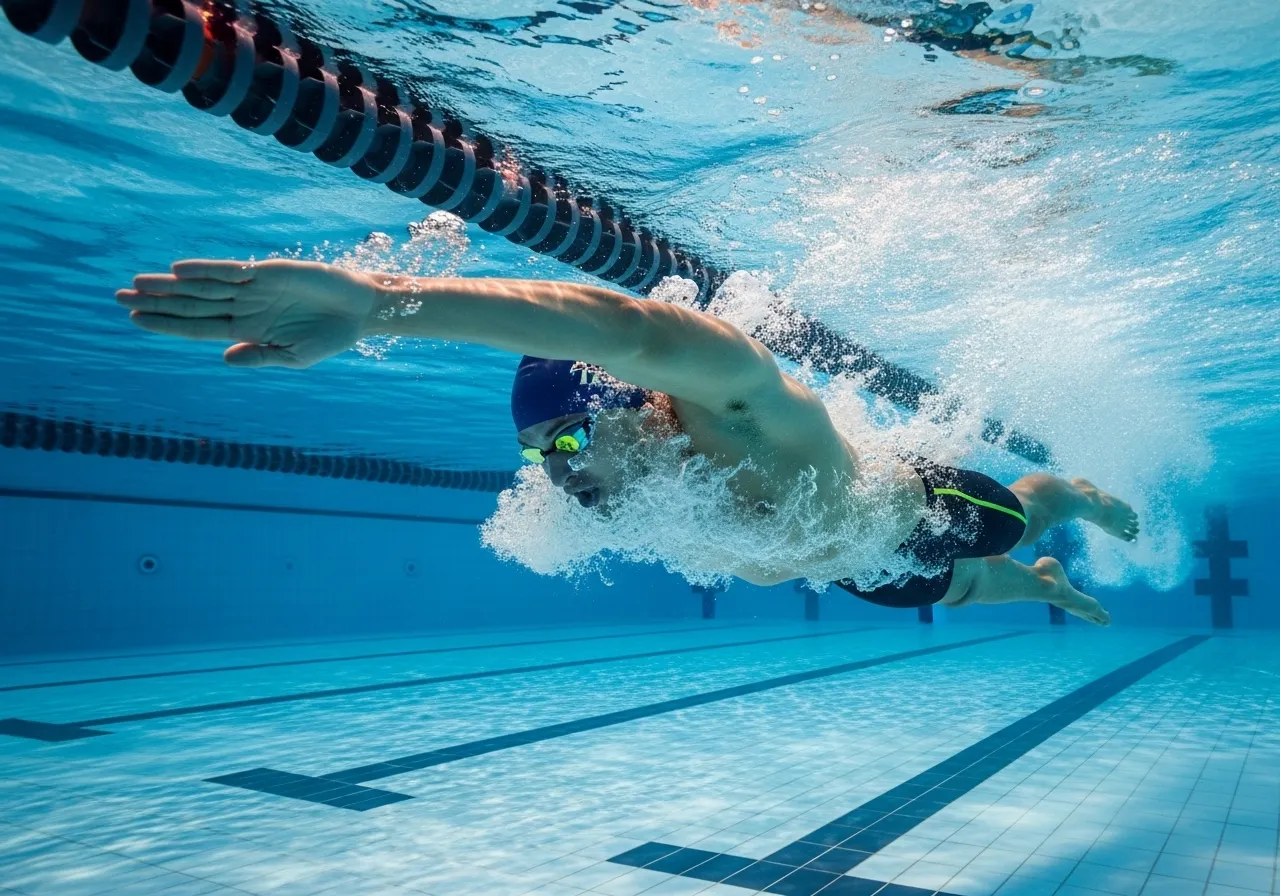
Swimming combines cardiovascular demand with full-body resistive training against a dense medium. Water is approximately 800 times denser than air, meaning every movement of every limb provides resistance without weights or machines. The cardiovascular demand of sustaining this full-body resistive effort produces heart rate responses comparable to running — but with zero impact loading, and the thermoregulatory effect of cool water that delays the heat accumulation that limits performance in land exercise.
The Research: Swimming’s Health Benefits
A systematic review of cycling health benefits provides useful context for aerobic modalities — swimming produces similar cardiovascular adaptations through different mechanisms. Research on swimming specifically finds VO2max improvements comparable to running training of equivalent volume and intensity, improvements in cardiovascular risk factors, and the unique advantage of allowing higher training volume without the musculoskeletal stress that limits running mileage. (see also: VO2 max guide)
The Impact Advantage
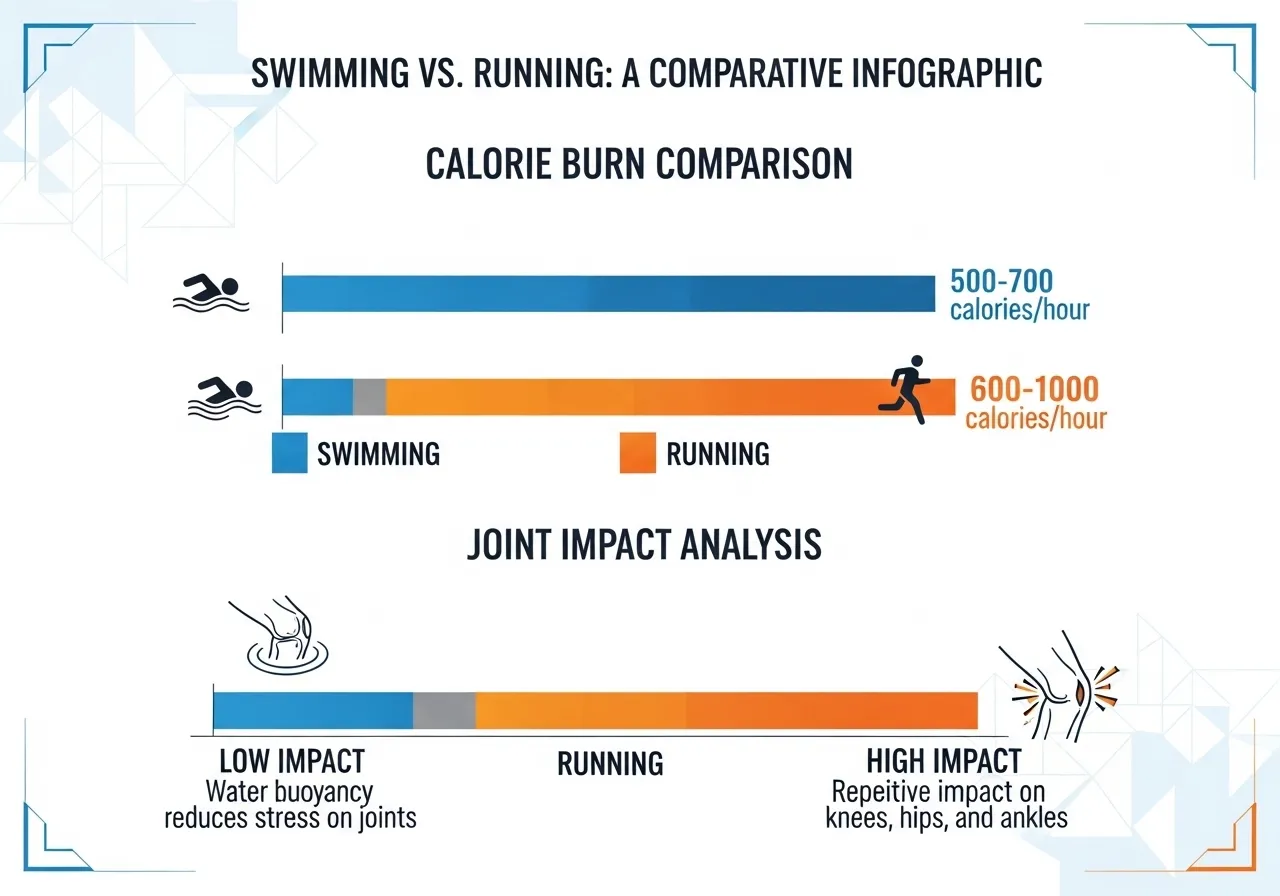
Running produces ground reaction forces of 2-3 times body weight per stride. Swimming produces essentially zero impact loading. This makes swimming particularly valuable for people with knee, hip, or lower extremity conditions that make running painful, for older adults managing joint health, and for athletes seeking higher cardio volume without accumulating overuse injury risk from running.
Freestyle Technique for Adult Beginners
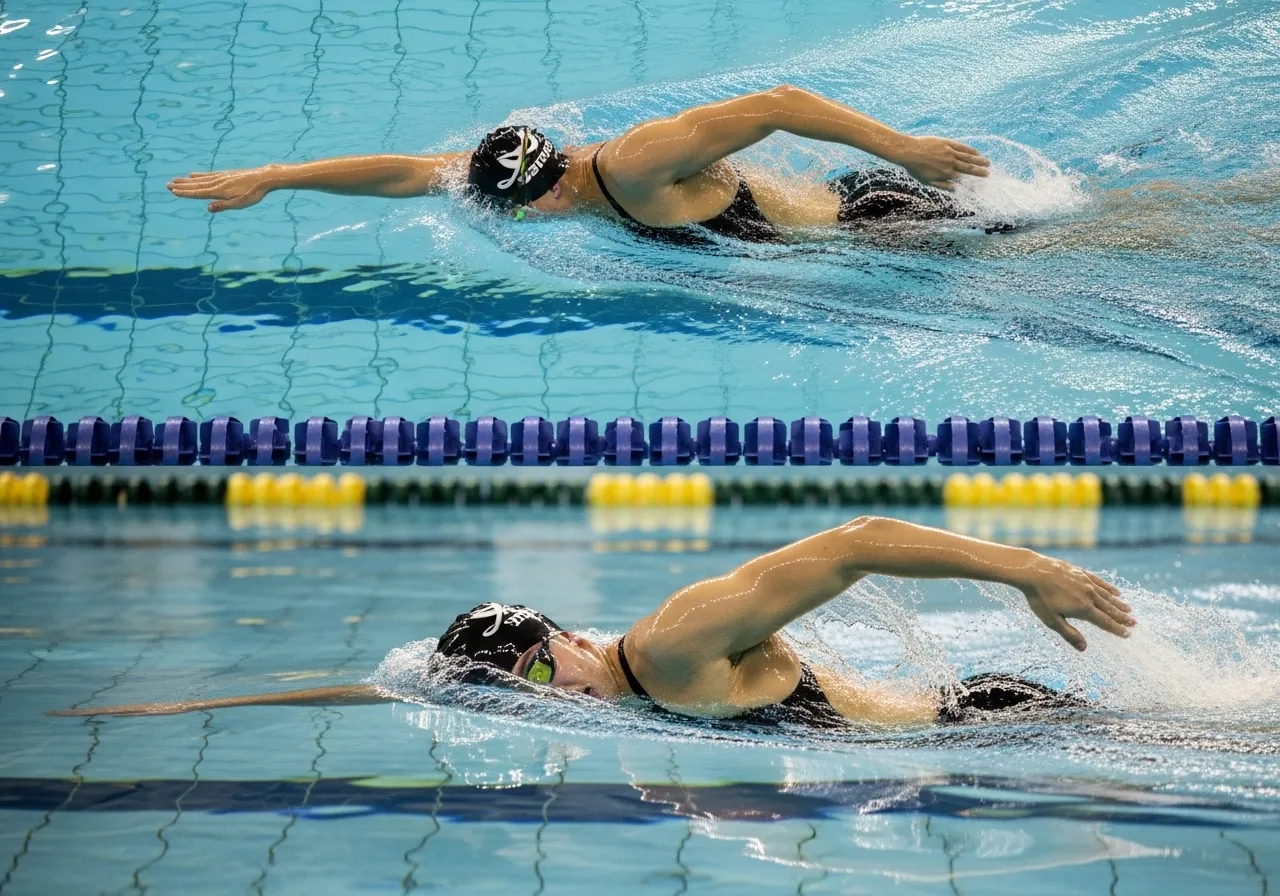
Adult-onset swimming has a technique learning curve that pool access alone cannot overcome. These fundamentals are the most impactful for recreational swimmers who want to be efficient enough to swim continuously for fitness.
Body Position: Horizontal Is Everything
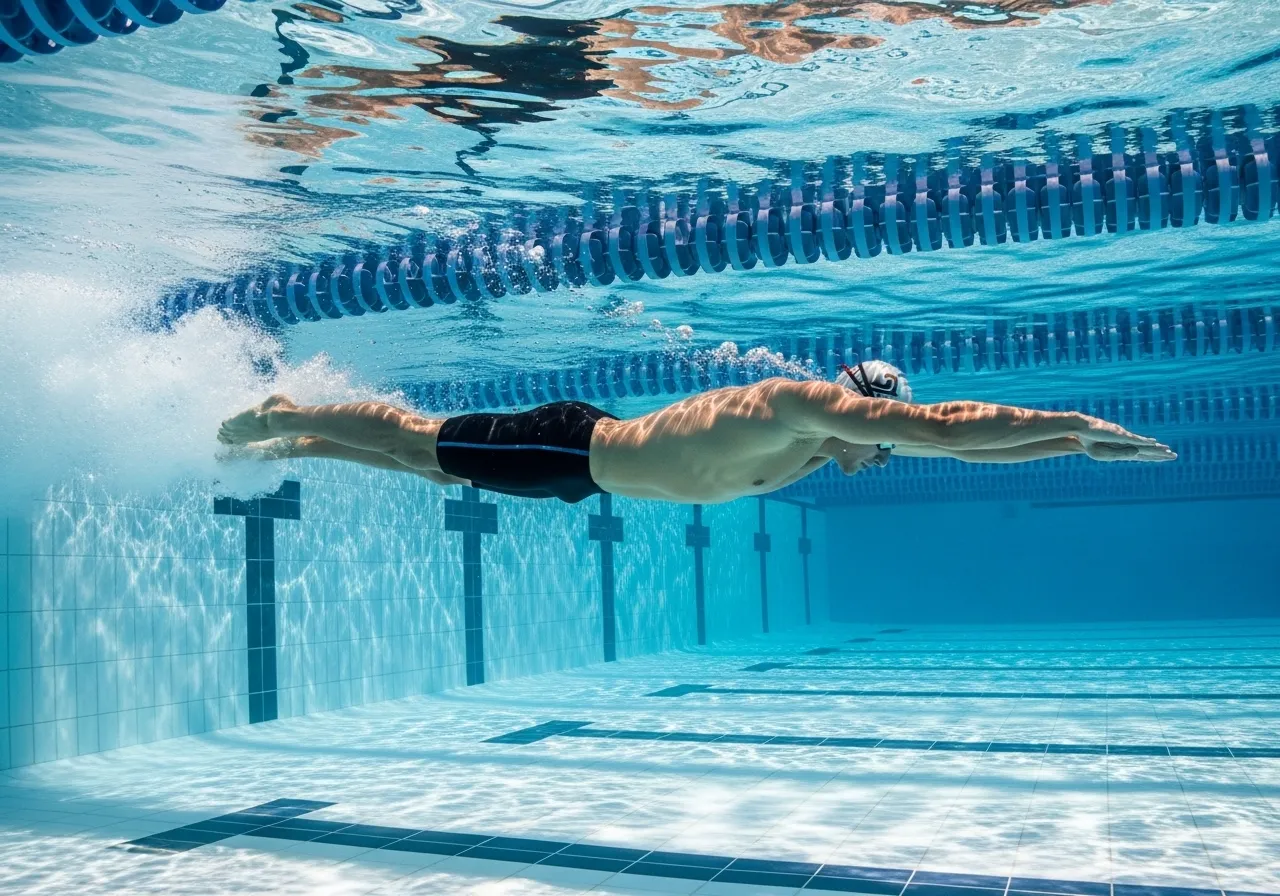
The primary cause of slow, exhausting swimming in beginners is dropped hips — body angled like a sinking ship rather than lying flat. Dropped hips dramatically increase drag and force the arms to do double duty as propulsion and lifting mechanisms. The fix: engage the core, look down (not forward), and press the chest slightly downward — this hydraulically lifts the hips to horizontal. If your feet are constantly sinking despite kicking, your body position is costing you half your propulsion.
Breathing: The Technique That Determines Everything Else
Bilateral breathing — alternating which side you breathe on every 3 strokes — is the gold standard for balanced freestyle development. Many beginners breathe every 2 strokes (same side), creating a rotation bias and asymmetrical stroke mechanics that cause shoulder problems over time. Practice breathing every 3 strokes from the beginning, even if it feels breathless initially — the adaptation takes 3-4 sessions but produces more balanced and sustainable technique.
The Catch: Where Propulsion Happens
The arm stroke’s propulsion comes from the “catch” — the moment the hand and forearm create a paddle to push backward against the water. Beginners typically slip their hand through the water rather than catching it, producing minimal propulsion per stroke. The catch cue: after your hand enters the water ahead, drop the elbow while keeping the wrist and forearm vertical, creating a paddle perpendicular to your direction of movement. Then pull your body past your hand, not your hand past your body.
Kicking Mechanics
The freestyle kick is a small-amplitude flutter kick originating from the hip with only slight knee bend. Large bicycle kicks (significant knee bend) create drag and exhaust the legs without generating meaningful propulsion. Keep the kick small, fast, and initiated from the core and hip. In fitness swimming, the kick’s primary function is balance and body position, not propulsion.
Structuring Swim Training for Cardiovascular Fitness
Beginner Session (Can Swim 1-4 Lengths Continuously)
Total: 30-40 minutes. Warm-up 4 lengths easy, then: 8 repetitions of 1 length (25m) with 30 seconds rest. Focus on technique during rest intervals before the next effort. Cool-down 4 lengths easy. Total distance: approximately 400-600m. The short rest intervals allow technique recovery between each length, maintaining quality movement rather than grinding through fatigue that reinforces poor patterns.
Intermediate Session (Can Swim 8-10 Lengths Continuously)
Total: 45 minutes. Warm-up 200m easy. Main set: 5×100m at moderate-hard effort with 45 seconds rest, then 5×50m at hard effort with 30 seconds rest. Cool-down 100m easy. This builds the aerobic capacity that makes continuous lap swimming sustainable. Total distance: approximately 1,000-1,200m.
Continuous Aerobic Swimming
Once 20+ lengths can be swum continuously, add a time-based continuous swim (20-30 minutes continuous at sustainable pace) alongside interval sessions. This aerobic base session develops the endurance capacity that makes interval sessions more productive. The combination of one interval session and one or two continuous aerobic sessions per week produces complete swimming fitness development.
Using Training Aids
Pull buoy (placed between the legs to float them) removes the kick, allowing focus on arm stroke mechanics and upper body endurance. Kickboard (held in the hands) removes the arm stroke, allowing focused kick development. Fins (worn on the feet) increase propulsion and make maintaining horizontal body position easier — useful for beginners learning body position before full technique is developed.
Common Swimming Mistakes and How to Fix Them
Lifting the Head to Breathe
Lifting the head upward disrupts horizontal body position and slows the breathing action. The correct technique: rotate the head to the side with one goggle still underwater, inhaling from the small pocket of air created by the bow wave at cheek height. The head should turn, not lift. This is the single most impactful technique correction for the majority of adult beginners.
Crossing the Center Line
Many beginners enter their hand past the center line during the catch, causing the hips to fishtail. Enter each hand in line with the same-side shoulder, not across the midline. Swimming with a kickboard between your knees for a few lengths is a diagnostic — if the board oscillates, you’re crossing the center line.
Overreaching at Entry
Entering the hand far ahead of the shoulder (overreaching) combined with pressing down rather than forward at the catch is one of the most common efficiency killers in recreational swimming. Enter the hand just beyond the head, and immediately drop the elbow to set the catch rather than pushing down.
Rushing the Stroke
Beginners typically swim with too high a stroke rate and insufficient power per stroke. Slowing down the stroke rate and focusing on fully completing each catch and pull produces more propulsion per stroke than rapid, shallow strokes. Count your strokes per length — most recreational swimmers improve significantly by consciously reducing strokes per length (gliding further per stroke) before worrying about speed.
Building Swimming Into Your Fitness Routine
Frequency and Recovery
Swimming’s low impact means it can be performed more frequently than running without accumulating the same musculoskeletal stress. Three sessions per week is appropriate for general cardiovascular fitness development. Five or more sessions per week is appropriate for performance-focused swimmers. Unlike running, swimming soreness is primarily upper body muscular (from the pulling) rather than joint-related — recoverable within 24 hours for moderate sessions.
Combining Swimming With Other Training
Swimming pairs exceptionally well with running and cycling in triathlon training precisely because its demands are largely complementary — upper body-focused, non-impact, and using different energy system demands than running. For gym-based athletes, swimming adds cardiovascular fitness without loading the joints stressed by weight training. A weekly schedule of 2-3 swim sessions plus 2 resistance training sessions provides complete fitness development with minimal overuse injury risk.
Is swimming enough exercise for complete fitness? Swimming is excellent for cardiovascular fitness and upper body muscular endurance. It doesn’t develop lower body strength equivalently to weight-bearing exercise, and it doesn’t maintain bone density the way impact exercise does. Combine swimming with resistance training for complete fitness.
How many laps should I swim per session? Focus on time (30-45 minutes) rather than laps, especially initially. A beginning swimmer completing 400m in 30 minutes with good technique is training more productively than one grinding through 1,000m with poor mechanics.
My arms are exhausted after 2 lengths. Is this normal? Yes, for beginners — upper body pulling endurance is typically underdeveloped in people who haven’t swum regularly. This adapts quickly within 3-4 weeks. Using a pull buoy during some lengths allows focus on arm technique and builds upper body endurance more specifically.
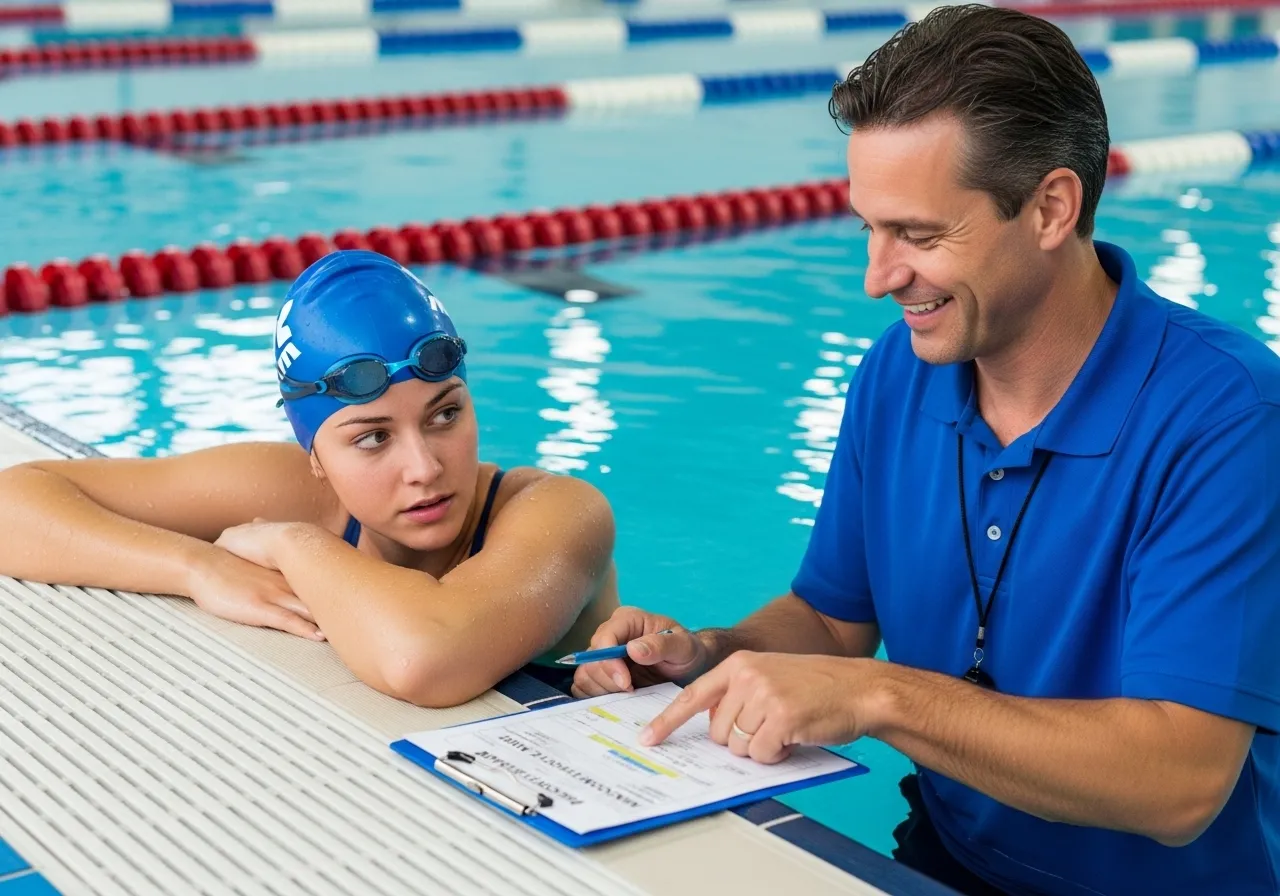
Do I need a coach to improve? Even 2-3 coaching sessions accelerates improvement significantly by identifying technique errors that self-correction cannot easily identify. Video analysis from above and below the water is particularly valuable. Self-taught swimmers often spend years trying to correct bad habits that a few coached sessions would prevent. Harvard’s nutrition and health resources identify swimming alongside cycling as one of the most health-beneficial moderate-intensity aerobic activities for sustained health improvement across all ages.
Can I lose weight swimming? Yes — moderate-intensity swimming burns 400-600 calories per hour. Swimming’s hunger response may be slightly higher than equivalent land exercise (cold water stimulates appetite), which can offset caloric expenditure if not managed. Swimming for weight loss requires the same caloric awareness as any other exercise modality — it creates the caloric expenditure, but the dietary side of the equation still requires attention.