Romanian Deadlift vs Conventional Deadlift: Which Builds More Hamstring and Glute Strength?

The Posterior Chain Exercise Debate That Every Serious Lifter Faces
I spent three years doing conventional deadlifts exclusively before I understood what I was missing. My lower back was strong, my traps were thick, and my overall pulling strength was progressing steadily. But my hamstrings — despite years of deadlifting — remained stubbornly underdeveloped relative to my quadriceps and my overall strength level. The posterior chain imbalance was showing up in my barbell back squat guide as a sticking point, in my sprint performance, and in an occasional tightness at the back of the knees that I couldn’t quite explain.
The change came when I started incorporating Romanian deadlifts as a dedicated secondary movement. Within eight weeks, the hamstring development I’d been chasing for years began materializing — and the conventional deadlift guide numbers I cared about started climbing faster than they had in the previous year. Understanding why requires understanding what each movement actually trains and why they are genuinely different rather than interchangeable.
The Posterior Chain: Your Body’s Most Powerful System
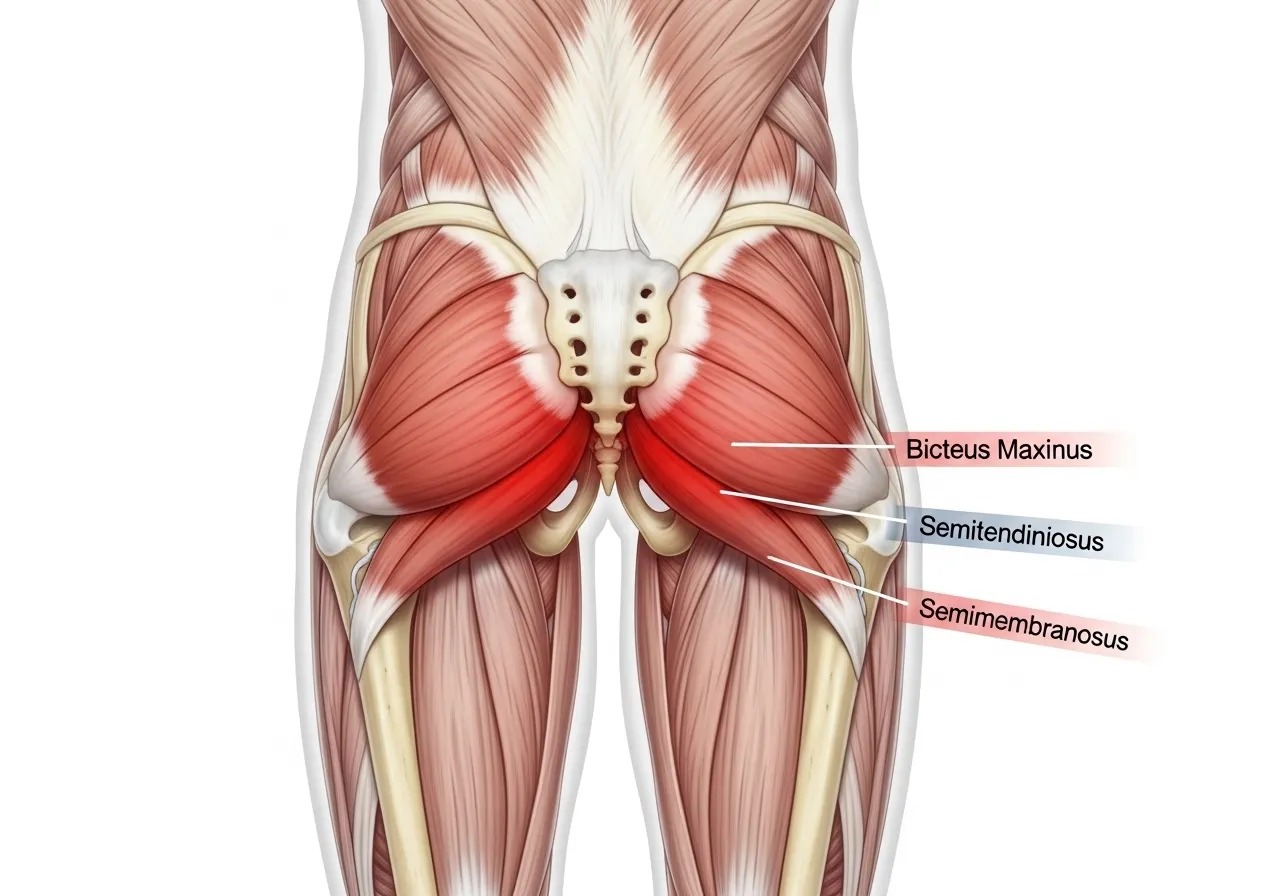
The posterior chain — the interconnected system of muscles running along the back of the body — is responsible for every powerful human movement. The gluteus maximus, hamstrings (biceps femoris, semitendinosus, semimembranosus), erector spinae, and upper back work as a coordinated unit to produce hip extension, control trunk flexion, and transfer force from the ground through the body. Developing this system completely requires exercises that load each component through its full range of motion and primary function.
Both the conventional deadlift and the Romanian deadlift technique guide train the posterior chain. The critical difference is where along each muscle’s length the primary loading occurs — and this distinction determines which exercises train which qualities most effectively.
The Hip Hinge: Foundation of Both Movements
Both exercises are hip hinge patterns: the hips move backward and the torso inclines forward while the spine maintains neutral position. The difference is in the degree of knee flexion, where the range of motion begins and ends, and consequently which muscles bear the greatest demand throughout the movement. Understanding the hip hinge mechanics is essential before distinguishing between the two variations — athletes who attempt either without a solid hip hinge pattern typically load the lumbar spine rather than the intended posterior chain muscles.
Why Range of Motion Determines Muscle Development
Research on muscle hypertrophy consistently identifies training at longer muscle lengths — the stretched position — as producing greater hypertrophic stimulus than equivalent training at shorter muscle lengths. Studies on muscle growth and range of motion confirm that exercises producing a greater stretch on the target muscle produce more growth per unit of training volume than exercises that load the muscle primarily at its shortened position. This principle directly differentiates the Romanian deadlift from the conventional deadlift in terms of hamstring development.

The Conventional Deadlift: Maximum Load, Full-System Integration
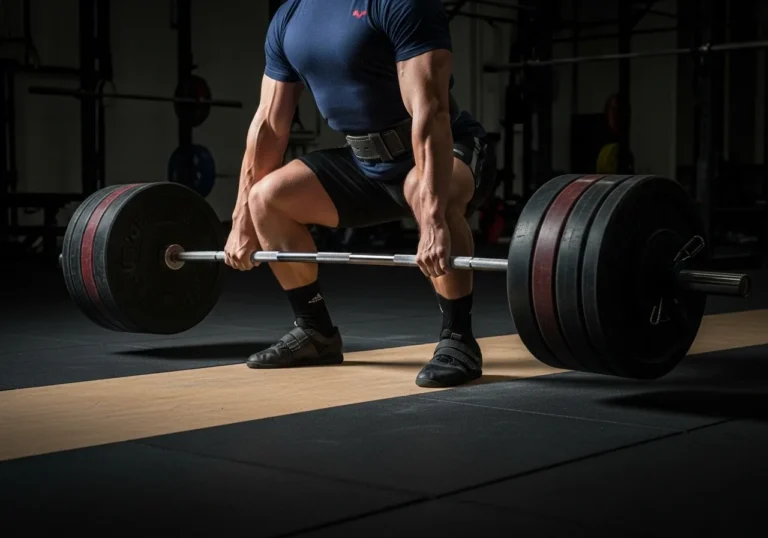
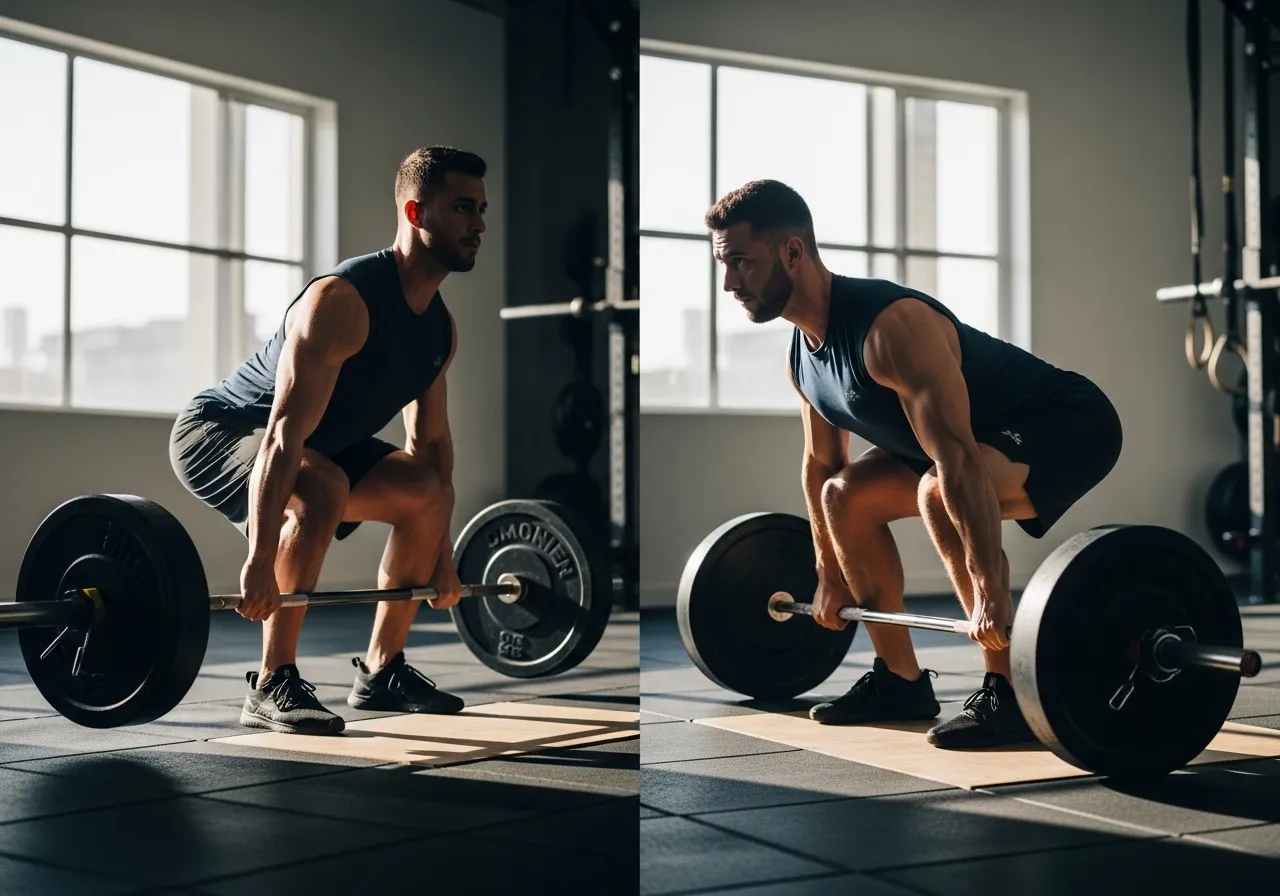
The conventional deadlift begins from the floor with the bar against the shins. The lifter starts with approximately 90 degrees of knee flexion, hips relatively low, chest up, and back tight. The initial pull requires the legs to drive the floor away while the hips extend — creating a leg press component in the first portion of the movement that the Romanian deadlift completely lacks.
Muscles Trained: The Full Posterior Chain Plus Quads
The conventional deadlift uniquely engages the quadriceps in the initial pull from the floor. As the bar passes knee height, the movement transitions to a hip hinge-dominant pattern with the erector spinae and glutes completing the lockout. The full movement recruits the quadriceps, hamstrings, gluteus maximus, erector spinae, trapezius, rhomboids, lats, forearms, and core — essentially every major muscle group in the body working simultaneously.
Why Conventional Deadlifts Allow Maximum Loading
The conventional deadlift’s mechanical advantage comes from the leg-drive component. Starting with significant knee flexion allows the quads to contribute force in the initial pull — the most mechanically challenging portion of the lift where the bar is farthest from the body’s center of mass. This additional muscular contribution enables substantially heavier absolute loading than any hamstring-dominant hip hinge movement. Most intermediate lifters can conventional deadlift 20-40% more than they can Romanian deadlift.
The Lockout: Where Conventional Deadlifts Train the Glutes Most
The conventional deadlift’s glute activation peaks at lockout — the final extension of the hips to standing. The conventional deadlift’s greatest strength is the systemic stimulus it provides: no other exercise loads the entire body with the same absolute weight simultaneously.
Conventional Deadlift and Spinal Loading
The conventional deadlift produces significant compressive and shear forces on the lumbar spine — particularly in the transition from the floor, where the combination of heavy loading and the lower back’s extended lever arm creates the highest spinal loading of any common gym exercise. This is not a reason to avoid the movement — the conventional deadlift’s spinal loading produces the erector spinae development that supports all other lifting — but it is a reason to prioritize technique and to recognize that the lower back is a limiting factor that accumulates fatigue faster than the posterior chain muscles it’s assisting.
The Romanian Deadlift: Hamstring Hypertrophy Specialist
The Romanian deadlift begins standing with the bar held at hip height. From standing, the lifter pushes the hips backward while keeping the knees slightly bent (15-25 degrees of flexion, maintained throughout) and the bar traveling close to the body. The movement ends when the hamstrings reach their maximum stretch — typically when the bar is at mid-shin height — and then the hips drive forward to return to standing.
The Critical Difference: Hamstrings at Full Stretch
The Romanian deadlift’s defining characteristic is that it loads the hamstrings through their maximum elongation. As the hips push backward and the torso inclines forward, the hamstrings are stretched from both ends simultaneously — the origin at the ischial tuberosity and the insertion at the knee. This dual-joint stretch creates a loaded elongation of the muscle that the conventional deadlift cannot replicate. This is why the Romanian deadlift produces superior hamstring hypertrophy per set compared to the conventional deadlift: it spends more time loading the muscle at the stretched position where hypertrophic stimulus is greatest.
EMG Evidence: Hamstring Activation Comparison
Electromyographic studies comparing Romanian deadlifts to conventional deadlifts consistently find higher average hamstring activation during Romanian deadlifts, with particularly notable differences in the peak stretch position where conventional deadlifts are least effective. Research on hamstring exercise biomechanics confirms that hip hinge movements with minimal knee flexion produce greater hamstring activation through the elongated range than movements beginning from full knee flexion.
Lower Back Loading: Romanian vs Conventional
The Romanian deadlift produces lower absolute lumbar loading than the conventional deadlift for equivalent perceived effort — partly because the loads used are lighter and partly because the absence of a leg-drive component reduces the peak force required. However, the Romanian deadlift produces sustained erector spinae isometric activation throughout the movement as the back holds its neutral position against the increasing hip flexion load.
Glute Loading in the Romanian Deadlift
The Romanian deadlift loads the gluteus maximus throughout the movement, with peak activation in the hip extension phase returning from the stretched position. The hip extension range covered by the Romanian deadlift provides substantial glute training that, combined with the hamstring focus, makes the exercise the most complete posterior chain development movement available.
Programming Both Movements: The Optimal Integration Strategy
The most productive posterior chain training programs use both the conventional deadlift and the Romanian deadlift, capitalizing on their complementary strengths rather than choosing between them.
The Conventional Deadlift as Primary Strength Movement
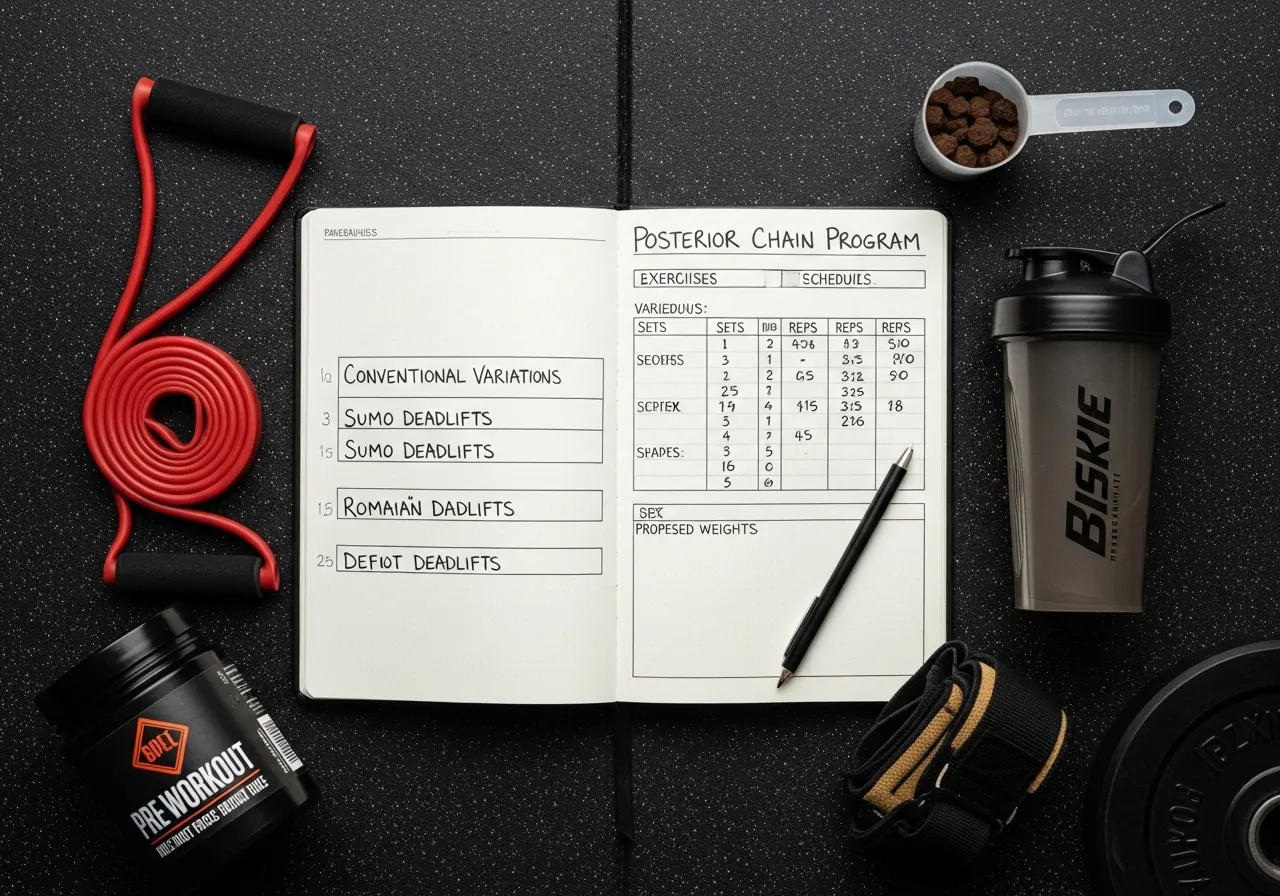
The conventional deadlift belongs early in lower body or full-body sessions as the primary heavy strength movement. Programming framework: 3-5 sets of 3-6 reps at 80-90% of 1RM for strength development; 3-4 sets of 6-10 reps at 70-80% for combined strength and hypertrophy. Conventional deadlifts should be the heaviest loaded exercise in any posterior chain session.
The Romanian Deadlift as Secondary Hypertrophy Movement
Romanian deadlifts belong after the primary strength work as a secondary hypertrophy-focused movement. The typical loading is 50-65% of conventional deadlift max. Rep ranges for maximum hamstring hypertrophy: 3-4 sets of 8-12 reps with controlled 3-4 second eccentrics. The slow eccentric is not optional — the hamstring development benefit of Romanian deadlifts is maximized when the loaded stretch is extended through deliberate tempo.
Weekly Frequency and Recovery
Heavy conventional deadlifts (85%+ of 1RM) require 72-96 hours of recovery before the next posterior chain session. Romanian deadlifts at moderate loads recover faster: 48-72 hours is typically sufficient. A practical weekly structure: heavy conventional deadlifts once per week, Romanian deadlifts as a secondary movement on a second lower body day, with 72+ hours between the two sessions.
Rep Tempo: The Most Underutilized Tool in Romanian Deadlift Programming
Implementing a 3-1-1 tempo (3 seconds down, 1 second pause at the bottom, 1 second up) on Romanian deadlifts dramatically increases the hypertrophic stimulus without increasing load — making it one of the most efficient programming adjustments available for hamstring development.
The Stiff-Leg Deadlift Variation
The stiff-leg deadlift performs the Romanian deadlift pattern from the floor rather than the standing position — adding the floor-to-knee portion that the Romanian deadlift omits. This variation provides a greater total range of motion but also requires more lower back endurance. It is appropriate for advanced trainees and should not be programmed before Romanian deadlift proficiency is established.
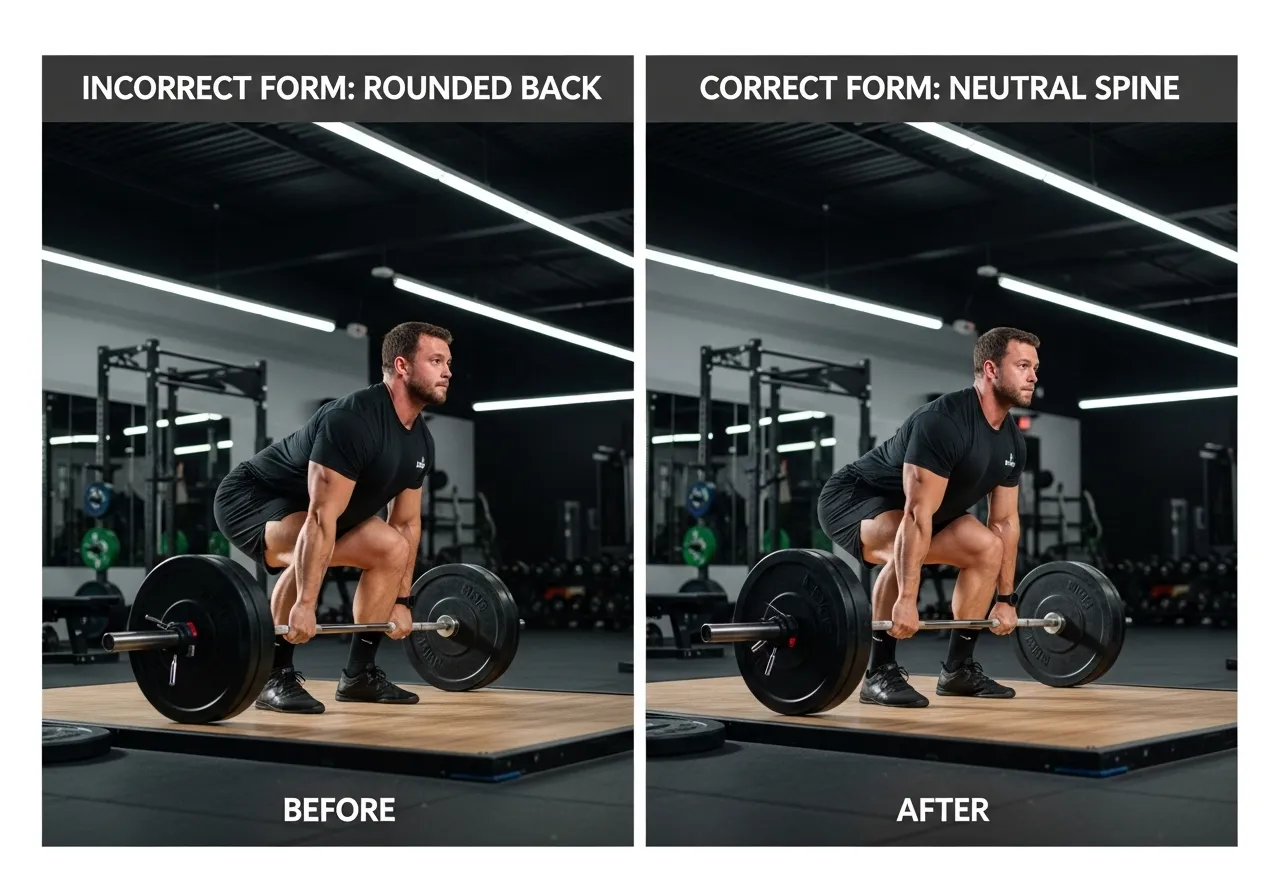
Technique Deep Dive: Common Errors and How to Fix Them
Conventional Deadlift: The Most Common Technical Errors
Bar drifting away from the body: the most common and most consequential conventional deadlift error. When the bar drifts forward, the lever arm between the bar and the spine increases dramatically, multiplying the lumbar loading. Fix: keep the bar dragging against the shins on the way up and reinforce lat engagement to keep the bar against the body.
Hips rising faster than the bar: this converts the initial leg-drive into a lower back-dominated pull, bypassing the quad contribution and overloading the spinal erectors. Fix: maintain hip angle through the floor phase by pushing the floor away rather than pulling the bar up.
Hyperextending at lockout: creates unnecessary lumbar loading at the finish. Fix: lockout by squeezing the glutes and driving the hips through to vertical.
Romanian Deadlift: The Most Common Technical Errors
Rounding the lower back at the bottom: as the hamstrings reach maximum stretch, many lifters allow the lower back to round to achieve additional range — this shifts load from the hamstrings to the lumbar discs. Fix: stop the descent when the first sign of lower back rounding appears, regardless of how low that is.
Excessive knee bend during the movement: adding knee flexion as the bar descends converts the Romanian deadlift toward a conventional deadlift pattern, reducing the hamstring stretch. Fix: maintain a consistent slight knee bend (15-25 degrees) throughout.
The Foot Position Variable
Both movements allow stance width variation that significantly affects muscle emphasis. Romanian deadlifts benefit from a hip-width stance — too wide reduces the posterior hip shift that creates the hamstring stretch.
Building Your Posterior Chain Program: Sample Templates and FAQ
Template 1: Strength Focus
Day 1: Conventional deadlift 4×4 at 82-87% 1RM, Romanian deadlift 3×8 at controlled tempo, leg press 3×12, hamstring curl 3×12. Day 2 (72+ hours later): Front squat 4×5, Romanian deadlift 4×10 with 3-second eccentric, Bulgarian split squat 3×10 per side, Nordic hamstring curl 3×6.
Template 2: Hypertrophy Focus
Day 1: Romanian deadlift 4×10 (primary movement), hip thrust guide 4×12, leg curl 4×12, cable pull-through 3×15. Day 2: Conventional deadlift 4×6 at 75-80% 1RM, stiff-leg deadlift 3×10, single-leg Romanian deadlift 3×10 per side, seated hamstring curl 3×12.
Progression System
Apply progressive overload to both movements independently. NSCA’s guidelines on progressive overload recommend consistent, measurable increases as the foundation of long-term strength development. The American College of Sports Medicine recommends progressive training approaches for safe and effective strength development. A practical progression milestone: when Romanian deadlift loads reach 60-65% of conventional deadlift 1RM, hamstring development is tracking well.
Should beginners learn the conventional deadlift or Romanian deadlift first? The Romanian deadlift is often a better starting point for teaching hip hinge mechanics — the fixed knee angle simplifies the pattern compared to the conventional deadlift’s combined leg-drive and hip hinge. Many coaches teach the Romanian deadlift as the foundation and introduce the conventional deadlift after hip hinge competency is established.
How much should I be able to Romanian deadlift compared to my conventional deadlift? Most intermediate lifters Romanian deadlift 55-65% of their conventional deadlift maximum. If the gap is much larger, hamstring development is likely lagging and RDL priority should increase.
Do Romanian deadlifts build the lower back? Yes — the erector spinae work isometrically throughout the Romanian deadlift to maintain neutral spine. For lower back development, conventional deadlifts provide superior stimulus; for hamstring development, Romanian deadlifts are superior.
Can I do Romanian deadlifts every day? The hamstrings and erectors need adequate recovery between sessions. Three times per week at moderate loads is typically sustainable; the soreness Romanian deadlifts produce requires 48-72 hours to resolve.
My hamstrings cramp during Romanian deadlifts. What should I do? Hamstring cramping typically indicates dehydration and electrolyte imbalance, or attempting range of motion beyond current hamstring flexibility guide while under load. Ensure adequate hydration, reduce range to a comfortable stretch, and progress depth gradually over weeks.