Shrugs: Build Trapezius Muscles
Trap blueprint: why shrugs transform your posture and strength

Build a reliable system for stronger traps
Shrugs train the trapezius, which stabilizes the shoulder girdle. Strong traps protect your neck and improve pulling strength.
Key principles:
- Target the upper traps with elevation. Lift the shoulders straight up, not forward.
- Use a full range of motion. Pause at the top for one second.
- Load heavy, then add volume. Traps love tension and time under load.
- Balance with mid and lower trap work. Your shoulders stay healthy.
Science made simple: EMG studies show high upper-trap activation during shrugs. Isometric carries add long tension, which supports growth. Heavy sets use the ATP-PC energy system, so rest long enough.
I learned to stop rolling my shoulders. Rolling shortened my range and irritated my neck. Straight up and down works better.
| Exercise | Primary Focus | Load Guide | Tempo | Why it works |
|---|---|---|---|---|
| Dumbbell Shrug | Upper traps | 8–15 reps at RPE 7–9 | 1 up, 1 hold, 2 down | Great control and symmetrical loading |
| Barbell Shrug | Upper traps, grip | 5–10 reps heavy | 1 up, 1 hold, 2 down | Max load for strength stimulus |
| Behind-the-Back Shrug | Upper traps, scapular posterior tilt | 8–12 reps moderate | 1 up, 1 hold, 2 down | Changes arm path for a new angle |
| Cable/Machine Shrug | Constant tension | 10–15 reps | 1 up, 2 hold, 3 down | Great mind-muscle connection |
| Farmer Carry Shrug | Isometric upper traps | 20–60 seconds | Walk tall, slight shrug | Time under tension and posture |
These moves anchor the rest of the plan. Next, master technique so you gain muscle without pain.
Technique that builds muscle, not neck pain

Execute perfect shrugs from day one
Good form makes traps grow while protecting your neck. Follow these simple steps.
Day-one routine (15 minutes):
- Warm-up: 2 minutes light band pull-aparts and neck nods.
- Dumbbell Shrug: 3 sets x 12 reps, 60 seconds rest.
- Farmer Carry: 3 x 30 seconds, 60–90 seconds rest.
- Doorway Pec Stretch: 2 x 30 seconds per side.
Keep the neck neutral. Think tall and proud.
Dumbbell Shrug cues: Stand tall. Brace your core. Pull shoulder blades slightly back. Elevate shoulders straight up. Hold one second. Lower under control.
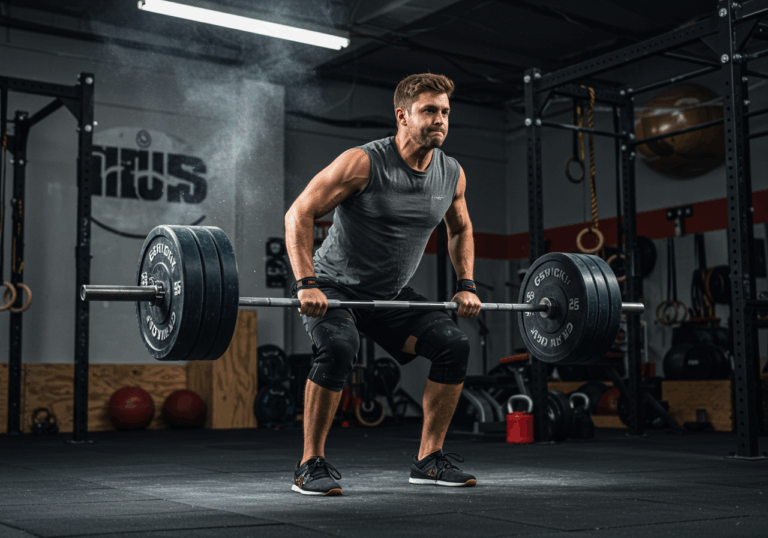
Barbell Shrug cues: Set feet hip-width. Grip just outside thighs. Keep ribs down. Shrug up. Pause. Lower slowly. Do not bounce.
Behind-the-Back cues: Use a rack for safe pickup. Keep elbows close. Stand tall. Elevate without leaning forward.
Machine/Cable cues: Sit or stand upright. Keep wrists stacked under elbows. Drive straight up. Squeeze.
| Common mistake | Fix | Why it matters |
|---|---|---|
| Rolling shoulders | Lift straight up and down | Protects joints and increases range |
| Neck jutting forward | Chin tucked, eyes forward | Reduces neck strain |
| Too heavy, no pause | Use load you can hold one second | Improves tension quality |
| Shrugging with bent elbows | Lock elbows softly | Focuses on traps, not biceps |
Good technique supports heavier loading. Heavier loading drives growth. Next, structure your week for steady progress.
Weekly programming and overload made practical

Plan the work so the work pays off
Place shrugs after major pulls. Your grip and posture are warm, and traps respond well then.
| Level | Shrug Volume | Carry Volume | Rest | Tempo |
|---|---|---|---|---|
| Beginner | 3 x 12 DB, RPE 7 | 3 x 30s | 60–90s | 1-1-2 |
| Intermediate | 4 x 10 BB, RPE 8 | 4 x 40s | 90–120s | 1-1-2 |
| Advanced | 5 x 6–8 BB, RPE 9 | 5 x 50–60s | 120–180s | Controlled |
Weekly placement example: Pull day: deadlift or row first, then shrugs, then rear-delt and lower-trap work.
Progressive overload menu:
- Double progression: hit top reps before increasing load.
- Tempo overload: add one-second pauses at the top.
- Density: keep total reps but reduce rest by 10–15%.
- Range gains: slow three-second negatives for mobility and control.
- Cluster sets: 4 + 4 + 4 with 15-second breaths for advanced lifters.
Mobility and balance: Add band face pulls, prone Y-raises, and thoracic extensions. Strong mid and lower traps protect shoulders.
| Recovery habit | Target | Why |
|---|---|---|
| Protein 1.6–2.2 g/kg | Daily | Supports muscle repair |
| Creatine 3–5 g | Daily | Improves high-force output |
| Sleep 7–9 hours | Nightly | Maximizes recovery hormones |
| Zone 2 cardio 20–30 min | 2–3x/week | Improves work capacity |
This structure drives consistent growth. Now, roll it out with a clear 12-week plan and tracking.
12-week rollout, tracking, and real-world adjustments

Implement the plan and measure everything
Track loads and recovery so progress stays predictable. Small improvements compound fast.
Tools I use:
- Garmin Forerunner for heart rate and recovery trends (garmin.com).
- MyFitnessPal to hit protein and calories (myfitnesspal.com).
- Strong app to log sets, reps, RPE. Any log works.
| Phase | Weeks | Focus | Shrug Prescription | Carry Prescription |
|---|---|---|---|---|
| Foundation | 1–4 | Technique and control | DB 3×12, +1 rep weekly until 15 | 3x30s, add 5s weekly |
| Strength | 5–8 | Heavier barbell loads | BB 4×8–10, add 2.5–5 kg when 10 reps achieved | 4×40–50s, heavier bells |
| Density | 9–12 | More work, same time | 5×6–8, 2s pause at top | 5×50–60s, shorter rests |
My real numbers: Week 1 DB shrugs: 26 kg x 12,12,12 at RPE 7. Week 6 BB shrugs: 120 kg x 8,8,8 at RPE 8. Week 12 BB shrugs: 150 kg x 6,6,6 at RPE 9. Farmer carries rose from 28 kg x 30 seconds to 40 kg x 60 seconds.
Heart rate tracking: Carries pushed my HR to 70–80% max. Garmin showed faster recovery by week 8.
Nutrition log snapshot: Bodyweight 78 kg. Calories 2,600–2,800. Protein 160–175 g. Carbs 280–320 g. Fat 70–80 g. Creatine 5 g daily. Caffeine 100 mg pre-lift only on heavy days.
Sample training week: Monday Pull: rows, pulldowns, shrugs, face pulls. Wednesday Push: presses, laterals, core. Friday Lower + Carries: squats, RDLs, farmer carries, calf raises.
Adjust one variable at a time. Your data will show what works for you.
Proof, troubleshooting, and sustainable routine maintenance

Validate outcomes and refine for sustainable routine maintenance
My 12-week results: Neck circumference increased 1.4 cm. BB shrug 3RM rose from 140 kg to 165 kg. Posture photos showed less forward head by roughly 10% angle reduction.
Client wins:
“Desk pain faded, and I hold my shoulders higher now.” — Luis, 39. He went from 18 kg DB shrugs x 12 to 30 kg x 12 in eight weeks. He also improved grip dynamometer from 38 kg to 45 kg.
“My backpack feels lighter, and deadlifts feel tighter.” — Maya, 31. Her behind-the-back shrugs climbed from 25 kg x 10 to 45 kg x 10 in six weeks. Deadlift 1RM improved 6%.
| Metric | Start | Week 12 |
|---|---|---|
| DB Shrug Top Set | 26 kg x 12 | 36 kg x 12 |
| BB Shrug 3RM | 140 kg | 165 kg |
| Farmer Carry | 28 kg x 30s | 40 kg x 60s |
Plateau busters:
- Switch to behind-the-back shrugs for four weeks.
- Add a two-second top pause to the first two sets.
- Use straps only on last set to save grip for progression.
- Add one extra carry set on Fridays.
Motivation dips: Keep sessions under 45 minutes. Pair shrugs with a favorite lift. Track visible wins weekly with photos and tape.
Cardio note: I tested HIIT finishers versus steady Zone 2 after shrug days. Zone 2 preserved next-day grip better. HIIT hurt my shrug progress when used three times weekly.
Recovery checks: Sleep 7–9 hours. If morning stiffness increases and RPE spikes at the same load, reduce set count by 20% for one week.
Stay consistent, review the log every two weeks, and adjust one lever. Your traps will keep growing, and your posture will hold strong.