Battle Ropes Training: The Full-Body Conditioning Tool That Transforms Fitness in 20 Minutes
Why 20 Minutes With battle ropes overview Can Transform Your Fitness
My introduction to battle ropes was humbling in a way no other piece of gym equipment had been. I was in reasonable shape — I ran regularly, I lifted consistently, I could do more than respectable pull-up numbers. Then a trainer suggested I try battle ropes for 30 seconds. I made it to about 22 seconds before the waves stopped looking like waves and started looking like subtle vibrations. My heart rate was at roughly what I would estimate was the surface temperature of the sun.
What I had experienced was the specific demand that makes battle ropes unlike anything else in the gym: simultaneous cardiovascular and muscular loading across the entire upper body, without any of the joint impact of running or the postural demands of weightlifting. The waves I was generating required continuous power output from my shoulders, arms, core, and legs — while the cardiovascular demand of sustaining that output pushed my system to a maximum I couldn’t approach through other training.
Battle ropes occupy a specific training niche: high-intensity, full-body battle ropes complete guide that develops power endurance — the ability to express force repeatedly at high intensity — in a way that neither steady cardio nor traditional resistance training can replicate. A 20-minute battle rope session burns approximately 300 to 400 calories, develops cardiovascular capacity, builds shoulder and arm endurance, and trains the explosive hip drive that athletic performance requires. This guide provides everything needed to begin battle rope training productively and progress systematically.
The Physiology of Battle Rope Training
Battle rope training produces a distinctive physiological demand: bilateral upper body power expression with simultaneous cardiovascular loading. EMG studies of battle rope exercises find high activation levels in the deltoids, biceps, triceps, forearms, core stabilizers, and hip extensors simultaneously — activating more total muscle mass per unit of time than most exercise modalities. This high total muscle activation produces both the cardiovascular response and the metabolic cost that makes battle rope training so effective for conditioning. Research on battle rope training and metabolic response confirms that battle rope training produces cardiovascular demands comparable to high-intensity running at equivalent effort levels, with the additional benefit of simultaneous upper body muscular loading that running doesn’t provide.
The Physics of Battle Rope Training: Why Waves Are More Than They Appear
The battle rope wave — the fundamental movement that defines the exercise — is more physiologically complex than it appears. Creating a continuous wave requires the upper body to alternately accelerate and decelerate the rope’s mass at each stroke, engaging the shoulder, elbow, and wrist in a continuous pattern of concentric and eccentric contractions that simultaneously develops strength, endurance, and coordination. The metabolic demand of sustaining this pattern at moderate to high intensity rivals that of running at equivalent heart rates — research measuring oxygen consumption during battle rope training finds VO2 values of forty to fifty milliliters per kilogram per minute during sustained vigorous battle rope work, comparable to moderate-intensity running. The battle rope’s specific advantage over running as a cardiovascular tool is its upper body emphasis — the heart and lungs are challenged through upper body work rather than lower body locomotion, developing cardiovascular capacity in a way that specifically benefits upper body athletic activities and provides active recovery from lower body-intensive training without competing with lower body tissue recovery. The upper body cardiovascular demand of battle rope training is uniquely valuable for swimmers, rowers, climbers, and any athlete whose sport demands upper body endurance that lower body cardiovascular training does not specifically develop. Research on metabolic demands of battle rope training confirms that vigorous battle rope exercise produces cardiovascular and metabolic demands equivalent to high-intensity running at similar subjective effort levels, validating its use as a primary cardiovascular conditioning tool alongside traditional locomotion-based cardio.
Battle Rope Training for Grip and Forearm Development
The grip and forearm demands of battle rope training are among the most specific and functionally relevant of any conditioning exercise. Sustaining the rope’s wave pattern for thirty to sixty seconds requires continuous grip tension against the rope’s oscillating resistance — a demand that develops grip endurance and forearm extensor strength simultaneously. The forearm extensors — the muscles responsible for wrist stability during gripping — are chronically undertrained in most gym programs that emphasize pulling exercises (which develop forearm flexors) without specific extensor work. Battle rope training loads the forearm extensors through the wrist stabilization demanded during the wave motion, developing the balanced forearm strength that reduces wrist and elbow overuse injury risk. Athletes who incorporate regular battle rope training consistently report improvements in grip endurance for pulling exercises (deadlifts, rows, pull-ups) — the direct transfer of battle rope grip endurance training to grip-limited pulling performance is one of the exercise’s most practically valuable secondary benefits. Competitive grip strength athletes, rock climbers, and martial artists who require sustained grip endurance specifically incorporate battle rope training for its unique grip endurance development that standard resistance exercises cannot provide with the same metabolic intensity.
Battle Rope Origins and Why This Ancient Tool Works in Modern Training
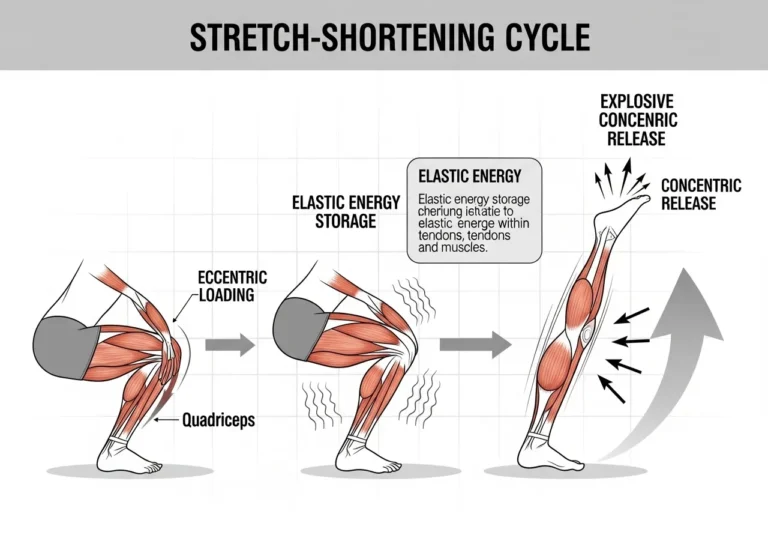
The use of ropes for physical conditioning has roots in traditional physical culture that predates modern gym equipment by centuries — sailors and maritime workers who hauled ropes daily developed the grip strength, shoulder endurance, and cardiovascular fitness that heavy rope manipulation produces. The modern battle rope training system was formalized by John Brookfield in the early 2000s, who developed the specific wave protocols and progressive training systems that transformed rope manipulation from incidental physical work into a structured training methodology. Brookfield’s insight — that varying wave amplitude, frequency, and duration provides precise intensity control for a broad range of fitness goals — is what distinguished battle rope training from casual rope work and established it as a legitimate training tool for structured conditioning programs. The physiological principles underlying battle rope effectiveness (stretch-shortening cycle development, high-intensity cardiovascular demand, grip and forearm endurance) are identical to those that made rope work valuable in traditional physical cultures — the modern innovation is the systematic, progressive programming that maximizes these benefits rather than relying on incidental work exposure. Understanding this historical context contextualizes battle rope training as a time-tested physical development approach that has been refined by modern exercise science rather than a fitness industry novelty with unproven effectiveness. The research validating battle rope training’s cardiovascular, muscular endurance, and grip development benefits confirms what millennia of practical experience in physical work cultures established empirically.
Battle rope training is the conditioning tool that most directly addresses the upper body cardiovascular fitness gap that traditional training programs leave — developing the grip endurance, shoulder conditioning, and upper body metabolic capacity that running, cycling, and standard resistance training collectively fail to develop as completely or as efficiently as consistent, well-programmed battle rope work provides.
Start with two sets. That is all. Two sets of thirty-second alternating waves, resting sixty seconds between sets. Do this twice per week for one month and the foundation for everything else this article describes will be established.

Battle Rope Exercises: A Complete Movement Library
The Alternating Wave: The Foundation Exercise
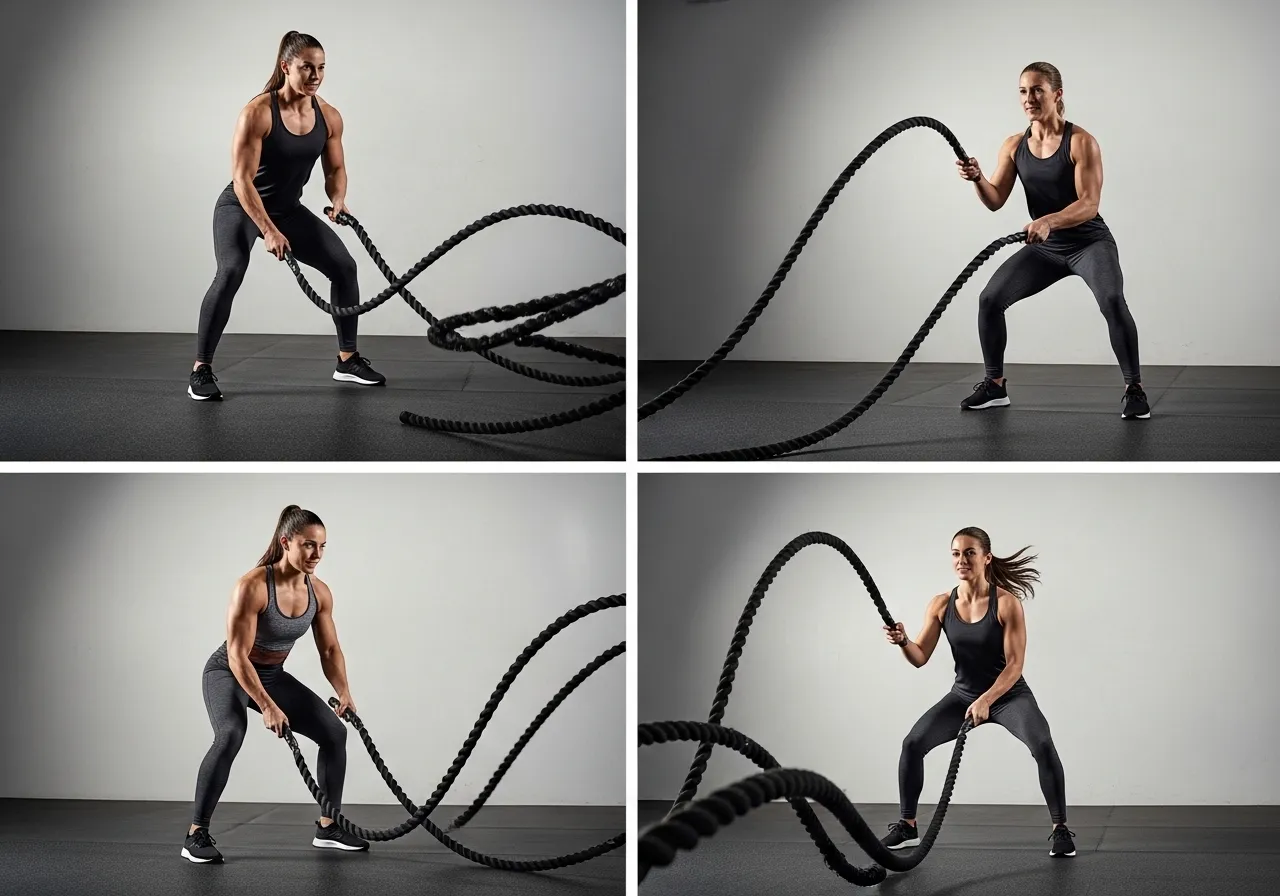
Stand with feet shoulder-width apart, knees slightly bent, holding one end of the rope in each hand. Alternately raise and lower each arm in a smooth rhythm, generating waves that travel from your hands to the anchor point. The movement should come from the entire body — hip drive initiates each wave, the shoulder amplifies it, the arm directs it. Alternating waves are the baseline battle rope exercise: they develop the hip-arm coordination, rope-wave mechanics, and cardiovascular conditioning that more complex exercises build upon. 30 seconds on, 30 seconds off, 6 to 8 rounds provides an excellent conditioning foundation for beginners.
Simultaneous Waves (Power Waves)
Both arms move together — up and down simultaneously — generating larger, more powerful waves than alternating waves. Simultaneous waves produce higher per-wave power output but lower total repetition count, making them better for power development and worse for cardiovascular endurance compared to alternating waves. The hip drive component is more pronounced: each simultaneous wave should be initiated by a hip hinge and hip extension pattern similar to a kettlebell training swing. Advanced athletes use heavy ropes for simultaneous waves as a specific power development stimulus.
Battle Rope Slams
Raise both ropes overhead and slam them to the ground with maximum force, immediately raising them again for the next slam. Slams combine the hip extension of a deadlift, the overhead press of a shoulder movement, and the conditioning demand of continuous effort. The concentric slam (raising the ropes) and the eccentric catch (preventing the ropes from simply falling) both provide training stimulus. Slams are the highest-intensity battle rope exercise and the one that most closely resembles functional athletic power expression.
Lateral Waves
Rather than moving the arms up and down, move them side to side simultaneously — creating lateral serpentine waves along the ropes. Lateral waves train the shoulder internal and external rotators, the obliques, and the transverse abdominis in a rotational pattern that alternating waves don’t specifically target. Alternating lateral waves (one arm moving forward while the other moves back, like a swimming motion) adds anti-rotation core demand. Both lateral wave variations are appropriate as secondary exercises after the foundational alternating waves are established.
Battle Rope Circles
Make circles with each arm — inward circles (toward the body) and outward circles (away from the body). Circles train the shoulders through circumferential rotation that develops the shoulder girdle muscles differently from any linear movement pattern. Inward circles emphasize the anterior deltoid and pectorals; outward circles emphasize the posterior deltoid and external rotators. Circles are an excellent shoulder health exercise that can be performed at lower intensity as active recovery between harder battle rope sets.
Wave Amplitude and Frequency: The Two Variables That Control Battle Rope Intensity
Battle rope training intensity is controlled through two primary variables: wave amplitude (the height of the wave) and wave frequency (the speed of the arm movement). Understanding these variables allows precise intensity management that heart rate monitoring alone cannot provide. High amplitude, low frequency (large waves moving slowly) emphasizes shoulder and upper back strength-endurance, loading the deltoids, rhomboids, and traps through a greater range of motion at lower metabolic cost. Low amplitude, high frequency (small waves moving very rapidly) maximizes metabolic demand by requiring rapid successive contractions at lower mechanical load — the strategy that produces the highest heart rates and greatest cardiovascular conditioning stimulus per unit of time. Alternating amplitude and frequency within a session creates the internal variation that prevents accommodation to either extreme and develops both strength-endurance and cardiovascular conditioning simultaneously. A practical intensity structure: thirty seconds of high-frequency waves (maximum speed, small amplitude) followed by twenty seconds of rest, repeated six to eight times — this HIIT research structure produces the cardiovascular adaptations of interval training with the upper body focus that battle ropes uniquely provide. The ability to modulate intensity through wave parameters rather than equipment adjustment makes battle ropes one of the most real-time adjustable conditioning tools available — the athlete can make the exercise harder or easier mid-set without stopping, by simply changing wave amplitude or frequency in response to current effort level and fatigue state.
Battle Ropes in a Complete Conditioning Program: Where They Fit
Battle ropes complement rather than replace traditional conditioning methods, and their placement in a complete conditioning program depends on their specific contribution relative to the training goals. As primary cardiovascular conditioning: battle rope HIIT sessions two to three times per week provide upper body cardiovascular stimulus that running and cycling cannot replicate. As finishers after strength training: four to six rounds of thirty-second battle rope intervals at the end of a strength session add metabolic conditioning and grip endurance development without the recovery demand that additional strength work would impose. As active recovery: low-intensity alternating waves (Zone 2 heart rate equivalent) during recovery sessions or between heavy lifting days provide movement and cardiovascular maintenance without interfering with strength recovery. As sports-specific conditioning for upper body sports: battle rope training two to three times per week specifically develops the upper body cardiovascular capacity that swimmers, rowers, and racket sport athletes require for sport-specific endurance. The flexibility of battle rope programming — adjustable from gentle active recovery through moderate endurance work to maximum-intensity interval training — makes them one of the most versatile conditioning tools available for athletes across all training goals and fitness levels. ACSM exercise programming guidelines support varied conditioning modalities as producing more comprehensive fitness development than any single conditioning approach, validating the battle rope’s role as a complementary tool within comprehensive conditioning programs.
Battle Rope Training for Core Stability and Rotational Power
The core stability demands of battle rope training — particularly during simultaneous waves, slams, and rotational exercises — are among the most functional and sport-relevant core training stimuli available in conditioning equipment. Unlike plank variations and standard core exercises that develop anti-movement stability in static positions, battle rope core training develops the dynamic stability required to transmit force from the lower body through the core to the upper extremity during continuous, high-speed movement. This dynamic stability is precisely what athletic performance requires — the ability to maintain core tension and force transfer efficiency during the chaotic, unpredictable movements of sport and work. The anti-rotation demand of alternating waves (each arm moving independently while the core resists the rotational tendency) develops the same transverse plane stability that Pallof presses and other anti-rotation exercises target, but in a more dynamic, metabolically demanding context that simultaneously conditions the cardiovascular system. For combat sports athletes who require both rotational power and rotational stability under fatigue, battle rope training — particularly the grappler’s toss and rotational slam variations — develops these qualities in a conditioning context that resistance training alone cannot replicate. Research on battle rope exercise and core muscle activation consistently finds high activation levels in the obliques, transverse abdominis, and erector spinae during wave and slam variations, validating the exercise’s legitimate core training stimulus alongside its primary cardiovascular and upper body conditioning applications. Research on core muscle activation during battle rope exercises confirms significant trunk muscle activation during wave and slam variations, supporting battle rope training as a comprehensive core conditioning tool.
The battle rope’s instant feedback — waves that grow with effort and collapse without commitment — makes it the most honest performance mirror in conditioning training. Every set reveals exactly what the athlete is willing to give, and consistent training builds both the physical capacity and the mental commitment to give more each session than the previous one.
Technique Principles That Make Battle Ropes More Effective
The Athletic Stance
Every battle rope exercise starts from an athletic base: feet shoulder-width apart or slightly wider, toes pointed slightly outward, knees soft and tracking over toes, hips loaded back into a slight squat. This position accomplishes two things: it lowers the center of gravity for stability against the rope’s pulling force, and it positions the hips and legs to contribute to wave generation through hip drive. Lifters who stand upright with locked knees during battle rope work lose the hip drive contribution that makes waves powerful and reduces the exercise to an arm workout only.
Hip Drive: Generating Power From the Ground Up
The most common battle rope mistake is generating all wave power from the arms and shoulders alone. This produces rapid arm fatigue, limits wave intensity, and misses the athletic conditioning benefit of training hip-to-upper-body power transfer. Every wave should be initiated by a slight hip extension — driving the hips forward as the arms rise — and absorbing through a slight hip hinge as the arms fall. This pattern mirrors the kettlebell swing, and many trainers use kettlebell swing training as preparation for battle rope training precisely because it teaches hip-drive mechanics that directly transfer.
Wave Quality Over Speed
Generating waves that travel the full length of the rope to the anchor point requires more force and produces more training benefit than generating short, choppy waves that dissipate quickly. The goal is full-length waves, not maximum speed. Slowing slightly and generating waves that visibly travel to the anchor produces more work per rep than rapid shallow arm movements that generate no visible wave propagation. This quality focus also reduces the forearm and grip fatigue that can limit battle rope sessions before the intended cardiovascular and muscular fatigue is achieved.
Rope Length and Weight Selection
Standard battle ropes are 9 to 15 meters long and 38 to 50mm in diameter. Longer, heavier ropes increase resistance per wave and are appropriate for stronger, more experienced athletes. Shorter, lighter ropes provide less resistance per wave and are more appropriate for beginners and cardiovascular-focused training. A 9-meter, 38mm rope is the most versatile option for general fitness use. The total weight of the rope matters less than the length available for wave propagation — a shorter rope produces choppy waves that dissipate quickly, limiting the exercise quality regardless of rope weight.
Common Battle Rope Mistakes That Reduce Effectiveness
Several technique errors consistently limit battle rope effectiveness and reduce the training stimulus to a fraction of what correct technique produces. Generating waves from the arms rather than from the hips and core is the most common error — athletes who use only arm movement create short, weak waves that minimally challenge the cardiovascular system and fail to engage the power-generating muscles of the lower body and core. The fix: initiate each wave with a hip hinge or squat movement, allowing the legs to drive energy through the core and into the arms, which function as transmitters of power rather than generators. Using a standing position too close to the anchor point — with the rope slack when the arms are extended forward — eliminates the rope’s resistance and converts the exercise into an arm swing without meaningful load. The fix: position far enough from the anchor that the rope is taut when the arms are in the forward position (approximately thirty to forty degrees from horizontal), maintaining rope tension throughout the wave. Pausing between waves — allowing the rope to go slack between each arm stroke — destroys the continuous wave pattern that makes battle ropes effective and converts a thirty-second set into a series of disconnected arm movements. The fix: maintain continuous arm movement without pausing, accepting that wave quality may decrease as fatigue accumulates while keeping the continuous rhythm. Gripping too tightly — creating forearm fatigue that limits training duration before cardiovascular capacity is challenged — reduces the cardiovascular conditioning stimulus that battle ropes are designed to provide. The fix: grip firmly enough to control the rope without excessive tension, relying on rope tension to maintain grip rather than squeezing the handle.
Battle Rope Exercise Variations for Complete Development
Beyond the fundamental alternating wave, battle rope training offers a library of exercises that develop different aspects of fitness and prevent accommodation to the basic movement. Simultaneous waves (both arms moving together rather than alternating) require greater shoulder strength and produce higher peak force per wave while reducing frequency — appropriate for strength-endurance emphasis rather than cardiovascular conditioning. Power slams (raising both ropes overhead and forcefully slamming them to the ground) develop explosive power production with a full-body involvement that few conditioning exercises replicate — the overhead raise develops shoulder flexion strength while the slam develops explosive hip extension power. Lateral waves (moving the arms side to side rather than up and down) develop the lateral deltoid and core rotation musculature that standard waves do not emphasize, providing rotational conditioning that transfers to throwing, swinging, and any sport requiring lateral trunk force production. The grappler’s toss (holding both ropes and rotating the trunk explosively side to side while slamming the ropes to the outside) develops the core rotation power and shoulder stability that combat sports athletes specifically require. Kneeling waves (performed from both knees rather than standing) eliminate lower body contribution and force all power generation through the upper body and core, dramatically increasing the upper body conditioning demand for athletes who specifically target upper body endurance. Rotating through these variations across training weeks prevents the accommodation that occurs when any single variation is repeated indefinitely and develops the complete upper body conditioning that single-exercise battle rope programs cannot achieve. Research on battle rope exercise variations and muscle activation confirms that different wave patterns activate distinct muscle group combinations, validating the exercise variety approach for comprehensive upper body conditioning development.
Battle Rope Equipment Selection: Choosing the Right Rope for Your Goals
Battle rope specifications — diameter, length, material, and weight — significantly affect training experience and outcomes, making informed equipment selection important for both effectiveness and enjoyment. Diameter: thicker ropes (1.5 inches / 38 mm) require greater grip strength and produce more resistance per wave, emphasizing strength-endurance. Thinner ropes (1 inch / 25 mm) allow greater wave frequency and are more appropriate for cardiovascular conditioning emphasis and beginners with limited grip strength. For most recreational athletes, a 1.5-inch diameter rope represents the best balance of grip accessibility and training stimulus. Length: longer ropes (50 feet / 15 meters) require more force to generate effective waves and provide more rope momentum once waves are established — beneficial for sustained endurance work. Shorter ropes (25-30 feet / 7-9 meters) are more appropriate for limited spaces and for power-focused wave work where the shorter response time of less rope mass is advantageous. Material: manila rope provides a natural feel and develops grip strength through its coarser texture, but degrades outdoors and can cause hand abrasion with bare-handed training. Polyester or nylon ropes are more durable, weather-resistant, and gentler on bare hands, making them preferable for regular training and outdoor use. Weight: heavier ropes (more than 20 kilograms) develop greater strength-endurance but limit wave frequency; lighter ropes (10-15 kilograms) allow higher frequencies and emphasize cardiovascular conditioning. For home gym purchasers buying one rope, a 1.5-inch diameter, 9-12 meter polyester rope weighing 12-15 kilograms provides the versatility to support both conditioning-focused and strength-endurance protocols at moderate cost.
Battle Rope Training for Swimmers and Overhead Athletes
Swimmers require upper body cardiovascular conditioning that no dry-land exercise other than battle ropes adequately provides. The sustained shoulder, back, and arm endurance that competitive swimming demands mirrors the muscular endurance demands of sustained battle rope wave training — both require the shoulder girdle musculature to sustain high-frequency force production for extended periods against resistance. Dry-land battle rope training for swimmers develops the shoulder endurance and cardiovascular capacity that transfers directly to pool performance without the impact demands of running or the lower body bias of cycling. Research on dry-land training for swimmers finds that upper body conditioning exercises including rope training produce significant improvements in swimming economy and speed across competitive distances, validating their inclusion in competitive swimmer preparation programs. Tennis players, volleyball players, and other overhead sport athletes benefit similarly — the sustained shoulder endurance that rally and match play requires is specifically developed by battle rope conditioning in ways that resistance training and running cannot replicate. Programming battle ropes twice weekly as the primary upper body conditioning modality for overhead sport athletes provides the sport-specific conditioning development that prepares these athletes for the sustained upper body demands of competition more effectively than traditional cardiovascular training approaches that emphasize lower body locomotion.

Battle Rope Programming: Building a Complete Conditioning Session
The Interval Structure
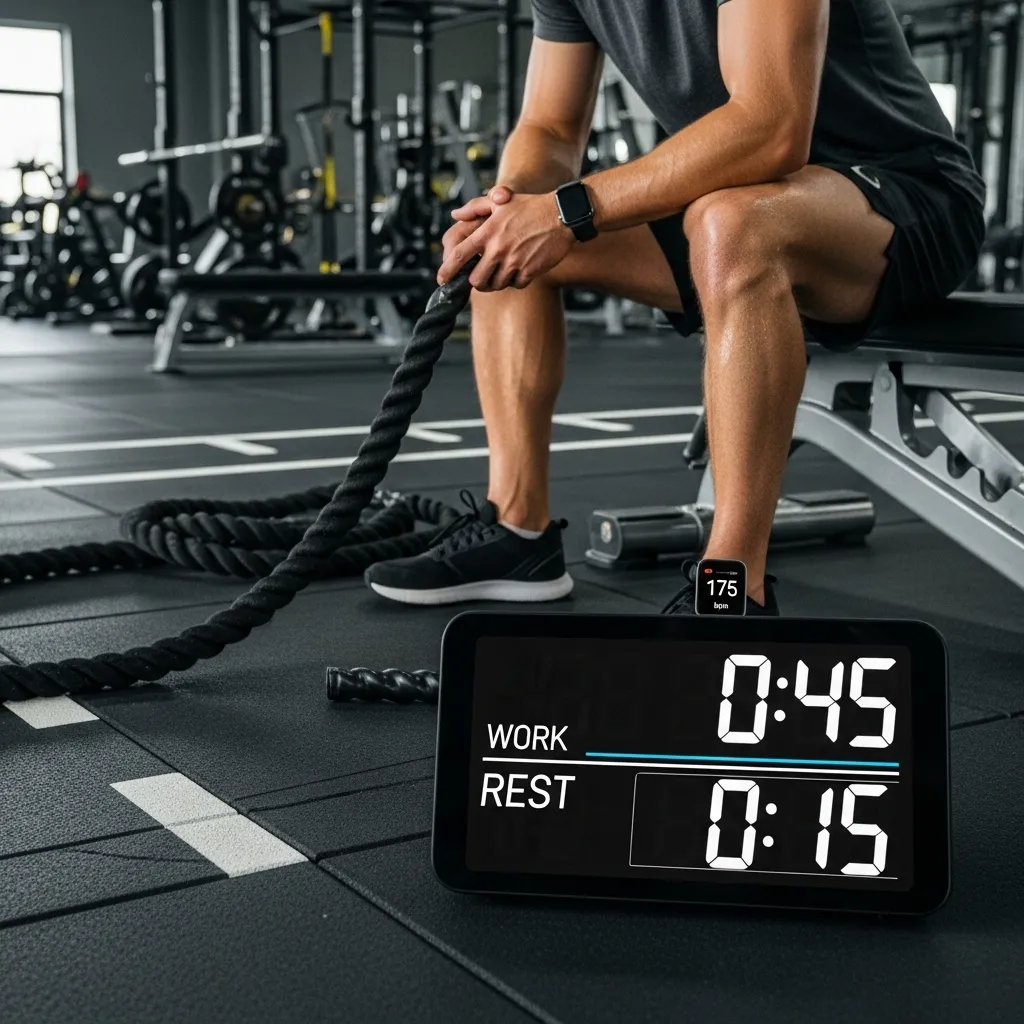
Battle rope training is most productive using interval structures: work periods followed by rest periods. The work-to-rest ratio determines the training emphasis. 1:1 ratio (30 seconds on, 30 seconds off): balanced cardiorespiratory and muscular conditioning. 1:2 ratio (20 seconds on, 40 seconds off): power emphasis, higher intensity per work interval. 2:1 ratio (40 seconds on, 20 seconds off): metabolic conditioning emphasis, higher total work volume. Begin with 1:2 or 1:1 ratios and progress toward 2:1 as conditioning improves over weeks of training.
Circuit Training with Battle Ropes
Battle ropes integrate seamlessly into circuit training that develops comprehensive conditioning alongside targeted strength or mobility work. A practical circuit: 30 seconds battle rope alternating waves, 30 seconds push-ups, 30 seconds battle rope slams, 30 seconds squat jumps, 30 seconds battle rope lateral waves, 30 seconds plank. Rest 90 seconds between complete rounds. 4 to 5 rounds produces approximately 20 minutes of high-intensity conditioning that develops cardiovascular fitness, upper body endurance, and total body power simultaneously.
Standalone Battle Rope Sessions
For dedicated battle rope conditioning: 3 to 4 minutes of technical warm-up (light alternating waves focusing on hip drive and wave quality), then the main session of 6 to 10 rounds of 30 to 40 seconds work with 20 to 30 seconds rest, finishing with 2 minutes of light circle work as cool-down. Total session: 15 to 20 minutes. This produces a cardiovascular challenge equivalent to a 20-minute run while additionally developing upper body power endurance that running cannot provide. Two to three sessions per week integrates effectively alongside strength training without the recovery cost of running at equivalent cardiovascular intensity. ACSM high-intensity interval training guidelines support structured interval protocols for cardiovascular and muscular endurance development in athletic populations.
Battle Rope Programming for Specific Fitness Goals
Battle rope training can be programmed to specifically target fat loss, cardiovascular fitness, muscle endurance, or power development depending on the protocol parameters chosen. For fat loss: alternating high-intensity thirty-second intervals (maximum effort waves) with thirty-second rest periods, repeated ten to fifteen times, produces the cardiovascular demand and post-exercise oxygen consumption elevation that maximizes caloric expenditure. For cardiovascular fitness development: moderate-intensity sustained waves at sixty to seventy percent of maximum heart rate for twenty to thirty continuous minutes provides the Zone 2 cardiovascular stimulus that develops aerobic base — unusual for battle ropes but achievable with appropriate wave frequency management. For muscle endurance: moderate-intensity waves for forty-five to sixty second sets with forty-five to sixty second rest, repeated eight to twelve times, develops the specific upper body endurance that overhead sports athletes require. For power development: maximum-effort five to ten second bursts with complete recovery (thirty to forty-five seconds rest), repeated eight to twelve times, develops the maximal power output that transfers to throwing, striking, and explosive athletic movements. Each protocol uses identical equipment but produces distinct physiological adaptations — the battle rope’s intensity adjustability through wave parameters (not equipment changes) makes these different programming approaches immediately accessible without any equipment modification. Matching the battle rope protocol to the specific training goal produces the targeted adaptation that generic battle rope training — typically performed at whatever intensity feels challenging that day without systematic variation — fails to develop as specifically or efficiently.
Battle Ropes for Rehabilitation and Low-Impact Conditioning
The battle rope’s non-impact upper body loading makes it uniquely valuable for athletes recovering from lower extremity injuries who need to maintain cardiovascular fitness without loading the healing structures. During ankle sprain rehabilitation, ACL reconstruction recovery, or stress fracture management, the battle rope provides vigorous upper body cardiovascular conditioning that preserves aerobic fitness without any ground impact forces. This non-impact cardiovascular conditioning during lower extremity injury rehabilitation prevents the significant fitness decline that complete rest or low-intensity activity produces, allowing athletes to return to sport with maintained cardiovascular fitness and reduced re-adaptation demands. Physical therapists increasingly prescribe battle rope training during lower extremity rehabilitation for this specific non-impact conditioning function, and sports medicine physicians recommend it as the cardiovascular maintenance tool of choice during the early and middle phases of lower extremity injury rehabilitation when running, cycling, and other impact activities are contraindicated. The battle rope’s additional upper body strength-endurance development during rehabilitation phases means that athletes often return from lower extremity injuries with improved upper body conditioning alongside their recovered lower extremity function — a net performance improvement that makes the rehabilitation period partially productive for athletic development rather than purely a maintenance challenge. NSCA rehabilitation conditioning guidelines support non-impact upper body cardiovascular training as the most effective approach to maintaining cardiovascular fitness during lower extremity injury rehabilitation, validating the battle rope’s role in sports medicine contexts alongside its performance training applications.
Battle Rope Training Results: What to Expect and When
Setting realistic expectations for battle rope training outcomes prevents the frustration of expecting results on timelines that physiology does not support and the discouragement of not recognizing genuine progress when it occurs. Cardiovascular fitness improvements: measurable VO2 max improvements typically require six to eight weeks of consistent twice-weekly battle rope training before they appear in performance metrics. The first four to six weeks produce primarily neurological and technique adaptations — the movements become more efficient and coordinated, requiring less energy for the same work. By weeks six to eight, true cardiovascular adaptations (increased stroke volume, improved mitochondrial density) become measurable as sustained wave duration at a given intensity increases noticeably. Grip and forearm endurance: improvements typically become apparent within two to four weeks of consistent training — the forearm endurance that initially limited sets to fifteen to twenty seconds extends to thirty to forty seconds within the first month. This faster adaptation reflects the relative trainability of forearm endurance compared to cardiovascular fitness when starting from a baseline that includes standard gym training. Upper body muscular endurance: improvements in the shoulders, trapezius, and biceps are typically noticeable within four to eight weeks, with the ability to sustain waves at given intensity for longer durations before technique breakdown. Body composition changes: consistent battle rope HIIT training contributes to fat loss through caloric expenditure, but body composition changes require both the training caloric expenditure and appropriate nutrition management — expecting battle rope training alone to produce significant fat loss without dietary attention consistently disappoints. With appropriate nutrition, six to twelve weeks of twice-weekly battle rope conditioning typically produces one to two kilograms of fat loss as part of a comprehensive training program. ACSM training adaptation timelines support these expected improvement schedules across cardiovascular fitness, muscular endurance, and body composition outcomes from consistent moderate-to-vigorous exercise programs.
Battle Rope Safety: Common Injuries and How to Prevent Them
Battle rope training, when performed with correct technique and appropriate progressive loading, has a low injury rate compared to many other high-intensity training modalities. The most common battle rope-related injuries are shoulder overuse conditions (rotator cuff tendinopathy, bicipital tendinopathy) from excessive volume before adequate shoulder conditioning is established, and wrist and elbow overuse from sustained high-frequency wave training without adequate grip endurance preparation. Preventing these overuse injuries: beginning with conservative volumes (four to six sets of twenty to thirty second waves) and progressive increases of no more than ten percent per week; ensuring adequate rotator cuff and shoulder health work (face pulls, external rotation exercises) as regular training components before and alongside battle rope work; taking one to two rest days between battle rope sessions to allow shoulder and forearm tissue recovery. The rope’s handle grip design affects wrist positioning during training — an ergonomically designed handle that maintains the wrist in a neutral position reduces wrist overuse risk compared to handles that force wrist deviation. If wrist or shoulder discomfort develops during battle rope training, reducing wave frequency (slower waves with larger amplitude) significantly reduces the repetitive stress on these structures while maintaining training continuity. According to NSCA guidelines on conditioning training safety, progressive loading management and adequate recovery between sessions are the primary modifiable factors in preventing overuse injuries from any high-repetition conditioning training, including battle rope protocols.
Battle rope training’s injury prevention profile — achieved through progressive loading management, shoulder health work, and adequate recovery between sessions — ensures that the conditioning benefits compound without the overuse interruptions that neglected shoulder health produces. Treat it as seriously as any primary training component and it will deliver the upper body conditioning transformation that justifies that investment many times over.
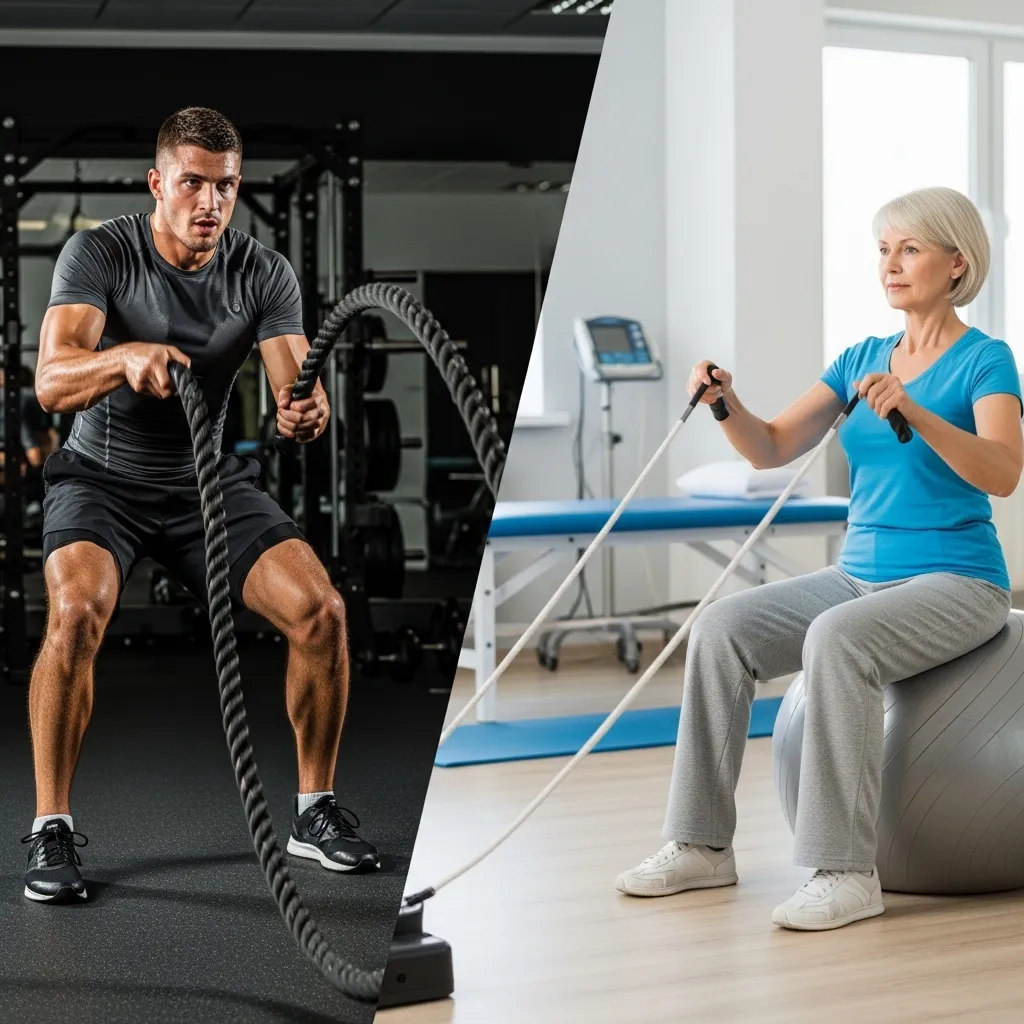
Battle Ropes for Specific Populations and Goals
For Combat Sports Athletes
Battle rope training is exceptionally specific to combat sports — the bilateral upper body power endurance, the hip-to-shoulder power transfer, and the high-intensity interval nature all directly mirror the demands of boxing, wrestling, and mixed martial arts. Boxing-specific battle rope use: alternating waves with footwork (moving laterally while generating waves) develops the combination of upper body work and footwork that ring movement requires. Wrestling-specific use: rope slams from a stance simulating the explosive hip extension of a double-leg takedown. MMA-specific circuits combine battle ropes with grappling positions and striking patterns.
For Rehabilitation and Low-Impact Conditioning
Battle ropes produce high cardiovascular demand without any lower extremity impact — the feet remain planted throughout, and the only ground reaction force is the static standing load. For athletes recovering from lower extremity injuries (stress fractures, knee surgeries, ankle sprains) who need cardiovascular conditioning maintenance without impact loading, battle ropes provide a high-intensity cardiovascular stimulus that is genuinely impact-free. The shoulder demands should be respected — individuals recovering from shoulder injuries should receive clearance before battle rope training — but for lower extremity-limited athletes, battle ropes are one of the most effective cardiovascular training substitutes available.
Frequently Asked Questions About Battle Rope Training
How heavy should battle ropes be for beginners? Beginners should start with the lightest available ropes — typically a 9-meter, 38mm rope at most facilities. Rope resistance increases significantly with weight, and the technical demands of battle rope training (hip drive, wave generation, athletic stance) are easier to learn with lighter resistance. Move to heavier ropes when light ropes can be used with consistent technique for 40 seconds of continuous high-quality waves without significant form degradation.
Can battle ropes build muscle? Battle ropes build muscular endurance in the shoulders, arms, core, and hip extensors rather than maximum hypertrophy. The training stimulus is high repetition at moderate resistance rather than the heavy progressive loading that drives maximum muscle growth. Expect noticeable improvements in shoulder endurance, arm definition from improved muscular tone, and core stability — not the mass gains that resistance training produces. Battle ropes complement rather than substitute for resistance training for physique development goals.
How do I anchor battle ropes at home? A battle rope anchor post driven into the ground or a wall-mounted anchor rated for the dynamic loading of battle rope training are the most secure options. A heavy power rack or squat rack with the rope looped through the base works for indoor training. The anchor must be absolutely fixed — any movement of the anchor point reduces wave quality and creates a safety hazard. Never anchor to a door handle, light fixture, or any non-structural point.
My shoulders fatigue before I feel the cardiovascular benefit. Is this normal? Yes — shoulder endurance is often the limiting factor for beginners before cardiovascular capacity becomes limiting. This is expected and resolves within two to four weeks of regular battle rope training as the shoulders adapt to the specific endurance demand. Shorten work intervals (15 to 20 seconds) and extend rest intervals until shoulder endurance builds sufficiently to sustain the cardiovascular demand that longer intervals require. The shoulder endurance adaptation is itself a valuable training outcome — it reflects the development of the rotator cuff and deltoid endurance that functional shoulder health requires.
Frequently Asked Questions About Battle Rope Training
How long should a battle rope session last?
Battle rope session duration depends entirely on the training protocol and goal. High-intensity interval sessions (maximum-effort thirty-second waves with thirty-second rest) are typically effective at fifteen to twenty-five minutes total, including warm-up — the high intensity of each work interval means the session is productive at shorter durations than steady-state cardio. Moderate-intensity endurance sessions (sustained waves at sixty to seventy percent maximum heart rate) can extend to twenty to forty-five minutes, similar to other Zone 2 cardiovascular training. A common mistake is performing battle rope training for too long at moderate intensity — the upper body muscles fatigue before the cardiovascular system receives adequate stimulus, reducing both the cardiovascular and conditioning effectiveness of the extended session. Programming battle rope sessions with defined work-to-rest ratios and total work periods (not just session duration) produces more consistently appropriate training loads than timing by the clock until the session feels complete. Most effectively programmed battle rope sessions last fifteen to thirty minutes of total time including rest periods — more is rarely better and frequently produces the accumulated upper body fatigue that compromises wave quality and reduces the training stimulus for both the remaining rounds and the next session’s freshness.
What rope weight and length should I use?
Battle rope specifications significantly affect training difficulty and the muscles primarily stressed. Heavier ropes (more than twenty kilograms) produce greater strength-endurance demand because each wave requires more force to sustain. Lighter ropes (under fifteen kilograms) allow higher wave frequencies and greater cardiovascular demand because the reduced mass permits faster arm movement without the strength limitation that heavier ropes impose. For beginners, a fifteen to twenty kilogram rope of nine to fifteen meters provides sufficient resistance for meaningful training while allowing the wave frequency needed for cardiovascular conditioning. Length affects the rope’s inertia and the distance between the exerciser and the anchor — longer ropes maintain wave momentum more consistently and forgive minor technique errors in wave initiation, making them slightly more beginner-friendly than shorter ropes that demand more consistent technique for effective wave generation. Most commercial gyms provide ropes in the fifteen to twenty-five kilogram range at nine to fifteen meter lengths — using the lighter option for conditioning-focused sessions and the heavier for strength-endurance focused sessions provides the variation that develops both qualities. Research on battle rope specifications and training outcomes confirms that rope weight and length significantly affect the cardiovascular and muscular demands of battle rope training, supporting specification selection based on the specific training goal.
Can battle ropes replace traditional cardio?
Battle ropes can replace traditional cardio as a primary conditioning method for athletes whose sport or training goals specifically benefit from upper body cardiovascular development — swimmers, rowers, climbers, and overhead athletes for whom lower body cardiovascular training provides incomplete specificity. For general fitness athletes whose goals include overall cardiovascular health and lower body conditioning, battle ropes complement rather than replace running and cycling by adding upper body cardiovascular stimulus that locomotion-based cardio cannot provide. The most comprehensive conditioning program for most athletes combines lower body cardiovascular training (running, cycling) for metabolic and lower body cardiovascular adaptations, with battle rope training for upper body conditioning and cardiovascular variety. The practical exception: during lower extremity injury rehabilitation, battle ropes can fully replace traditional cardio for the duration of the rehabilitation period, maintaining cardiovascular fitness through upper body work without loading healing lower extremity structures.
Advanced Battle Rope Protocols for Serious Conditioning Athletes
Athletes who have mastered foundational battle rope training and seek advanced conditioning protocols can access significantly greater training demands through complex protocols that combine multiple exercises and energy systems. The Tabata battle rope protocol (twenty seconds of maximum-effort waves followed by ten seconds rest, repeated eight times for four minutes total) produces one of the highest metabolic demands achievable in four minutes of exercise — research on Tabata-style battle rope training finds average heart rates of ninety to ninety-five percent of maximum during the work periods, with significant EPOC extending metabolic elevation for one to two hours post-exercise. The battle rope complex (performing alternating waves, simultaneous waves, lateral waves, and power slams consecutively without rest for five minutes) develops the sustained upper body endurance that traditional interval training cannot replicate because it maintains the upper body demand across the full five-minute duration without lower body substitution. Partner battle rope training (two athletes holding opposite ends of a shared rope, alternating one performing waves while the other absorbs the force) adds an interactive, competitive element that drives greater effort than solo training while developing the resistance patterns that martial arts and contact sport athletes specifically require. These advanced protocols require the technique foundation, cardiovascular fitness, and grip endurance that foundational battle rope training develops — attempting them without this preparation produces the acute technique breakdown and injury risk that well-prepared athletes avoid. The progression from foundational to advanced battle rope protocols follows the same principles as all athletic development: master the foundation before progressing, allow adaptation before adding complexity, and maintain quality throughout the loading increase that transforms conditioning capacity.
Battle Rope Integration With Strength Training: The Complete Conditioning Athlete
The most comprehensively conditioned athlete combines strength training, cardiovascular endurance training, and battle rope conditioning into a complete physical development program that addresses all major fitness components simultaneously. Strength training develops maximum force production and structural muscle; cardiovascular training develops aerobic base and lactate threshold; battle rope conditioning develops upper body cardiovascular capacity, grip endurance, and explosive upper body endurance that the other modalities do not specifically address. A practical weekly schedule that integrates all three: Monday, upper body strength training with face pull warm-up; Tuesday, Zone 2 cardiovascular training (running or cycling); Wednesday, battle rope HIIT (six to eight rounds of thirty-second maximum-effort waves with thirty-second rest); Thursday, lower body strength training; Friday, battle rope conditioning at moderate intensity (twenty minutes of sustained waves at sixty to seventy percent maximum heart rate); Saturday, optional Zone 2 cardiovascular or active recovery; Sunday, complete rest. This schedule provides three strength sessions, two cardiovascular sessions, and two battle rope sessions per week — sufficient stimulus for meaningful development in all three modalities without exceeding recovery capacity for most intermediate athletes. The battle rope sessions function as the upper body conditioning bridge between strength training and cardiovascular training, developing the complete physical conditioning that recreational sport participation, functional fitness, and long-term health require simultaneously.
Battle Rope Science: What Research Confirms About This Training Tool
The research on battle rope training has developed rapidly since the exercise entered mainstream fitness approximately fifteen years ago, and the findings consistently validate its effectiveness as a cardiovascular and muscular endurance training tool. Studies measuring heart rate during battle rope training find average heart rates of eighty to ninety percent of maximum during vigorous wave protocols — consistently within the high-intensity exercise range that ACSM classifies as vigorous exercise with significant cardiovascular training stimulus. Oxygen consumption measurements during battle rope training find VO2 values of thirty-five to fifty milliliters per kilogram per minute depending on wave intensity and duration — comparable to moderate-to-vigorous running at equivalent subjective effort. Electromyography studies of battle rope exercise find significant activation in the anterior and medial deltoids, trapezius, biceps, and core musculature during alternating waves, with greater core activation during simultaneous wave and slam variations. Post-exercise caloric expenditure — the metabolic elevation that continues after exercise — shows significant EPOC (excess post-exercise oxygen consumption) following high-intensity battle rope intervals, supporting its use for caloric expenditure maximization alongside the session’s direct energy demand. Research specifically on battle rope training outcomes — studies measuring the effect of regular battle rope training on fitness markers — finds significant improvements in cardiovascular fitness (VO2 max improvements of five to ten percent) and upper body muscular endurance over eight to twelve week programs, confirming that the acute physiological responses translate into meaningful fitness adaptations with consistent training. According to systematic review of battle rope training research, the cumulative evidence supports battle rope training as an effective cardiovascular and muscular endurance training tool with particularly strong evidence for upper body conditioning applications.
Battle Rope Training Across the Training Year
Periodizing battle rope training — varying its role, volume, and intensity across planned training phases — produces superior conditioning development compared to using it at the same intensity and volume year-round. During strength development phases, battle rope training serves as the conditioning component that maintains cardiovascular fitness without competing with the heavy strength work for recovery — two to three sessions per week of moderate-intensity sustained waves that preserve aerobic base without the DOMS (delayed onset muscle soreness) that additional strength work would produce. During performance phases, battle rope HIIT replaces or supplements traditional cardiovascular intervals for athletes whose upper body conditioning is the performance-limiting factor. During deload and recovery phases, light battle rope work (very light ropes, very low intensity, focused on movement quality) serves as active recovery that maintains the movement pattern and light cardiovascular stimulus without imposing meaningful recovery demand. During preparatory phases before specific competitions or performance tests, battle rope volume and intensity peak alongside other conditioning work, ensuring the upper body cardiovascular capacity is fully developed before the performance period. This periodized approach treats battle ropes as a serious component of the complete conditioning program rather than a novelty exercise performed when the treadmill is occupied — a perspective that produces the meaningful conditioning development that purposeful programming enables and that casual battle rope use cannot achieve. ACSM conditioning periodization guidelines support systematic variation of conditioning training across planned annual cycles as the most evidence-based approach to long-term cardiovascular fitness development.
The Psychological Benefits of Battle Rope Training
Beyond the physiological adaptations, battle rope training provides psychological benefits that distinguish it from many other conditioning modalities. The immediate, visceral feedback of the rope’s response to effort — waves that grow larger and faster with increased effort, that collapse without sustained commitment — creates a direct, honest performance mirror that most conditioning tools do not provide. This feedback loop produces a psychological engagement and sense of agency over training outcomes that motivates consistent effort in ways that the abstract metrics of heart rate monitors and caloric expenditure displays cannot replicate for many athletes. The mental toughness demand of sustaining maximum-effort waves when the forearms and shoulders are burning and the cardiovascular system is at capacity — choosing to continue when the body signals stop — trains the psychological tolerance for sustained discomfort that competitive athletic performance requires and that daily life challenges benefit from. Athletes who regularly push through the discomfort of maximum-effort battle rope intervals develop a generalized willingness to sustain effort through discomfort that transfers to challenging training, competitive performance, and the demanding moments of daily professional and personal life. Research on exercise and psychological resilience finds that high-intensity exercise training — including battle rope HIIT — produces measurable improvements in stress tolerance, emotional regulation, and persistence under difficulty that lower-intensity training does not equivalently produce. Research on high-intensity exercise and psychological resilience confirms that vigorous exercise training produces significant improvements in stress management, confidence, and psychological persistence that compound alongside the physical fitness benefits of consistent training.
The battle rope’s combination of cardiovascular demand, upper body strength-endurance development, core conditioning, and psychological engagement makes it one of the most complete single-tool conditioning investments available to the serious recreational athlete. Add it to your training twice per week and experience the upper body conditioning transformation that no other tool provides as efficiently or as enjoyably.
Building Battle Rope Mastery: From First Session to Advanced Practice
Battle rope mastery develops through the same patient progressive stages that characterize all skill and fitness development — foundational technique establishment, progressive loading, and long-term consistency. The first session should focus entirely on technique (stance, grip, hip-drive wave initiation) at low intensity for ten to fifteen minutes, establishing the movement pattern before any conditioning demand is imposed. Sessions two through eight develop technique consistency and basic wave endurance — thirty-second work intervals with ample rest, focused on maintaining wave quality through the complete work period rather than maximizing intensity. Sessions nine onward introduce the HIIT protocols, variation exercises, and progressive overload that drive the cardiovascular and conditioning adaptations that make battle ropes genuinely transformative. Long-term battle rope practice — maintained as a consistent twice-weekly training component across months and years — develops the upper body cardiovascular capacity that one-off battle rope exposure cannot approach. Athletes who incorporate battle ropes consistently for a full year find that the exercise that was exhausting after twenty seconds at the beginning is now manageable for thirty to forty-five second intervals — a physiological transformation that represents genuine cardiovascular and muscular endurance development from the consistent training stimulus. This progression from beginner fatigue to advanced capacity is both the measure of development and the motivation that sustains consistent practice through the initial challenging phase. The battle rope rewards consistency and patience with conditioning improvements that compound across months into the complete upper body cardiovascular fitness that distinguishes athletes who train systematically from those who sample tools without the commitment that produces meaningful adaptation. NSCA long-term athletic development guidelines support consistent, progressive training across years as the most evidence-based approach to developing comprehensive physical fitness that short-term intensive training blocks cannot replicate.
Battle rope training rewards the athlete who approaches it as a serious conditioning tool — with deliberate wave mechanics, systematic progressive programming, and the consistency that allows cardiovascular adaptations to develop across weeks and months into genuine conditioning superiority. The investment of twice-weekly battle rope training, maintained consistently across months and years, produces the upper body cardiovascular capacity, grip endurance, and metabolic conditioning that make every athletic activity more effective and every physical challenge more manageable.
Battle rope training delivers its greatest returns to those who approach it with systematic programming, technical discipline, and long-term consistency — the same qualities that produce excellence in any physical training domain. Commit to the twice-weekly practice, progress the protocols as fitness develops, and experience the comprehensive upper body conditioning transformation that makes this ancient training tool one of the most effective modern conditioning investments available to any serious athlete.