Treadmill: Weather-Proof Cardio

Weather-Proof Cardio Blueprint for the Treadmill
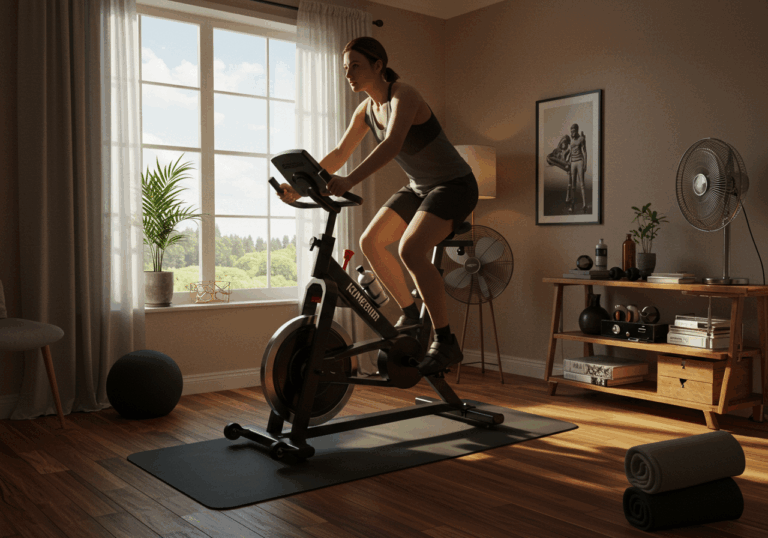
Treadmill training creates dependable cardiovascular progress in any weather. I use it to control pace, incline, and heart rate precisely.
Training principles shape every session. I set a weekly mix of easy aerobic runs, threshold work, and short intervals.
Heart rate zones guide intensity decisions. I adjust treadmill speed or incline to stay in the correct zone.
| Zone | % Max HR | Feel (RPE 1–10) | Goal |
|---|---|---|---|
| Z1 Recovery | 50–60% | 2–3 | Circulation and readiness |
| Z2 Aerobic | 60–70% | 3–4 | Fat oxidation and base |
| Z3 Tempo | 70–80% | 5–6 | Efficiency and pace control |
| Z4 Threshold | 80–90% | 7–8 | Lactate tolerance |
| Z5 VO2max | 90–100% | 9–10 | Max oxygen use |
Treadmill settings change the stress profile. I favor small inclines to mimic outdoor running economy.
| Setting | Effect | Use Case |
|---|---|---|
| 1% Incline | Simulates outdoor wind resistance | Base runs |
| 3–5% Incline | Raises heart rate at lower speeds | Aerobic power |
| 6–10% Incline | Strengths calves and glutes | Hill intervals |

Stepwise Progressions: Beginner to Advanced on the Belt
Progressions create steady adaptations. I scale duration, pace, and incline week by week.
Beginner strategies focus on consistency. I coach short bouts with walking recoveries.
| Level | Session | Details | Rest |
|---|---|---|---|
| Beginner | Walk-Jog 20–30 min | 1% incline, 2 min walk, 1 min jog, Z2 | Walk periods |
| Intermediate | Tempo Ladder 35 min | 10 min Z2, then 3×6 min Z3, 1% | 2 min Z1 |
| Advanced | VO2 Hills 40–50 min | 8×2 min at 6% incline, Z4–Z5 | 2 min Z1 |
Weekly structure supports recovery. I assign two easy days around any hard session.
| Day | Focus | Example |
|---|---|---|
| Mon | Easy base | 30 min Z2, 1% incline |
| Tue | Intervals | 8×1 min Z5, 2% incline |
| Wed | Recovery | 20 min Z1–Z2 walk |
| Thu | Tempo | 25 min Z3 continuous |
| Fri | Optional | Mobility or rest |
| Sat | Long Z2 | 40–60 min Z2, 1% |
| Sun | Rest | Sleep and stretching |
Personal data reinforces these choices. My last six-week block improved consistency and pace control.
Load increases require patience. I add no more than 10% weekly time for new runners.

Energy Systems, Fuel, and Recovery that Move the Needle
Energy systems drive treadmill outcomes. I match sessions to the correct pathway for targeted gains.
Fueling supports intensity control. I eat 0.8–1.0 g protein/kg for beginners and 1.6–2.0 g/kg when training hard.
| Goal | Calories | Macros | Notes |
|---|---|---|---|
| Fat loss | Bodyweight x 11–12 | 30% P, 40% C, 30% F | Prioritize Z2 volume |
| Endurance | Bodyweight x 13–15 | 25% P, 50% C, 25% F | Carbs around hard days |
| Performance peak | Bodyweight x 15–16 | 25% P, 55% C, 20% F | Fuel intervals |
Hydration maintains output. I add 300–500 ml water for sessions over 30 minutes.
Sleep completes adaptation. I aim for 7.5–9 hours with a consistent schedule.
Tech improves compliance. I track heart rate with a Garmin watch and log meals in MyFitnessPal.
Recovery tools aid consistency. I use an easy incline walk cooldown and calf mobility daily.

12-Week Ramp, Apps, and Tracking to Stay Consistent
Implementation bridges goals and results. I break the plan into focused phases.
| Phase | Weeks | Focus | Progression |
|---|---|---|---|
| Foundation | 1–4 | Z2 base and mechanics | +5–10% time weekly |
| Build | 5–8 | Tempo and short hills | Add Z3 blocks |
| Peak | 9–11 | Threshold or VO2 intervals | Reduce easy time slightly |
| Deload | 12 | Recovery and test | -30–40% time |
Testing confirms improvements. I run a 12-minute time trial or a 5-minute ramp test on week 12.
Apps streamline tracking. I sync workouts to Garmin and review trends on Strava.
Metrics guide adjustments. I monitor resting heart rate, perceived effort, and speed at Z2 heart rate.
| Metric | Target Change | Meaning |
|---|---|---|
| VO2max estimate | +5–10% in 8–12 weeks | Better fitness |
| Resting HR | -3 to -7 bpm | Improved recovery |
| Z2 pace | Faster at same HR | Higher economy |
Strength work complements treadmill gains. I keep two short sessions for calves, glutes, and core.

Results, Case Studies, Plateaus, and long-term result interpretation
Outcomes validate the system. I evaluate fitness changes using repeatable treadmill tests and wearable data.
My latest 8-week block delivered clear results. VO2max estimate rose by 8% using mixed intervals and Z2 volume.
Clients saw similar changes. Structured work beats random sessions.
| Client | Timeline | Protocol | Result |
|---|---|---|---|
| Anna, 41 | 6 weeks | 3x/week Z2 + 1 tempo | -4.1 kg, VO2max +7% |
| Marcus, 35 | 8 weeks | HIIT 1 day + Z2 3 days | 5 km -2:18, RHR -5 bpm |
| Maya, 50 | 10 weeks | Incline hikes + strength | Knee pain resolved, pace +9% |
Testimonials illustrate the experience. Their words capture the practical benefits.
Plateaus require simple fixes. I rotate interval formats and add small incline changes.
| Issue | Likely Cause | Fix |
|---|---|---|
| Stalled pace | Monotony, no Z4 | Add 6×2 min Z4 weekly |
| High fatigue | Too many hard days | Cap to two hard days |
| Shin discomfort | Overstride, low cadence | Shorten stride, 165–175 spm |
Nutrition supports adherence during plateaus. I raise carbs by 0.5 g/kg before interval days.
Comparison guides programming choices. HIIT produced faster fat loss for Marcus, but Z2 built durability.
Monitoring sustains habits. I schedule a deload week every fourth week and retest pace at Z2 heart rate.
Final assessment ensures sustainability. I maintain three weekly runs and one supplemental strength circuit for sustainable routine maintenance.