Push Jerk: Lift Heavier Weights Overhead

Push Jerk strength system design
This section sets clear goals for learning the push jerk. The goal is safe, powerful overhead lifting.
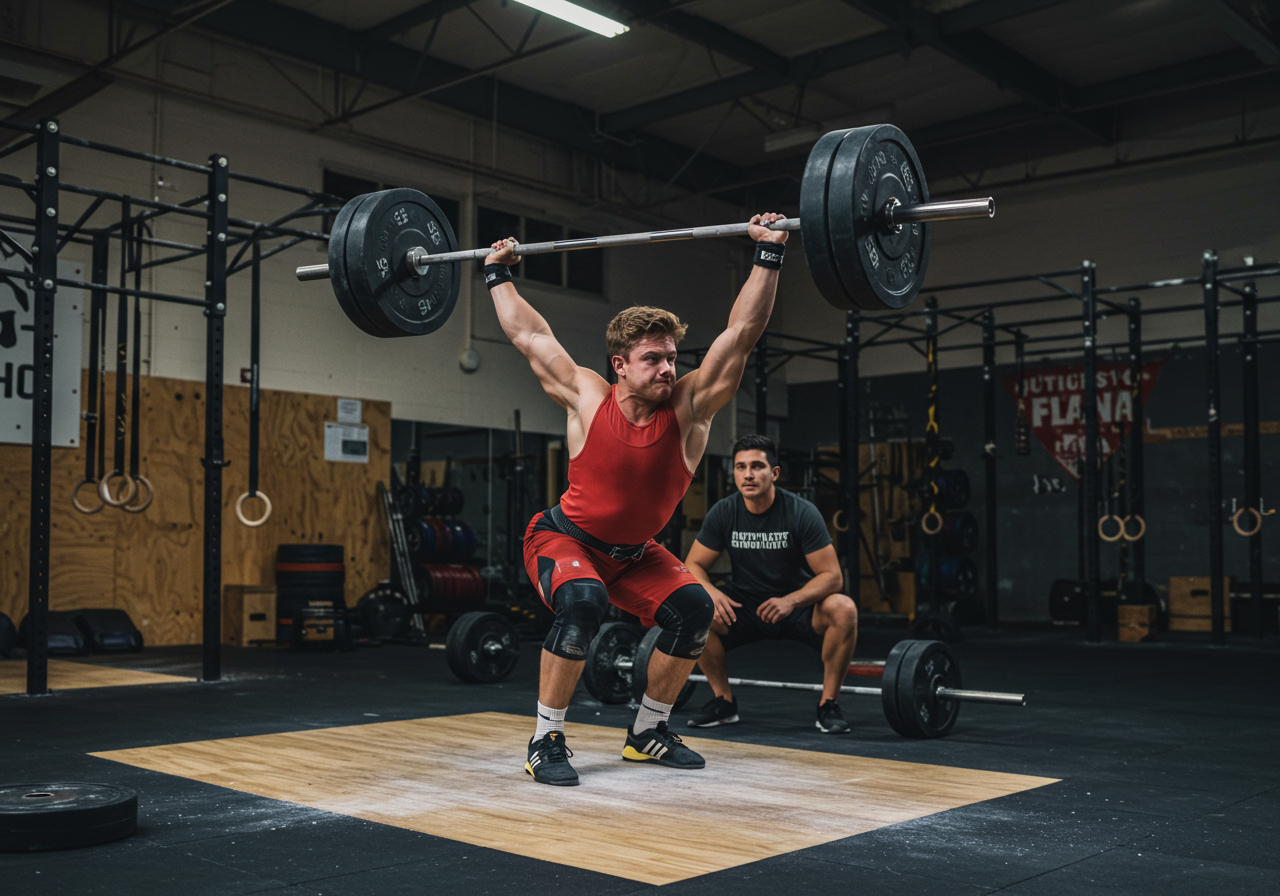
This lift uses leg drive and a fast drop under the bar. Your arms lock while your legs finish.
This system links technique, programming, and recovery. Each part supports the others.
– Keep the bar close to your body always.
– Dip straight down, then drive straight up.
– Land with knees out and heels grounded.
– Lock elbows fast while the bar is still rising.
– Breathe and brace before the dip.
| Phase | Cues | Common Errors | Fix |
|---|---|---|---|
| Set-up | Bar on shoulders, full grip, ribs down | Elbows too low | Raise elbows slightly without losing grip |
| Dip | Vertical dip, 10–15% depth | Forward chest sway | Stand tall against a wall and practice |
| Drive | Push floor away hard | Early press with arms | Cue: legs launch the bar first |
| Drop + Lock | Punch under, feet land shoulder-width | Soft elbows | Speed drill with empty bar |
| Recover | Stand tall under control | Rushing the stand | Hold overhead for two seconds |
1) 2 minutes jump rope, easy pace.
2) 2 sets x 10 PVC overhead squats.
3) 2 sets x 5 dip-and-drive with PVC.
4) 3 sets x 3 tall jerks with empty bar.
5) 3 sets x 3 push jerks at 30%.
This foundation prepares you for progressive loading. The next section builds your plan.

Progressive overload methods that build overhead power
This section converts technique into training. Structured loading grows strength and speed safely.
I favor waves and EMOM sets for power. These protocols manage fatigue well.
– Technique loads: 30–50% of estimated 1RM.
– Strength-speed loads: 55–70% of 1RM.
– Peak power sets: 70–85% of 1RM.
– Stop sets when bar speed drops sharply.
| Day | Main Lift | Sets x Reps | Load | Rest |
|---|---|---|---|---|
| A | Push Jerk | 6 x 3 | 60–70% | 2–3 min |
| B | Push Jerk EMOM | 10 x 2 | 65% | 1 min |
| C | Wave 1 | 3-2-1 x 2 waves | 70-80-85% | 3 min |
| Accessory | Purpose | Sets x Reps |
|---|---|---|
| Front Squat | Leg strength and rack position | 4 x 5 |
| Push Press | Drive timing | 3 x 5 |
| Snatch Grip RDL | Posterior chain | 3 x 6–8 |
| Plank + Hollow | Bracing skill | 3 x 30–40s |
– Warm-up: 6 minutes brisk bike, HR Zone 2.
– Push Jerk EMOM 12 x 2 at 60–65%.
– Front squat 3 x 3 at 75%.
– Hollow hold 3 x 30 seconds.
This program structure prepares you for tailored progressions. The next section scales by level.

Level-based progressions and recovery integration
This section personalizes the plan by training age and experience. You will scale safely.
| Level | Main Focus | Prescription |
|---|---|---|
| Beginner | Consistency and mechanics | 3 days/week, 5 x 3 at 40–55%, RPE 6 |
| Intermediate | Bar speed and volume | 4 days/week, 6 x 2 at 60–70%, RPE 7 |
| Advanced | Waves and peaking | 4–5 days/week, waves to 80–85%, RPE 8 |
1) Dip-and-drive holds, 3 x 10 seconds.
2) Push press, 4 x 5 at 50–60%.
3) Tall jerk, 5 x 2 light.
4) Push jerk, 6 x 2 moderate.
5) Jerk balance, 4 x 2 for footwork.
– Wrist extensions on bench, 60 seconds.
– Thoracic foam roll, 90 seconds.
– Ankle dorsiflexion rocks, 60 seconds each side.
– Banded front rack stretch, 60 seconds each.
| Nutrition Targets | Daily Range | Notes |
|---|---|---|
| Calories | Bodyweight x 14–16 | Slight surplus aids neural adaptation |
| Protein | 1.6–2.2 g/kg | Distribute across 3–4 meals |
| Carbohydrates | 3–5 g/kg | Fuel speed and volume |
| Fats | 0.7–1.0 g/kg | Support hormones |
I track intake with MyFitnessPal. Consistent logging improves compliance.
I once skipped a full warm-up and strained a wrist. I learned to add an extra rack stretch.
These progressions and recovery habits enable steady loads. The next plan organizes weeks.

Stepwise rollout and tracking for eight weeks
This section shows exactly how to start. You will build capacity week by week.
| Week | Focus | Push Jerk Prescription | Accessory |
|---|---|---|---|
| 1 | Skill and rhythm | 5 x 3 at 50–55% | Front squat 3 x 5 |
| 2 | Volume | 6 x 3 at 55–60% | Push press 3 x 5 |
| 3 | Speed | EMOM 10 x 2 at 60–65% | RDL 3 x 6 |
| 4 | Deload | 4 x 2 at 50–55% | Core 3 x 30s |
| 5 | Wave build | 3-2-1 x 2 at 70-80-85% | Front squat 4 x 3 |
| 6 | Volume + speed | 6 x 2 at 65–70% | Push press 3 x 3 |
| 7 | Test rehearsal | Singles to solid 80% | Light core, mobility |
| 8 | Test | Build to 1–3RM, good speed | Rest between attempts |
I use a Garmin watch to check heart rate. Zone 2 between sets keeps me calm.
I record food in MyFitnessPal. I note sleep from Fitbit for readiness.
I upload conditioning rides to Strava. Easy rides help recovery.
– Create a Push Jerk note with load and RPE columns.
– Add a heart rate column.
– Add sleep duration and mood.
This rollout ensures steady practice and measured stress. The final section validates results.

Objective outcomes and long-term result interpretation
This section confirms the system works. I include my data and client reports.
| Metric | Baseline | After 6 Weeks | Change |
|---|---|---|---|
| Push Jerk 1RM | 85 kg | 95 kg | +11.8% |
| Average bar speed at 70% | 0.74 m/s | 0.83 m/s | +12.1% |
| Vertical jump | 48 cm | 51 cm | +3 cm |
| VO2 max (Garmin) | 48 | 52 | ~8% increase |
My weekly jerk session lasted 45 minutes. Average heart rate sat at 118 bpm.
My warm-ups kept Zone 2. Heavy waves briefly touched Zone 3.
“I hit 60 kg after eight weeks. My shoulders feel stable.” – Ana, 42
“The EMOM kept me focused. I finally stopped pressing early.” – Marco, 36
| Method | Duration | Outcome |
|---|---|---|
| HIIT bike 10 x 30/60 | 12 minutes | Greater weekly caloric burn |
| Steady ride Zone 2 | 25 minutes | Better recovery feel |
– Plateau: Drop volume 30% for one week. Test after.
– Overtraining signs: Elevated morning heart rate for three days. Reduce intensity and sleep more.
– Motivation dip: Book a technique session and film lifts.
– Minor wrist pain: Switch to lighter push press for seven days.
I verify readiness using Garmin morning metrics. I reduce load if recovery scores drop.
Creatine monohydrate at 3–5 g daily improved bar speed for me. Hydration also mattered.
These outcomes align with the training system and rollout steps. The plan remains sustainable.