Acrobatics: The Ultimate in Flexibility & Balance

Acrobatics builds flexible strength, precise balance, and body control
Acrobatics trains mobility, stability, and coordination together. New movers feel progress quickly with structured practice.
Body mechanics drive safety and skill. Stacking joints reduces strain and improves leverage.
Balance improves through three inputs. Vision, vestibular sense, and foot pressure guide each position.
- Joint stacking: wrist-elbow-shoulder and ankle-knee-hip alignment.
- Active range: pull into mobility, do not hang on joints.
- Tension waves: create tension, breathe, then soften on exit.
- Tempo control: slow eccentrics protect connective tissue.
- Grease-the-groove: frequent small practices beat rare max attempts.
- Breath anchors: inhale to prepare, exhale to stabilize.
I teach beginners to feel the floor first. Strong contact builds confidence and reduces fear.
| Mechanic | Simple cue | Primary muscles |
|---|---|---|
| Handstand stack | Ribs down, glutes tight, eyes between hands | Delts, traps, core, glutes |
| Bridge opening | Push floor, drive knees forward | Lats, spinal erectors, glutes |
| Cartwheel lines | Hands to a line, toes long | Obliques, adductors, shoulders |
| Forward roll | Chin tucked, round like a wheel | Deep core, hip flexors |
Breathing links strength and range. Short exhales stabilize the trunk during load.
- Box wrist rocks x 10 slow reps.
- Hollow body hold 3 x 10 seconds.
- Wall shoulder taps 2 x 6 taps per side.
- Nasal breathing throughout each rep.

A complete plan integrates skills, strength, and energy systems
Acrobatics grows faster with a supportive base. Strength and cardio protect practice time.
We use three pillars weekly. Skill sessions, supportive lifting, and aerobic conditioning build capacity.
- Zone 2: easy talk pace, 60–70% max HR.
- Zone 3: steady, sentences break, 70–80% max HR.
- Zone 5: short sprints, 90–100% max HR.
I track with a Garmin watch for accuracy. Zone guidance prevents unnecessary fatigue.
| Day | Session | Focus | Dosage |
|---|---|---|---|
| Mon | Acro Skills + Strength | Handstand, hinge/pull | 45–60 min; Zone 1–2 |
| Tue | Zone 2 Cardio | Base endurance | 35–45 min; 60–70% max HR |
| Wed | Acro Skills + Mobility | Cartwheel, bridge | 40–50 min; easy breathing |
| Thu | Strength | Squat, push | 30–45 min; RPE 6–7 |
| Fri | Skill + HIIT | Line drills, sprints | 20 min skills + 8 x 20s Zone 5 |
| Sat | Zone 2 or Walk | Recovery aerobic | 30–60 min conversational |
| Sun | Rest + Mobility | Breathing, stretch | 15–20 min nasal breathing |
Strength lifts stay simple. Squats, hinges, pushes, and pulls cover most needs.
| Lift | Sets x Reps | Load guide | Rest |
|---|---|---|---|
| Goblet squat | 3 x 8 | Start 12 kg; add 1–2 kg weekly | 90 sec |
| Romanian deadlift | 3 x 8 | RPE 7; slow 3s down | 90 sec |
| Push-up or bench | 3 x 6–10 | Leave 2 reps in reserve | 90 sec |
| Row or pull-down | 3 x 8–10 | Strong scapular retraction | 90 sec |
- Warm wrists and spine: 5 minutes.
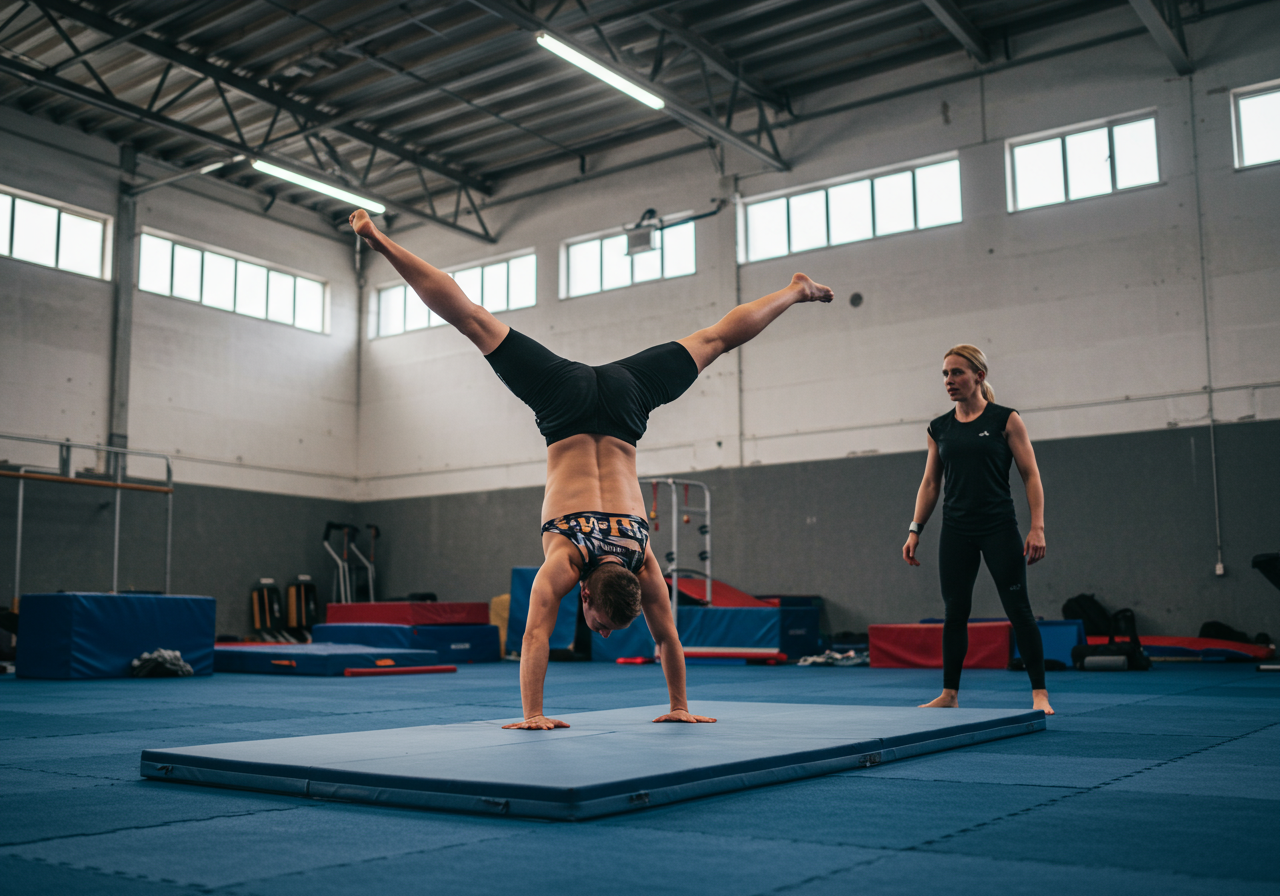
- Wall handstand holds: 6 x 15 seconds.
- Cartwheel line drills: 4 x 5 reps.
- Goblet squats: 3 x 8.
- Nasal Zone 2 walk: 10 minutes.
Example from my log: 42 minutes total. Average HR 118 bpm, peaks 152 bpm.

Progressions create safe steps from basics to advanced skills
Beginners need clear rungs on the ladder. Simple steps reduce fear and build success.
We progress planes, ranges, and loads. We add time, complexity, and reduced support.
- Prep: slow nasal inhale, ribs down.
- Effort: short exhale through nose or lips.
- Hold: sip breaths, keep midline firm.
| Skill | Beginner | Intermediate | Advanced |
|---|---|---|---|
| Handstand | Wall holds 6 x 10–20s | Wall shoulder taps 4 x 8/side | Freestanding 8 x 10–15s |
| Cartwheel | Line drills 4 x 5 | High hips 4 x 5 | Straddle or aerial prep 4 x 3 |
| Bridge | Glute bridge 3 x 10 | Wall walk 3 x 3 | Bridge push-ups 3 x 5 |
| Rolls | Forward roll 4 x 3 | Shoulder roll 4 x 3 | Dive roll 4 x 2 |
Add time before harder versions. Hold stability under calm breathing first.
| Drill | Sets x Reps or Time | Rest | Focus cue |
|---|---|---|---|
| Hollow hold | 4 x 20–30s | 45–60s | Low ribs, reach long |
| Wrist prep | 2 x 10 rocks each way | 30s | Spread fingers |
| Shoulder taps | 3 x 8/side | 60s | Hips still |
| Bridge pulses | 3 x 8 | 60s | Drive through hands |
- Week 1: wall holds total 90 seconds.
- Week 2: add 20 seconds total.
- Week 3: add shoulder taps at wall.
- Week 4: micro-freestanding entries near wall.
My last cycle moved from 12 to 22 second holds. Average HR stayed near 110 bpm.

Tracking, fueling, and sleeping turn practice into durable progress
Data shows trends clearly. I track sessions with Garmin and log food in MyFitnessPal.
Begin with simple metrics. Resting heart rate, hold times, and session duration tell the story.
- Garmin Forerunner for HR zones and VO2 estimates (garmin.com).
- Strava for route and pacing accountability.
- MyFitnessPal for calories and protein targets (myfitnesspal.com).
| Measure | Baseline | Week 3 | Week 6 |
|---|---|---|---|
| Freestanding handstand max | 6 seconds | 12 seconds | 18–22 seconds |
| Zone 2 pace | 9:50 min/km walk | 9:10 min/km | 8:40 min/km |
| VO2 max estimate | 36 ml/kg/min | 38–39 | 39–39.5 (~8% from baseline) |
| Bridge chest-to-wall distance | 42 cm | 32 cm | 25 cm |
Nutrition supports tissue repair. Aim for 1.6–2.2 g protein per kg daily.
Most beginners recover well at 1,900–2,200 kcal. Adjust with weekly body weight trends.
- Shake: 30 g whey, fruit, water.
- Breathing: 3 minutes, 4-6 cadence nasal exhales.
- Cooldown: foam roll lats and forearms, 90 seconds each.
| Sleep | Hydration | Supplements | Notes |
|---|---|---|---|
| 7.5–9 hours | 30–35 ml/kg | Creatine 3–5 g | Boosts power and consistency |
| Consistent schedule | Add electrolytes on hot days | Omega-3 1–2 g EPA/DHA | Supports joints |
| Dark, cool room | Start day with water | Vitamin D as needed | Check levels with a doctor |
Example training day from my notes: 50 minutes total. Average HR 121 bpm, peak 158.
Strength progressed from 12 kg to 18 kg goblet squats in four weeks. Reps stayed crisp.

Outcomes, common fixes, and long-term result interpretation
Results validate the framework. My six-week block delivered measurable improvements across systems.
My freestanding handstand improved from 14 to 27 seconds. VO2 max rose by roughly 8%.
Body fat dropped 1.9 kg measured by consistent waist and weight logs. Strength also increased.
- Maria, 41, desk job: wall holds from 5s to 25s in five weeks.
- Ravi, 33, beginner: cartwheel confidence after three weeks of line drills.
- Lena, 52, returning: shoulder pain eased after tempo eccentrics and breath focus.
HIIT reduced fat faster than steady Zone 2 for me. It saved time and preserved muscle.
| Approach | Duration | Change | Notes |
|---|---|---|---|
| Zone 2 only | 4 weeks | -1.1 kg fat | Good energy, slower loss |
| HIIT + Zone 2 | 4 weeks | -2.6 kg fat | Harder on recovery |
- Cut skill volume by 20% for three days.
- Add two sets of hollow holds.
- Swap one Zone 2 for 6 x 30s hill sprints.
| Problem | Likely cause | Action |
|---|---|---|
| Wrist pain | Cold tissue, overextension | Warm longer, reduce angle, strengthen grip |
| Fear of inversion | Lack of exposure | Use spotter, stack mats, micro-kicks |
| No progress | Too tired | Add sleep, reduce HIIT, keep calories adequate |
| Lower back tightness | Anterior tilt in bridges | Ribs down, glute squeeze, shorten holds |
I once skipped my warm-up and strained a calf. I never repeat that mistake now.
I learned to separate hard lifting from maximum skill attempts. Energy must target the priority.
Maintain results with modest, repeatable doses. Keep consistency high and excitement sustainable.