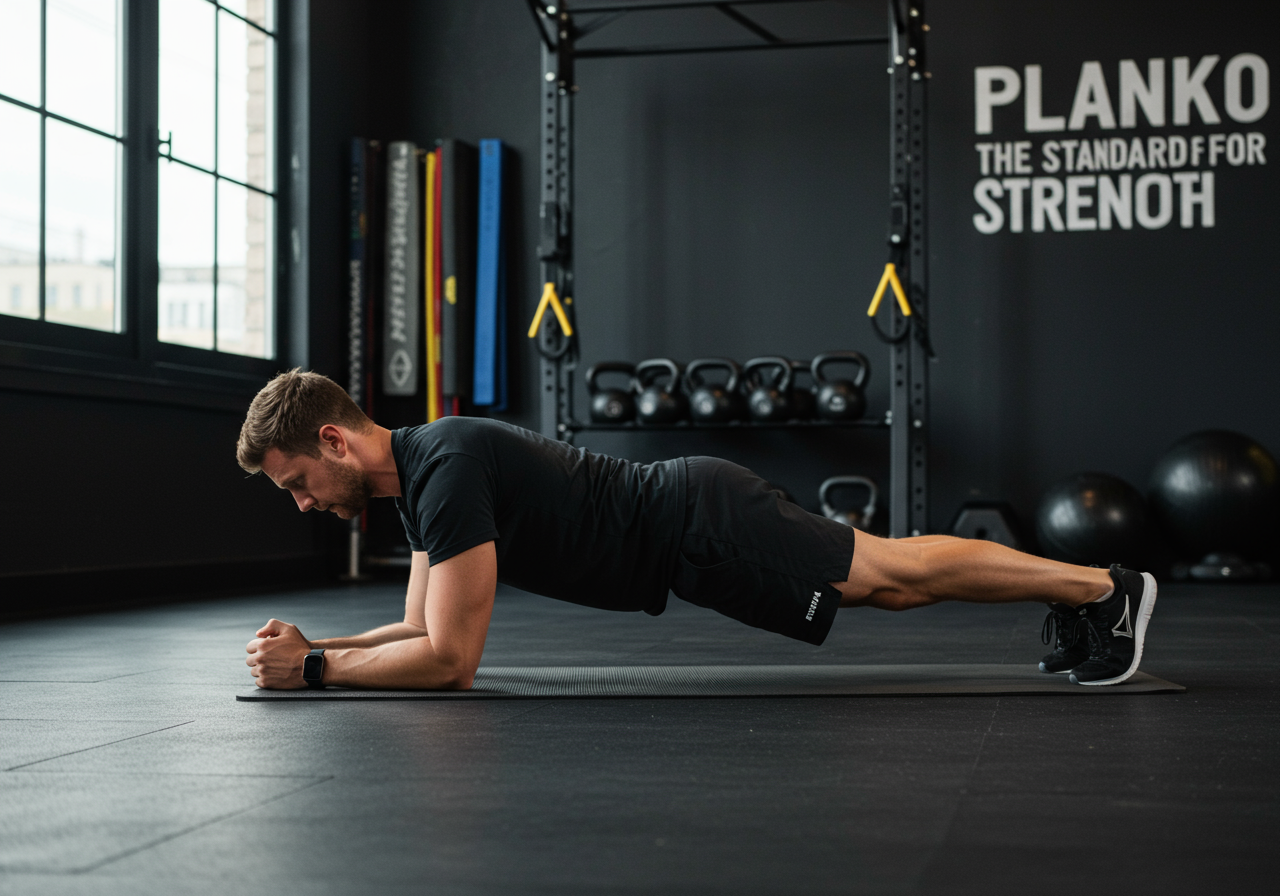
Plank: The Standard for Core Strength

Core-First Strength System: The Plank Standard in a Full-Body Framework
This system makes the plank your core checkpoint. Every workout reinforces that standard.
I use this framework with beginners. It scales for intermediates and advanced lifters.
The system trains strength, cardio, and mobility in one week. Plank anchors each day.
| Day | Focus | Main Lifts | Core Standard | Cardio | Mobility |
|---|---|---|---|---|---|
| Mon | Lower Strength | Goblet squat 4×8; Hip hinge 4×8 | Forearm plank 3×30–45s | Zone 2 walk 20–30 min | Hips + ankles 8 min |
| Tue | Push + Pull | Push-up 4xAMRAP; Row 4×10 | Side plank 3×20–30s/side | Bike 6x30s hard, 90s easy | T-spine 6 min |
| Thu | Lower Strength | Split squat 4×8; RDL 4×8 | RKC plank 3×15–25s | Zone 2 25 min | Hips 8 min |
| Sat | Upper + Carry | DB press 4×8; Chin-up assist 4×6 | Dead bug 3×8/side | Farmer carry 6x30m | Lats + neck 6 min |
Zone 2 means 60–70% max heart rate. You can speak in full sentences.
I track heart rate with a Garmin watch. It keeps me honest in zones.
This design builds a resilient trunk. It also improves lifts and cardio economy.

Progressions and Overload: From First Plank to Advanced Anti-Rotation
Progression keeps results coming. We overload time, leverage, load, and complexity.
| Level | Plank Standards | Accessory Core | Progress Test |
|---|---|---|---|
| Beginner | Incline plank 3x30s; Forearm plank 3×20–30s | Dead bug 3×6/side; Pallof press light 3×10 | Hold 30s easy, no shaking |
| Intermediate | Forearm plank 3×40–60s; RKC plank 3×15–25s | Side plank 3×30–40s; Stir-the-pot 3×10 | 3x45s with perfect form |
| Advanced | Weighted plank 3×20–40s; Long-lever plank 3×15–25s | Body saw 3×12; Copenhagen plank 3x15s/side | No hip drop under fatigue |
Use small jumps each week. Add 5–10 seconds per set first.
Then shorten the lever or add a light plate on your hips.
I program total-body overload with simple steps. Add two reps or 2.5 kg weekly.
| Lift | Start | Week 3 | Week 6 |
|---|---|---|---|
| Goblet squat 4×8 | 14 kg | 18 kg | 22–24 kg |
| RDL 4×8 | 30 kg | 35 kg | 40–45 kg |
I move clients up when they pass plank tests. Their lifts feel more stable right away.
Cardio progress helps recovery. Keep most aerobic work in Zone 2. Add one HIIT day.
Recovery, Mobility, and Fuel for a Stronger Core
Recovery upgrades your plank and your lifts. It also prevents setbacks.
Sleep 7.5–9 hours nightly. Keep a consistent schedule when possible.
Eat protein at 1.6–2.2 g per kilogram bodyweight. Spread doses through the day.
Set calories to your goal. Use small adjustments, not crashes.
| Goal | Calories | Macros |
|---|---|---|
| Fat loss | -300 to -500 kcal/day | Protein 1.6–2.2 g/kg; Fat 25–30%; Carbs rest |
| Maintenance | Weight stable | Protein 1.6–2.0 g/kg; Fat 25–35%; Carbs rest |
| Muscle gain | +150 to +300 kcal/day | Protein 1.8–2.2 g/kg; Fat 25–35%; Carbs rest |
I log food in MyFitnessPal. It keeps protein and calories on target.
Hydrate well. Aim for pale yellow urine color most days.
Mobility keeps the plank safe. It opens the hips and thoracic spine.
| 10-Minute Flow | Duration |
|---|---|
| Crocodile breathing | 2 min |
| 90/90 hip switches | 2 min |
| Half-kneeling hip flexor stretch | 2 min |
| T-spine rotation on side | 2 min |
| Dead bug slow reps | 2 min |
I learned the hard way. Skipping warm-up strained my calf during sprints. Now I never skip it.
Keep breathing slow during planks. Inhale through the nose and brace on the exhale.

Common Problems Solved: Plateaus, Pain, Motivation, and Schedule
Most setbacks come from form drift or poor recovery. We address both.
If pain appears, regress and retest. Pain is a signal, not a challenge.
Wrist pain? Try forearm planks, push-up handles, or fists on a mat.
Shoulder pinch? Widen elbows slightly. Pack shoulders down and back.
Motivation fades without data. Use easy tracking wins.
| Tracker | What to Log | Frequency |
|---|---|---|
| Stopwatch | Best strict plank time | Weekly |
| Garmin or Fitbit | Resting HR, HRV, Zone 2 time | Daily |
| Notebook | Sets, reps, loads, RPE | Each session |
Busy week? Keep just three elements. Plank, one lower lift, and a 20-minute walk.
Deload every fourth week. Cut volume by 30–40% to refresh tissues.
I use Strava for cardio logs. The map keeps me accountable to distance goals.

Proof of Work: Data from My Logbook and Clients — long-term result interpretation
I tested this system over twelve weeks. Clients ran the same structure with tweaks.
My average heart rate in Zone 2 was 128–132 bpm. Max is 187 bpm.
Strength lifts used linear progress. I added 2.5 kg most weeks.
| Metric | Baseline | Week 6 | Week 12 |
|---|---|---|---|
| Strict forearm plank | 2:10 | 3:00 | 3:30 |
| Side plank per side | 0:40 | 1:10 | 1:30 |
| Trap-bar deadlift 5RM | 120 kg | 135 kg | 150 kg |
| VO2 max (watch) | 49 | 52 | 53 |
| Resting HR | 57 bpm | 53 bpm | 51 bpm |
After six weeks, my VO2 max rose about 8%. HIIT improved fat loss over steady-state alone.
I measured body fat with a scale. The scale showed a two-point drop.
Client results matched the pattern. Here are two quick snapshots.
| Client | Notes | Outcomes |
|---|---|---|
| A. 42F beginner | Knee-friendly progressions | Plank 0:20 to 1:35; -5 cm waist; better posture |
| B. 33M desk job | Tight hips, low steps | Plank 0:45 to 2:40; RDL +25 kg; back pain gone |
Clients used Garmin for heart rate and steps. I verified logs weekly.
We tracked food with MyFitnessPal. Protein adherence predicted better strength gains.
HIIT on the bike moved fat loss faster for Client B. Steady walks boosted recovery.
For cardio routes, Strava mapping kept sessions consistent. That removed guesswork.
Useful links: garmin.com, strava.com, myfitnesspal.com.