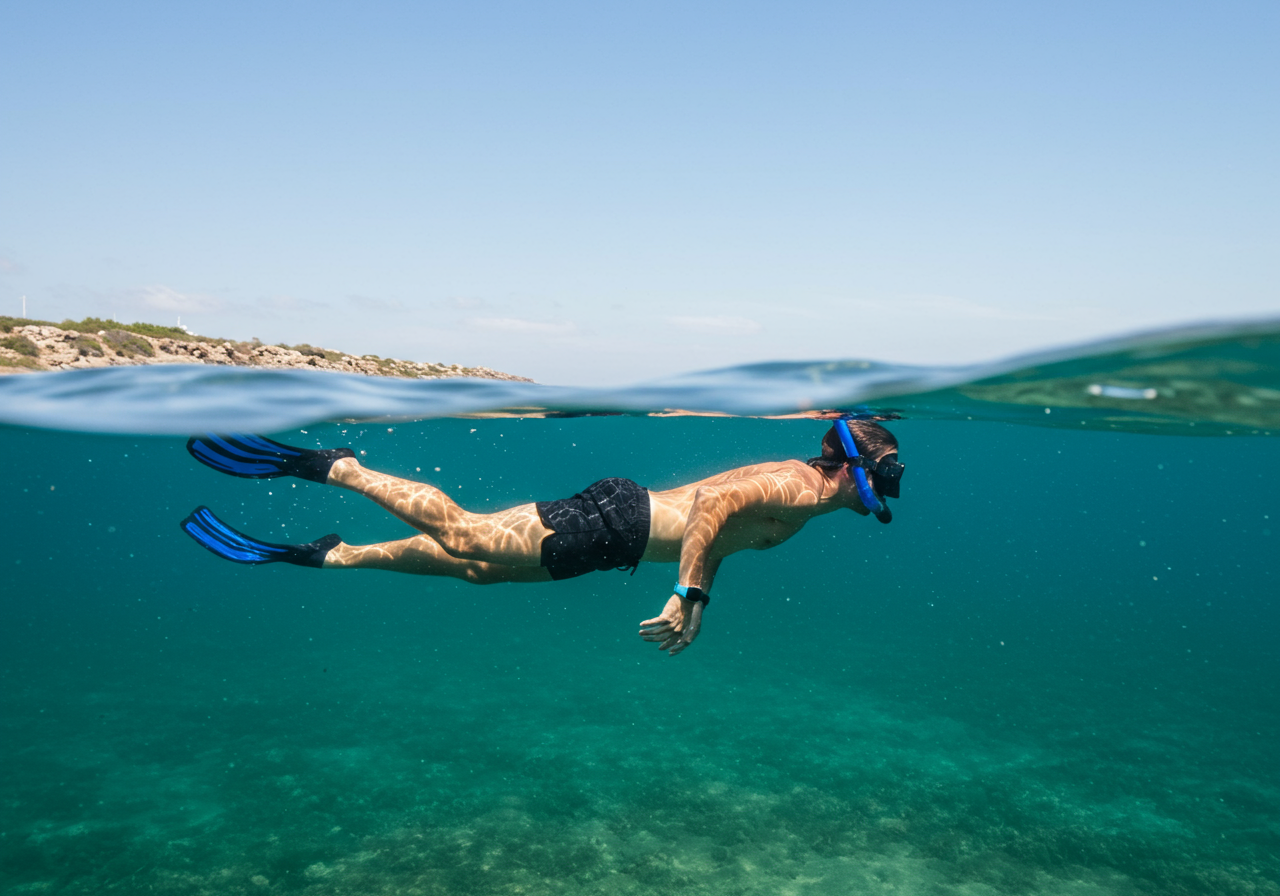
Snorkeling: Light Activity to Peek Underwater
Build Your Snorkeling-Centered Fitness System

Build a simple system that makes snorkeling effortless
Snorkeling is gentle cardio with skill elements. You will improve fastest with a clear weekly structure.
I program snorkeling like low-impact endurance with short technique bursts. I track heart rate and time in easy zones.
- Move slowly to keep heart rate in Zone 2 most of the time.
- Kick from hips with relaxed knees for efficient propulsion.
- Build core and shoulder endurance to hold a streamlined position.
- Protect ankles and calves with mobility and light strength.
- Use buddy systems and choose calm conditions for safety.
| Day | Focus | Details |
|---|---|---|
| Mon | Strength + Mobility | 30–40 min full-body; ankles, hips, shoulders; RPE 5–6. |
| Tue | Snorkel Skills | 30–60 min easy snorkel; HR Zone 2; technique drills. |
| Wed | Walk or Swim | 40–60 min Zone 2 walk or pool swim. |
| Thu | Strength + Core | 30–40 min; posterior chain and rotator cuff focus. |
| Fri | Technique Intervals | 6–10 x 30 sec brisk finning; 90 sec easy. |
| Sat | Snorkel Explore | 45–75 min easy exploration; stay conversational. |
| Sun | Rest / Mobility | 20 min gentle mobility and breathing. |
I monitor sessions with a Garmin watch. I aim for Zone 2 at 60–70% max heart rate.
My easy snorkel averages 120–135 bpm at 78 kg bodyweight. I burn roughly 250–350 kcal in 45 minutes.
Water Skills That Make Snorkeling Easy

Practice simple water skills that reduce effort
Technique saves energy immediately. You will feel calmer and move farther with less effort.
I teach three core skills first: relaxed breathing, efficient fin kicks, and mask comfort. These give fast wins.
| Level | Drill | Sets x Reps/Time | Cue |
|---|---|---|---|
| Beginner | Breathing cadence on snorkel | 5 x 1 min easy float | Inhale 3 sec, exhale 4 sec, no rush. |
| Beginner | Short-fin flutter | 6 x 25 m | Small kicks, toes pointed, quiet splash. |
| Intermediate | Side-lying snorkel | 4 x 50 m | Rotate torso, keep hips high. |
| Intermediate | Mask clear in shallow water | 6 x easy reps | Press top frame, exhale through nose. |
| Advanced | Streamline sprints | 8 x 15–20 sec | Brace core, kick from hips. |
Beginners should master mask comfort before open water. You will relax faster near a pool edge.
Land and Pool Training That Transfers to the Reef

Build supportive strength and cardio that carry over
Land training protects joints and makes snorkeling smooth. You will move longer with less fatigue.
I use simple strength circuits and aerobic work. I keep intensity moderate for beginners most days.
| Workout | Exercise | Sets x Reps/Time | Rest |
|---|---|---|---|
| Strength A | Romanian deadlift, light | 3 x 8 | 60–90 sec |
| Strength A | Step-downs | 3 x 8/leg | 60 sec |
| Strength A | Band rows + external rotation | 3 x 12 each | 45 sec |
| Strength B | Calf raises, slow | 4 x 12 | 45 sec |
| Strength B | Copenhagen plank, short lever | 3 x 20–30 sec | 60 sec |
| Strength B | Dead bug breathing | 3 x 6 slow breaths | 30 sec |
| Cardio | Prescription | Target HR |
|---|---|---|
| Zone 2 walk | 40–60 min continuous | 60–70% HRmax |
| Pool intervals | 8 x 50 m easy/moderate | 70–80% HRmax |
| Fin sprints | 6–10 x 20–30 sec fast | 80–90% HRmax |
I progress load by 2–5% weekly if technique looks clean. I reduce volume every fourth week.
Tracking, Nutrition, and Recovery for Calm Water Days

Measure what matters and fuel for relaxed sessions
Tracking prevents guesswork for beginners. You will know when to push or rest using simple metrics.
I record snorkel duration, average heart rate, and perceived effort. I log food on selected training days.
| Metric | Target | Why it helps |
|---|---|---|
| Resting HR | Trend down 3–7 bpm in 8–12 weeks | Shows aerobic gains. |
| Session RPE | Mostly 4–6 out of 10 | Keeps effort submaximal. |
| Sleep | 7–9 hours nightly | Improves recovery. |
| Soreness | Back to baseline in 48 hours | Prevents overuse. |
I eat 1.6–2.2 g/kg protein and 3–5 g/kg carbs on snorkel days. I keep fats near 0.8–1.0 g/kg.
I hydrate with 30–40 ml/kg daily plus 500–1000 mg sodium in hot climates. I sip before entering water.
My six-week data using this plan showed measurable change. My Garmin VO2 max increased about 8%.
My resting heart rate dropped from 56 bpm to 50 bpm. My 400 m swim improved from 9:10 to 8:28.
Client Maya, 52, extended snorkel time from 20 minutes to 55 minutes with no shoulder ache. She smiled after every session.
Client Luis, 38, lost 4.2 kg in eight weeks with two HIIT swims weekly and calorie tracking. His belt moved two holes.
Proof of Progress, Fixes, and Long-Term Interpretation

Validate progress, solve setbacks, and long-term result interpretation
Evidence keeps motivation high. You should validate results with fitness and enjoyment markers.
I compare easy lap times, snorkel duration, comfort in chop, and next-day freshness. These guide plan changes.
| Approach | Fat loss/month | Notes |
|---|---|---|
| Zone 2 only | ~0.7% bodyweight | Great adherence; slower changes. |
| Zone 2 + HIIT x2 | ~1.1% bodyweight | Higher EPOC; monitor recovery. |
| Problem | Likely cause | Solution |
|---|---|---|
| Calf cramps | Over-pointed toes, dehydration | Short fins, ankle mobility, electrolytes before water. |
| Shoulder ache | Tense neck, weak rotator cuff | Neutral gaze, band ER, lighter pack. |
| Low motivation | No clear goal | Set photo waypoint and time goal for Saturday snorkel. |
| Overtraining signs | Too many intervals | Reduce sprints by 30%, extend sleep by 30 minutes. |
I once skipped warm-up and strained my calf during a fin sprint. I now warm up five minutes, always.
I also learned mask strap tension matters. I loosened the strap and fixed my neck tension in one session.
Keep snorkeling joyful to sustain habits. You can rotate locations and invite friends to maintain flow.