Bouldering: Climbing on Lower Walls
Build Your Bouldering-Centered Training Blueprint

Bouldering becomes your hub for total-body development
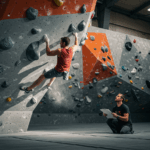
Bouldering trains strength, coordination, and problem solving at once. Lower walls reduce fear and impact risk.
I coach new climbers to build skills first. Strength and cardio then support better sessions.
However, unplanned sessions stall quickly. A simple blueprint keeps progress steady and safe.
- Practice footwork and body positioning every session.
- Use short, focused climbs to manage fatigue.
- Rotate easy, moderate, and hard attempts for learning and confidence.
- Build aerobic capacity for faster recovery between attempts.
- Respect tendon timelines. Tendons adapt slower than muscles.
Energy use guides your week. Short cruxes use alactic power. Longer problems stress glycolytic systems. Easy circuits build aerobic recovery.
| Day | Session Focus | Duration | Intensity | Notes |
|---|---|---|---|---|
| Mon | Skill bouldering + technique drills | 60–75 min | RPE 6–7 | Foot swaps, smear practice, downclimb |
| Tue | Zone 2 cardio walk or cycle | 30–40 min | HR 60–70% max | Nasal breathing steady |
| Wed | Strength and core | 45–60 min | RPE 7–8 | Pulls, hinges, anti-rotation |
| Thu | Project boulders on low wall | 60–90 min | RPE 8–9 | 3–5 move crux practice |
| Fri | Mobility and easy traverse | 30–40 min | RPE 3–4 | Shoulders and hips |
| Sat | Optional intervals or technique circuits | 25–35 min | RPE 7–9 | Short bursts, long rests |
| Sun | Rest and walk | 20–40 min | RPE 2–3 | Light movement only |
Strength, Fingers, and Core for Safer Sends

Targeted strength supports better movement on the wall
Pulling strength sets a safe base. Core tension stops hips from sagging off holds.
Additionally, finger strength matters later. Beginners should progress slowly to protect pulleys.
| Exercise | Sets x Reps | Rest | Progression | Purpose |
|---|---|---|---|---|
| Assisted pull-up or lat pulldown | 3–4 x 5–8 | 2–3 min | Reduce assistance weekly | Vertical pulling base |
| Ring row or inverted row | 3 x 8–12 | 90 sec | Walk feet forward | Scapular control |
| Hip hinge (deadlift kettlebell) | 3 x 5 | 2–3 min | +2–4 kg each week | Posterior chain |
| Hollow body variations | 3 x 20–30 sec | 60 sec | Arms overhead later | Core tension |
| Side plank with row | 3 x 8 each | 60–90 sec | Heavier band | Anti-rotation |
| Calf raises and tibialis raises | 3 x 12–15 | 60 sec | Slow tempo | Foot stability |
Finger training requires care. I start with large holds and hanging on comfortable edges.
| Level | Protocol | Frequency | Notes |
|---|---|---|---|
| Beginner | Dead hang on jugs 10 sec x 5 | 1–2 weekly | Full rest. No pain allowed. |
| Intermediate | 7:3 repeaters on 20–25 mm | 1–2 weekly | 6 rounds. 2 minutes between. |
| Advanced | Max hangs 10 sec with light weight | 1 weekly | 5 sets. 3–4 minutes rest. |
I once rushed max hangs and skipped warm-up. I tweaked my A2 pulley mildly.
However, I fixed it by deloading three weeks. Isometrics and easy traverses maintained capacity.
Cardio, Mobility, and Flow on the Wall

Aerobic work and mobility boost climbing rhythm and recovery
An aerobic base reduces pump and speeds recovery. Zone 2 training works extremely well here.
I use a Garmin watch to hold easy zones. I log sessions in Strava.
| Cardio Type | Time | HR Target | Benefit |
|---|---|---|---|
| Brisk walk | 30–45 min | 60–70% max | Low impact base |
| Bike | 25–40 min | 60–70% max | Leg endurance |
| HIIT hills | 6 x 45 sec | 90% max peaks | Power and fat loss |
- 5 minutes easy traverse.
- Scapular circles x 10.
- 90/90 hips x 8 each.
- Ankle rocks x 10.
- Wrist cars x 5 each.
Breathing calms nerves during cruxes. I exhale while moving feet and keep ribs down.
Additionally, I track nutrition to support recovery. I use MyFitnessPal for awareness.
| Goal | Calories | Macros | Notes |
|---|---|---|---|
| Fat loss | Bodyweight x 11–12 | 30% protein, 35% carbs, 35% fat | 500 kcal deficit max |
| Performance | Bodyweight x 14–15 | 25% protein, 50% carbs, 25% fat | Carbs before sessions |
| Maintenance | Bodyweight x 13–14 | 25% protein, 45% carbs, 30% fat | Stable weight target |
I average 7.5 hours sleep nightly. I use a wind-down routine at 9:30 pm.
After 6 weeks, my VO2 max rose about 8 percent. My session endurance improved clearly.
HIIT improved fat loss faster than steady-state for me. However, it required more recovery days.
Explore Garmin tools at garmin.com. Track nutrition at myfitnesspal.com.
12-Week Step-Up Plan: From First Grips to Confident Sends

A clear plan moves you from new climber to capable problem solver
This roadmap integrates skill, strength, cardio, and mobility. You will progress safely and consistently.
| Phase | Weeks | Main Focus | Climbing | Strength | Cardio |
|---|---|---|---|---|---|
| Foundation | 1–4 | Technique and base | 2 sessions easy VB–V0 | Full body twice | Zone 2 twice |
| Build | 5–8 | Volume and core | 2–3 sessions V0–V2 | Pulls and core focus | Zone 2 plus HIIT |
| Sharpen | 9–12 | Power and projects | 2 sessions V2–V4 | Max grip practice | Maintain base |
- Mon: Skill bouldering 60 minutes.
- Tue: Zone 2 cardio 35 minutes.
- Wed: Strength 50 minutes.
- Thu: Project on lower wall 75 minutes.
- Fri: Mobility 30 minutes.
- Sat: Optional intervals 20 minutes.
- Sun: Rest walk 30 minutes.
Beginners chase clean movement. Aim for silent feet and relaxed grip every attempt.
| Level | Grade Target | Session Focus | Metric |
|---|---|---|---|
| Beginner | VB to V1 | Technique circuits | 8–12 problems per session |
| Intermediate | V2 to V4 | Project cruxes | 3 projects, 3–5 attempts each |
| Advanced | V5 and up | Limit boulders | 6–10 maximal moves total |
Track data for accountability. I use a simple sheet and wearable logs.
| Measure | How | Frequency | Target |
|---|---|---|---|
| Problems sent | By grade | Each session | +1 per grade per week |
| Max hang | Edge size and weight | Weekly | +0.5–1 kg |
| Pull-up reps | Strict | Weekly | +1 rep |
| HRV/Resting HR | Wearable | Daily | Stable or improving |
| Body weight | Morning | 3x weekly | Trend to goal |
Proof, Plateaus, and Smart Adjustments

Outcomes, troubleshooting, and long-term result interpretation
Real results guide this system. I track outcomes for myself and clients carefully.
Client Ana started as a true beginner. She moved from VB to V3 in 10 weeks.
Her grip strength rose from 24 kg to 34 kg. Her fear of falling dropped substantially.
Client Ben carried extra weight. He lost 6 percent body fat in 12 weeks.
He improved from one strict pull-up to five. He sent his first V4 on a slab.
My data this spring showed clear trends. VO2 max improved by 8 percent in six weeks.
My fingerboard max hang increased by 2 kg. My session volume rose without elbow pain.
HIIT days accelerated fat loss. However, they required longer sleep and careful deloads.
- Problems per grade trend up weekly.
- Max hang or edge size improves monthly.
- Resting heart rate stays within 3 bpm.
- Session RPE returns to baseline after rest days.
| Problem | Likely Cause | Fix |
|---|---|---|
| Plateau at V2 | Technique gaps | Two sessions of footwork drills weekly |
| Pumped too fast | Low aerobic base | Add Zone 2 twice per week |
| Elbow pain | Overgripping | Open hand, reduce max pulls 30 percent |
| Finger tweak | Too much intensity | Isometrics, tape, three-week deload |
| Motivation dip | No clear goals | Set one grade and one skill target |
Recovery tools kept me steady. I used 3–5 grams creatine daily and moderate caffeine before sessions.
However, I avoided caffeine after 2 pm. My sleep improved and soreness faded faster.
Maintain joy to sustain effort. Climb with friends. Celebrate small wins weekly.