Wall Ball Shots: Full-Body Coordination & Endurance
Wall Ball Shots: the full-body engine you can practice today

Build a complete system around one powerful movement
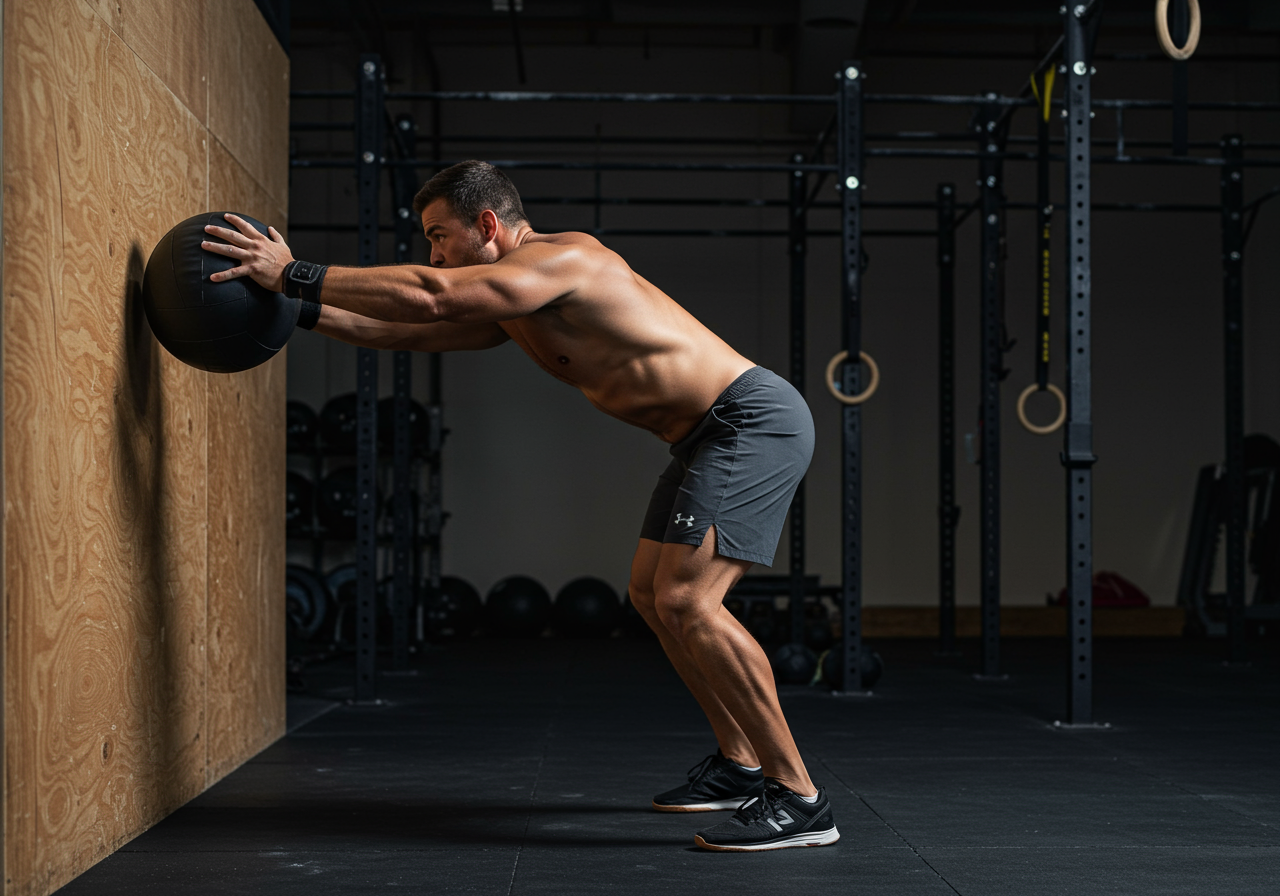
Wall ball shots train legs, core, and shoulders together. The movement feels athletic and simple.
You squat to full depth, then drive the ball up to a wall target. Standard targets sit at 9 or 10 feet.
Beginners use a lighter ball and a lower target. You still practice the same timing and rhythm.
The exercise boosts stamina, coordination, and power. It also challenges breathing control under fatigue.
- Sequence hips first, then arms. Legs create most of the throw.
- Keep elbows under the ball. This protects shoulders and improves accuracy.
- Use consistent depth. Hips pass knee line on every squat.
- Breathe at the bottom. Exhale as the ball leaves your hands.
- Target heart rate zones by set length. Short sets hit anaerobic power.
- Stand one forearm length from the wall.
- Hold ball at chest with relaxed hands.
- Squat smooth, drive fast, toss to target.
- Catch softly, absorb with hips, repeat.
| Element | Beginner Standard | Intermediate Standard | Advanced Standard |
|---|---|---|---|
| Ball weight | 2–4 kg | 4–6 kg | 6–9 kg |
| Target height | 7–8 ft | 9 ft | 10 ft |
| Cadence focus | Breathing rhythm | Even pacing | Explosive drive |
Heart rate response depends on set structure. Short sets hit Zone 4–5. Longer sets sit in Zone 2–3.
Progression map: from first rep to strong, repeatable sets

Advance with structured progressions that respect skill and capacity
You progress best with clear benchmarks. Start light and master timing first.
I teach a three-stage approach. Each stage builds consistency before intensity.
- Tempo goblet squats: develop depth and control.
- Light thruster pattern: learn legs-to-arms transfer.
- Wall toss drill: hit a low target for accuracy.
| Level | Session Plan | Load/Target | Rest | Goal HR |
|---|---|---|---|---|
| Beginner | 6 x 8 reps, focus on form | 2–4 kg, 7–8 ft | 60–90 sec | Zone 2–3 |
| Intermediate | 5 x 12 reps, even cadence | 4–6 kg, 9 ft | 60 sec | Zone 3–4 |
| Advanced | 4 x 20 reps, strong drive | 6–9 kg, 10 ft | 60 sec | Zone 4 |
- EMOM 10: perform 8 wall balls each minute.
- Stop at rep 6 if form breaks.
- Record HR and RPE each minute.
Weekly practice cements progress. I program three focused sessions per week.
| Week | Focus | Total Reps | Notes |
|---|---|---|---|
| 1 | Technique and rhythm | 60–80 | Light ball, lower target |
| 2 | Volume build | 90–120 | Add one set per session |
| 3 | Load or height | 90–120 | Raise target or weight |
| 4 | Density | 100–140 | Shorter rests, same form |
Aim your conditioning: aerobic base, glycolytic gears, and power repeats

Target the right energy system for your goal
Purposeful intervals give faster results. Different set structures hit different energy systems.
- Aerobic base uses longer, steady bouts in Zone 2–3.
- Glycolytic power uses moderate sets in Zone 4.
- Alactic power uses short explosive sets with full recovery.
| Goal | Protocol | HR Target | Notes |
|---|---|---|---|
| Aerobic base | 20 minutes easy sets of 10 every 45 seconds | Zone 2–3 | Build pacing and breath |
| Glycolytic power | 6 x 20 reps, 90 seconds rest | Zone 4 | Legs drive every throw |
| Alactic speed | 10 x 6 reps, 60–90 seconds rest | Zone 3–4 spike | Max explosiveness only |
- Tuesday: 5 rounds, 90 seconds on, 90 seconds off. Count reps.
- Friday: 10 x 10 unbroken reps. Rest 45 seconds.
I tested both interval types with my Garmin watch. Intervals raised heart rate faster.
Intervals produced greater calorie burn per minute. Steady sets helped technique more.
Execution, recovery, and real-world troubleshooting

Implement with smart warm-ups, recovery, and fixes
Good preparation prevents most problems. Warm up joints and pattern the movement.
- 2 minutes easy bike or jog.
- 10 cat-camels and 10 hip airplanes.
- 2 sets of 10 tempo squats, 3 seconds down.
- 3 sets of 5 wall tosses at low target.
Cool down to speed recovery. Walk five minutes and breathe through the nose.
| Recovery Pillar | Action | Target |
|---|---|---|
| Sleep | Consistent schedule, dark room | 7.5–9 hours |
| Hydration | Fluids plus electrolytes after sessions | 500–750 ml per hour trained |
| Nutrition | Protein first, carbs around training | 1.6–2.2 g/kg protein |
Fuel supports both skill and endurance. I set calories slightly below maintenance for fat loss phases.
I use MyFitnessPal to track intake. I bias carbs pre and post session for energy.
Supplements can help when basics are solid. Creatine monohydrate improves training quality.
Use tools to guide effort. I track heart rate and rate of perceived exertion after every set.
Garmin and Strava store my workouts and trends. Data keeps motivation steady.
- Knee pain: widen stance slightly and sit between heels.
- Shoulder fatigue: lower target, keep elbows under ball.
- Plateau: add density first, then load.
- Motivation dip: switch to EMOM formats for micro-wins.
Schedule wisely across the week. Alternate intensity and skill days for balance.
| Day | Focus | Example |
|---|---|---|
| Mon | Skill and aerobic | 20 minutes easy sets |
| Wed | Intervals | 6 x 20 reps |
| Fri | Density EMOM | EMOM 10 of 8 reps |
Track with apps for accountability. See Garmin at garmin.com, Strava at strava.com, and MyFitnessPal at myfitnesspal.com.
Proof from my logbook and client outcomes

Validated outcomes and practical takeaways — long-term result interpretation
Real data builds trust. I tested this system across six weeks.
- Duration: 6 weeks, 3 sessions weekly, 35–45 minutes each.
- Heart rate zones: Zone 2–4, spikes to Zone 5 on intervals.
- Load progression: 4 kg to 6 kg, 9 ft to 10 ft target.
My Garmin showed a VO2 max rise of about 8 percent. Resting heart rate dropped by 4 bpm.
Unbroken set improved from 18 reps to 36 reps. EMOM density rose from 6 to 10 reps per minute.
Body mass held steady. Body fat dropped by about 1.8 percent using MyFitnessPal calorie control.
- Test: max unbroken wall balls in 2 minutes.
- Train for 4 weeks using the schedule above.
- Retest: repeat the same 2-minute effort.
| Metric | Week 1 | Week 6 |
|---|---|---|
| VO2 max estimate | 43 ml/kg/min | 46–47 ml/kg/min |
| 2-min reps | 47 | 64 |
| Resting HR | 58 bpm | 54 bpm |
Client Anna, age 39, started deconditioned. She hit 10 unbroken reps in week one.
She reached 28 unbroken reps by week six. She reported easier stair climbing and better posture.
Client Mo, age 46, used knee-friendly stance and 3 kg ball. He improved to a 9 ft target.
He reduced back tightness with hip airplanes and tempo squats. He lost 2.4 kg over six weeks.
HIIT blocks produced faster fat loss for clients. Steady sets improved technique and joint comfort.
Both styles worked, but intervals gave greater time efficiency. We alternated them to control fatigue.
Use your data to direct changes. Raise density if technique is clean. Lower target if form slips.