Battle Ropes: The Total-Body Conditioning Tool That Burns Fat and Builds Power at the Same Time
The Exercise That Humbled Me in the Best Possible Way
I considered myself fit when I first tried battle ropes. I had been training consistently for four years — squatting well over bodyweight, running 5K in under 22 minutes, doing pull-ups for sets of 15. I was, by any reasonable measure, in good shape. Then a trainer at a new gym handed me a set of battle ropes and said: “Alternate waves, 30 seconds. Go.”
I lasted 22 seconds before my form collapsed completely. My shoulders felt like they were filled with wet cement. My lungs were working harder than they did during sprint intervals. I had to sit down. It was 22 seconds of exercise. I was embarrassed, but I was also immediately interested — what kind of training stimulus produces that kind of response in 22 seconds from someone who is genuinely fit?
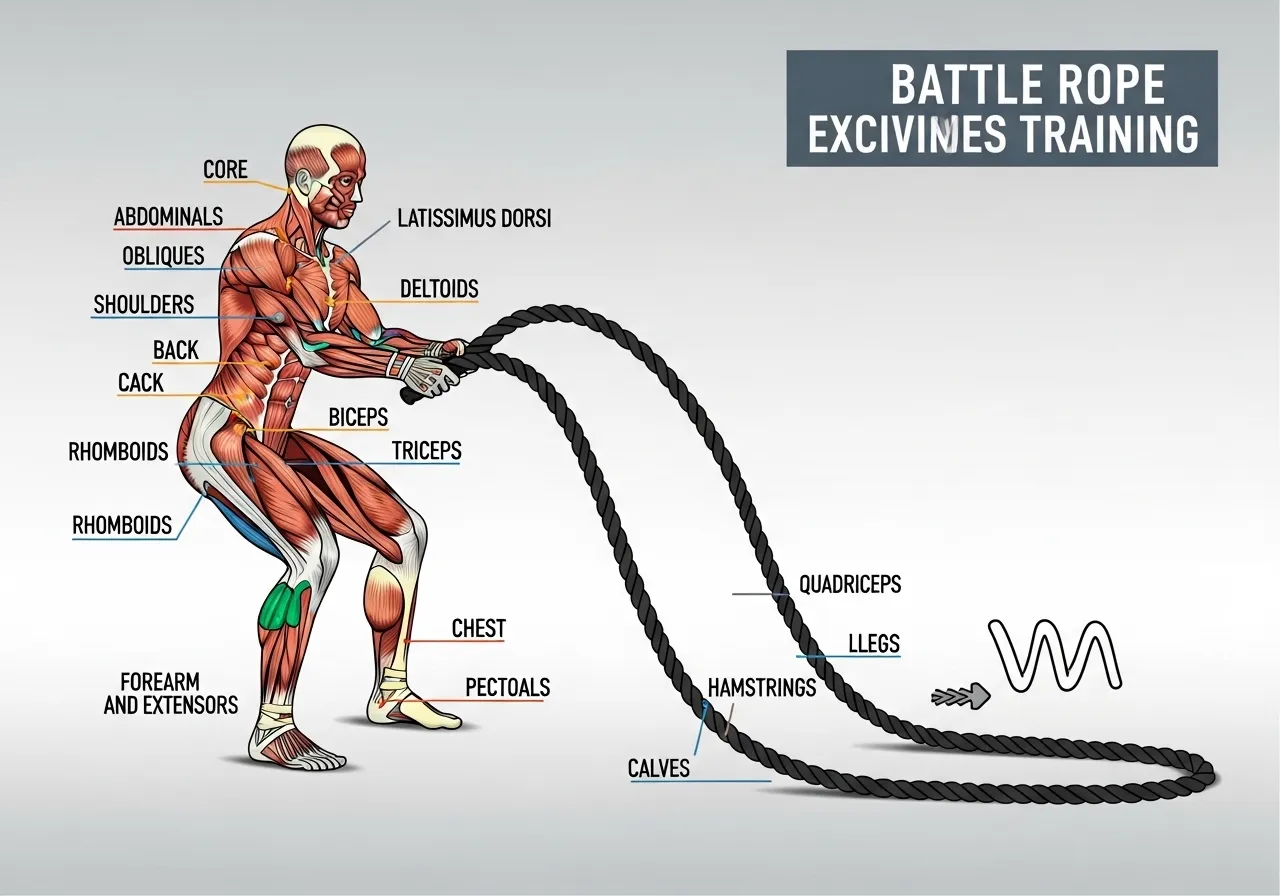
The answer, I’ve since learned, is the answer to why battle ropes have become a fixture in elite athletic training programs worldwide. They challenge the cardiovascular system through upper body work — a relatively uncommon combination that rapidly fatigues because the upper body’s cardiovascular capacity is much lower than the legs’. They train power endurance — the ability to express force repeatedly over time — which pure strength training doesn’t develop. And they do it without spinal loading, making them accessible for people who can’t or shouldn’t do high-impact lower body conditioning work.
This guide covers the physiology of why battle ropes produce such intense responses, the complete technique foundation, a progressive workout structure from beginner to advanced, and the specific variations that target different training qualities.
The Physiology of Battle Rope Training
Battle rope training is metabolically demanding in a way that is disproportionate to how it looks. The primary reason is that alternating wave and simultaneous slam movements require continuous, coordinated full-body effort with no passive phase — unlike barbell exercises where the eccentric phase provides some recovery, battle rope work is constant active effort throughout the working interval.
Studies measuring oxygen consumption and heart rate during battle rope training find VO2 and heart rate responses comparable to all-out sprint intervals — in the 85-95% of maximum heart rate range — within the first 15-20 seconds of a working interval. This rapid cardiovascular demand, combined with the localized muscular fatigue that high-frequency arm work produces, creates an exercise experience that feels significantly harder than its cardiovascular demand alone would suggest.
The caloric expenditure is substantial: studies find approximately 10-15 kcal per minute during high-intensity battle rope work, comparable to rowing machine sprint intervals. The EPOC response — elevated post-exercise metabolism — is also significant given the high-intensity nature of the training, meaning caloric expenditure continues above baseline for hours after the session.
Battle Rope Technique: The Foundation Movements
There are dozens of battle rope variations, but mastering the three foundational movements covers 90% of what makes battle rope training effective. Learn these before adding complexity.
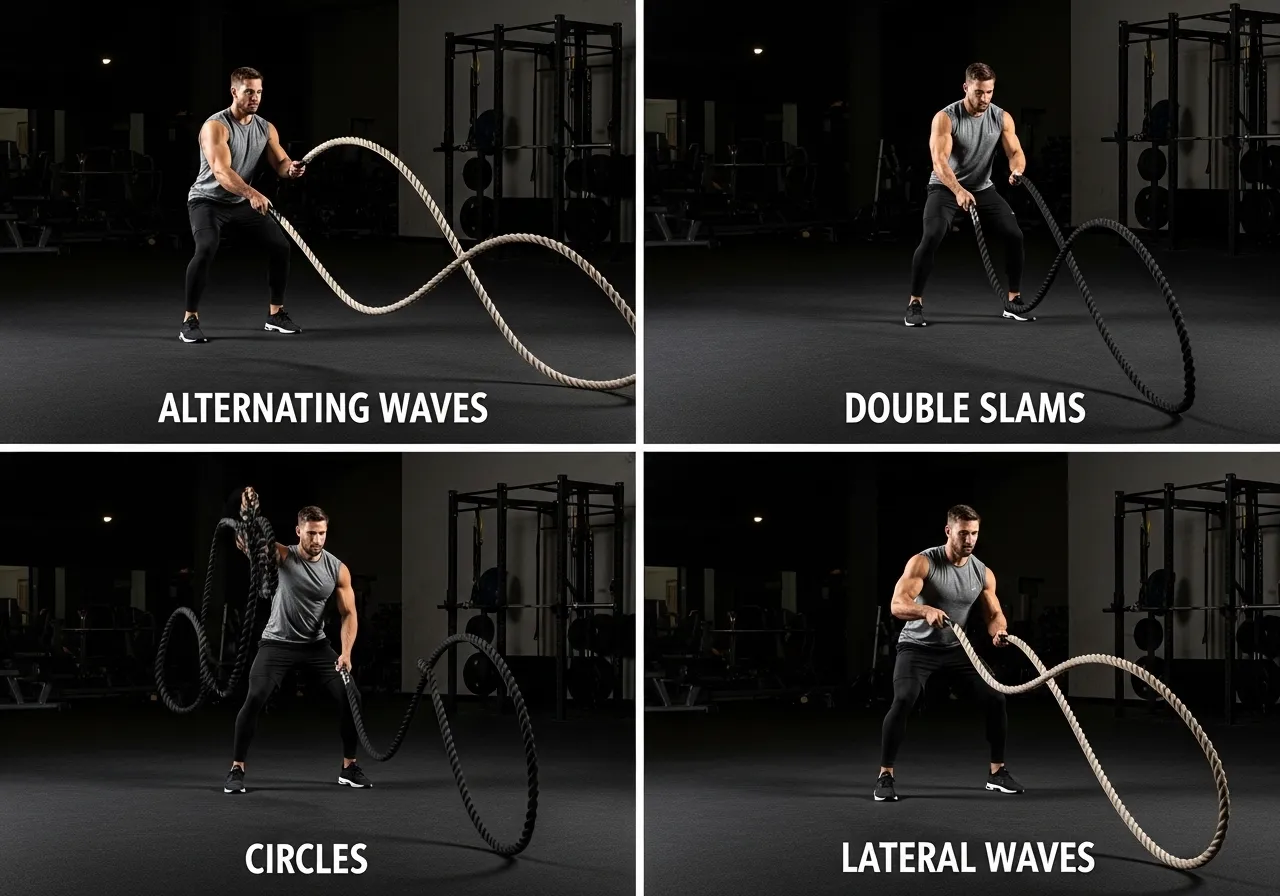
Movement 1: Alternating Waves
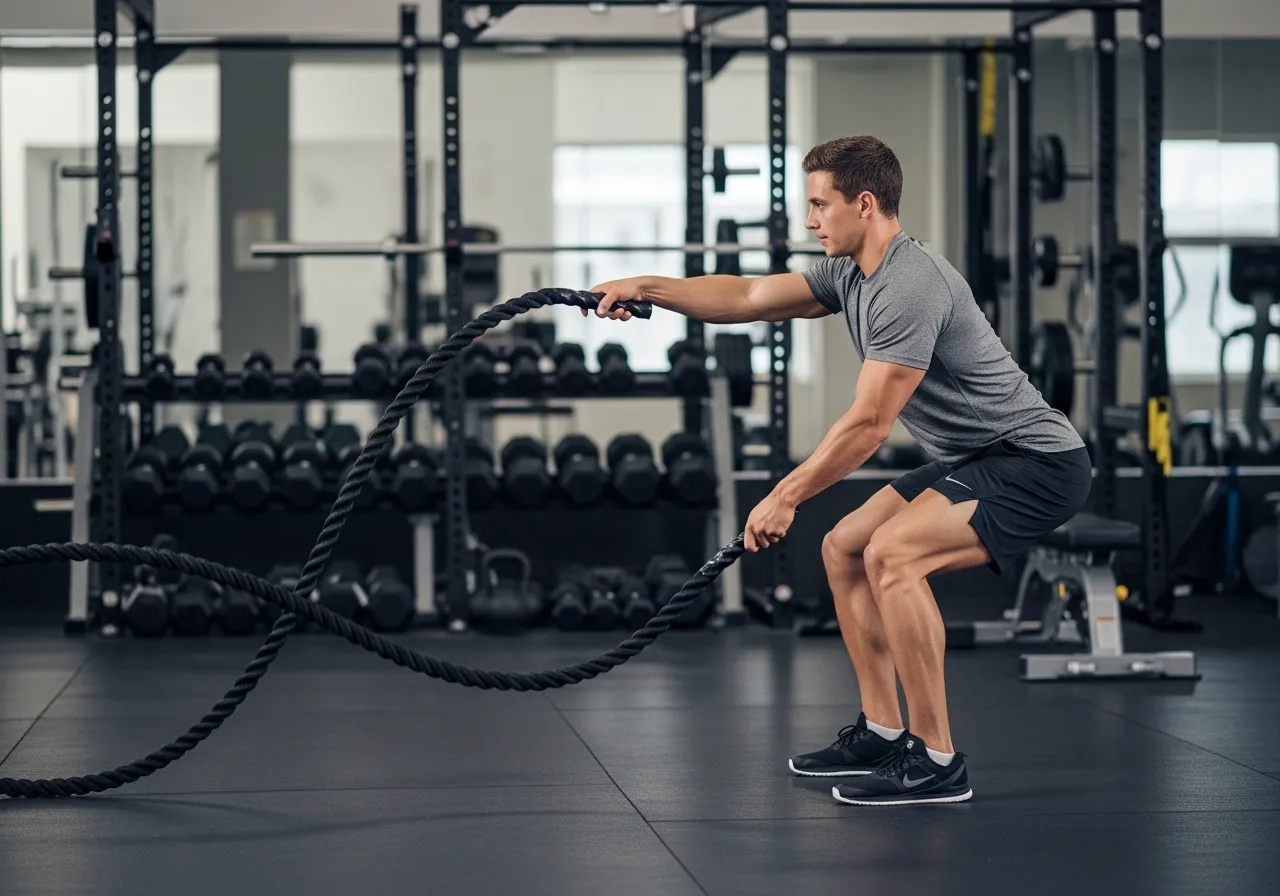
Stand facing the anchor point, feet shoulder-width apart, slight hip hinge (like the start of a deadlift), knees slightly bent. Hold one rope end in each hand with an overhand grip. Raise one arm to shoulder height while simultaneously lowering the other — create a continuous alternating wave pattern that travels down the rope toward the anchor. The movement comes from the shoulders and arms, not the wrists. Your lower body should be stable and athletic — not passive, but not driving the movement.
Key cues: Keep your core braced throughout. Don’t let your lower back round under fatigue — this is the most common form breakdown and the primary injury risk with battle ropes. When you feel your back rounding, reduce intensity rather than maintain it with poor posture. The waves should be large and defined, not short and fluttery — larger waves require more force production and produce greater training stimulus.
Movement 2: Double Slams
Hold both ropes together, raise both arms overhead, then slam both ropes simultaneously down to the ground with maximal force. The slam is full-body — your hips extend as you raise the ropes and your entire body produces force for the downward slam. This is a power development movement, not an endurance movement — rest fully between slams and express maximum force on each repetition.
Double slams develop explosive hip extension and overhead pulling power that directly transfers to throwing sports, combat sports, and any athletic movement requiring rapid hip and shoulder coordination. Research on battle rope training and power development found significant improvements in upper body power output and muscular endurance after 6 weeks of battle rope training.
Movement 3: Circles
Hold both ropes, one in each hand, and rotate both arms in circles simultaneously — either both inward (toward each other) or both outward. Circles challenge the shoulders and arms in a rotational pattern that waves and slams don’t provide, particularly targeting the rotator cuff and the muscles that control shoulder rotation. This movement is lower intensity than alternating waves and is useful as an active recovery movement between harder intervals or as a warm-up movement for shoulder preparation before pressing work.
The Complete Battle Rope Training Program
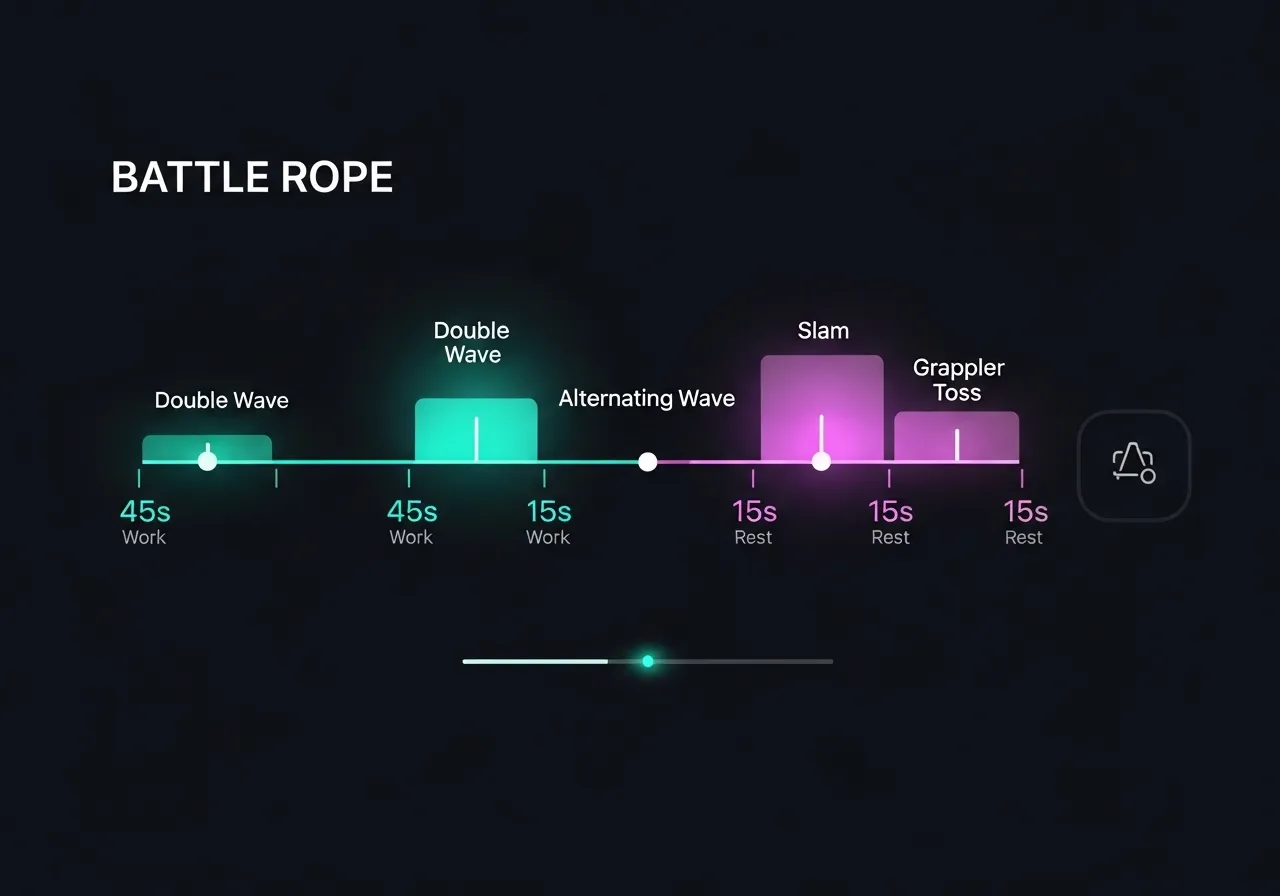
This program progresses over 8 weeks from building baseline endurance to developing genuine power-endurance capacity. The structure mirrors the jump rope HIIT progression: build the work capacity first, then increase intensity.
Phase 1: Foundation (Weeks 1-3)
Focus: Building the shoulder endurance and technique precision to sustain quality movement under fatigue. Structure: Alternating waves, 20 seconds work / 40 seconds rest, 8 rounds, 3 sessions per week. Total work time per session: 2 minutes 40 seconds. This feels easy enough — it isn’t. The localized shoulder fatigue in weeks 1-2 will be more intense than expected. Prioritize form throughout and stop the interval early if your back rounds or your wave quality collapses.
Phase 2: Conditioning (Weeks 4-6)
Focus: Building cardiovascular and muscular endurance simultaneously. Structure: Alternating waves, 30 seconds work / 30 seconds rest, 10 rounds. Add 1 round of double slams (5 slams, rest 60 seconds) between every 3 rounds of alternating waves. This phase is where most people begin to see visible body composition changes — the 1:1 work-to-rest ratio at this intensity is metabolically demanding enough to drive significant fat loss alongside the strength and conditioning adaptations.
Phase 3: Power-Endurance (Weeks 7-8+)
Focus: Maximum intensity intervals for athletic conditioning. Structure: Alternating waves, 40 seconds maximum effort / 20 seconds rest, 12 rounds. Replace every 4th round with double slams at maximum power (6 slams). This phase’s 2:1 work-to-rest ratio at genuine maximum effort is elite athletic conditioning territory. Heart rate in the 88-95% range throughout working intervals, with significant lactate accumulation and EPOC response. Not recommended for people with heart conditions without medical clearance.
Battle Rope Variations for Specific Training Goals
Beyond the three foundation movements, these variations target specific qualities or make battle rope training accessible for people with limitations.
Lateral Waves (Side-to-Side)
Instead of raising and lowering the ropes alternately, move both arms laterally — right, then left, creating a side-to-side wave. This variation challenges the core in the frontal plane and targets the lateral deltoids differently from standard alternating waves. It’s also slightly lower intensity than alternating waves, making it useful as an active recovery variation within circuit training.
Battle Rope Squats
Perform alternating waves while simultaneously performing bodyweight squats — one squat per wave cycle. This combination demands cardiovascular output from both the upper and lower body simultaneously, producing the highest total metabolic demand of any battle rope variation. It’s also the most technically demanding — maintaining wave quality while squatting requires significant coordination and core stability. Master standing alternating waves first.
Kneeling Waves
Performing alternating waves from a kneeling position removes lower body contribution entirely, forcing the upper body and core to manage all of the demand. Kneeling waves are useful for people with lower body injuries who can’t perform standing work and as an isolation tool for training upper body conditioning specifically. The core demand in kneeling waves is also higher than standing because there’s no hip hinge available as a compensatory strategy.
Battle Rope Burpee Combination
Place the rope ends on the floor, drop to pushup position (plank or pushup), jump up and grab the ropes, perform 5 alternating wave cycles, drop again. This interval combination is genuinely one of the hardest bodyweight-accessible conditioning exercises available and is used in combat sports conditioning programs for its exceptional cardiovascular demand and full-body engagement.
Choosing and Setting Up Battle Ropes
Battle rope selection and setup significantly affect training experience. The wrong rope length or thickness makes the training unnecessarily difficult or limits its effectiveness.
Rope Thickness
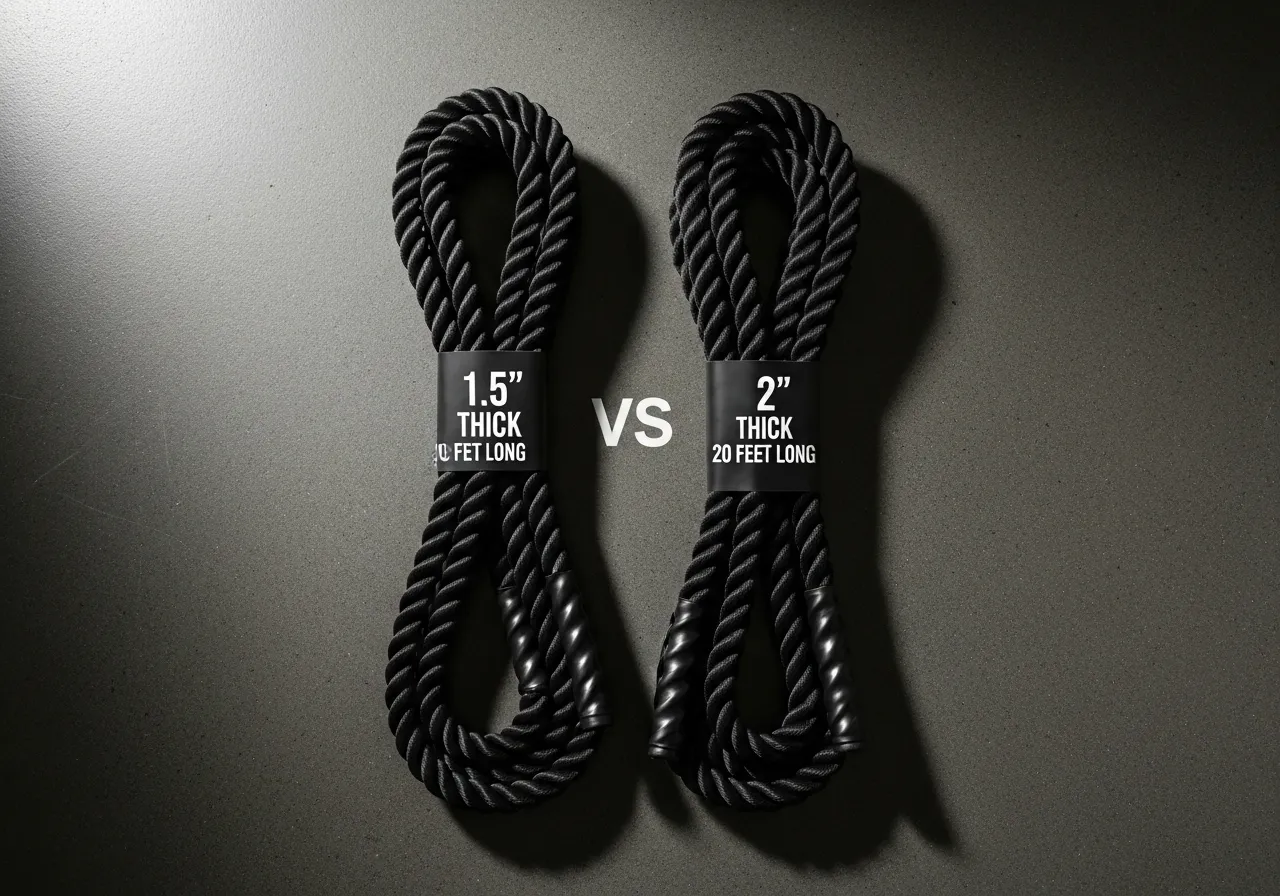
Battle ropes come in 1.5-inch and 2-inch diameters. The 1.5-inch rope is lighter, faster, and better suited for high-repetition endurance work and beginners. The 2-inch rope is heavier, creates more resistance per wave, and is better for power development and advanced athletes. Most gyms stock 1.5-inch ropes — this is the right starting point for the majority of users. If you’re buying for home use, start with a 1.5-inch rope.
Rope Length
Standard battle rope lengths are 30 feet (9m), 40 feet (12m), and 50 feet (15m). Longer ropes require more force to create defined waves because the wave has further to travel. A 30-foot rope in a confined space or for beginners, 40-foot for intermediate to advanced in a gym with space. The anchor point should be at the rope’s midpoint, giving 15-25 feet of active rope on each side.
Anchor Setup
Loop the rope around a stable fixed point — a squat rack post, a heavy dumbbell rack base, or a wall-mounted anchor sleeve. The anchor should be at ground level or near it — anchoring at mid-height changes the rope angle and reduces wave effectiveness. If training at home, a tree works perfectly.

Integrating Battle Ropes Into a Complete Training Program
Battle rope training’s value is highest when positioned strategically within a weekly program rather than used as a standalone training modality.
As Conditioning Finishers After Strength Training
10-15 minutes of battle rope intervals after a strength training session provides cardiovascular conditioning and metabolic stress without compromising the primary strength stimulus of the session. This sequencing — strength first, conditioning second — is the standard approach for athletes who want to develop both qualities without one compromising the other. The strength stimulus is prioritized by placing it first when neural resources are fresh; the battle rope conditioning follows as a secondary stimulus.
As Standalone HIIT Sessions
On days between strength sessions, 20-25 minutes of battle rope HIIT provides maximum cardiovascular adaptation and caloric expenditure without the muscle damage and recovery demand of additional strength training. This approach is particularly effective for fat loss goals, where creating a large caloric deficit through training is a priority. ACSM guidelines on physical activity support high-intensity interval training as an efficient method for achieving cardiovascular health benefits in reduced time compared to steady-state training.
For Athletic Development
Athletes in combat sports, team sports, and any sport requiring repeated explosive upper body efforts should incorporate battle rope training for its unique power-endurance stimulus. A standard athletic conditioning circuit might alternate battle rope rounds with medicine ball throws, sprint intervals, or plyometric jumps — creating the varied metabolic demand that sport performance requires.
Frequently Asked Questions About Battle Ropes
Are battle ropes good for weight loss? Yes — the caloric expenditure (10-15 kcal per minute at high intensity) and significant EPOC response make battle rope HIIT an effective fat loss tool. Combined with appropriate nutrition, regular battle rope training produces meaningful body composition changes within 4-6 weeks.
Do battle ropes build muscle? Battle ropes build muscular endurance and some hypertrophy, particularly in the shoulders, arms, and core. They’re not optimal for maximum muscle building (progressive loading with free weights or cables is more effective for that goal) but they do build functional muscle that carries over to athletic performance.
Can I use battle ropes if I have shoulder problems? It depends on the nature of the shoulder issue. Battle rope training is generally lower risk than overhead pressing for common shoulder impingement issues because the movement doesn’t require elevation above shoulder height. However, the high-repetition nature can aggravate existing rotator cuff tears or labral issues. Consult a physiotherapist before starting battle rope training if you have a diagnosed shoulder condition.
How much space do I need? For a 30-foot rope, you need approximately 18-20 feet of clear space from the anchor point. The width needed is approximately 6 feet (rope width plus arm swing clearance). A standard garage or living room provides enough space for battle rope training with a 30-foot rope.
What’s the difference between battle ropes and resistance bands for upper body conditioning? Battle ropes provide free-moving, dynamic resistance — the wave creates variable loading that challenges both concentric and eccentric phases in unpredictable patterns that develop reactivity and coordination alongside strength. Resistance bands provide more consistent resistance and are better for isolation and rehabilitation work. Battle ropes are the superior tool for power-endurance and cardiovascular conditioning; bands are the superior tool for targeted muscle development and rehabilitation.
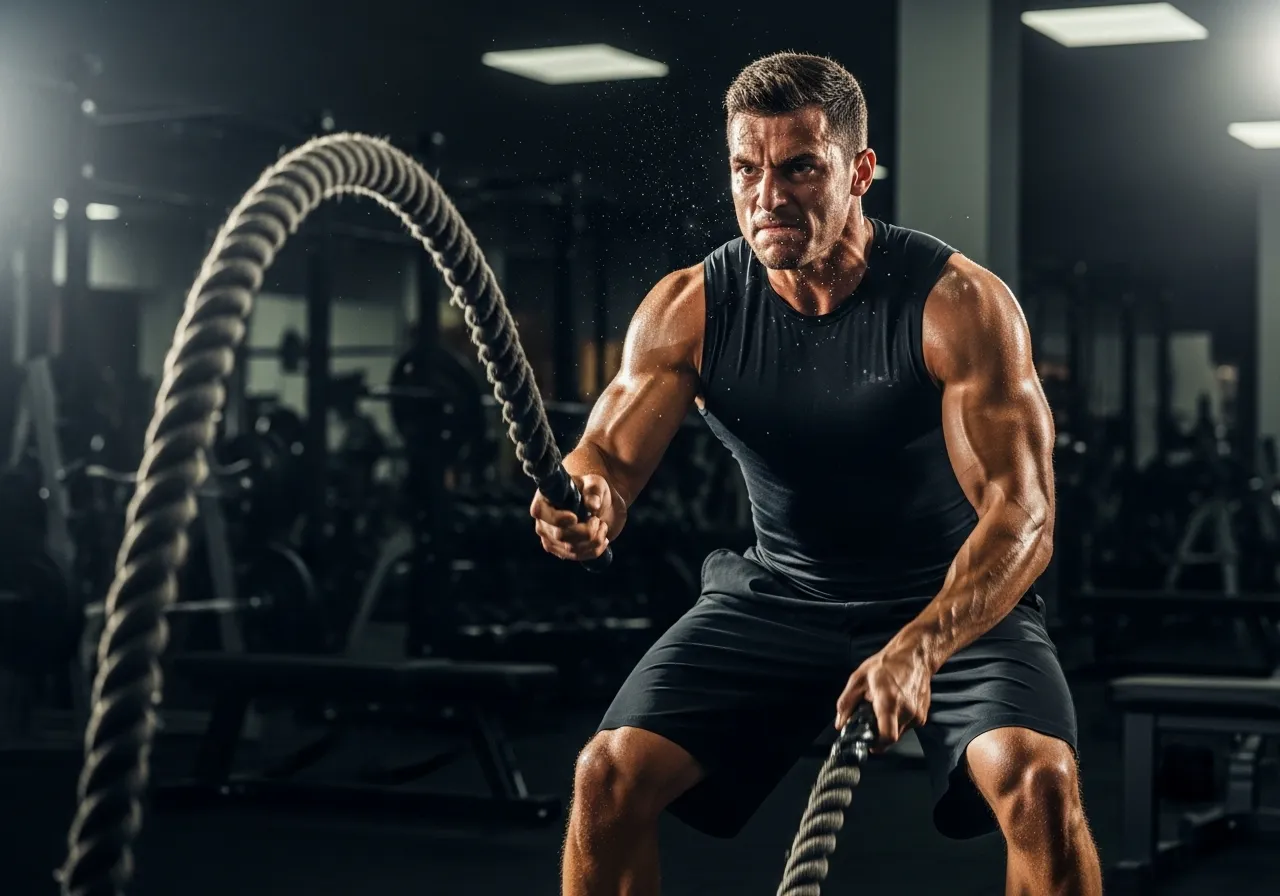
athlete doing battle rope waves workout intense conditioning