⚠️ Fitness Disclaimer: The information in this article is for general educational purposes only and does not constitute professional fitness or medical advice. Always consult a qualified healthcare professional before starting any new exercise program.
The Exercise That Serious Lifters Do But Never Talk About
Watch a serious, experienced lifter’s training session and you will almost certainly see face pulls in it. Ask a beginner or intermediate lifter what face pulls are and you will frequently get a blank stare. This gap between what experienced lifters do and what is publicly discussed as important is one of the most consequential knowledge gaps in recreational fitness — because the face pull is almost certainly the single highest-value exercise that most programs are missing.
I added face pulls after developing anterior shoulder impingement that was interfering with every pressing movement I performed. My physical therapist prescribed three sets of face pulls three times per week alongside the cessation of heavy overhead pressing. Within six weeks, the impingement was resolved. Within eight weeks, my pressing performance had returned and exceeded where it had been. Within six months, the shoulder that had been my chronic limitation had become my most stable and highest-performing joint. I have not missed a week of face pulls since.
The face pull is not glamorous. It doesn’t produce visible muscle mass that impresses anyone. It doesn’t allow heavy loading that produces gym floor credibility. What it does is develop the posterior shoulder musculature that almost every gym program systematically neglects — and this neglect is directly responsible for the shoulder impingement, rotator cuff injuries, and forward posture that affect a disproportionate number of regular gym-goers.
What the Face Pull Trains That Nothing Else Does
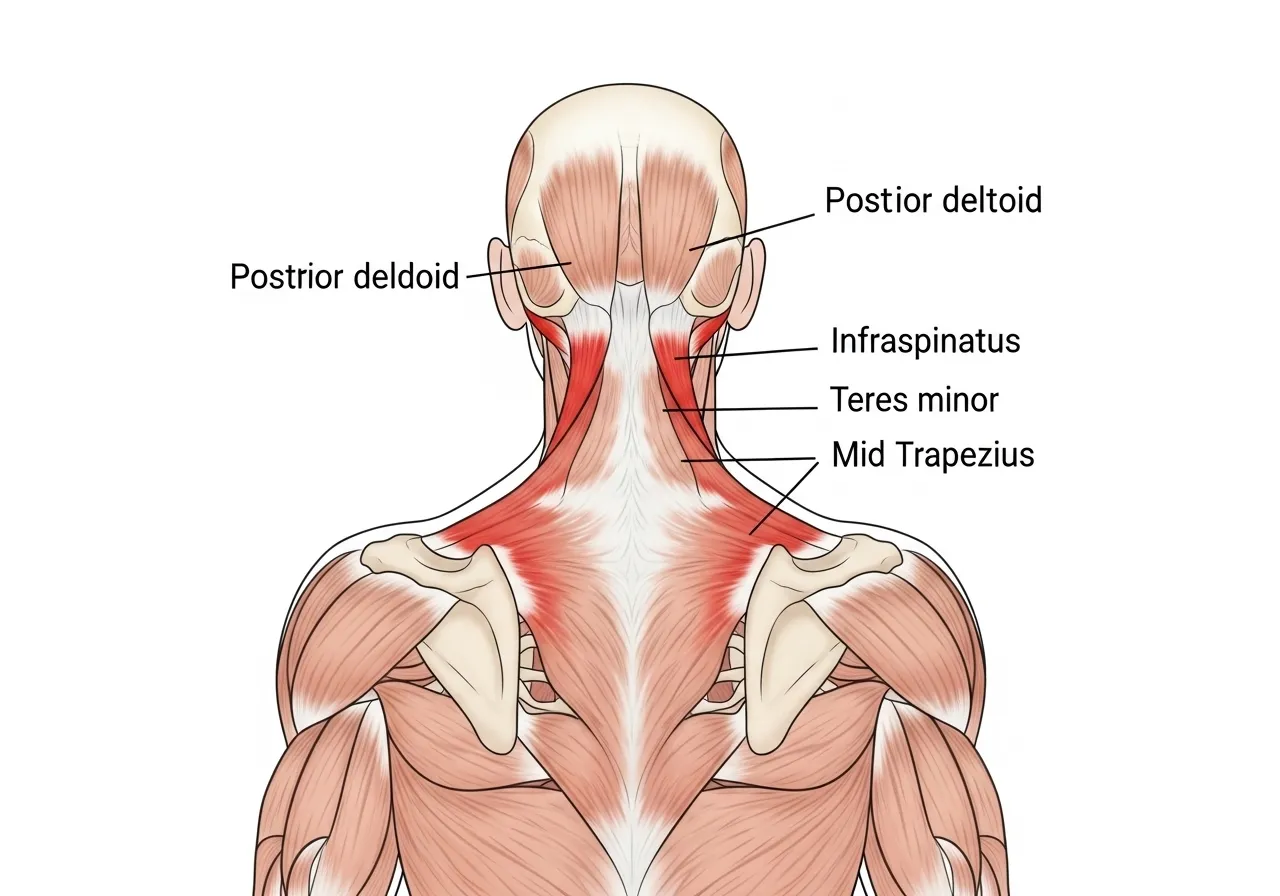
The face pull trains the posterior deltoid, infraspinatus, teres minor, and mid-trapezius in their most functional action: pulling the shoulder into external rotation and horizontal abduction simultaneously. This combined movement directly counteracts the internal rotation, anterior dominance, and rounded shoulder posture that heavy pressing, desk work, and forward-facing daily activities produce. No other exercise in a standard gym program develops this specific combination of muscles in this specific movement pattern — which is exactly why the anterior-to-posterior shoulder imbalance that face pulls correct is so universally present in gym populations.
The Anatomy of Shoulder External Rotation and Why Face Pulls Are Non-Negotiable
The rotator cuff — supraspinatus, infraspinatus, teres minor, and subscapularis — stabilizes the glenohumeral joint by maintaining the humeral head centered in the glenoid during all arm movements. The infraspinatus and teres minor, which externally rotate the humerus, are chronically undertrained in most gym programs that emphasize pushing movements. The bench press, overhead press, and dip all internally rotate the humerus, progressively strengthening the subscapularis and the anterior structures while allowing the posterior rotator cuff to fall progressively weaker relative to the internal rotators. This internal rotation dominance is the primary mechanical driver of shoulder impingement, rotator cuff tears, and the chronic anterior shoulder pain that plagues heavy bench pressers. The face pull directly and specifically trains the external rotators — particularly the infraspinatus and teres minor — alongside the posterior deltoid and the scapular retractors (rhomboids and middle trapezius) in a single movement. No other common gym exercise provides this specific combination of posterior shoulder chain development that counterbalances the internal rotation dominance of pressing. This is why coaches including Eric Cressey, Mike Robertson, and others who specialize in shoulder health have called the face pull the most important exercise most lifters are not doing. Research on rotator cuff muscle imbalances in strength athletes confirms that internal rotation strength significantly exceeds external rotation strength in heavy pressing athletes, validating targeted external rotation training as an injury prevention priority.
Face Pull Variations for Different Training Contexts
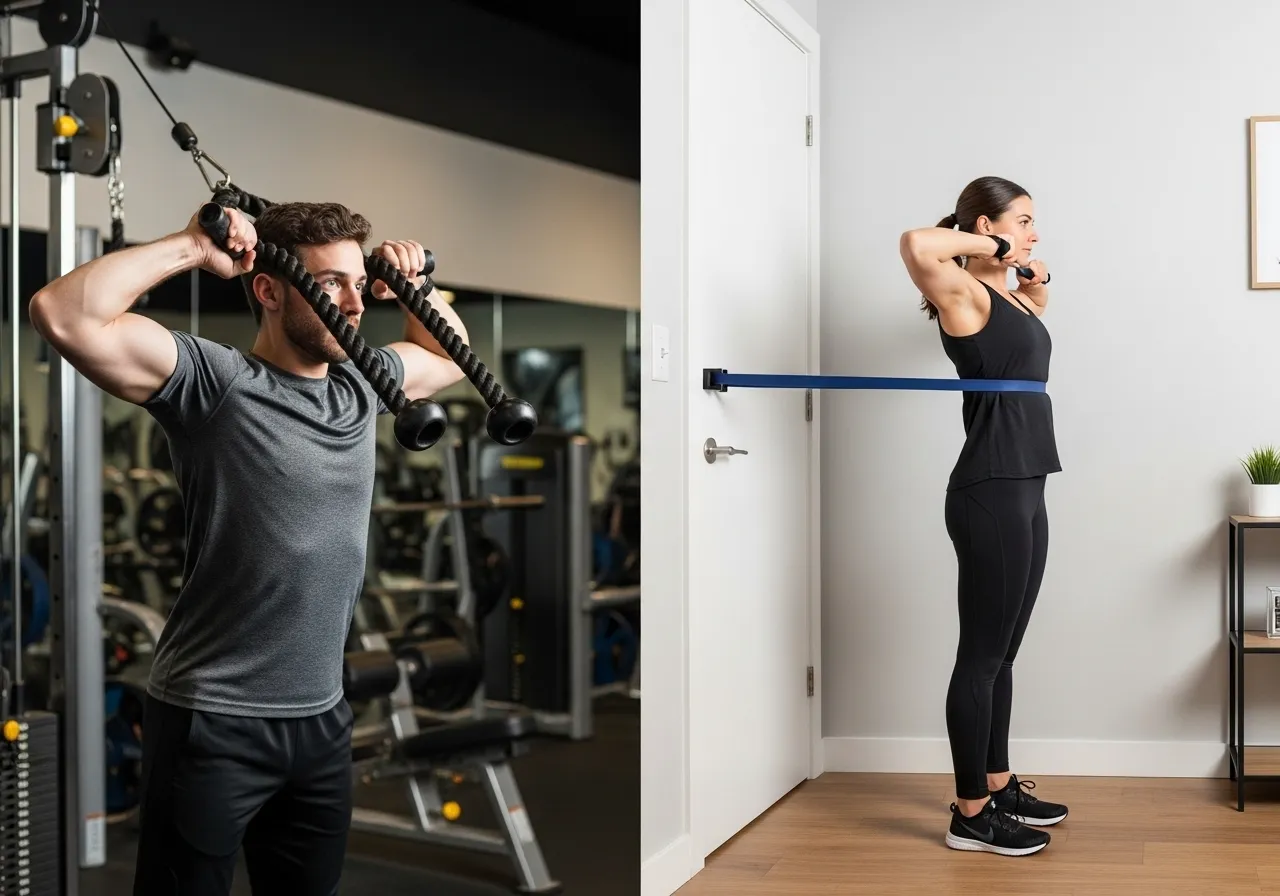
The standard cable face pull has several effective variations that expand its application across different training contexts. The band face pull — using a resistance band anchored at face height — provides a portable alternative that can be performed anywhere without cable equipment and is appropriate for warm-up and daily maintenance work at home or while traveling. The rope face pull with external rotation emphasis — deliberately exaggerating the external rotation at the end range, finishing with the hands positioned beside the ears with elbows high — maximizes the infraspinatus and teres minor activation that provides the most specific rotator cuff balance benefit. The half-kneeling face pull — performed kneeling on one knee facing the cable stack — eliminates the lower body contribution to the movement and forces the core to stabilize against the cable’s pull, adding a core stability demand to the shoulder health work. The prone face pull — lying face down on an incline bench while performing the face pull motion — provides additional mid-trapezius and lower trapezius activation that the standing variation does not emphasize, developing the complete scapular stabilizer chain alongside the external rotators. Each variation serves a specific context — daily maintenance work benefits from the band variation’s accessibility; maximum external rotation development benefits from the rope variation with rotation emphasis; core integration benefits from the half-kneeling variation; and complete scapular chain development benefits from the prone variation.
The face pull is not merely an accessory exercise — it is the foundation of long-term shoulder health and the structural counterbalance that makes decades of heavy pressing both possible and sustainable. Every session that begins with face pulls is a session that invests in the shoulder health that protects all subsequent training. Make it non-negotiable and watch both pressing performance and shoulder health improve simultaneously across years of consistent training.
Start the face pull today — not as an afterthought at the end of your pressing session, but as the first deliberate exercise before any pressing begins. Three sets of fifteen reps with light resistance, focusing entirely on the external rotation quality at the end position. Do this consistently for sixty days and the difference in shoulder health and posterior development will be undeniable.
Face Pull Technique: The Setup and Execution That Makes It Work
Cable Setup
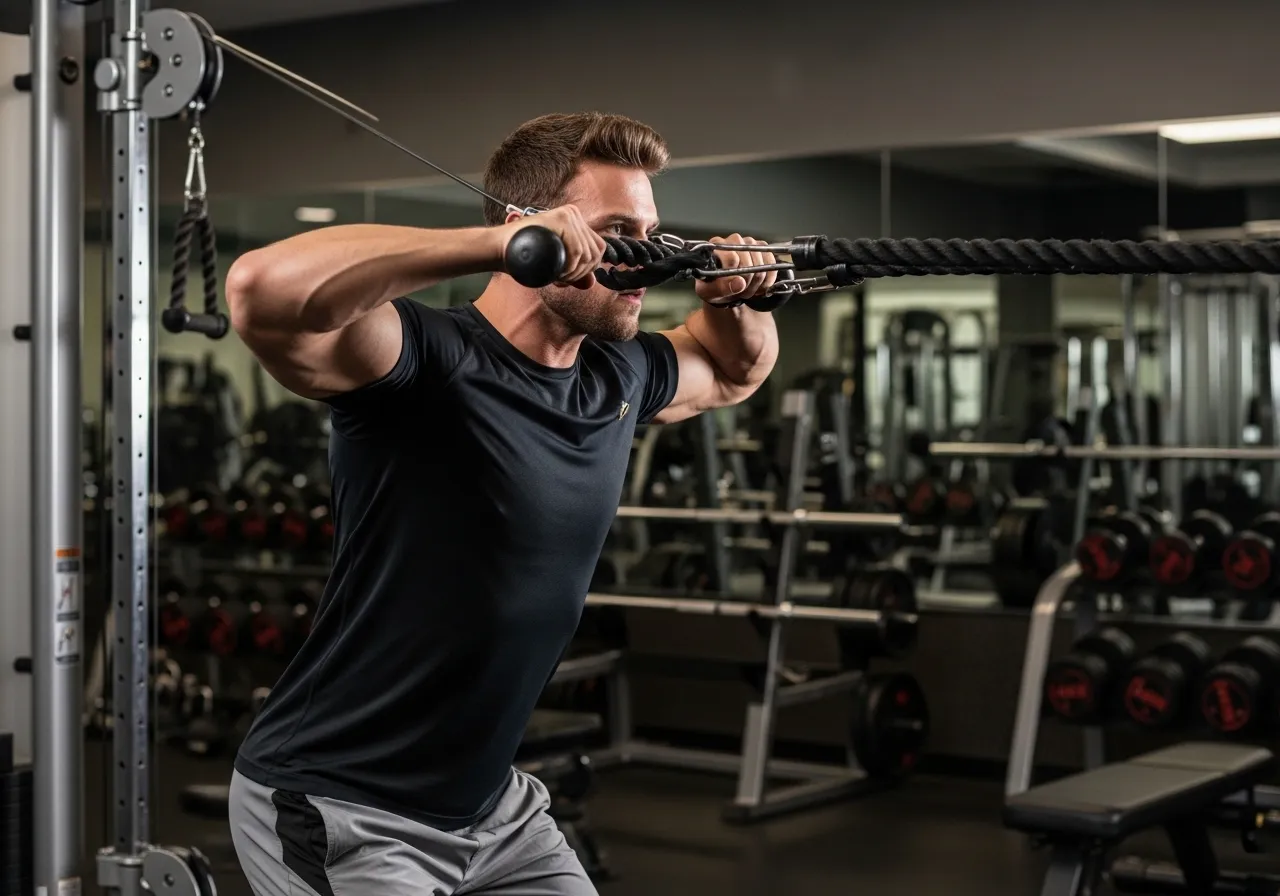
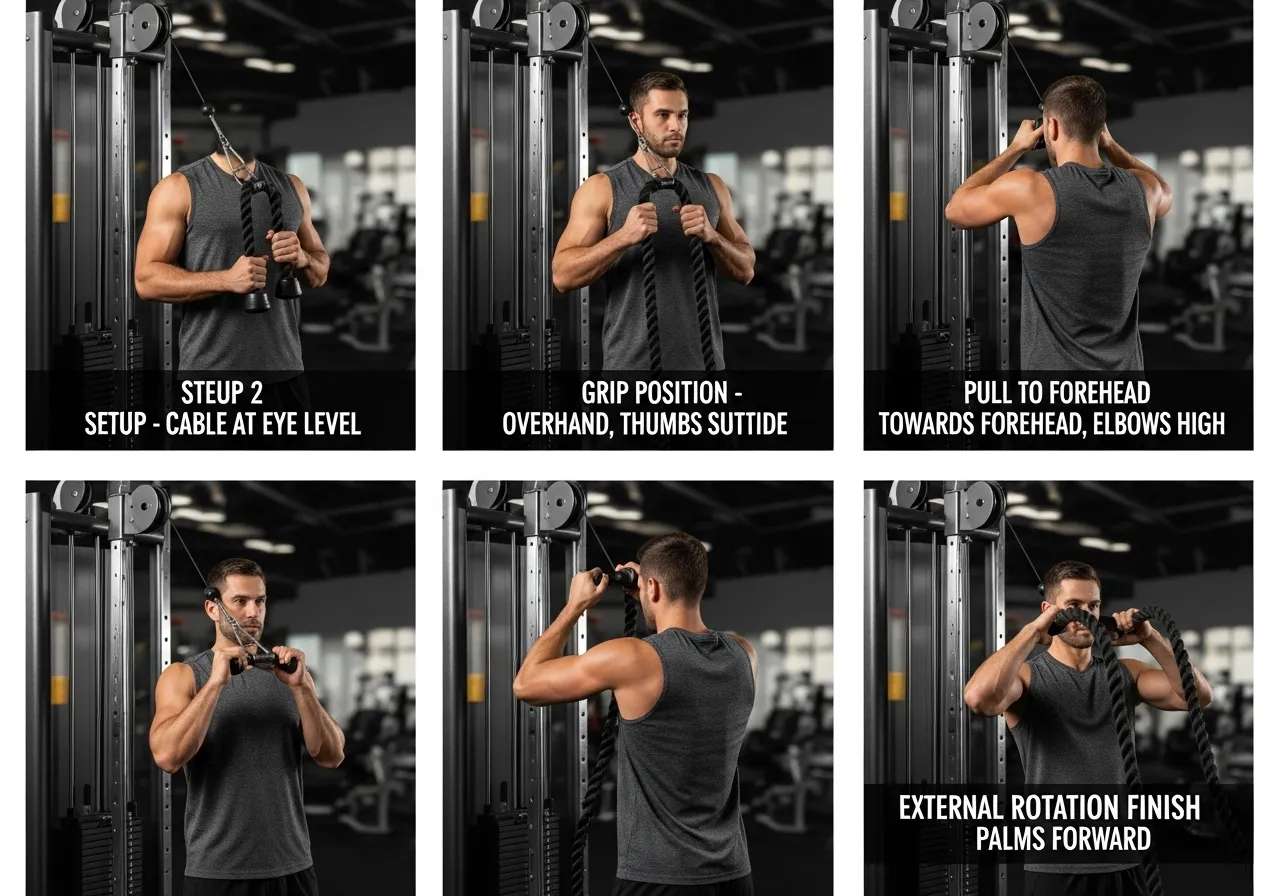
Set the cable machine to approximately face or eye height. Attach a rope attachment — not a straight bar. The rope allows each hand to move independently and the palms to face inward at the start of the pull, which is critical for the external rotation component that makes face pulls effective. Stand far enough from the cable stack that there is meaningful resistance even with arms extended — approximately 1.5 to 2 meters from the stack for most machines. Lean very slightly back, approximately 5 to 10 degrees, creating a stable base.
The Pull
Grip the ends of the rope with both hands, thumbs pointing toward you. Pull the rope toward your face — specifically toward your forehead or just above, not toward your chin or neck. As the rope approaches your face, flare the elbows out and up (to approximately 90 degrees or slightly above horizontal) and externally rotate — the hands should end with thumbs pointing behind you or slightly upward, palms facing forward. This finish position is the critical element that makes face pulls effective: the external rotation at the end range is exactly the movement pattern the posterior shoulder and rotator cuff need to counteract pressing-induced internal rotation dominance.
Common Errors
Pulling to the chin rather than forehead: this changes the elbow angle and reduces the external rotation demand. The rope should always travel toward forehead height. Elbows below horizontal at the finish: pulling with elbows pointed downward trains a rowing pattern rather than the face pull’s specific posterior deltoid and external rotator pattern. Elbows should be at or above horizontal at the finish. Using too much weight: the face pull is a high-rep shoulder health exercise, not a heavy loading exercise. If form degrades before 15 reps, reduce the weight. Rope ends not separating at the finish: the hands should finish pointing in different directions (thumbs back) with clear separation between them — if they’re staying close together, the external rotation is being omitted.
Recommended Loading
Face pulls should be performed with light to moderate weight for 15 to 25 repetitions. The muscles trained — posterior deltoid, infraspinatus, teres minor — are endurance-oriented stabilizers that respond better to higher-rep loading than the heavy low-rep loading used for prime mover development. Using heavy weight compels the larger muscles to take over and eliminates the specific stimulus that makes face pulls unique. Choose a weight that produces genuine muscle effort at 20 reps without any technique degradation.
The Scapular Stabilizers: Why Face Pulls Are Not Just a Rotator Cuff Exercise
The face pull’s benefit extends beyond the rotator cuff to the complete posterior shoulder girdle musculature that controls scapular position and movement. The rhomboids (major and minor) and middle trapezius retract the scapula during the face pull’s pulling motion, developing the retraction strength that maintains scapular position during overhead movements and counteracts the scapular protraction that bench pressing and desk work progressively reinforce. The lower trapezius depresses the scapula during the high-elbow finish position of the face pull, developing the depression strength that prevents the shoulder elevation (shrugging) that occurs during overhead pressing in people with weak lower trapezius. The serratus anterior is eccentrically loaded during the pull phase, developing the control of scapular protraction that is essential for overhead stability. This comprehensive posterior shoulder chain activation in a single movement makes the face pull uniquely efficient for addressing the collection of posterior shoulder weaknesses that most gym programs create through their pressing emphasis. The goal of face pull training is not just to feel the movement in the posterior shoulder — it is to develop the integrated scapular control that allows the shoulder to move optimally through all ranges in pressing, pulling, and overhead movements. According to NCBI research on scapular stabilizer activation, exercises that combine shoulder external rotation with scapular retraction and depression produce the most comprehensive posterior shoulder chain activation available in common exercise movements.
Face Pulls and Posture: The Office Worker’s Essential Exercise
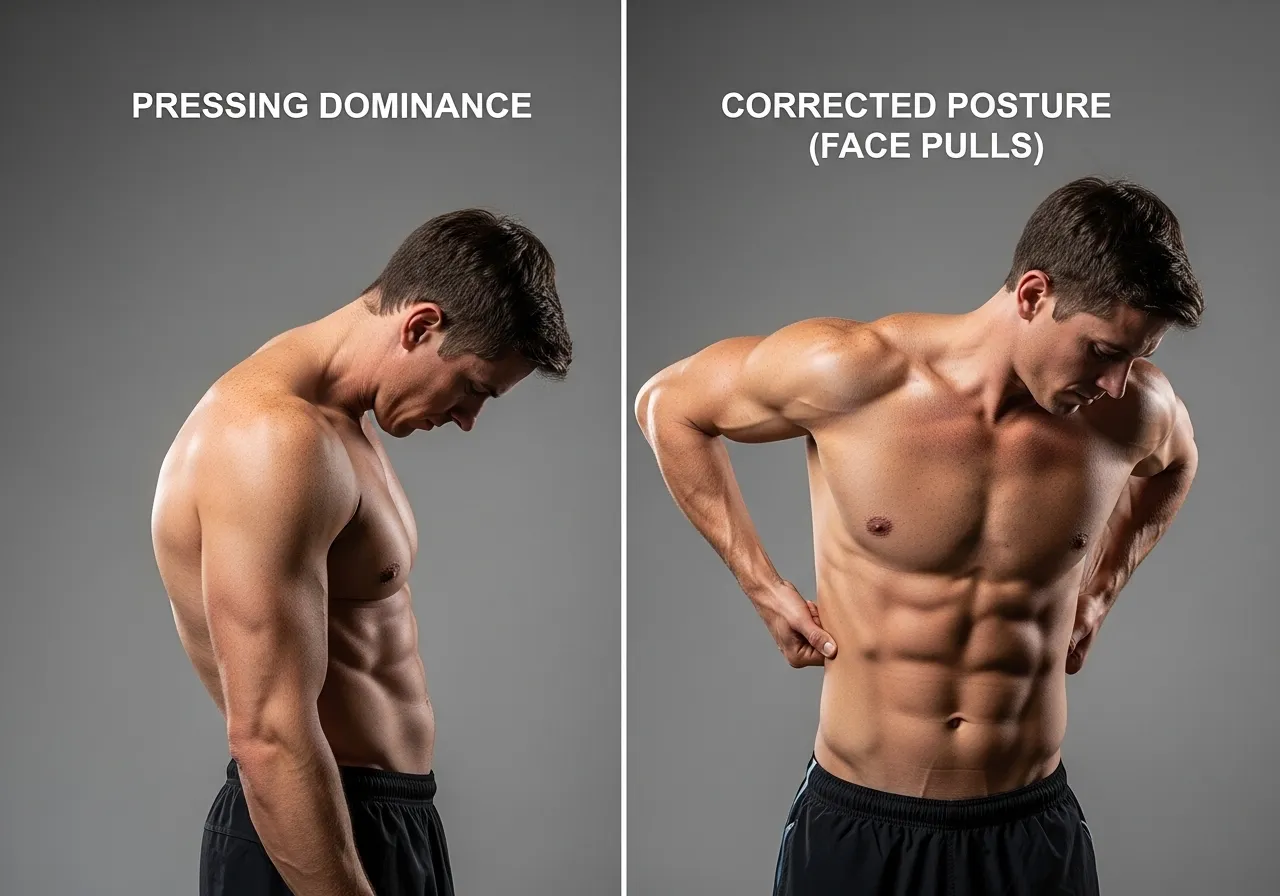
The postural adaptations of prolonged sitting and forward head positioning — forward head, rounded shoulders, protracted scapulae, internally rotated humeri — create exactly the anterior dominance and posterior weakness that face pulls correct. The combination of tight anterior structures (pectorals, anterior deltoid, subscapularis) and weak posterior structures (posterior deltoid, infraspinatus, teres minor, rhomboids, middle trapezius) that characterizes desk-worker posture is precisely the imbalance that face pull training targets. Three sets of face pulls performed before each training session, plus two sets performed daily at home with a resistance band, provide the corrective stimulus that begins reversing the postural adaptations of extended sitting within four to six weeks. The postural improvements from face pull training — reduced shoulder rounding, improved thoracic extension, better head positioning — are among the most visually noticeable training-induced changes available, motivating continued practice through the visible physical transformation that correcting years of postural adaptation produces. Physical therapists consistently prescribe face pull variations as primary corrective exercises for postural dysfunction, shoulder impingement, and rotator cuff rehabilitation — the exercise’s effectiveness in clinical populations validates its use in healthy athletes as injury prevention and performance enhancement.
The Posterior Deltoid: The Missing Piece in Most Shoulder Programs
The posterior deltoid — the rear head of the three-headed deltoid muscle — is one of the most chronically undertrained muscles in recreational gym training despite its critical role in shoulder health, posture, and the balanced shoulder development that makes the shoulder girdle appear full and three-dimensional rather than merely wide. The anterior deltoid receives substantial training stimulus from all pressing movements; the lateral deltoid receives direct training from lateral raises; but the posterior deltoid receives direct stimulus only from exercises specifically designed for it — face pulls, reverse flyes, and bent-over lateral raises. Most recreational programs that include pressing, overhead pressing, and lateral raises leave the posterior deltoid chronically understimulated relative to the anterior and lateral heads, creating the visual imbalance of forward-projecting shoulders that appear well-developed from the front but flat from the side. The face pull’s combination of horizontal pulling and external rotation places the posterior deltoid in its most mechanically advantaged position — shoulder abduction combined with external rotation at approximately ninety degrees of elevation — producing the most effective posterior deltoid stimulus of any common gym exercise. Research comparing posterior deltoid activation across exercises finds that the face pull with high elbow position consistently ranks among the highest activators of the posterior deltoid, explaining its consistent recommendation from coaches who specialize in both shoulder aesthetics and shoulder health. EMG research on shoulder muscle activation confirms the face pull’s superior posterior deltoid activation compared to most alternative posterior shoulder exercises at equivalent relative intensities.
The combination of cable face pull technique mastery and consistent programming — high frequency, moderate load, attention to external rotation quality — produces the posterior shoulder development that transforms both shoulder aesthetics and shoulder health simultaneously. The exercise rewards investment in technical quality with returns that compound across years of consistent practice into lasting physical capability.
Why Your Shoulders Are Hurting and How Face Pulls Fix It
The Anterior Dominance Problem
Standard gym programming overwhelmingly develops the anterior (front) side of the shoulder: bench press, overhead press, front raises, push-ups, and dips all heavily involve the anterior deltoid and chest while the posterior shoulder receives minimal direct loading. This imbalance gradually pulls the humeral head forward in the glenoid socket, changes the resting position of the scapula, and produces the rounded-shoulder posture that is visually ubiquitous in gym populations. Beyond aesthetics, this anterior dominance directly causes shoulder impingement — the compression of rotator cuff tendons in the subacromial space — by reducing the clearance available for shoulder elevation.
Research on shoulder impingement consistently identifies posterior shoulder weakness and internal rotation dominance as primary modifiable risk factors. Research on rotator cuff exercise and shoulder health confirms that external rotator strengthening is among the most effective interventions for reducing shoulder impingement symptoms and preventing recurrence in athletes and gym-goers.
The Scapular Component
The face pull’s high elbow position at the finish simultaneously activates the mid-trapezius and lower trapezius in scapular retraction and depression. These muscles are the primary stabilizers of the scapula against the rib cage, and their weakness produces the scapular winging and dyskinesis that contributes to shoulder impingement and rotator cuff stress under loading. Regular face pulls develop these stabilizers alongside the rotator cuff, producing comprehensive posterior shoulder health rather than isolated muscle development.
How Long Before Shoulder Pain Reduces
Most lifters with early-stage shoulder impingement related to anterior dominance report noticeable improvement within three to four weeks of consistent face pull training (three sessions per week). The mechanism: progressive strengthening of the external rotators and posterior deltoid begins correcting the muscle balance that was creating impingement, increasing subacromial clearance during shoulder elevation. Significant structural improvement — where shoulder mechanics are measurably corrected — typically takes six to twelve weeks. This timeline assumes face pulls are added alongside reduction of the pressing volume that was creating impingement, not as an addition to unchanged heavy pressing.
Quantifying Shoulder Health: The External-to-Internal Rotation Ratio
The ratio of external rotation strength to internal rotation strength — measured at ninety degrees of shoulder abduction — is one of the primary shoulder health metrics used in sports medicine. A ratio below 0.65 (external rotation less than 65% of internal rotation strength) is associated with significantly elevated shoulder injury risk in throwing athletes and in any athlete performing repetitive overhead or pressing movements. Most recreational lifters who train with pressing emphasis but without targeted external rotation work have ratios well below this threshold — bench press and overhead press develop internal rotation strength robustly while external rotation receives no direct stimulus. Measuring this ratio requires an isokinetic dynamometer in a clinical setting, but practical indicators of external rotation weakness include: difficulty maintaining the high-elbow position during face pulls with moderate load, an inability to hold the shoulder in external rotation under resistance without compensating with trunk rotation, and the characteristic forward shoulder rounding that results from internal rotation muscle dominance. Addressing this imbalance through consistent face pull training typically requires three to six months of twice-weekly training to meaningfully improve the external-to-internal rotation ratio, with both direct strength gains in the external rotators and indirect improvements from the reduced anterior shortening that external rotation development facilitates. Research on external-to-internal rotation ratio and shoulder injury confirms that athletes with ratios below 0.65 have two to three times higher shoulder injury rates than those with balanced ratios, validating external rotation training as a clinically significant injury prevention intervention.
Integrating Face Pulls Into a Complete Shoulder Health Program
Face pulls are most effective as part of a comprehensive shoulder health program that addresses all dimensions of shoulder function rather than as an isolated corrective exercise. A complete shoulder health program includes: face pulls for external rotation and scapular retraction (three sets of fifteen, performed before pressing sessions); band pull-aparts for additional external rotation and scapular retraction development (two sets of twenty, performed as part of the pre-session warm-up); serratus anterior activation through push-up plus movements (two sets of twelve, maintaining the “plus” protracted position at the top of each repetition); and thoracic extension mobility work (foam roller extension, thoracic rotation stretching) to maintain the thoracic mobility that allows the shoulder to move through its full range without compensating at the lumbar spine. This four-component program addresses the full collection of posterior shoulder weaknesses and mobility limitations that pressing-dominant training creates, taking fifteen to twenty minutes before pressing sessions. Athletes who consistently implement this program report dramatic reductions in pressing-related shoulder discomfort within six to eight weeks, with continued shoulder health improvements throughout months and years of subsequent training. The time investment of twenty minutes before pressing sessions prevents the injury rehabilitation periods that can last months and the permanent shoulder dysfunction that untreated impingement progressively creates — making the prevention investment dramatically more valuable than the treatment it prevents.
Face Pull Warm-Up Protocol for Every Pressing Session
A standardized face pull warm-up protocol before every pressing session represents the most reliable injury prevention investment available in gym training. The protocol: fifteen to twenty reps of band face pulls at very light resistance (the goal is activation, not training stimulus) with deliberate attention to external rotation at the end of each rep; followed by ten reps of band pull-aparts; followed by ten reps of a shoulder circle (arms extended, drawing large circles in each direction) to assess current shoulder range and comfort. This three-exercise, five-minute sequence activates the posterior rotator cuff and scapular stabilizers before the pressing session imposes anterior loading, ensuring that the posterior chain is awake and contributing to shoulder mechanics rather than passively allowing the anterior structures to dominate from the first pressing rep. Athletes who consistently perform this warm-up report that pressing sessions feel smoother from the first warm-up set, with better shoulder positioning and reduced anterior shoulder discomfort — confirming that the activation state of the posterior chain at the session’s start meaningfully affects pressing mechanics throughout the session. The five-minute investment in this warm-up protocol is directly proportional in value to the pressing volume that follows — a five-minute warm-up before sixty minutes of pressing work has a higher return on time invested than almost any other five-minute training decision available. ACSM warm-up guidelines support sport-specific activation exercises as the most evidence-based approach to preparing specific muscle groups for the demands of subsequent training, validating the face pull warm-up protocol as physiologically appropriate shoulder preparation before pressing sessions.
Consistent face pull practice — beginning each pressing session with the face pull warm-up sequence and maintaining the twice-weekly standalone sessions — is the single highest-leverage shoulder health intervention available in standard gym training. Its combination of external rotation development, posterior deltoid training, and scapular chain activation makes it the exercise that protects everything else you train from the shoulder injuries that end training careers prematurely.
Programming Face Pulls: Where and How Often
Frequency: The More the Better Within Reason
Unlike the primary compound movements that require 48 to 72 hours of recovery, face pulls can be performed daily without recovery concerns because the loading is light and the muscles trained have high endurance capacity. Many experienced lifters perform face pulls in every upper body session, accumulating 6 to 9 sets per week. For shoulder health maintenance, 2 to 3 sessions per week of 3 sets each provides adequate stimulus. For shoulder health rehabilitation alongside impingement symptoms, daily face pulls at low intensity (2 sets of 20 reps at moderate weight) accelerates the correction process without overloading recovering tissues.
Where in the Session
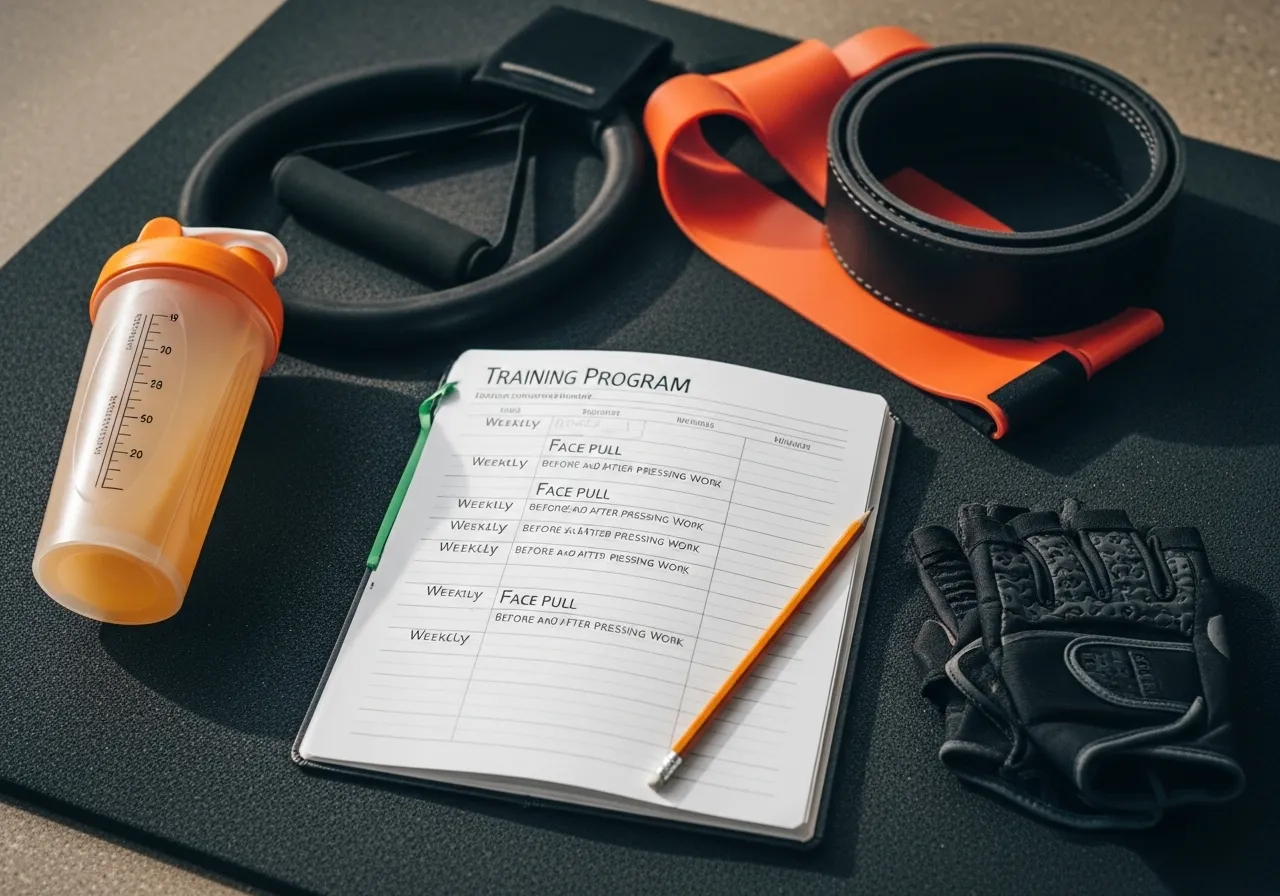
Face pulls before pressing: performing 2 sets of face pulls as part of the pressing warm-up activates the posterior shoulder and external rotators before the heavy anterior-dominant pressing begins. This pre-activation reduces the neural dominance of anterior shoulder muscles during pressing and improves the balance of forces around the shoulder joint during the session. Many lifters report that their pressing feels more stable and their shoulder is more comfortable during the session when face pulls precede it. Face pulls after pressing: adding face pulls as the first accessory exercise after primary pressing ensures the posterior shoulder work occurs in every pressing session, accumulating the consistent volume that shoulder health requires. Both approaches work — the most consistent implementation for your schedule is the correct choice.
Combining With Other Shoulder Health Exercises
Face pulls are most effective as part of a shoulder health approach that also includes: band pull-aparts (2 sets of 25 daily, providing additional posterior deltoid and rhomboid activation), external rotation exercises (cable or band, developing the infraspinatus and teres minor specifically), and rear delt flyes (dumbbell or cable, isolating the posterior deltoid). Together, these four exercises provide comprehensive posterior shoulder development that counteracts the anterior dominance of all pressing activity. ACSM resistance training guidelines recommend balanced anterior and posterior shoulder training as part of a comprehensive resistance training program for long-term shoulder health.
Advanced Face Pull Programming: Periodization and Progression
Unlike primary strength exercises that benefit from heavy loading and systematic load progression, face pulls respond best to moderate loads, high reps, and attention to technique quality rather than maximum weight. The progressive element in face pull training is not load but technique refinement — progressively improving the quality of external rotation at the end range, the consistency of scapular retraction throughout the movement, and the ability to maintain the high-elbow position without trunk compensation as fatigue accumulates. Loading progression is appropriate but should follow technique mastery — add resistance only when the current load can be performed with complete control of all technique elements for the full prescribed rep range. Face pull volume can be periodized in relation to pressing volume: during high-volume pressing phases (increased bench press frequency or intensity), face pull volume should increase proportionally to maintain the balance between anterior and posterior development. During deload phases from pressing, face pull volume can be maintained at baseline since they impose minimal recovery demand. Research on shoulder health in strength athletes confirms that maintaining a ratio of approximately one set of horizontal pulling (rows, face pulls) for every set of horizontal pressing (bench press, chest flies) is associated with lower rates of shoulder injury and better long-term shoulder function than pressing-dominant programs that neglect horizontal pulling. NSCA shoulder health programming guidelines support this balanced approach as the most evidence-supported strategy for maintaining shoulder health in athletes who perform significant pressing volumes.
Face Pulls for Overhead Athletes: Specific Applications
Overhead athletes — baseball pitchers, tennis players, swimmers, volleyball players — have the highest shoulder injury rates of any athletic population because their sports create extreme rotator cuff demands during throwing, striking, and overhead reaching movements. The external rotation deceleration forces during the follow-through of a pitch exceed the maximum isometric strength of the infraspinatus and teres minor in many overhead athletes, explaining why rotator cuff tears occur most commonly at the deceleration phase of throwing motions. Face pull training for overhead athletes specifically targets the infraspinatus and teres minor deceleration capacity — the ability to eccentrically resist external rotation through the late cocking to follow-through phase of overhead movements. Programming face pulls at slow eccentric tempos (three to four seconds lowering) and at end-range positions (holding the fully externally rotated position for two to three seconds) develops the specific deceleration capacity that overhead throwing demands. Research on rotator cuff training in overhead athletes confirms that external rotation strength training — particularly eccentric and end-range training — significantly reduces throwing arm injury rates compared to programs that neglect posterior rotator cuff development. The face pull, performed with attention to end-range quality and eccentric control, is the most practical external rotation development exercise available for overhead athletes training in standard gym environments without specialized equipment.
The Evidence for Face Pulls: What Research Actually Shows
EMG research comparing posterior shoulder muscle activation across common gym exercises consistently places the face pull among the highest activators of the infraspinatus, teres minor, and posterior deltoid when performed with correct external rotation emphasis. A 2013 study comparing shoulder exercises found that the face pull with external rotation produced significantly greater infraspinatus and teres minor activation than lateral raises, reverse flyes, or band pull-aparts at equivalent relative intensities — the exercises that are most commonly prescribed for posterior shoulder development. The key differentiator is the combination of shoulder abduction and external rotation that the face pull provides simultaneously, which loads the external rotators through their combined function rather than in isolation. Research also demonstrates that the face pull’s scapular retraction component activates the middle trapezius at rates comparable to specific middle trapezius exercises like the prone Y-raise, making it one of the few exercises that simultaneously develops both the rotator cuff external rotators and the scapular retractors in a single movement. This combination efficiency — developing multiple posterior shoulder chain components simultaneously — is why coaches who specialize in shoulder health consistently recommend the face pull as a primary exercise rather than a supplementary accessory. According to EMG research on shoulder exercises and muscle activation, face pulls with external rotation emphasis produce among the highest posterior rotator cuff activation of any common gym exercise, validating their specific application for shoulder health and injury prevention.
Face Pull Alternatives When Cable Equipment Is Unavailable
The band face pull provides the most direct alternative to cable face pulls for home training or travel contexts. A resistance band anchored at face height — around a door frame, a rack post, or any fixed point at shoulder height — replicates the cable’s resistance profile with reasonable accuracy. The key technique difference: band resistance increases progressively through the pulling range rather than remaining constant as cable resistance does, which means the end range (fully externally rotated position) receives higher resistance than the mid-range. This is actually advantageous for the face pull’s specific purpose, as the end range is where external rotation development is most valuable and the increased resistance at that position provides greater s
The Face Pull’s Role in Longevity of Pressing Performance
The most compelling argument for consistent face pull training is not aesthetic or performance-related but longevity-related — the ability to continue pressing heavy for decades rather than suffering the shoulder injuries that end heavy pressing careers prematurely. Research on shoulder injury in long-term strength athletes finds that the athletes who maintain heavy pressing performance into their fifties and sixties universally incorporate posterior chain shoulder work throughout their training careers, while those who develop career-limiting shoulder injuries typically have programs that neglected posterior chain development in favor of maximum pressing volume. The face pull is the single exercise most consistently present in the programs of lifters who maintain shoulder health across decades of heavy training — not because it is magic, but because it develops the specific posterior structures that prevent the anterior dominance from becoming the structural imbalance that produces impingement and tears. Investing fifteen minutes per week in face pulls and shoulder health work across a training career prevents the months-long shoulder rehabilitation interruptions and the permanent performance limitations that neglected shoulder health produces. The arithmetic is unambiguous — preventing one six-month shoulder rehabilitation period through consistent face pull practice saves more than ten years of face pull time investment. This longevity perspective, rather than any immediate performance argument, is the most convincing case for making the face pull a permanent fixture in any serious strength training program. ACSM long-term athletic development guidelines consistently identify injury prevention as the primary determinant of long-term athletic development outcomes, validating the longevity argument for posterior chain shoulder training as the highest-priority investment in sustainable pressing performance.
The face pull rewards patience with returns that no other shoulder exercise provides — the posterior deltoid development, external rotation strength, and scapular stability that compound across months of consistent practice into a shoulder that is simultaneously more developed, more resilient, and more capable than the pressing-only shoulder that most athletes develop without this critical balance.
Face Pulls for Athletes: Sport-Specific Applications
For Throwing Athletes
Baseball pitchers, quarterbacks, tennis players, and javelin throwers subject the shoulder to enormous deceleration forces during the follow-through phase of throwing. The posterior shoulder and external rotators must absorb the braking force that stops the arm after ball release — forces that are multiples of body weight applied to a relatively small muscle group. Posterior shoulder weakness in throwing athletes is a primary mechanism of rotator cuff injuries from accumulated high-speed throws. Face pulls performed consistently year-round build the posterior shoulder resilience that withstands the deceleration demands of high-velocity throwing.
For Swimmers
Swimmer’s shoulder — the most common swimming overuse injury — results from the repetitive overhead internal rotation patterns of freestyle and butterfly stroke combined with the repetitive impingement that occurs at shoulder elevation during the catch phase. The same anterior dominance and posterior shoulder weakness that affects pressing-focused gym athletes affects swimmers, except at much higher repetition volumes. Face pulls are a standard component of shoulder injury prevention programs for competitive swimmers, providing the external rotation and posterior deltoid strengthening that counteracts the swimming stroke’s internal rotation demands.
Frequently Asked Questions About Face Pulls
Can I do face pulls with a resistance band instead of a cable? Yes — band face pulls are fully effective and are the best option for home training. Anchor the band at approximately face height around a door frame or post. The mechanics are identical to cable face pulls. The limitation is that band resistance increases toward the end of the pull (at maximum external rotation), which actually enhances the training stimulus for external rotation compared to cable resistance, which remains constant. Band face pulls are not inferior to cable face pulls for shoulder health purposes.
How do I know if I am doing face pulls correctly? After a set of face pulls, you should feel the muscles between and above your shoulder blades (mid-trapezius, rear deltoid, and the back of the shoulder) worked, not the muscles on top of the shoulder (upper trapezius) or in the arms (biceps). If you primarily feel the upper trapezius, your elbows are too low at the finish. If you primarily feel the biceps, you are pulling too much with elbow flexion rather than shoulder horizontal abduction and external rotation. Adjust elbow height upward and focus on the external rotation component until the posterior shoulder becomes the primary sensation.
I don’t have access to a cable machine. What alternatives work? Band face pulls as described above. Dumbbell rear delt flyes (lying face down on an incline bench, raising dumbbells out to the sides with a slight external rotation at the top). Band pull-aparts. Each of these trains the posterior deltoid and mid-trapezius with varying emphasis on the external rotation component. For the external rotator-specific training that face pulls provide, band external rotation (arm at 90 degrees, rotating against band resistance) provides the most direct substitute.
My shoulders click or grind during face pulls. Should I stop? Clicking without pain is usually normal joint cavitation — gas bubble release that is harmless. Grinding sensations are more concerning and may indicate mechanical issues within the shoulder joint. Clicking or grinding accompanied by pain warrants cessation and evaluation by a physiotherapist before continuing. Asymptomatic clicking alone is not a reason to stop performing face pulls and often reduces or resolves as the posterior shoulder strengthens and the shoulder mechanics improve through consistent training.
Programming Face Pulls for Maximum Shoulder Health Benefit
The specific programming parameters that maximize face pull effectiveness for shoulder health differ from strength training parameters in important ways. Frequency: three to five days per week with light resistance band face pulls; two to three days per week with moderate cable resistance. Unlike strength exercises where forty-eight to seventy-two hour recovery is required, the face pull’s light-to-moderate loading and rotator cuff focus allows higher frequency without accumulating recovery debt. The rotator cuff, as a primarily stabilizing muscle group, responds well to daily low-intensity work in a way that primary strength muscles do not. Repetitions: fifteen to thirty reps per set, emphasizing the quality of the end-range external rotation rather than the weight used. High repetitions at moderate weight develop the muscle endurance that the rotator cuff requires for its stabilization function — the rotator cuff stabilizes the shoulder throughout hours of daily activity and training, requiring the endurance that low-rep heavy training does not specifically develop. Load: sixty to seventy percent of maximum for the specific exercise, selected to allow complete external rotation at the end of each rep without compensating with trunk rotation. Many athletes use too much weight on face pulls, which causes substitution patterns that reduce the specific stimulus to the external rotators and posterior deltoid. Rest: thirty to sixty seconds between sets is sufficient for the moderate intensity of face pull training, allowing high frequency without excessive session duration. ACSM rotator cuff training guidelines support high-frequency, moderate-load training for rotator cuff health and injury prevention, validating the face pull’s programming approach as physiologically appropriate for its stabilization function.
timulus. The band pull-apart — holding a resistance band at arm’s length and pulling both ends apart to touch the chest before returning — provides a second effective alternative that develops similar posterior chain muscles through a slightly different movement pattern. Three sets of twenty to twenty-five band pull-aparts as a morning warm-up or throughout the workday (one to two sets every hour during desk work) provides the daily posterior shoulder stimulus that prevents the anterior dominance accumulation from pressing and sitting. For anyone without gym access, these band alternatives provide sufficient posterior shoulder development to maintain the muscle balance that prevents impingement and maintains shoulder health across training years without requiring cable equipment. NSCA home training guidelines support resistance band training as an effective alternative to cable-based exercises for posterior shoulder chain development when gym access is limited.
Face Pulls for Youth and Adolescent Athletes
The growing demand for youth sports participation and the associated increase in youth overhead sport injuries (particularly in baseball, volleyball, and swimming) has made posterior shoulder training increasingly important in youth athletic development programs. The face pull, performed with resistance bands at appropriate resistance levels, is a safe and effective posterior shoulder development exercise for adolescent athletes who are beginning to accumulate overhead sport training loads. Youth athletes who establish the face pull habit early — as a pre-practice warm-up or in conjunction with sport-specific training — develop the posterior shoulder chain that protects against the rotator cuff stress of high-volume overhead sport training. The exercise’s low injury risk (light loads, natural movement pattern, no joint compression) makes it appropriate for athletes as young as twelve to fourteen years who are beginning serious overhead sport training. Research on youth overhead sport injuries consistently identifies rotator cuff muscle imbalance — specifically external rotation weakness relative to internal rotation — as a primary modifiable risk factor, validating early intervention with external rotation training programs that include the face pull as a central component. Beginning face pull training before overhead sport injuries develop is dramatically more effective than beginning rehabilitation after they occur, making youth athlete programs that include this exercise from the start the most evidence-supported approach to long-term overhead athlete shoulder health.
Face Pull in the Context of a Balanced Upper Body Program
The face pull earns its place in a balanced upper body program by providing the specific posterior shoulder stimulus that no other common exercise adequately delivers. A complete upper body program for intermediate athletes: two pressing sessions per week (bench press and overhead press as primary movements), two pulling sessions per week (lat pulldown or pull-up and seated cable row as primary movements), and face pulls performed before every pressing session and as a standalone corrective exercise twice per week on non-pressing days. This structure ensures the posterior shoulder chain receives stimulus six days per week through varying combinations of face pulls, rows, and pull-ups — the balance of frequency and volume that maintains healthy pushing-to-pulling ratios across the training week. Reducing face pulls to once or twice per week as a pure accessory exercise produces some benefit but falls short of the consistent posterior chain stimulus that prevents the anterior dominance accumulation that aggressive pressing schedules create. The six-day-per-week posterior chain stimulus, achieved through the combination of face pulls and pulling exercises in a balanced program, represents the maintenance dose that keeps the shoulder girdle healthy across years of ambitious pressing development. According to research on upper body muscle balance and shoulder health, maintaining adequate posterior chain stimulus relative to anterior chain training stimulus is the primary modifiable factor determining long-term shoulder health outcomes in strength training populations.
Frequently Asked Questions About Face Pulls
How much weight should I use for face pulls?
The appropriate face pull load is whatever allows complete external rotation at the end of each repetition — finishing with the hands beside the ears with elbows high and the thumbs pointing behind the head — for the full prescribed rep range without compensating by rotating the trunk or shrugging the shoulders. For most people this is significantly less weight than their intuition suggests. Many athletes who can bench press their bodyweight use only ten to twenty kilograms on face pulls, because the external rotators are not as strong as the pressing muscles and the exercise’s effectiveness depends on technique quality rather than maximum load. Starting at a weight that feels too easy and confirming that the end-range external rotation is complete before adding resistance is the correct approach. The moment the external rotation becomes incomplete or the trunk begins rotating, the weight is too heavy — reduce it rather than compromising the technique that makes the exercise effective for its specific purpose.
Can face pulls fix existing shoulder pain?
Face pulls are frequently prescribed by physical therapists and sports medicine physicians for shoulder impingement rehabilitation because they develop the posterior shoulder chain that impingement patients universally display as weak. However, shoulder pain with a specific diagnosis requires professional evaluation before beginning any specific exercise program. For confirmed anterior shoulder impingement without structural damage, face pulls typically reduce symptoms within four to six weeks of consistent practice alongside pressing technique modifications. For shoulder pain of unknown cause, rotator cuff tears, labral pathology, or AC joint dysfunction, professional evaluation is essential before beginning face pull training — some shoulder pathologies are worsened by specific movement patterns that face pulls involve. When in doubt, consult a sports medicine physician or physical therapist before beginning a face pull program specifically to address existing shoulder pain, as the diagnosis determines which specific exercises are appropriate. Journal of Orthopaedic and Sports Physical Therapy research provides comprehensive evidence on exercise therapy for shoulder impingement rehabilitation that guides clinical prescription of face pull variations for different shoulder pathologies.
Do face pulls replace rows for back development?
Face pulls and rows train overlapping but distinct muscle groups and serve different functions — they complement rather than replace each other. Rows (seated cable row, barbell row, dumbbell row) primarily develop the latissimus dorsi, rhomboids, and biceps through a large-range horizontal pulling motion with heavier loads. Face pulls primarily develop the posterior deltoid, external rotators (infraspinatus, teres minor), and upper trapezius through a shorter-range, lighter-load external rotation-focused pulling motion. The back development and strength gains from rowing cannot be replicated by face pulls, and the specific rotator cuff balance that face pulls develop cannot be adequately provided by rows. A complete upper body training program includes both — heavy rowing for back development and strength, and face pulls for shoulder health and rotator cuff balance. Attempting to replace one with the other leaves either back development (if rows are omitted) or shoulder health (if face pulls are omitted) inadequately addressed.
The Long-Term View: Building Excellence Through Consistent Practice
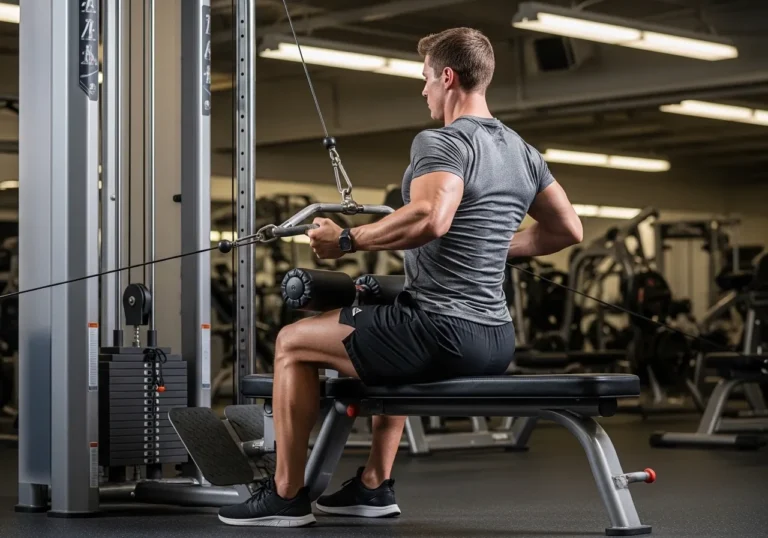
Excellence in any resistance training exercise develops through the accumulation of hundreds of high-quality training sessions rather than through any individual session breakthrough. The face pull and seated row — the two exercises most important for complete upper body development and shoulder health — reward consistent, patient practice more than almost any other gym exercise because their technique development is ongoing and the rewards of technical mastery are greatest for exercises where the difference between good and poor technique determines whether the exercise develops the intended muscles at all. An athlete who performs face pulls and seated rows with excellent technique twice per week accumulates over one hundred technique-reinforcing sessions per year — each session building the neural patterns and muscle memory that make the technique increasingly automatic and the exercises increasingly effective. Over five years, this accumulation produces the deeply ingrained movement quality that allows near-maximum loading with complete technique control, generating the development stimulus that translates into the back thickness, shoulder health, and physical capability that years of arm-dominant rows never produced. The patience required for this long-term approach is the same patience that produces all meaningful physical development — the willingness to prioritize quality over quantity, technique over load, and the consistent accumulation of excellent repetitions over the intermittent performance of impressive weights with compensated technique. According to NSCA skill acquisition research, motor pattern development in resistance training follows the same principles as skill acquisition in sport — requiring hundreds to thousands of quality repetitions to establish the automatic movement patterns that produce consistent high performance under varying conditions including fatigue, heavier loads, and competitive or high-stakes training environments.
Tracking Progress in Posterior Chain Development
Progress in face pulls, seated rows, and posterior chain development is measured differently than progress in primary strength lifts. Rather than tracking one-rep maximums, posterior chain development is best measured through: the load sustainable at fifteen to twenty reps with complete technique quality (including the external rotation quality in face pulls and the scapular initiation in rows); shoulder health indicators including reduction in anterior shoulder pain during pressing, improved posture measured by a training partner’s observation or a photo comparison across months, and reduced shoulder girdle fatigue after pressing sessions; and performance in primary lifts that depend on the posterior chain — overhead press stability, deadlift grip endurance, and barbell row strength all benefit from well-developed posterior shoulder chain, providing indirect progress indicators. The most reliable overall progress indicator: repeating the technique evaluation process described for each exercise every three to four months and assessing whether the technique errors identified earlier have been resolved. Improvements in technique quality, even without proportional load increases, represent genuine neural and muscular development in the posterior chain that accumulates into meaningful physical development across months and years of consistent practice. Research on technique-based progress measurement in resistance training validates the use of technique quality as a primary progress metric for exercises where technique determines stimulus effectiveness more than load magnitude.
The face pull stands alone as the exercise that most directly addresses the specific posterior shoulder weakness that pressing-dominant training creates. No other single exercise provides the combination of external rotation development, posterior deltoid training, and scapular retractor activation that makes the face pull uniquely irreplaceable in any program that includes significant pressing volume. Adding it consistently, performed with the technique quality that makes it effective rather than the arm-dominant execution that most people use, transforms shoulder health outcomes within months and protects pressing performance for decades.
Building the Face Pull Habit: Making Shoulder Health Automatic
The most effective face pull programming is the programming that is consistently executed — meaning the exercise should be positioned in the training session where it is most reliably performed rather than where it is theoretically optimal. Pre-session placement (performed as part of the warm-up before any pressing) ensures it is performed on every session regardless of time pressure, because the warm-up is completed before fatigue accumulates and before the temptation to skip accessory work arises. Post-session placement risks being skipped when sessions run long or fatigue reduces motivation for additional work. The habit framing — treating face pulls as mandatory shoulder maintenance rather than optional accessory work — produces better adherence than treating them as supplementary exercises that can be skipped when time is short. Many elite coaches who work with heavy pressing athletes implement this mandatory framing explicitly: no pressing session begins without the face pull warm-up, creating a conditioned association between pressing and shoulder health work that becomes automatic over months of consistent practice. Developing this automatic association — where preparing to press automatically triggers shoulder health preparation — produces the most reliable long-term face pull adherence and, consequently, the most consistent shoulder health outcomes across years of heavy training. The ten minutes spent on face pulls and shoulder health work before each pressing session is not ten minutes removed from productive training — it is ten minutes that protect the shoulder health that makes all subsequent pressing training possible and sustainable across a long training career.
Face Pull Mastery: The Six-Month Development Timeline
Setting realistic expectations for face pull development prevents the frustration that comes from expecting immediate results from an exercise that requires technique development before it delivers its full benefit. Month one: establishing the correct setup (rope attachment at face height, standing back to create tension, elbows high), learning to pull toward the face rather than toward the chest, and beginning to develop the external rotation at the end position. Most athletes feel the exercise primarily in the arms during this phase — this is normal and improves with technique development. Month two: reducing load by twenty percent to allow deliberate practice of external rotation quality, developing the sensation of the posterior deltoid and infraspinatus contracting at the end range. The exercise begins feeling less like an arm exercise and more like a shoulder exercise. Month three: adding the scapular retraction emphasis to the existing external rotation quality, feeling the rhomboids and middle trapezius contributing to the movement. Load can begin increasing again as technique becomes more automatic. Months four through six: technique becomes automatic at moderate loads, allowing progressive load increases while maintaining technique quality. The posterior shoulder begins showing visible development — rounder rear deltoid, improved shoulder positioning at rest, reduced anterior shoulder discomfort during pressing. By month six, the face pull has become a genuinely effective posterior shoulder development exercise rather than the ineffective arm exercise it was in month one, demonstrating the patience-rewards relationship that characterizes all technique-dependent training. NSCA motor learning guidelines support the six-month timeline for establishing automatic technique in complex multi-joint exercises, validating the patience required for face pull technique development.
Face Pulls as a Daily Practice: Beyond the Training Session
The face pull’s light loading and specific muscle target make it one of the few resistance exercises appropriate for daily practice, including on rest days from main training. A set of twenty band face pulls performed two to three times throughout a desk workday — once in the morning, once at midday, once in the afternoon — provides continuous activation of the posterior shoulder chain that counteracts the sustained anterior dominance of sitting and screen work. This daily practice approach treats face pulls as maintenance rather than training — similar to how physical therapists prescribe corrective exercises for daily use rather than only on training days. The cumulative effect of daily band face pulls alongside the more intensive cable face pull training sessions is dramatically greater than training-only face pulls, because the daily activation frequency maintains the posterior chain in a consistently active state rather than allowing it to return to the passive, inhibited state that prolonged sitting reinforces. Athletes who implement daily band face pull practice alongside their regular training consistently report the fastest shoulder health improvements of any face pull programming approach — the combination of maintenance frequency and training intensity provides the stimulus volume that isolated twice-weekly cable sessions alone cannot match. The practical logistics are minimal: a resistance band hung over a door handle provides instant access to face pull training anywhere with a door, requiring no gym access and fitting into any schedule gap throughout the day.
The face pull is one of the rare exercises where doing less (lighter load, more reps, greater technique focus) produces more (better posterior chain development, greater injury prevention, longer-term pressing sustainability). Resist the temptation to load it like a strength exercise and treat it instead as the shoulder health maintenance practice it is designed to be.
⚠️ Fitness Disclaimer: The information in this article is for general educational purposes only and does not constitute professional fitness or medical advice. Exercise carries inherent risks. Always consult a qualified healthcare professional or certified personal trainer before starting or modifying any exercise program, especially if you have a pre-existing medical condition, injury, or health…
⚠️ Fitness Disclaimer: The information in this article is for general educational purposes only and does not constitute professional fitness or medical advice. Always consult a qualified healthcare professional before starting any new exercise program, especially if you have existing injuries or medical conditions. The Lat Pulldown: The Most Underestimated Back Builder in the Gym…
⚠️ Fitness Disclaimer: The information in this article is for general educational purposes only and does not constitute professional fitness or medical advice. Always consult a qualified healthcare professional before starting any new exercise program. Why You Feel the Seated Row Everywhere Except Your Back The seated cable row is one of the most commonly…
⚠️ Fitness Disclaimer: The information in this article is for general educational purposes only and does not constitute professional fitness or medical advice. Always consult a qualified healthcare professional before starting any new exercise program, especially if you have existing injuries or medical conditions. The Leg Press: An Honest Assessment of What It Does Well…
Warning Fitness Disclaimer: The information in this article is for general educational purposes only and does not constitute professional fitness or medical advice. Always consult a qualified healthcare professional before starting any new exercise program, especially if you have existing injuries or medical conditions. The Most Versatile Piece of Equipment in the Gym That Most…
⚠️ Fitness Disclaimer: The information in this article is for general educational purposes only and does not constitute professional fitness or medical advice. Always consult a qualified healthcare professional before starting any new exercise program, especially if you have existing injuries or medical conditions. The Exercise That Changed How I Understood Glute Training For the…