⚠️ Fitness Disclaimer: The information in this article is for general educational purposes only and does not constitute professional fitness or medical advice. Always consult a qualified healthcare professional before starting any new exercise program, especially if you have existing injuries or medical conditions.
Why the Front Squat Is the Smarter Squat for Quad Development and Athletic Performance
I added front squats to my program after a coach watched me back squat and said something that stopped me: “You squat like a hinge.” He was right — my back squat was heavily posterior-chain dominant, with significant forward lean that turned it into a quasi-deadlift. The quads were not developing proportionally, and the knee drive that athletic movements require was absent from my training. Front squats fixed both problems within eight weeks.
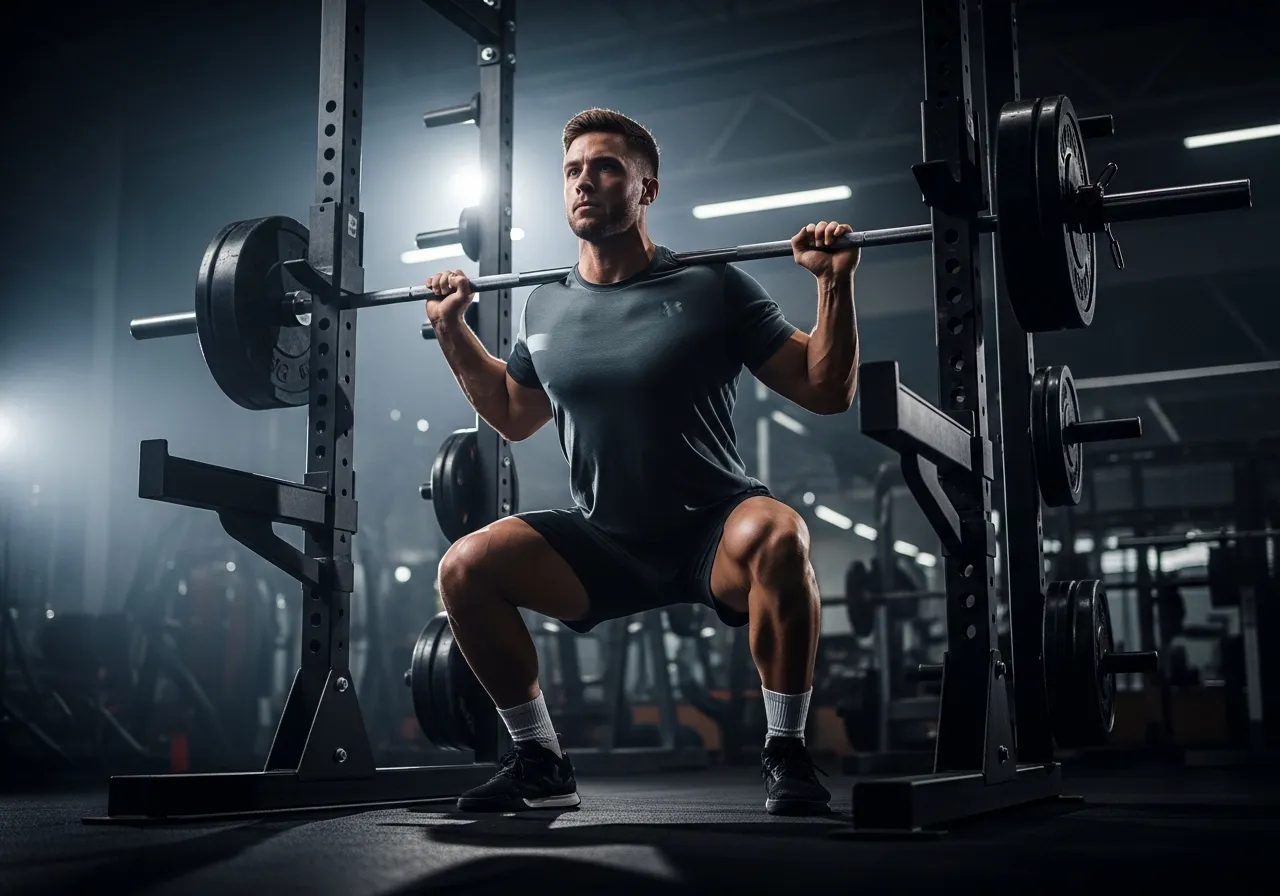
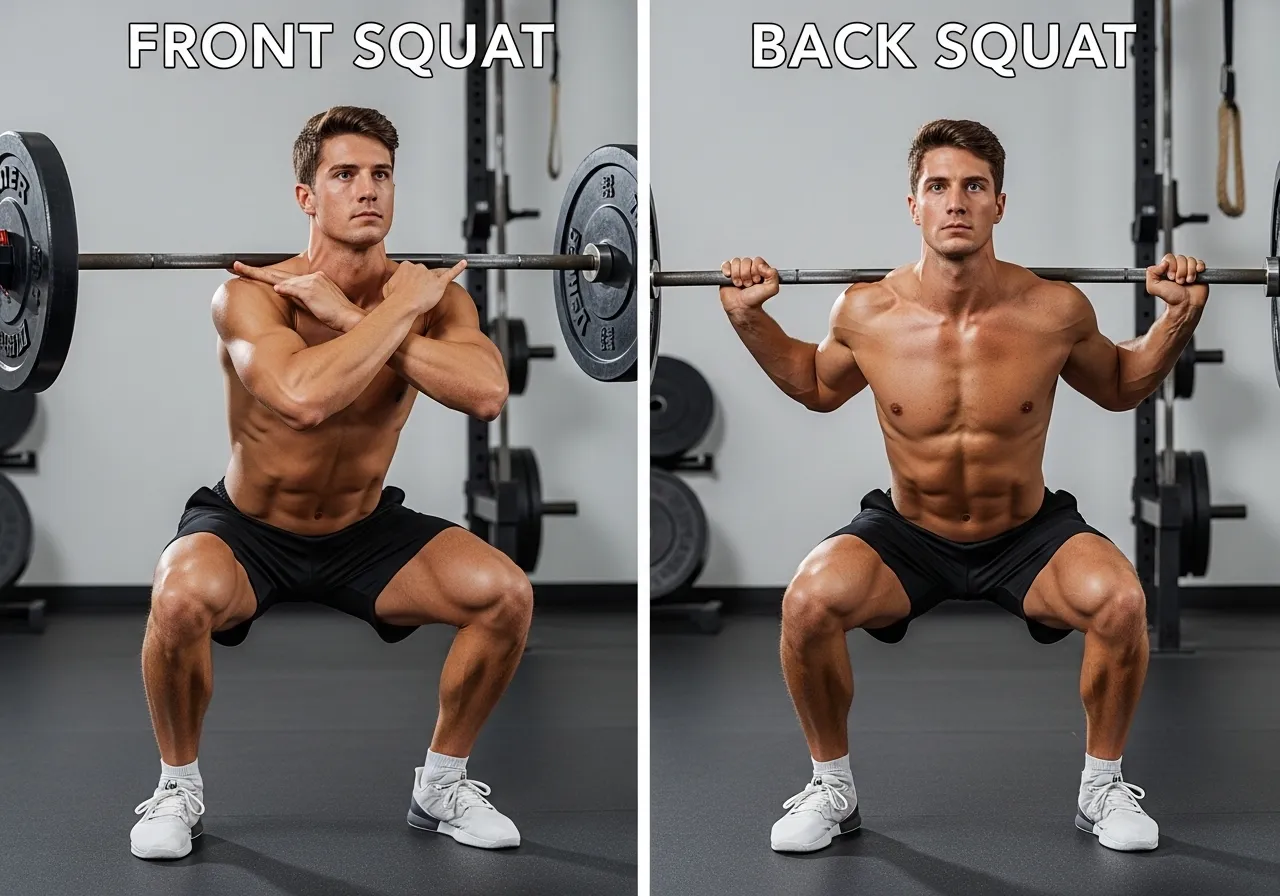
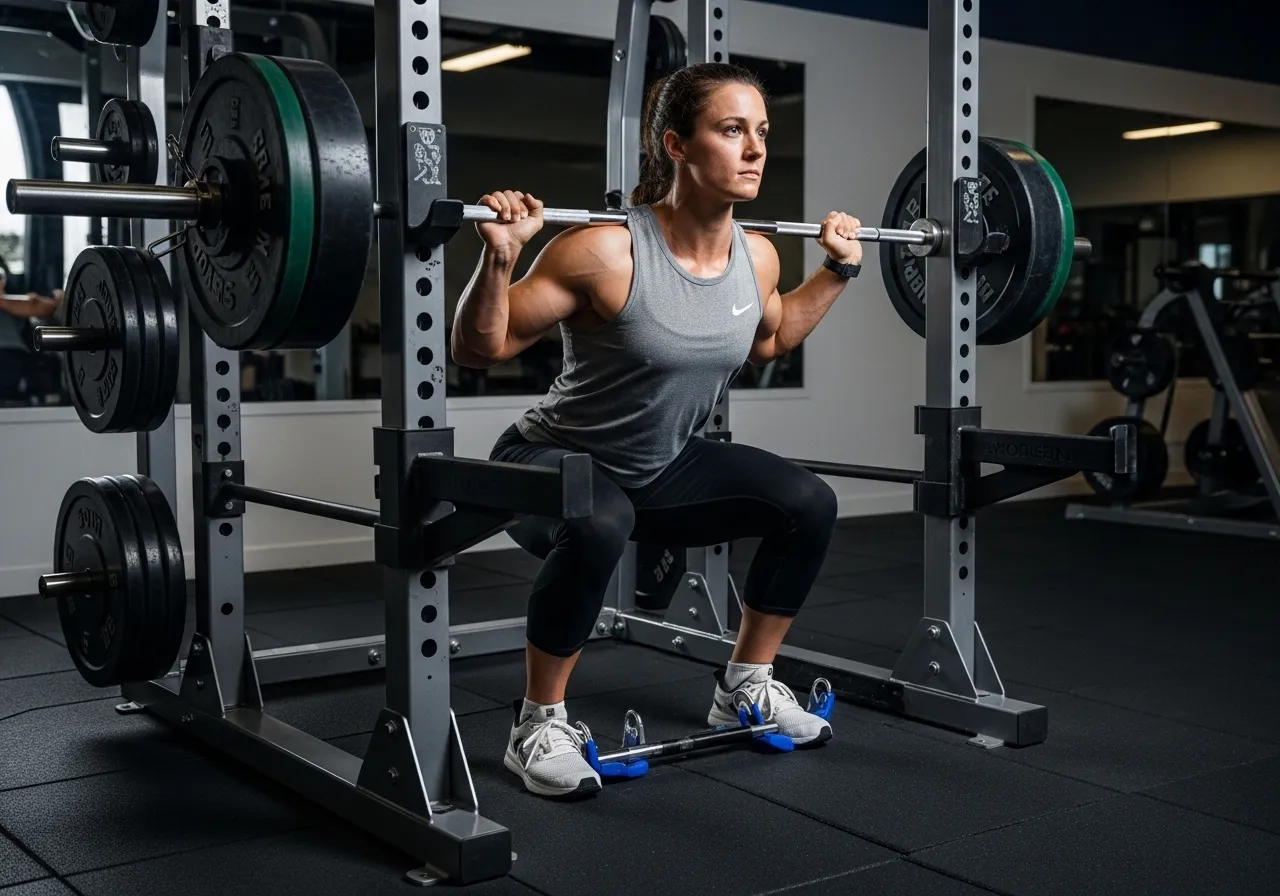
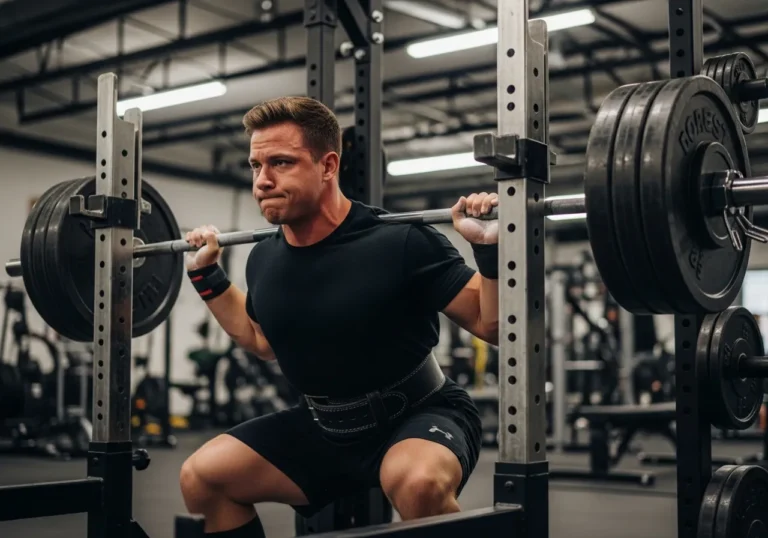
The front squat positions the barbell across the front deltoids and clavicles rather than on the upper back. This seemingly small change in bar position fundamentally alters the mechanics of the squat: the torso must remain more upright, the knees must travel further forward, and the quadriceps bear a dramatically greater share of the load compared to the back squat. The result is a movement that develops the quads, upper back, and core simultaneously — and that transfers directly to the athletic movement patterns of sprinting, jumping, and change of direction.
The Mechanics: Why Bar Position Changes Everything
In the back squat, the bar sits behind the body’s center of mass, encouraging the hips to drive back and the torso to lean forward to keep the bar over the mid-foot. In the front squat, the bar sits in front of the center of mass. To prevent the bar from rolling off the shoulders, the lifter must maintain a vertical torso — which requires the knees to drive further forward and the quads to work harder throughout the movement. This mechanical necessity is not a technique compromise; it is the defining feature of the front squat and the reason it develops the quads differently from any posterior-chain dominant squat variation.
Quad Activation: The Research
Electromyographic studies comparing back squats and front squats find similar overall muscle activation but with meaningful differences in distribution: front squats produce higher vastus medialis and rectus femoris activation, while back squats produce higher gluteus maximus and erector spinae activation. Research comparing front and back squat mechanics confirms that front squats produce a more knee-dominant loading pattern with greater quadriceps demand and less spinal loading — making them particularly valuable for athletes who need quad development and for anyone with lower back issues that limit back squat training.
Front Squat in Olympic Weightlifting: The Essential Context
In Olympic weightlifting, the front squat is not an accessory exercise — it is the primary strength development tool for the clean. The clean’s catch position requires standing up from the bottom of a front squat while holding a barbell that has been received from a pull from the floor. An Olympic weightlifter’s front squat capacity directly determines how much weight they can clean, making the front squat as important to Olympic lifting as the bench press is to powerlifting. Elite Olympic weightlifters typically front squat 120-135% of their clean maximum, providing sufficient strength reserve to stand up from any catch position. For competitive weightlifters, front squat programming is extremely high frequency (4-6 sessions per week) at high intensity (85-100% of front squat maximum), reflecting the absolute centrality of this exercise to their competitive performance.
The front squat’s association with Olympic lifting has created a perception that it is an advanced or specialized movement not suitable for general fitness athletes. This perception is incorrect — the front squat is appropriate for any athlete who can maintain the rack position and descend to parallel with neutral spine. The technical barriers to front squatting (wrist flexibility, thoracic extension, ankle dorsiflexion) are addressable through 4-6 weeks of dedicated mobility work, and the resulting exercise is one of the most complete lower body development tools available to any gym-goer regardless of competitive aspirations.
Front Squat Load Characteristics Across Rep Ranges
The front squat’s loading characteristics differ from the back squat in ways that affect rep range selection. At maximal loads (1-3 rep maximum), the front squat’s limiting factor is typically the rack position stability rather than leg strength — the anterior chain fatigue from maintaining the upright torso under maximum load fails before the legs reach their strength limit. This makes very heavy low-rep front squat work technically demanding in a way that back squatting is not — each rep at maximum intensity requires perfect rack position maintenance throughout a fatiguing set. For this reason, many coaches prefer to work the front squat in the 3-6 rep range rather than single-rep maximums, which provides sufficient strength development stimulus while allowing better technique control across the set.
At moderate loads (6-10 reps), the front squat’s quad emphasis becomes most productive for hypertrophy — the higher rep count combined with the knee-dominant loading pattern produces metabolic stress in the quadriceps that drives muscle growth through both mechanical tension and cellular swelling mechanisms. Many bodybuilders who include front squats in their programs specifically for quad hypertrophy find that 4 sets of 8 reps at a challenging load produces more noticeable quad development than equivalent back squat volume, precisely because the front squat’s quad emphasis concentrates the growth stimulus in the intended muscle group. At high reps (12-20), the front squat becomes an excellent metabolic conditioning exercise — the full-body tension required for the rack position, combined with the quad and glute loading of the squat, creates a cardiovascular demand that transforms the movement from pure strength training into comprehensive conditioning.
The Science of Quad Dominance: Why It Matters for Injury Prevention
Quad dominance — the relative predominance of quadriceps force production over hamstring force production during dynamic movement — has important implications for knee health and injury risk. Athletes with significant quad-to-hamstring strength imbalances are at elevated risk for hamstring strains (from the hamstrings being overwhelmed by quadriceps deceleration demands during high-speed movement) and for ACL injuries (from insufficient hamstring co-contraction to protect the ACL during loading). Front squat training addresses quad dominance beneficially by developing the quadriceps specifically — not by reducing quad strength, but by improving the overall quad strength and knee joint mechanics that allow more efficient movement patterns and reduced injury risk during athletic activity.
The front squat’s knee-dominant loading pattern develops the quads through ranges of motion that protect rather than stress the ACL — the full knee flexion range trained in front squatting develops the closed-kinetic-chain quad strength that sports medicine research consistently identifies as protective against ACL injury. Contrast this with open-chain knee extension exercises (leg extension machine), which develop quad strength but in a position that places greater shear force on the ACL. The front squat provides the ACL-friendly quad development that athletic populations specifically need, making it a uniquely appropriate exercise for injury prevention in jumping, sprinting, and cutting sports where ACL injury risk is highest.
Training for Health vs Performance: Understanding the Distinction
The training demands required for health benefit and for athletic performance are dramatically different — a distinction that allows most people to achieve excellent health outcomes with far less training volume and intensity than competitive athletes require. Research on the dose-response relationship between exercise and health outcomes finds that the largest health improvements occur in the transition from sedentary to lightly active, with diminishing returns as training volume and intensity increase. The difference in cardiovascular disease risk between a completely sedentary person and one who performs 150 minutes of moderate-intensity exercise per week is enormous; the difference between 150 minutes and 300 minutes per week is meaningful but much smaller; the difference between 300 minutes and 600 minutes per week is smaller still. This diminishing returns relationship means that optimizing training for health requires far less training than optimizing for athletic performance — and that the health-focused recreational exerciser who trains 3-4 hours per week achieves most of the health benefit available from any training volume.
For people training primarily for health and quality of life rather than athletic performance, this research context provides liberating permission: the pressure to optimize every training variable, match elite training volumes, or progress to advanced techniques is not justified by health goals that can be fully achieved with consistent moderate training. The most health-promoting training practice for most people is not the most elaborate or most intense but the most consistently executed over the longest period. Establishing and maintaining a consistent moderate training practice across decades produces more cumulative health benefit than any period of intense training followed by abandonment. The exercise that is most consistently performed is the most health-promoting exercise — not the exercise that is theoretically most effective when performed optimally. This principle should guide training decisions for health-motivated individuals more than any performance optimization consideration. ACSM physical activity guidelines confirm that health-related benefits are achievable with moderate training volumes and that additional benefits from higher volumes are meaningful but incrementally smaller than the initial health gains from transitioning from sedentary to active.
Front Squat Technique: The Rack Position Is Everything
The Clean Grip (Olympic) Rack Position
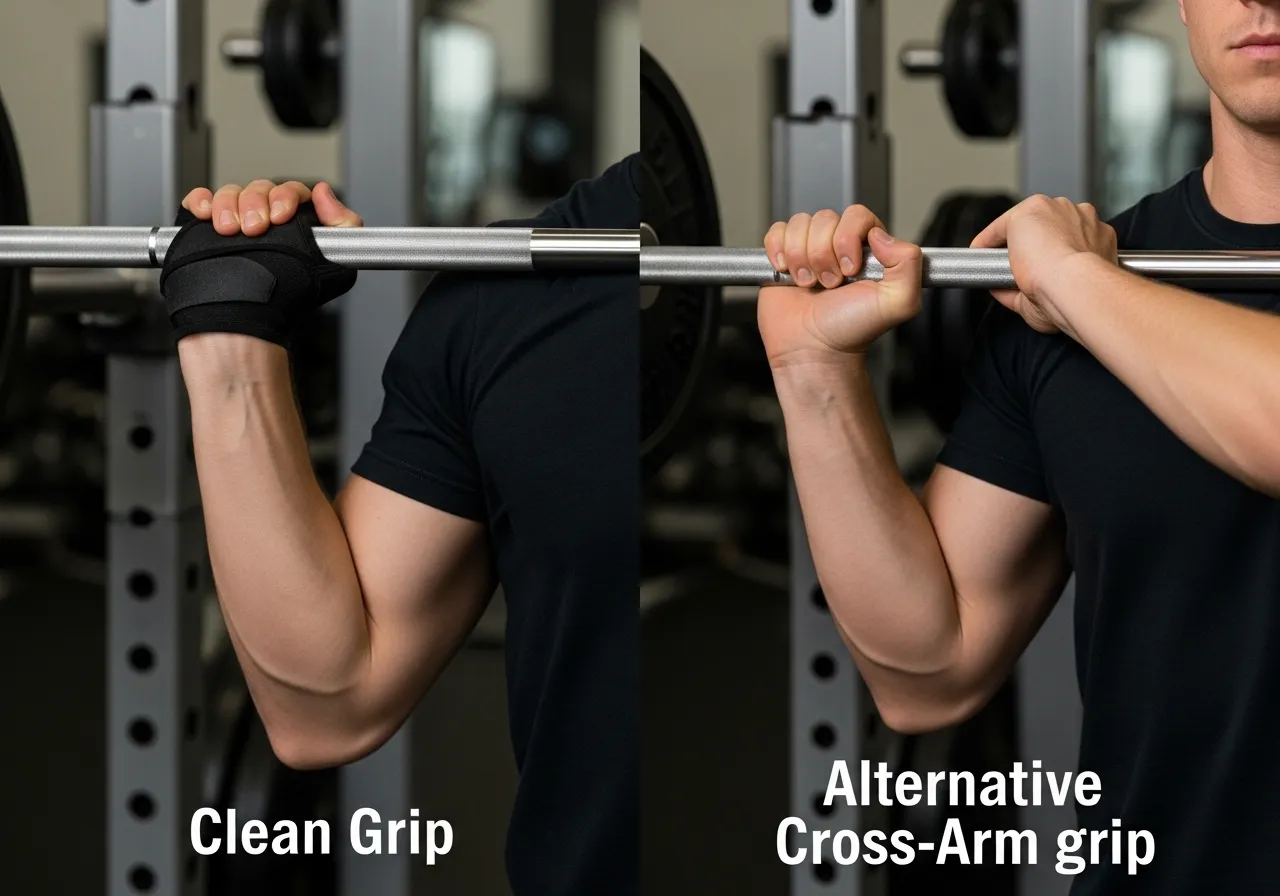
The standard front squat rack position uses a clean grip: hands inside shoulder-width, elbows driven as high as possible (parallel to the floor or higher), the bar resting on the front deltoids and the fingertips lightly supporting the bar from below. The elbows-high position is critical — when the elbows drop, the bar rolls forward off the shoulders, ending the set. Developing the wrist and shoulder flexibility for the clean grip takes weeks of consistent practice; most beginners cannot immediately achieve the elbow height required. During this adaptation period, the cross-arm grip provides a workable alternative.
The Cross-Arm Grip Alternative
Cross both arms in front of the body and grip the bar from above, with hands on the opposite-side sections of the bar. The bar rests on the same front deltoid position, but the crossed arms create a shelf that prevents the bar rolling forward without requiring wrist flexibility. The cross-arm grip allows immediate front squat training for people lacking clean grip wrist mobility and is appropriate as a permanent alternative for athletes who find the clean grip uncomfortable. The limitation: it makes adding straps or wrist wraps impossible and is slightly less stable at maximum loads.
The Descent
Initiate the front squat by pushing the knees outward in the direction of the toes (not allowing valgus collapse) and sitting straight down — not back. The upright torso means the movement feels more vertical than the back squat. Descend until the tops of the thighs are at or below parallel. Most lifters find front squatting to depth easier than back squatting because the upright torso and forward knee travel allow the pelvis to sit lower without buttwink (posterior pelvic tilt at the bottom).
Common Errors
Elbows dropping during the descent: the most common and most consequential error. Once the elbows drop, the bar rolls forward and the set is over or the lower back rounds catastrophically. Actively think “elbows up” as a cue throughout the entire set. Good mornings (torso falling forward at the bottom): indicates the quads are too weak to maintain upright posture at the sticking point. Reduce load until the torso stays vertical.
Front Squat Warm-Up Protocol for Maximum Performance
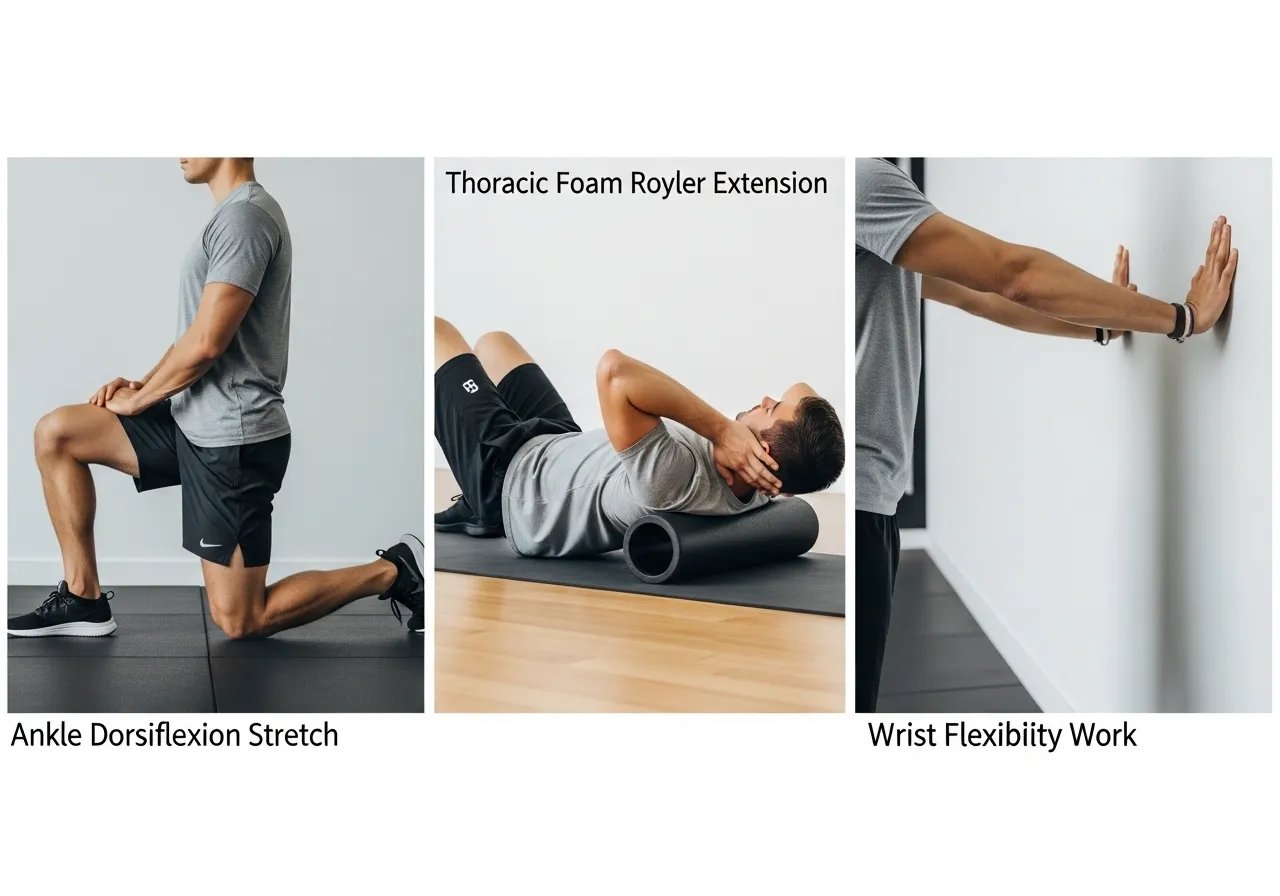
An effective front squat warm-up addresses the three most common limiting factors before working sets begin. Five minutes of thoracic mobility: foam roller extension over three positions of the mid-to-upper thoracic spine, held 30 seconds each. Seated and standing wrist stretches: 2 minutes of each wrist extended flat against the floor (kneeling) and fingers bent back against the hand (standing). Ankle mobility work: 2 minutes of wall ankle stretches (knee to wall repetitions) and calf stretching. After this mobility preparation, perform warm-up sets: empty bar 2×5 with exaggerated elbow height focus, then 40% 1RM 2×5, 60% 1RM 1×4, 75% 1RM 1×3, 85% 1RM 1×2, then working sets begin. This 15-minute preparation eliminates the technique limitations from cold joints and tight tissues that commonly cause front squat sessions to feel worse than they should, and produces consistently better performance on working sets by ensuring all range-of-motion requirements are met before loading begins.
Recognizing and Addressing Front Squat Sticking Points
Every front squat has a sticking point — the portion of the ascent where forward lean increases, bar speed slows dramatically, or where the set is most likely to be missed. Identifying the sticking point guides specific training solutions. If the sticking point is at the bottom (immediately off the bottom, first 10-15% of the ascent): the problem is typically quad weakness at the most flexed knee position, or insufficient ankle dorsiflexion preventing optimal weight distribution. Solutions: paused front squats (building strength at the sticking position), heel elevation (compensating for dorsiflexion limitation while it is addressed), and leg press at deep range to build quad strength at the limiting position. If the sticking point is mid-range (between parallel and three-quarter position): the problem is typically a hip extension strength deficit or loss of upright torso as the hips drive forward faster than the shoulders. Solutions: box squats at the sticking position height, good mornings to develop hip extensor strength, and video analysis to confirm the compensation pattern. Addressing sticking points specifically rather than generically adding front squat volume is the most efficient path to front squat development beyond intermediate levels.
Integrating the Front Squat Into Different Training Philosophies
The front squat fits into virtually any evidence-based training philosophy, though its specific role differs based on training priorities. In functional fitness and CrossFit programming, the front squat is a foundational movement trained multiple times per week, often as preparation for barbell clean work and as a standalone strength exercise. The high frequency and moderate intensity typical of CrossFit programming develops technical proficiency rapidly while managing cumulative fatigue through mixed training modalities. In traditional strength and conditioning programming, the front squat is most commonly used as a primary or secondary lower body exercise on leg day, programming 2-4 sets of 3-8 reps at 75-87% of maximum after any primary deadlift or conventional squat work. In bodybuilding programming, the front squat is used specifically for its quad emphasis, typically programmed at higher rep ranges (8-15 reps) at moderate loads to maximize metabolic stimulus and hypertrophy in the targeted muscle groups. Each of these applications reflects legitimate programming priorities and produces genuine front squat development — the optimal application depends on the overall training goal rather than any absolute hierarchy of programming approaches. What is consistent across all successful front squat programming is progressive loading over time, attention to the rack position and mobility prerequisites, and sufficient recovery between front squat sessions to allow technique and strength to develop without accumulating the overuse stress that high-frequency, high-intensity front squat programming without adequate recovery produces. NSCA programming guidelines support individualized exercise selection and periodization as the most effective approach to long-term strength development across all training populations.
Setting Realistic Training Goals and Expectations
Unrealistic training expectations — derived from fitness media, social media athletes using performance-enhancing drugs, or exceptional genetic outliers — are one of the primary causes of exercise program abandonment. When expected results don’t materialize on the timeline presented by fitness marketing, people commonly conclude that the program is ineffective, that they are personally incapable of achieving the results, or that the effort required exceeds the benefit. In most cases, the problem is not the program, the individual, or the effort — it is the expectation. Evidence-based rates of physical development are substantially slower than fitness media representations. Natural strength development: intermediate lifters gain approximately 1-3 kg of muscle per month under optimal conditions. Cardiovascular fitness improvement: VO2max improves approximately 10-15% over 8-12 weeks of consistent training. Body composition change: sustainable fat loss is approximately 0.5
Programming Front Squats: Where They Fit in Your Training
As a Primary Squat Variation
Athletes who want quad-dominant lower body strength — competitive weightlifters, cyclists, sprinters, jumpers — often make the front squat their primary squat variation and program it accordingly: 4-5 sets of 3-6 reps at 80-87% 1RM as the first exercise in a lower body session. For these populations, the front squat’s specificity to the movement patterns that matter (upright torso, knee drive, vertical force application) makes it more valuable than the back squat as the primary loaded squat.
As a Secondary Variation Alongside Back Squats
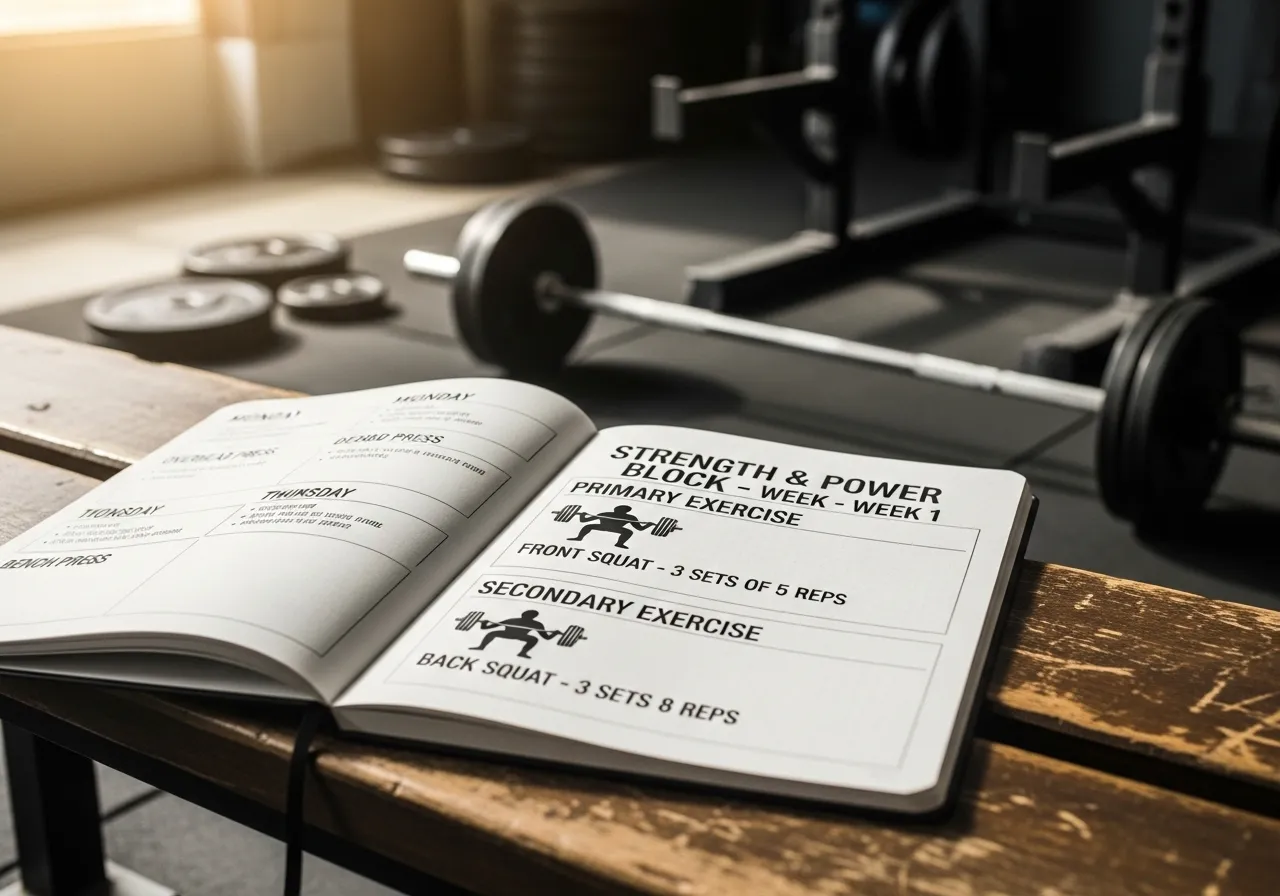
Most strength and fitness athletes benefit from treating the front squat as a secondary variation to the back squat: 3×5-8 front squat after the primary back squat work, or on a separate lower body day. This approach uses the back squat’s loading advantage for overall strength development while adding the front squat’s quad emphasis and upper back demand to fill the developmental gaps that back squatting alone creates.
Front Squat Loading Relative to Back Squat
Most intermediate lifters front squat approximately 80-85% of their back squat maximum. A lifter back squatting 140 kg should expect to work front squats around 110-120 kg. If the gap is much larger — front squat below 70% of back squat — it typically indicates either poor rack position technique or significant quad weakness relative to posterior chain strength. Addressing front squat technique and increasing quad-specific volume will close this gap over time.
Paused Front Squat: The Most Effective Accessory
Adding a 2-3 second pause at the bottom of the front squat dramatically increases the training stimulus per set by eliminating the stretch-shortening cycle assistance that makes the transition from descent to ascent easier. Paused front squats develop the quad strength at the most mechanically disadvantaged position of the squat — the bottom — where most squat failures occur. Program 3×3-5 paused front squats at 70-75% of regular front squat 1RM as an accessory after primary squat work.
Front Squat Safety: Managing the Dropped Bar Risk
One of the practical obstacles to front squatting is the concern about what happens if the weight is too heavy to complete the lift. Unlike the back squat, where safeties can catch a barbell lowered backward, the front squat’s bar position in front of the body means the bar will fall forward if the lift fails — potentially onto the lifter or bystanders. Managing this risk requires understanding the correct bail technique. When a front squat is going to fail, the lifter should allow the elbows to drop, which rolls the bar forward and downward off the shoulders — this should be practiced deliberately at light weights before attempting heavy front squats. The bar drops in front of the body, and the lifter steps backward. Performing front squats in a power rack with safety pins set at parallel depth provides complete protection — if the bail fails, the bar lands on the safeties rather than on the floor or the lifter. Until the bail technique is practiced and automatic, front squats should always be performed in a rack with safeties set, regardless of the weight being used.
The psychological barrier of potential bar dropping also resolves with dedicated bail practice. Lifters who have deliberately practiced dropping the bar in a controlled setting — feeling and understanding exactly what happens — approach heavy front squatting with significantly less anxiety than those who have never experienced a deliberate bail. This psychological confidence allows better performance on working sets by eliminating the tentative execution that fear of dropping the bar produces. Most experienced front squatters describe the front squat bail as far less dramatic than anticipated once it has been practiced — the bar rolls forward cleanly with minimal effort when the elbows drop, and the lifter simply steps back from the bar on the floor or pins.
Front Squat Programming for the Long Term: Years, Not Weeks
The front squat rewards patient, long-term development more than almost any other exercise. The technical demands — rack position, upright torso, ankle and hip mobility — require months of consistent practice before they become automatic. The strength development — quad and glute strength through the knee-dominant squat pattern — compounds over years of progressive loading. And the mobility development — thoracic extension, wrist flexibility, ankle dorsiflexion — continues improving for as long as the exercise is practiced regularly. A lifter who begins front squatting at 60 kg and commits to the exercise for three years, applying consistent progressive overload and addressing the mobility requirements that emerge at each load level, can reasonably expect to develop a 120-140 kg front squat — a strength level that represents elite status for most gym populations and a level of athletic development that transfers broadly to sport and function. The key is treating the front squat as a permanent fixture in the program rather than a temporary specialization phase, developing the exercise’s technical and strength demands simultaneously over the long timelines that meaningful progress in complex exercises requires.
Understanding Knee Valgus in the Front Squat
Knee valgus — the inward collapse of the knees during the squat descent and ascent — is one of the most commonly observed technique errors in front squatting and one of the most important to address. Valgus collapse occurs when the hip abductors are insufficiently strong to maintain femoral alignment as the hips flex and extend under load, and it places excessive medial knee stress that accumulates into overuse injury with repeated heavy loading. The front squat’s knee-forward positioning actually increases the leverage at which valgus forces act on the knee compared to more hip-dominant squat variations, making valgus correction particularly important in front squat technique.
Addressing valgus: adding a light resistance band just above the knees during front squat warm-up sets provides external cueing that activates the hip abductors to resist the band’s inward pull. Clamshell exercises and lateral band walks before front squatting activate the gluteus medius — the primary hip abductor responsible for knee alignment — improving its tone and activation readiness. Foot position adjustment (slight toe-out of 10-20 degrees) allows the femur to externally rotate slightly, making valgus mechanically more difficult. Heavy front squatting should be reduced or suspended until valgus control at moderate loads is established — training through consistent valgus accumulates the medial knee stress that produces chronic pain and injury that interrupts training far more than the temporary setback of reducing load for technique correction. The investment in valgus correction produces both safer and more productive front squatting by ensuring the quad loading is actually occurring in the intended muscles rather than being distributed through the medial knee structures in a damaging pattern.
Front Squat for Athletic Development: The Transfer Evidence
Olympic Weightlifting Transfer
The front squat is essential for Olympic weightlifting because the catch position of the clean requires the lifter to stand up from a front squat under the received barbell. Olympic weightlifters typically dedicate substantial training volume to front squats specifically to develop the strength needed to recover from heavy clean attempts. The front squat’s upright torso mechanics are identical to the clean recovery position — making it the only squat variation that directly trains the specific strength required.
Sprinting and Jumping
Sprint mechanics require forceful knee extension from a partially flexed knee position — the same muscular demand the front squat trains most directly. Athletes who add front squat training to sprint programs consistently show improvements in sprint acceleration compared to athletes who squat exclusively with posterior-chain dominant variations. The knee-drive demand of front squatting develops the rectus femoris and vastus medialis in the specific patterns athletic movement requires.
Team Sport Applications
Basketball, soccer, rugby, and American football all require the ability to generate force from upright positions — cutting, jumping, and decelerating while maintaining an upright trunk. The front squat trains upright-trunk force production more specifically than the back squat for these demands. Many elite team sport strength and conditioning programs use front squats as a primary lower body exercise, with back squats used for maximum strength development rather than as the primary movement. NSCA sport-specific training resources highlight front squats as among the most transferable lower body exercises for athletic development.
Comparing Front Squat to Alternative Quad-Dominant Exercises
The front squat competes with several other exercises for the role of primary quad-dominant movement in a training program. The hack squat machine provides a similar upright torso, knee-dominant loading pattern with the mechanical support of a guided path — appropriate for lifters who cannot achieve the rack position or who want isolated quad training without the technical demands of the front squat. The leg press, as discussed throughout this article, provides quad-dominant loading without any of the mobility requirements — appropriate as an accessory but not as a replacement for the functional movement pattern development of the front squat. The Bulgarian split squat provides unilateral quad loading that the front squat cannot replicate, with the additional hip flexor mobility demand of the elevated rear foot.
The front squat’s unique advantage over all machine and unilateral alternatives is its combination of bilateral loaded squat movement with complete free weight stabilization demands, upright torso maintenance under heavy external loading, and the specific ankle-knee-hip-thoracic mobility integration that real athletic movement requires. No machine or unilateral exercise replicates this combination simultaneously. For athletes whose performance demands upright torso stability under load — Olympic lifters, CrossFit athletes, volleyball players, basketball players — the front squat provides training specificity that alternatives cannot match. For general fitness athletes who simply want superior quad development with additional core and mobility benefits, the front squat is the most complete option available and is worth the technical investment required to perform it correctly.
Front Squat and Knee Health: Setting the Record Straight
The front squat’s forward knee travel — knees tracking significantly over the toes at the bottom of the movement — is often cited as a knee injury risk. This concern is largely unfounded when the movement is performed with adequate ankle dorsiflexion and appropriate loading progression. Research on knee forces during squatting consistently finds that the forward knee travel in front squatting is within the range that healthy knee structures can tolerate, and that the lower spinal loading of the front squat compared to the back squat reduces total musculoskeletal system stress despite the higher knee flexion. The front squat produces higher patellofemoral compressive forces than shallower squatting variations — this is relevant for lifters with existing patellofemoral syndrome, who should approach the front squat with caution and professional guidance, but is not a concern for lifters with healthy knees.
The front squat can actually benefit knee health by developing the quad strength through the full knee flexion range that protects the knee during athletic activities requiring deep flexion. Athletes who regularly front squat develop knee flexion strength and joint tolerance that reduces injury risk during activities like sprinting, landing from jumps, and changing direction — activities that impose far higher forces on the knee than controlled front squatting. The front squat is one of the exercises that physical therapists recommend for developing the quad strength needed for ACL reconstruction rehabilitation and return to sport, precisely because its loading pattern develops the specific strength required for safe return to cutting and jumping activities. NSCA exercise standards classify the front squat as a fundamental lower body exercise appropriate for athletes at all levels when technique prerequisites are met.
Nutritional Foundations for Physical Development
Physical development from training depends on nutritional support that is often underappreciated in fitness culture that emphasizes training techniques while treating nutrition as secondary. The fundamental nutritional requirements for training adaptation are: adequate total caloric intake to support both daily energy needs and the additional demands of training (insufficient calories produce adaptation impairment regardless of training quality), adequate protein to support muscle protein synthesis (1.6-2.2 grams per kilogram of body weight daily for people training for strength or muscle development), and adequate carbohydrate to fuel high-intensity training sessions (25-50 grams before and after intense sessions for most athletes).
Hydration is the most commonly neglected nutritional variable affecting training perfor
Front Squat and Core Development
Why Front Squats Are Superior Core Training
The front squat’s upright torso requirement creates a core demand that the back squat cannot match. As the bar sits in front of the body’s center of mass, the entire anterior and posterior core must work maximally to prevent the torso from folding forward. The erector spinae work isometrically to extend the spine against the forward pull of the front-loaded bar; the obliques and transverse abdominis resist the flexion moment created by the bar position. Research consistently finds higher core muscle activation during front squats compared to back squats at equivalent loads.
Practical Benefit for Everyday Lifters
The core demand of front squats directly develops the upright posture strength that daily life and sport require. People who work at desks, carry loads in front of the body, or play any sport benefit from the anterior core strength that front squatting develops. The movement teaches the body to maintain an upright spine under load — a skill that transfers to lifting objects from the floor, carrying groceries, and any activity requiring loaded upright posture.
Nutrition Strategy for Front Squat Development
Front squat development — like all strength development — depends on nutritional support that is often overlooked in technique-focused discussions. Protein intake at 1.6-2.2 grams per kilogram of body weight provides the amino acids required for the muscle protein synthesis that converts training stimulus into structural strength and hypertrophy. Carbohydrate intake maintains the glycogen stores that fuel high-intensity front squat training — training sessions performed in significant carbohydrate deficit produce earlier technical breakdown and reduced performance across sets that limits the training stimulus. Pre-training nutrition (a mixed meal of protein and carbohydrate 2-3 hours before the session, or a smaller carbohydrate-containing snack 60-90 minutes before) supports session quality. Post-training nutrition (protein within 2 hours of training) supports the muscle protein synthesis that the training session has stimulated. Dietary Guidelines for Americans provide comprehensive nutritional frameworks that support the recovery requirements of consistent high-intensity resistance training.
Sleep and Front Squat Progress: The Non-Negotiable Recovery Tool
Sleep is the most impactful recovery intervention for strength development, and front squat progress specifically benefits from consistent high-quality sleep in two ways. First, the neural adaptations that improve front squat technique — the motor pattern consolidation that converts consciously controlled technique into automatic skilled movement — occur primarily during sleep. Athletes who sleep less than 7 hours per night demonstrate slower skill acquisition and technique improvement than those sleeping 8-9 hours, independent of training volume. Second, the structural adaptations that improve front squat strength — muscle hypertrophy and connective tissue remodeling in the quads, glutes, and lower back — depend on growth hormone secretion and muscle protein synthesis that peak during sleep. Sacrificing sleep for additional training time is physiologically counterproductive: the additional training session performed in a sleep-deprived state produces less adaptation than the sleep would have generated from the previous session. For anyone seriously pursuing front squat development, optimizing sleep quality and quantity deserves the same deliberate attention as programming and technique.
Long-Term Physical Development: The 5-Year Perspective
The most meaningful perspective on physical training is the 5-year view rather than the 12-week program cycle that fitness marketing emphasizes. In 5 years of consistent, progressive training — training that accumulates rather than restarts with each new program — the physical changes achievable exceed anything a 12-week transformation could produce. Five years of consistent strength training typically produces: 15-30 kg of additional muscle mass for men, 8-15 kg for women; strength improvements of 200-400% from starting levels across major lifts; significant improvements in movement quality, body composition, and functional capacity that persist throughout the subsequent lifespan if training continues. Five years of consistent cardiovascular training typically produces: VO2max improvements of 20-40%; cardiovascular disease risk reduction approaching that of lifelong athletes; measurably reduced biological aging markers compared to sedentary age peers.
These 5-year outcomes are achievable not through the most sophisticated programming but through the most consistent execution of sound basic principles. The athletes who achieve the most dramatic 5-year physical development are rarely those who found the most optimized program — they are those who showed up consistently, progressed loads systematically, recovered adequately, and adapted their training to their life circumstances rather than abandoning training when optimal conditions weren’t available. The secret of long-term physical development is no secret at all: it is the patient, consistent accumulation of training stimulus over years, guided by sound principles and adapted to individual circumstances. Understanding this at the beginning of a training journey — rather than discovering it after years of program-hopping — saves years of misdirected effort and produces the compounding physical development that consistency alone generates.
Environmental and Contextual Factors in Training Success
Physical training outcomes are influenced by factors beyond training programming, nutrition, and recovery — the environmental and social context in which training occurs significantly affects both performance quality and long-term adherence. Training environment quality (lighting, temperature, equipment availability, noise level) affects acute performance: research on environmental conditions and exercise performance finds that slightly cool temperatures (15-20°C) produce better endurance performance than hot conditions, that familiar training environments produce better strength performance than novel ones (due to reduced cognitive load from navigation and equipment unfamiliarity), and that social presence (training with others or in a populated gym versus alone) tends to increase effort level through social comparison and motivation mechanisms. These environmental effects are smaller than training, nutrition, and recovery in their impact on outcomes but are worth considering when training environment choices are available.
The social and cultural context of training shapes the behaviors and expectations that drive long-term outcomes. Fitness communities — whether competitive sports teams, CrossFit affiliates, running clubs, or online training groups — create social norms around training frequency, intensity, and recovery that members tend to conform to. Joining communities with healthy training norms (progressive training, appropriate intensity management, injury prevention awareness) produces better long-term outcomes than training in isolation because the community’s norms function as an external accountability system that supplements individual motivation. The selection effect — people who join fitness communities may be more intrinsically motivated than those who train alone — is partially responsible for community exercisers’ better outcomes, but experimental research on social support and exercise adherence confirms that the social environment itself contributes meaningfully to training consistency beyond individual motivation differences. NSCA resources consistently recognize that training context and social environment influence long-term athletic development alongside the purely technical programming variables that exercise science research primarily studies.
Mobility Requirements and How to Develop Them
Wrist and Forearm Flexibility
The clean grip rack position requires sufficient wrist extension to allow the elbows to drive high. Many beginners have insufficient wrist flexibility from years of desk work and anterior-dominant training. Daily wrist stretching — kneeling with palms flat on the floor and slowly shifting weight over the hands — produces the required flexibility within 4-6 weeks for most people. Alternatively, using straps looped under the bar alongside the clean grip reduces the wrist extension demand while the flexibility adapts.
Thoracic Extension
Front squatting requires thoracic extension — the upper back must be extended and the chest proud to maintain elbow height. Lifters with significant thoracic kyphosis find front squatting uncomfortable and technically difficult because the rounded upper back prevents achieving the rack position. Thoracic mobility work (foam roller extensions, thread-the-needle rotations) performed before front squat sessions accelerates the adaptation and immediately improves rack position comfort.
Ankle Dorsiflexion
Front squats require more ankle dorsiflexion than back squats because the knees must travel further forward over the toes. Limited ankle dorsiflexion causes the heels to rise, destabilizing the lift and reducing depth. Assessment: squat to the bottom position and observe whether the heels stay flat. If they rise, ankle dorsiflexion is limiting. Ankle circles, calf stretching, and elevated heel squat variations (plates under the heels) address this limitation while the ankle mobility improves.
Front Squat Across the Lifespan
The front squat’s technical requirements make it somewhat more demanding to learn at older training ages, but these requirements also make it more valuable as a mobility maintenance tool as the body ages. Adults over 40 who begin front squatting typically require a longer technical development period than younger beginners — wrist, ankle, and thoracic mobility that younger lifters adapt to in 4-6 weeks may require 3-4 months of consistent work for adults with accumulated postural limitations. The extended development timeline is worthwhile: the mobility improvements produced by front squat practice directly improve daily function, reduce joint discomfort from postural imbalances, and maintain the movement quality that aging tends to progressively restrict without deliberate intervention.
For adults over 60 with joint concerns, the front squat can be modified to reduce loading while maintaining the mobility and functional benefits. Goblet squats (holding a kettlebell or dumbbell at the chest in a position similar to the front squat rack) require the same upright torso mechanics and ankle dorsiflexion while eliminating the heavy external loading and rack position that may be problematic. Progressing from goblet squats to light front squats, and potentially to moderate front squats over years of consistent practice, maintains the squatting function and lower body strength that support independent living at the movement quality level that barbell training develops. The front squat, adaptable through loading and range of motion modifications, is one of the most longevity-promoting exercises available because it maintains the mobility and leg strength that functional independence requires across all decades of adult life.
Building Your Front Squat: A Year-Long Development Plan
A realistic year-long front squat development plan for someone starting from zero front squat experience: months 1-2 (mobility foundation) — daily wrist, ankle, and thoracic mobility work; goblet squats 3×10 to practice upright torso mechanics; empty bar front squat technique practice 3 sessions per week. Months 3-4 (technique consolidation) — light front squats 3×8 at 40-50% estimated maximum; continue daily mobility work; introduce video analysis to identify and correct technique errors. Months 5-7 (strength accumulation) — front squat 2 sessions per week, progressive loading; one heavy session (3-5 reps) and one volume session (6-10 reps); mobility work reduced to pre-session rather than daily as mobility becomes less limiting. Months 8-10 (intensification) — front squat heavy session 4-5 reps at 80-87% maximum; add paused front squats for sticking point development; begin tracking volume-load (sets × reps × weight) for long-term trend analysis. Months 11-12 (peak and reset) — test new 1RM or 3RM; evaluate progress; plan the next year’s development cycle with the new baseline. Most athletes completing this year-long plan establish a front squat in the 80-120 kg range (depending on body weight and starting strength level) and develop the mobility and technique foundation for continued progress in subsequent years. ACSM guidelines support progressive long-term planning as the most effective approach to sustainable strength development.
Long-Term Physical Development: The 5-Year Perspective
The most meaningful perspective on physical training is the 5-year view rather than the 12-week program cycle that fitness marketing emphasizes. In 5 years of consistent, progressive training — training that accumulates rather than restarts with each new program — the physical changes achievable exceed anything a 12-week transformation could produce. Five years of consistent strength training typically produces: 15-30 kg of additional muscle mass for men, 8-15 kg for women; strength improvements of 200-400% from starting levels across major lifts; significant improvements in movement quality, body composition, and functional capacity that persist throughout the subsequent lifespan if train
Frequently Asked Questions About the Front Squat
Is the front squat safer than the back squat for the lower back? The front squat produces lower lumbar compression and shear forces than the back squat at equivalent loads — the more upright torso reduces the moment arm between the bar and the lumbar spine. For people with lower back issues that make back squatting painful, front squats frequently allow training to continue without aggravation. However, front squats still load the spine substantially; any lower back pain during squatting warrants evaluation by a physiotherapist before continuing.
Why do my wrists hurt during front squats? Wrist discomfort in the clean grip position is almost always due to insufficient wrist extension flexibility combined with attempting to grip the bar tightly. The front squat clean grip requires the fingers to hold the bar lightly — the bar rests on the deltoids, not in the hands. Tight gripping prevents the wrist from moving to a comfortable position. Use the cross-arm grip while wrist flexibility develops, and practice daily wrist mobility work.
How deep should I front squat? At minimum, the tops of the thighs should be parallel to the floor at the bottom. For most lifters with adequate ankle dorsiflexion, front squatting to full depth (thighs well below parallel) is achievable and provides greater quad stimulus than parallel squatting. The front squat’s mechanics — upright torso, forward knee travel — make full depth easier to achieve safely than many back squat variations.
Should I use weightlifting shoes for front squats? Weightlifting shoes (heeled shoes) are beneficial for front squatting because the raised heel reduces the ankle dorsiflexion requirement, allowing greater depth and more upright posture. Most Olympic weightlifters wear heeled shoes for all front squatting. For general fitness athletes, heeled shoes are helpful but not essential — adequate ankle dorsiflexion development produces similar results over time. ACSM exercise guidelines emphasize appropriate equipment selection for safe and effective resistance training.
Can front squats replace back squats entirely? Front squats can replace back squats for athletes whose goals prioritize quad development, Olympic lifting, or athletic transfer. They do not develop the posterior chain (glutes, hamstrings, erectors) as heavily as back squats, so a complete lower body program typically uses both — front squats for quad dominance and upright-torso strength, back squats for posterior chain development and maximum loading.
Front Squat for Complete Athletic Development: The Full Picture
The front squat’s true value in athletic development extends beyond the quad dominance and upright torso that distinguish it from the back squat. The movement demands simultaneous hip and ankle mobility, thoracic extension, shoulder and wrist flexibility, and core stability — making it the single barbell exercise that assesses and develops the most movement qualities simultaneously. An athlete who can front squat with excellent technique across a full range of motion has necessarily developed the mobility, stability, and proprioception that athletic movement requires. The front squat’s technical demands make it a superior assessment tool as well as a training exercise: identifying an athlete’s limiting movement quality (ankle, thoracic, core, hip) through the front squat reveals the specific mobility work that will produce the most immediate athletic improvement.
Elite weightlifters, CrossFit competitors, and performance coaches consistently identify the front squat as one of the most complete athletic development exercises available in a conventional gym setting. The combination of demands it places on the body — loaded through near-full hip and knee flexion, requiring simultaneous mobility and stability throughout the chain, with no upper body support available — creates a training stimulus that transfers to virtually every athletic movement pattern. Adding front squats to programs that have relied exclusively on back squatting consistently produces immediate improvements in athletes’ ability to maintain upright torso position under load, reducing the forward lean and lower back rounding that limits both performance and safety in heavy back squatting.
Programming Front Squats for Maximal Long-Term Development
The most effective long-term front squat programming follows the same periodization principles as other compound movements. A 16-week front squat development cycle: weeks 1-4 (technique foundation — 4×5 at 70%, daily mobility work), weeks 5-8 (strength accumulation — 4×4 at 80-82%), weeks 9-12 (intensification — 5×3 at 85-87%), weeks 13-14 (deload — 3×5 at 65%), weeks 15-16 (peak and test — build to new maximum). This cycle produces 8-12% improvement in front squat maximum for most intermediate lifters who complete it consistently. The technique work in weeks 1-4 is not optional even for experienced lifters — front squat mechanics drift over time, and periodically returning to technique-focused lighter work reinforces the patterns that heavy loading will then express.
For athletes who want to front squat but struggle with the rack position, the 6-week mobility program that precedes actual programming dramatically improves success rates. Daily practice: wrist stretches and forearm stretches (5 minutes), thoracic extension over foam roller (3 minutes), ankle dorsiflexion stretches (3 minutes), and front squat practice with empty bar or dowel (5 minutes). This preparatory investment makes the front squat technically accessible for people who currently cannot achieve the rack position, rather than forcing a compromised technique that limits both safety and development. NSCA resources on front squat programming confirm the front squat as a fundamental athletic development movement appropriate for all training levels when appropriate progression and mobility work precede heavy loading.
Nutrition for Training Adaptation
Training produces adaptation only when nutritional support is adequate. Research consistently identifies 1.6-2.2 grams of protein per kilogram of body weight per day as the range that maximizes muscle protein synthesis. Consistently sleeping 7-9 hours per night maximizes adaptation from every session. Dietary Guidelines for Americans provide evidence-based nutritional recommendations supporting athletic performance and overall health.
Advanced Front Squat Variations for Experienced Lifters
For lifters with established front squat technique and strength, several advanced variations extend the development potential beyond standard front squatting. The front squat with pause at parallel (2-3 seconds at the bottom): eliminates the stretch-shortening cycle assistance at the transition from descent to ascent, requiring the quads and glutes to generate force from a dead stop at the most mechanically disadvantaged position. This variation is extraordinarily effective for developing bottom-position strength and improving the sticking point that limits most front squatters’ maximum attempts. The front squat with chains (chains draped over the barbell that pile on the floor at the bottom, adding load as the lifter ascends): provides accommodating resistance that increases as the movement becomes mechanically easier, developing explosive power through the full range of motion. The tempo front squat (5-second eccentric, 1-second pause, 1-second concentric): maximizes time under tension and produces exceptional quad hypertrophy and connective tissue strength development at loads 20-30% below maximum, appropriate for hypertrophy phases or when joint stress management is a priority.
The zombie squat (arms extended straight forward rather than in the clean grip, making balance and thoracic position impossible to fake): is a diagnostic and corrective exercise that exposes every technique deficiency — any forward lean, elbow drop, or balance loss is immediately visible and felt. Performing zombie squats with empty bar or very light load identifies technique issues to address in regular front squatting. The overhead front squat (front squat while holding a light barbell overhead with arms locked): is an extreme mobility and stability challenge used primarily in specialized strength sports but valuable as an assessment of total body mobility integration for any serious athlete. Each of these variations has specific applications; incorporating them cyclically rather than continuously prevents accommodation to any single variation while developing the front squat capacity from multiple angles.
Consistency over time is the most powerful force in physical development. The athlete who trains three times per week for five years accumulates more than 700 training sessions. The knowledge, the physical adaptation, and the habitual practice that accumulates across those 700 sessions — each building incrementally on the ones before it — produces transformative physical and cognitive development that no short-term program can replicate. The first year of consistent training produces visible results; the second year produces structural changes that support the first year’s adaptations; the third year reveals capabilities that the first year’s physiology could not support; the fourth and fifth years express the full potential that patient, consistent development has built. Training with this multi-year perspective — treating each session as one of hundreds rather than the first of a 12-week program — produces both better immediate performance and better long-term outcomes. The willingness to trust the process, to train consistently during periods of apparent plateau, and to take the long view of physical development is the psychological quality that most reliably predicts extraordinary physical outcomes among people of equal genetic potential and training access.
The practical translation: show up consistently, progress systematically, recover adequately, and take a longer view of your development than any marketing-driven program encourages. The results that consistency produces over years are genuinely extraordinary — and they are available to anyone willing to commit to the patient accumulation that physical development requires. ACSM long-term physical activity recommendations support sustained, progressive exercise across the lifespan as the most evidence-based approach to both performance development and long-term health maintenance for all populations.
Consistency over time is the most powerful force in physical development. The athlete who trains three times per week for five years accumulates more than 700 training sessions. The knowledge, the physical adaptation, and the habitual practice that accumulates across those 700 sessions — each building incrementally on the ones before it — produces transformative physical and cognitive development that no short-term program can replicate. The first year of consistent training produces visible results; the second year produces structural changes that support the first year’s adaptations; the third year reveals capabilities that the first year’s physiology could not support; the fourth and fifth years express the full potential that patient, consistent development has built. Training with this multi-year perspective — treating each session as one of hundreds rather than the first of a 12-week program — produces both better immediate performance and better long-term outcomes. The willingness to trust the process, to train consistently during periods of apparent plateau, and to take the long view of physical development is the psychological quality that most reliably predicts extraordinary physical outcomes among people of equal genetic potential and training access.
The practical translation: show up consistently, progress systematically, recover adequately, and take a longer view of your development than any marketing-driven program encourages. The results that consistency produces over years are genuinely extraordinary — and they are available to anyone willing to commit to the patient accumulation that physical development requires. ACSM long-term physical activity recommendations support sustained, progressive exercise across the lifespan as the most evidence-based approach to both performance development and long-term health maintenance for all populations.
Consistency over time is the most powerful force in physical development. The athlete who trains three times per week for five years accumulates more than 700 training sessions. The knowledge, the physical adaptation, and the habitual practice that accumulates across those 700 sessions — each building incrementally on the ones before it — produces transformative physical and cognitive development that no short-term program can replicate. The first year of consistent training produces visible results; the second year produces structural changes that support the first year’s adaptations; the third year reveals capabilities that the first year’s physiology could not support; the fourth and fifth years express the full potential that patient, consistent development has built. Training with this multi-year perspective — treating each session as one of hundreds rather than the first of a 12-week program — produces both better immediate performance and better long-term outcomes. The willingness to trust the process, to train consistently during periods of apparent plateau, and to take the long view of physical development is the psychological quality that most reliably predicts extraordinary physical outcomes among people of equal genetic potential and training access.
The practical translation: show up consistently, progress systematically, recover adequately, and take a longer view of your development than any marketing-driven program encourages. The results that consistency produces over years are genuinely extraordinary — and they are available to anyone willing to commit to the patient accumulation that physical development requires. ACSM long-term physical activity recommendations support sustained, progressive exercise across the lifespan as the most evidence-based approach to both performance development and long-term health maintenance for all populations.
⚠️ Fitness Disclaimer: The information in this article is for general educational purposes only and does not constitute professional fitness or medical advice. Always consult a qualified healthcare professional before starting any new exercise program, especially if you have existing injuries or medical conditions. The Exercise That Separated Me From the Athletes I Trained With…
⚠️ Fitness Disclaimer: The information in this article is for general educational purposes only and does not constitute professional fitness or medical advice. Exercise carries inherent risks. Always consult a qualified healthcare professional or certified personal trainer before starting or modifying any exercise program, especially if you have a pre-existing medical condition, injury, or health…
Back-Dominant Pull-Up Blueprint This framework targets maximal back growth with safe shoulder mechanics. It builds pulling strength and total stability. Key principles:– Depress and retract the scapula before pulling.– Pull elbows toward ribs, not behind the torso.– Maintain a slight hollow body for core tension.– Progress volume and intensity in planned waves.– Track every set…
⚠️ Fitness Disclaimer: The information in this article is for general educational purposes only and does not constitute professional fitness or medical advice. Always consult a qualified healthcare professional before starting any new exercise program, especially if you have existing injuries or medical conditions. The Debate That Every Gym Member Has an Opinion On Ask…
⚠️ Fitness Disclaimer: The information in this article is for general educational purposes only and does not constitute professional fitness or medical advice. Always consult a qualified healthcare professional before starting any new exercise program, especially if you have existing injuries or medical conditions. Why the Overhead Press Is the Most Neglected Compound Lift in…
⚠️ Fitness Disclaimer: The information in this article is for general educational purposes only and does not constitute professional fitness or medical advice. Always consult a qualified healthcare professional before starting any new exercise program, especially if you have existing injuries or medical conditions. The Posterior Chain Exercise Debate That Every Serious Lifter Faces I…