⚠️ Fitness Disclaimer: The information in this article is for general educational purposes only and does not constitute professional fitness or medical advice. Always consult a qualified healthcare professional before starting any new exercise program, especially if you have existing injuries or medical conditions.
The Exercise That Changed How I Understood Glute Training
For the first four years of serious training, I believed squats were sufficient for glute development. My squats were strong and technical, and I assumed the glutes were developing proportionally. They weren’t. The reason wasn’t clear until I started hip thrusting.
The first time I performed loaded barbell hip thrusts correctly — full hip extension, glute squeeze at lockout, controlled eccentric — I felt the glutes contracting with an intensity that squatting had never produced. The next day, my glutes were sore in a way they had never been from any other exercise. Within six weeks of adding hip thrusts to my program, the posterior chain development I’d been trying to achieve through squat variations finally materialized.
Why the Glutes Are Undertrained in Most Programs
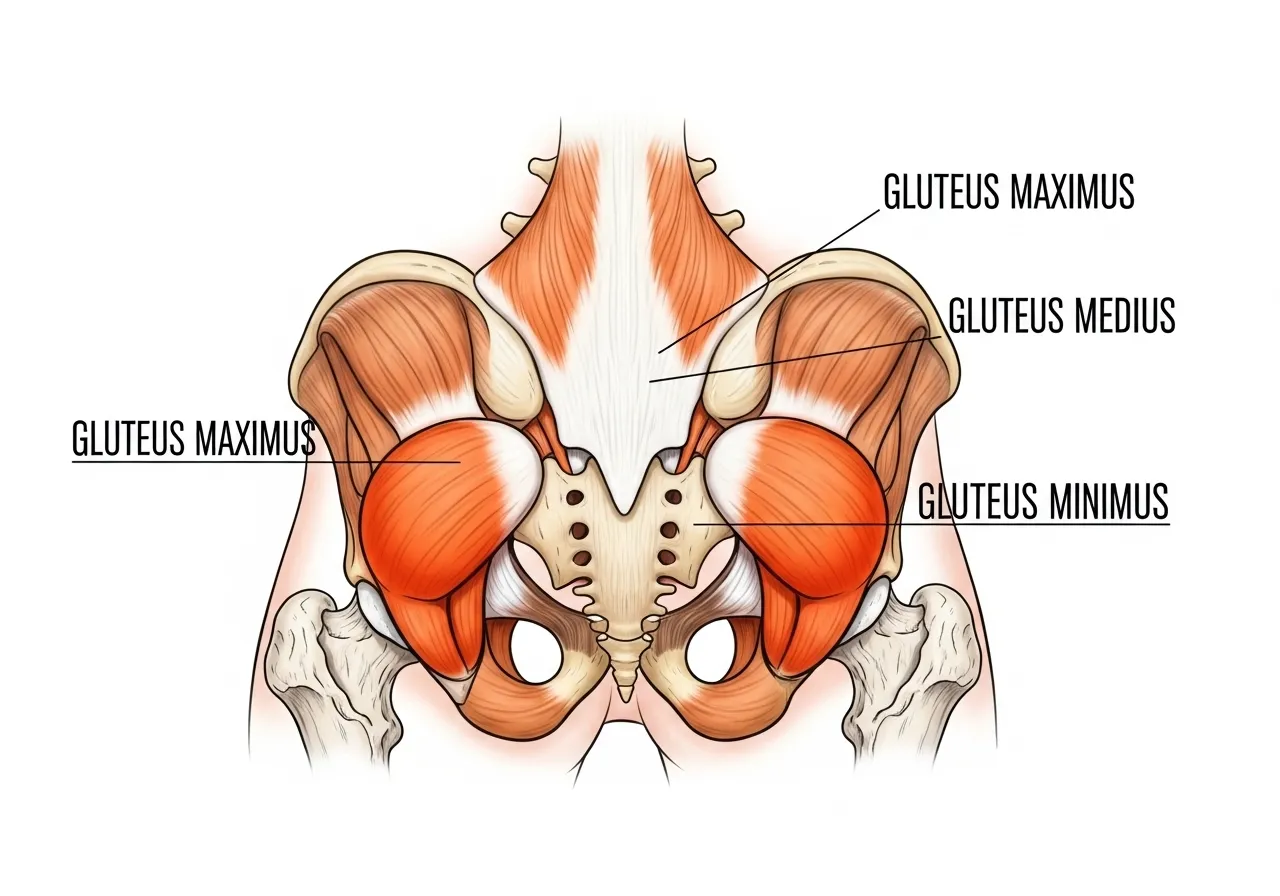
The gluteus maximus is the largest muscle in the human body by volume. It is the primary hip extensor, primary external rotator of the hip, and a critical contributor to lumbopelvic stability. Every powerful human movement — sprinting, jumping, changing direction, lifting from the floor — depends on gluteal force production. Despite this, most training programs produce chronically underdeveloped glutes compared to the quadriceps, hamstrings, and spinal erectors that are more readily activated by conventional exercises.
The reason is mechanical. The gluteus maximus is most fully activated at full hip extension — the standing upright position. Exercises that load the hip through flexion-extension cycles (squats, deadlifts) do load the glutes, but they reach maximum effort in the mid-range of hip flexion, not at full extension where the glute is strongest and most activated. The hip thrust specifically loads the hip extension through the range where the glutes are most capable — producing a training stimulus that flexion-dominated exercises genuinely cannot replicate.
The EMG Evidence
Multiple EMG studies comparing hip thrusts to squats, deadlifts, lunges, and leg press consistently find that the barbell hip thrust produces the highest gluteus maximus activation of any exercise tested. Research by Bret Contreras found that barbell hip thrusts produced peak and average gluteus maximus activation 2-3 times higher than barbell squats and Romanian deadlifts. The mechanism: the hip thrust loads the glute maximally at full hip extension, the position of greatest glute activation potential, while squats and deadlifts load the glute most during the mid-range of hip flexion where other muscles share the load. Research on posterior chain exercises confirms hip extension movements as the most targeted glute training stimulus available.
Hip Thrust Technique: The Complete Setup and Execution Guide
The Setup
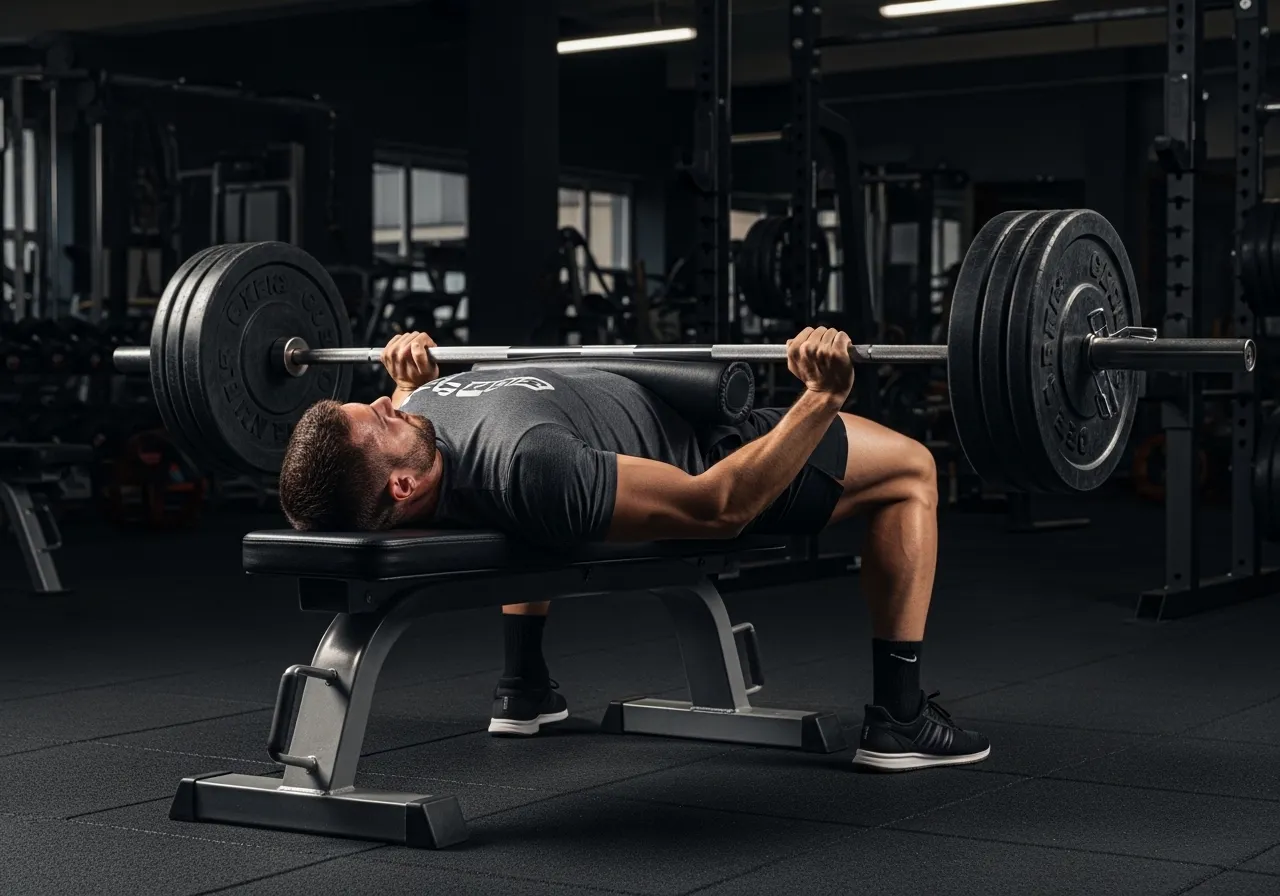
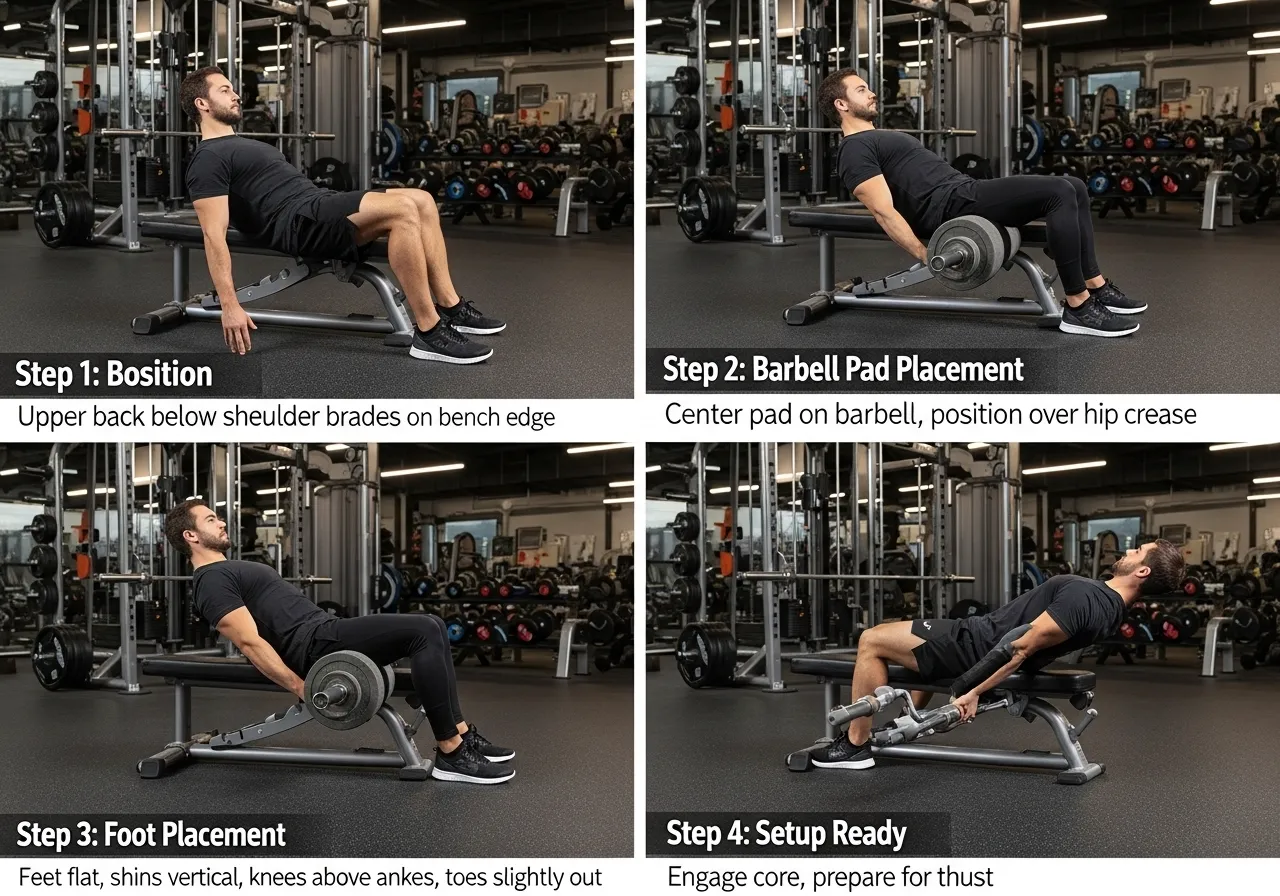
Sit on the floor with your upper back against the long side of a flat bench (or padded box). The bench should be positioned just below the shoulder blades — when you thrust up, the pivot point should be the mid-to-upper back, not the neck or lower back. Place a barbell across your hips with padding (squat pad, foam, or rolled mat) between the bar and your hip bones — direct bar-to-bone contact is painful enough to limit loading and must be avoided.
Foot position: feet flat on the floor, approximately shoulder-width apart, toes pointed slightly out (10-20 degrees). Shins should be vertical (or slightly angled toward knees) at the top of the movement — this produces 90 degrees of knee flexion at peak extension. Feet too close to the body forces excessive knee travel forward; feet too far reduces glute activation at the top. Calibrate foot position so shins are vertical at the top and the glutes are contracting maximally at lockout.
The Movement: Hip Extension, Not Spinal Extension
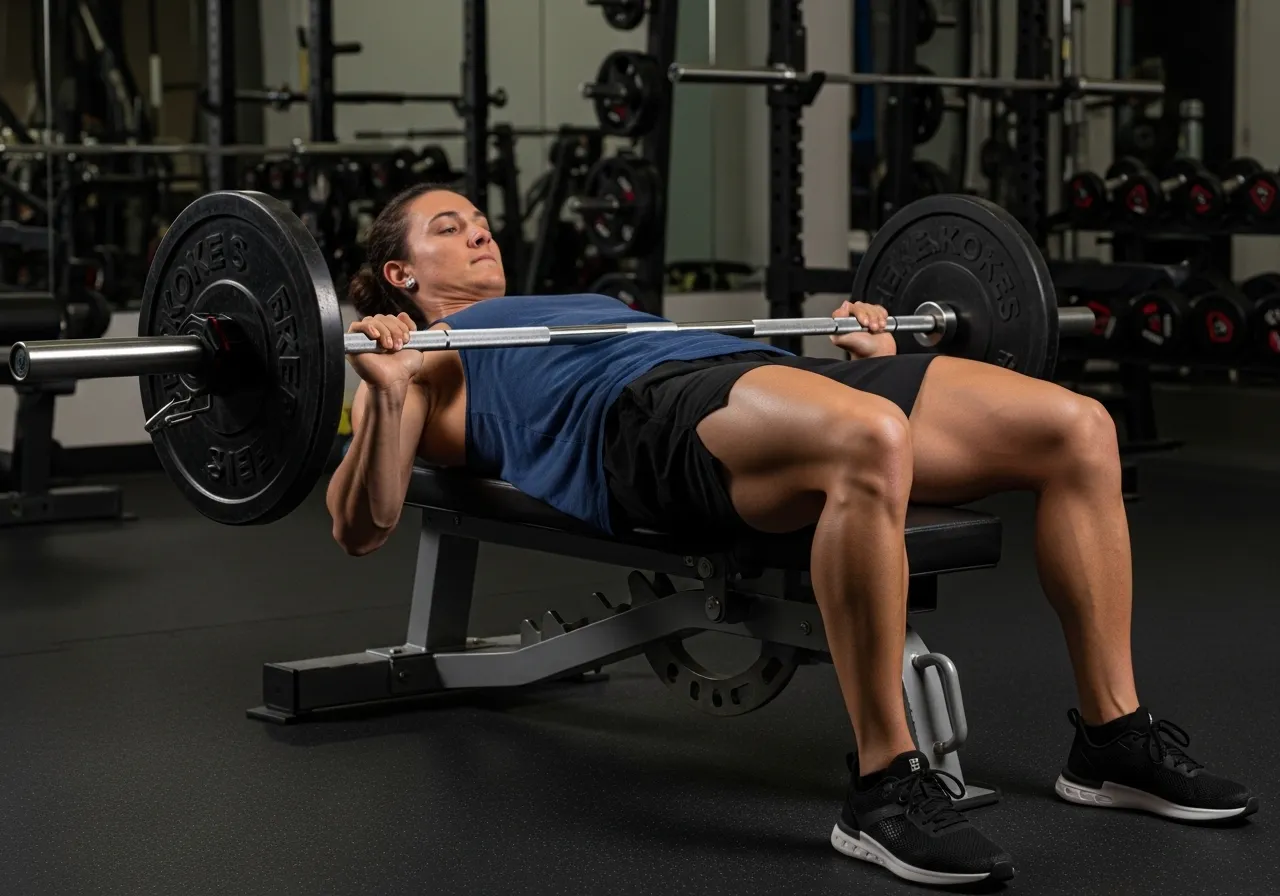
Drive through your heels, push the hips upward, and squeeze the glutes forcefully at the top. At full extension, your torso should form a straight line from shoulders to knees. If you see your ribs flaring and lower back arching rather than hips rising, you’re extending through the spine rather than the hip. Engage your core throughout to maintain neutral lumbar — the movement comes from the hip extensors, not the spinal erectors.
Hold the top position for 1-2 seconds, squeezing the glutes maximally. Return slowly to the starting position over 2-3 seconds — this controlled eccentric loads the glutes through their lengthening phase and produces the stretch stimulus that accelerates hypertrophy. Never drop from the top; control the descent completely.
Common Errors
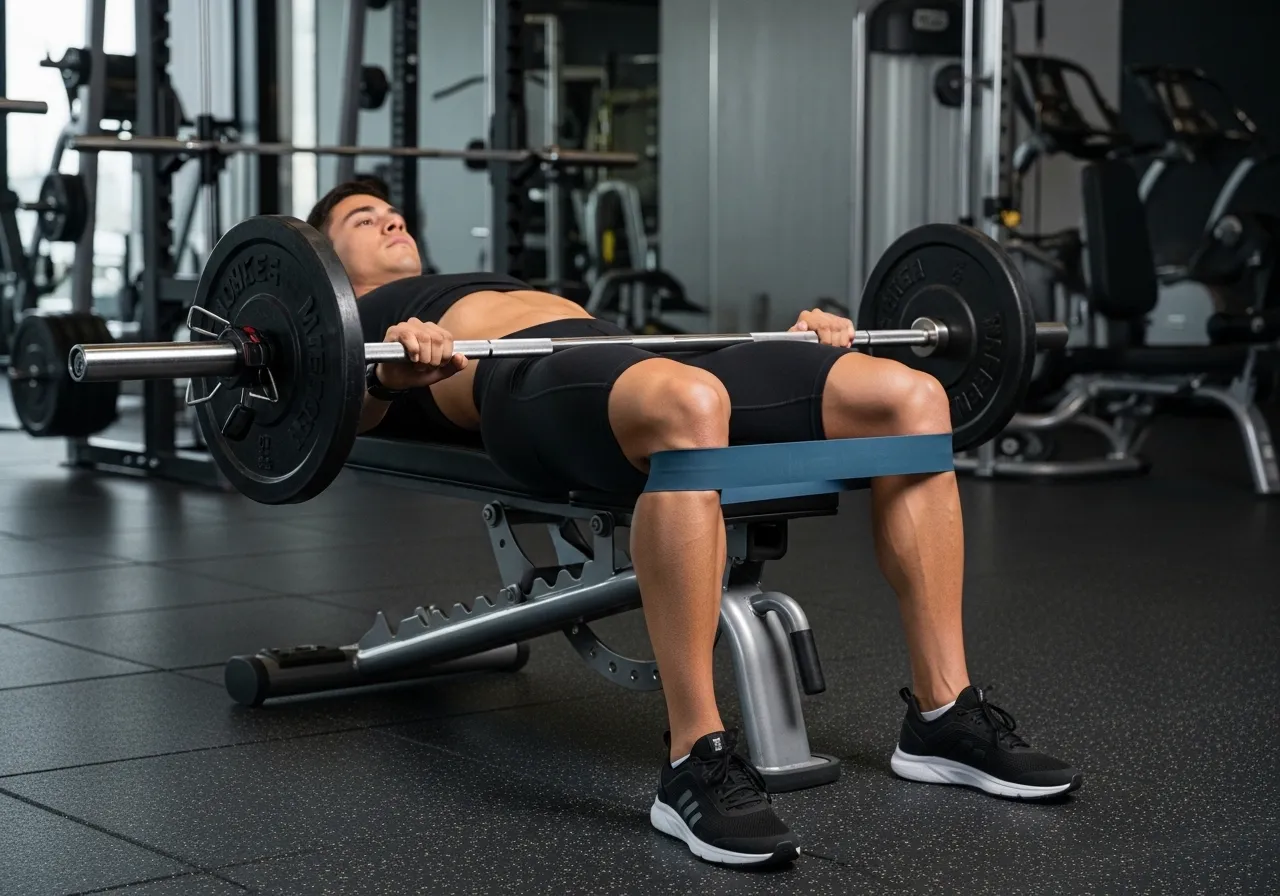
Lumbar hyperextension at top: core isn’t braced or feet are too far from the body. Fix: brace the core, bring feet slightly closer, focus on squeezing glutes without arching. Knees caving inward: glute medius weakness. Fix: add a resistance band above the knees to cue external rotation and strengthen the abductors. Not reaching full hip extension: bench height is wrong or range of motion is limited. Fix: adjust bench height so the upper back pivot allows full hip extension at the top.
Hip Thrust Variations for Every Level
Glute Bridge (Floor Level — Beginners)
The floor glute bridge requires no equipment and is the appropriate starting point. Lying on your back, feet flat on the floor, drive through heels to lift hips toward the ceiling. The range of motion is less than the elevated hip thrust because the floor limits starting hip position. Add a resistance band above the knees for additional glute medius activation. Progress to single-leg glute bridge when bodyweight is no longer challenging.
Bodyweight Hip Thrust
Same setup as barbell hip thrust but without the bar. This allows focus on technique — pivot point, foot position, and glute contraction pattern — before adding load. Most beginners should spend 2-4 weeks with bodyweight before adding the barbell, both for technique quality and to build the hip mobility that the bench-elevated position requires.
Single-Leg Hip Thrust
Performing the hip thrust on one leg dramatically increases glute activation per repetition and develops the unilateral hip strength that addresses left-right asymmetries. Use significantly less load than bilateral thrusting — single-leg hip thrusts with bodyweight or a light dumbbell are challenging enough for most intermediate trainees. This variation is also valuable for rehabilitation after hip or lower extremity injuries.
Banded Hip Thrust
Adding a resistance band above the knees creates an external rotation demand that specifically activates the gluteus medius and minimus alongside the maximus. The band cue also prevents the common knees-caving error. Use a medium-resistance band that creates noticeable resistance to inward knee movement without restricting the stance width that produces optimal gluteus maximus activation.
Programming Hip Thrusts for Maximum Glute Development
Position in the Session
For maximum glute development, treat the hip thrust as a primary movement early in the session rather than an accessory finisher. Heavy hip thrust loading early, when neural resources are freshest, produces better execution quality and heavier absolute loads than fatigued finishing work. A practical structure: hip thrust (primary), Romanian deadlift (secondary posterior chain), quad-emphasis exercise (squat or leg press), accessories. This sequencing treats the hip thrust with the seriousness its role in posterior chain development deserves.
Rep Ranges and Loading
The glutes respond well to a range of rep schemes. For strength: 3-4 sets of 5-8 reps at 80-85% of 1RM. For hypertrophy: 3-4 sets of 10-15 reps at 65-75% of 1RM. For metabolic stress: 2-3 sets of 20-30 reps with lighter load and slow tempo. Research supports varied rep ranges producing more complete glute development than a single rep range used exclusively — rotate between heavy, moderate, and higher rep sessions across the weekly schedule.
Progressive Overload
Hip thrust strength progresses quickly for most people — typical intermediate lifters can hip thrust 1.5-2× bodyweight within 6-12 months of consistent training. Progress the barbell hip thrust using the same principles as other compound movements: add 2.5-5 kg when all sets can be completed with full range of motion, full lockout contraction, and controlled eccentric. Never sacrifice lockout quality for additional load — the contraction at the top is where the training effect lives.
Hypertrophy Research and Athletic Transfer
Hypertrophy Evidence
Studies comparing squat-only to squat-plus-hip-thrust programs find greater posterior development in the combined groups, with the hip thrust’s contribution to total glute volume measurably distinct from the squat’s contribution. This research directly supports the training observation that adding hip thrusts to squat-based programs produces visible glute development that squatting alone did not achieve. The glute development produced is not merely cosmetic — research finds hip thrust training improves sprint times, vertical jump height, and horizontal power output, confirming that the glute development is functional.
Athletes and Hip Thrusts
Athletes in sprinting sports, team sports requiring acceleration and change of direction, and any activity involving explosive hip extension directly benefit from hip thrust training. The exercise develops hip extension power in the range most relevant to athletic movement — not the mid-range flexion of a squat but the near-extension position of the push-off phase of sprinting and jumping. This is why hip thrusts have become a standard component of athletic development programs from professional team sports to track and field.
Are hip thrusts better than squats for glutes? For gluteus maximus activation and development specifically, yes — EMG and hypertrophy research consistently shows superior glute stimulus from hip thrusts. For overall lower body development and athletic transfer, squats produce qualities hip thrusts cannot replicate. Both belong in a complete program.
How much should I be able to hip thrust? Beginner benchmark: 1× bodyweight for 10 reps within 3 months. Intermediate: 1.5× bodyweight. Advanced: 2× bodyweight or more. Progress is typically faster than squatting because the movement pattern is simpler.
Why do I feel hip thrusts in my lower back instead of my glutes? Lower back dominance indicates either lumbar hyperextension at the top or insufficient glute activation initiation. Fix by actively squeezing the glutes throughout, keeping ribs down and core braced, and ensuring hip extension (not spinal extension) drives the movement.
Do women and men need to train hip thrusts differently? The mechanics and progression principles are identical. Research shows women typically have high relative glute activation during hip extension exercises — making hip thrusts particularly effective for female athletes and fitness enthusiasts who prioritize glute development. The same rep ranges, loading percentages, and progression strategies apply across sexes.
Can I hip thrust every day? The glutes recover relatively quickly compared to the lower back or legs. 3-4 hip thrust sessions per week are feasible for many people. Monitor recovery — if each session feels as strong as the last, frequency is appropriate. Daily hip thrusts at moderate loads are feasible for some individuals with well-developed work capacity.
⚠️ Fitness Disclaimer: The information in this article is for general educational purposes only and does not constitute professional fitness or medical advice. Always consult a qualified healthcare professional before starting any new exercise program, especially if you have existing injuries or medical conditions. Why Two Straps Changed What I Thought Training Equipment Needed to…
⚠️ Fitness Disclaimer: The information in this article is for general educational purposes only and does not constitute professional fitness or medical advice. Always consult a qualified healthcare professional before starting any new exercise program. ⚠️ Cardiovascular Health Notice: If you have a history of heart disease, high blood pressure, or any cardiovascular condition, obtain…
⚠️ Fitness Disclaimer: The information in this article is for general educational purposes only and does not constitute professional fitness or medical advice. Always consult a qualified healthcare professional before starting any new exercise program, especially if you have existing injuries or medical conditions. The Debate That Every Gym Member Has an Opinion On Ask…
⚠️ Fitness Disclaimer: The information in this article is for general educational purposes only and does not constitute professional fitness or medical advice. Always consult a qualified healthcare professional before starting any new exercise program, especially if you have existing injuries or medical conditions. The Exercise That Separated Me From the Athletes I Trained With…
⚠️ Fitness Disclaimer: The information in this article is for general educational purposes only and does not constitute professional fitness or medical advice. Always consult a qualified healthcare professional before starting any new exercise program. ⚠️ Cardiovascular Health Notice: If you have a history of heart disease, high blood pressure, or any cardiovascular condition, obtain…
⚠️ Fitness Disclaimer: The information in this article is for general educational purposes only and does not constitute professional fitness or medical advice. Always consult a qualified healthcare professional before starting any new exercise program, especially if you have existing injuries or medical conditions. The Ball That Made My Conventional Training Feel Incomplete I added…