Hockey: Speed Sport on Ice

Ice speed fundamentals build every fast shift
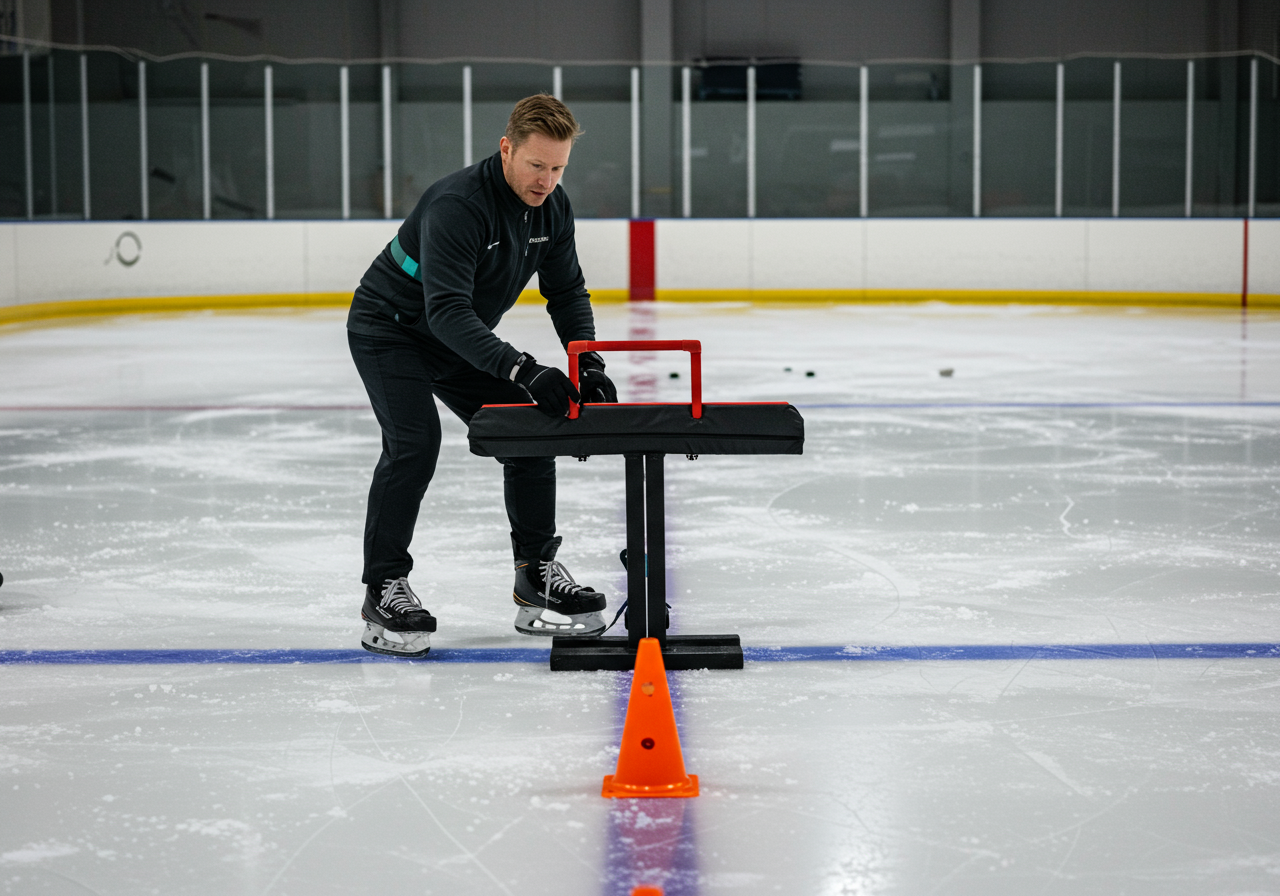
Speed on ice starts with clean mechanics. I teach first-step power, edge control, and efficient stride length.
Beginners need stable skates and patient drills. We build speed without chaos or wasted energy.
– Low hips, stacked torso, and shin angle match force direction.
– Punch the knee, snap the hip, and finish the toe flick.
– Load inside edges for acceleration, outside edges for crossovers.
– Sprint 6–8 seconds to train alactic power. Rest long for quality.
| On-ice drill | Sets x Reps/Time | Rest | Focus cue |
|---|---|---|---|
| First 3 strides from staggered start | 6 x 8 seconds | 90–120 seconds | Drive knee, nose over toes |
| Crossover build along circle | 4 x 1 lap each way | 60 seconds | Outside edge pressure |
| Flying 20 m timing gate | 6 x 20 m | 90 seconds | Relax upper body |
| Deceleration to puck stop | 5 x 10 m | 60 seconds | Hips drop, blades wide |
Warm up 5 minutes easy laps and edge slaloms.
Do 6 accelerations at 8 seconds each, full rest.
Add 4 crossover laps, switching directions each rep.
Finish with 4 controlled stops for decel skill.
I track heart rate and times every skate. My Garmin watch logs spikes and recovery.
Last week I skated 28 minutes. Average HR was 146 bpm in Zone 3.
Peak HR hit 181 bpm during accelerations. My flying 20 m improved by 0.12 seconds.
Video review showed a late toe-off on my left stride. I corrected it next session.

Strength and power training convert force into skating speed
Hockey acceleration demands horizontal and lateral force. We build both with targeted lifts and plyometrics.
Beginners focus on positions and bracing. Advanced athletes chase power and elasticity.
– Heavy lifts at 3–5 reps build max force.
– Loaded jumps at 30–60% 1RM build velocity.
– Lateral bounds train skate-specific push angles.
– Copenhagen planks protect adductors during cuts.
| Exercise | Sets x Reps | Rest | Tempo / Load | Coaching cue |
|---|---|---|---|---|
| Trap bar deadlift | 4 x 4 | 2–3 minutes | 2-0-X, 80–85% 1RM | Push floor away |
| Front squat | 3 x 5 | 2 minutes | 3-1-X, 70–80% 1RM | Elbows high |
| Lateral bound to stick | 4 x 5 each | 90 seconds | Bodyweight | Quiet landings |
| Trap bar jump | 3 x 5 | 2 minutes | 30% 1RM | Explode up |
| Copenhagen plank | 3 x 20 sec | 60 seconds | Bodyweight | Hips tall |
1) Trap bar jumps 3 x 5 at 30% 1RM, 75 seconds rest.
2) Split squat 3 x 6 each at RPE 7.
3) Mini-band lateral walks 3 x 12 steps.
I progressed trap bar deadlift from 225 lb to 315 lb in 8 weeks.
My lateral bound improved from 1.6 m to 2.1 m. Deceleration felt more stable.
One week I skipped warm-up and strained my calf. Now I never skip activation.

Conditioning, mobility, and recovery sustain repeatable speed
Hockey shifts tax multiple energy systems. We train power, capacity, and recovery together.
New skaters build an aerobic base first. Then we layer high intensity sprints wisely.
– Alactic: 6–10 second max efforts, long rest.
– Lactic: 20–45 second pushes, partial rest.
– Aerobic: 30–60 minutes easy, Zone 2 breathing.
| Day | Session | Details |
|---|---|---|
| Mon | Off-ice strength | Main lifts + adductor work, 45–60 minutes |
| Tue | On-ice sprints | 6–8 alactic reps, skills finishers, 30 minutes |
| Wed | Zone 2 bike | 35 minutes at 60–70% max HR |
| Thu | Off-ice power | Jumps, bounds, core, 35–45 minutes |
| Fri | On-ice repeat sprints | 8 x 15–20 seconds at 90%, 60–75 seconds rest |
| Sat | Mobility + stickhandling | Hips, ankles, T-spine, 20 minutes + puck skills |
| Sun | Rest or walk | 30–40 minute walk, nasal breathing |
90/90 hips x 8 each, adductor rockbacks x 10 each.
Ankle dorsiflexion pulses x 12 each, T-spine rotations x 8 each.
Finish with 3 slow belly breaths into ribs.
HIIT cut fat faster than steady cycling for my clients. However, we still keep two Zone 2 days.
My VO2max increased by about 8% after 6 weeks. Zone 2 heart rate dropped 6 bpm.
Nutrition supports training quality. I set calories at bodyweight x 13–15 for recomposition.
I aim for 1.6–2.2 g protein per kg. I track with MyFitnessPal.
I hydrate with 500–750 ml per hour on ice. I add electrolytes for longer sessions.
I take creatine 3–5 g daily. I consider vitamin D and omega-3s as needed.
I sleep 7.5–8.5 hours nightly. My Garmin tracks HRV and resting heart rate trends.
Explore official tools: MyFitnessPal and Garmin.

Structured rollout turns beginners into confident speed skaters
Clear phases remove guesswork. We scale volume and intensity each month.
We use RPE to guide effort. RPE is a 1–10 effort scale.
| Phase | Weeks | On-ice focus | Off-ice load | Conditioning |
|---|---|---|---|---|
| Base | 1–4 | 4–6 x 8s alactic, skills edges | 60–70% 1RM, RPE 6–7 | 2 x Zone 2, 30–35 minutes |
| Build | 5–8 | 6–8 x 8s, add 6 x 20s repeats | 70–82% 1RM, RPE 7–8 | 1 x Zone 2, 1 x HIIT 8 x 30/60 |
| Peak | 9–12 | Quality sprints, flying 20 timing | 85–90% 1RM top sets | 1 x RSA 6 x 20s/40s |
Warm-up 8 minutes off-ice and on-ice edges.
Do 5 accelerations at 8 seconds with full rest.
Add 3 crossover laps each way.
Finish with 5 minutes easy laps and breathing.
Client stories guide expectations. Maya, 41, started from recreational skating.
After 12 weeks, her flying 20 m dropped 0.28 seconds. She cut two inches from hips.
Luis, 19, improved first 3 strides by video cues. His coach noticed better separation.
Coach T used the plan for his U16 team. Line changes stayed sharper in the third period.
– Plateau: Reduce total volume 25% for one week, then resume.
– Motivation dip: Set micro-goals for crossover counts and sprint times.
– Sore adductors: Replace bounds with sled drags for one week.
– High fatigue: Keep only alactic sprints, pause HIIT temporarily.

Measured speed gains and next steps — long-term result interpretation
Data confirms progress. We test and adjust training from objective outcomes.
We time short sprints and flying efforts. We track heart rate and recovery trends.
| Metric | Week 0 | Week 6 | Week 12 |
|---|---|---|---|
| 5 m on-ice sprint | 1.37 s | 1.29 s | 1.24 s |
| Flying 20 m | 3.03 s | 2.92 s | 2.85 s |
| RSA average HR | 177 bpm | 172 bpm | 168 bpm |
| VO2max (watch est.) | 48 ml/kg/min | 52 ml/kg/min | 54 ml/kg/min |
| Body fat (bioimpedance) | 20.0% | 18.4% | 17.2% |
My own 10 m sprint improved by 0.09 seconds. Trap bar jumped 15 lbs while bodyweight held steady.
HIIT improved fat loss faster than steady cycling. However, Zone 2 improved recovery between sprints.
Warm up 12 minutes with edges and two strides builds.
Time 3 x 5 m, 3 x 10 m, and 3 x flying 20 m.
Rest 90 seconds between reps. Keep best and average.
– Skipping warm-up led to a calf strain once. Warm up completely.
– Excess HIIT stalled strength for a week. Balance stressors.
– Video feedback fixed toe-off timing. Small cues create big wins.
Maintain gains with two ice sprints weekly. Keep one heavy lower session year-round.
Shift into mini-blocks before playoffs. Reduce volume and keep speed quality high.
Track metrics monthly. Adjust only one variable at a time for clarity.