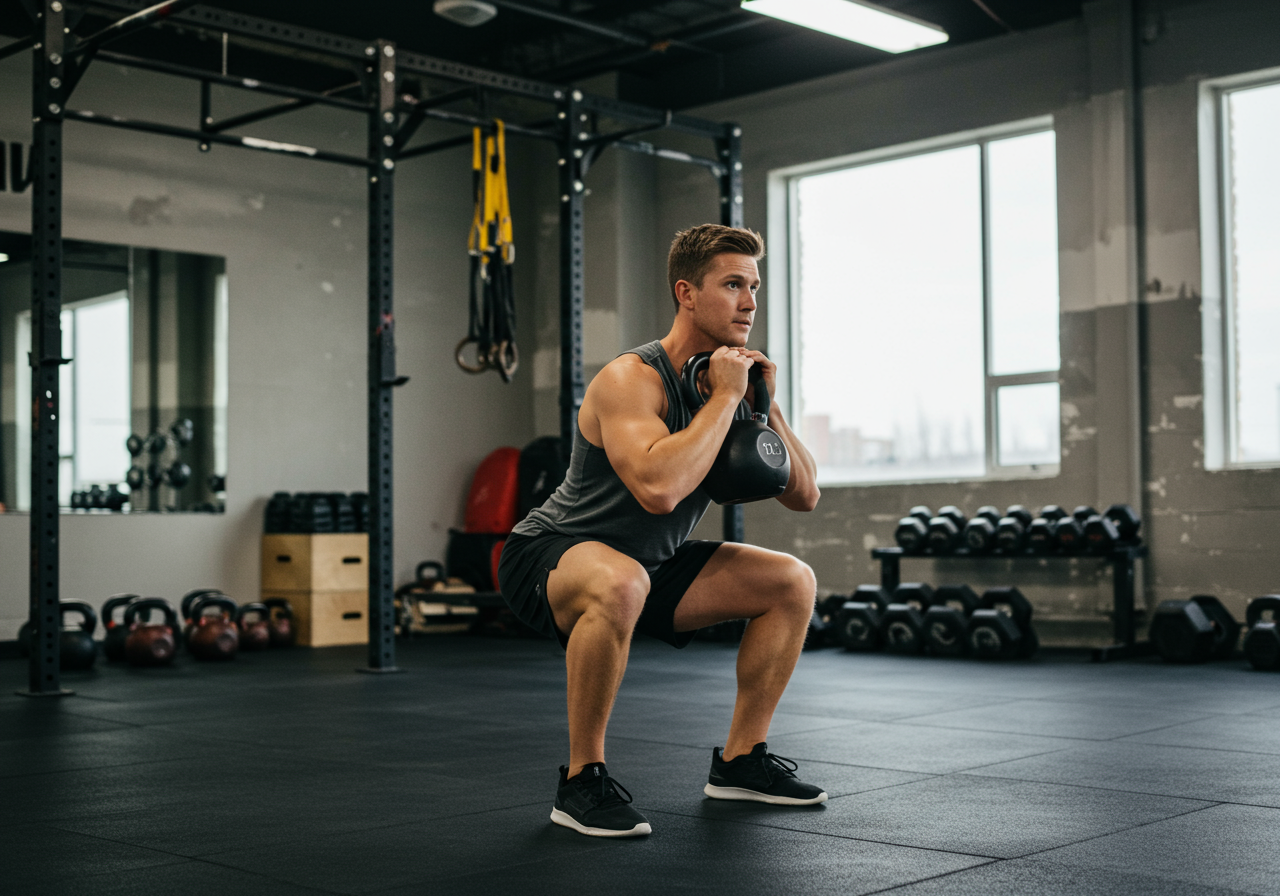
Kettlebell Goblet Squats: Core-Strengthening Squat Variation
Why Goblet Squats Anchor a Strong, Resilient Body

Goblet squats build leg strength, core stability, and safe squat mechanics
I coach beginners to master goblet squats first. The front-loaded weight forces an upright torso. Your abs brace hard. Your hips and ankles learn clean depth without pain.
- Brace your core before each rep. Think ‘ribs down, belly tight.’
- Keep your chest tall. Let the bell sit under your chin.
- Let knees track over toes. Keep full foot pressure.
- Descend with control. Drive up fast.
I switched new clients from back squats to goblet squats years ago. Their knees felt better. Their depth improved within two weeks.
| Primary muscles | Secondary muscles | Form cues |
|---|---|---|
| Quads, Glutes | Core, Upper back | Elbows inside knees at depth |
| Adductors | Hamstrings, Calves | Knees track over middle toes |
| Erectors (isometric) | Lats (cradle the bell) | Breathe in at top. Brace. Exhale at lockout. |
Goblet squats transfer to daily life. You stand up easier. You carry groceries safer. You protect your back.
A practical weekly plan centered on goblet squats

Train your whole body with a squat-first weekly structure
This plan blends strength, cardio, and mobility. It suits busy beginners. It scales for growth.
| Day | Focus | Details |
|---|---|---|
| Mon | Strength A | Goblet squat + Push + Hinge + Carry |
| Tue | Zone 2 cardio | 30–40 minutes at 60–70% max heart rate |
| Wed | Strength B | Goblet squat + Pull + Hinge + Core |
| Thu | Mobility | Hips, ankles, thoracic spine, 20 minutes |
| Fri | Strength C | Goblet squat + Single-leg + Press + Carry |
| Sat | Optional HIIT | 6–10 sprints, 20–30 seconds hard, long recoveries |
| Sun | Rest | Walk 20 minutes and stretch |
I track zones with a Garmin watch. Zone 2 feels conversational. HIIT feels breathless but controlled.
- 90/90 breathing with reach, 1 minute.
- World’s greatest stretch, 1 minute each side.
- Ankle rocks, 15 each side.
- Bodyweight squat to hold, 3 sets of 20 seconds.
| Level | Goblet squat | Accessories | Rest |
|---|---|---|---|
| Beginner | 3×8 with 6–12 kg, RPE 6 | Kettlebell deadlift 3×8; Incline push-up 3×8 | 75–90 seconds |
| Intermediate | 4×6 with 14–24 kg, RPE 7–8 | Row 4×8; RDL 4×8; Side plank 3x30s | 90–120 seconds |
| Advanced | 5×5 with 24–40 kg, RPE 8–9 | Bulgarian split squat 4×8; Press 4×6; Farmer carry 4x30m | 120–150 seconds |
Finish each strength day with a 6 minute carry. Use farmer or suitcase carries. Keep ribs down.
I log sets and heart rate in Garmin. I log food in MyFitnessPal. Data keeps me honest.
Simple progressions that never stall

Use load, reps, tempo, and range to progress safely
Progress needs a clear path. I use four lanes: weight, volume, tempo, and depth.
| Weeks | Focus | Prescription | Goal |
|---|---|---|---|
| 1–2 | Technique | 3×8 at RPE 6; 3-second eccentric | Even depth. No knee cave. |
| 3–4 | Volume | 4×8 at RPE 7; last set AMRAP cap 12 | 12 clean reps possible. |
| 5–6 | Load | 5×5 at RPE 8; heavier bell | Stronger core brace. |
| 7–8 | Range | Heels-elevated 3×6; pause 2 seconds at depth | More knee flexion safely. |
I track sets, RPE, and notes in my phone. I test a 10 rep max every 4 weeks.
Personal data helps here. My last block started at 24 kg for 3×8, RPE 7. Week six hit 36 kg for 5×5, RPE 8. My Garmin average session heart rate dropped by 5 bpm at the same workload.
Upgrade options include double kettlebell front squats. Try them when you can goblet squat your bodyweight for 5 clean reps. That means bell weight equals about 40–50% bodyweight in the goblet, due to lever differences.
Use MyFitnessPal to support strength gains. Set protein and calories correctly. Fuel performance and recovery.
Fuel, mobility, and safeguards for steady gains

Nutrition and recovery keep progress steady and joints happy
Strength depends on sleep, food, and mobility. I treat these as training.
- Protein: 1.6–2.2 g per kg bodyweight.
- Calories: Maintenance for recomposition. 250–400 deficit for fat loss.
- Sleep: 7–9 hours, dark room.
| Goal | Macronutrients | Notes |
|---|---|---|
| Muscle gain | Protein 1.8–2.2 g/kg; Carbs 3–5 g/kg; Fat 0.8–1.0 g/kg | Add 200–300 kcal above maintenance. |
| Fat loss | Protein 2.0–2.4 g/kg; Carbs 2–3 g/kg; Fat 0.6–0.8 g/kg | Hold protein high. Keep lifting heavy. |
I log meals in MyFitnessPal. It helps me hit protein. It keeps weekends honest.
- Box squat sit-breathe, 2×5 breaths.
- Ankle dorsiflexion knee-to-wall, 2×10 each.
- Hip flexor stretch with posterior tilt, 2×30 seconds each.
- Thoracic rotation on floor, 2×8 each.
I strained a calf once after skipping warm-up. I never skip now. My first set always feels better after ankle rocks and breathing.
Use easy zone 2 walks on rest days. Blood flow aids recovery. My Garmin tracks sleep and stress. Poor sleep days get lighter loads.
Hydrate well. Aim for pale yellow urine. Add a pinch of salt on hot days.
Real results, proof, and fixes when things stall

Measure outcomes and adjust for long-term result interpretation
Numbers guide choices. Feeling better matters too. I use both.
| Metric | My 8-week change | Client example |
|---|---|---|
| Goblet squat 10RM | From 28 kg to 40 kg | Anna: 12 kg to 20 kg |
| VO2 max (Garmin) | +6% with Zone 2 and HIIT | +8% after 6 weeks |
| Waist circumference | -3.5 cm | -4.0 cm |
| Resting heart rate | -5 bpm | -6 bpm |
Client note: ‘My knees do not ache now. Groceries feel light.’ Anna, 41, two kids.
If knees hurt, check ankle mobility and stance width. Use a box squat for two weeks. Keep torso tall. If motivation dips, shorten sessions to 20 minutes. Do squats, a pull, and a carry. Win small.
HIIT burns fat well for busy people. I see faster waist changes than steady-state alone. However, too much HIIT stalls strength. Limit HIIT to once weekly while building your squat.
Use trusted tools. Track workouts with Garmin at garmin.com. Track nutrition with MyFitnessPal at myfitnesspal.com.
Review progress monthly. Keep what works. Adjust what lags. Your goblet squat becomes your anchor for strength and health.