⚠️ Fitness Disclaimer: The information in this article is for general educational purposes only and does not constitute professional fitness or medical advice. Always consult a qualified healthcare professional before starting any new exercise program, especially if you have existing injuries or medical conditions.
The Lat Pulldown: The Most Underestimated Back Builder in the Gym
The lat pulldown spent years in my program as a warm-up exercise before pull-ups and rows — something I did lightly for 15 reps to get the lats firing before the real work began. I treated it as a beginner’s pull-up substitute and nothing more. That changed when I started experimenting with heavier loading, slower eccentrics, and different grip widths — and discovered that the lat pulldown, trained seriously, produced upper back and lat development that my pull-up-focused training had not been achieving.
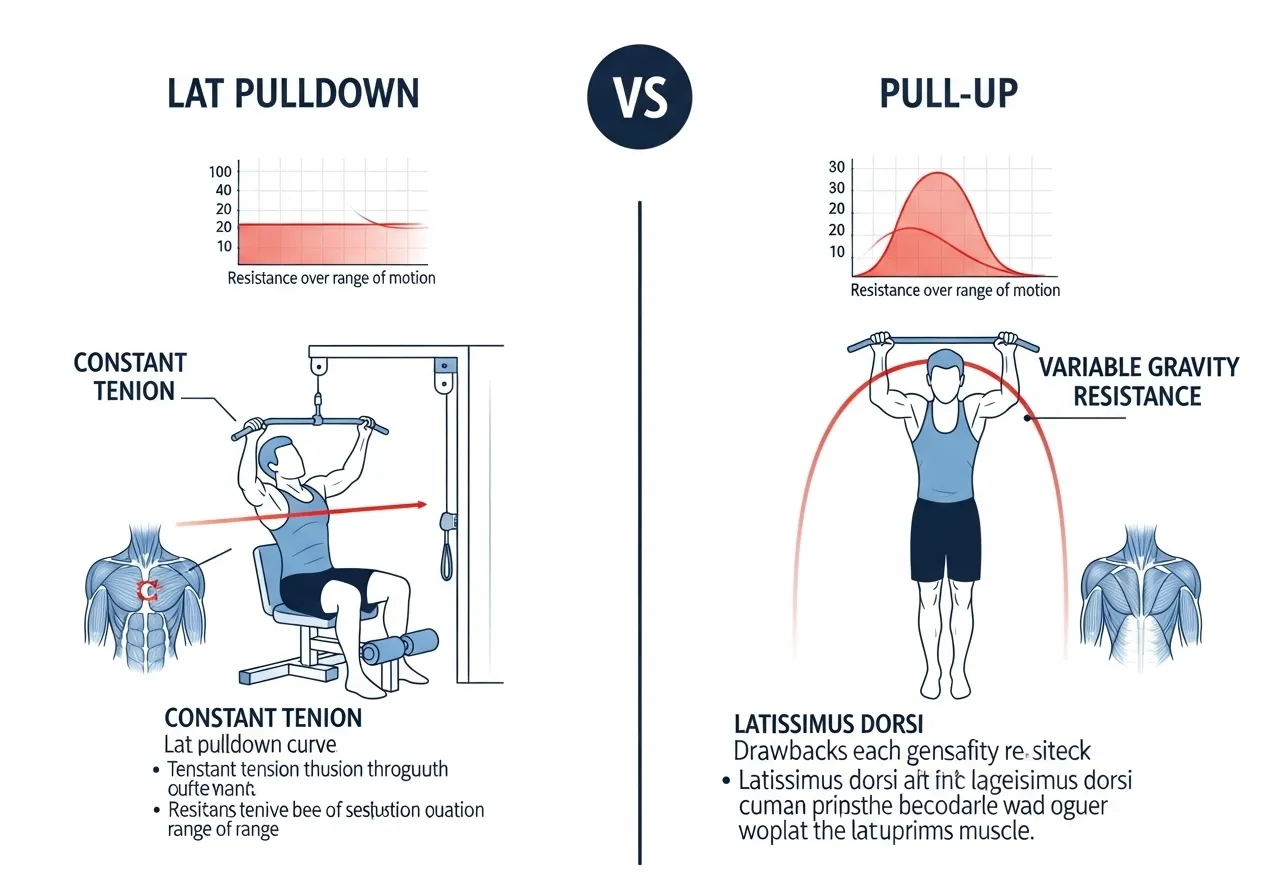
The lat pulldown’s greatest underappreciated advantage is consistent resistance through the full range of motion. Pull-ups are loaded maximally when the arms are nearly extended and minimally at the contracted top position — the moment when the lats are most activated. The lat pulldown, by contrast, maintains consistent cable resistance throughout the entire range, including the contraction at the bottom where the lats are most engaged. For lat hypertrophy specifically, this constant-tension property makes the pulldown a superior tool to the pull-up, even for people strong enough to do pull-ups with added weight.
Latissimus Dorsi Anatomy and Function
The latissimus dorsi is the broadest muscle of the back, originating from the thoracolumbar fascia, posterior iliac crest, and lower ribs, inserting at the intertubercular groove of the humerus. Its primary functions are shoulder adduction (pulling the arm toward the body), shoulder extension (pulling the arm from overhead to the side), and internal rotation of the humerus. The lat pulldown trains all three functions: the pulling action from overhead to the shoulders involves adduction and extension through the range that maximally recruits the lat from its elongated to contracted position.
Muscles Involved Beyond the Lats
The lat pulldown is a compound pulling movement involving the biceps brachii (elbow flexion), rear deltoid (shoulder extension assistance), lower trapezius (scapular depression during the pull), and rhomboids (scapular retraction). The teres major — a smaller muscle on the lateral back that performs the same actions as the lat — is co-activated throughout. Research on lat pulldown muscle activation confirms that the wide-grip lat pulldown produces the highest latissimus dorsi activation of common back exercises, making it the most targeted lat development tool available on standard gym equipment.
Progressive Overload: The Engine of All Long-Term Improvement
Every meaningful improvement in physical performance results from progressive overload — the systematic increase of training demands over time. The body’s adaptation mechanism is fundamentally conservative: it adapts to meet imposed demands, not to exceed them. This means that training at a constant level produces initial adaptation followed by maintenance, not continued improvement. Only by progressively increasing training demands — more load, more volume, higher intensity, shorter rest — does the body continue adapting beyond the initial plateau. This principle applies universally to cardiovascular training (adding duration or intensity), strength training (adding load or sets), flexibility training (working at slightly greater range over time), and skill development (adding complexity to established patterns). Understanding progressive overload not as a technique to apply in specific contexts but as the fundamental mechanism underlying all physical improvement reframes training decisions: the most important question about any training decision is not whether the exercise is good or bad in isolation, but whether it contributes to a progressive demand increase that drives continued adaptation.
The practical application of progressive overload varies by training level. For beginners, progression can occur session-to-session because the initial training stimuli are far below the body’s adaptive ceiling — adding weight to every workout is sustainable for 2-4 months before the pace of adaptation slows. For intermediate athletes, progression occurs weekly to bi-weekly — the same exercise at the same load becomes stimulating enough for continued adaptation only if load is increased every 1-2 weeks. For advanced athletes, monthly progressions are typical — the body’s adaptive ceiling is closer to current training levels, making smaller, less frequent load increases appropriate as the marginal stimulus of any additional training demand decreases. Matching progression rate to current training level prevents both the frustration of attempting to progress faster than biology allows and the stagnation of progressing more slowly than the body’s current capacity. NSCA progressive overload guidelines provide detailed frameworks for applying progressive overload across all training levels and modalities, representing the consensus of the most experienced strength and conditioning practitioners worldwide.
Training for Health vs Performance: Understanding the Distinction
The training demands required for health benefit and for athletic performance are dramatically different — a distinction that allows most people to achieve excellent health outcomes with far less training volume and intensity than competitive athletes require. Research on the dose-response relationship between exercise and health outcomes finds that the largest health improvements occur in the transition from sedentary to lightly active, with diminishing returns as training volume and intensity increase. The difference in cardiovascular disease risk between a completely sedentary person and one who performs 150 minutes of moderate-intensity exercise per week is enormous; the difference between 150 minutes and 300 minutes per week is meaningful but much smaller; the difference between 300 minutes and 600 minutes per week is smaller still. This diminishing returns relationship means that optimizing training for health requires far less training than optimizing for athletic performance — and that the health-focused recreational exerciser who trains 3-4 hours per week achieves most of the health benefit available from any training volume.
For people training primarily for health and quality of life rather than athletic performance, this research context provides liberating permission: the pressure to optimize every training variable, match elite training volumes, or progress to advanced techniques is not justified by health goals that can be fully achieved with consistent moderate training. The most health-promoting training practice for most people is not the most elaborate or most intense but the most consistently executed over the longest period. Establishing and maintaining a consistent moderate training practice across decades produces more cumulative health benefit than any period of intense training followed by abandonment. The exercise that is most consistently performed is the most health-promoting exercise — not the exercise that is theoretically most effective when performed optimally. This principle should guide training decisions for health-motivated individuals more than any performance optimization consideration. ACSM physical activity guidelines confirm that health-related benefits are achievable with moderate training volumes and that additional benefits from higher volumes are meaningful but incrementally smaller than the initial health gains from transitioning from sedentary to active.
Lat Pulldown Technique: Grip Width, Bar Path, and the Scapular Trick Most People Miss
Grip Width Selection
Wide grip (hands 1.5-2× shoulder-width): targets the lats in a lengthened position and produces the widest possible range of shoulder adduction, maximizing lat stretch and activation. The most commonly used lat pulldown grip for a reason — it produces the highest lat activation of any grip variation. Standard grip (hands slightly wider than shoulder-width): the most mechanically comfortable position for most people, allowing the elbows to travel optimally beneath the bar at the pull’s bottom. Close grip (hands close together, narrow bar or V-bar): reduces lat activation and increases bicep involvement. Useful for variety but not optimal for lat development as the primary goal.
The Scapular Depression Initiation: The Most Important Technical Element
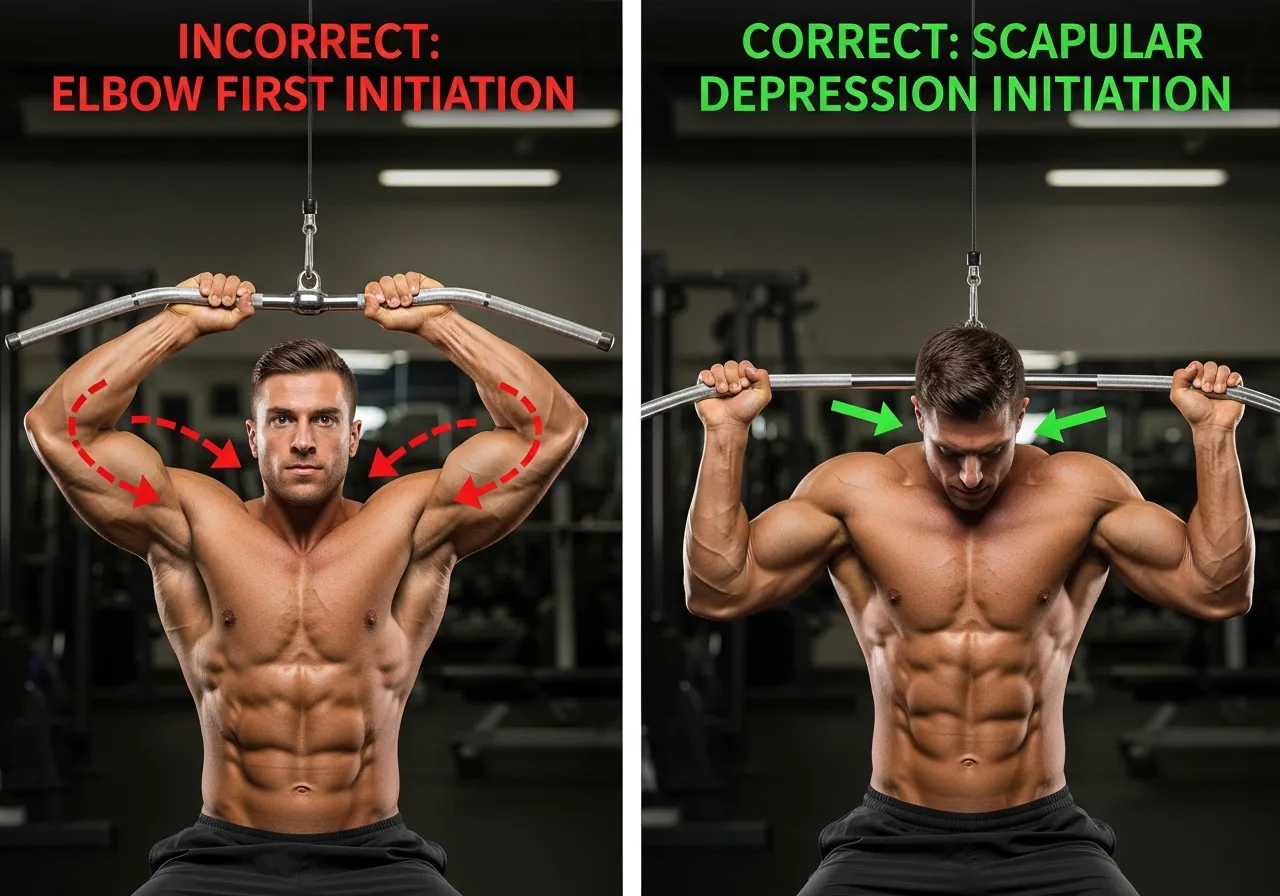
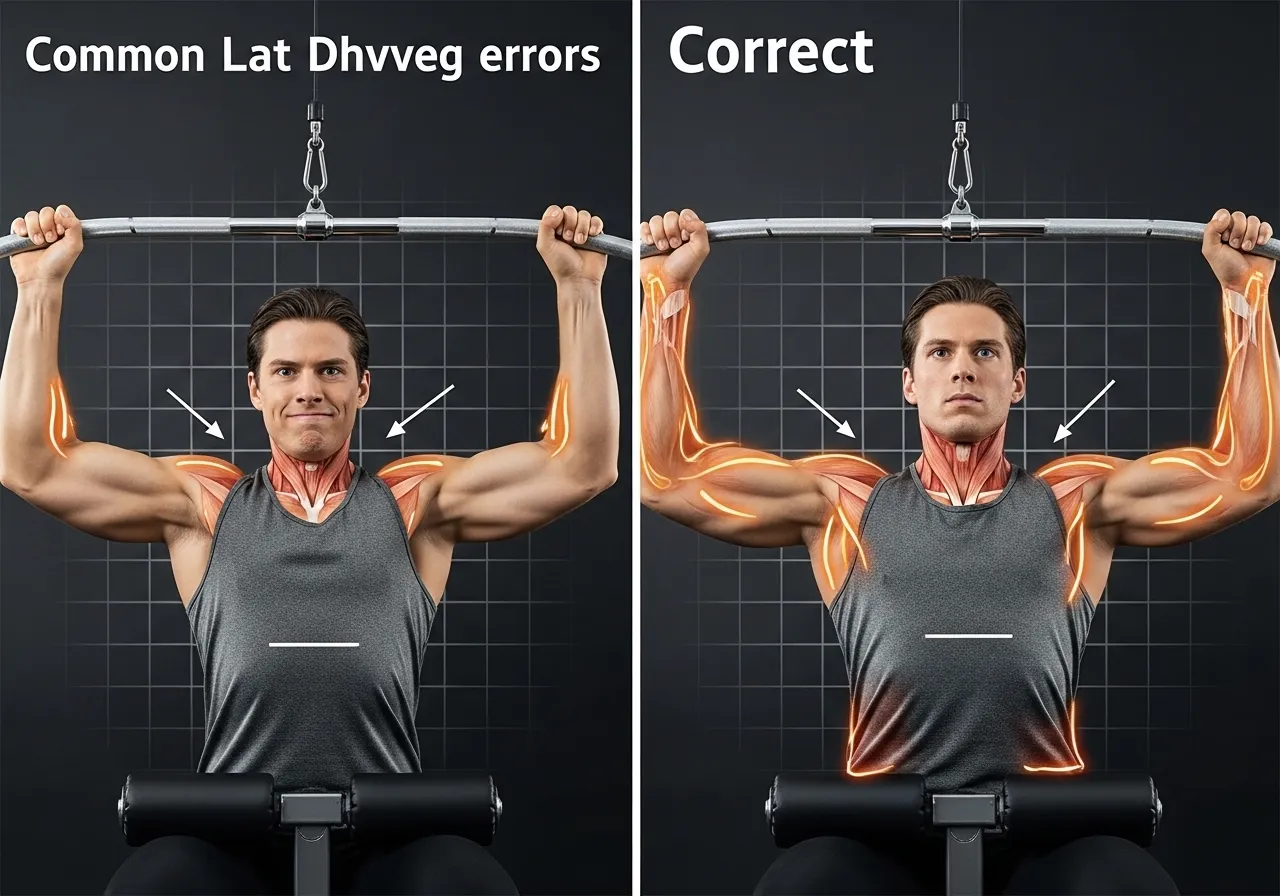
Before any elbow bending occurs in the lat pulldown, the shoulder blades should depress (move downward away from the ears) and slightly retract. This scapular movement is the first action in a correctly executed lat pulldown, and it determines whether the lats or the biceps initiate the pull. The cue: “put your shoulder blades in your back pockets” before the arms pull. Lifters who skip scapular initiation and begin the pulldown by bending the elbows train primarily the biceps and rear deltoids — the “elbow flexion-first” pattern that produces arm fatigue before back fatigue and explains why many people feel lat pulldowns primarily in their arms rather than their back.
Bar Path: In Front or Behind the Head
The behind-the-neck lat pulldown — pulling the bar behind the head to neck level — was a staple of 1970s-1980s bodybuilding but is no longer recommended. The behind-the-neck position places the cervical spine in a vulnerable flexed-and-rotated position under load, creating significant cervical compression and rotator cuff stress that the standard in-front variation does not. No evidence supports superior lat development from the behind-the-neck variation; the injury risk is real. Always pull to the front, targeting the upper chest or clavicle.
Body Position and Lean
A slight backward lean of approximately 20-30 degrees improves the lat activation angle by aligning the resistance more directly with the lat’s pulling direction. Excessive backward lean (leaning far back and using momentum to swing the bar down) turns the pulldown into a row-like movement that reduces lat specificity. Sit upright with a slight backward lean, chest slightly proud, and initiate with the scapulae before the elbows.
Nutritional Foundations for Physical Development
Physical development from training depends on nutritional support that is often underappreciated in fitness culture that emphasizes training techniques while treating nutrition as secondary. The fundamental nutritional requirements for training adaptation are: adequate total caloric intake to support both daily energy needs and the additional demands of training (insufficient calories produce adaptation impairment regardless of training quality), adequate protein to support muscle protein synthesis (1.6-2.2 grams per kilogram of body weight daily for people training for strength or muscle development), and adequate carbohydrate to fuel high-intensity training sessions (25-50 grams before and after intense sessions for most athletes).
Hydration is the most commonly neglected nutritional variable affecting training performance. Even mild dehydration (1-2% of body weight) measurably reduces strength output, cardiovascular performance, and cognitive function during training. Training in a hydrated state — drinking 400-600 ml of water in the 2 hours before training and replacing fluid losses during training (approximately 400-800 ml per hour of exercise depending on sweat rate and environmental conditions) — maintains the performance quality that represents the intended training stimulus. Micronutrient status — iron (essential for oxygen transport), vitamin D (essential for muscle function and immune health), magnesium (essential for muscle contraction and recovery), and zinc (essential for protein synthesis and hormone function) — affects training adaptation through mechanisms that direct caloric and macronutrient management doesn’t address. Athletes who experience unexplained fatigue, persistent soreness, or performance plateaus despite adequate protein and caloric intake benefit from micronutrient assessment before attributing training problems to programming or recovery management. Dietary Guidelines for Americans provide comprehensive nutritional recommendations supporting both athletic performance and long-term health across the lifespan.
Setting Realistic Training Goals and Expectations
Unrealistic training expectations — derived from fitness media, social media athletes using performance-enhancing drugs, or exceptional genetic outliers — are one of the primary causes of exercise program abandonment. When expected results don’t materialize on the timeline presented by fitness marketing, people commonly conclude that the program is ineffective, that they are personally incapable of achieving the results, or that the effort required exceeds the benefit. In most cases, the problem is not the program, the individual, or the effort — it is the expectation. Evidence-based rates of physical development are substantially slower than fitness media representations. Natural strength development: intermediate lifters gain approximately 1-3 kg of muscle per month under optimal conditions. Cardiovascular fitness improvement: VO2max improves approximately 10-15% over 8-12 weeks of consistent training. Body composition change: sustainable fat loss is approximately 0.5-1% of body weight per week, limited by caloric deficit and muscle preservation constraints. These rates feel slow relative to before-and-after photos presented in 30-day program marketing, but they represent genuine physiological change that compounds into transformative results over 1-2 years of consistent application.
Setting training goals with realistic timelines prevents the disappointment that drives program abandonment. Instead of targeting a specific body composition outcome in 8 weeks, targeting a consistent training practice established over 8 weeks — with body composition outcomes following over 6-12 months — produces better adherence and better eventual outcomes. Instead of targeting a specific strength number in 12 weeks, targeting a specific training frequency and consistency over 12 weeks — with strength outcomes following the established consistent practice — maintains motivation through the inevitable slower-progress periods that any training goal encounters. Process goals (consistent training execution, progressive load management, technique development) produce better long-term outcomes than outcome goals (specific weight targets, specific strength numbers) because process goals can be achieved through consistent behavior regardless of the biological timeline that outcome goals depend on. Experienced trainers uniformly report that their most dramatic physical improvements occurred during periods when they focused on consistent training execution rather than specific outcome targets — the outcomes followed consistent process, not the other way around.
Lat Pulldown Variations: A Complete Guide
Neutral Grip Pulldown
Using a parallel grip attachment (palms facing each other), the neutral grip pulldown reduces the wrist and elbow stress of the pronated wide-grip version and allows the elbows to travel in a more natural arc. Many lifters find they can feel the lats more directly with a neutral grip because the reduced supination allows the shoulder to internally rotate less during the pull, changing the mechanical contribution of the different muscles involved. Excellent variation for lifters with elbow or wrist discomfort during standard pulldowns.
Single-Arm Pulldown
Attaching a single handle and pulling one arm at a time addresses bilateral strength asymmetries and provides an anti-rotation core demand that bilateral pulldowns lack. Single-arm pulldowns also allow a greater range of motion — the working arm can reach further overhead at the start and pull further past the shoulder at the finish — maximizing the lat’s length-tension relationship. 3×10-12 per side as either a primary or accessory lat exercise.
Straight-Arm Pulldown
Standing at the cable station with arms extended, pulling the bar or rope from overhead to hip height with arms remaining straight (elbows locked). The straight-arm pulldown isolates the lat’s shoulder extension function without any elbow flexion — the biceps do not contribute, meaning the exercise specifically trains the lat through its primary range of motion. This is the best exercise for developing the mind-muscle connection to the lat because the arm-straight constraint forces the lat to do all the work. 3×12-15 as a finishing or pre-exhaust exercise.
Banded Pulldown
For home training or warmup purposes, a resistance band attached overhead and pulled to the chest replicates the lat pulldown movement without a cable machine. Band resistance is lighter at the start (band not yet stretched) and heavier at the contracted position — opposite to what would be ideal for lat development. Use banded pulldowns for movement pattern practice, warm-up, and home training rather than primary lat development stimulus.
Recovery Modalities: What Works and What Doesn’t
The recovery modality market — foam rollers, massage guns, ice baths, compression garments, infrared saunas, and dozens of other products — creates the impression that sophisticated recovery requires expensive equipment and elaborate protocols. The research evidence is more modest: most recovery modalities produce small, short-lived improvements in subjective recovery experience with limited effects on actual performance outcomes. This does not mean they are worthless — subjective recovery improvement has real value in maintaining training motivation and reducing the psychological burden of training — but it does mean they should be understood as marginal enhancements rather than fundamental recovery requirements.
The recovery interventions with the strongest evidence base are the simplest: sleep (the most powerful recovery tool available, with a dose-response relationship between sleep quality and training adaptation), adequate protein intake (supporting muscle protein synthesis that converts training damage into strength and mass), light movement on recovery days (increasing blood flow to recovering tissues without imposing additional training stress), and cold water immersion (reducing acute muscle soreness but potentially blunting some hypertrophic adaptations when used after every strength training session — best reserved for competitive periods when performance recovery is prioritized over adaptation development). Foam rolling and massage gun use consistently reduce subjective muscle tightness and improve short-term range of motion but show minimal effects on strength performance, injury rates, or long-term flexibility in controlled research. They are pleasant and may support training motivation through improved subjective wellbeing; they are not transformative recovery tools that meaningfully affect training outcomes. Investing recovery attention in sleep, nutrition, and training load management — the high-evidence-base fundamentals — before adding elaborate recovery modalities produces the best long-term return on investment. ACSM recovery guidelines prioritize sleep and nutrition as the primary recovery interventions, with additional modalities recommended as supplementary rather than foundational elements.
Technology and Training: Tools That Add Value
Fitness technology — training apps, wearable monitors, video analysis tools, smart home gym equipment — has proliferated dramatically in recent years, creating both genuine value and significant marketing-driven noise. Evaluating fitness technology through the lens of evidence and practical utility separates genuinely useful tools from expensive gadgets that add complexity without proportionate benefit. The most valuable fitness technologies share common characteristics: they provide objective data that training subjectively cannot provide, they are used consistently enough to generate meaningful data over time, and the data they provide drives actual training decisions rather than merely being observed passively. Technologies that meet these criteria include heart rate monitoring during cardiovascular training (objective intensity measurement that prevents both undertraining and overtraining), training logs whether paper or digital (objective progress tracking across weeks and months), and video analysis of lifting technique (provides visual feedback unavailable through feel alone, particularly valuable for identifying asymmetries and technique errors that only appear from external viewpoints).
Technologies that frequently don’t meet the practical utility threshold include continuous calorie tracking apps (high user burden for modest accuracy that doesn’t justify the burden for most people), elaborate biosensor suites that track dozens of metrics (data quantity without clarity about which metrics to act on produces confusion rather than guidance), and premium gym equipment with built-in coaching algorithms (the algorithm’s exercise prescription is usually less sophisticated than a qualified human coach’s assessment). The useful test for any fitness technology: would eliminating this technology change my training decisions, and would it change them in ways that would affect my outcomes? If the answer is no to either question, the technology may not be worth the financial or attention cost it requires. Simple, consistently used tracking tools outperform sophisticated tools used inconsistently or without clear protocols for translating data into training decisions. NSCA resources on training technology emphasize that training principles — progressive overload, specificity, recovery — remain more important than technology in determining training outcomes at all levels.
Programming the Lat Pulldown for Maximum Lat Development
As a Primary Back Exercise
For people who cannot perform pull-ups or who want to complement pull-up training with additional lat volume, the lat pulldown is the primary back exercise. Program 4×8-10 at challenging load with slow 3-second eccentrics. The eccentric phase of the lat pulldown — the controlled return from the bottom position to overhead — loads the lats in their elongated position, which research identifies as the most potent hypertrophic stimulus. Most gym-goers perform lat pulldowns with fast eccentrics that reduce this stimulus; slowing to 3 seconds dramatically increases the training effect per set.
Alongside Pull-Ups: The Volume Complement
For lifters who train pull-ups as a primary exercise, the lat pulldown adds training volume without the neurological fatigue of additional pull-up sets. After 3-4 sets of maximum-effort pull-ups, 3 sets of lat pulldowns at moderate weight provide additional lat stimulus when the pull-up performance has declined. The pulldown’s constant tension and lower neurological demand make it effective for volume accumulation that continues after pull-ups are near-depleted.
Tempo: The Most Impactful Programming Variable
3-1-1 tempo (3-second eccentric, 1-second pause at full stretch, 1-second concentric) converts a standard lat pulldown into one of the most effective lat hypertrophy exercises available. The 3-second eccentric in the stretched position and the pause at overhead extension both occur at the lat’s most elongated position — maximizing the mechanical tension and stretch-mediated hypertrophic stimulus. Reduce load by 20-25% compared to normal weight to accommodate the slower tempo. ACSM guidelines support varied tempo training as an effective method for increasing muscular hypertrophy stimulus without increasing training load.
The Psychology of Physical Training: Mind-Muscle Connection and Focus
The mind-muscle connection — the deliberate attentional focus on the target muscle during exercise — has been shown in research to meaningfully affect muscle activation patterns and hypertrophic outcomes. Studies comparing external focus (attending to the movement’s effect on the external world, such as pushing the floor away during a squat) versus internal focus (attending to the sensations in the contracting muscles) find that internal focus during isolation exercises and external focus during heavy compound exercises produces optimal outcomes. For bodybuilding-oriented training where hypertrophy in specific muscles is the goal, deliberately directing attention to the target muscle during each set — feeling it contract and stretch through the range of motion — produces greater activation in that muscle and superior hypertrophic outcomes compared to unfocused repetition completion.
Pre-training mental preparation — establishing clear session goals, reviewing technique cues, and mentally rehearsing the session before beginning — has documented effects on training performance, particularly for complex or heavy lifts where technical execution determines the training outcome. Athletes who mentally rehearse correct technique before heavy sets consistently demonstrate better technique maintenance under fatigue than those who approach heavy sets without deliberate pre-set preparation. This mental preparation doesn’t require elaborate visualization protocols — simply reviewing the 2-3 most important technique cues for the primary exercise of the session, in the 60 seconds before beginning warm-up sets, provides sufficient mental priming. The psychological barrier between current performance and potential performance is often smaller than it appears — deliberate focus and clear intention frequently unlock performance that unfocused effort repeatedly misses. Building the habit of intentional mental preparation as a consistent session element, rather than an occasional practice, produces compounding performance and technique improvements that unfocused training cannot generate. Consistency of focused practice produces expertise; consistency of unfocused practice produces repetition without development.
Training for Health vs Performance: Understanding the Distinction
The training demands required for health benefit and for athletic performance are dramatically different — a distinction that allows most people to achieve excellent health outcomes with far less training volume and intensity than competitive athletes require. Research on the dose-response relationship between exercise and health outcomes finds that the largest health improvements occur in the transition from sedentary to lightly active, with diminishing returns as training volume and intensity increase. The difference in cardiovascular disease risk between a completely sedentary person and one who performs 150 minutes of moderate-intensity exercise per week is enormous; the difference between 150 minutes and 300 minutes per week is meaningful but much smaller; the difference between 300 minutes and 600 minutes per week is smaller still. This diminishing returns relationship means that optimizing training for health requires far less training than optimizing for athletic performance — and that the health-focused recreational exerciser who trains 3-4 hours per week achieves most of the health benefit available from any training volume.
For people training primarily for health and quality of life rather than athleti
Common Lat Pulldown Mistakes and How to Fix Them
Pulling With the Arms Instead of the Back
The most common lat pulldown error: initiating the pull by bending the elbows rather than depressing the scapulae. This trains primarily the biceps and feels like a bicep curl more than a back exercise. Fix: apply the scapular depression cue before every set. As a diagnostic drill, perform scapular depression pulls — with arms straight, depress the shoulder blades as far as possible without bending the elbows. Feel the lat activate. Then allow the elbows to flex to complete the pull. This sequence, practiced consistently, corrects the arm-dominant pattern within a few sessions.
Using Excessive Backward Lean and Momentum
Leaning far back and swinging the bar down with body momentum increases the weight that can be moved but reduces the lat activation by changing the movement from a shoulder adduction to a modified row. Fix: maintain a consistent 20-30 degree lean throughout the set and initiate each rep from a momentary pause at the top rather than bouncing through the bottom position.
Not Reaching Full Range at the Top
Many lifters stop the eccentric phase with the bar at eye level rather than allowing the arms to fully extend overhead. This truncates the lat’s lengthening range, reducing the stretch stimulus. Allow the bar to return all the way to arm extension overhead — the scapulae should elevate as the arms extend, and the lat should feel a noticeable stretch at the top of each rep. This full overhead range is where much of the lat development potential of the pulldown is located.
Scaling Training to Life Demands: The Sustainable Approach
Training programs exist within the larger context of life — work demands, family responsibilities, sleep schedules, social commitments, and the unpredictable events that disrupt planned routines. The most technically perfect training program that cannot be consistently executed within the realistic constraints of a person’s life produces inferior outcomes to a simpler program that can be consistently adhered to. This fundamental truth is often forgotten in the pursuit of optimal programming: the gap between optimal and good-enough is tiny compared to the gap between any consistent program and inconsistent program adherence. Designing training around life’s realistic constraints — available time, energy level after work, gym access logistics — produces better long-term outcomes than designing optimal training in the abstract and then struggling to execute it against life’s inevitable friction.
Minimum effective dose thinking is useful for periods of reduced training availability: what is the minimum training that maintains current fitness without regression? Research on training detraining and maintenance finds that strength can be maintained with as little as one session per week at full intensity (maintaining intensity while reducing volume), and cardiovascular fitness can be maintained with 2-3 sessions per week at moderate-to-high intensity. During vacation, illness recovery, or life disruption periods, a dramatically reduced training schedule that maintains the training habit — even 2-3 brief sessions per week — prevents the full detraining that results from complete cessation. The training habit maintained at reduced intensity returns to full programming much faster than the training habit completely abandoned and restarted. This makes minimum effective dose programming during difficult periods not a compromise but a strategic investment that preserves the foundation for rapid return to full training when circumstances allow. NSCA training maintenance guidelines support reduced-volume, maintained-intensity approaches for preserving adaptation during unavoidable training interruptions.
Long-Term Physical Development: The 5-Year Perspective
The most meaningful perspective on physical training is the 5-year view rather than the 12-week program cycle that fitness marketing emphasizes. In 5 years of consistent, progressive training — training that accumulates rather than restarts with each new program — the physical changes achievable exceed anything a 12-week transformation could produce. Five years of consistent strength training typically produces: 15-30 kg of additional muscle mass for men, 8-15 kg for women; strength improvements of 200-400% from starting levels across major lifts; significant improvements in movement quality, body composition, and functional capacity that persist throughout the subsequent lifespan if training continues. Five years of consistent cardiovascular training typically produces: VO2max improvements of 20-40%; cardiovascular disease risk reduction approaching that of lifelong athletes; measurably reduced biological aging markers compared to sedentary age peers.
These 5-year outcomes are achievable not through the most sophisticated programming but through the most consistent execution of sound basic principles. The athletes who achieve the most dramatic 5-year physical development are rarely those who found the most optimized program — they are those who showed up consistently, progressed loads systematically, recovered adequately, and adapted their training to their life circumstances rather than abandoning training when optimal conditions weren’t available. The secret of long-term physical development is no secret at all: it is the patient, consistent accumulation of training stimulus over years, guided by sound principles and adapted to individual circumstances. Understanding this at the beginning of a training journey — rather than discovering it after years of program-hopping — saves years of misdirected effort and produces the compounding physical development that consistency alone generates.
Environmental and Contextual Factors in Training Success
Physical training outcomes are influenced by factors beyond training programming, nutrition, and recovery — the environmental and social context in which training occurs significantly affects both performance quality and long-term adherence. Training environment quality (lighting, temperature, equipment availability, noise level) affects acute performance: research on environmental conditions and exercise performance finds that slightly cool temperatures (15-20°C) produce better endurance performance than hot conditions, that familiar training environments produce better strength performance than novel ones (due to reduced cognitive load from navigation and equipment unfamiliarity), and that social presence (training with others or in a populated gym versus alone) tends to increase effort level through social comparison and motivation mechanisms. These environmental effects are smaller than training, nutrition, and recovery in their impact on outcomes but are worth considering when training environment choices are available.
The social and cultural context of training shapes the behaviors and expectations that drive long-term outcomes. Fitness communities — whether competitive sports teams, CrossFit affiliates, running clubs, or online training groups — create social norms around training frequency, intensity, and recovery that members tend to conform to. Joining communities with healthy training norms (progressive training, appropriate intensity management, injury prevention awareness) produces better long-term outcomes than training in isolation because the community’s norms function as an external accountability system that supplements individual motivation. The selection effect — people who join fitness communities may be more intrinsically motivated than those who train alone — is partially responsible for community exercisers’ better outcomes, but experimental research on social support and exercise adherence confirms that the social environment itself contributes meaningfully to training consistency beyond individual motivation differences. NSCA resources consistently recognize that training context and social environment influence long-term athletic development alongside the purely technical programming variables that exercise science research primarily studies.
Frequently Asked Questions About the Lat Pulldown
Should I do lat pulldowns or pull-ups? Both have genuine advantages. Pull-ups develop the stabilizers, core, and grip more comprehensively due to the full body tension required. Lat pulldowns provide constant tension through the full lat range and allow more precise load selection. For beginners developing upper body pulling strength: start with pulldowns and transition to pull-ups as strength permits. For intermediate and advanced lifters: use both — pull-ups as the primary heavy strength movement, pulldowns for volume and constant-tension hypertrophy work.
How much weight should I lat pulldown? Most intermediate lifters should lat pulldown approximately 60-80% of their body weight for 8-12 reps with correct technique. A 75 kg lifter should be working in the 45-60 kg range for quality hypertrophy training. Regularly lat pulldowning more than body weight with strict form indicates strong pull-up potential. The meaningful benchmark is form quality and lat activation, not the absolute weight on the stack.
Why do I feel lat pulldowns in my biceps more than my back? Bicep-dominant lat pulldowns indicate either elbow-first initiation (skipping scapular depression) or excessive supination grip that puts the biceps in a more mechanically advantageous position than the lats. Apply the scapular depression cue described above and consider a neutral grip which reduces bicep mechanical advantage and increases lat recruitment. Pre-exhaust the lats with straight-arm pulldowns before the main lat pulldown set to establish the lat activation pattern before fatigue.
What attachment should I use for lat pulldowns? For maximum lat development: wide straight bar or slightly angled lat pulldown bar. For comfort and elbow health: neutral grip parallel bar. For single-arm work: D-handle or rotating single handle. For isolation and finishing: rope attachment for straight-arm pulldowns. The straight bar wide-grip remains the most effective for pure lat development, but any attachment that allows comfortable scapular depression and full-range lat activation is appropriate. NSCA exercise technique resources provide detailed guidance on back exercise mechanics and equipment selection for different training goals.
How many lat pulldown reps should I do? For strength: 4-6 reps at heavy load. For hypertrophy: 8-15 reps at moderate load with controlled tempo. For muscular endurance: 15-20 reps at lighter load. The lat responds well across rep ranges — varying the rep range within a training cycle produces more complete lat development than training at a single rep range. The slow eccentric (3 seconds) provides additional stimulus regardless of the rep count used.
Warm-Up Science: Maximizing Performance While Minimizing Injury Risk
The pre-training warm-up is one of the most evidence-studied areas of exercise preparation, with clear research findings that challenge some traditional warm-up practices. Static stretching — the traditional hold-a-stretch-for-30-60-seconds warm-up — measurably reduces subsequent strength and power performance when performed immediately before high-intensity exercise. This performance reduction (typically 5-8% for static stretches held 30+ seconds) results from reduced muscle stiffness and altered neuromuscular activation that static stretching produces. Static stretching has genuine flexibility development benefits when performed as post-training or standalone flexibility work, but its placement in the pre-exercise warm-up is counterproductive for performance goals. Dynamic warm-up movements — joint circles, leg swings, arm circles, walking lunges, high knees, and exercise-specific rehearsal movements — provide the tissue temperature increase, joint lubrication, and neuromuscular activation that prepare the body for training without the performance-reducing effects of static stretching.
The optimal warm-up structure for most training sessions: 5 minutes of light cardiovascular activity (jogging, cycling, rowing at conversational intensity) to increase core temperature and heart rate; 5 minutes of dynamic mobility movements targeting the joints and muscles used in the session’s primary exercises; exercise-specific warm-up sets (progressively heavier sets from empty bar through 85% of working weight, adding load every 1-2 sets). This 15-20 minute total warm-up produces measurably better performance on working sets compared to training cold — the performance improvement from proper warm-up typically exceeds the time investment by producing more effective working sets that drive better adaptation. Athletes who report that they “don’t have time” for warm-up and jump directly into working sets at full load consistently perform worse and sustain more injuries than those who invest in appropriate preparation. Reframing warm-up as part of the productive training session — not time taken away from training — produces both better adherence to warm-up protocols and more accurate perception of the session’s total benefit. ACSM warm-up guidelines recommend 5-10 minutes of active warm-up before all vigorous exercise as a standard injury prevention and performance optimization practice.
Long-Term Physical Development: The 5-Year Perspective
The most meaningful perspective on physical training is the 5-year view rather than the 12-week program cycle that fitness marketing emphasizes. In 5 years of consistent, progressive training — training that accumulates rather than restarts with each new program — the physical changes achievable exceed anything a 12-week transformation could produce. Five years of consistent strength training typically produces: 15-30 kg of additional muscle mass for men, 8-15 kg for women; strength improvements of 200-400% from starting levels across major lifts; significant improvements in movement quality, body composition, and functional capacity that persist throughout the subsequent lifespan if training continues. Five years of consistent cardiovascular training typically produces: VO2max improvements of 20-40%; cardiovascular disease risk reduction approaching that of lifelong athletes; measurably reduced biological aging markers compared to sedentary age peers.
These 5-year outcomes are achievable not through the most sophisticated programming but through the most consistent execution of sound basic principles. The athletes who achieve the most dramatic 5-year physical development are rarely those who found the most optimized program — they are those who showed up consistently, progressed loads systematically, recovered adequately, and adapted their training to their life circumstances rather than abandoning training when optimal conditions weren’t available. The secret of long-term physical development is no secret at all: it is the patient, consistent accumulation of training stimulus over years, guided by sound principles and ad
Building a Complete Back Program Around the Lat Pulldown
The Vertical Pull and Horizontal Pull Balance
A complete back program requires both vertical pulling (lat pulldown, pull-up) and horizontal pulling (cable row, barbell row, dumbbell row) movements to develop the full back musculature. Vertical pulling primarily develops the latissimus dorsi and teres major through shoulder adduction and extension. Horizontal pulling primarily develops the middle and lower trapezius, rhomboids, and rear deltoids through scapular retraction and shoulder extension at lower angles. Programs that overemphasize vertical pulling develop lats without developing the scapular retractors — producing the “gorilla arms” posture where rounded shoulders and anterior shoulder positioning remain despite lat development. The opposite error — rows only — develops the scapular retractors without the lat width that vertical pulling produces. Equal emphasis on both movement patterns produces the complete upper back development that either alone cannot achieve.
The practical programming ratio: for every set of vertical pulling (lat pulldowns or pull-ups), include one set of horizontal pulling (any row variation). This 1:1 vertical-to-horizontal ratio develops the back muscles in balance and maintains the shoulder positioning that reduces impingement and rotator cuff injury risk. For people with rounded shoulders or existing shoulder issues, temporarily shifting to a 2:1 horizontal-to-vertical ratio (more rows than pulldowns) accelerates the scapular retractor development that improves shoulder positioning before returning to balanced training.
Tempo Manipulation for Lat Development
Of all the training variables available for lat pulldown programming, eccentric tempo produces the most significant impact on hypertrophic stimulus per set. The evidence supporting stretched-position loading for muscle hypertrophy is particularly strong for the lats — muscles that have a long free length and a significant stretch available at full overhead arm extension. A 4-second eccentric on every lat pulldown rep doubles the time the lat spends at its most stretched position compared to a 2-second eccentric, and research on eccentric tempo and hypertrophy consistently finds superior outcomes from slower eccentrics at equivalent total volume. Reducing load by 15-20% to accommodate 4-second eccentrics produces more lat development than the faster version with heavier weight.
A practical tempo protocol for maximum lat development: 4-1-1-1 (4 seconds eccentric, 1-second pause at full arm extension overhead, 1-second concentric, 1-second pause at contracted position). This tempo at 8-10 reps per set creates over 1 minute of total time under tension per set — significantly more than the 20-25 seconds a standard set at 2-second cadence would produce. Use 60-70% of normal working weight and expect the sets to feel substantially harder than the heavier-but-faster alternative. Research on eccentric training and hypertrophy consistently identifies the eccentric phase as the primary driver of muscular hypertrophy when compared to concentric training at equivalent loads.
12-Week Lat Pulldown Development Program
Phase 1 (weeks 1-4): Technique refinement. 4×10 at moderate weight with scapular depression initiation drill before each set. Strict tempo: 3-second eccentric. Log weights and focus on lat activation quality over load. Phase 2 (weeks 5-8): Volume accumulation. 5×8-10, progressing weight every week when all reps completed with full range and 3-second eccentric. Add single-arm pulldown 3×10 per side as accessory. Phase 3 (weeks 9-12): Intensity phase. 4×6 at heavier load with 4-second eccentric, 3×12 straight-arm pulldown as isolation finisher. Progress through this program adds approximately 10-15% to lat pulldown weight while producing visible lat width development and significant improvement in pull-up performance for those using pulldowns to develop pull-up capacity.
Progressive Overload and Long-Term Development
Every long-term training result depends on progressive overload. The body adapts to a given stimulus within 4-6 weeks and requires increased demand to continue improving. A training log transforms subjective effort into objective data. NSCA guidelines confirm systematic progression as the foundational development strategy for all training levels.
Nutrition for Optimal Adaptation
Training produces adaptation only when nutritional support is adequate. Research identifies 1.6-2.2 grams of protein per kilogram of body weight per day as optimal for muscle protein synthesis. Sleep of 7-9 hours per night maximizes adaptation from every session. Dietary Guidelines for Americans provide evidence-based recommendations supporting athletic performance and overall health.
Deload Weeks and Planned Recovery: The Counterintuitive Path to Faster Progress
Deload weeks — planned reductions in training volume or intensity, typically every 4-8 weeks of hard training — are among the most evidence-supported strategies for long-term training progress that most recreational athletes consistently skip. The logic of continuous hard training appears sound: if hard training produces adaptation, more hard training should produce more adaptation. The problem is that adaptation requires not just the training stimulus but the recovery environment in which adaptation occurs. When training intensity and volume exceed the body’s recovery capacity over multiple weeks, accumulated fatigue progressively impairs performance — working sets feel harder, technique deteriorates, and the training quality that drives adaptation declines. The deload week resolves this accumulated fatigue, and the resulting performance improvement when full training resumes often reveals that the deload produced net fitness improvement rather than loss.
Practical deload implementation: reduce weekly volume by 40-50% (fewer sets per session and fewer sessions per week) while maintaining exercise selection and intensity (working weight doesn’t decrease dramatically — the reduction comes from fewer sets and reps at similar intensities). A lifter who normally performs 4 sets of 5 at 85% on their primary exercises deloads with 2 sets of 5 at 75-80%. This maintains enough training stimulus to prevent detraining while providing sufficient volume reduction for accumulated fatigue to dissipate. Most athletes report that the week following a proper deload features noticeably better performance across all exercises — lifts feel lighter, technique is sharper, and motivation is higher — confirming that the accumulated fatigue preceding the deload was masking fitness that the deload revealed. Scheduling deloads proactively every 4-6 weeks, rather than reactively when performance forces a reduction, produces better outcomes by preventing the performance nadir that precedes reactive deloads. Planned deloads maintain consistent motivation and training quality; reactive deloads occur after motivation and quality have already declined significantly.
Consistency over time is the most powerful force in physical development. The athlete who trains three times per week for five years accumulates more than 700 training sessions. The knowledge, the physical adaptation, and the habitual practice that accumulates across those 700 sessions — each building incrementally on the ones before it — produces transformative physical and cognitive development that no short-term program can replicate. The first year of consistent training produces visible results; the second year produces structural changes that support the first year’s adaptations; the third year reveals capabilities that the first year’s physiology could not support; the fourth and fifth years express the full potential that patient, consistent development has built. Training with this multi-year perspective — treating each session as one of hundreds rather than the first of a 12-week program — produces both better immediate performance and better long-term outcomes. The willingness to trust the process, to train consistently during periods of apparent plateau, and to take the long view of physical development is the psychological quality that most reliably predicts extraordinary physical outcomes among people of equal genetic potential and training access.
The practical translation: show up consistently, progress systematically, recover adequately, and take a longer view of your development than any marketing-driven program encourages. The results that consistency produces over years are genuinely extraordinary — and they are available to anyone willing to commit to the patient accumulation that physical development requires. ACSM long-term physical activity recommendations support sustained, progressive exercise across the lifespan as the most evidence-based approach to both performance development and long-term health maintenance for all populations.
Consistency over time is the most powerful force in physical development. The athlete who trains three times per week for five years accumulates more than 700 training sessions. The knowledge, the physical adaptation, and the habitual practice that accumulates across those 700 sessions — each building incrementally on the ones before it — produces transformative physical and cognitive development that no short-term program can replicate. The first year of consistent training produces visible results; the second year produces structural changes that support the first year’s adaptations; the third year reveals capabilities that the first year’s physiology could not support; the fourth and fifth years express the full potential that patient, consistent development has built. Training with this multi-year perspective — treating each session as one of hundreds rather than the first of a 12-week program — produces both better immediate performance and better long-term outcomes. The willingness to trust the process, to train consistently during periods of apparent plateau, and to take the long view of physical development is the psychological quality that most reliably predicts extraordinary physical outcomes among people of equal genetic potential and training access.
The practical translation: show up consistently, progress systematically, recover adequately, and take a longer view of your development than any marketing-driven program encourages. The results that consistency produces over years are genuinely extraordinary — and they are available to anyone willing to commit to the patient accumulation that physical development requires. ACSM long-term physical activity recommendations support sustained, progressive exercise across the lifespan as the most evidence-based approach to both performance development and long-term health maintenance for all populations.
Consistency over time is the most powerful force in physical development. The athlete who trains three times per week for five years accumulates more than 700 training sessions. The knowledge, the physical adaptation, and the habitual practice that accumulates across those 700 sessions — each building incrementally on the ones before it — produces transformative physical and cognitive development that no short-term program can replicate. The first year of consistent training produces visible results; the second year produces structural changes that support the first year’s adaptations; the third year reveals capabilities that the first year’s physiology could not support; the fourth and fifth years express the full potential that patient, consistent development has built. Training with this multi-year perspective — treating each session as one of hundreds rather than the first of a 12-week program — produces both better immediate performance and better long-term outcomes. The willingness to trust the process, to train consistently during periods of apparent plateau, and to take the long view of physical development is the psychological quality that most reliably predicts extraordinary physical outcomes among people of equal genetic potential and training access.
The practical translation: show up consistently, progress systematically, recover adequately, and take a longer view of your development than any marketing-driven program encourages. The results that consistency produces over years are genuinely extraordinary — and they are available to anyone willing to commit to the patient accumulation that physical development requires. ACSM long-term physical activity recommendations support sustained, progressive exercise across the lifespan as the most evidence-based approach to both performance development and long-term health maintenance for all populations.
Consistency over time is the most powerful force in physical development. The athlete who trains three times per week for five years accumulates more than 700 training sessions. The knowledge, the physical adaptation, and the habitual practice that accumulates across those 700 sessions — each building incrementally on the ones before it — produces transformative physical and cognitive development that no short-term program can replicate. The first year of consistent training produces visible results; the second year produces structural changes that support the first year’s adaptations; the third year reveals capabilities that the first year’s physiology could not support; the fourth and fifth years express the full potential that patient, consistent development has built. Training with this multi-year perspective — treating each session as one of hundreds rather than the first of a 12-week program — produces both better immediate performance and better long-term outcomes. The willingness to trust the process, to train consistently during periods of apparent plateau, and to take the long view of physical development is the psychological quality that most reliably predicts extraordinary physical outcomes among people of equal genetic potential and training access.
The practical translation: show up consistently, progress systematically, recover adequately, and take a longer view of your development than any marketing-driven program encourages. The results that consistency produces over years are genuinely extraordinary — and they are available to anyone willing to commit to the patient accumulation that physical development requires. ACSM long-term physical activity recommendations support sustained, progressive exercise across the lifespan as the most evidence-based approach to both performance development and long-term health maintenance for all populations.
Consistency over time is the most powerful force in physical development. The athlete who trains three times per week for five years accumulates more than 700 training sessions. The knowledge, the physical adaptation, and the habitual practice that accumulates across those 700 sessions — each building incrementally on the ones before it — produces transformative physical and cognitive development that no short-term program can replicate. The first year of consistent training produces visible results; the second year produces structural changes that support the first year’s adaptations; the third year reveals capabilities that the first year’s physiology could not support; the fourth and fifth years express the full potential that patient, consistent development has built. Training with this multi-year perspective — treating each session as one of hundreds rather than the first of a 12-week program — produces both better immediate performance and better long-term outcomes. The willingness to trust the process, to train consistently during periods of apparent plateau, and to take the long view of physical development is the psychological quality that most reliably predicts extraordinary physical outcomes among people of equal genetic potential and training access.
The practical translation: show up consistently, progress systematically, recover adequately, and take a longer view of your development than any marketing-driven program encourages. The results that consistency produces over years are genuinely extraordinary — and they are available to anyone willing to commit to the patient accumulation that physical development requires. ACSM long-term physical activity recommendations support sustained, progressive exercise across the lifespan as the most evidence-based approach to both performance development and long-term health maintenance for all populations.
Consistency over time is the most powerful force in physical development. The athlete who trains three times per week for five years accumulates more than 700 training sessions. The knowledge, the physical adaptation, and the habitual practice that accumulates across those 700 sessions — each building incrementally on the ones before it — produces transformative physical and cognitive development that no short-term program can replicate. The first year of consistent training produces visible results; the second year produces structural changes that support the first year’s adaptations; the third year reveals capabilities that the first year’s physiology could not support; the fourth and fifth years express the full potential that patient, consistent development has built. Training with this multi-year perspective — treating each session as one of hundreds rather than the first of a 12-week program — produces both better immediate performance and better long-term outcomes. The willingness to trust the process, to train consistently during periods of apparent plateau, and to take the long view of physical development is the psychological quality that most reliably predicts extraordinary physical outcomes among people of equal genetic potential and training access.
The practical translation: show up consistently, progress systematically, recover adequately, and take a longer view of your development than any marketing-driven program encourages. The results that consistency produces over years are genuinely extraordinary — and they are available to anyone willing to commit to the patient accumulation that physical development requires. ACSM long-term physical activity recommendations support sustained, progressive exercise across the lifespan as the most evidence-based approach to both performance development and long-term health maintenance for all populations.
Warning Fitness Disclaimer: The information in this article is for general educational purposes only and does not constitute professional fitness or medical advice. Always consult a qualified healthcare professional before starting any new exercise program, especially if you have existing injuries or medical conditions. The Most Versatile Piece of Equipment in the Gym That Most…
⚠️ Fitness Disclaimer: The information in this article is for general educational purposes only and does not constitute professional fitness or medical advice. Always consult a qualified healthcare professional before starting any new exercise program, especially if you have existing injuries or medical conditions. The Machine That Gym Culture Can’t Seem to Agree On No…
⚠️ Fitness Disclaimer: The information in this article is for general educational purposes only and does not constitute professional fitness or medical advice. Always consult a qualified healthcare professional before starting any new exercise program, especially if you have existing injuries or medical conditions. The Exercise That Changed How I Understood Glute Training For the…
⚠️ Fitness Disclaimer: The information in this article is for general educational purposes only and does not constitute professional fitness or medical advice. Exercise carries inherent risks. Always consult a qualified healthcare professional or certified personal trainer before starting or modifying any exercise program, especially if you have a pre-existing medical condition, injury, or health…