⚠️ Fitness Disclaimer: The information in this article is for general educational purposes only and does not constitute professional fitness or medical advice. Always consult a qualified healthcare professional before starting any new exercise program, especially if you have existing injuries or joint conditions.
Why Strength Alone Will Never Make You Truly Explosive
I squatted over 140kg before I ever trained plyometrics seriously. By every strength metric, my legs were strong. Then I participated in a fitness assessment that included a vertical jump test, and the result was humbling: my jump was barely above average for recreational athletes, and significantly below what my squat strength theoretically predicted. I could produce force — I just couldn’t produce it fast enough to matter in any movement that required actual explosiveness.
The gap between strength and power is the gap that plyometric training fills. Power is force multiplied by velocity — strength at speed. A heavy squat develops force production but does so slowly, through a deliberate concentric contraction that takes 2 to 3 seconds. Athletic movement demands force production in milliseconds: the ground contact time during sprinting is approximately 100 to 200 milliseconds, and the muscular response must occur within this window. Plyometric training specifically develops this rapid force expression — the rate of force development — that traditional resistance training cannot adequately address.
Six months of plyometric training alongside my existing strength program increased my vertical jump by 7cm, noticeably improved my sprint acceleration, and produced a reactive quality in my lower extremity movement that years of squatting alone had not developed. This guide covers the physiology of plyometric adaptation, the exercise progressions from beginner to advanced, and the programming that makes plyometrics safely productive for athletes and fitness enthusiasts at every level.
The Stretch-Shortening Cycle: The Foundation of Explosive Movement
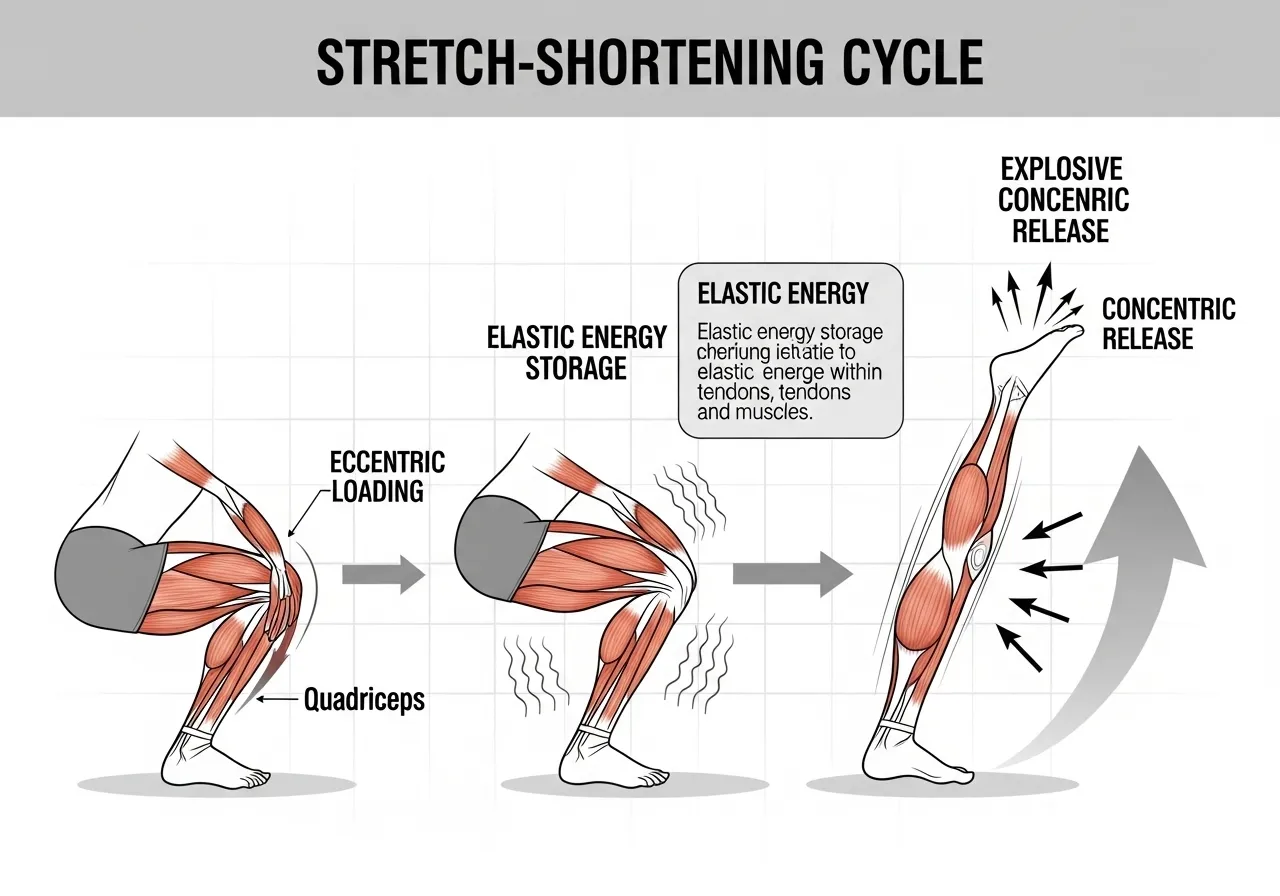
Plyometric exercises harness the stretch-shortening cycle — the mechanism by which muscles pre-load during a brief eccentric (lengthening) phase and release that stored elastic energy during the subsequent concentric (shortening) phase. When a muscle rapidly stretches immediately before contracting, it produces more force and power than a concentric contraction alone, because the elastic energy stored in the muscle-tendon unit during the eccentric phase is added to the muscular force production during the concentric phase. Trained plyometric athletes have more effective stretch-shortening cycles than untrained individuals — they store and release more elastic energy per movement and do so faster. This is why elite sprinters and jumpers can express power levels that would seem to exceed their measured maximum strength.
The Physics of Explosive Movement: Why Strength Alone Is Never Enough
Power — the rate at which force is produced — is the physical quality that determines explosive athletic performance, and it is fundamentally different from strength. Strength is the maximum force a muscle can produce; power is how quickly that force can be produced. An athlete who can squat 200 kilograms but requires two seconds to produce peak force is less powerful than one who can squat 150 kilograms but produces peak force in 0.3 seconds — and the faster force producer will sprint faster, jump higher, and change direction more effectively in competition. This distinction explains why strength training alone, without specific power development, produces athletes who are strong but not explosive: the slow-velocity strength adaptations of standard resistance training do not train the nervous system to produce force rapidly, which is the specific neuromuscular quality that explosive athletic performance requires. Plyometric training specifically develops rate of force development — the speed of force production — by training the stretch-shortening cycle (the rapid eccentric-to-concentric transition) at movement velocities and intensities that approach or replicate the demands of actual athletic performance. The result is not just stronger muscles but more responsive, faster-activating muscles that translate their strength into athletic power. Research consistently finds that adding plyometric training to strength training programs produces performance improvements in sprint speed, jump height, and change-of-direction speed that strength training alone does not produce, confirming that power development requires specific plyometric training beyond what strength work provides. Research on plyometric training and athletic performance demonstrates significant improvements in sprint time, jump height, and agility from plyometric training programs in athletes at all levels.
The Nervous System Adaptations From Plyometric Training
The initial adaptations from plyometric training are primarily neurological rather than structural — the muscles do not significantly change in the first four to six weeks of plyometric training, but their firing patterns change dramatically. The nervous system increases motor unit recruitment (more muscle fibers activated simultaneously), improves synchronization (motor units firing more coordinated rather than asynchronously), reduces inhibitory signals from Golgi tendon organs (allowing greater force production before protective inhibition activates), and shortens electromechanical delay (the time between neural signal and muscle force production). These neurological improvements collectively produce explosiveness that precedes any structural muscle changes, explaining why plyometric training produces athletic performance improvements more quickly than the slow structural remodeling of hypertrophy training. The practical implication: plyometric adaptations become measurable within two to four weeks of consistent training — athletes who begin plyometric programs can expect noticeably better vertical jump and sprint performance within one month, with continued improvement as both neurological and structural adaptations compound across months of progressive training. This rapid initial response makes plyometrics one of the fastest-acting training interventions available for athletic performance improvement, particularly for athletes who have developed significant strength through resistance training but whose nervous systems have not been trained for rapid force production.
Plyometrics and Tendon Health: The Dual Benefit of Impact Training
Tendons — the connective tissue structures that transmit muscle force to bone — respond to plyometric training through structural adaptations that improve both stiffness (more efficient force transmission) and tensile strength (greater resistance to rupture). Tendon stiffness improvements from plyometric training mean that the same muscle force produces greater joint motion, improving movement efficiency without requiring additional muscle output. This mechanical efficiency improvement is one of the primary contributors to the running economy improvements — reduced energy cost at equivalent speeds — that plyometric training produces in distance runners. Tendon tensile strength improvements from plyometric training reduce Achilles tendon, patellar tendon, and other lower extremity tendon injury risk by increasing the load these structures can sustain before damage occurs. Research on tendon adaptation to plyometric training finds significant improvements in Achilles tendon stiffness and cross-sectional area within twelve weeks of twice-weekly jump training, validating both the performance and injury prevention benefits of consistent plyometric practice. According to research on tendon adaptation to plyometric training, regular jumping exercises produce measurable tendon structural improvements that translate into both performance enhancement and reduced tendon injury risk across athletic populations.
Plyometric Training for Non-Athletes: Why Explosive Training Is for Everyone
The term “plyometric training” often evokes images of elite sprinters and professional basketball players — athletic populations whose explosive performance demands make power training obviously relevant. This association has created the false impression that plyometric training is inappropriate or unnecessary for recreational athletes and general fitness enthusiasts. The reality is opposite: the power development and bone density benefits of plyometric training are most valuable for exactly the populations who most commonly believe it is not for them. Adults who lose two to four percent of explosive force production per decade after the third decade, sedentary individuals who never developed the SSC training that athletic youth provides, and older adults whose fall risk is directly related to their explosive leg power all benefit dramatically from appropriately dosed plyometric training. The exercises do not need to be maximal depth jumps or sprint bounds — box steps with an explosive final push, jumping rope at moderate intensity, or simple vertical jumps provide sufficient plyometric stimulus for significant power and bone density adaptations in deconditioned populations. The dosing that produces meaningful adaptation in these populations is far lower than the volumes and intensities appropriate for competitive athletes — two to three sets of ten simple jumps twice per week is sufficient for meaningful adaptation in previously sedentary adults. Making plyometric training accessible rather than intimidating — presenting it as an important health practice rather than an elite athletic preparation tool — is the perspective shift that allows its most-needy populations to access its most-important benefits. ACSM physical activity recommendations for adults now include power training (including plyometric exercises) alongside traditional strength and cardiovascular recommendations, reflecting the evidence consensus that explosive training benefits health outcomes in all adult populations.
Plyometric training is the bridge between the strength that the gym builds and the explosive athleticism that sport and life demand — the training modality that converts accumulated strength into the rapid, powerful movements that define athletic performance and physical capability at every level of competition and fitness.
Plyometric Exercise Progressions: From Foundation to Advanced
Level 1: Foundation (No Training History in Plyometrics)
Beginners to plyometric training should start with low-intensity exercises that develop landing mechanics and basic reactive ability before introducing any jumping or bounding. The ability to absorb landing forces safely — the eccentric component of plyometrics — is the prerequisite for developing explosive concentric force production. Skipping this phase by jumping to intermediate exercises is the primary cause of plyometric-related overuse and acute injuries.
Squat jumps: from a squat position, jump vertically and land softly with knees bent and a controlled landing. The emphasis is on landing quality — quiet landing, knees tracking over toes, immediate stability. 3 sets of 5 repetitions with full recovery between sets. Box step-ups to stand: step up onto a box (30 to 40cm) and drive the standing leg to full extension — no jump, just a forceful step. Develops single-leg power without the landing demands of jumps. Ankle hops: small rapid hops in place using primarily the ankles and calves, minimizing knee bend. Develops the reactive ankle and Achilles elasticity that all higher-level plyometrics require. 3 sets of 10 hops.
Level 2: Development (4 to 8 Weeks of Foundation Training)
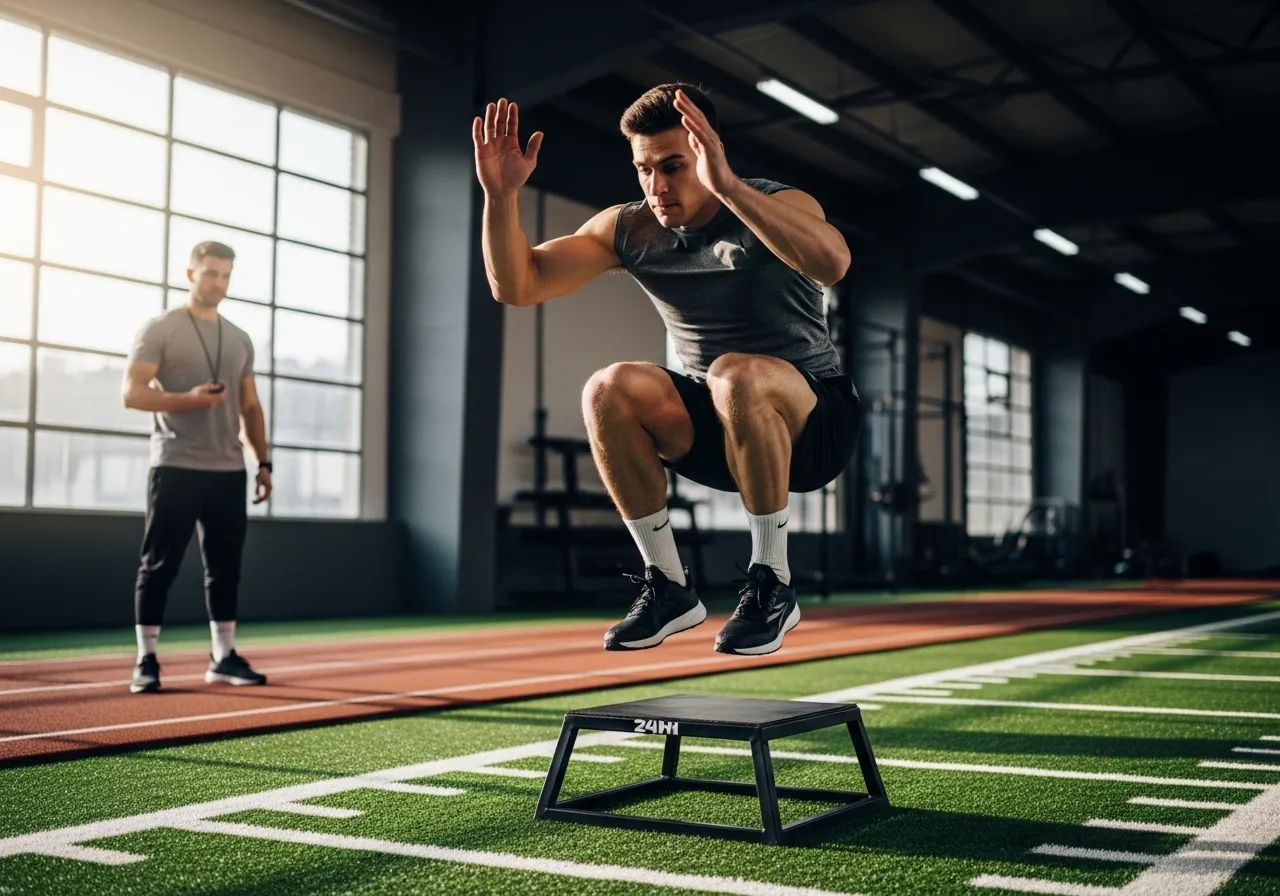
With landing mechanics established, introduce true plyometric exercises with brief ground contact. Depth drops: step off a box (30cm), land, absorb, and hold — developing eccentric landing strength that prepares the joints for depth jumps. Box jumps: jump onto a box (30 to 50cm) and stand up — the concentric jump with soft landing. Broad jumps: horizontal jump for maximum distance, land softly and hold. Lateral bounds: jump laterally and land on the opposite foot, absorbing and stabilizing before the next bound. All Level 2 exercises emphasize landing quality and full recovery between repetitions — never perform plyometrics under fatigue during this phase.
Level 3: Power Development (8 to 16 Weeks of Consistent Plyometric Training)
Reactive plyometrics with minimal ground contact time: depth jumps (step off box, immediately jump as high as possible upon landing — the landing is a trigger for the jump, not a pause), consecutive broad jumps, single-leg hops for distance. The key element: ground contact should be as brief as possible. Research on plyometric training and athletic performance finds that reactive plyometrics — those emphasizing minimal ground contact time — produce the greatest improvements in sprint speed and jumping performance. Research on plyometric training and power development confirms that high-intensity reactive plyometrics produce significantly greater power improvements than basic jump training, with the stretch-shortening cycle quality being the primary differentiating mechanism.
Ground Contact Time: The Most Important Plyometric Performance Metric
Ground contact time — the duration of foot contact with the ground during plyometric exercises — is the single most important technical metric in plyometric training because it determines whether the exercise is developing true plyometric power or simply developing strength in a jumping pattern. True plyometric exercises require ground contact times below 250 milliseconds — the threshold above which the stretch-shortening cycle’s elastic energy contribution is lost and the movement becomes a standard concentric contraction. Elite sprinters have ground contact times of 80-120 milliseconds; elite vertical jumpers make ground contact during depth jumps in 150-200 milliseconds. Recreational athletes beginning plyometric training typically have ground contact times of 300-500 milliseconds during jump landings, meaning they are not yet training the stretch-shortening cycle effectively. Reducing ground contact time — cueing athletes to “land and immediately go,” to “treat the ground like a hot surface,” or to “minimize contact time” — is the primary technical coaching point that transforms low-intensity jumping into genuine plyometric training. Measuring ground contact time requires force plates in a laboratory setting, but training for short ground contact time can be assessed practically: if the athlete can hear a distinct pause between landing and leaving the ground, contact time is too long. Silent, immediate rebounds indicate appropriate plyometric quality. Research on plyometric training and ground contact time confirms that programs emphasizing short ground contact time produce superior stretch-shortening cycle adaptations compared to programs that allow long ground contact times regardless of jump height. NSCA plyometric training guidelines specifically identify ground contact time as a primary quality indicator for plyometric exercise selection and progression.
Reactive Strength Index: Measuring Plyometric Development Progress
The Reactive Strength Index (RSI) — jump height divided by ground contact time — is the most comprehensive single metric for plyometric development because it captures both the output (jump height) and the efficiency (contact time) of the stretch-shortening cycle simultaneously. An RSI of 2.0 (for example, a 40 centimeter jump with a 0.20 second contact time) represents good plyometric performance for a recreational athlete; values above 3.0 represent elite-level plyometric ability. Tracking RSI across a plyometric training program reveals whether improvement is coming from better jump height, shorter contact time, or both — information that guides coaching emphasis. An athlete whose jump height improves but contact time remains long needs coaching focused on reactive speed; one whose contact time decreases but jump height stagnates needs continued strength development to increase force output within the shortened contact window. RSI testing requires a jump mat or video analysis software to measure contact time, making it accessible primarily in sports performance facilities. For recreational athletes without access to this measurement, tracking vertical jump height (measured by standing reach versus maximum reach on a wall) monthly provides a simplified progress indicator that, combined with the subjective assessment of ground contact quality described above, provides sufficient feedback for progressive plyometric development outside of a performance facility setting.
Landing Mechanics: The Foundation That Prevents Plyometric Injuries
Landing mechanics — how the body decelerates and absorbs force upon ground contact — is the primary determinant of both plyometric safety and plyometric effectiveness. Poor landing mechanics (stiff-legged landing, knee valgus collapse, forward trunk lean) expose the ACL, patellar tendon, and ankle ligaments to forces that exceed their structural capacity, producing the overuse and acute injuries that give plyometric training an undeserved reputation for danger. Good landing mechanics (knees bent and tracking over the toes, hips loaded, trunk upright, weight distributed across the full foot) distribute landing forces across the large muscles of the lower body in the way these structures are designed to absorb impact. Teaching and reinforcing good landing mechanics before introducing significant plyometric loading is the non-negotiable prerequisite for safe plyometric training. The landing mechanics assessment: drop from a box of moderate height (thirty to forty centimeters) and observe the landing. Knees that cave inward, a loud impact sound, or significant forward trunk collapse all indicate landing mechanics that require correction before box jumps and depth jumps are introduced. Spending two to four weeks on landing mechanics practice — box drops focusing on soft, quiet, balanced landings — is the investment that makes all subsequent plyometric training safe and productive. Athletes who skip this foundational work develop explosive power at the cost of the structural resilience that appropriate landing mechanics develop, setting themselves up for the connective tissue injuries that improperly prepared plyometric training reliably produces. NSCA landing mechanics guidelines identify landing quality as the primary safety prerequisite for all plyometric exercise progressions, recommending mechanical assessment before introducing any loading beyond bodyweight.
Plyometrics for Combat Sports: Explosive Power for Fighting Athletes
Combat sports athletes — boxers, MMA fighters, wrestlers, and practitioners of striking martial arts — have among the greatest demands for explosive power of any athletic population. The ability to generate maximum force in minimum time determines punch power, takedown success, and the explosive athleticism that separates competitive from elite performance in every combat sport discipline. Plyometric training specifically targets the rate of force development that combat sports performance requires — the ability to generate force not just maximally but rapidly, in the time windows available during competitive exchanges. Box jumps, bounding, and medicine ball throws develop the general explosive qualities that transfer to combat sports performance; more specific plyometric applications include explosive clap push-ups for punching power, rotational medicine ball slams for rotational striking power, and single-leg bounds for the explosive takedown drive. Research on plyometric training in combat sports athletes consistently finds improvements in striking power of five to fifteen percent, takedown success rates, and the general explosive athleticism that makes competitive fighting more effective across all grappling and striking disciplines. The training principle for combat athletes: plyometric training at two sessions per week — one lower body emphasis (jumps, bounds) and one upper body emphasis (medicine ball throws, explosive push variations) — provides the complete explosive development that combat sport performance requires without the volume that would compete with technical skill training for recovery resources.
The Science of Plyometric Adaptation
Neural Adaptations: The First 6 Weeks
The earliest plyometric adaptations are neural rather than structural. The nervous system learns to fire muscles more rapidly and synchronously in response to the stretch stimulus — improving the speed and coordination of the stretch-shortening cycle without any changes to muscle size or tendon structure. These neural adaptations are responsible for the rapid jump and sprint improvements that athletes report within the first four to eight weeks of plyometric training: they represent improved neural utilization of existing physical capacity rather than increases in that capacity.
Structural Adaptations: 8 to 24 Weeks
Longer-term plyometric training produces structural adaptations in the muscle-tendon unit: increased tendon stiffness and cross-sectional area that improves elastic energy storage and release capacity, and muscle fiber adaptations that improve rapid force production. These structural changes develop more slowly than neural adaptations but produce more durable performance improvements. Research on tendon adaptation to plyometric training finds measurable increases in tendon stiffness and cross-sectional area within 12 to 16 weeks of consistent training — adaptations that directly improve the elastic energy storage that differentiates elite jumpers and sprinters from strength-matched but less explosive athletes.
Force Production Rate: The Performance Metric That Matters
Rate of force development (RFD) — the speed at which muscle force increases from rest to maximum — is the performance quality most directly developed by plyometric training and most directly relevant to athletic performance. A muscle that can produce 1,000N of force but requires 500ms to do so is less athletically useful than a muscle that can produce 800N in 100ms. Plyometric training specifically develops RFD by repeatedly demanding rapid force expression — the nervous system and musculotendinous unit adapt to produce force faster, not necessarily to produce more maximum force.
Periodizing Plyometrics: The Annual Training Cycle
Plyometric training responds to periodization as reliably as strength training, with different training phases producing different adaptations that collectively produce comprehensive power development across an annual cycle. An annual plyometric periodization for a recreational athlete: foundational phase (twelve weeks), emphasizing landing mechanics, bilateral jumps, and low-intensity bounds at submaximal effort to establish the movement quality and connective tissue preparation that high-intensity plyometrics require; accumulation phase (eight weeks), progressively increasing plyometric volume (number of foot contacts per session) at moderate intensity while maintaining technique quality; intensification phase (six weeks), reducing volume but increasing intensity — maximum-effort single bounds, depth jumps, and shock-method training that pushes the stretch-shortening cycle to its maximum; competition or maintenance phase (four to eight weeks), reducing plyometric volume to maintain developed qualities while allowing recovery for the competitive season or a training reset before the next annual cycle. This structure prevents the overuse injuries that high-volume, high-intensity plyometric training without foundational preparation produces, while ensuring the foundational phase does not become permanent accommodation at low stimulus levels. Research on annual plyometric periodization in team sport athletes finds this structure produces fifteen to twenty-five percent improvements in jump height and five to ten percent improvements in sprint speed compared to pre-season plyometric-only programs, validating the superiority of year-round periodized development over concentrated pre-season plyometric blocks. Research on annual plyometric periodization supports the multi-phase approach for producing comprehensive power development that single-phase plyometric programs cannot achieve.
Plyometrics and Bone Density: The Most Underappreciated Benefit
The impact forces generated during plyometric training — particularly during box jumps, depth jumps, and bounding — produce osteogenic (bone-building) stress that stimulates bone density improvements through the same mechanostat mechanism that makes bones adapt to loading. Research on jump training and bone density finds that as few as fifty jumps three times per week produces significant bone mineral density improvements in the lumbar spine and femoral neck — the sites most vulnerable to osteoporotic fracture — within six months of consistent training. This bone density benefit is particularly significant for women, who are at higher lifetime osteoporosis risk, and for older adults whose bone density naturally declines from the third decade onward without deliberate osteogenic stimulus. Plyometric training provides osteogenic stimulus that walking, cycling, and swimming — the most common recommendations for bone health — cannot provide, because the impact forces during these low-impact activities fall below the threshold that stimulates bone adaptation. For recreational athletes whose primary motivation is performance, this bone health benefit is a valuable bonus. For older adults whose primary motivation is healthy aging, plyometric training (modified to age-appropriate intensities and impact levels) is one of the most effective bone health interventions available outside of pharmaceutical treatment. According to research on jump training and bone mineral density, regular plyometric training produces significantly greater bone density improvements than non-impact cardiovascular exercise across all age groups studied.
Plyometrics for Older Adults: Safe Power Development After 40
Power declines with age more rapidly than strength — research finds that explosive force production decreases approximately three to four percent per decade from the third decade onward, while maximal strength declines at approximately one to two percent per decade. This greater rate of power decline makes power training (plyometrics) increasingly important as athletes age, not less important as many people assume. Older adults who maintain plyometric training preserve explosive capability that age-matched sedentary adults lose progressively — the difference in functional explosive capacity between trained and untrained older adults is dramatic by the sixth decade and directly affects fall risk, athletic performance, and quality of life. The appropriate plyometric approach for adults over forty: begin conservatively with low-impact alternatives (jump rope at moderate intensity, step jumps rather than box jumps, lateral shuffles rather than maximum-effort bounds) before progressing to more intensive options; allow longer recovery between sessions (seventy-two hours rather than forty-eight); reduce total volume per session by twenty to thirty percent compared to younger athlete recommendations; and prioritize landing quality over height or distance. Research on power training in older adults consistently finds significant improvements in explosive force production from twice-weekly plyometric training, with the greatest relative benefits seen in the most deconditioned populations — those with the greatest power deficit show the largest percentage improvements from training. According to NCBI research on power training in older adults, plyometric exercises specifically targeting explosive lower body power produce significantly greater functional performance improvements in adults over fifty than strength training alone, validating the inclusion of age-appropriate plyometric training in senior fitness programs.
Plyometric Training Across Environments: Indoor, Outdoor, and Minimal Equipment Options
Plyometric training’s minimal equipment requirements make it one of the most accessible high-performance training methods available — a box, a flat surface, and sufficient space are all that most plyometric exercises require. Outdoor plyometric training on grass surfaces provides softer landing surfaces than gym floors, reducing impact forces and making it appropriate for athletes in the early stages of plyometric development or those with joint sensitivity. The variable surface of outdoor training also adds the proprioceptive challenge of adapting to slightly uneven terrain, developing the reactive stability that gym floor training on perfectly even surfaces does not provide. Indoor gym plyometric training benefits from controlled surfaces, climate control, and access to box jump platforms of precise heights that allow consistent, measurable progression. Home plyometric training with minimal equipment — bodyweight squats jumps, lateral bounds, and jumping rope — provides sufficient plyometric stimulus for meaningful power development when dedicated gym access is not available or convenient. The jump rope is one of the most underrated plyometric tools available — consistent jump rope training at moderate to high intensity develops ankle spring stiffness, lower leg endurance, and cardiovascular fitness simultaneously in a portable, inexpensive format that fits any training environment. Research on jump rope training and athletic performance finds improvements in jumping ability, agility, and cardiovascular fitness comparable to other plyometric training methods, validating it as a legitimate plyometric tool rather than merely a warm-up activity. The accessibility of plyometric training across diverse environments removes the equipment and facility barriers that limit many training modalities, making power development genuinely available to any motivated athlete regardless of training location or equipment access.
Programming Plyometrics: How to Integrate Explosive Training
When in the Session
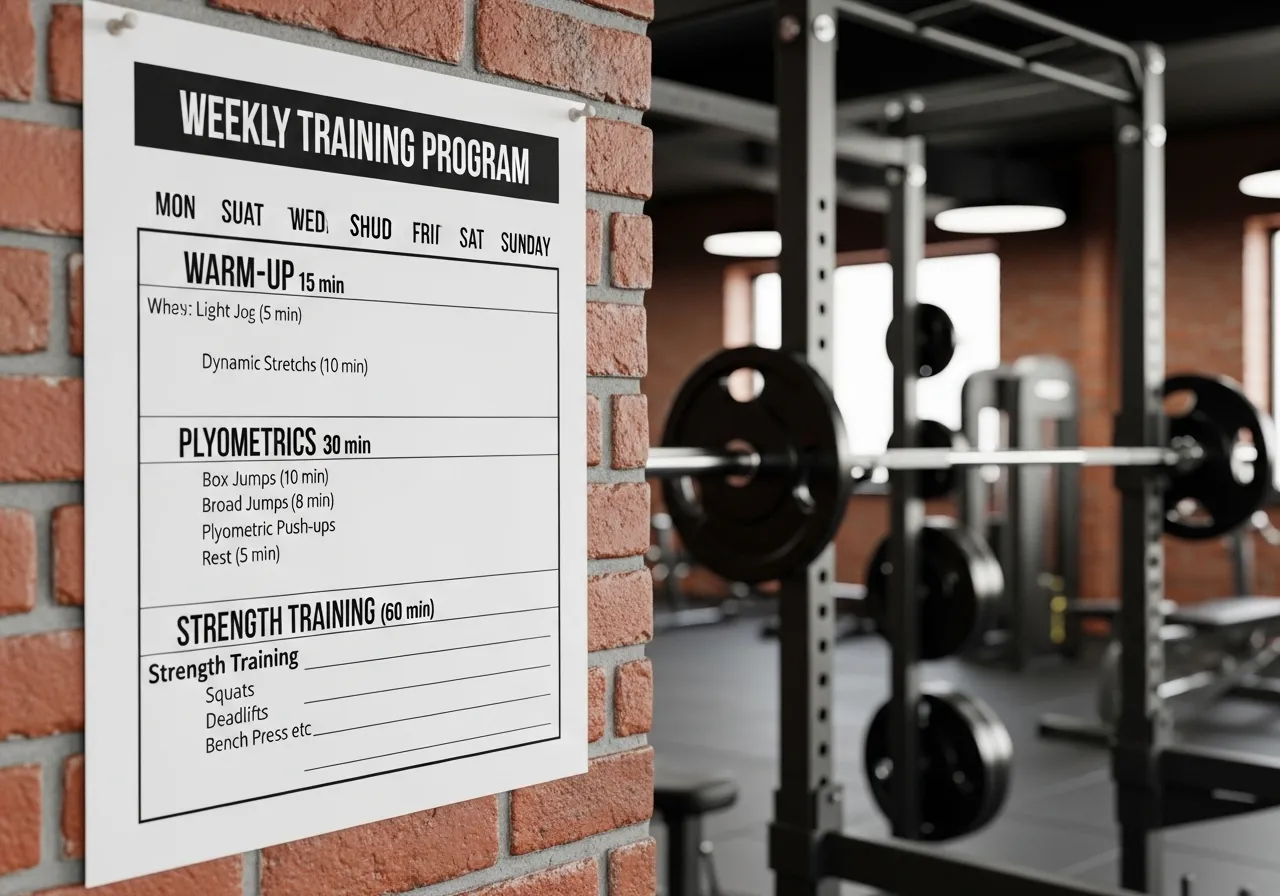
Plyometric exercises produce their greatest training effect when performed in a neurologically fresh state — at the beginning of training sessions after warm-up but before any significant fatigue from strength training or cardiovascular work. Performing plyometrics while fatigued reduces the rate of force development and teaches the neuromuscular system to express power inefficiently. The classic sequencing: warm-up (5 to 10 minutes), plyometrics (10 to 15 minutes), strength training (main session). This placement ensures maximum quality for the plyometric component and primes the neuromuscular system for the strength work that follows.
Volume: Less Is More
Plyometric volume is measured in foot contacts (individual ground contacts per session). Beginner guidelines: 80 to 100 contacts per session. Intermediate: 100 to 150 contacts. Advanced: 150 to 200 contacts. These volumes seem low compared to resistance training sets and reps, but plyometric training is neurologically demanding — each maximum-effort jump or bound demands full neural recruitment. Excessive volume produces fatigue that compromises the quality of explosive expression and defeats the training purpose. Two plyometric sessions per week for recreational athletes provides adequate stimulus without excessive joint loading. NSCA plyometric training guidelines provide detailed volume progressions and intensity classifications for all plyometric exercises used in athletic development programs.
Progressions and Recovery
Progress plyometric intensity over 4-week blocks: Block 1 — high volume, low intensity (basic jumps, 120 contacts per session). Block 2 — moderate volume, moderate intensity (box jumps, broad jumps, 100 contacts). Block 3 — low volume, high intensity (depth jumps, reactive bounding, 80 contacts). Block 4 — recovery week (50 contacts, basic exercises). This undulating pattern develops the full range of plyometric qualities — volume capacity, power expression, reactive ability — while managing cumulative joint loading that excessive high-intensity plyometric volume produces.
Programming Plyometrics for Recreational Athletes: Practical Templates
Recreational athletes who are not preparing for specific sport competition benefit from plyometric programming that develops general power and athleticism rather than sport-specific movement patterns. A practical twice-weekly plyometric program for a recreational athlete at the development phase: session one, lower body emphasis — three sets of ten box jumps (step down between reps, reset for maximum jump each time), three sets of eight broad jumps (jump as far as possible, walk back, reset), two sets of ten lateral bounds each direction; session two, combined upper and lower — three sets of eight squat jumps, three sets of eight medicine ball chest passes against a wall (throwing with maximum force and receiving the return), two sets of ten alternating leg bounds. This program provides sufficient plyometric stimulus for general power development without the specialized equipment or movement complexity of sport-specific plyometric training. Total weekly foot contacts in this program: approximately one hundred twenty, within the range recommended for intermediate plyometric training by NSCA guidelines. As fitness improves over eight to twelve weeks, progress by increasing the height of the box, increasing the number of sets, or introducing more complex movements like depth jumps (stepping off a box and immediately jumping upon landing) that provide greater stretch-shortening cycle stimulus than the foundational exercises. NSCA plyometric volume guidelines provide specific recommendations for appropriate foot contact volumes at each training level, from beginner (eighty to one hundred contacts per session) through advanced (one hundred twenty to one hundred fifty contacts per session) to elite (up to two hundred contacts per session with appropriate preparation).
Upper Body Plyometrics: The Overlooked Power Development Tool
Plyometric training is most commonly associated with lower body exercises, but upper body plyometric training — medicine ball throws, plyometric push-ups, explosive pull exercises — develops the upper body rate of force development that translates directly to throwing, punching, swimming, and any activity requiring explosive upper body power. Medicine ball chest passes, overhead throws, rotational throws, and slams replicate the throwing mechanics of sport while training the stretch-shortening cycle of the pectoral, shoulder, and core musculature. Plyometric push-ups — where the hands leave the ground during the concentric phase — develop the explosive pressing power that standard push-ups and bench press cannot develop because they do not train the maximum rate of force development needed to overcome body weight acceleration. Upper body plyometric training is appropriate for athletes in throwing sports (baseball, football, javelin), racket sports (tennis, squash), combat sports (boxing, MMA), and swimming — any activity where upper body explosiveness determines performance. For general fitness athletes, upper body plyometric training improves functional movement quality and develops the athletic capability that makes daily activities and recreational sports more effective and enjoyable. Programming upper body plyometrics at one to two sessions per week, with two to three days of recovery between sessions targeting the same upper body structures, provides the training frequency that drives power adaptations without the overuse risk that higher frequency would impose on the shoulder and elbow joints involved.
The Stretch-Shortening Cycle in Detail: How Elastic Energy Powers Athletic Movement
The stretch-shortening cycle (SSC) is the physiological mechanism underlying all plyometric training adaptations, and understanding it in detail clarifies why plyometric training produces athletic capabilities that strength training alone cannot develop. The SSC involves three sequential phases: the eccentric phase, where the muscle lengthens under load and stores elastic energy in its cross-bridges and the surrounding connective tissue (tendons and fascia); the amortization phase, the brief period between the end of eccentric loading and the beginning of concentric contraction, during which the stored elastic energy is either used or dissipated as heat depending on the duration; and the concentric phase, where the muscle shortens and generates force, augmented by the elastic energy recovered from the eccentric phase if the amortization phase is short. The key insight: elastic energy stored during the eccentric phase contributes to concentric force production for free — it does not require additional metabolic energy from ATP. This free energy contribution explains why running, jumping, and other cyclical movements are more efficient than the equivalent static contraction: the elastic energy storage and recovery of the SSC reduces the metabolic cost of each stride or jump by fifteen to twenty percent compared to movements without SSC contribution. Plyometric training specifically develops the SSC by improving the nervous system’s ability to transition rapidly from eccentric to concentric (reducing amortization phase duration), the tendon’s stiffness (allowing greater elastic energy storage per unit of strain), and the muscle’s ability to produce force rapidly at the beginning of the concentric phase before contractile proteins are fully engaged. These SSC adaptations collectively produce the explosive athleticism that strength training, which develops maximum force capacity without specifically training the SSC, cannot replicate. Research on stretch-shortening cycle mechanics and training provides comprehensive evidence for SSC-specific adaptations from plyometric training that are distinct from the maximum strength adaptations produced by resistance training.
Plyometrics and Cardiovascular Health: The Power Training Cardio Connection
Plyometric training produces cardiovascular adaptations that complement the strength and power adaptations for which it is primarily known. The repeated explosive efforts of a plyometric training session impose significant cardiovascular demand — heart rates of one hundred forty to one hundred seventy beats per minute during sprint bounds and box jump circuits rival the cardiovascular stimulus of moderate-to-vigorous running. The intermittent high-intensity nature of most plyometric protocols produces EPOC (excess post-exercise oxygen consumption) that elevates metabolic rate for two to twenty-four hours after the session, contributing to total daily energy expenditure beyond the session’s direct caloric cost. Research on plyometric training and cardiovascular fitness finds improvements in VO2 max of five to ten percent in recreational athletes following twelve-week plyometric programs — improvements comparable to those from continuous moderate-intensity cardiovascular training at similar time investments. This cardiovascular benefit from plyometric training explains why coaches in sports that require both explosive power and cardiovascular endurance (soccer, basketball, rugby) prioritize plyometric conditioning alongside traditional cardiovascular training rather than choosing between the two. The athlete who develops explosive power through plyometrics while also developing cardiovascular fitness through the conditioning demand of plyometric training achieves a more complete athletic development than one who segregates power training from cardiovascular training. Research on plyometric training and cardiovascular adaptations confirms significant cardiovascular fitness improvements from plyometric training programs independent of and additive to the power development benefits that are the primary training target.
The power development that plyometric training produces compounds across months and years into the explosive athletic capability that makes every physical activity more effective — invest in it consistently and let the results accumulate.
Plyometrics for Different Athletic Goals
For Team Sport Athletes
Basketball, soccer, rugby, and American football players need multi-directional explosive power — vertical jump for basketball, horizontal and lateral power for field sports. Multi-directional plyometrics (lateral bounds, 45-degree bounds, deceleration drills) develop the specific power qualities these sports require, not just vertical jump. Programming: 2 plyometric sessions per week year-round during off-season and preseason, reducing to once per week during competition season to maintain explosiveness while managing fatigue. The plyometric session during competition season should be short (10 to 12 minutes) and low-volume — maintenance, not development.
For Recreational Fitness Athletes
Recreational athletes who train for general fitness and health benefit from plyometrics primarily for the power maintenance that prevents the age-related power decline that occurs faster than strength decline. Rate of force development decreases at approximately twice the rate of maximum strength with aging, making power training increasingly important after age 35 for maintaining functional capacity. A modest plyometric program — 10 minutes of basic jumps and hops twice weekly — preserves the explosive capacity that functional independence and injury prevention require, at a time investment that is trivial compared to the benefit.
Frequently Asked Questions About Plyometric Training
Can beginners do plyometric training? Yes, with appropriate starting point selection. The Level 1 exercises in this article are appropriate for most healthy beginners with no lower extremity injuries. The prerequisite is the ability to perform a bodyweight squat with good mechanics — if squat mechanics are compromised, plyometric training should wait until basic movement quality is established. Beginners should start with the lowest intensity Level 1 exercises and progress through the levels based on exercise quality rather than time elapsed.
Do I need a box for plyometric training? No — many of the most effective plyometric exercises require no equipment: squat jumps, broad jumps, lateral bounds, ankle hops, and single-leg hops can all be performed without equipment. A box expands the exercise variety available and allows depth jumps, which are among the most effective advanced plyometric exercises. A 30 to 40cm plyo box is a worthwhile investment for serious plyometric training but is not required to begin.
My knees hurt during box jumps. What should I do? Knee pain during box jumps usually indicates either landing mechanics issues (knees caving inward or absorbing impact with insufficient knee bend) or that the exercise intensity exceeds current tissue preparation. Step back to Level 1 landing practice — performing deliberate controlled landing drills until landing mechanics are automatic and painless. Reduce box height. Ensure adequate hip abductor strength (through clamshells and lateral band walks) before returning to box jumps. Persistent knee pain during any plyometric exercise warrants physiotherapy evaluation before continuing.
How long before I see improvements in my jump and sprint from plyometrics? Neural adaptations that produce initial performance improvements typically appear within 4 to 6 weeks of consistent plyometric training. Measurable jump improvements of 3 to 5cm are common in this window. Structural adaptations that produce larger, more durable improvements develop over 12 to 20 weeks. Athletes who commit to 6 months of well-structured plyometric training alongside strength development consistently demonstrate jump and sprint improvements that purely strength-focused programs cannot match. Research on plyometric training adaptations confirms that consistent plyometric programs produce significant improvements in power output metrics within 8 to 12 weeks across athletic populations.
Plyometrics for Different Sports: Transfer Evidence
The research on plyometric training transfer to sport performance is extensive and consistently positive across a wide range of sports. Soccer players who added plyometric training to their regular training programs showed sprint speed improvements of three to five percent and jump height improvements of eight to twelve percent over twelve-week programs, without any reduction in soccer-specific fitness from the additional training load. Basketball players who integrated plyometric jump training showed vertical jump improvements of five to eight centimeters over eight to ten weeks, with corresponding improvements in rebounding success rates and defensive positioning that coaches rated as clearly performance-relevant. Sprinters who added plyometric training to their standard sprint training showed ten to twenty meter sprint time improvements of two to four percent — meaningful differences in competitive performance — without any reduction in top-end speed that would suggest the plyometric work was interfering with sprint development. Volleyball players who performed plyometric training showed spike jump height improvements of six to ten centimeters over twelve-week programs, with corresponding improvements in attacking success that match statistics confirmed. These sport-specific transfer findings are not surprising given the mechanism of plyometric adaptation — the stretch-shortening cycle improvements that plyometrics develop contribute to any sport movement that involves rapid force production, which includes virtually every athletic movement except those performed at very slow, controlled velocities. Research on plyometric training and sport-specific performance confirms consistent transfer from plyometric training to competitive sport performance across multiple team and individual sports, validating plyometrics as a universally beneficial training component for athletic populations regardless of sport specificity.
Plyometric Training Errors That Limit Development and Increase Injury Risk
Several consistent errors in plyometric training reduce effectiveness and increase injury risk simultaneously. Progressing too quickly — attempting depth jumps and maximum-intensity bounds before landing mechanics are established and basic jump strength is developed — produces the acute and overuse injuries that give plyometrics an undeserved reputation for danger. The fix: follow the progression ladder (landing practice, then low jumps, then medium jumps, then high-intensity training) regardless of how confident the athlete feels about skipping foundational steps. Training while fatigued — performing plyometrics at the end of a long strength training session when the nervous system and muscles are depleted — reduces both the quality of the training stimulus (the nervous system cannot fire maximally when fatigued) and the safety (fatigue-compromised landing mechanics produce the valgus collapse and impact absorption failures that cause acute injuries). The fix: always perform plyometrics at the beginning of the training session when the nervous system is fresh, or in a dedicated session separate from strength training. Ignoring bilateral asymmetry — significant differences in jump height or landing quality between left and right legs — allows the compensatory patterns that weak-leg plyometric loading creates to accumulate into overuse injuries on the stronger side. The fix: include single-leg plyometric exercises and compare performance between sides monthly. Continuing the same exercises indefinitely — performing the same ten box jumps every session for six months — produces accommodation that eliminates the explosive adaptation stimulus as the nervous system fully adapts to the repeated demand. The fix: change at least one plyometric exercise every four to six weeks, progressively increasing height, distance, or complexity to maintain the novel stimulus that drives continued power adaptation. ACSM plyometric safety guidelines identify these programming errors as the primary causes of plyometric-related injuries, validating the importance of conservative progression and session management in plyometric training programs.
Measuring Explosive Power Development: Practical Testing Protocols
Tracking plyometric development requires measuring explosive power rather than the strength and cardiovascular metrics that primary training metrics capture. The most practical explosive power tests for recreational athletes without laboratory access: the vertical jump test (standing reach versus maximum reach, measured monthly using a wall and chalk or a commercial jump mat); the standing broad jump (maximum horizontal jump distance from a standing start, measured monthly on a marked floor or outdoor surface); and the ten-meter sprint from a standing start (timed using a stopwatch or timing gates, measured every four to six weeks as sprint performance reflects the most direct expression of lower body explosive power in athletic contexts). These three tests collectively measure vertical power (jump height), horizontal power (broad jump), and sprint acceleration — the primary expressions of explosive athletic power that plyometric training develops. Testing before beginning a plyometric program, after eight weeks, and after twelve weeks reveals the specific improvements that plyometric training has produced across power expression types. Athletes who are improving in vertical jump but not broad jump may have technique limitations in horizontal force direction; those improving in broad jump but not vertical jump may have difficulty expressing power vertically — information that guides emphasis in subsequent training phases. The objectivity of these measurements, compared to subjective assessments of how training feels or how explosive one subjectively feels, provides the honest progress data that motivates continued investment in the plyometric training that produces genuine athletic development. NSCA athletic testing guidelines recommend the vertical jump and sprint as primary measures of lower body explosive power in athlete assessment protocols across all training levels.
Frequently Asked Questions About Plyometric Training
How do I know if I am ready for plyometric training?
The standard prerequisite criterion for beginning plyometric training is the ability to squat one and a half times bodyweight for one repetition — a standard developed by NSCA researchers to indicate sufficient foundational strength for the connective tissue stress of plyometric landing forces. For athletes who cannot meet this strength standard, foundational strength development should precede intensive plyometric training to reduce injury risk. However, this criterion applies to high-intensity plyometrics (depth jumps, maximum-effort bounds) rather than entry-level plyometrics (submaximal box jumps, skipping, hopping). Most people who can comfortably perform bodyweight squats and walking lunges with good form are ready for foundational plyometric exercises at submaximal intensity — the conservative progression that builds plyometric capacity while reducing injury risk. The more relevant readiness indicator is landing quality: can you land from a jump with quiet, controlled mechanics — soft knees, flat feet, upright torso — without obvious impact noise or balance disruption? Athletes who cannot land quietly and in balance are not ready for the repeated high-impact landings of intensive plyometric training regardless of their squat strength. NSCA plyometric readiness guidelines provide comprehensive criteria for plyometric training readiness assessment across different training levels and exercise intensities.
Can plyometric training replace strength training?
Plyometric training and strength training develop different qualities and cannot replace each other — they are complementary tools that together produce the complete athletic development that neither can achieve independently. Strength training develops maximum force production capacity, structural muscle development, and connective tissue strength that provides the foundation for plyometric training. Plyometric training develops the rate of force development, elastic energy utilization, and neuromuscular coordination that converts strength into explosive power. Research comparing athletes who train with strength only, plyometrics only, or combined programs consistently finds that combined programs produce the greatest improvements in both strength and power outcomes — the sum of the two modalities is greater than either alone. The optimal ratio of strength to plyometric work depends on the athlete’s current development: beginners need more foundational strength development relative to plyometrics; intermediate athletes benefit from equal emphasis; advanced athletes who have reached near-maximum strength development benefit from increasing plyometric emphasis to convert accumulated strength into higher levels of power expression.
How many plyometric sessions per week is appropriate?
Two sessions per week is the most consistently recommended plyometric frequency for recreational athletes and developing competitive athletes. This frequency provides sufficient training stimulus for power development while allowing forty-eight to seventy-two hours of recovery between sessions — the minimum recovery that the connective tissue stress of plyometric landing forces requires to prevent accumulation into overuse injury. Three sessions per week is appropriate for advanced athletes in specific power development phases with carefully managed session volume and intensity. One session per week maintains plyometric capacity but produces slower development than twice-weekly training. The quality of plyometric sessions matters more than frequency for most athletes — two sessions per week performed with maximum effort and correct technique is substantially more effective than three sessions per week performed with fatigue-compromised technique and submaximal effort. Never perform plyometric training when significantly fatigued from strength training or the previous session — the neuromuscular freshness required for maximum-effort plyometric training means it should be scheduled when the nervous system is recovered, typically on days separate from or before (not after) heavy strength training sessions.
The Long-Term Athletic Development Perspective on Plyometric Training
Plyometric training occupies a unique position in long-term athletic development models — it is both a foundational physical literacy component for young athletes and an advanced performance tool for elite competitive athletes, with meaningful applications at every stage between these extremes. In youth athlete development (ages eight to twelve), basic plyometric activities including jumping, hopping, skipping, and bounding develop the movement patterns and neuromuscular coordination that form the foundation for all subsequent athletic development. These activities appear in natural play and sport participation for active children, but are specifically incorporated into development programs to ensure all youth athletes receive this stimulus regardless of their sport participation patterns. In adolescent development (ages thirteen to eighteen), progressive plyometric loading develops the explosive power that sport performance at competitive levels increasingly demands, moving from foundational bilateral jumps through unilateral exercises to sport-specific explosive patterns. In adult recreational athletes (all ages), plyometric training maintains and develops the power qualities that recreational sport participation, physical independence, and quality of life depend on across the decades when these qualities would otherwise decline without deliberate cultivation. In senior athletes (over sixty), modified plyometric training preserves the explosive leg power that directly determines fall risk and functional independence — perhaps the most clinically significant application of plyometric training from a public health perspective. This lifespan perspective on plyometric training reveals it as not merely an athletic performance tool but a fundamental physical development practice with applications and benefits across all stages of human physical development and aging. Research on plyometric training across the lifespan supports its application from youth development through senior health maintenance as one of the most comprehensively beneficial exercise modalities available.
Plyometric training is the training modality most directly responsible for the explosive athleticism that separates physically capable adults from merely strong or fit ones — the quality that makes sport more effective, daily movement more responsive, and physical challenges more manageable. Invest in it consistently, progress it systematically, and the explosive capability that develops across months and years will transform every physical activity it touches.
Building a Plyometric Training Practice That Lasts
Plyometric training, like all physical training, produces its greatest benefits through long-term consistent practice rather than short-term intensive blocks. The athlete who performs plyometric training twice per week for five years develops power qualities that occasional intensive plyometric phases interspersed with long periods of neglect cannot replicate — the connective tissue adaptations, neuromuscular patterns, and progressive loading that long-term consistent practice develops are unavailable to intermittent training regardless of the intensity during active phases. Building the plyometric training habit requires accepting the conservative progression that injury-free long-term practice demands: the patience to begin with foundational exercises, progress conservatively based on demonstrated readiness rather than ambition, and maintain the discipline to treat plyometrics as a permanent component of athletic development rather than a tool to use intensively before a specific event or competition. Athletes who approach plyometric training with this long-term perspective develop the explosive capability that five years of consistent progressive practice produces — a level of athleticism that no short-term plyometric block can approach, and that forms a lasting physical asset that athletic activities of all kinds benefit from indefinitely. The investment in developing and maintaining plyometric training as a permanent practice returns dividends in athletic performance, injury resistance, and physical capability that compound across years into the comprehensive explosive athleticism that distinguishes physically capable adults from those who have relied on strength and endurance alone. ACSM physical activity guidelines for long-term athletic development support consistent, progressive power training across the lifespan as one of the most evidence-supported strategies for maintaining athletic capability and reducing fall and injury risk in active populations of all ages.
The plyometric training investment — patient foundational development, progressive loading, and long-term consistency — produces the explosive athletic capability that no other training approach can replicate. Begin with the fundamentals, respect the progression requirements, and build the power that transforms both athletic performance and the physical quality of daily life across years of consistent practice.
⚠️ Fitness Disclaimer: The information in this article is for general educational purposes only and does not constitute professional fitness or medical advice. Always consult a qualified healthcare professional before starting any new exercise program, especially if you have existing injuries or medical conditions. Resistance Bands: The $30 Training Tool That Belongs in Every Serious…
⚠️ Fitness Disclaimer: The information in this article is for general educational purposes only and does not constitute professional fitness or medical advice. Always consult a qualified healthcare professional before starting any new exercise program, especially if you have existing injuries or medical conditions. The Ball That Made My Conventional Training Feel Incomplete I added…
⚠️ Fitness Disclaimer: The information in this article is for general educational purposes only and does not constitute professional fitness or medical advice. Exercise carries inherent risks. Always consult a qualified healthcare professional or certified personal trainer before starting or modifying any exercise program, especially if you have a pre-existing medical condition, injury, or health…
⚠️ Fitness Disclaimer: The information in this article is for general educational purposes only and does not constitute professional fitness or medical advice. Always consult a qualified healthcare professional before starting any new exercise program, especially if you have existing injuries or medical conditions. Why the Kettlebell Is the Most Efficient Training Tool in Existence…