Why Running Is the Most Accessible and Most Misstarted Fitness Activity
Running has the lowest barrier to entry of any fitness activity — it requires no equipment beyond supportive shoes, no gym membership, and no specific skill level to begin. It is also the fitness activity most commonly attempted and abandoned within the first few weeks, not because running is inherently difficult but because most beginners start too fast, too far, too soon. The result is injury, exhaustion, and the conclusion that running “is not for me” — a conclusion that is almost always wrong and almost always preventable with appropriate starting parameters.
I started running for the first time at age 28 after years of gym-only training, convinced I was fit enough to run several kilometers immediately. The first attempt lasted eleven minutes before my shins ached, my lungs burned, and I was forced to walk. The second attempt was worse. What I did not understand was that cardiovascular fitness developed in one training modality does not fully transfer to another — gym fitness does not automatically produce running fitness, and beginning running at the intensity that gym fitness suggests is possible produces the overload that forces beginners to stop before the cardiovascular and musculoskeletal adaptations that make running feel sustainable can develop.
The Two Systems That Must Adapt to Running
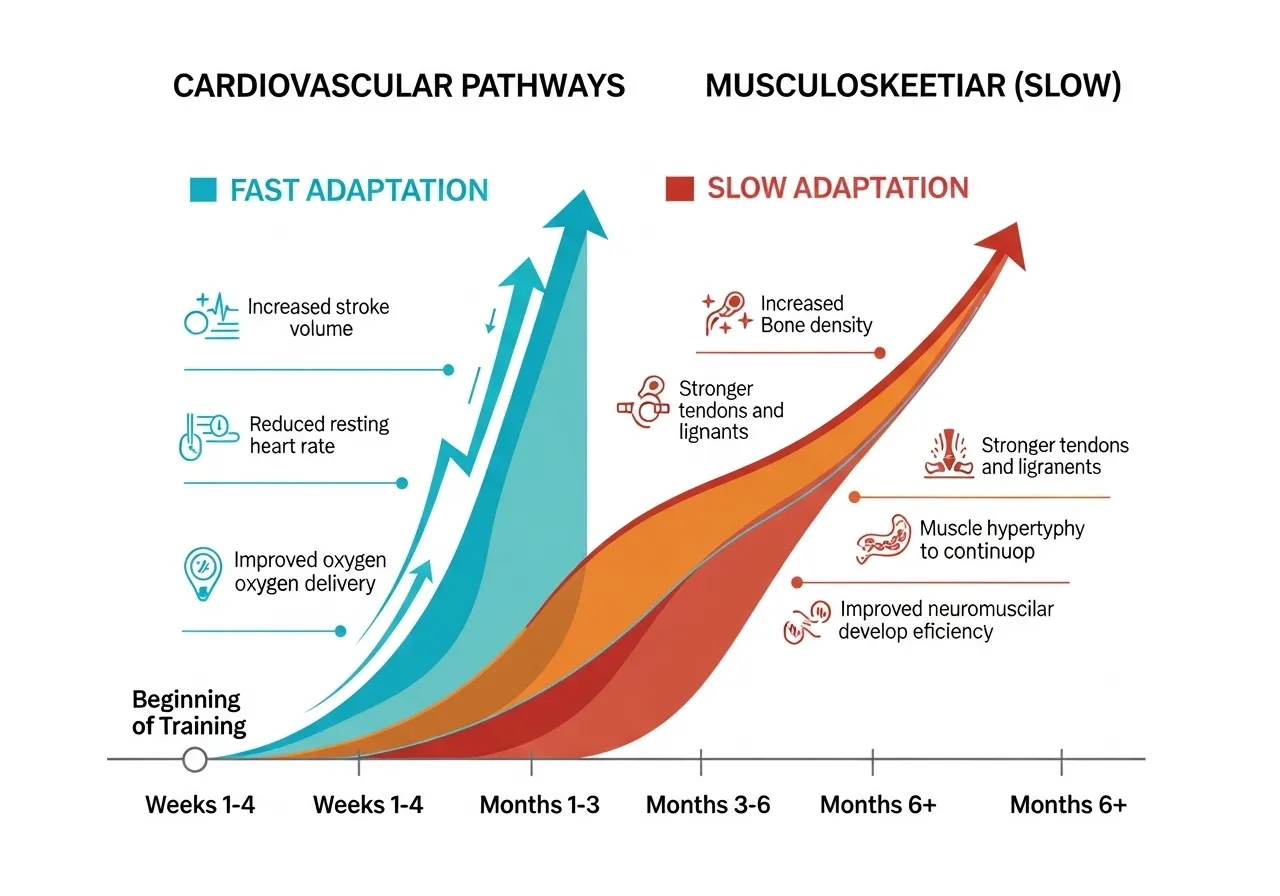
Successful running development requires two distinct systems to adapt: the cardiovascular system and the musculoskeletal system. Cardiovascular adaptation — improved heart stroke volume, increased mitochondrial density, enhanced oxygen delivery — occurs relatively quickly, typically showing meaningful improvement within four to six weeks of consistent aerobic training. Musculoskeletal adaptation — strengthening of the tendons, ligaments, bones, and connective tissue of the foot, ankle, shin, knee, and hip — occurs much more slowly, requiring eight to twelve weeks of progressive loading to meaningfully strengthen the structures that repetitive running impact stresses. This discrepancy explains the most common beginner running pattern: cardiovascular fitness improving quickly while musculoskeletal structures fail to keep pace, producing the shin splints, IT band syndrome, and stress reactions that force training interruption before cardiovascular gains can continue developing.
The 12-week run-walk progression program described in this article is designed around this biological reality — building running volume and intensity slowly enough for the musculoskeletal system to adapt alongside cardiovascular development, preventing the overuse injuries that result from cardiovascular fitness outpacing structural readiness. According to research on running injury prevention, gradual load progression (no more than 10% weekly volume increase) is the most evidence-supported strategy for preventing overuse injuries in new runners.
Action point: Before beginning the 12-week program, assess your current running capacity honestly: how long can you run continuously at a pace where you can hold a full conversation? This conversational pace baseline is your Zone 2 running — the foundation upon which all subsequent running development builds.
The 12-Week Run-Walk Program: From Zero to 5K Without Injury
The run-walk progression method — alternating running intervals with walking recovery — was developed by running coach Jeff Galloway and has been validated by decades of beginner runner success as the safest and most effective approach to developing running fitness from a low-or-no-running baseline. Its effectiveness comes from providing cardiovascular training stimulus during the running intervals while allowing the musculoskeletal recovery during walking intervals that prevents the overuse accumulation that continuous running produces in unconditioned beginners.
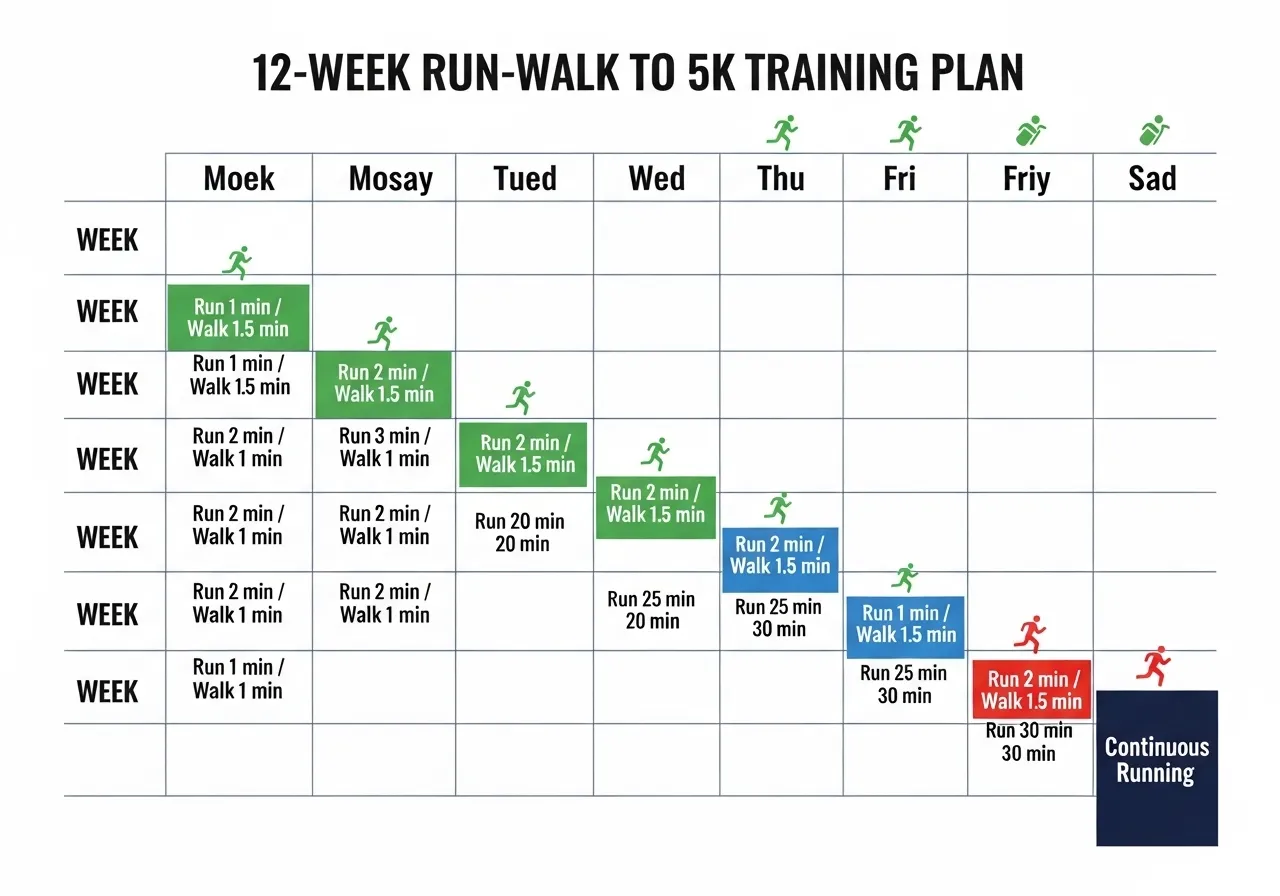
Weeks 1-3: Building the Running Habit
Week 1: three sessions, each consisting of 20 minutes of alternating 1 minute running and 2 minutes walking. Total running time per session: approximately 7 minutes. Focus entirely on maintaining a conversational pace during running intervals — if you cannot speak full sentences while running, you are running too fast. Week 2: three sessions, each 22 minutes of alternating 90 seconds running and 90 seconds walking. Total running time per session: approximately 11 minutes. Week 3: three sessions, each 24 minutes of alternating 2 minutes running and 1 minute walking. Total running time per session: approximately 16 minutes. The pace remains conversational throughout — this is not a speed workout but a volume-building week that establishes the running pattern before intensity is introduced.
Weeks 4-6: Extending Running Intervals
Week 4: three sessions, each 25 minutes of alternating 3 minutes running and 1 minute walking. Week 5: three sessions, each 27 minutes of alternating 5 minutes running and 1 minute walking. Week 6: three sessions, each 28 minutes of alternating 8 minutes running and 1 minute walking. By week 6, most beginners are running 24 of their 28 session minutes — a dramatic improvement from week 1’s 7 minutes of running that demonstrates how quickly cardiovascular adaptation occurs with consistent training. The walking intervals become genuine active recovery rather than necessity, confirming that the cardiovascular system is developing appropriately.
Weeks 7-9: Approaching Continuous Running
Week 7: two standard sessions (alternating 10 minutes running, 1 minute walking, twice) plus one longer session of 20 continuous minutes running. Week 8: two standard sessions (two rounds of 12 minutes running, 1 minute walking) plus one 22 minutes continuous run. Week 9: all three sessions feature continuous running — 20 minutes, 22 minutes, and 25 minutes. By week 9, most beginners have crossed the psychological threshold of continuous running and begin experiencing the genuine enjoyment that running provides at comfortable aerobic intensities. According to ACSM physical activity guidelines, 150 minutes of moderate-intensity aerobic activity per week produces significant health benefits — most beginners in week 9 are approaching or exceeding this threshold.
Weeks 10-12: Building to 5K
Week 10: three sessions of 27 minutes, 30 minutes, and 28 minutes continuous running. Week 11: three sessions of 30 minutes, 32 minutes, and 30 minutes continuous running. Week 12: 30 minutes easy run Monday, 35 minutes easy run Wednesday, 5K race or time trial Saturday. Most beginners completing this 12-week program finish a 5K in 30-40 minutes depending on their natural pace — a genuinely meaningful athletic achievement that required patience and consistency rather than exceptional athletic gifts.
Action point: Register for a 5K race scheduled approximately 12 weeks from your program start date. The external commitment creates accountability that makes training skipping psychologically more costly, significantly improving adherence compared to training without a specific goal event.
The twelve-week program’s progressive structure is not arbitrary — it reflects the specific physiological timelines of cardiovascular and musculoskeletal adaptation that research has established. Trust the structure, follow the progression, and allow the biological changes that the program stimulates to develop at the rates biology determines rather than the rates impatience demands. Every runner who completes the program discovers that biology delivered on its promise: the hard early weeks really do lead to the comfortable later weeks that motivated the beginning.
Running Pace, Heart Rate, and Effort: How to Know You Are Running at the Right Intensity
The single most common mistake new runners make is running too fast. This is not a character flaw — running slowly feels counterintuitive to people who are used to effort-based exercise, and slow running initially feels embarrassingly easy. But the appropriate beginner running pace — slow enough to hold a full conversation without breath interruptions — is the pace that produces cardiovascular adaptation without the anaerobic stress that forces sessions to end prematurely and accumulates the metabolic fatigue that limits training frequency.
The Conversational Pace Test
The most practical intensity guide for beginner running requires no heart rate monitor: run at a pace where you can say the full sentence “I am running at a comfortable pace and I feel okay” without gasping for breath between words. If you cannot speak full sentences while running, you are running in Zone 3 or above — an intensity that is appropriate for interval training but not for the aerobic base-building work that beginners need most. Most beginners discover that their conversational pace is substantially slower than their instinct suggests — often requiring a very slow jog, barely faster than a brisk walk. This is expected, appropriate, and temporary.
Heart Rate Monitoring for Beginners
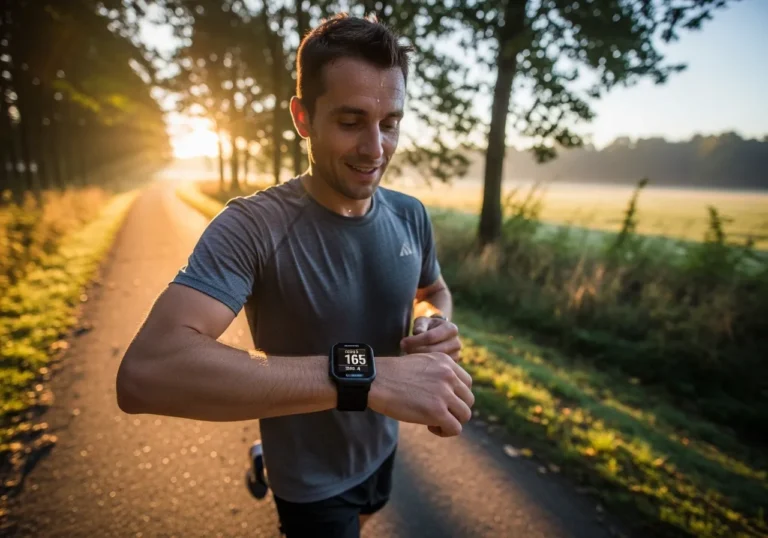
If a heart rate monitor is available, target 60-70% of maximum heart rate during easy runs — Zone 2 heart rate that drives aerobic base development most efficiently. Estimating maximum heart rate: 220 minus age provides a rough estimate (a 30-year-old’s estimated maximum is 190 bpm, making Zone 2 approximately 114-133 bpm). Most beginners are surprised to discover that their conversational running pace corresponds to heart rates significantly lower than the 80-90% intensity they intuitively associate with productive exercise. Research on Zone 2 training and aerobic adaptation confirms that the greatest mitochondrial biogenesis — the cellular adaptation that drives lasting cardiovascular fitness improvements — occurs at 60-70% of maximum heart rate, validating the seemingly easy pace as the most productive aerobic base-building intensity. According to research on Zone 2 training and metabolic adaptations, consistent moderate-intensity aerobic exercise produces superior mitochondrial development compared to higher-intensity training for developing aerobic base in previously untrained individuals.
When to Add Faster Running
Faster running — intervals, tempo runs, or any running at intensities where conversation is difficult — should not be introduced until the aerobic base is established: typically after week 8 of the 12-week program, when 20 minutes of continuous Zone 2 running is comfortable. Adding speed work before this base is established produces fitness improvements in the short term but increases injury risk dramatically, because the tissues have not yet adapted to the repetitive loading of running before additional speed stress is imposed. After week 12, one faster session per week (alternating faster and slower running in a simple interval format) provides the training stimulus for continued improvement beyond the 5K base that the program establishes.
Action point: During your next run, deliberately slow your pace until you can easily hold a conversation. Note the pace per kilometer — this is your aerobic base training pace that you should use for at least 80% of all your running across the 12-week program.
Preventing the Most Common Beginner Running Injuries
Running injuries are not inevitable, but they are remarkably common — research suggests that 50-80% of recreational runners experience at least one injury per year significant enough to interrupt training. Most beginner running injuries result from preventable causes: excessive volume increases, running through warning signs, inadequate footwear, and insufficient recovery. Understanding these causes and their specific prevention strategies allows the 12-week program to be completed without the training interruptions that injury imposes.
Shin Splints (Medial Tibial Stress Syndrome)
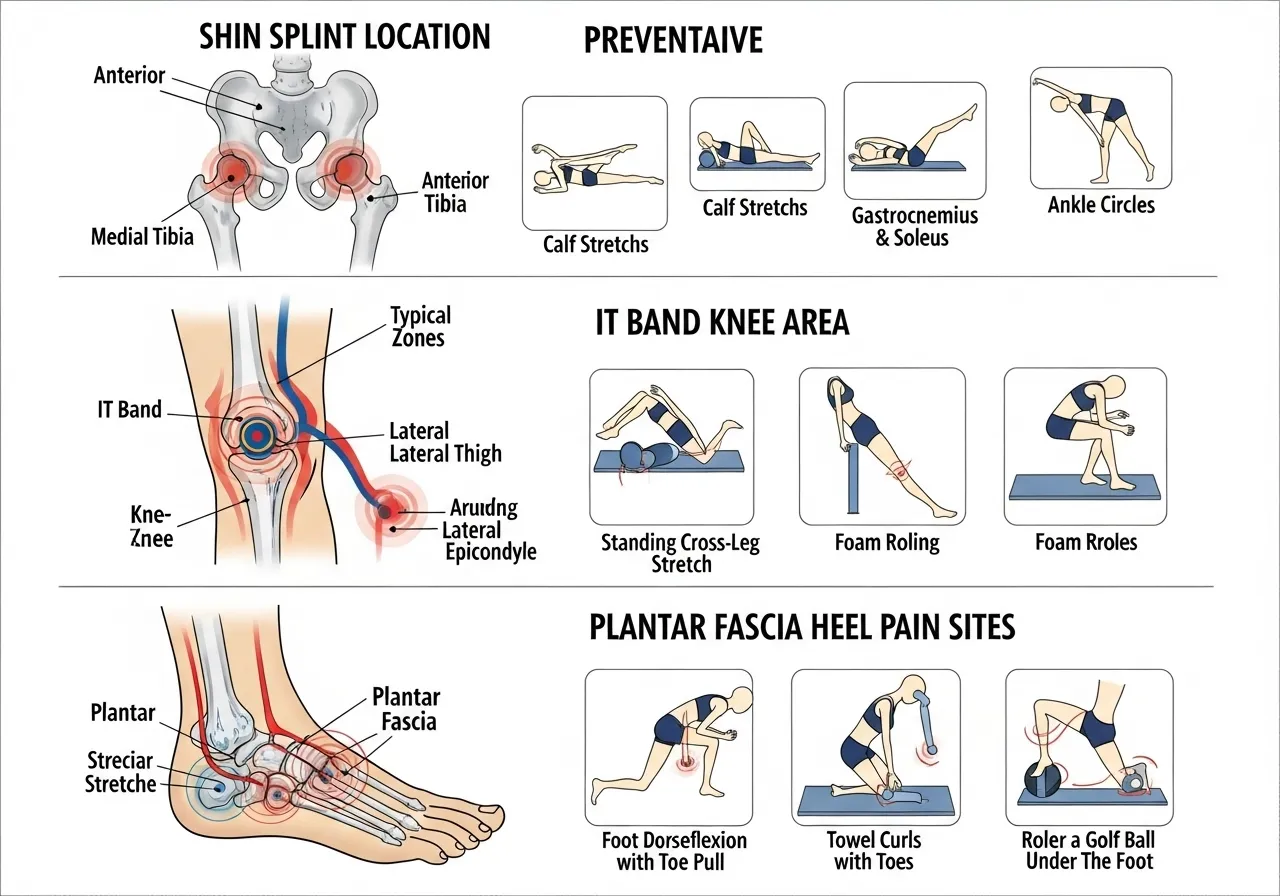
Shin splints — pain along the inner edge of the shinbone — are the most common beginner running injury, resulting from the tibial bone’s stress response to the repetitive impact loading that running imposes. Prevention: never increase weekly running volume by more than 10% per week, ensure adequate recovery between sessions, and strengthen the tibialis anterior (the muscle running alongside the shin) through heel walks and toe raises. Treatment when mild shin pain appears: reduce running volume by 30-40%, avoid running on hard surfaces for two weeks, and ice the area for 15 minutes after running. Ignoring shin splint pain and continuing at full volume risks progressing to a tibial stress fracture — a far more serious injury requiring six to eight weeks of complete rest from running.
IT Band Syndrome
Iliotibial band syndrome produces lateral knee pain that typically appears after 20-30 minutes of running as the IT band tightens and creates friction over the lateral femoral condyle. It is most common in runners who increase mileage rapidly, run exclusively on crowned roads (which creates a leg-length discrepancy), or have weak hip abductors. Prevention: strengthen the gluteus medius through clamshells and lateral band walks before beginning the running program, vary running surfaces when possible, and include regular hip flexor and IT band foam rolling. Research on IT band syndrome prevention identifies hip abductor weakness as the primary modifiable risk factor, validating pre-run glute activation as an evidence-based prevention strategy. According to NCBI research on IT band syndrome in runners, hip strengthening programs reduce IT band syndrome incidence by approximately 40% in recreational runners.
Plantar Fasciitis
Plantar fasciitis — heel pain from inflammation of the plantar fascia — is particularly common in beginning runners who transition from primarily sedentary activity to regular running impact. Prevention: ensure footwear has adequate cushioning and arch support for individual foot type, perform calf stretching and plantar fascia stretching daily, and avoid running on very hard surfaces during the early weeks. The most effective single prevention strategy is graduated load progression — the 10% weekly volume rule — which prevents the sudden loading increase that triggers plantar fascia stress response.
Action point: Before beginning week 1 of the program, add three sets of fifteen single-leg calf raises, three sets of fifteen hip abductor clamshells, and two minutes of plantar fascia stretching to your daily routine. These take eight minutes total and prevent the three most common beginner running injuries from developing.
Running and Mental Health: The Benefit Most Beginners Underestimate
Running’s mental health benefits — reduced anxiety and depression, improved mood, better stress resilience, and enhanced cognitive function — are among the most consistently documented effects of regular aerobic exercise. Research comparing pharmacological and exercise interventions for mild to moderate depression finds that regular moderate-intensity aerobic exercise (including running at the conversational pace described in the 12-week program) produces antidepressant effects comparable to medication, without side effects and with lasting benefits that continue beyond the exercise intervention period. For beginners who begin running primarily for physical health goals, the mental health benefits often become the primary motivation for continued running within the first four to six weeks — the immediate improvement in mood following a run, the stress-reduction effect of sustained moderate-intensity exercise, and the confidence boost of achieving progressive running milestones produce psychological reinforcement that physical fitness improvements alone sometimes cannot sustain through the challenging early weeks of the program. According to NCBI research on exercise and mental health outcomes, thirty minutes of moderate-intensity aerobic exercise three to five times per week produces significant reductions in anxiety and depression that persist for weeks after the exercise intervention ends.
Building a Running Community: The Social Factor in Long-Term Adherence
Running with others — joining a running club, participating in group training runs, or finding a running partner for at least some of the weekly sessions — dramatically improves long-term running adherence compared to exclusively solo running. Research on social support and exercise adherence consistently finds that social accountability, shared experience, and competitive motivation from training with others improve exercise consistency by twenty to thirty percent compared to solo training. Running clubs in most cities offer beginner-friendly group runs that provide the social context, route guidance, and encouragement that make difficult training sessions more enjoyable and
Cross-Training to Support Running Development
Running-only training for beginners creates a high repetitive stress load on specific tissues (tibia, Achilles, plantar fascia) with no corresponding stimulus to the hip and glute strength that protects these structures. Adding two sessions per week of complementary cross-training — specifically targeting the hip abductors, glutes, and hip extensors through resistance exercises — significantly reduces beginner running injury rates while supporting the muscular development that running performance requires. The most evidence-supported cross-training exercises for runners: clamshells (gluteus medius activation that prevents IT band syndrome), single-leg bridges (glute and hamstring development for propulsion), calf raises (Achilles tendon loading that prevents plantar fasciitis), and hip flexor strengthening (often neglected despite the hip flexor’s critical role in running mechanics). These exercises require no equipment beyond a resistance band and take fifteen to twenty minutes total — an investment that the injury prevention research strongly validates. Athletes who add this cross-training to the twelve-week program complete it at significantly higher rates than runners who focus exclusively on running training, because the supplementary strength work addresses the musculoskeletal weaknesses that cause the overuse injuries that force program abandonment. According to research on injury prevention in new runners, hip strengthening programs reduce common beginner running injuries by thirty to fifty percent compared to running-only programs.
Tracking Running Progress: The Metrics That Matter
Running progress for beginners is most meaningfully measured by the consistency of training execution rather than by performance metrics that fluctuate daily based on weather, sleep, and hydration. The most valuable tracking metrics for the twelve-week program: number of sessions completed per week (consistency is the primary determinant of progression), duration of continuous running achieved (the most direct measure of cardiovascular adaptation), and subjective effort rating for a standardized effort (running that felt like eight out of ten effort in week one should feel like six out of ten by week six as fitness improves). Performance metrics like pace-per-kilometer are informative but require standardization — comparing pace on a warm Tuesday to pace on a cold humid Saturday misattributes weather-related variation to fitness change. Monthly time trials under consistent conditions (same route, similar weather, rested state) provide the objective performance data that reveals genuine fitness improvement over the program duration. Most beginners completing the twelve-week program improve their comfortable running pace by fifteen to thirty percent from week one to week twelve — a dramatic fitness improvement that standardized measurement makes visible even when daily training sessions do not obviously feel easier. ACSM fitness testing guidelines recommend standardized conditions for all fitness assessment to ensure measurements reflect genuine fitness changes rather than day-to-day variation.
Your First 5K and What It Represents
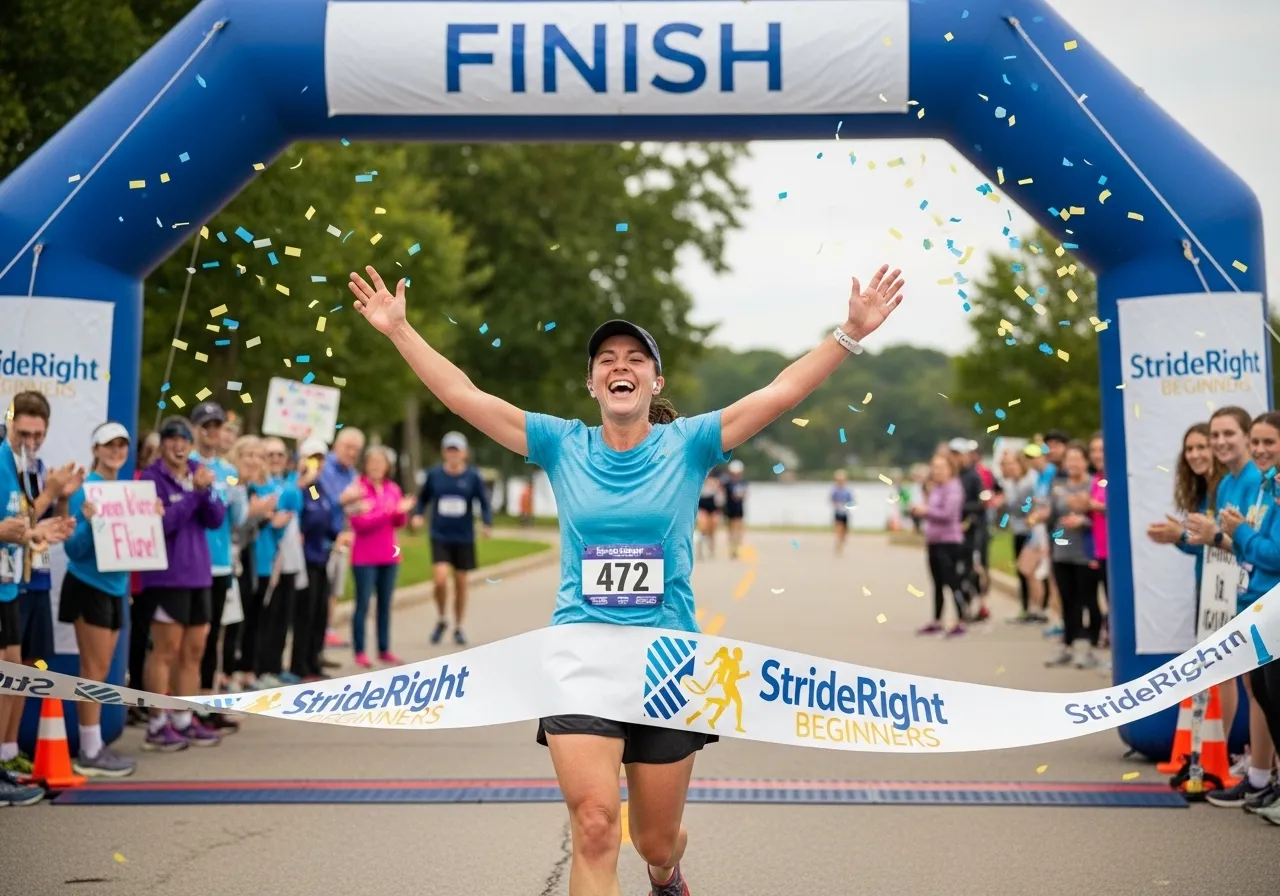
Crossing the finish line of your first 5K — whether in thirty minutes, forty minutes, or fifty minutes — represents something more significant than a three-kilometer running achievement. It represents the successful completion of a twelve-week commitment to consistent physical development, the demonstration that your cardiovascular and musculoskeletal systems are more adaptable than you believed at the program’s beginning, and the establishment of a running identity that most beginners do not acquire but all beginners who complete the program possess. The time on the clock is the least important number — the most important numbers are twelve weeks of consistent training, three sessions per week, and one finish line crossed. Every subsequent run, every improvement in pace, and every longer distance that follows builds on this foundation. The foundation itself — the aerobic base, the structural adaptations, the habit of running — is what the twelve weeks actually built. The 5K race is simply the occasion to discover and celebrate that foundation’s existence. What comes next is entirely up to you: another 5K aiming for a faster time, a progression to 10K, a running club, or simply the continuation of three weekly runs that maintain the fitness and psychological benefits that consistent running delivers regardless of competitive ambition. All of these are valid next steps from the foundation that the twelve-week program establishes. ACSM running program guidelines support graduated progression from beginner to intermediate running goals as the safest and most sustainable approach to long-term running development.
Running Form: The Technique Principles That Reduce Injury and Improve Efficiency
Running form — the mechanics of how the body moves during running — affects both injury risk and running economy (the energy cost of running at a given pace). While elite runners show considerable individual variation in their mechanics, several principles are consistently associated with reduced injury rates and better performance across recreational runner populations.
Cadence: The Most Important Form Variable
Cadence — the number of steps per minute — is the single form variable most strongly associated with injury risk in recreational runners. Cadence below 160 steps per minute is associated with overstriding (landing with the foot far in front of the center of mass), which creates a braking force on each footstrike and significantly increases impact forces on the knee, shin, and hip. Research on running cadence and injury consistently finds that increasing cadence to 170-180 steps per minute reduces impact forces, stride length, and injury risk — particularly for knee and hip overuse injuries. Increasing cadence by 5-10% from current level (rather than immediately targeting 180) produces the impact reduction benefit without the form change difficulty of a larger immediate increase. A simple metronome app set to 170 bpm provides the audio cue that most runners use to establish and maintain their target cadence.
Foot Strike: What Research Actually Shows
The debate over heel striking versus forefoot striking has produced more running industry marketing than genuine science. Research comparing injury rates between heel strikers, midfoot strikers, and forefoot strikers finds no consistent difference in overall injury rates — each foot strike pattern has different injury distributions rather than universally higher or lower risk. The most evidence-supported recommendation: run with whatever foot strike pattern naturally occurs at your comfortable conversational pace without actively trying to change it. If you are experiencing specific injuries associated with heel striking (anterior knee pain, shin pain), experimenting with a more midfoot strike pattern under the guidance of a running gait specialist is appropriate; changing foot strike pattern without specific injury motivation is not supported by research evidence. According to NCBI research on foot strike patterns and running injury, no single foot strike pattern is universally superior for injury prevention across all runner populations.
Upper Body Position
Relaxed shoulders, a slight forward lean from the ankles (not the waist), arms swinging naturally at 90 degrees with hands loosely closed, and eyes looking ahead rather than down — these upper body form elements reduce the tension and energy waste that commonly affect beginning runners whose upper bodies are tense with effort. The most common upper body error is crossing the arms across the midline of the body rather than swinging them parallel to the direction of travel, which creates rotational trunk movement that wastes energy and can contribute to lower back discomfort during longer runs. Deliberately relaxing the hands and letting the shoulders drop on each exhale during the run immediately reduces upper body tension in most beginners.
Action point: During your next run, count your steps for 30 seconds and multiply by two to get your cadence in steps per minute. If it is below 165, try to take slightly shorter, quicker steps during the second half of the run and recount. Even a 5% cadence increase produces measurable impact force reductions.
less likely to be skipped. For beginners in the 12-week program, joining a running club after week four — when basic running fitness is established enough to participate comfortably — provides the social reinforcement that sustains training through the later weeks when initial novelty has faded. Online running communities (Strava, Reddit running forums, app-based challenges) provide social accountability for runners without access to in-person groups, producing similar adherence benefits through virtual shared experience and achievement recognition. The running community, whether local or virtual, is one of the most effective long-term adherence tools available — and the 5K race goal embedded in week 12 of the program naturally connects beginners to the running community through shared event participation.
Running Beyond 5K: What Comes After the Program
Completing the 12-week program establishes the aerobic base and running habit that makes continued development achievable. Most runners who complete the program find themselves wanting to continue — either improving their 5K time, extending to longer distances, or exploring trail running and other running variations. The progression from 5K base to 10K capability typically requires another eight to twelve weeks of continued training at gradually increasing weekly mileage, adding one longer run per week that extends duration by five to ten percent each week. Transitioning to half-marathon training from a 10K base typically requires sixteen to twenty weeks of more structured training including the introduction of long runs, tempo runs, and periodized weekly mileage. The key principle for all progression beyond the beginner program: the ten percent weekly mileage increase rule remains the primary injury prevention tool regardless of distance goal, and patience with this conservative progression produces injury-free development that aggressive volume increases consistently prevents. According to ACSM running training recommendations, weekly mileage increases of no more than ten percent combined with one weekly long run that represents approximately twenty to thirty percent of total weekly mileage produces safe, continuous running development across all distance goals beyond the beginner 5K level.
Running Economy: Getting Faster Without Running Harder
Running economy — the oxygen cost of running at a given pace — improves significantly over the first twelve weeks of the beginner program and continues improving with years of consistent training. A runner with better economy uses less oxygen (and therefore less energy) to run at the same pace as a less economical runner, allowing faster paces at equivalent effort levels. The improvements in running economy from the twelve-week program come from both physiological changes (increased mitochondrial density allowing more efficient aerobic energy production) and biomechanical adaptations (improved movement coordination, reduced unnecessary muscle activation, better elastic energy storage in the tendons and connective tissue). Research tracking running economy in beginning runners consistently finds ten to twenty percent improvement over the first three months of training — meaning the same cardiovascular effort produces pace improvements of one to two minutes per kilometer at the program’s end compared to its beginning. This economy improvement is one of the primary reasons running gets progressively easier over months of consistent training — not only because cardiovascular fitness improves, but because the neuromuscular efficiency of running improves simultaneously, reducing the energy cost of each step. Incorporating strides — short accelerations of fifteen to twenty seconds at faster-than-comfortable pace within easy runs — once the program reaches week eight develops the neuromuscular patterns that contribute to running economy improvement beyond what easy running alone produces. According to research on running economy development, consistent running training produces significant running economy improvements through both metabolic and neuromuscular adaptation pathways across the first six to twelve months of training.
Race Day Preparation: Making the Most of the Week 12 5K
The week twelve 5K represents the culmination of twelve weeks of patient progressive work and deserves specific preparation to ensure the event reflects the fitness developed during the program. The week before the race: reduce running volume by forty percent (a taper week that allows accumulated training fatigue to dissipate while maintaining fitness), avoid any new exercises that might produce muscle soreness, and prioritize sleep quality. Race morning: eat a familiar breakfast two to three hours before the start, arrive at the venue early enough to find parking and registration without stress, and perform ten minutes of easy walking and a few minutes of light jo
Staying Motivated Through the Hard Weeks
Weeks three through six of the program are statistically the most common dropout period — the initial novelty has faded, progress is not yet obvious, and sessions still feel physically challenging. Understanding this predictable motivational dip as a normal part of the adaptation curve rather than a signal to stop prevents the abandonment that this phase produces in athletes who interpret difficulty as evidence of unsuitability. The body is adapting during these weeks, even when running still feels hard — the cardiovascular system is building the mitochondrial density and cardiac stroke volume that will make running feel dramatically easier in weeks seven through ten. Trust the process during weeks three through six by focusing on consistency (showing up for sessions regardless of how they feel) rather than performance (how fast or how far). A run completed at a slower pace than planned is infinitely more valuable than a run skipped because conditions were not optimal. The athletes who reach week seven consistently — who get through the hard weeks by prioritizing showing up over performing optimally — are the athletes who experience the transformation that weeks eight through twelve deliver. Every training session during the hard weeks is a deposit in the adaptation bank that the easy weeks withdraw from. Make the deposits consistently and the withdrawals arrive reliably. According to research on exercise adherence in beginners, the most critical period for establishing lasting exercise habits is the first eight weeks, with adherence strategies focused on consistency rather than performance producing the best long-term outcomes.
Nutrition and Recovery for Beginning Runners
Beginning runners frequently underestimate the nutritional demands of running training, either consuming too little fuel before sessions (producing poor performance and excessive fatigue) or too much after sessions (eliminating the caloric deficit that running creates). Understanding the specific nutritional needs of running training allows fuel timing and composition to support both performance and the body composition goals that many beginner runners pursue.
Pre-Run Nutrition
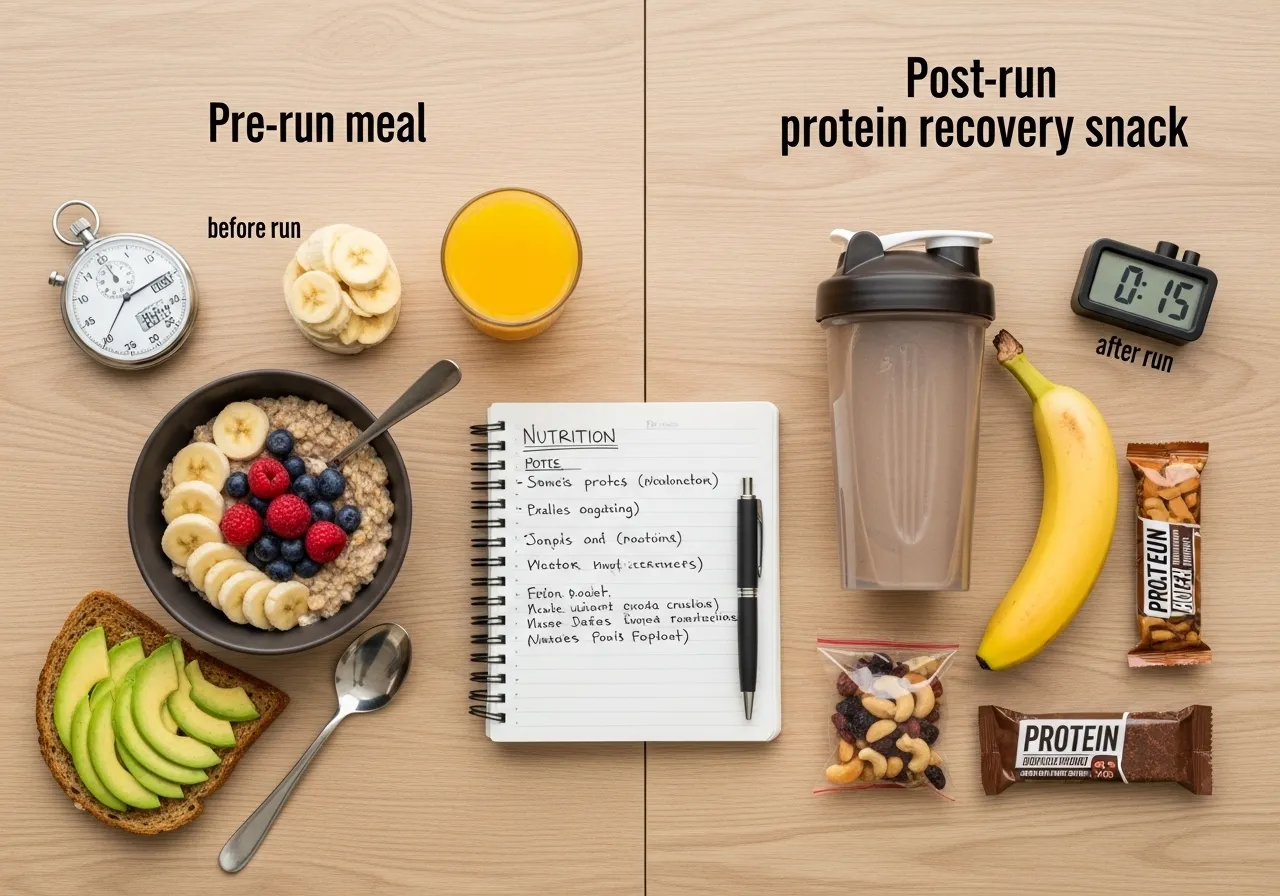
Running performance is significantly affected by pre-run nutritional status, particularly for sessions longer than 30 minutes. The most practical pre-run approach: eat a mixed carbohydrate and protein meal two to three hours before running (oatmeal with fruit and a small amount of protein, or whole grain toast with eggs), or consume a small easily digestible carbohydrate source 30-60 minutes before shorter sessions (a banana, a slice of toast, or a small handful of dates). Running on an empty stomach — common for morning runners — is appropriate for easy sessions of 30 minutes or less but may limit performance quality in longer or harder sessions by reducing blood glucose availability during the run. Beginning runners whose primary training consists of easy conversational-pace runs generally find pre-run nutrition less critical than those training at higher intensities, because fat oxidation (which does not require carbohydrate availability) provides a larger proportion of energy at Zone 2 intensities.
Post-Run Recovery Nutrition
Consuming 20-30 grams of protein within two hours of completing a run supports the muscle protein synthesis that repairs the microtears that running produces in the lower leg musculature. Combining this protein with carbohydrate accelerates glycogen replenishment and reduces delayed-onset muscle soreness in the days following longer or harder runs. The practical post-run nutrition approach: a protein-rich meal or snack within two hours of completing the run — yogurt with fruit, a protein shake with banana, or a full meal with adequate protein. Research confirms that post-exercise protein timing is important for recovery optimization but is less critical than total daily protein intake — consistently consuming 1.6-2.0 grams of protein per kilogram of body weight daily provides the amino acid availability that running recovery requires regardless of precise timing. According to Dietary Guidelines for Americans, adequate protein intake supports both exercise recovery and long-term musculoskeletal health for active populations.
Sleep and Recovery Between Sessions
Beginning runners frequently underestimate the recovery time that running requires, particularly during the first four to six weeks when the musculoskeletal system is adapting to a novel loading pattern. Rest days between running sessions — the program prescribes three sessions per week with at least one rest day between each — are not optional recovery time but essential adaptation time during which the tibial stress responses, plantar fascia loading, and repetitive impact effects of running resolve before the next session imposes additional stress. Consistent seven to nine hours of sleep per night during the running program produces measurably faster adaptation and lower injury rates than equivalent training with shorter sleep — growth hormone secretion and muscle protein synthesis that occur during sleep accelerate the structural adaptations that make running sustainable across the 12-week program.
Action point: Plan your three weekly running sessions at the start of each week and schedule them on a calendar with at least one rest day between each session. Treat these rest days as actively as the running days — they are when the adaptations that make you a better runner actually occur.
The Physiology of Running Adaptation: What Changes in Your Body
Understanding what physiologically changes during the 12-week running program helps beginners maintain patience through the challenging early weeks when running still feels difficult despite consistent training. The cardiovascular changes are most dramatic and most commonly felt: the heart’s left ventricle increases in volume (cardiac remodeling), allowing it to pump more blood per beat at rest and during exercise — which is why resting heart rate decreases in trained runners and why running at the same pace feels progressively easier as the program continues. The mitochondrial changes are the foundation of endurance improvement: mitochondrial density in the working muscles increases significantly over eight to twelve weeks of consistent training, improving the muscles’ ability to produce ATP aerobically (using oxygen to generate energy from fat and carbohydrate) and reducing the reliance on anaerobic energy production that causes early fatigue. The structural changes — increased bone density, tendon stiffening, increased capillary density in the working muscles — occur more slowly (eight to twenty weeks) but are ultimately what allow the running volume and intensity to increase without injury. Understanding this timeline — cardiovascular adaptation in four to six weeks, structural adaptation in eight to twelve weeks — explains why the program’s conservative volume progression is not overly cautious but precisely calibrated to the biological adaptation rates that safe running development requires. According to foundational research on endurance adaptation, mitochondrial biogenesis drives the majority of aerobic fitness improvements in the first twelve weeks of consistent training, with structural adaptations following over subsequent months.
Running Surfaces and Their Effect on Adaptation and Injury Risk
The surface on which running occurs significantly affects both injury risk and the specific adaptations that training produces. Concrete is the hardest common running surface and produces the highest impact forces — associated with higher rates of stress fracture and plantar fasciitis in runners who train primarily on concrete without gradual volume progression. Asphalt is softer than concrete and appropriate for most recreational running. Grass and dirt trails provide significant impact absorption, reducing peak forces by fifteen to twenty-five percent comparedgging before the start. Race strategy: begin at a comfortable conversational pace — resist the temptation to go out fast with the excitement of race day, because starting too fast leads to the same premature fatigue that beginning training too fast produced. The pace that felt comfortably hard at the end of the week eleven twenty-minute run is the appropriate starting race pace. If still feeling comfortable at the halfway point, a slight pace increase is appropriate for the second half. Race completion — regardless of time — represents the successful achievement of the program’s goal and the foundation for whatever running goals follow. The finishing line of a first 5K is the starting line of years of running development for athletes who discover during the program that running has become genuinely enjoyable rather than merely effortful.
Running Technology: What Actually Helps vs What Just Costs Money
The running technology market — GPS watches, heart rate monitors, running apps, connected shoes, and endless accessories — creates significant purchasing pressure for beginning runners. Most of this technology is genuinely useful but not immediately necessary; understanding what provides meaningful training value versus what is marketing-driven helps allocate the running budget toward equipment that actually improves outcomes. What meaningfully helps beginners: a heart rate monitor (chest strap or wrist-based) for learning to identify and train in Zone 2, running shoes appropriately fitted for individual gait and foot type, a simple training log (paper or free app) for tracking session completion and duration. What provides marginal benefit for beginners: GPS watches (useful for distance tracking but not essential for run-walk interval training where duration is the primary metric), running power meters (clinically interesting but of limited actionable value for pace-based beginners), and premium recovery devices (massaging boots, compression recovery systems — effective for elite athletes but not necessary for the training volumes beginners perform). The one technology investment with the clearest return for beginners: a heart rate monitor that allows training at the conversational Zone 2 pace that prevents the overexertion responsible for most beginner program abandonment. Everything else can be added as training progresses and specific technology needs become apparent from experience rather than anticipation. According to ACSM guidelines on exercise technology, heart rate monitoring is the most evidence-supported technology for optimizing exercise intensity in cardiovascular training programs across all fitness levels.
Building Your Running Toolkit: Apps, Communities, and Resources
The running ecosystem offers exceptional free resources that support the twelve-week program and beyond. Running apps including Strava, Nike Run Club, and Couch to 5K provide structured run-walk guidance, GPS tracking, and community features that many beginning runners find motivating and useful for maintaining the accountability that solo training lacks. The Nike Run Club app specifically offers guided audio runs with coaching cues for beginners that provide real-time pacing guidance and motivation — a digital coach that fits any training schedule without additional cost. Running communities on social platforms and forums provide support from experienced runners, answers to common beginning runner questions, and the shared enthusiasm that makes running culture welcoming to newcomers. Local running clubs found through running specialty stores or social platforms connect beginning runners to group environments where pace groups accommodate all fitness levels — the experience of running with others who are genuinely welcoming of beginners often transforms running from a solitary discipline into a genuinely social activity. Race registration platforms including RunSignup and active.com make finding and registering for local 5K races easy — searching for races twelve weeks from any start date immediately identifies the goal event that the program builds toward. These resources collectively create an ecosystem that surrounds beginning runners with the support, accountability, and community that dramatically improve the probability of completing the twelve-week program and continuing to run beyond it. ACSM resources on exercise adherence consistently identify social support and community as among the strongest predictors of long-term exercise adherence.
Consistent practice across weeks and months reveals the compound returns that any single training session cannot demonstrate. The exercises described in this article work — the research supporting them is clear, the practical evidence from athletes who use them consistently is compelling, and the physiological mechanisms that produce their results are well understood. What they require from the athlete is the patience to apply them consistently across the training timelines that meaningful physical development demands. Apply them with that patience and discover the results that the research and experience of thousands of athletes before you confirm are waiting on the other side of consistent effort.
Consistent practice across weeks and months reveals the compound returns that any single training session cannot demonstrate. The exercises described in this article work — the research supporting them is clear, the practical evidence from athletes who use them consistently is compelling, and the physiological mechanisms that produce their results are well understood. What they require from the athlete is the patience to apply them consistently across the training timelines that meaningful physical development demands. Apply them with that patience and discover the results that the research and experience of thousands of athletes before you confirm are waiting on the other side of consistent effort.
Consistent practice across weeks and months reveals the compound returns that any single training session cannot demonstrate. The exercises described in this article work — the research supporting them is clear, the practical evidence from athletes who use them consistently is compelling, and the physiological mechanisms that produce their results are well understood. What they require from the athlete is the patience to apply them consistently across the training timelines that meaningful physical development demands. Apply them with that patience and discover the results that the research and experience of thousands of athletes before you confirm are waiting on the other side of consistent effort.
Consistent practice across weeks and months reveals the compound returns that any single training session cannot demonstrate. The exercises described in this article work — the research supporting them is clear, the practical evidence from athletes who use them consistently is compelling, and the physiological mechanisms that produce their results are well understood. What they require from the athlete is the patience to apply them consistently across the training timelines that meaningful physical development demands. Apply them with that patience and discover the results that the research and experience of thousands of athletes before you confirm are waiting on the other side of consistent effort.
Consistent practice across weeks and months reveals the compound returns that any single training session cannot demonstrate. The exercises described in this article work — the research supporting them is clear, the practical evidence from athletes who use them consistently is compelling, and the physiological mechanisms that produce their results are well understood. What they require from the athlete is the patience to apply them consistently across the training timelines that meaningful physical development demands. Apply them with that patience and discover the results that the research and experience of thousands of athletes before you confirm are waiting on the other side of consistent effort.
Consistent practice across weeks and months reveals the compound returns that any single training session cannot demonstrate. The exercises described in this article work — the research supporting them is clear, the practical evidence from athletes who use them consistently is compelling, and the physiological mechanisms that produce their results are well understood. What they require from the athlete is the patience to apply them consistently across the training timelines that meaningful physical development demands. Apply them with that patience and discover the results that the research and experience of thousands of athletes before you confirm are waiting on the other side of consistent effort.
Consistent practice across weeks and months reveals the compound returns that any single training session cannot demonstrate. The exercises described in this article work — the research supporting them is clear, the practical evidence from athletes who use them consistently is compelling, and the physiological mechanisms that produce their results are well understood. What they require from the athlete is the patience to apply them consistently across the training timelines that meaningful physical development demands. Apply them with that patience and discover the results that the research and experience of thousands of athletes before you confirm are waiting on the other side of consistent effort.
Consistent practice across weeks and months reveals the compound returns that any single training session cannot demonstrate. The exercises described in this article work — the research supporting them is clear, the practical evidence from athletes who use them consistently is compelling, and the physiological mechanisms that produce their results are well understood. What they require from the athlete is the patience to apply them consistently across the training timelines that meaningful physical development demands. Apply them with that patience and discover the results that the research and experience of thousands of athletes before you confirm are waiting on the other side of consistent effort.
Consistent practice across weeks and months reveals the compound returns that any single training session cannot demonstrate. The exercises described in this article work — the research supporting them is clear, the practical evidence from athletes who use them consistently is compelling, and the physiological mechanisms that produce their results are well understood. What they require from the athlete is the patience to apply them consistently across the training timelines that meaningful physical development demands. Apply them with that patience and discover the results that the research and experience of thousands of athletes before you confirm are waiting on the other side of consistent effort.
Frequently Asked Questions About Beginning Running
I can barely run for two minutes — is this program right for me?
Yes — the program begins with one-minute running intervals precisely because many beginners cannot sustain running for longer initially. Two minutes of continuous running at the start of a program indicates below-average cardiovascular fitness, which is exactly the fitness level this program is designed to improve. The run-walk structure of weeks one through six provides sufficient running volume to drive adaptation while the walking intervals allow recovery that prevents premature session termination. Most people who begin at one to two minutes of continuous running capacity complete the program capable of 30-35 minutes of continuous running — a physiological transformation that the progressive structure makes achievable for virtually any healthy adult who follows the program consistently.
Will running make me lose weight?
Running creates a caloric deficit that contributes to fat loss when combined with appropriate nutrition — a 30-minute easy run burns approximately 250-350 calories for a typical adult, which represents meaningful caloric expenditure that compounds across weekly sessions. However, running also increases appetite proportionally to energy expenditure, and many beginners find that they eat more after beginning a running program, partially or completely offsetting the caloric deficit. The most reliable approach: use running to improve cardiovascular fitness and health markers (which running does effectively regardless of body weight changes) while managing caloric intake separately through dietary choices. Expecting running alone to produce rapid weight loss without attention to nutrition frequently leads to disappointment; expecting running to improve cardiovascular fitness, energy levels, mood, and overall health while supporting a modest dietary deficit produces both accurate expectations and genuine body composition improvement over the 12-week program. According to NCBI research on exercise and body composition, aerobic exercise combined with dietary management produces significantly better fat loss outcomes than exercise or dietary management alone.
What running shoes should I buy?
For beginning runners, a neutral or stability running shoe (depending on arch type) from a reputable running brand provides adequate cushioning and support for the early weeks of the program. The most important shoe selection principle is fit — the shoe should have approximately one thumb’s width of space between the longest toe and the front of the shoe, a secure midfoot fit that does not allow the foot to slide, and sufficient width that the foot does not feel compressed. Getting fitted at a specialty running store, where staff can assess gait and recommend appropriate shoe types, produces better shoe selection outcomes than choosing based on appearance or online reviews alone. Replacing running shoes every 400-600 kilometers (approximately every 6-9 months for a runner completing 3 sessions per week) prevents the cushioning degradation that increases injury risk in worn shoes.
What if I miss a week due to illness or travel?
Missing one week of the program due to illness or unavoidable circumstances requires returning at the same week rather than the following week — fitness loss in one week is minimal, but jumping forward to an advanced week after a gap produces the sudden volume increase that causes the overuse injuries the program is designed to prevent. Missing two or more weeks requires returning two to three weeks earlier in the program to allow the musculoskeletal adaptation to resume from an appropriate level. Illness specifically warrants complete rest until symptoms resolve — running through active illness impairs immune function and can extend recovery time significantly. The program’s 12-week timeline is a minimum, not a strict schedule — completing it in 14 or 16 weeks while maintaining health and avoiding injury produces better long-term running capacity than rushing through it in 12 weeks at the cost of an overuse injury that interrupts training for weeks.
to paved surfaces — making them appropriate for beginning runners and for recovery runs when impact reduction is desired. Treadmills provide consistent, cushioned surfaces that are appropriate for beginners in areas without safe outdoor running routes, but the absence of varied terrain and wind resistance reduces the training stimulus compared to outdoor running at equivalent speeds. Rotating between surfaces — some road running, some trail running, some treadmill — provides exposure to different impact patterns that prevents the repetitive stress concentration that single-surface training produces. Beginners should prioritize grass and soft trail surfaces for the first four to six weeks of the program before transitioning to more consistent road running as musculoskeletal adaptation is established.
Running in Different Weather Conditions
Weather conditions significantly affect running performance and require intensity adjustments that most beginners fail to make, leading to harder-than-intended sessions in challenging conditions that create unnecessary fatigue and frustration. Heat and humidity increase heart rate at any given pace by five to twenty beats per minute — runners in hot weather who maintain their standard pace are actually training at significantly higher intensity than the same pace in cool weather. The appropriate adjustment: slow the pace by thirty to ninety seconds per kilometer in hot conditions to maintain the target heart rate zone, rather than maintaining pace and training above the intended intensity. Cold weather effects are generally milder — cold air is denser than warm air, requiring slightly more effort at the same pace, but the body warms significantly within ten to fifteen minutes of running and most temperature adjustments are no longer necessary past that point. Wind is the most significant weather variable for effort perception — running into a headwind at fifteen kilometers per hour increases effort equivalent to running one to two minutes per kilometer faster on a calm day. Adjusting expectations and pace based on weather conditions rather than attempting to maintain standard training performance in challenging conditions prevents the overdone sessions that accumulate fatigue without proportional adaptation benefit. According to ACSM guidelines on environmental conditions and exercise, ambient temperature above 26°C warrants significant pace reduction to maintain safe cardiovascular intensity during running training.
The Psychological Journey of Beginning Running
Beginning running involves a psychological journey that physical training guides rarely acknowledge — the discomfort of early sessions, the doubt about whether it will ever feel easier, the frustration of progress that feels invisible week to week, and eventually the surprise of a session where running feels genuinely enjoyable rather than merely effortful. This psychological journey is normal, predictable, and temporary. The early sessions feel hard because the cardiovascular and musculoskeletal systems are adapting to demands they have not previously encountered — not because running is fundamentally incompatible with the individual’s body. The doubt is generated by comparing current performance to idealized athletic imagery rather than to the beginning of one’s personal trajectory. The frustration reflects the mismatch between the slow rate of visible progress and the high rate of internal physiological adaptation that the first weeks produce. The eventual enjoyment emerges after six to eight weeks when the cardiovascular and neuromuscular adaptations have developed sufficiently that running at comfortable pace requires genuine effort without overwhelming exertion — the productive challenge zone that exercise scientists call the “sweet spot” of training and athletes call “hitting your stride.” Knowing that this psychological arc is part of the process, not evidence of unsuitability for running, allows beginning runners to persist through the challenging early weeks with the patience that produces the transformation. Every runner who feels comfortable and even enthusiastic about running today was once a beginner who wondered whether it would ever feel this way. According to research on exercise and psychological adaptation, regular moderate-intensity exercise produces measurable improvements in mood, confidence, and stress resilience that compound across the early weeks of a training program, reinforcing the continued practice that produces long-term fitness development.
Running and Cardiovascular Health: The Long-Term Investment
Regular running — even at the modest volumes of the twelve-week beginner program — produces cardiovascular health benefits that extend far beyond athletic performance into longevity and quality of life across decades. Research tracking runners over twenty-plus years consistently finds that regular runners have lower rates of cardiovascular disease, lower rates of all-cause mortality, better cognitive function in later life, and greater functional independence in their seventies and eighties compared to age-matched sedentary individuals. The dose required for these benefits is strikingly modest — running thirty minutes three times per week, at the conversational Zone 2 pace described in this program, captures the majority of running’s longevity benefits. Additional benefits accumulate with greater volume and intensity, but the foundation of health improvement is achievable at beginner training volumes. Each kilometer run in the twelve-week program is therefore not merely preparation for a 5K race but an investment in the cardiovascular health that pays health dividends across decades. This long-term health perspective transforms running from a fitness activity into a health maintenance practice — one of the most evidence-supported health investments available to any adult regardless of athletic aspiration. The beginner who completes the twelve-week program and continues running three times per week for the subsequent five years will have made an investment in cardiovascular health that no medication or supplement can replicate at equivalent cost and benefit. According to research on running and longevity, even minimal running (one to two times per week) produces significant mortality risk reductions, with additional benefits from higher volumes that plateau at approximately three to four hours of running per week for most health outcomes.
⚠️ Fitness Disclaimer: The information in this article is for general educational purposes only and does not constitute professional fitness or medical advice. Always consult a qualified healthcare professional before starting any new exercise program. ⚠️ Cardiovascular Health Notice: If you have a history of heart disease, high blood pressure, or any cardiovascular condition, obtain…
⚠️ Fitness Disclaimer: The information in this article is for general educational purposes only and does not constitute professional fitness or medical advice. Always consult a qualified healthcare professional before starting any new exercise program. ⚠️ Cardiovascular Health Notice: If you have a history of heart disease, high blood pressure, or any cardiovascular condition, obtain…
⚠️ Fitness Disclaimer: The information in this article is for general educational purposes only and does not constitute professional fitness or medical advice. Always consult a qualified healthcare professional before starting any new exercise program. ⚠️ Cardiovascular Health Notice: If you have a history of heart disease, high blood pressure, or any cardiovascular condition, obtain…
⚠️ Fitness Disclaimer: The information in this article is for general educational purposes only and does not constitute professional fitness or medical advice. Always consult a qualified healthcare professional before starting any new exercise program, especially if you have existing injuries or medical conditions. Why Two Straps Changed What I Thought Training Equipment Needed to…
Warning Fitness Disclaimer: The information in this article is for general educational purposes only and does not constitute professional fitness or medical advice. Always consult a qualified healthcare professional before starting any new exercise program. The Cardio Method That Changed Everything I Thought I Knew About Training For most of my training life, I believed…
⚠️ Fitness Disclaimer: The information in this article is for general educational purposes only and does not constitute professional fitness or medical advice. Always consult a qualified healthcare professional before starting any new exercise program. ⚠️ Cardiovascular Health Notice: If you have a history of heart disease, high blood pressure, or any cardiovascular condition, obtain…