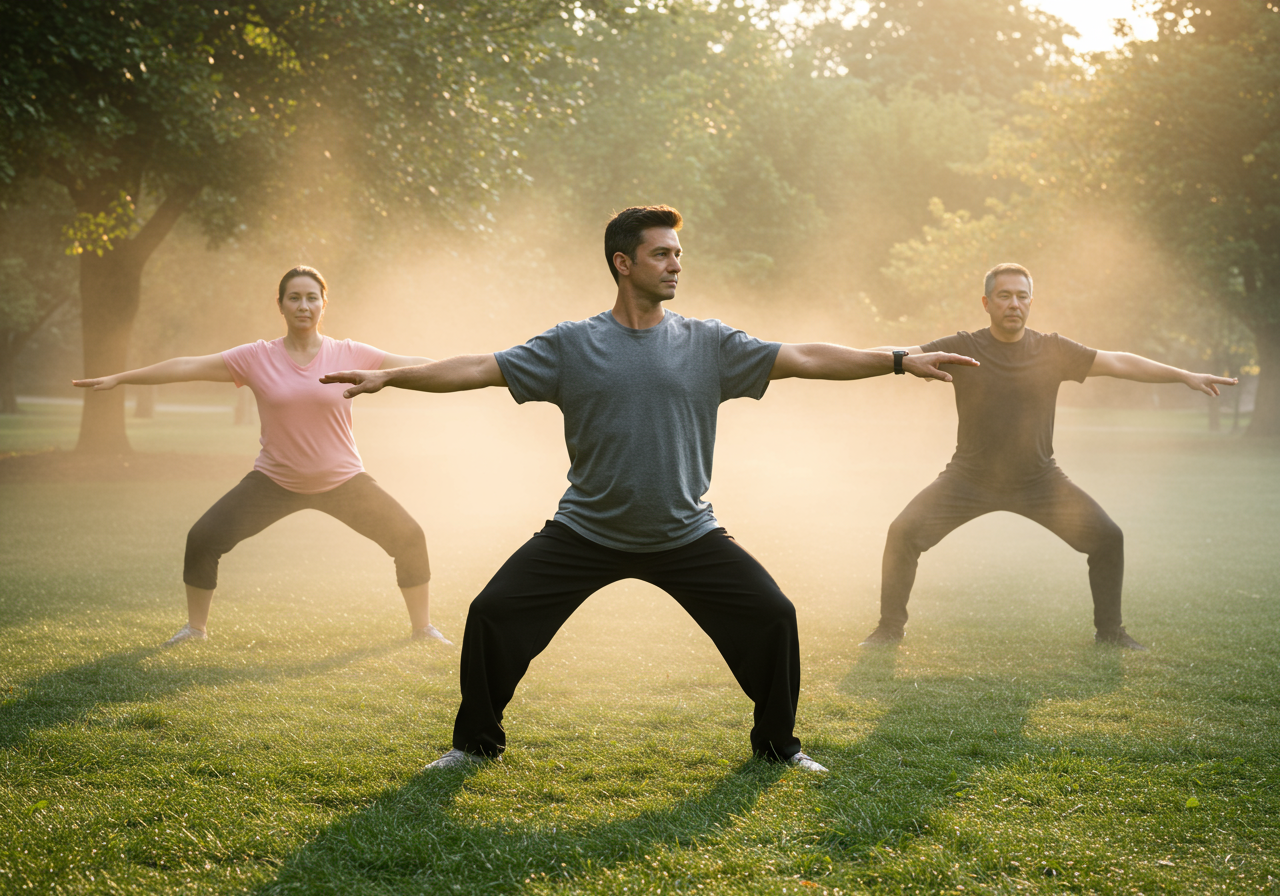
Tai Chi: Gentle Movements for Body & Mind
Whole-Body Blueprint: Tai Chi at the Center of Your Week

Build a balanced plan that puts Tai Chi at the core
Tai Chi supports balance, posture, and joint health. I make it the anchor. Then I add simple strength and gentle cardio. This pairing improves stability and energy without burnout.
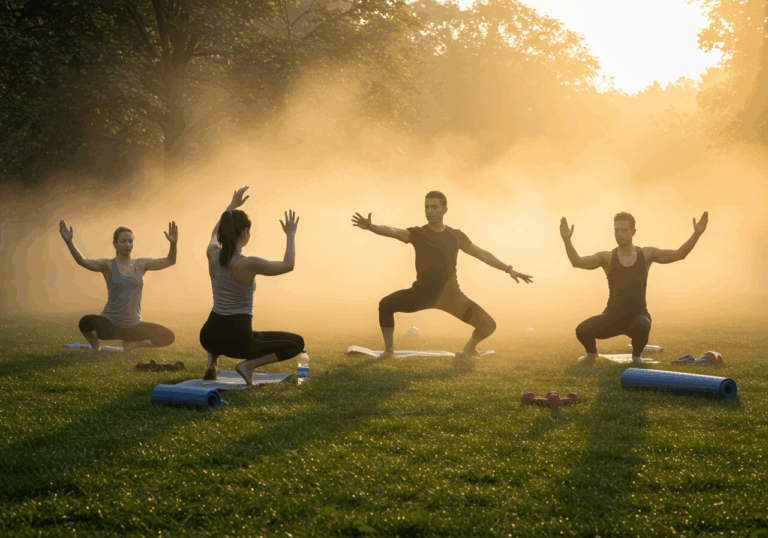
Tai Chi teaches alignment. You stack head over ribs over pelvis. You keep knees tracking toes. Your breath stays smooth and quiet.
I structure weeks for beginners first. I then scale volume and complexity. My clients feel more grounded and less tense within two weeks.
| Day | Main Focus | Details |
|---|---|---|
| Mon | Tai Chi + Walk | 20–30 min form + 20 min walk, HR Zone 2 |
| Tue | Strength | Full-body: 3×8–10, light to moderate load |
| Wed | Tai Chi + Mobility | 25 min flow + 10 min hips and spine |
| Thu | Cardio | 30 min cycling or brisk walk, Zone 2 |
| Fri | Strength + Tai Chi | Strength 30 min + 10 min quiet standing |
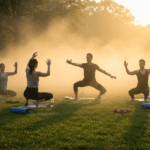
| Sat | Tai Chi Outdoors | 30–40 min form; breathe with scenery |
| Sun | Active Rest | Easy walk or stretching, 20 minutes |
My Garmin watch keeps me honest with heart rate zones. Zone 2 work feels conversational. Tai Chi usually stays in Zone 1 to low Zone 2.
I keep lifts simple. I use goblet squats, rows, hinges, and carries. This strength supports stable stances and smooth weight shifts.
Tai Chi Fundamentals: Steps, Stances, and Flow

Learn the shapes that make every movement feel light and stable
Good Tai Chi starts with simple shapes. I teach posture first. Then I add stepping. Finally, I layer flow and intent.
Practice these steps with slow transitions. Feel weight pass from one foot to the other. Keep your breath quiet and smooth.
| Drill | How To | Reps/Time | Rest |
|---|---|---|---|
| Wu Ji Standing | Feet hip-width, soft knees, long spine, quiet gaze | 2–5 minutes | 60 seconds |
| Weight Shifts | Shift 70% to one leg, keep knee tracking toes | 10 each side | 30 seconds |
| Bow Stance | Front knee soft, back leg long, hips square | 5 holds x 20–30 sec | 30 seconds |
| Silk Reeling | Circle hands while hips spiral gently | 2 minutes | 30 seconds |
Now blend drills into a short form. I use a simplified Yang sequence. It teaches timing without overwhelm.
Move each posture with three slow breaths. Shift weight with intent. Keep palms soft and elbows heavy.
Modifications help beginners stay safe. Use a wall for balance. Shorten steps. Reduce depth. Stay pain-free always.
Your Progress Path: From First Steps to Skilled Flow

Advance volume, control, and awareness with clear metrics
I set simple targets first. I then increase time, posture depth, and sequence complexity. This keeps progress steady and safe.
| Level | Session Length | Focus | Metrics |
|---|---|---|---|
| Beginner Weeks 1–4 | 15–25 minutes | Posture, weight shifts, 8-form | Balance 10–20 sec, RPE 3–4 |
| Intermediate Weeks 5–8 | 25–40 minutes | Deeper stances, longer holds | Balance 30–45 sec, RPE 4–5 |
| Advanced Weeks 9–12 | 35–50 minutes | Complex transitions, eyes-soft focus | Balance 60+ sec, RPE 5–6 |
Energy stays mostly in Zone 1–2. I check this with my Garmin. Tai Chi should feel restorative, not draining.
Strength sessions progress slowly. I add 2.5–5 lb each week when form stays crisp. I log all sessions in Strava.
| Marker | Start | Week 6 | Week 12 |
|---|---|---|---|
| Single-leg balance (eyes open) | 18 sec | 36 sec | 52 sec |
| Resting Heart Rate | 66 bpm | 62 bpm | 60 bpm |
| Hamstring ROM (sit-and-reach) | +2 cm | +5 cm | +7 cm |
| VO2 max estimate | 36 ml/kg/min | 39 ml/kg/min | 41 ml/kg/min |
My results after 12 weeks felt clear. VO2 max rose about 8%. Resting HR dropped 6 bpm. HRV improved by 12–15 ms.
Clients report similar gains. They balance longer. They feel less joint ache. They manage stress better during busy weeks.
I use MyFitnessPal to track protein. I also use Garmin for HR and HRV. I share sessions to Strava for accountability.
Tools you can use: Garmin, Strava, MyFitnessPal.
Fuel, Recovery, and Fixes for Common Stalls

Support training with simple nutrition and reliable recovery habits
Recovery magnifies the benefits from Tai Chi and strength. I keep it simple and consistent. Good fuel and sleep win.
Calorie targets depend on your goal. I set a gentle 300–400 kcal deficit for fat loss. I use maintenance on heavy weeks.
My basics: 7–8 hours sleep, 10-minute evening breath work, and a 20-minute walk most days. These lift energy fast.
| Problem | Likely Cause | Fix |
|---|---|---|
| Plateau in balance | Not enough single-leg time | Add 2×30 sec holds each side, three days weekly |
| Knee discomfort | Stance too deep or twisted | Shorten stance, align knee with second toe |
| Low energy | Under-fueling or poor sleep | Increase carbs around training; target 7–8 hours sleep |
| Motivation dips | Sessions feel long or complex | Use 10-minute micro-sessions; track streaks |
| Back tightness | Over-arched spine | Stack ribs over pelvis; reduce depth; add cat-cow |
Supplements I actually use: creatine 3–5 g daily, magnesium glycinate 200–400 mg, and vitamin D as needed. I confirm levels with my doctor.
Mistakes I made: I skipped warm-ups once and strained a calf. I now do calf rocks and ankle circles first. I also keep shoes flat and flexible for better foot feel.
Real Outcomes: My Data and Client Wins

Track what matters and confirm change with long-term result interpretation
Good plans deserve proof. I measure balance, mobility, heart markers, and how you feel. We retest every four weeks.
| Test | Target | Why It Matters |
|---|---|---|
| Single-leg stance | 45–60 sec each side | Predicts fall risk and ankle stability |
| 30s sit-to-stand | >14 reps | Tracks leg strength and endurance |
| 2-minute step test | ≥80 steps | Estimates cardio capacity |
| Sit-and-reach | +5–8 cm gain | Shows hamstring and back mobility |
My 12-week block numbers: body mass −3.4 kg, waist −5.2 cm, VO2 max +8%. Balance rose from 18 to 52 seconds. Hamstring reach improved by 7 cm.
Maria, 58, knee osteoarthritis: “Pain went from 6/10 to 2/10.” She now balances 40 seconds. She walks stairs with confidence again.
Jason, 34, desk job: “Back stiffness faded in week three.” He now does 16 sit-to-stands. His resting HR dropped from 71 to 64 bpm.
Priya, 42, postpartum: “The calm focus reduced overwhelm.” She completes the 8-form smoothly. Her HRV increased by 10 ms.
What did not work for me: doing HIIT on Tai Chi days. Fatigue diluted focus. Fat loss improved when I kept HIIT separate.
What worked better: steady Zone 2 cardio paired with Tai Chi. I saw faster waist loss and better sleep quality.
I keep measurements inside Garmin and MyFitnessPal notes. I also write one sentence about mood and energy after each session.