The Bulgarian Split Squat: Why One Leg at a Time Builds More Muscle Than Two
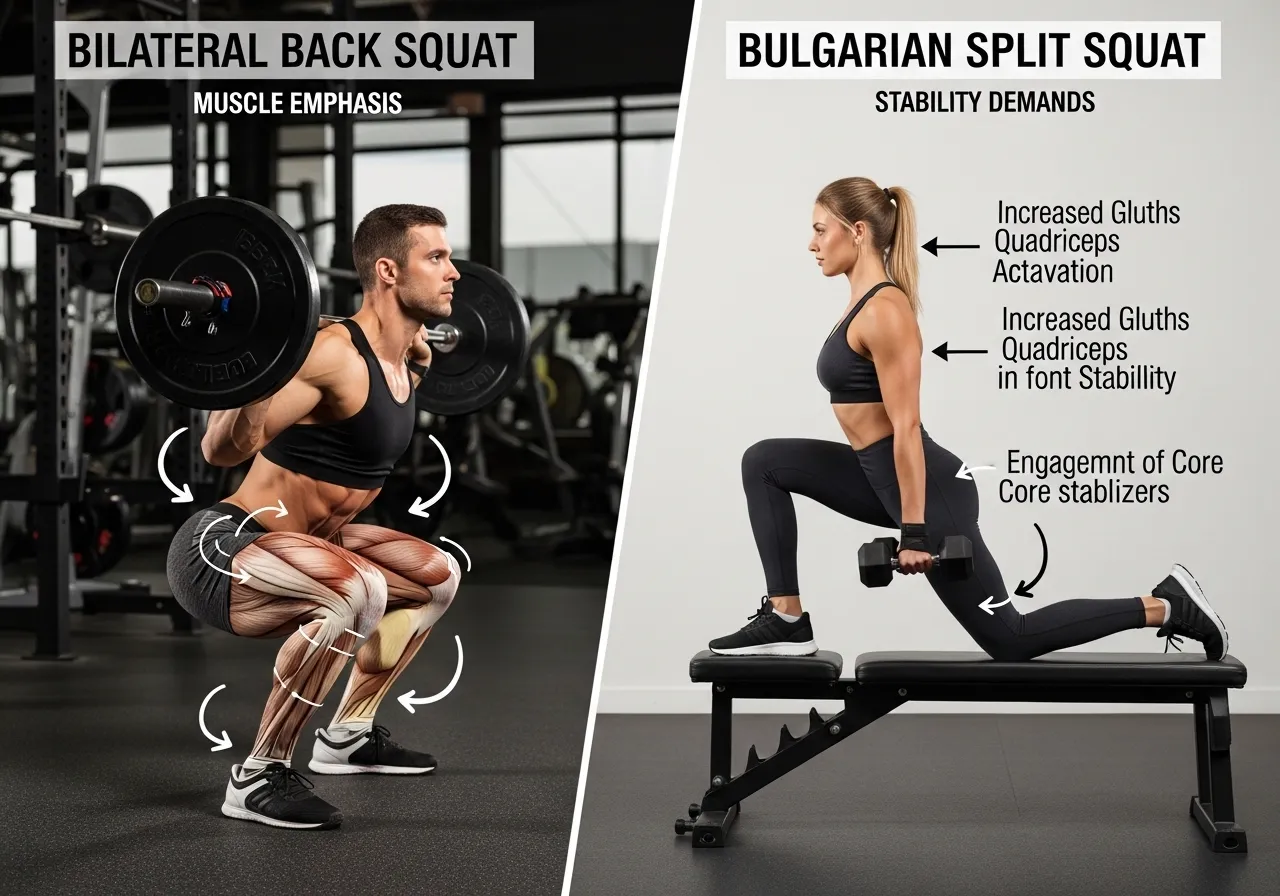
Why One Leg at a Time Builds More Muscle Than Two
For the first three years of serious training, I avoided the Bulgarian split squat. It looked uncomfortable, it was uncomfortable, and my bilateral back squat was progressing fine — so I told myself the split squat was unnecessary. Then a recurring right knee issue forced me off bilateral squatting for six weeks, and I spent those six weeks doing nothing but Bulgarian split squats with moderate dumbbells.
When I returned to bilateral squatting, my squat had not declined. It had improved by approximately 10kg. The six weeks of unilateral work had corrected a left-right strength imbalance I had never known existed, improved my hip flexor mobility enough to change my squat depth, and developed the gluteus medius activation that my bilateral squatting had never adequately trained. I have programmed the Bulgarian split squat as a primary lower body exercise ever since.
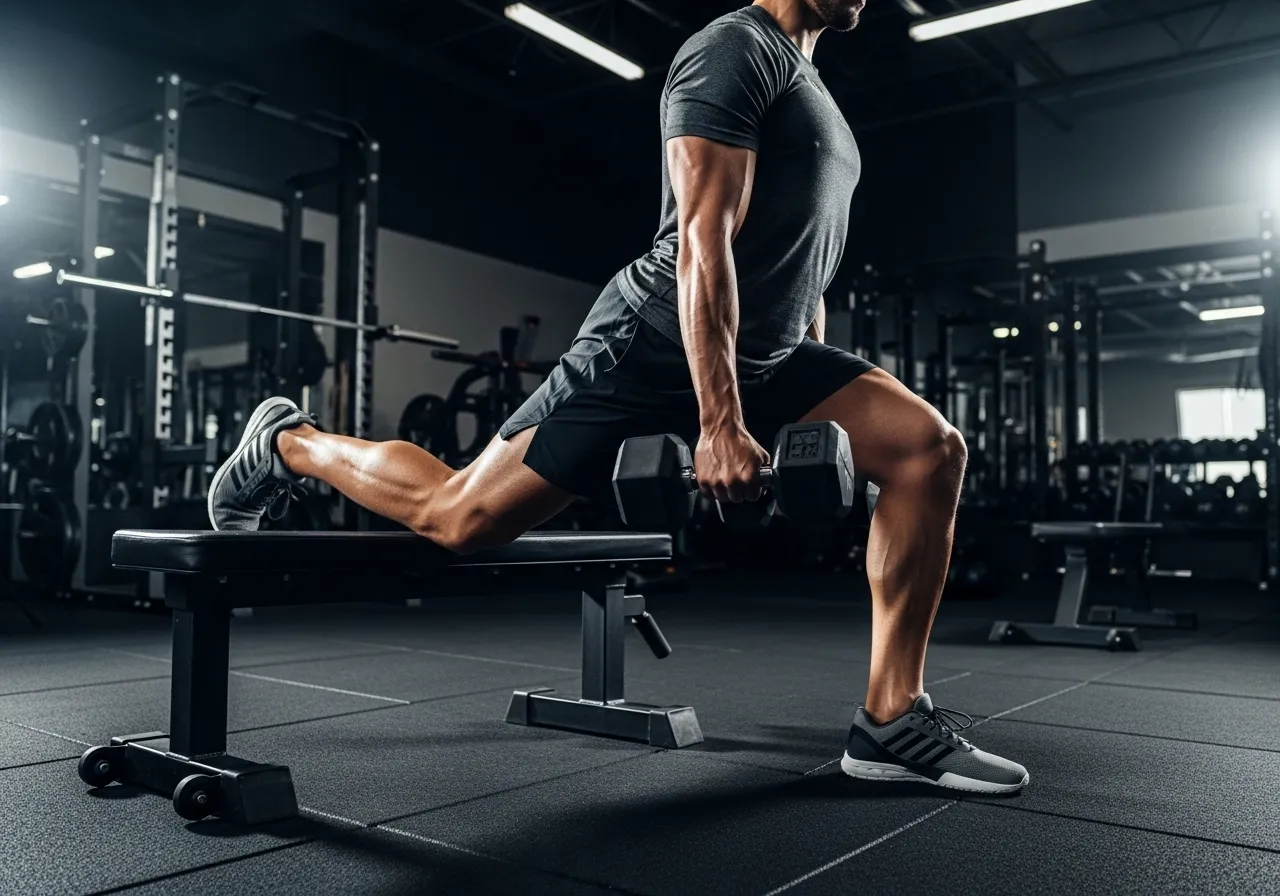
The Bulgarian split squat — rear foot elevated split squat — is not a squat variation. It is a categorically different exercise that trains the lower body in ways bilateral squatting cannot, and the evidence for its superiority in specific training contexts is substantial and growing.
The Asymmetry Problem in Bilateral Training
Bilateral exercises allow the stronger side to compensate for the weaker side — a phenomenon researchers call the bilateral strength deficit. When you back squat, your dominant leg can subtly take more of the load without you realizing it. Over months and years, this creates strength asymmetries that eventually limit bilateral performance and increase injury risk. The Bulgarian split squat eliminates compensation by loading each leg independently, forcing bilateral symmetry to develop rather than allowing it to remain hidden.
What the Research Shows
Research on unilateral versus bilateral leg training consistently finds that unilateral exercises produce comparable or superior hypertrophic outcomes for the quads and glutes compared to bilateral exercises at equivalent training volumes, while additionally developing the hip stability and balance that bilateral exercises cannot train. The functional transfer of unilateral leg strength to athletic performance — sprinting, jumping, change of direction — is also superior to bilateral-only training because athletic locomotion is inherently unilateral.
The Bilateral Strength Deficit and How the Bulgarian Split Squat Fixes It
Most people who have trained exclusively with bilateral squats have developed a bilateral strength deficit — their combined single-leg strength is lower than their two-leg strength because the nervous system has learned to inhibit maximum output on each leg when both legs work simultaneously. Research has quantified this deficit at 5-15% in most trained individuals, meaning the sum of your single-leg maximums exceeds your bilateral squat maximum by that margin. The Bulgarian split squat, by forcing each leg to work independently, eliminates this inhibition and develops the full single-leg strength capacity that bilateral training leaves undertrained. Athletes who add Bulgarian split squats to a previously bilateral-only program typically find their bilateral squat improves alongside their split squat, because the single-leg work develops the individual leg strength that was previously the limiting factor. Research published in NCBI on unilateral vs bilateral training confirms that athletes with the largest bilateral deficits show the greatest bilateral performance improvements after unilateral training interventions.
Hip Flexor Flexibility: The Hidden Prerequisite Most Lifters Skip
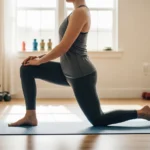
The rear leg’s hip flexor must be sufficiently flexible to allow the split position without pulling the pelvis into anterior tilt. When the hip flexors are too tight — as they commonly are in people who sit for extended periods — the body compensates by arching the lower back and tilting the pelvis forward, which shifts the loading away from the intended muscles and creates lumbar stress. Testing hip flexor flexibility before loading the Bulgarian split squat: in the bottom position, can the rear hip be fully extended without the lower back rounding or arching? If not, hip flexor stretching before each training session is non-negotiable, not optional. The Thomas test — lying at the edge of a bench with one knee pulled to the chest, observing whether the other leg raises off the bench — provides a standardized assessment of hip flexor flexibility that should be performed before beginning Bulgarian split squat training and periodically during a training program to monitor improvement.
The Bulgarian split squat’s combination of unilateral loading, hip flexor stretch, quad-dominant knee flexion, and glute extension creates a uniquely comprehensive lower body stimulus that bilateral exercises cannot replicate. Understanding why the exercise produces the results it does — through the bilateral deficit reduction, hip flexor flexibility development, and eccentric glute and quad loading it provides — allows it to be programmed more intelligently and its benefits to be maximized across a long training career. Every hour invested in mastering this exercise pays dividends across years of improved lower body strength, reduced injury risk, and enhanced athletic performance that generalize well beyond the gym environment.
The combination of mobility challenge, stability demand, and targeted muscle loading that the Bulgarian split squat provides makes it irreplaceable in any serious lower body training program. Those who invest in mastering it — accepting the learning curve, addressing the prerequisite mobility, and progressing loads systematically — develop lower body capabilities that bilateral training alone cannot produce in equivalent training time.
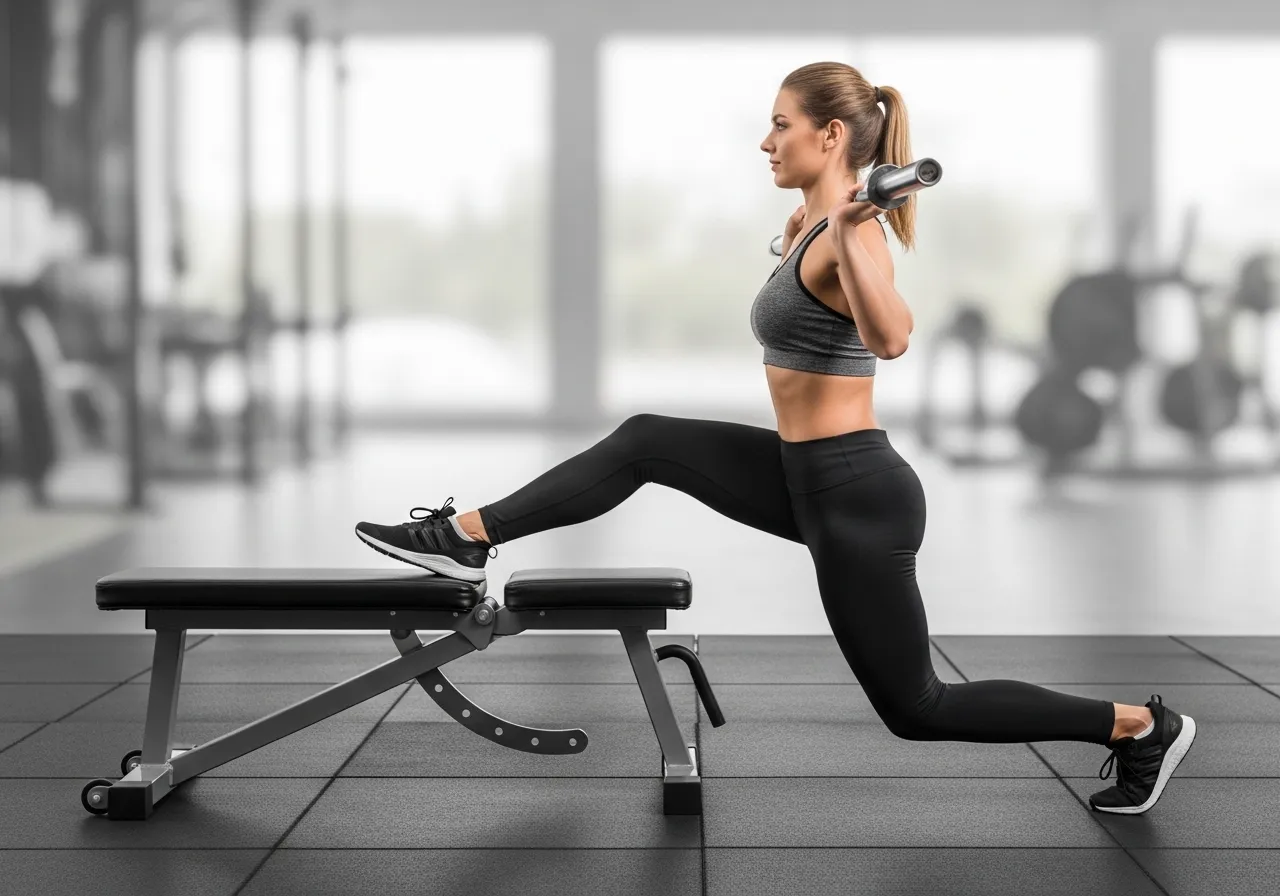
The Setup: Every Detail That Changes the Exercise
Rear Foot Height and Placement
The rear foot elevation height directly determines the exercise’s character. A bench at standard height (approximately 45cm) creates substantial hip flexor stretch in the rear leg and places the front leg in a position requiring significant hip flexor mobility. Lower elevation (30 to 35cm, using a step or low box) reduces the hip flexor demand and makes the exercise more accessible for beginners or those with hip flexor restrictions. Higher elevation increases the stretch and the quad and glute demand on the front leg. Start at bench height and adjust based on comfort and target — if the rear hip feels strained rather than stretched, reduce elevation.
Rear foot placement on the bench matters more than most lifters realize. The foot should rest with the top of the foot or the ball of the foot on the bench, not the heel. Heel contact on the bench creates an ankle extension demand that destabilizes the rear leg and causes the bench to slide. Top-of-foot or ball-of-foot contact creates a stable, predictable rear leg position throughout the movement.
Front Foot Distance From the Bench
Front foot distance is the most commonly miscalibrated variable. Too close to the bench: excessive forward lean and knee travel well past the toes. Too far from the bench: the torso must lean far forward at the bottom to maintain balance, turning the exercise into a hip-dominant movement rather than the quad-dominant pattern most people want. Correct distance: at the bottom of the movement, the front shin should be vertical or slightly angled, and the torso should be upright or with only minimal forward lean. This typically places the front foot 50 to 70cm from the bench, but varies significantly with leg length.
Loading Options: Dumbbells, Barbell, or Bodyweight
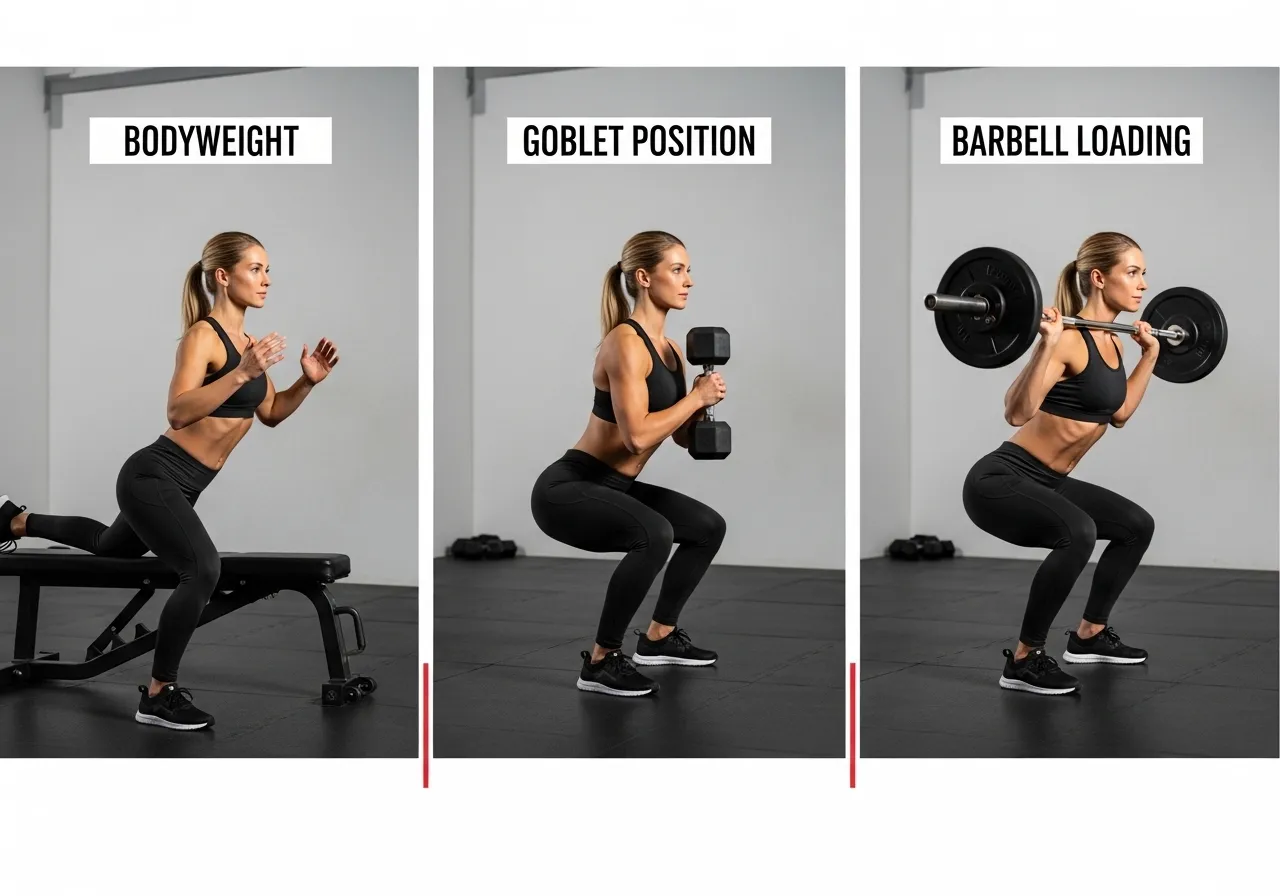
Dumbbells held at the sides are the most practical loading option for most lifters — easier to set up, safer to bail from, and comfortable through a wide range of loads. The limitation is grip fatigue at very heavy loads, which a barbell eliminates. A barbell placed on the upper back (either high bar or low bar position) allows maximum loading but requires greater stability and makes bailing more complex. Bodyweight Bulgarian split squats are appropriate for beginners learning the movement pattern before adding load, and for very high-rep conditioning purposes. Each loading option produces the same primary muscle stimulus — the choice is practical rather than physiologically significant.
The Bench Height Variable: Why It Changes Everything
The height of the rear foot elevation profoundly affects the Bulgarian split squat’s training stimulus and difficulty. A standard bench height of 40-45 centimeters produces the classic split squat position that most coaching resources describe. Lower rear foot positions (20-30 centimeters, using a step or low box) reduce the hip flexor stretch demand and allow deeper front knee flexion — appropriate for beginners or those with hip flexor tightness. Higher rear foot positions (50-60 centimeters, using a high bench or rack setting) increase the hip flexor stretch and the hip extension demand at the bottom, placing greater loading on the glute and hip flexor simultaneously — appropriate for advanced lifters targeting additional hip development. Experimenting with different bench heights across training blocks develops the movement pattern across different ranges and prevents accommodation to a single position. The most commonly prescribed height — standard bench height — is not universally optimal and should be adjusted based on individual anatomy, training goals, and current mobility limitations.
Addressing the Balance Challenge: Practical Strategies
The balance demand of the Bulgarian split squat is frequently cited as a barrier to productive loading, with lifters spending more cognitive and physical effort on maintaining balance than on the intended muscle engagement. Several practical strategies reduce the balance demand without compromising the exercise’s effectiveness. Placing the rear foot on a surface with a slight grip (rubber mat rather than smooth bench) prevents the rear foot from sliding, which is a common balance disruptor. Holding the dumbbells at arm’s length rather than with arms bent keeps the center of mass lower and more stable. Looking at a fixed point on the floor three to four meters ahead provides a visual anchor that stabilizes balance through the same mechanism used in yoga balance poses. Performing the first set of each session at lighter load than the working weight specifically for balance calibration — rather than treating the first set as a working set — reduces the instability that creates poor first-set performance and builds the proprioceptive calibration that makes subsequent sets significantly more stable and productive.
A final note on setup: the Bulgarian split squat rewards attention to small details that compound across thousands of repetitions. Taking sixty seconds to properly set up the bench height, front foot position, and loading before each working set produces better technique consistency and better training outcomes than rushing into sets without deliberate setup. Elite athletes and experienced coaches consistently emphasize setup quality as one of the most differentiating factors between lifters who progress consistently and those who plateau — the discipline to prepare properly before each set reflects the same quality of attention that produces long-term training success more broadly.
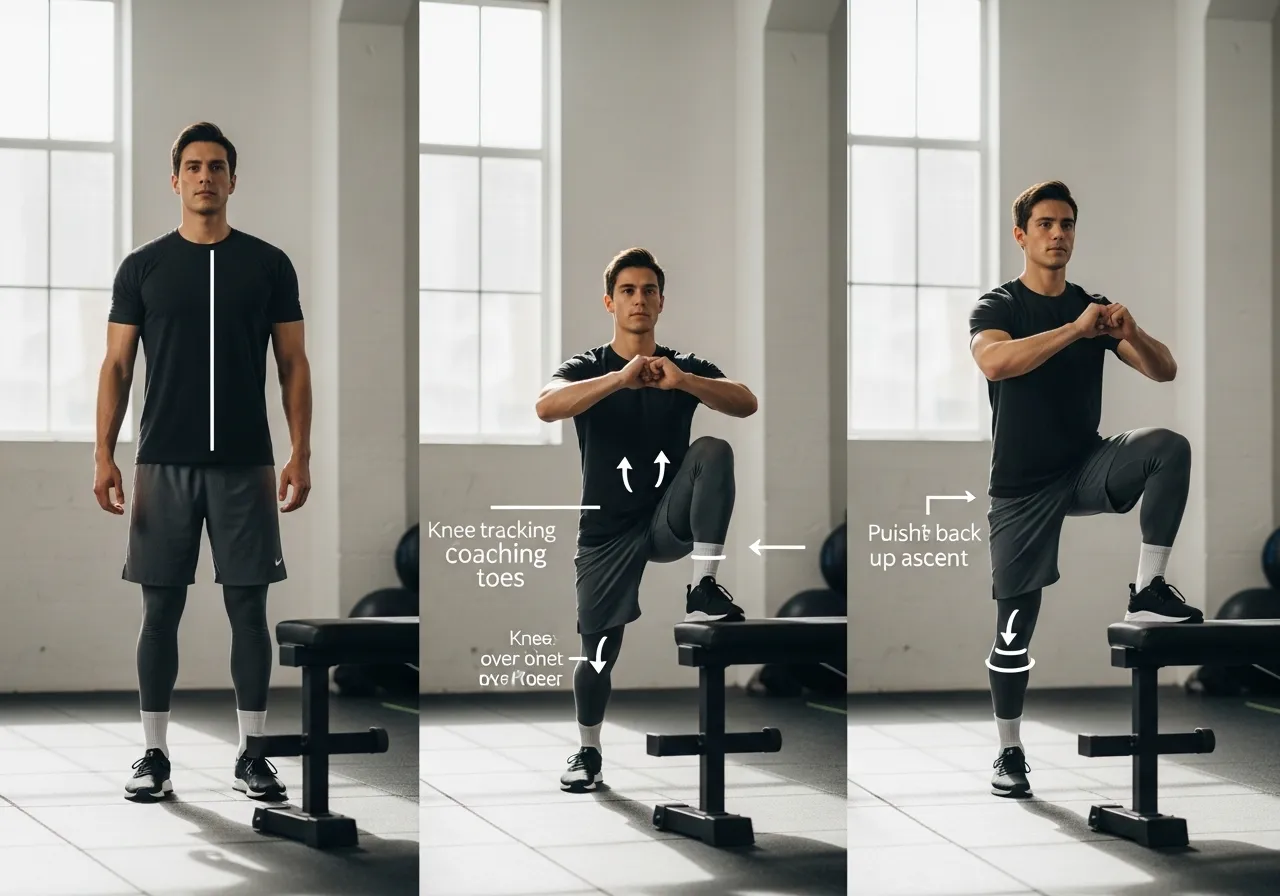
Technique Deep Dive: What Separates Productive from Painful
The Descent
Initiate the descent by pushing the rear knee toward the floor — not by bending the front knee. This subtle mental cue dramatically changes the exercise: hip-initiated descent loads the glutes and maintains upright torso position, while knee-initiated descent creates excessive forward lean and anterior knee stress. Descend until the rear knee nearly touches the floor or until the front thigh is parallel — whichever comes first. At the bottom, the front knee should track over the second and third toes. Any inward collapse (valgus) at the bottom indicates either hip abductor weakness or excessive load — reduce load and add hip abductor work if this consistently occurs.
The Ascent
Drive through the full front foot — heel included — rather than pushing only through the toes. Heel-included drive activates the glutes more fully and produces a more powerful ascent. Think about pushing the floor away rather than standing up — this external focus on the floor produces better mechanical execution than the internal focus of thinking about your leg muscles. Maintain the same torso angle on the way up as on the way down — if the torso lurches forward during the ascent, the load is too heavy or the front foot position needs adjustment.
Balance and Stability Challenges
The Bulgarian split squat feels unstable for most people during the first four to six sessions. This instability is normal and a feature rather than a flaw — the balance demand recruits the hip abductors, external rotators, and core stabilizers that bilateral squatting doesn’t adequately challenge. Resist the temptation to hold onto a rack or wall for balance in early sessions — the instability is where much of the exercise’s additional benefit resides. If balance is severely limiting your ability to perform the movement, practice bodyweight Bulgarian split squats for two weeks before adding load.
Common Errors and Their Fixes
Torso falling forward: front foot is too close to the bench or the load is too heavy for current hip flexor flexibility. Move foot further from bench and reduce load. Rear knee flaring outward: hip external rotator weakness in the rear hip. Add clamshells and lateral band walks to your program. Front knee caving inward: hip abductor weakness. Add a light resistance band above both knees as a cueing tool and reduce load. Bouncing off the rear knee at the bottom: the rear knee is making contact with the floor and using the bounce for momentum — control the descent to hover just above the floor rather than contact it.
Why the Bulgarian Split Squat Produces Superior Glute Development
The glute maximally contracts at full hip extension — the top of the Bulgarian split squat where the front leg is straight and the hip is fully extended. Unlike bilateral squats where both legs reach extension simultaneously, the Bulgarian split squat allows the front leg’s glute to be fully loaded at the precise position of maximum mechanical advantage and maximum glute activation. EMG studies comparing glute activation between bilateral squats and Bulgarian split squats consistently find greater peak glute activation in the split squat, with some studies reporting 30-40% higher peak glute EMG in the Bulgarian split squat compared to the back squat at equivalent subjective intensities. The practical implication: if glute development is a primary training goal, the Bulgarian split squat should be the primary lower body exercise rather than a supplementary one. Bodybuilders who add Bulgarian split squats to previously bilateral-squat-dominated programs consistently report accelerated glute development, validating the EMG research findings in training practice outcomes. According to NCBI research on glute activation during lower body exercises, unilateral hip extension exercises produce consistently higher glute activation than bilateral exercises at equivalent relative intensities.
Integrating the Bulgarian Split Squat With Sprint and Jump Training
For athletes in sprint and jump sports, the Bulgarian split squat’s transfer to performance is direct and substantial. Sprinting is fundamentally a series of single-leg force applications against the ground — the leg extension strength, hip extension power, and single-leg stability that the Bulgarian split squat develops are precisely the qualities that determine sprint acceleration and top speed. Jump performance similarly depends on single-leg strength (for single-leg jumps) and the bilateral power that single-leg training disproportionately develops through the reduction of the bilateral deficit. Research on sprint athletes who added Bulgarian split squats to their strength training programs shows improvements in 10-meter and 40-meter sprint times of two to four percent, which represents meaningful competitive performance differences at elite levels. Programming the Bulgarian split squat in the same week as sprint and jump training requires attention to sequencing — perform strength training on days separate from speed training, or perform speed work before strength work on the same day, because fatigued legs from heavy split squats impair sprint mechanics and reduce the quality of speed training.
The Science of Eccentric Loading in the Bulgarian Split Squat
The eccentric phase of the Bulgarian split squat — the controlled descent — produces the greatest mechanical tension in the quadriceps and glutes, triggering the structural adaptations (myofibril damage and repair, satellite cell activation) that drive muscle hypertrophy. Research on eccentric-emphasized training consistently finds twenty to forty percent greater hypertrophic stimulus from controlled eccentric loading compared to concentric-dominated training at equivalent absolute loads, because the muscles are capable of greater eccentric than concentric force production and the greater tension drives more stimulus. Deliberately controlling the Bulgarian split squat descent to three to four seconds produces this eccentric emphasis without specialized equipment, simply by resisting gravity during the lowering phase rather than allowing passive descent. The additional benefit: controlled eccentric loading in the stretched muscle position — where the quad and glute are maximally lengthened at the bottom of the split squat — produces hypertrophy in the lengthened range that shortens the muscle’s overall length-tension curve in ways that improve both athletic performance and injury resistance. Athletes with strong eccentric quad and glute capacity in the lengthened position resist hamstring and glute injuries more effectively because they can control rapid deceleration forces that the shortened range cannot manage adequately. Research on eccentric training and muscle hypertrophy confirms significantly greater muscle growth from eccentric-emphasized protocols compared to concentric-dominated training at equivalent training volumes.
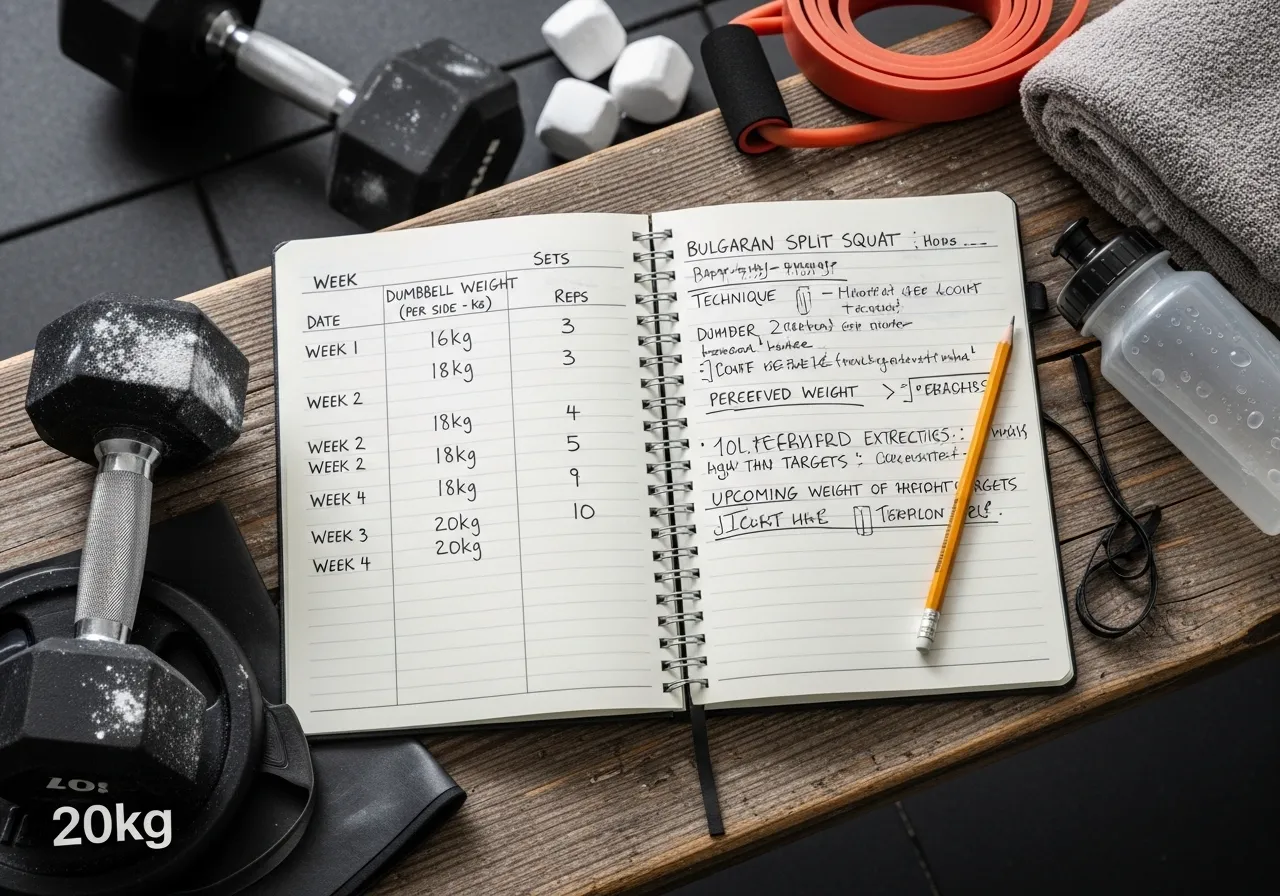
Programming the Bulgarian Split Squat: Where It Fits and How to Progress
As a Primary Lower Body Exercise
The Bulgarian split squat can serve as the primary lower body exercise in a program, replacing bilateral squatting entirely or alternating with it across training days. As a primary exercise, program it early in the session when the neural system is freshest: 4 sets of 6 to 10 reps per side, with 2 to 3 minutes of rest between sets. Progress load using the same principles as barbell squatting: add weight when all sets are completed at the top of the rep range with excellent form, maintaining this approach across weeks and months.
As a Secondary Exercise After Bilateral Squatting
The most common and productive placement is as a secondary exercise after primary bilateral squatting: 3 sets of 8 to 12 reps per side at moderate load. This placement develops the unilateral strength and symmetry that bilateral squatting cannot provide, while the primary squatting delivers the maximum loading that bilateral exercises permit. The combination produces more complete lower body development than either alone.
Progressive Overload for the Bulgarian Split Squat
Most intermediate lifters can progress Bulgarian split squat loads at a rate similar to bilateral squatting in the early weeks of incorporating the exercise. Once technique is established, add 2.5 kg per side when all sets are completed at the top of the prescribed rep range. A useful benchmark: intermediate lifters should aim for Bulgarian split squats with dumbbells equal to approximately 30 to 40 percent of their back squat maximum per hand. Advanced lifters may Bulgarian split squat with dumbbells exceeding 50 percent of their back squat maximum per hand — a load that becomes impractical with dumbbells and typically transitions to a barbell.
Weekly Volume Recommendations
For general strength and hypertrophy: 6 to 12 sets per leg per week, distributed across 2 training sessions. This volume produces robust quad and glute development without the recovery demands of higher volumes. For athletes prioritizing unilateral leg strength development: up to 16 sets per leg per week may be appropriate during dedicated development phases, with recovery carefully monitored through performance metrics. The Bulgarian split squat’s relatively lower spinal loading compared to bilateral squatting means it can be performed more frequently than bilateral squats before recovery becomes limiting.
Common Bulgarian Split Squat Mistakes That Limit Results
The most common mistake is placing the front foot too close to the rear foot, creating a cramped position that forces the front heel to rise and shifts loading from the intended muscles to the ankle and calf. The front foot should be far enough forward that the front shin can remain relatively vertical (or only slightly forward) at the bottom position, with the heel fully planted. A second extremely common error is allowing the front knee to cave inward (valgus collapse) on the ascent — this indicates hip abductor weakness on the working leg and creates medial knee stress. Adding a light resistance band above the knees during warm-up sets to activate the hip abductors before working sets, and consciously cueing the knee to track over the second toe throughout the movement, corrects this pattern within four to six weeks of deliberate practice. A third mistake is rushing the eccentric (descent) phase to avoid the balance challenge at the bottom — this eliminates the valuable eccentric loading stimulus that produces hypertrophy and connective tissue strengthening in the muscles stretched at the bottom. A deliberate two to three second descent pace, even if balance is more challenging, produces superior training outcomes by maximizing the time under tension in the most important range of the movement.
Bulgarian Split Squat for Older Athletes: Modifications and Benefits
The Bulgarian split squat is particularly valuable for older athletes because its unilateral loading corrects the strength imbalances that bilateral training allows to persist and worsen with age, and its functional movement pattern develops the single-leg stability that directly protects against falls — the leading cause of injury-related mortality in adults over 65. Modifications for older athletes with joint concerns: reducing rear foot elevation to 15-20 centimeters reduces the hip flexor stretch demand and may reduce anterior knee discomfort; using a TRX or suspension trainer for hand support during the movement eliminates the balance challenge while maintaining the lower body loading stimulus; and beginning with bodyweight only until the movement pattern is well-established before adding external load. Research from NCBI studies on unilateral training in older adults consistently finds that single-leg strength training produces superior functional independence outcomes compared to bilateral-only training in populations over 60, specifically through improvements in balance, gait stability, and stair climbing ability that bilateral training does not develop equivalently.
Periodizing the Bulgarian Split Squat Across a Training Year
A year-long Bulgarian split squat periodization plan produces systematic development that random training cannot replicate. Quarter one (weeks 1-13): foundation phase emphasizing bodyweight and goblet loading, three sets of twelve reps per leg, focusing on mobility development and technique establishment. Quarter two (weeks 14-26): hypertrophy phase using dual dumbbells at 8-10 rep range, four sets per leg, with weekly load progression of two to three percent. Quarter three (weeks 27-39): strength phase with barbell or heavy dumbbell loading at five to six rep range, five sets per leg, testing new five-rep maximum at end of quarter. Quarter four (weeks 40-52): variation phase incorporating tempo, paused, and different foot position variations at moderate loading to prevent accommodation and address movement quality gaps revealed during the strength phase. This annual structure produces comprehensive Bulgarian split squat development across strength, hypertrophy, and movement quality dimensions that quarterly or semester-based programming approaches cannot achieve within their shorter timelines. Testing and recording five-rep maximum at the end of each quarter provides the longitudinal progress data that reveals year-over-year development — the most motivating and most accurate reflection of the cumulative training investment that consistent annual programming produces. NSCA annual training periodization resources support this multi-phase approach as the most effective structure for long-term strength and athletic development across all experience levels.
The Bulgarian split squat’s programming versatility — fitting as a primary or secondary exercise, accommodating loading from bodyweight to barbell, and serving both strength and hypertrophy goals — makes it one of the most program-adaptable lower body exercises available across all training levels.
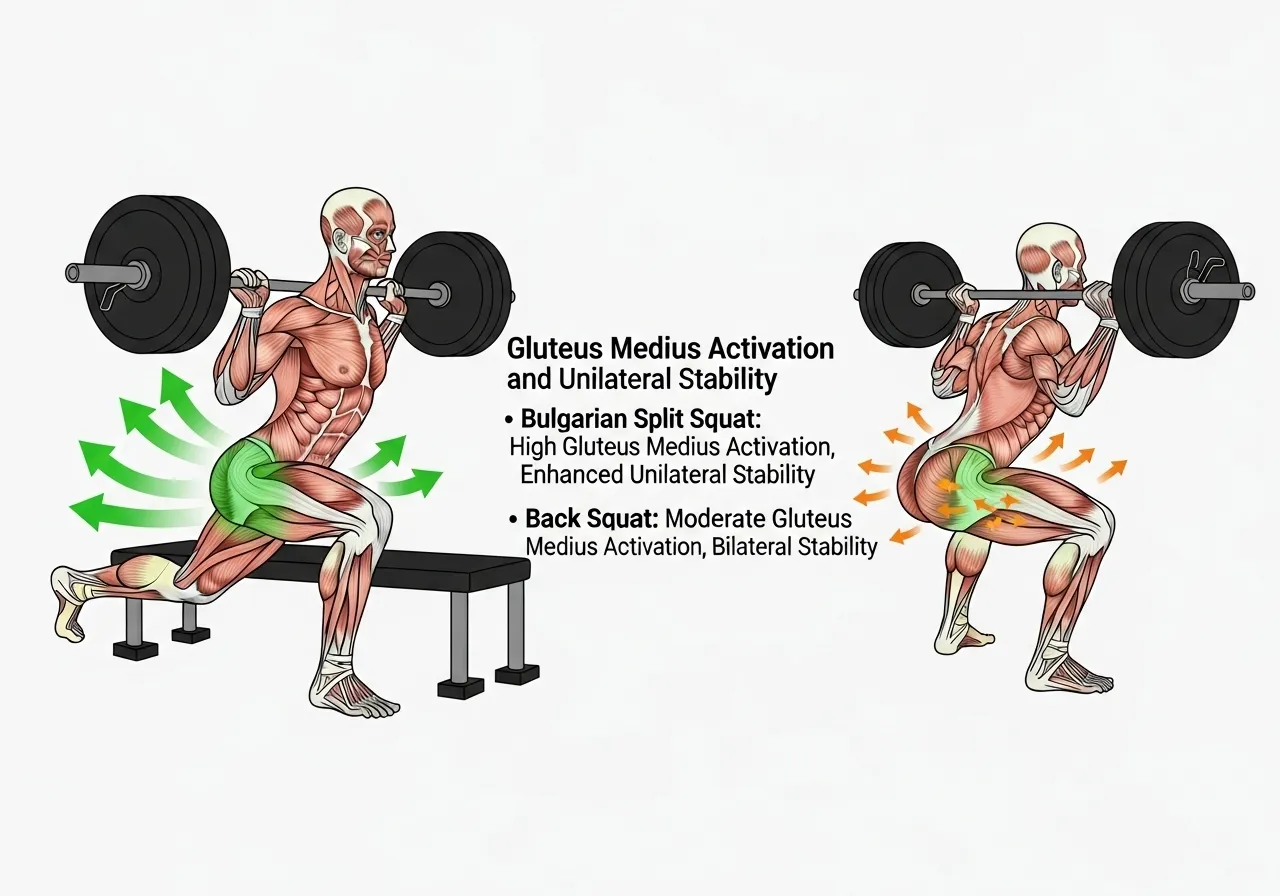
Bulgarian Split Squat vs Back Squat: The Comparison Most Programs Get Wrong
What Each Exercise Does Better
The back squat allows maximum absolute loading, develops bilateral coordination, and trains the posterior chain through the hip extension pattern that athletic movement requires. The Bulgarian split squat develops unilateral strength and hypertrophy, corrects bilateral asymmetries, trains hip stability that bilateral squatting cannot, and provides greater hip flexor stretch that improves mobility. Neither is universally superior — they develop different qualities that are both necessary for complete lower body development.
The Research on Muscle Activation
EMG studies comparing the Bulgarian split squat to the back squat find similar or higher quadriceps activation in the Bulgarian split squat at equivalent perceived effort, with additionally higher gluteus medius activation that bilateral squats rarely produce. The hip abductor demand of maintaining alignment on a single leg recruits the gluteus medius continuously throughout the movement — a training stimulus with direct functional transfer to running mechanics, landing stability, and injury prevention that bilateral squatting simply cannot replicate.
For Athletes: Why Unilateral Training Cannot Be Skipped
Athletic movement — sprinting, jumping, changing direction — is fundamentally unilateral. Every stride in running is a single-leg squat pattern. Every jump takeoff and landing requires single-leg stability. Programs that develop only bilateral strength consistently produce athletes who are strong on the platform but limited on the field because their unilateral stability, single-leg strength, and hip abductor function haven’t been specifically developed. The Bulgarian split squat directly addresses each of these athletic qualities. NSCA sport-specific training resources consistently include unilateral lower body exercises as essential components of athletic development programs across all sports and competition levels.
Frequently Asked Questions About the Bulgarian Split Squat
My knees hurt during Bulgarian split squats. What’s wrong? The most common cause of knee pain during Bulgarian split squats is front foot position too close to the bench, causing the knee to travel too far forward. Move your front foot 5 to 10cm further from the bench and retest. If pain persists, check for valgus collapse at the bottom — if the knee caves inward, hip abductor weakness is causing medial knee stress. Sharp or structural knee pain warrants evaluation by a physiotherapist before continuing.
How do I stop wobbling during Bulgarian split squats? Wobbling during the first several sessions is entirely normal — the exercise recruits stabilizers that haven’t been previously challenged. Practice bodyweight Bulgarian split squats for two weeks before adding load. Focus on gripping the floor with your front foot and actively squeezing the glute of the front leg throughout the movement. Balance improves rapidly with consistent practice and is largely resolved within three to four weeks for most people.
Can Bulgarian split squats replace back squats entirely? Yes, for most fitness and physique goals. Bulgarian split squats develop quad and glute hypertrophy comparable to back squats, while adding unilateral strength and hip stability benefits that back squats cannot provide. The primary limitation is maximum absolute loading — you cannot load a Bulgarian split squat as heavily as a bilateral back squat with a barbell on your back. For competitive powerlifters whose sport requires back squatting, bilateral squatting cannot be replaced. For general fitness athletes and bodybuilders, the Bulgarian split squat is a fully sufficient substitute.
How much weight should I use for Bulgarian split squats? Begin with bodyweight or very light dumbbells to establish technique. Once technique is solid, a practical starting point for most intermediate lifters is dumbbells equal to 15 to 20 percent of body weight per hand. Progress from there based on performance — when all prescribed sets and reps are completed with excellent form, add 2.5 kg per hand at the next session. ACSM progressive resistance guidelines support consistent, measured load increases as the evidence-based approach to long-term strength development in unilateral exercises.
Why is one side significantly harder than the other? Significant bilateral asymmetry — where one side is 15 percent or more stronger than the other — is common in lifters who have trained primarily with bilateral exercises. This asymmetry is exactly what the Bulgarian split squat is designed to identify and correct. Train both sides equally in every session. Do not add additional sets to the weaker side — the asymmetry corrects itself through equal bilateral training over 8 to 12 weeks in most cases. If the asymmetry is severe or accompanied by pain, have a movement assessment performed to rule out structural causes.
Testing and Measuring Bulgarian Split Squat Progress Objectively
Tracking Bulgarian split squat progress requires consistent measurement protocols because the exercise’s balance and stability demands mean that day-to-day performance variation is higher than in bilateral exercises. The most reliable progress metric is the load used for a standardized set and rep count (such as three sets of eight per leg) measured every two to four weeks under consistent conditions — same time of day, same warm-up, same bench height. Testing single-repetition maximums in the Bulgarian split squat is less informative than in bilateral exercises because the balance challenge at maximum loads introduces a confounding variable; performance may vary based on balance quality rather than strength alone. Volume-load tracking (sets times reps times weight per leg per session) provides a more comprehensive progress indicator that accounts for all three training variables and reveals upward trends that any single metric might miss. Photographing the movement from the side every four weeks also reveals technique improvements that loading data cannot capture — specifically, changes in front knee tracking, rear hip position, and torso angle that develop gradually as strength and mobility improve.
Why Single-Leg Training Transfers Better to Real Life Than Bilateral Training
Nearly every functional human movement — walking, running, climbing stairs, stepping over obstacles, kicking, jumping off one leg — is performed on a single leg rather than both simultaneously. The bilateral squat develops force production in the specific position of equal two-leg loading, which occurs in almost no natural human movement. The Bulgarian split squat develops force production in the single-leg extended position that is the actual movement pattern of walking, running, and the vast majority of athletic movements. This specificity advantage is not merely theoretical — research on transfer of training from strength exercises to functional performance consistently finds stronger correlations between single-leg strength exercises and functional performance metrics than between bilateral strength exercises and the same functional metrics. For anyone whose training goals include real-world functional capacity, athletic performance, or injury prevention rather than purely bilateral barbell sport performance, the Bulgarian split squat deserves primary rather than supplementary status in the training program. ACSM functional training guidelines specifically recommend unilateral lower body exercises for functional strength development in all populations, citing their superior transfer to daily movement patterns compared to bilateral alternatives.
The Psychological Benefits of Mastering the Bulgarian Split Squat
Beyond the physical adaptations, the Bulgarian split squat develops psychological qualities that transfer broadly to athletic and physical development. The balance challenge in the early learning phase develops frustration tolerance and the patience to persist through a learning curve that produces no immediate performance reward. The single-leg loading reveals strength imbalances that bilateral training hides — confronting these imbalances and addressing them systematically develops the honest self-assessment that effective long-term training requires. The progressive mastery of a technically demanding movement — from wobbly bodyweight attempts to controlled heavy loading — builds genuine confidence in physical capability that easier exercises cannot produce. Athletes who persist through the challenging learning phase of the Bulgarian split squat consistently report that mastering the movement changed their relationship with training difficulty, making other challenging exercises and physical situations feel more manageable. This psychological transfer is difficult to quantify but frequently mentioned by experienced lifters as one of the most valuable outcomes of incorporating the Bulgarian split squat as a primary training movement across years of consistent practice.
Consistent measurement of Bulgarian split squat performance over months and years reveals the compounding nature of strength development — small improvements each week accumulate into dramatic capability differences across training years that no single short-term program could produce.
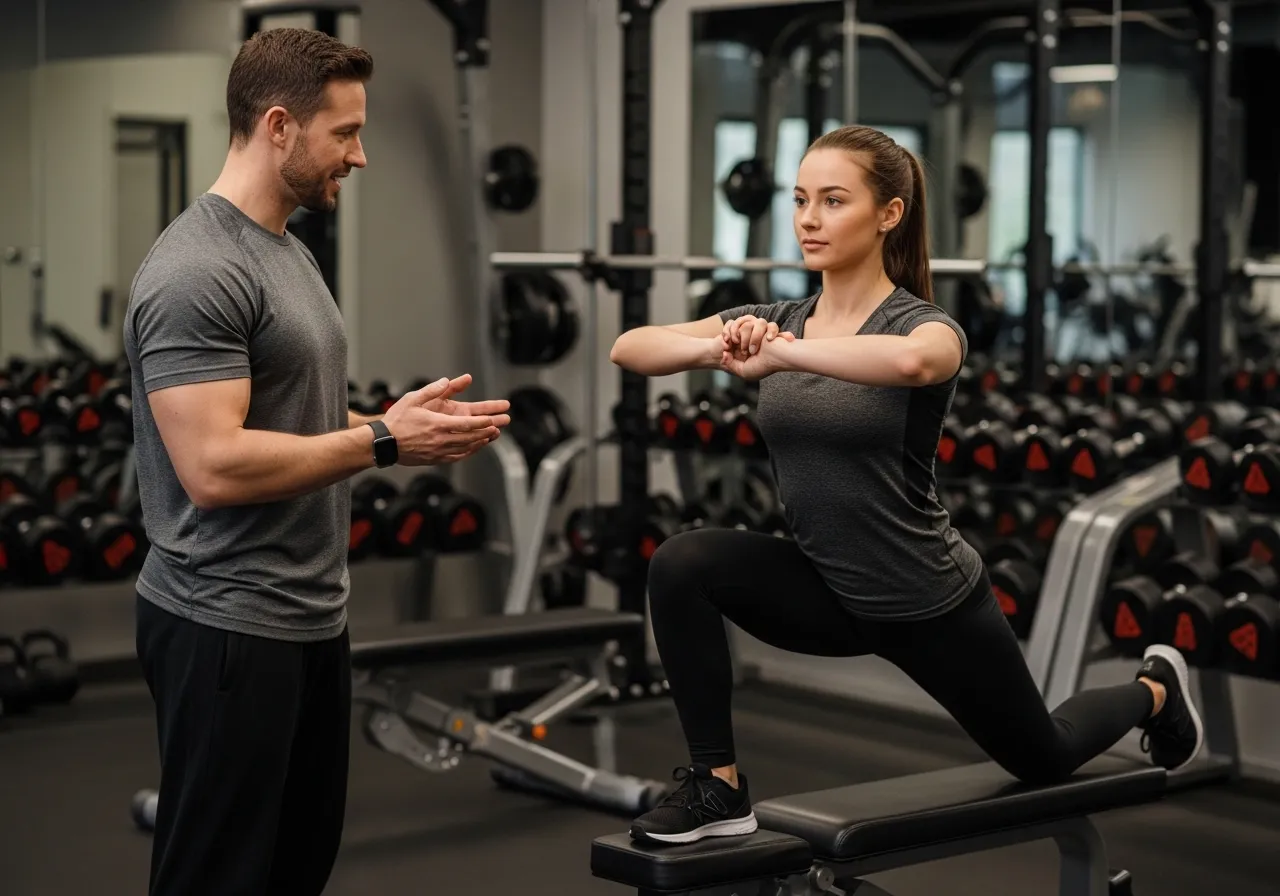
Bulgarian Split Squat Variations and Progressions
The standard rear-foot-elevated split squat is just the beginning. Once you have mastered the fundamental movement pattern and can perform three sets of ten with bodyweight comfortably, an entire progression system opens up that can develop your legs for years without the movement becoming stale or losing its training stimulus.
Loading Progressions: From Bodyweight to Barbell
The loading progression for Bulgarian split squats follows a logical sequence that matches load increases to demonstrated stability and strength. Start with bodyweight for the first two to four weeks until the balance and hip flexor flexibility demands are no longer limiting factors. Progress to a goblet position (holding one dumbbell at the chest) for two to four weeks — this position adds load while the front-loaded weight actually helps with balance by shifting the center of mass forward. Advance to dual dumbbells held at the sides, which increases the balance demand by removing the counterbalance effect of the goblet position. Progress to a barbell in the low bar or high bar position once dual dumbbell proficiency is established. Research from sports science studies on unilateral exercise loading confirms that the Bulgarian split squat allows heavier relative loading than most other single-leg exercises while maintaining movement quality, making it uniquely scalable from beginner to elite.
Foot Position Variations
Shifting the front foot position dramatically changes which muscles are emphasized. A standard foot position (front foot roughly 60-70 centimeters from the bench) produces balanced quad and glute loading. Moving the front foot further forward shifts emphasis toward the glutes and hip extensors by increasing hip flexion at the bottom. Moving the front foot closer to the bench increases the knee-over-toe angle and shifts more load to the quadriceps. Elevating both the front foot and the rear foot on separate platforms (sometimes called the deficit Bulgarian split squat) increases the range of motion beyond the standard version, adding a deep stretch to the working hip flexors and glutes that drives additional hypertrophic stimulus through the lengthened range. Each foot position variation offers a distinct training stimulus that can be rotated across training blocks to prevent accommodation.
Tempo Manipulation for Strength and Hypertrophy
Controlling the speed of the Bulgarian split squat multiplies its training stimulus without adding load. A three-second eccentric (lowering phase) dramatically increases time under tension in the quadriceps and glutes, producing greater hypertrophic stimulus at the same absolute load. A two-second pause at the bottom of the movement eliminates the elastic rebound contribution and forces the muscles to generate force from a dead stop at the most mechanically challenging position — this develops functional strength that transfers directly to athletic performance. Combining a three-second eccentric with a two-second pause produces a five-second time-under-tension per rep that makes even moderate loads extraordinarily challenging and highly effective for hypertrophy focused training cycles.
Programming Cycles for Continuous Progress
A twelve-week Bulgarian split squat development cycle might structure as follows: weeks one to four, goblet position, three sets of ten to twelve reps, focusing on technique and range of motion; weeks five to eight, dual dumbbells, four sets of eight to ten, adding load weekly; weeks nine to twelve, barbell or heavy dumbbells, five sets of five to six, emphasizing strength development. After completing this twelve-week cycle, test the maximum load achievable for five clean reps, add five to ten percent, and restart the cycle at the new loading baseline. This structure produces continuous adaptation by varying both load and rep range across the training year while maintaining the movement pattern’s technical demands throughout.
Action point: If you have never tried the front-foot-elevated variation, add ten centimeters of elevation under your front foot this week. The increased range of motion will immediately reveal whether your hip flexor and quad flexibility is limiting your standard Bulgarian split squat depth.
Advanced Bulgarian Split Squat Programming: Building Unilateral Strength Over Years
The Bulgarian split squat is not a movement you master in weeks — it is a movement you develop across training years, with each stage revealing new challenges and opportunities for growth. Understanding the long-term development arc of the exercise helps set realistic expectations and prevents the frustration that comes from expecting rapid mastery of one of the most technically demanding lower body exercises.
Year One: Building the Foundation
The first year of Bulgarian split squat training is almost entirely dedicated to developing the mobility prerequisites and neuromuscular coordination that the movement demands. Most people discover within the first session that their hip flexors, ankles, and single-leg balance are all more limited than they realized. This is normal and expected — the Bulgarian split squat is uniquely effective at revealing mobility and stability deficiencies that bilateral squatting can mask. Year-one priorities: achieving consistent depth below parallel on both legs with bodyweight and light dumbbell loading, developing the hip flexor flexibility to maintain posterior pelvic tilt in the split position, and building the single-leg balance that allows attention to be directed toward muscle engagement rather than stability management. By the end of year one, most dedicated trainees can perform three sets of ten per leg with dumbbells equal to 15-20% of their body weight in each hand — a meaningful achievement that represents genuine lower body strength development.
Year Two: Loading and Hypertrophy
Once the foundational mobility and coordination are established, year two focuses on systematic loading progression and hypertrophy development. The movement pattern is now automatic enough to allow deliberate muscle engagement focus — consciously squeezing the glute at the top of each rep, feeling the quad stretch at the bottom, maintaining the torso position throughout without active concentration. Dual dumbbells progress toward a challenging load across four to eight sets of six to ten reps per leg. By year two’s end, many lifters can Bulgarian split squat with dumbbells approaching 30-40% of bodyweight in each hand — loads that rival the training stimulus of moderate-intensity bilateral squatting while developing unilateral-specific strength and muscle that bilateral training cannot provide. According to NSCA unilateral training guidelines, consistent unilateral lower body training over two-plus years produces significant improvements in bilateral squat performance as the strength imbalances and stability limitations that bilateral training masked are addressed.
Year Three and Beyond: Strength Mastery
Advanced Bulgarian split squatters shift toward barbell loading, which allows loads that exceed what dumbbell grip strength permits and develops the additional core and upper back stability demands of barbell loading in the split position. Barbell Bulgarian split squats approaching bodyweight total load represent elite recreational strength; loads exceeding bodyweight are genuinely exceptional achievements that few recreational athletes reach. At this advanced stage, training focus shifts from load progression toward performance optimization — using the Bulgarian split squat as a primary athletic development tool, integrating plyometric variatio
How do I know if my Bulgarian split squat depth is correct?
Correct depth means the rear knee approaches but does not slam the floor — typically one to five centimeters above the surface at the bottom — while the front thigh reaches parallel to the floor or slightly below. The front heel must remain fully planted throughout; if it rises, the front foot is too close to the rear foot or ankle dorsiflexion is limiting the movement. Video from the side provides the clearest depth assessment. A useful depth marker: place a small folded towel under the rear knee so the knee touches the towel gently at correct depth, providing tactile feedback without hard floor contact. Depth should be established at bodyweight before any loading is added — training a shallow Bulgarian split squat under heavy load does not develop the hip flexor length and ankle dorsiflexion that full depth requires, and making the transition to full depth under load later creates a sudden jump in difficulty that disrupts loading progression.
Should I feel soreness after Bulgarian split squats and where?
Appropriate post-session soreness from Bulgarian split squats concentrates in the front quad of the working leg (one to two days after the session), the glute of the working leg (one to two days after), and occasionally the hip flexor of the rear leg if the position stretched the hip flexors beyond their current comfortable range. Knee soreness — particularly in the front knee or behind the kneecap — indicates either excessive knee-over-toe angle (front foot too close) or too-rapid load progression. Lower back soreness indicates anterior pelvic tilt compensation from hip flexor tightness. Rear knee soreness indicates direct floor contact (add cushioning) or insufficient hip flexor flexibility for the rear hip extension position. Significant soreness that persists beyond four to five days or that is present in joints rather than muscles warrants load reduction and technique review before the next session. Normal muscle soreness from a challenging session — the delayed onset muscle soreness that peaks at 24-48 hours and resolves by 72 hours — confirms that the training stimulus was sufficient without indicating that recovery will be incomplete. ACSM guidelines on DOMS confirm that muscle soreness is a normal response to novel or high-intensity training stimuli and does not indicate injury when concentrated in muscle tissue rather than joints.
The Bulgarian split squat rewards investment in understanding its mechanics because the exercise’s complexity means that small technique improvements produce large performance gains, particularly in the early to intermediate stages. Approaching the exercise as a long-term skill development project rather than a simple loading challenge produces better technique, better results, and a more satisfying training relationship with one of the most effective lower body exercises available to any athlete.
Frequently Asked Questions About the Bulgarian Split Squat
How much weight should I be able to Bulgarian split squat?
Strength standards for the Bulgarian split squat are less established than for bilateral exercises, but useful benchmarks exist. For men, being able to perform ten clean reps per leg with dumbbells equal to 40% of bodyweight in each hand (so 80% of bodyweight total) represents solid intermediate strength. For women, ten reps per leg with 25-30% of bodyweight in each hand represents comparable development. Advanced lifters of both genders commonly perform Bulgarian split squats with barbell loads approaching or exceeding bodyweight. These standards assume full range of motion to a point where the rear knee approaches but does not slam the floor, with an upright torso maintained throughout. Powerlifters and Olympic weightlifters who Bulgarian split squat seriously often exceed these benchmarks substantially, reflecting the exercise’s exceptional strength development potential.
My rear knee hurts during Bulgarian split squats. What should I do?
Rear knee discomfort during Bulgarian split squats typically comes from one of three sources: the knee contacting the floor (solvable by adding a folded mat under the knee or adjusting depth slightly), patellar tendon stress from excessive knee flexion angle (solvable by adjusting foot position), or hip flexor tightness creating tension that pulls on the knee (solvable through dedicated hip flexor stretching before the exercise). True joint pain that worsens during the exercise or persists after training warrants professional evaluation before continuing. Most rear knee discomfort in this exercise is setup-related rather than pathological and resolves quickly with the appropriate adjustment. NSCA exercise guidelines recommend addressing discomfort proactively rather than training through it, as compensatory movement patterns developed to avoid pain often create secondary issues in adjacent joints.
Can I replace squats with Bulgarian split squats?
Yes, and many coaches argue that Bulgarian split squats are superior to bilateral squats for most training goals outside of powerlifting competition. The unilateral loading corrects strength imbalances between legs that bilateral squats can mask, the reduced spinal loading makes the exercise safer for people with lower back issues, and the hip flexor mobility demands develop functional range of motion that bilateral squatting does not address. Athletes in sports requiring single-leg force production (sprinting, jumping, cutting) particularly benefit from Bulgarian split squat emphasis over bilateral squat emphasis. The practical limitation is that absolute loading is lower in unilateral exercises, which may limit maximal strength development for athletes whose competitive goals specifically require bilateral loaded squat strength.
Why do I feel the Bulgarian split squat more in my front hip flexor than my quad or glute?
Hip flexor dominance during the Bulgarian split squat indicates that the rear leg’s hip flexor is actively working to maintain the elevated position, taking training demand away from the working front leg. This usually means either the rear foot is too high (reducing this by using a lower bench or box), the front foot is too close to the bench (creating excessive rear hip extension demand), or the hip flexors lack the flexibility to remain relaxed in the stretched position. The fix is typically a combination of lowering the rear foot height, moving the front foot slightly further forward, and adding dedicated hip flexor stretching before the exercise. Once the rear leg can maintain its position passively without active hip flexor engagement, the front leg receives the full training stimulus the exercise is designed to deliver.
ns, and using the movement to develop the sport-specific lower body power that coaches in elite athletic programs specifically prescribe this exercise to develop. ACSM guidelines on unilateral training support its integration across all training levels as a uniquely effective lower body development tool.
Action point: Determine which year of Bulgarian split squat development you are in based on the loading standards above. Program accordingly — do not rush to barbell loading if your dumbbell loading has not yet established the strength foundation that makes barbell work productive and safe.
Bulgarian Split Squat for Injury Rehabilitation and Prevention
The Bulgarian split squat has become a standard rehabilitation exercise in sports medicine for good reason. Its unilateral loading allows an injured limb to be trained within its tolerance while the healthy limb maintains full training load. Its closed kinetic chain mechanics produce functional strength in the muscle groups most commonly involved in lower extremity injuries. And its hip flexor stretch demand addresses one of the most common biomechanical contributors to lower back pain, hip impingement, and knee overuse injuries in active populations.
ACL Rehabilitation Applications
Following anterior cruciate ligament reconstruction, the Bulgarian split squat is introduced in rehabilitation protocols at approximately three to four months post-surgery, after basic quadriceps and hamstring strength has been re-established. Its value in ACL rehabilitation comes from its ability to load the quad and glute in a functional movement pattern while controlling the shear forces on the healing graft through careful depth and foot position selection. Research published in the Journal of Orthopaedic and Sports Physical Therapy identifies the Bulgarian split squat as one of the most effective exercises for developing the quad-to-hamstring strength ratios required for safe return to cutting and jumping sports after ACL reconstruction.
Hip Impingement Management
Femoroacetabular impingement — a condition where the hip joint’s ball and socket create abnormal contact during certain movement ranges — often limits bilateral squatting. The split squat position allows the hip to be trained in a range that avoids the impingement zone for most people, because the anterior hip angle in the split position differs from the bilateral squat’s hip flexion angle. Many people with hip impingement who cannot squat deeply bilaterally can Bulgarian split squat comfortably, making it not merely an alternative but often a superior training choice for people managing this condition. Professional guidance from a sports medicine physician or physical therapist is essential for determining appropriate depth and loading for individuals with diagnosed hip impingement, but the exercise is frequently recommended as a primary strength development tool even within the constraints of managing this condition.
Action point: If you have a history of lower extremity injury and have been avoiding single-leg training because of it, start with bodyweight box-supported Bulgarian split squats — placing your hand lightly on a wall for balance — to assess whether the movement is appropriate for your situation before loading it.
How often should I do Bulgarian split squats each week?
Two sessions per week is the most commonly recommended frequency for intermediate athletes making the Bulgarian split squat a priority movement. This provides sufficient stimulus for strength and hypertrophy development while allowing adequate recovery between sessions — the hip flexors, quads, and glutes need 48-72 hours of recovery from a genuinely challenging Bulgarian split squat session. One session per week is appropriate when the exercise is supplementary to other primary lower body training, or during high-volume training blocks where recovery is already taxed. Three sessions per week is appropriate only for advanced athletes in dedicated split squat specialization phases with carefully managed session intensity. Beginners learning the movement may benefit from three weekly sessions at very light load purely for pattern practice, as the neurological learning that establishes the movement pattern benefits from higher frequency. NSCA training frequency guidelines support two sessions per week as the optimal frequency for most intermediate athletes targeting lower body strength development.
Do Bulgarian split squats replace deadlifts and leg presses?
The Bulgarian split squat occupies a unique position in lower body training — it is neither a hip hinge like the deadlift nor a guided machine movement like the leg press, but a free-standing unilateral squat pattern that develops qualities neither alternative provides. It does not replace deadlifts because the hip hinge pattern, posterior chain loading in hip extension, and spinal loading demands of deadlifting are distinct from the split squat pattern. It does not replace leg presses because the leg press’s isolated quad loading without balance or stability demands serves a different training purpose. What the Bulgarian split squat can replace is the barbell back squat as the primary bilateral squat movement, providing superior unilateral development and mobility demands while delivering similar or greater lower body hypertrophy stimulus. In a well-designed program, the Bulgarian split squat pairs with a hip hinge (deadlift, Romanian deadlift) and a single horizontal push movement to create comprehensive lower body development that addresses all major movement patterns. The combination of Bulgarian split squat plus deadlift provides more complete lower body development than any other two-exercise combination available to recreational athletes.
The Bulgarian split squat is simultaneously one of the most demanding and most rewarding exercises available to any strength athlete. Its technical demands, mobility requirements, and psychological challenges separate it from simpler bilateral exercises — but these same characteristics are what make it so comprehensively effective. Mastering it produces not just stronger legs but better movement, greater single-leg stability, and the physical self-awareness that transfers to every other training and athletic pursuit. The investment is substantial; the return is greater.