The Hack Squat: Why This Machine Builds Quads Better Than Most Lifters Think
The Hack Squat: Why This Machine Deserves a Primary Place in Leg Training
The hack squat machine sits in the corner of most gyms, largely ignored by serious lifters who dismiss machine exercises as inferior to free weights and embraced primarily by beginners who haven’t yet learned to squat. This dismissal is a training error — the hack squat machine offers unique mechanical advantages that free weight squats cannot replicate, and its specific quad loading pattern makes it one of the most effective quad hypertrophy tools available regardless of training experience level.
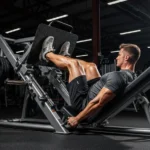
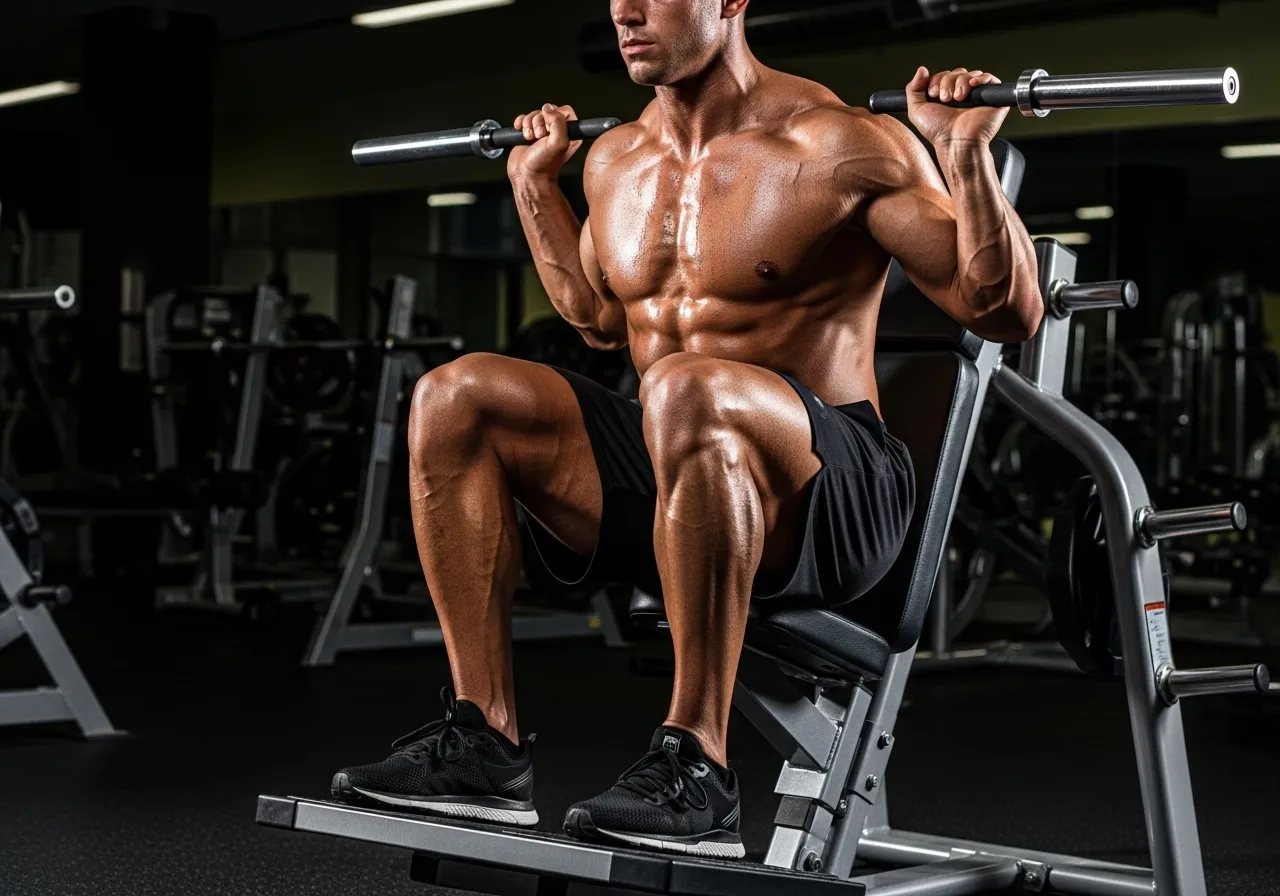
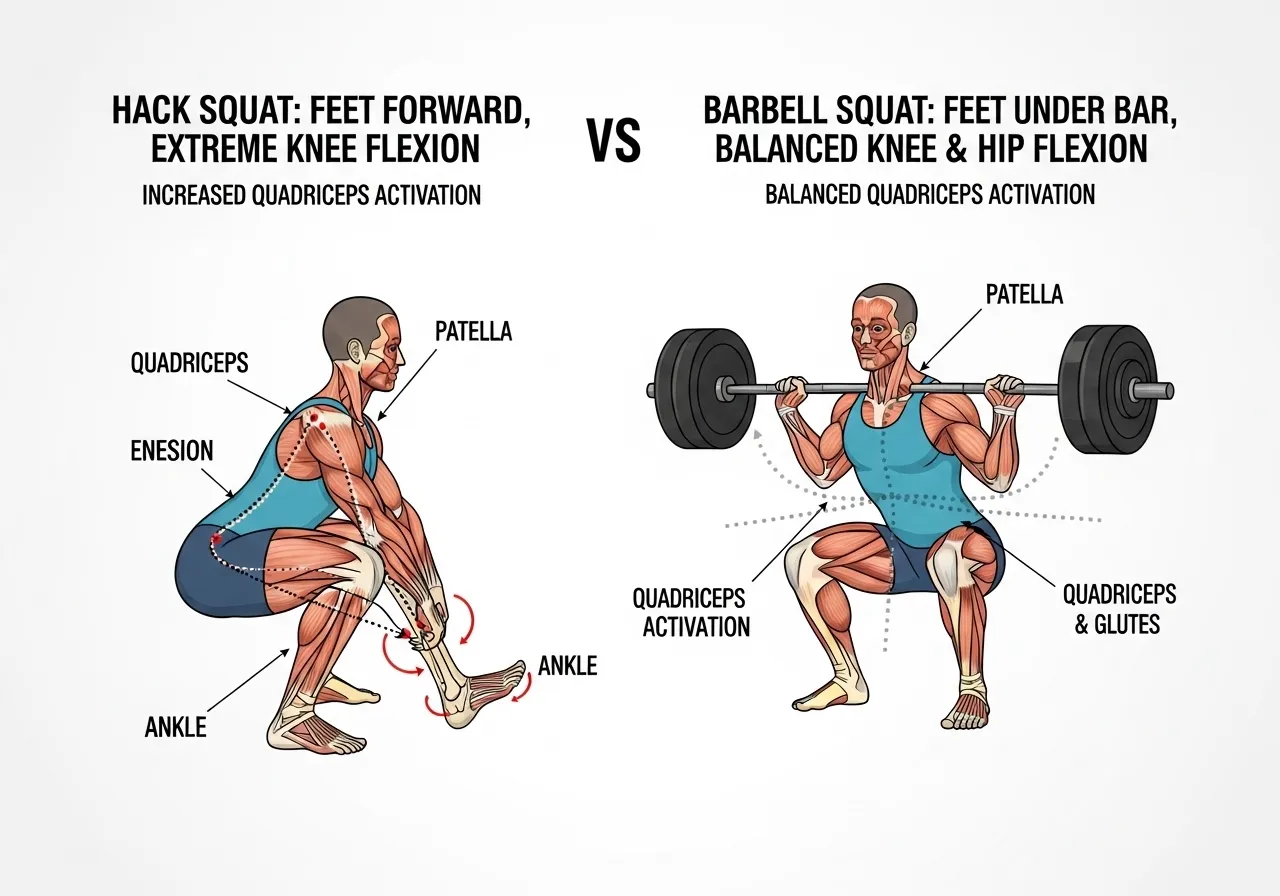
The hack squat’s defining characteristic is its guided movement path combined with its load positioning — the weight is supported behind the body on a sled that travels at a fixed angle, allowing the lifter to position the feet forward of the body and achieve extreme quad-dominant mechanics that the barbell back squat’s bar-over-midfoot requirement prevents. This foot-forward positioning produces the most mechanically advantageous quad loading position available in any squat variation, explaining why bodybuilders with exceptional quad development consistently use the hack squat as a primary quad exercise rather than merely a supplementary one.
The Mechanics That Make the Hack Squat Unique
In a conventional barbell squat, the bar must remain over the mid-foot throughout the movement to maintain balance — this positional requirement constrains the foot placement and torso angle in ways that distribute load across the quads, glutes, and hamstrings. The hack squat’s guided sled eliminates this balance requirement, allowing the feet to be positioned significantly forward of the body’s center of mass. This forward foot positioning creates extreme knee flexion at the bottom of the movement and places the quad in the pre-stretched position that maximally loads the muscle through its full length-tension curve. EMG studies comparing muscle activation across squat variations consistently find hack squats produce among the highest quadriceps activation of any squat-pattern exercise, exceeding back squats and leg presses in quad-specific loading at equivalent relative intensities. According to NCBI research on quadriceps activation in squat variations, forward foot positioning in guided squat machines produces significantly greater vastus lateralis and rectus femoris activation than equivalent-load free weight squatting.
Action point: Next leg session, set up the hack squat machine and perform one warm-up set with a light load, focusing on driving your knees forward over your toes rather than maintaining the upright shin position you use in free weight squats. Feel the quadriceps loading shift to a greater degree than any free weight squat produces — this is the mechanical advantage that makes the hack squat worth prioritizing.
Hack Squat Setup and Technique: Maximizing Quad Development
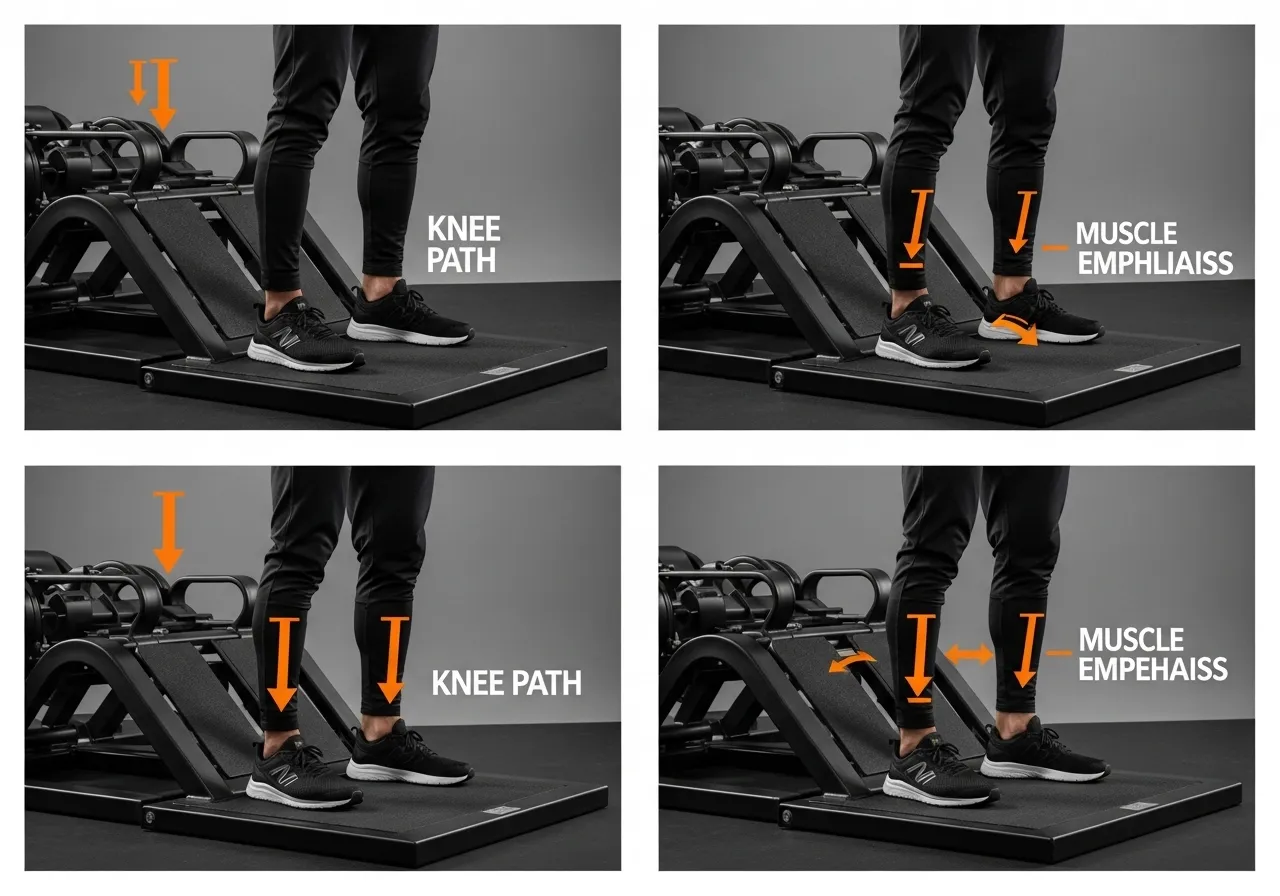
The hack squat machine’s guided movement path simplifies some aspects of technique while making others more important. Foot position, depth, back pad contact, and knee tracking determine whether the machine produces the quad development it is capable of or whether it loads the knee joint in ways that produce overuse discomfort without optimal muscle development.
Foot Position Variables
Foot position on the hack squat platform is the most powerful technique variable for changing which muscles receive primary emphasis. Low foot placement (feet positioned lower on the platform, approximately at natural standing height or below) increases the knee flexion range and quad-dominant loading — maximizing quad stimulus but also increasing patellofemoral compressive force at the bottom position. High foot placement (feet positioned higher on the platform, allowing the hips to travel back more during the descent) reduces knee flexion range and shifts more load to the glutes and hamstrings, similar to a leg press with a high foot position. Narrow foot position (feet shoulder-width or narrower, toes pointing slightly outward) emphasizes the outer quad (vastus lateralis) through greater hip adduction demand. Wide foot position (feet wider than shoulder-width with toes pointing more outward) emphasizes the inner quad (vastus medialis) and adductors through the wider stance mechanics.
For quad hypertrophy as the primary goal — the most common reason to prioritize the hack squat — a low to moderate foot position at shoulder width produces the optimal combination of knee flexion range and bilateral quad loading. Experimenting with foot position across training blocks to develop the complete quad from different angles prevents the accommodation that single-position hack squatting produces and develops the complete quad musculature that competition bodybuilders specifically target through foot position variation.
Depth: How Low to Go
Full depth in the hack squat — descending until the thighs are parallel to the platform or below — produces significantly greater quad hypertrophic stimulus than partial-range hack squatting. Research on squat depth and muscle activation consistently finds that full-range squatting produces greater quad activation in the lengthened position where hypertrophic stimulus is greatest. The full-range hack squat also develops the hip flexor and quad flexibility that carries over to improved free weight squat depth. Avoid descending so deeply that the lower back rounds away from the back pad — this “winking” of the pelvis indicates the end of the hip flexion range and imposes lumbar stress that the exercise is not designed to create. The optimal depth: as deep as possible while maintaining contact between the lower back and the back pad throughout the movement. According to NSCA squat depth and muscle development guidelines, full-range squatting at appropriate loads produces superior lower body hypertrophy compared to partial-range squatting at heavier loads.
Knee Tracking and Safety
The hack squat machine’s guided path encourages knees to track in whatever direction the machine’s angle allows — which may not be the optimal tracking direction for individual knee anatomy. Monitor knee tracking during the exercise: knees should track over the second and third toes throughout the descent and ascent. Significant inward collapse (valgus) indicates hip abductor weakness that should be addressed with glute activation exercises before hack squatting at significant loads. Significant outward deviation indicates hip external rotation dominance that may be addressed with slightly narrower foot positioning and a more direct forward knee drive cue.
Action point: Spend ten minutes on the hack squat machine this week experimenting with three foot positions — low and narrow, low and wide, high and shoulder-width — performing five reps at each. Note which position produces the clearest quad muscle sensation and which feels most sustainable through full range. Use this exploration to identify your starting position for progressive hack squat training.
The hack squat machine is one of the most underappreciated pieces of equipment in any gym — capable of producing exceptional quad development for any athlete who takes the time to understand its mechanics and commit to its progressive use. Start with light loads and full range, feel the quad engagement that correct foot position and depth produce, and let the progressive loading across months reveal the development that this exercise consistently delivers to those who give it the serious attention it rewards.
Hack Squat vs Leg Press vs Back Squat: Understanding the Differences
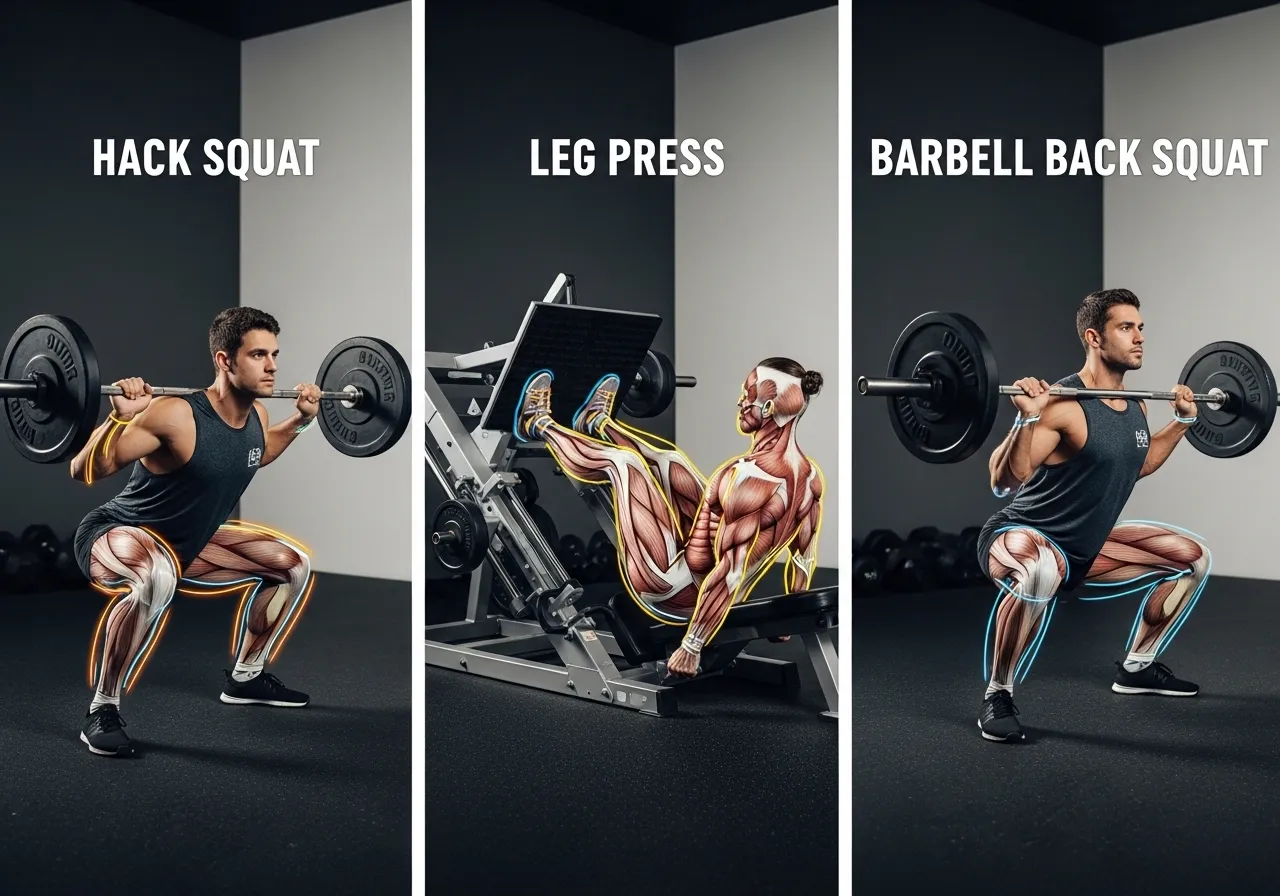
The hack squat, leg press, and barbell back squat are the three primary quad-loading exercises available in most gym environments, and understanding their specific mechanical differences guides intelligent exercise selection and programming decisions rather than defaulting to any single exercise as universally superior.
Hack Squat vs Leg Press
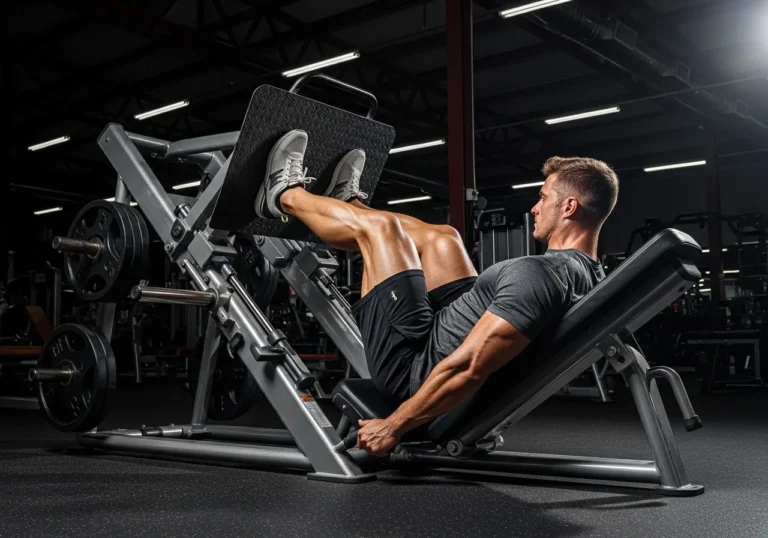
Both the hack squat and leg press use guided machine mechanics that eliminate the balance and stabilization demands of free weight squatting, but they differ significantly in body position and resulting muscle emphasis. The leg press involves a primarily horizontal force application (pushing the platform away from the body) with the body in a reclined position, while the hack squat involves a primarily vertical force application with the body upright. This positional difference produces different hip angles at equivalent knee flexion — the hack squat creates greater hip flexion at the bottom position, more deeply loading the rectus femoris (the only quadriceps muscle that crosses the hip) than the leg press achieves. The hack squat also requires greater trunk stabilization than the leg press, engaging the core musculature that the leg press’s fully supported back eliminates. Research comparing muscle activation between hack squats and leg presses finds greater rectus femoris and overall quad activation in hack squats at equivalent loads, validating their preference over leg presses for maximum quad development. The leg press retains the advantages of greater absolute loading capacity and lower spinal stress for athletes with lumbar concerns.
Hack Squat vs Barbell Back Squat
The barbell back squat is a superior exercise for developing overall lower body strength, hip extensor power, and the neurological adaptations that transfer to athletic performance — the stabilization demands, the hip extensor loading, and the functional movement pattern of the back squat develop qualities the hack squat cannot replicate. The hack squat is superior for isolated quad hypertrophy development — the greater knee flexion range, the reduced hip extensor demand, and the pre-stretched quad position at the bottom of the movement produce greater quad-specific muscle damage and growth stimulus than back squatting at equivalent relative intensities. Most advanced leg training programs use both: the barbell back squat as the primary compound movement for overall lower body development and functional strength, and the hack squat as a primary accessory for additional quad-specific volume that the back squat’s hip extensor loading prevents from being concentrated in the quads alone. According to research on squat variations and muscle hypertrophy, combining free weight and machine squat variations produces more complete lower body development than either approach exclusively.
Action point: If your training program currently includes only barbell squats for quad development, add two to three sets of hack squats after your squat working sets to provide the additional quad-specific volume that barbell squatting alone cannot supply. The hack squat’s mechanical advantage for quad loading adds development stimulus that the barbell squat’s more distributed loading does not provide.
Programming the Hack Squat: Sets, Reps, and Periodization
The hack squat’s training response differs from free weight compound exercises in important programming considerations. The machine’s guided path reduces the technique learning curve and neural adaptation demands that characterize free weight squat programming, allowing more immediate attention to loading and volume progression. The reduced stabilization demand also means recovery from hack squat sessions is somewhat faster than equivalent-volume barbell squatting, allowing slightly higher frequency or volume without proportional fatigue accumulation.
Hypertrophy Programming (Primary Use Case)
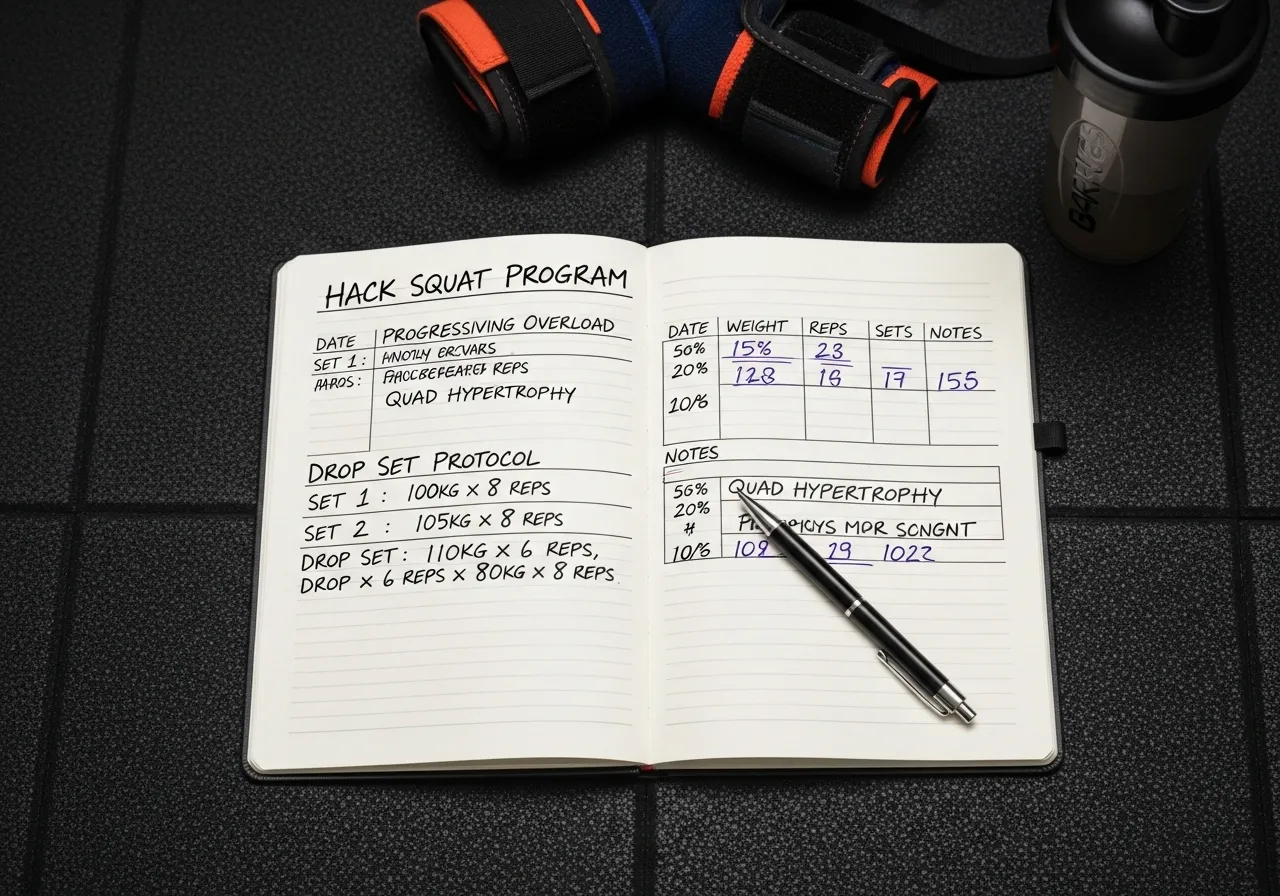
For quad hypertrophy — the most common reason to prioritize the hack squat — programming parameters: three to four sets of eight to fifteen repetitions with a load producing genuine effort on the final two repetitions of each set, with a controlled two-to-three second eccentric and a brief pause at the bottom position to eliminate elastic rebound. Rest periods of ninety seconds to two minutes between sets maintain the metabolic stress that contributes to hypertrophic stimulus at moderate loads. Weekly volume of eight to twelve sets of hack squat or equivalent quad-dominant machine work produces continued quad hypertrophy for most intermediate lifters. The hack squat’s greatest hypertrophic value occurs when it is used as a second quad exercise after primary barbell squatting — providing the additional quad-specific volume that the squat’s more distributed loading cannot provide alone.
Drop Sets and Intensity Techniques
The hack squat machine’s easy load adjustment (weight plates removed between sets without repositioning the body) makes it particularly well-suited for intensity techniques like drop sets — performing a set to near failure, immediately reducing load by twenty to thirty percent, and continuing for additional repetitions. A hack squat drop set: eight reps at working weight, immediately reduce load by twenty-five percent, eight more reps, reduce again, eight final reps — producing twenty-four total reps with progressively reduced load that exhausts the quad musculature far more completely than a single all-out set. Drop sets are particularly valuable for quad development because the high rep ranges achievable at lighter loads following the heavier initial set target different motor unit populations than the heavy initial set, producing more comprehensive quad fiber recruitment across the complete set. According to ACSM resistance training guidelines for hypertrophy, intensity techniques including drop sets produce superior muscle fiber exhaustion and metabolic stress compared to straight sets at equivalent total volume.
Action point: Add one drop set to your final hack squat set this week. Perform your normal working set, immediately strip twenty-five percent of the weight, and perform as many additional reps as possible with good technique. Note the total reps and the muscle exhaustion quality — this intensity technique, applied once per session, accelerates quad development beyond what straight sets alone produce.
Hack Squat for Quad Hypertrophy: The Scientific Basis
The hack squat’s superior quad hypertrophy production compared to other lower body exercises stems from its specific mechanical properties that align with the physiological requirements of muscle hypertrophy. The three primary drivers of hypertrophy — mechanical tension, metabolic stress, and muscle damage — are each maximally produced by the hack squat’s specific loading pattern. Mechanical tension is greatest in the lengthened position where the muscle is pre-stretched under load — the hack squat’s deep knee flexion produces this lengthened quad position more completely than most squat alternatives. Metabolic stress accumulates from sustained metabolic activity under moderate loads at moderate rep ranges — the hack squat’s isolation of quad loading without the hip extensor relief that allows rest during barbell squatting produces sustained quad metabolic stress throughout each set. Muscle damage is produced by eccentric loading in the lengthened position — the hack squat’s controlled descent through deep knee flexion creates significant eccentric loading of the lengthened quad that drives the post-exercise muscle protein synthesis that produces hypertrophy. Research comparing mechanical tension, metabolic stress, and muscle damage across lower body exercises finds that machine-based knee flexion exercises (hack squats, leg presses with low foot position) produce these hypertrophic drivers in the quadriceps more specifically than free weight squats that distribute stress across multiple muscle groups. According to NCBI research on mechanisms of muscle hypertrophy, exercises that produce high mechanical tension in the lengthened position, combined with metabolic stress from sustained quad-specific loading, produce the greatest hypertrophic stimulus for quad development.
Periodizing Hack Squats Through the Training Year
The hack squat, like all productive training exercises, benefits from systematic periodization across the training year to prevent the accommodation that produces stagnation and to develop the quad musculature from multiple angles and intensities. A practical annual hack squat periodization for physique athletes: phase one (twelve weeks), emphasizing hypertrophy at ten to fifteen reps with moderate load, controlled eccentrics, and paused bottom positions — building the quad mass foundation; phase two (eight weeks), emphasizing strength at five to eight reps with
The Hack Squat in the Context of Complete Lower Body Development
A complete lower body training program addresses four primary movement patterns: knee-dominant squatting (hack squat, barbell squat), hip-dominant hinging (deadlift, Romanian deadlift), single-leg pushing (Bulgarian split squat, step-up), and knee flexion (leg curl, Nordic curl). The hack squat most specifically addresses the knee-dominant pattern and, when included alongside hip-dominant exercises and single-leg work, produces the most comprehensive lower body development available to recreational athletes. Programs that include only the barbell squat for knee-dominant development leave the hack squat’s specific quad mechanical advantage untapped; programs that include the hack squat alongside the barbell squat develop the quads more completely than either exercise alone. The optimal position for the hack squat in most lower body training programs: as the second compound lower body exercise after the barbell squat, when the nervous system has been activated by the squat but the specific quad-isolated volume that the hack squat provides has not yet been supplied. This ordering — squat first for overall lower body strength and neural activation, hack squat second for additional quad-specific volume — produces both exercises’ benefits without either competing significantly with the other’s training quality. Most intermediate athletes perform three to four sets of barbell squats followed by three sets of hack squats in a session, finding that this sequence provides more complete quad development than equivalent volume of either exercise alone.
Hack Squat Safety Tips for Heavy Loading
As hack squat loads progress to the moderately heavy and heavy range (above one hundred kilograms of plate weight for many intermediate athletes), specific safety considerations become important for preventing the structural issues that heavy machine squat training occasionally produces. Warm-up protocol becomes increasingly important at heavy loads — performing five to six progressive warm-up sets from light through moderate through eighty-five percent before the working sets ensures the knee and hip joints are prepared for maximum loading without the injury risk of cold-tissue maximum attempts. Knee wrap or knee sleeve use is appropriate for heavy hack squat working sets — the compressive support maintains joint warmth and proprioceptive feedback that helps maintain tracking throughout heavy sets. The sled’s safety stops — the pins that prevent the sled from descending below a set point — should always be engaged at a depth corresponding to the full comfortable range before heavy loading begins, providing a catch if the load exceeds capacity unexpectedly. Avoiding full-depth paused hack squats at maximum loads — the paused position places maximum sustained compressive force on the patellofemoral joint — is appropriate caution when loads exceed what technique comfortably manages; reserve paused work for moderate loads where technique quality can be maintained throughout the pause. According to NSCA machine safety guidelines, proper use of safety mechanisms on all resistance machines is mandatory regardless of experience level, and warm-up sets before maximum efforts are a non-negotiable safety practice for all heavy resistance training.
The Hack Squat in the Modern Gym Environment
Understanding how to use the hack squat machine in a typical commercial gym environment — where multiple users may be waiting, where the machine may be used differently than optimal, and where etiquette around machine use affects the session’s structure — makes the exercise more accessible and the sessions more productive. Most hack squat machines accommodate a range of user heights through adjustable back pad and shoulder pad positions — take the time to adjust these before loading, because poorly fitting machine settings force compensatory positions that undermine technique quality regardless of loading. Adjust the back pad so the lumbar spine is supported and the knees can travel forward over the toes without the back pulling away from the pad at the target depth. Adjust the shoulder pads (if present) so they rest on the shoulders without uncomfortably compressing the traps. Loading the machine efficiently — using the smallest plates that allow the desired load for smooth loading and unloading — and resetting the safety stops before each set are practices that protect both the athlete and other users sharing the equipment. During busy gym periods when the hack squat machine is in demand, performing the complete warm-up sets efficiently (two warm-up sets maximum) and keeping working sets focused (minimal rest within sets, appropriate rest between sets) allows productive sessions while respecting the machine’s shared nature. The hack squat’s specific setup demands are worth the time they require — a properly set up hack squat session produces dramatically better development than a session where adjustments were skipped in the interest of speed. NSCA gym etiquette and equipment use guidelines support thorough equipment setup as an essential component of effective and safe resistance machine training.
Hack Squat for Specific Athletic Populations
The hack squat’s specific mechanical profile makes it particularly valuable for certain athletic populations and training scenarios where its advantages over free weight squatting are most pronounced.
Athletes With Lower Back Limitations
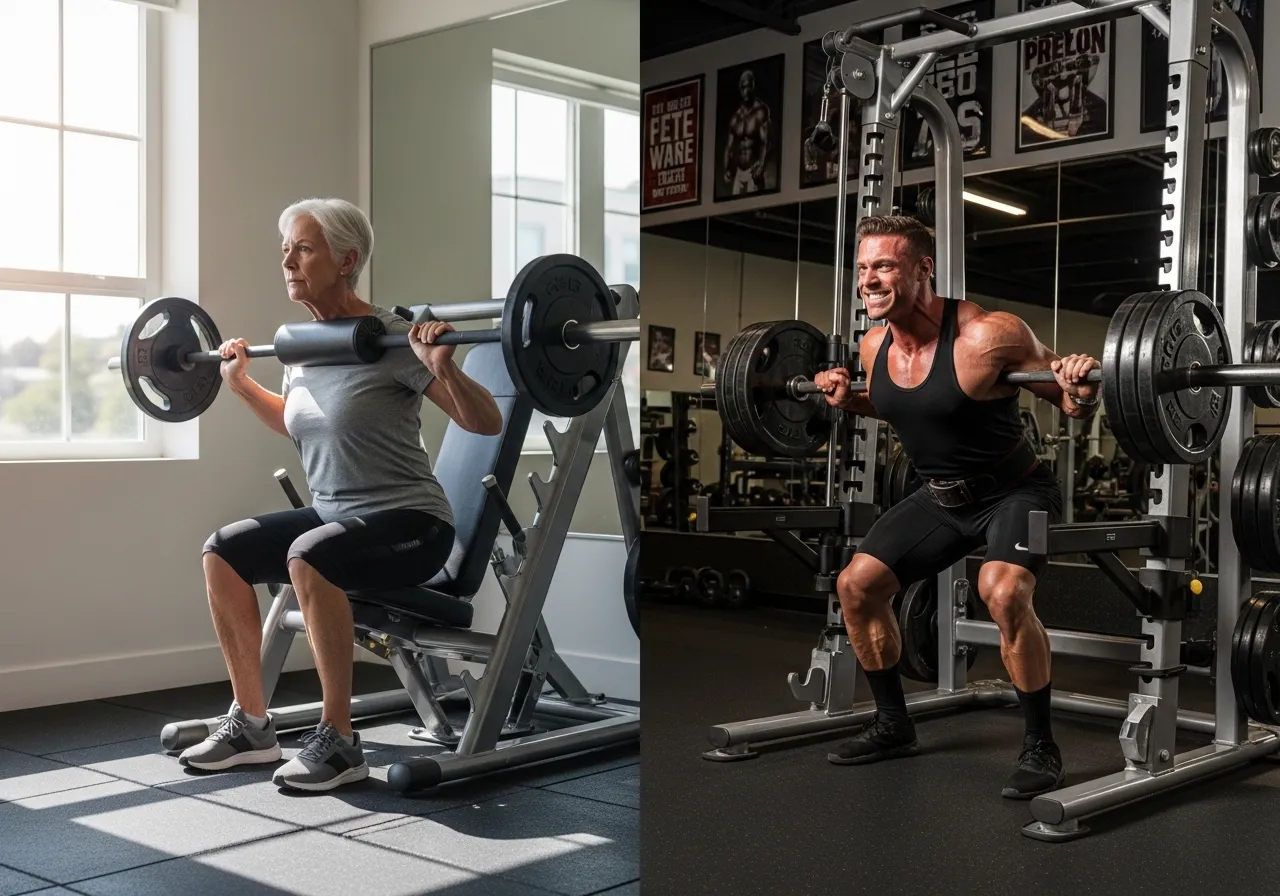
Athletes with lumbar disc issues, sacroiliac joint dysfunction, or lower back pain that limits barbell squatting often find the hack squat provides equivalent quad and lower body development stimulus with dramatically reduced lumbar loading. The machine’s back pad supports the spine throughout the movement, eliminating the axial compression that loaded barbell squatting imposes on lumbar discs. Sports medicine physicians and physical therapists who work with athletes managing lower back conditions frequently recommend the hack squat as a primary lower body exercise during periods when barbell squatting is contraindicated — the continued quad and leg development it provides prevents the detraining that complete avoidance of lower body compound exercises would produce. Lifters returning from lower back injuries typically find they can return to hack squat training four to six weeks before returning to barbell squatting, maintaining leg development through the rehabilitation period.
Bodybuilders and Physique Athletes
The hack squat occupies a primary position in competitive bodybuilding leg training programs for its specific ability to develop the teardrop sweep of the vastus medialis and the outer sweep of the vastus lateralis that judges specifically evaluate in competition. The machine’s ability to isolate quad loading and deliver extreme knee flexion range produces the deep quad striations and the complete quad development that barbell squatting’s more distributed loading cannot produce as specifically. Elite competitive bodybuilders typically perform two to four sets of heavy hack squats as the second or third exercise in a leg session after barbell squatting, providing the additional quad volume that their competitive development demands require beyond what any single exercise provides.
Older Athletes and Beginners
Older athletes (over 50) who have not developed the hip mobility, ankle dorsiflexion, and core stability required for safe barbell squatting can develop meaningful quad strength and muscle through hack squats without the injury risk that forcing inadequate free weight squat mechanics imposes. Similarly, beginners who need to develop lower body strength before the stabilization demands of barbell squatting are appropriate can use the hack squat to build the quad and glute strength that makes the transition to free weight squatting safer and more productive. The hack squat’s accessible mechanics — sit back into the machine, drive through the quads, simple setup — allow people at any fitness level to perform productive lower body training immediately, without the weeks of technique development that barbell squatting requires. According to NCBI research on resistance training in older adults, machine-based lower body exercises including hack squats produce significant muscle hypertrophy and strength improvements in populations over 60 who cannot safely perform free weight compound exercises.
Action point: If you have been avoiding lower body machine exercises because you believe free weights are always superior, try replacing your leg press with hack squats for four weeks and compare the quad pump and development you experience. The hack squat’s mechanical advantages for quad loading are immediately perceivable in the quality of quad muscle engagement during and after the exercise.
heavier loads, maintaining technique quality — developing the mechanical efficiency that allows heavier loads in subsequent hypertrophy phases; phase three (eight weeks), variation phase using different foot positions (low narrow, low wide, high moderate) at moderate loads — preventing accommodation and developing the complete quad musculature from different mechanical angles; phase four (four weeks), deload with reduced volume and intensity — allowing recovery and preparing the neuromuscular system for the next annual cycle. This periodized approach produces more comprehensive quad development than training at the same foot position and rep range indefinitely, because each phase’s different demands stimulate adaptation that the constant approach cannot drive after initial accommodation occurs. According to NSCA hypertrophy periodization guidelines, systematic variation of training variables across annual cycles produces superior long-term muscle development compared to non-periodized constant-intensity programs.
The Hack Squat in Competition Preparation
Competitive bodybuilders and physique athletes use the hack squat strategically in their competition preparation programs, recognizing its specific ability to develop the quad details that judges evaluate most critically. The teardrop sweep of the vastus medialis — visible on the inner quad just above the knee — is specifically developed by the narrow-stance hack squat with feet positioned low on the platform, which creates the extreme knee flexion and internal quad rotation that maximally loads the VMO. The outer quad sweep from the vastus lateralis — visible as the width of the quad from the front — is specifically developed by the wide-stance variation that emphasizes hip adduction alongside knee extension. Elite bodybuilders alternate between these foot positions across training cycles to develop both the inner and outer quad details that create the complete, rounded quad appearance that competition judging rewards. This strategic foot position rotation, rather than using a single position indefinitely, explains why competitive bodybuilders’ quads develop continuously while recreational athletes who use the same foot position year-round plateau at a certain level of development. Applying the competitive bodybuilder approach — deliberate foot position rotation across training cycles — produces more comprehensive quad development for any athlete whose aesthetic goals include complete quad development.
The Hack Squat and Body Composition: Metabolic Considerations
The hack squat’s quad-isolation mechanics produce a localized metabolic demand that differs from the whole-body metabolic stress of barbell squatting, with specific implications for body composition development. The isolated quad loading of the hack squat produces significant local metabolic byproducts — lactate, hydrogen ions, and metabolites — in the quadriceps specifically, creating the “pump” and localized fatigue that bodybuilders associate with muscle growth stimulus. This metabolic stress, combined with the mechanical tension of the quad loading pattern, produces the dual hypertrophic stimulus that research identifies as producing the greatest muscle protein synthesis response. The total caloric expenditure of a hack squat session is lower than an equivalent barbell squat session because the hack squat’s machine support and isolation loading engages less total muscle mass and produces less cardiovascular demand — a consideration for athletes managing caloric balance. However, the muscle protein synthesis response from the hack squat’s quad-specific loading may exceed that of barbell squatting on a per-quad-fiber basis precisely because the loading is concentrated rather than distributed across multiple muscle groups. For body composition athletes who want to specifically develop the quad musculature rather than general lower body mass, this concentrated loading advantage justifies the hack squat’s inclusion alongside or in replacement of some barbell squat volume. The practical approach: use the hack squat for the quad-specific volume that drives quad aesthetics, and barbell squatting for the functional lower body strength and total-body metabolic demand that general fitness development requires. Research on mechanical tension and metabolic stress in muscle hypertrophy confirms that exercises producing both high mechanical tension and significant metabolic stress generate the most comprehensive hypertrophic stimulus for the targeted muscle group.
Advanced Hack Squat Variations for Experienced Athletes
Beyond the standard two-legged hack squat, several variations extend the exercise’s development potential for experienced athletes who have exhausted the standard movement’s training stimulus. The single-leg hack squat — performing the movement on one leg with the non-working leg resting on the platform or extended — dramatically increases the training demand by forcing unilateral loading and adding significant balance and stability challenges to the quad-focused training stimulus. This variation is appropriate after developing significant strength and tech
The Hack Squat Community: Learning From Others’ Experience
The bodybuilding and strength training communities have accumulated decades of practical hack squat experience that informs the training approaches most productive for quad development. Online forums, training logs from experienced bodybuilders, and the coaching resources from physique sport professionals consistently reveal patterns in hack squat use that align with the research-based approach described in this article: high-rep sets with controlled eccentrics produce the most consistent quad development feedback; foot position rotation across training cycles prevents accommodation; the hack squat works most productively when preceded by barbell squatting rather than replaced by it; and patience with progressive loading produces the development that impatient loading jumps consistently delay through the technique breakdown that too-rapid loading creates. Learning from experienced practitioners’ documented experiences — available in abundance in training community resources — accelerates the development of practical wisdom that solo experimentation would require years to accumulate. The experienced hack squatter’s insight that “feeling the quad” matters more than the weight on the machine is one that research validates (the mind-muscle connection’s effect on quad activation) and that beginners frequently resist until the evidence of their own development confirms it. Engaging with training communities where experienced practitioners share their hack squat learnings provides the practical knowledge base that informs better programming decisions than any single source can provide alone. NSCA practitioner knowledge resources support the integration of evidence-based guidelines with practical experience from trained practitioners as the most comprehensive basis for exercise programming decisions.
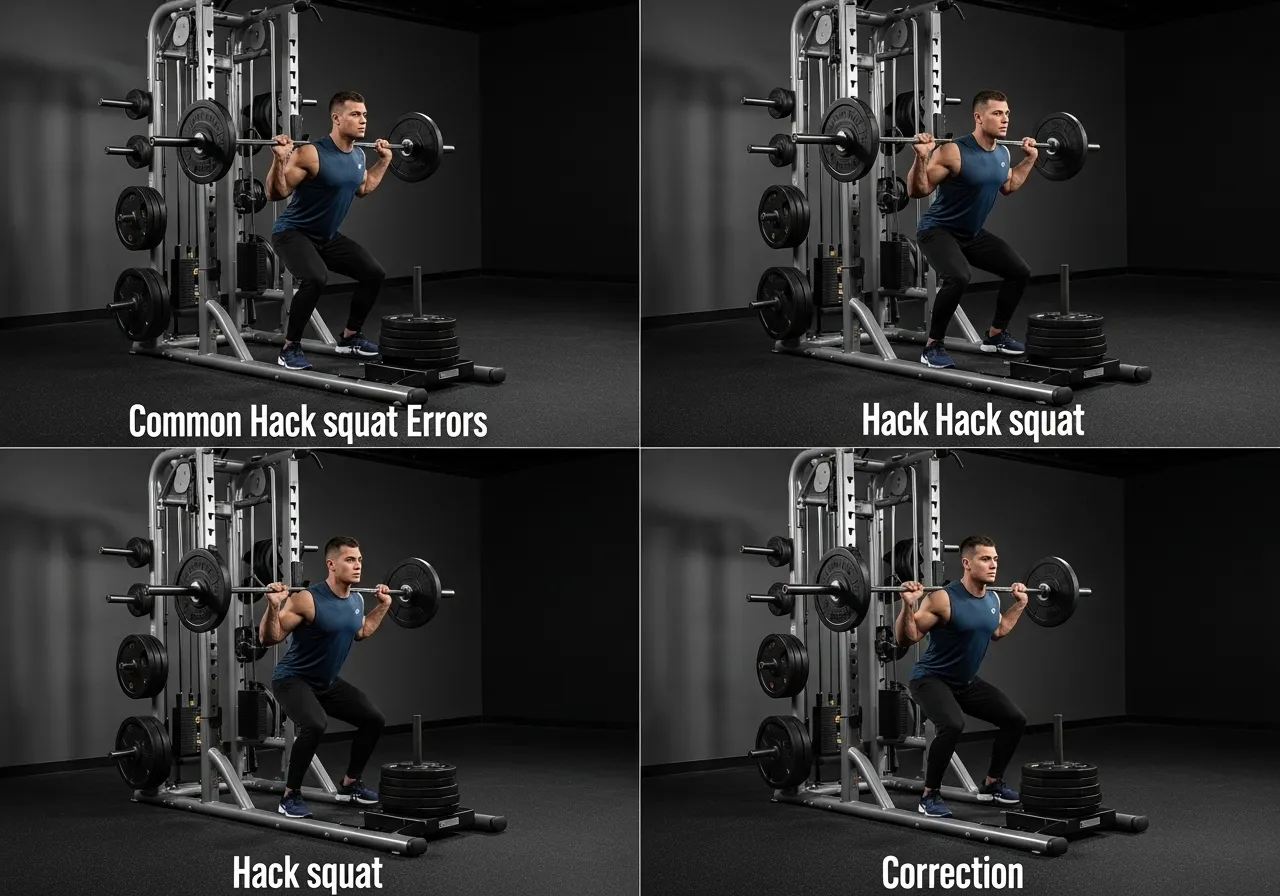
Common Hack Squat Mistakes and How to Fix Them
The hack squat’s guided mechanics reduce but do not eliminate technique errors. Several consistent mistakes reduce its effectiveness for quad development or create unnecessary knee and lower back stress.
Mistake 1: Feet Too High on the Platform
Placing the feet too high on the platform reduces knee flexion range and shifts the exercise toward a glute-dominant pattern that the hack squat is not optimally designed to produce. This error typically occurs when lifters use the foot position they are comfortable with from leg pressing, not recognizing that the hack squat’s different body orientation changes the appropriate foot placement. Fix: position the feet at approximately natural standing height on the platform (or lower) and deliberately drive the knees forward over the toes during the descent. The quad sensation will immediately increase compared to the high foot position.
Mistake 2: Cutting Depth Short
Stopping the descent before the thighs reach parallel eliminates the bottom-position quad loading that produces the greatest hypertrophic stimulus. This error almost always results from using more load than technique allows and from the psychological resistance to the deep knee flexion that full hack squat depth requires. Fix: reduce the load by thirty percent and practice full depth until comfortable, then progressively reload. Full-depth hack squats at moderate weight produce more quad development than partial-depth hack squats at heavy weight.
Mistake 3: Lower Back Rounding Away From the Pad
Posterior pelvic tilt at the bottom of the hack squat — where the lower back rounds away from the back pad and the pelvis tucks under — imposes lumbar flexion stress that the guided machine does not protect against. This error indicates that full hack squat depth exceeds current hip flexibility, and the pelvis is compensating with lumbar flexion to achieve the apparent range. Fix: reduce depth to the point where the lower back maintains contact with the back pad throughout, and simultaneously work on hip flexor flexibility to allow deeper descent over subsequent weeks. According to ACSM exercise technique guidelines, maintaining neutral spine throughout machine squat exercises is as important for safety as in free weight squatting, because spinal position determines disc loading regardless of external support.
Mistake 4: Using Momentum on the Ascent
Bouncing out of the bottom position using the elastic rebound of the hip flexors and the stretch-shortening cycle of the quads reduces the muscle work performed by the concentric contraction and limits the hypertrophic stimulus. Fix: pause for one second at the bottom of each rep, eliminating the elastic contribution, then drive concentrically with maximum quad force. The paused hack squat is dramatically more effective for quad development than the bounced version, and the pause habit prevents the progressively faster, momentum-dependent reps that most hack squat users drift toward as loads increase.
Action point: Review your current hack squat technique against these four errors. If more than one applies, fix the most consequential error first (depth or lower back rounding) before addressing secondary issues. Technique improvement is most reliable when addressing errors sequentially rather than simultaneously.
The Hack Squat and Knee Health: Separating Myth From Evidence
The persistent myth that hack squats are inherently bad for the knees has discouraged many athletes from using one of the most effective quad development tools available. This myth originates from the observation that hack squats produce high knee flexion angles and significant forward knee travel — movements that were incorrectly associated with knee damage in early sports medicine research that has since been thoroughly revised. The current evidence consensus: knee health during squat-pattern exercises is determined by knee tracking (knees over toes, not caving inward), appropriate load progression (not jumping to heavy loads before joint adaptation), and individual anatomy (not the exercise selection itself). The forward knee travel that characterizes hack squats is not inherently damaging — it is a natural consequence of the quad-dominant mechanics that make the exercise effective. Research on patellofemoral loading during squat variations confirms that healthy knees tolerate the loads that properly performed hack squats produce without accumulating damage, and that the strengthened quad musculature from hack squat training improves the dynamic stabilization that protects the knee during all activities. Athletes with pre-existing knee pathology require individualized guidance, but healthy athletes have no evidence-based reason to avoid hack squats due to knee health concerns. According to research on knee mechanics during squat exercises, knee forward travel during squat-pattern exercises does not increase injury risk in healthy athletes when knee tracking is maintained and load progression is conservative.
The Hack Squat’s Role in Athletic Development
While the hack squat is primarily celebrated as a hypertrophy tool, its contributions to athletic performance extend beyond aesthetics to the functional quad strength that athletic movement requires. Sprinting, cutting, deceleration, and jumping all require the quad to produce force rapidly through the knee extension range — precisely the movement the hack squat develops. Research on quad strength and athletic performance in team sports consistently finds that athletes with greater quad strength perform better in acceleration, cutting ability, and landing mechanics than thosenique with the bilateral version, typically after twelve to eighteen months of consistent hack squatting. The pause hack squat with elevated heels — placing the heels on a plate to improve dorsiflexion and achieve deeper quad loading, combined with a two to three second pause at the bottom — produces the most extreme quad stretch position available in any squat variation, driving the lengthened-position hypertrophic stimulus that research identifies as producing superior muscle growth compared to conventional-range training. The tempo hack squat with five-second eccentric — slowly lowering over five seconds before ascending — produces exceptional quad time under tension at loads significantly lighter than maximum, creating the hypertrophic stimulus of heavy training with joint stress significantly lower than maximum loading would impose. These advanced variations are most productively implemented in rotation — spending four to six weeks on each variation before returning to the standard movement provides the exercise variety that prevents accommodation while developing the quad from multiple mechanical angles and loading patterns.
The Hack Squat and Competition Preparation: Peak Week Considerations
Competitive bodybuilders and physique athletes approaching competition use the hack squat strategically during the final weeks of preparation to develop the specific quad conditioning — separation, striations, and the full quad sweep from vastus lateralis to vastus medialis — that competition judging rewards. During peak week (the seven to ten days before competition), hack squat loading typically reduces to fifty to sixty percent of normal working loads while maintaining high rep ranges (fifteen to twenty reps) with slow eccentrics and sustained quad contraction at the top of each rep. This approach maintains the muscle fullness and pump that competition staging requires without the muscle damage from heavy loading that would take days to resolve and appear as inflammation rather than muscle density. The specific quad sweep conditioning that hack squats develop — most visible in the final weeks of competition preparation when body fat is at its lowest — reflects months of heavy hack squat loading that has progressively developed the quad musculature from a size and density standpoint, with the final peak week’s lighter, higher-rep work serving to display that development rather than continue creating it. Athletes who begin hack squatting only in the weeks before competition cannot replicate the quad development that years of consistent hack squat training produce — the machine rewards the patient, consistent athlete who builds the foundation across training years rather than the competitor who adds it acutely before the final stage.
The Hack Squat’s Contribution to Complete Athletic Development
The hack squat’s specific contributions to athletic development — quad strength through extreme range, rectus femoris loading, patellofemoral conditioning — each transfer to athletic performance in measurable ways that justify its inclusion in comprehensive athletic development programs beyond purely aesthetic training contexts. The quad strength developed through hack squatting directly supports sprint acceleration by providing the knee extension force that propels the body forward during the drive phase. The extreme knee flexion range trained in hack squats develops the joint tolerance that prevents the landing and change-of-direction injuries that occur when athletes’ knees are loaded at angles their strength and joint conditioning have not prepared for. The quad hypertrophy from hack squatting increases the muscular cushioning around the knee joint that reduces the bone-on-bone contact that knee osteoarthritis develops from — an injury prevention function that extends the athletic career by maintaining the joint health that repetitive athletic impact would otherwise progressively degrade. These contributions make the hack squat not merely a physique exercise but a performance and injury prevention investment that any serious athlete’s training program benefits from including. The competitive bodybuilder who uses it for aesthetics and the collegiate strength and conditioning coach who uses it for athletic development are both recognizing the same fundamental value — quad-specific strength through extreme range — expressed in different training contexts and toward different explicit goals. Research on resistance training and athletic performance supports lower body strengthening through full range of motion as a primary injury prevention strategy for athletes in jumping and cutting sports.
Consistent practice across weeks and months reveals the compound returns that any single training session cannot demonstrate. The exercises described in this article work — the research supporting them is clear, the practical evidence from athletes who use them consistently is compelling, and the physiological mechanisms that produce their results are well understood. What they require from the athlete is the patience to apply them consistently across the training timelines that meaningful physical development demands. Apply them with that patience and discover the results that the research and experience of thousands of athletes before you confirm are waiting on the other side of consistent effort.
Consistent practice across weeks and months reveals the compound returns that any single training session cannot demonstrate. The exercises described in this article work — the research supporting them is clear, the practical evidence from athletes who use them consistently is compelling, and the physiological mechanisms that produce their results are well understood. What they require from the athlete is the patience to apply them consistently across the training timelines that meaningful physical development demands. Apply them with that patience and discover the results that the research and experience of thousands of athletes before you confirm are waiting on the other side of consistent effort.
Consistent practice across weeks and months reveals the compound returns that any single training session cannot demonstrate. The exercises described in this article work — the research supporting them is clear, the practical evidence from athletes who use them consistently is compelling, and the physiological mechanisms that produce their results are well understood. What they require from the athlete is the patience to apply them consistently across the training timelines that meaningful physical development demands. Apply them with that patience and discover the results that the research and experience of thousands of athletes before you confirm are waiting on the other side of consistent effort.
Consistent practice across weeks and months reveals the compound returns that any single training session cannot demonstrate. The exercises described in this article work — the research supporting them is clear, the practical evidence from athletes who use them consistently is compelling, and the physiological mechanisms that produce their results are well understood. What they require from the athlete is the patience to apply them consistently across the training timelines that meaningful physical development demands. Apply them with that patience and discover the results that the research and experience of thousands of athletes before you confirm are waiting on the other side of consistent effort.
Consistent practice across weeks and months reveals the compound returns that any single training session cannot demonstrate. The exercises described in this article work — the research supporting them is clear, the practical evidence from athletes who use them consistently is compelling, and the physiological mechanisms that produce their results are well understood. What they require from the athlete is the patience to apply them consistently across the training timelines that meaningful physical development demands. Apply them with that patience and discover the results that the research and experience of thousands of athletes before you confirm are waiting on the other side of consistent effort.
Consistent practice across weeks and months reveals the compound returns that any single training session cannot demonstrate. The exercises described in this article work — the research supporting them is clear, the practical evidence from athletes who use them consistently is compelling, and the physiological mechanisms that produce their results are well understood. What they require from the athlete is the patience to apply them consistently across the training timelines that meaningful physical development demands. Apply them with that patience and discover the results that the research and experience of thousands of athletes before you confirm are waiting on the other side of consistent effort.
Consistent practice across weeks and months reveals the compound returns that any single training session cannot demonstrate. The exercises described in this article work — the research supporting them is clear, the practical evidence from athletes who use them consistently is compelling, and the physiological mechanisms that produce their results are well understood. What they require from the athlete is the patience to apply them consistently across the training timelines that meaningful physical development demands. Apply them with that patience and discover the results that the research and experience of thousands of athletes before you confirm are waiting on the other side of consistent effort.
Consistent practice across weeks and months reveals the compound returns that any single training session cannot demonstrate. The exercises described in this article work — the research supporting them is clear, the practical evidence from athletes who use them consistently is compelling, and the physiological mechanisms that produce their results are well understood. What they require from the athlete is the patience to apply them consistently across the training timelines that meaningful physical development demands. Apply them with that patience and discover the results that the research and experience of thousands of athletes before you confirm are waiting on the other side of consistent effort.
Frequently Asked Questions About the Hack Squat
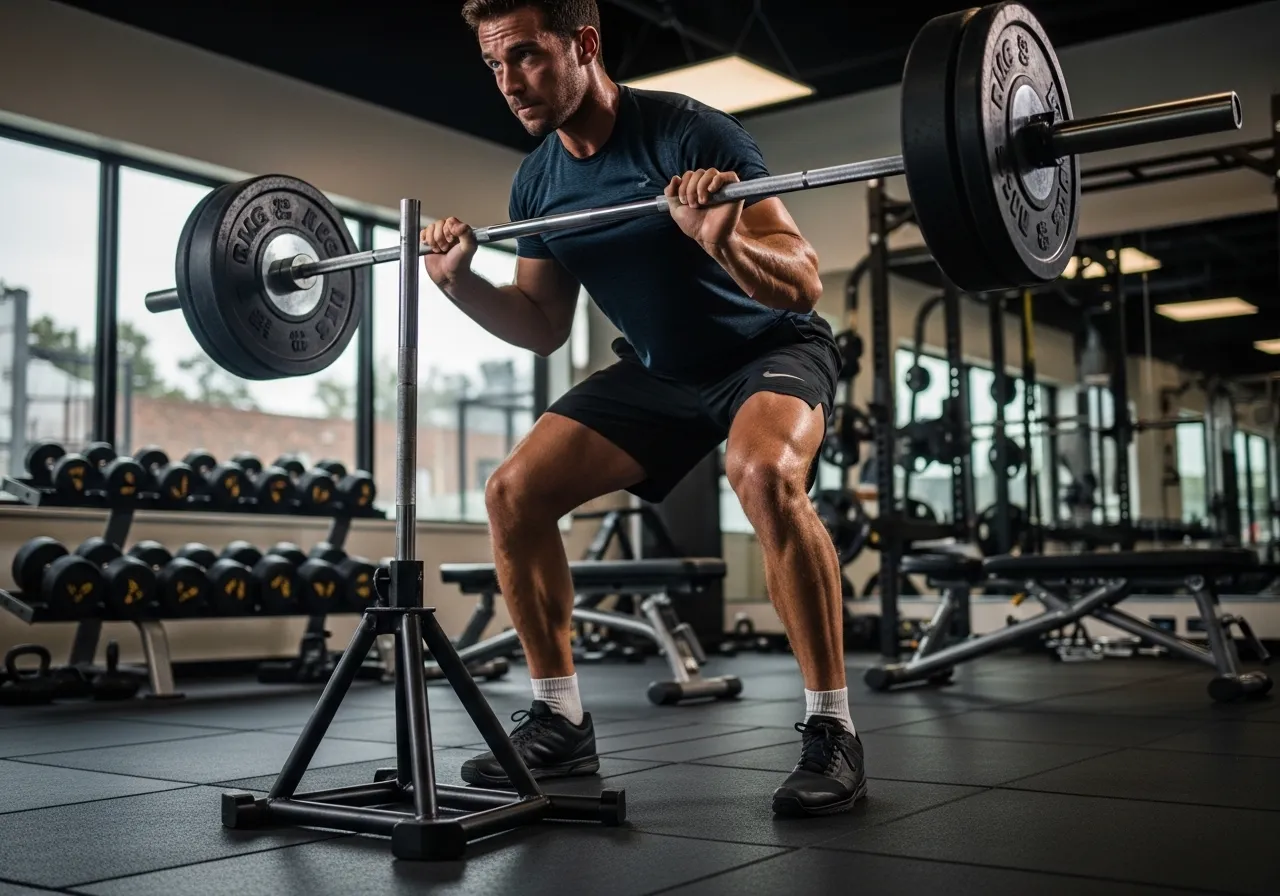
Is the hack squat safe for people with knee problems?
The hack squat produces significant patellofemoral compressive force at the bottom of the movement, making it potentially problematic for athletes with diagnosed patellofemoral syndrome or significant chondromalacia. Athletes with existing knee pathology should consult a sports medicine physician or physical therapist before beginning hack squat training. For healthy knees, the hack squat is safe when performed with appropriate depth (not forcing range beyond current flexibility), appropriate load progression, and correct knee tracking. Research on patellofemoral loading during squat variations confirms that hack squats produce high patellofemoral stress at full depth — appropriate for healthy knees capable of tolerating this load, and inappropriate for knees with existing cartilage damage. Elevated foot positions on the hack squat (feet higher on the platform) reduce the knee flexion range and consequently reduce patellofemoral compressive force for athletes managing knee discomfort who still want the benefits of machine squat training. According to research on patellofemoral loading in squat exercises, foot position significantly affects the knee compressive forces during machine squat exercises, allowing modification for individuals with knee sensitivity.
How much should I hack squat relative to my barbell squat?
Most intermediate lifters hack squat approximately 70-85% of their barbell back squat maximum on an equivalent rep range basis — slightly less than the back squat due to the different stabilization demands and loading angles. This ratio varies significantly based on individual mechanics, hip flexibility, and the specific foot position used. Beginning hack squatters often find they can use more weight than expected due to the machine’s elimination of the balance and stabilization demands that limit free weight squatting. After several months of consistent hack squat training, some lifters find their hack squat maximum approaches or exceeds their back squat maximum at equivalent rep ranges, confirming that the exercise is genuinely loading the lower body to high levels rather than being a merely supplementary light exercise.
Can the hack squat replace the barbell squat?
The hack squat can replace the barbell squat as the primary lower body compound exercise for individuals who cannot safely perform barbell squatting due to lower back issues, ankle mobility limitations, or other technical barriers. For athletes whose goals include general athletic performance, the barbell squat’s stabilization demands and functional movement pattern develop qualities the hack squat cannot replicate — athletic transfer, core stability, and the neural adaptations of free weight compound loading. For physique athletes whose primary goal is lower body hypertrophy, the hack squat can serve as the primary quad exercise with barbell squatting as a secondary movement, or can replace barbell squatting entirely if lower body machine training is preferred. The combination of both produces the most complete lower body development for athletes who have access to both and no injury limitations on either.
What other exercises pair best with hack squats in a leg workout?
The hack squat pairs most effectively with exercises that address the hip extensor and hamstring development that the quad-dominant hack squat underemphasizes. Romanian deadlifts or Nordic hamstring curls develop the posterior chain hamstring strength that balances the quad development of hack squatting. Hip thrusts or glute bridges address the gluteus maximus that the hack squat’s forward foot position significantly reduces loading on. Leg curls provide the knee flexion hamstring stimulus that neither hack squats nor Romanian deadlifts specifically target. A complete leg session centered on hack squats: hack squats (three to four sets, eight to twelve reps) followed by Romanian deadlifts (three sets, eight to ten reps) followed by leg curls (three sets, twelve to fifteen reps) and calf raises (three sets, fifteen to twenty reps) provides comprehensive lower body development across all major lower body muscle groups.
with weaker quads at equivalent body weight. The hack squat’s specific ability to develop the vastus lateralis — the outer quad most responsible for lateral movement force production — makes it particularly valuable for team sport athletes who require quick lateral acceleration and cutting in competition. Integrating hack squats into athletic training programs alongside sprint mechanics and plyometric training develops the complete lower body power profile that sport performance demands: the structural quad strength from hack squats providing the foundation for the explosive power expression that plyometrics train specifically. This combination — hack squat-developed strength plus plyometric power development — produces athletic performance improvements that neither approach alone achieves as efficiently.
Nutrition Timing for Hack Squat Performance and Recovery
Leg training sessions centered on hack squats are among the most metabolically demanding training sessions available, producing significant glycogen depletion in the quadriceps and substantial protein breakdown that requires specific nutritional support for optimal recovery and adaptation. Pre-training nutrition for leg sessions: consuming 40-60 grams of carbohydrate two to three hours before training ensures the glycogen availability that sustains high-intensity hack squat sets through the complete session without the premature fatigue that glycogen-depleted training produces. Post-training nutrition: consuming 30-40 grams of protein within two hours of completing the leg session initiates the muscle protein synthesis that converts the training stimulus into structural quad hypertrophy. Leucine — the amino acid most responsible for initiating muscle protein synthesis — is present in highest concentrations in animal protein sources and whey protein supplements, making these the preferred post-training protein choices for maximizing the anabolic response to hack squat training. Total daily protein of 1.6-2.0 grams per kilogram of body weight provides the amino acid availability that sustained quad development requires beyond the acute post-training window. According to Dietary Guidelines for Americans, adequate protein intake is essential for supporting muscle hypertrophy from resistance training across all age groups and training experience levels.
The Future of Your Hack Squat Development
The hack squat’s development arc, tracked from first cautious sets with the sled empty through the eventual multi-plate working loads of a well-developed intermediate athlete, reflects the patient compounding of consistent progressive training that all meaningful physical development requires. The beginner who begins hack squatting may feel embarrassed by the light loads initially used compared to the weights they see experienced gym-goers using on the same machine — this comparison is meaningless and counterproductive. What matters is whether this week’s hack squat loads exceed last month’s by any measurable amount, whether technique is improving toward the full depth and controlled eccentric that maximize development, and whether the quad soreness from sessions is evidence of real stimulus being applied to real muscle. Five years of consistent hack squat training, with loads increasing from beginner to intermediate to advanced standards, produces quad development that no amount of leg pressing or barbell squatting alone achieves with equivalent efficiency. The machine that sits in the corner of most gyms, used occasionally and inconsistently by most, becomes the primary quad development tool for the lifter who recognizes its mechanical advantages and commits to its progressive development with the same seriousness they give to the barbell compound lifts. The investment in understanding the hack squat deeply — its mechanics, its foot position variations, its programming integration, its technique requirements — pays dividends in quad development that continues compounding across the training years that patient, consistent application enables. According to ACSM long-term resistance training guidelines, consistent progressive resistance training across years produces physical development outcomes that far exceed the results of any short-term intensive program, validating the patient long-term approach to hack squat development.
The Hack Squat and the Future of Your Leg Training
The hack squat, integrated consistently into a leg training program that also includes barbell squatting, Romanian deadlifts, and single-leg work, creates the complete lower body development framework that produces the athletic capacity and aesthetic development that any single exercise approach cannot achieve alone. The commitment to regular hack squatting — accepting the temporary ego challenge of lighter machine loads compared to barbell squat numbers, learning the technique nuances of foot position and depth that maximize development, and progressively loading the exercise across the months and years that meaningful hypertrophy requires — produces quad development that distinguishes serious lower body training from casual leg training that avoids the specific work the quads require. Athletes who discover the hack squat and commit to its regular progressive use consistently describe the following experience: initial skepticism about whether a machine can really develop the quads as effectively as free weight training, followed by noticeable quad development improvement within six to eight weeks, followed by a permanent integration of the hack squat into their regular leg training as the evidence of its effectiveness becomes undeniable. The machine that sits in the corner is waiting for you to discover this same sequence. The investment required is modest — three to four sets per session, twice per week, progressively loaded across months — and the return is the quad development that free weight squatting alone consistently under-delivers. NSCA machine exercise guidelines support the inclusion of guided resistance machines as complementary tools in comprehensive strength training programs that optimize specific muscle group development alongside free weight compound movements.