⚠️ Fitness Disclaimer: The information in this article is for general educational purposes only and does not constitute professional fitness or medical advice. Always consult a qualified healthcare professional before starting any new exercise program.
Why You Feel the Seated Row Everywhere Except Your Back
The seated cable row is one of the most commonly performed and most commonly performed incorrectly exercises in commercial gyms. I spent two years doing it and feeling it primarily in my biceps and forearms — occasionally in my shoulders, sometimes in my lower back — but almost never in the middle of my back where the exercise is actually supposed to work. When I eventually learned what correct execution felt like, the difference was immediate and dramatic: the same weight, the same machine, but an entirely different muscular experience.
The seated row is an exercise that reveals the gap between performing a motion and training a muscle. Moving the cable handle toward your torso produces a motion — but whether that motion is training your rhomboids, mid-trapezius, and latissimus dorsi, or primarily your biceps and forearms, depends entirely on technical details that most people have never been explicitly taught.
This guide covers every technical element that makes the difference between a seated row that builds back thickness and one that just tires your arms. More importantly, it explains the specific sensations and cues that confirm you are achieving genuine back muscle activation — because knowing what to look for is more valuable than any list of instructions.
What the Seated Row Should Develop
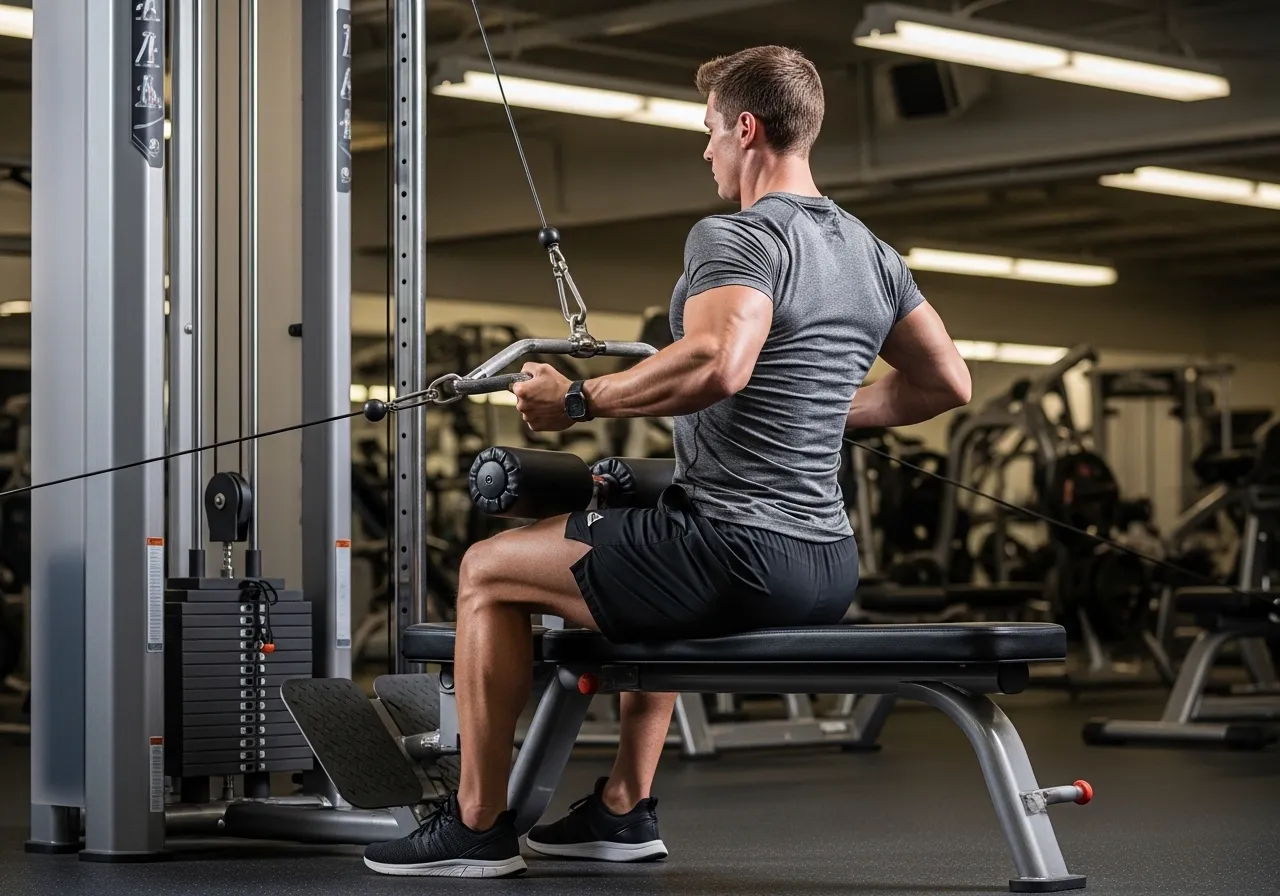
The seated cable row, when performed correctly, is one of the most complete back development exercises available. The primary movers: rhomboids and mid-trapezius (scapular retraction), latissimus dorsi (shoulder extension and adduction), and posterior deltoid (shoulder extension). The stabilizers: erector spinae (maintaining upright torso), core (preventing excessive lean), and biceps (elbow flexion as a secondary contributor). A correctly executed row produces fatigue in the middle of the back — between the shoulder blades — with bicep fatigue as a secondary sensation. If the primary fatigue location is the biceps, the execution is dominated by elbow flexion rather than shoulder and scapular retraction.
Why the Seated Row Is the Most Technically Demanding Cable Exercise
The seated cable row appears simple — you sit, grip a handle, and pull toward your torso. In practice it is one of the most technically demanding cable exercises because its effectiveness depends entirely on the sequence and quality of muscle activation rather than on the movement itself. Most people perform a bicep curl with a cable attachment while their back watches passively — the arms do all the work, the scapulae move without order or control, and the lats never enter a meaningful contraction. The result is a moderately effective bicep exercise masquerading as a back builder. The technical distinction that separates effective seated rows from this bicep-dominant pattern is the scapular initiation — the deliberate retraction and depression of the shoulder blades before the arms begin pulling. This reordering of the movement sequence — scapulae first, arms following — transforms the seated row from an arm exercise into the most effective middle back development movement available in cable training. Mastering this sequence takes most people four to six weeks of deliberate practice, during which loads must be reduced to allow conscious control of the initiation sequence. The patience required for this technical development is the investment that makes subsequent seated rowing genuinely develop the back rather than merely fatiguing the arms. Research on muscle activation sequencing in horizontal pulling exercises confirms that scapular retraction initiation significantly increases rhomboid, middle trapezius, and latissimus dorsi activation compared to arm-initiated pulling, validating the technical emphasis on scapular sequence in seated row coaching.
The Lats in the Seated Row: Understanding the Pull-Down vs Row Distinction
A common misconception about the seated row is that it trains the lats in the same way as the lat pulldown. The lats are biaxial muscles — they both extend the shoulder (pulling the arm from overhead to the side, as in lat pulldown) and adduct the shoulder (pulling the arm from the side toward the body, as in horizontal rowing). The seated row loads the lats primarily in shoulder extension and adduction from the anatomical position, while the lat pulldown loads them in shoulder adduction from elevation. These different loading angles develop different portions of the lat and different aspects of its function, explaining why experienced back trainers feel the two exercises differently despite both ostensibly training the same muscle. The seated row specifically develops the lat’s function at the insertion point — its attachment to the lower humerus — through the horizontal pulling range that contributes most to the appearance of back width at the waist, different from the overhead-to-neutral range that the lat pulldown develops most effectively. This distinction justifies including both exercises in back programming rather than treating them as interchangeable alternatives, as each specifically develops the lat through a different movement arc that the other does not adequately address.
Why the Seated Row Is the Most Versatile Back Exercise
The seated cable row’s versatility — adjustable grip width, multiple attachment options, variable resistance, adjustable seat height — makes it the most adaptable back exercise in the gym, capable of emphasizing different portions of the back musculature through simple equipment adjustments without changing the fundamental movement pattern. This adaptability allows a single exercise to serve multiple programming functions across different training phases: heavy close-grip rows for strength development, moderate-weight wide-grip rows for mid-back hypertrophy, light-weight single-arm rows for technique development and mind-muscle connection, and paused neutral-grip rows for contracted-position strength development. No other back exercise offers this range of variation within a single equipment setup, making the seated cable row the most efficient exercise choice for comprehensive back development in time-limited training programs. The cable’s constant tension throughout the movement — unlike free weight exercises where gravity creates variable resistance across the range — ensures that the back muscles are loaded consistently from the stretched starting position through the fully contracted finish, maximizing the time under tension that drives hypertrophic adaptation. This constant-tension advantage specifically benefits the mid-back muscles (rhomboids, middle trapezius) that receive their greatest training stimulus during the contracted position, where cable resistance maintains its full magnitude unlike gravity-based resistance which approaches zero at the anatomical neutral position. Understanding and utilizing this mechanical advantage makes the seated cable row more productive for mid-back development than free weight alternatives at equivalent perceived intensities.
The seated cable row’s combination of constant tension, adjustable resistance, and multiple variation options makes it the most comprehensive back development exercise available in standard gym equipment. Performing it correctly — with scapular initiation, full range, and elbow travel behind the torso — transforms it from a mediocre arm exercise into an exceptional back builder that drives the mid-back development and shoulder health that pressing-dominant programs systematically fail to develop.
The seated cable row is the most comprehensive back exercise available to the recreational athlete — adaptable, progressive, and effective for developing the mid-back musculature that determines posture quality, shoulder health, and functional pulling strength across decades of training. Master it early and maintain it consistently for the back development that compounds across years into genuinely impressive physical results.
The Technique That Makes All the Difference
The Scapular Initiation: The Most Important Element
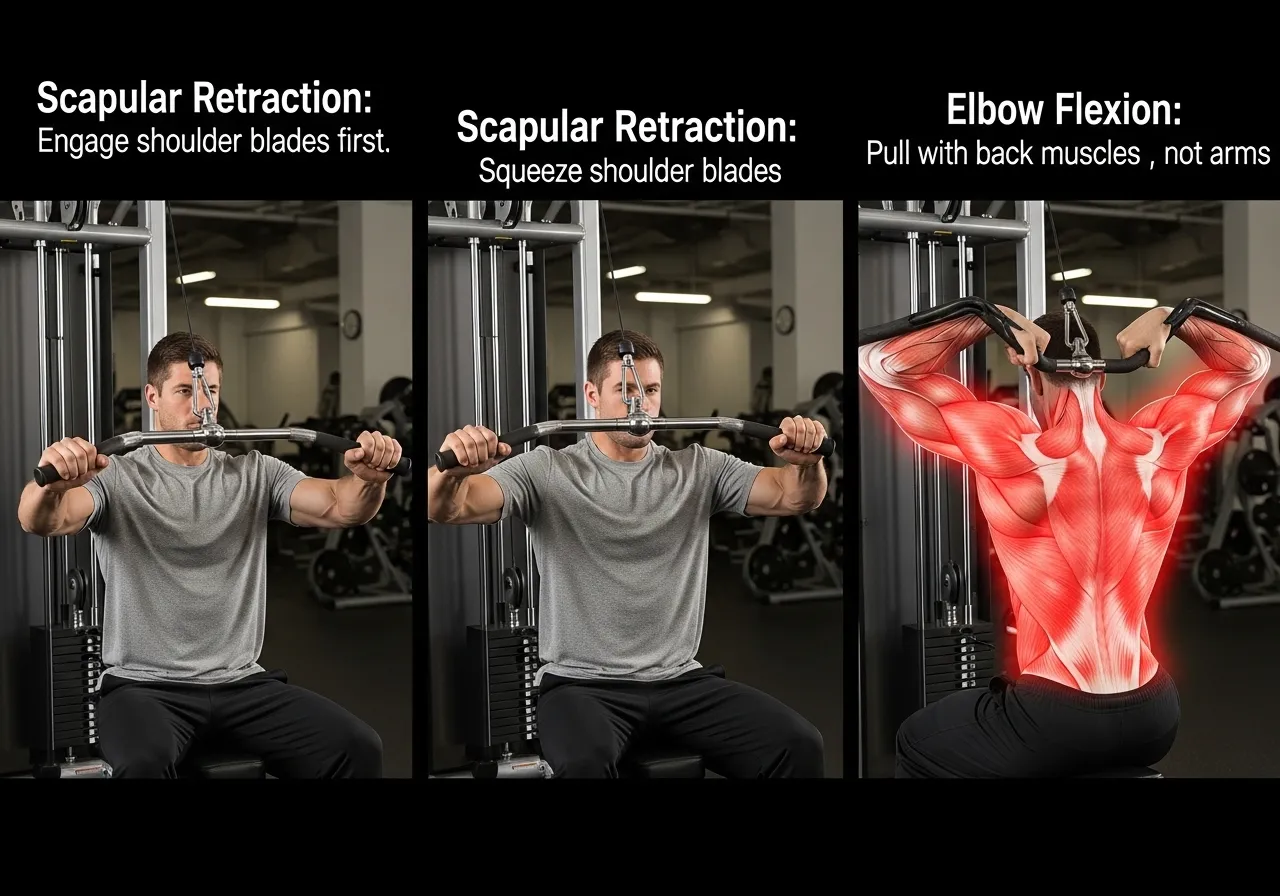
The seated row should begin with scapular retraction before any elbow flexion occurs. From the starting position with arms extended and the cable taut, the first movement is pulling the shoulder blades together and down — without bending the elbows. This scapular retraction moves the handle approximately 5 to 8cm toward you before the arms are involved at all. Only after the scapulae have retracted does elbow flexion complete the row. This sequencing — scapulae first, elbows second — is the single most important technical element that determines whether the row trains the back or the arms.
The reason this sequence matters: if elbow flexion initiates the row, the biceps and brachialis perform most of the work of moving the handle, and the shoulder and scapular muscles contribute only stabilizing force. If scapular retraction initiates, the rhomboids and mid-trapezius perform the primary work of the first portion, and the lats and posterior deltoid complete the movement as the elbow flexes. The muscular experience is entirely different, and the training effect — back development versus arm development — follows accordingly.
Elbow Path and Position
Elbow path determines which back muscles are most targeted. Elbows traveling straight back, close to the sides: maximum latissimus dorsi activation. Elbows flaring out to approximately 45 to 60 degrees from the torso: increased rhomboid and mid-trapezius activation. Elbows flaring to 90 degrees or above: transitions toward a rear delt fly pattern rather than a compound row. For overall back development, a moderate elbow path of 30 to 45 degrees from the sides typically produces the most complete back muscle stimulus.
Torso Position and Movement
The most commonly observed seated row error is excessive torso swing — using the lower back to lean backward at the start of the pull and then throw the torso forward at the end. This momentum transforms the row from a back exercise into a lower back-loaded momentum exercise that primarily tests spinal erector endurance. The torso should stay essentially vertical throughout the row, with only a very slight (5 to 10 degree) lean: upright at the finish, very slightly forward at the start. More torso movement than this removes resistance from the intended back muscles and loads the spine unnecessarily.
The Finish Position: Where Most People Stop Early
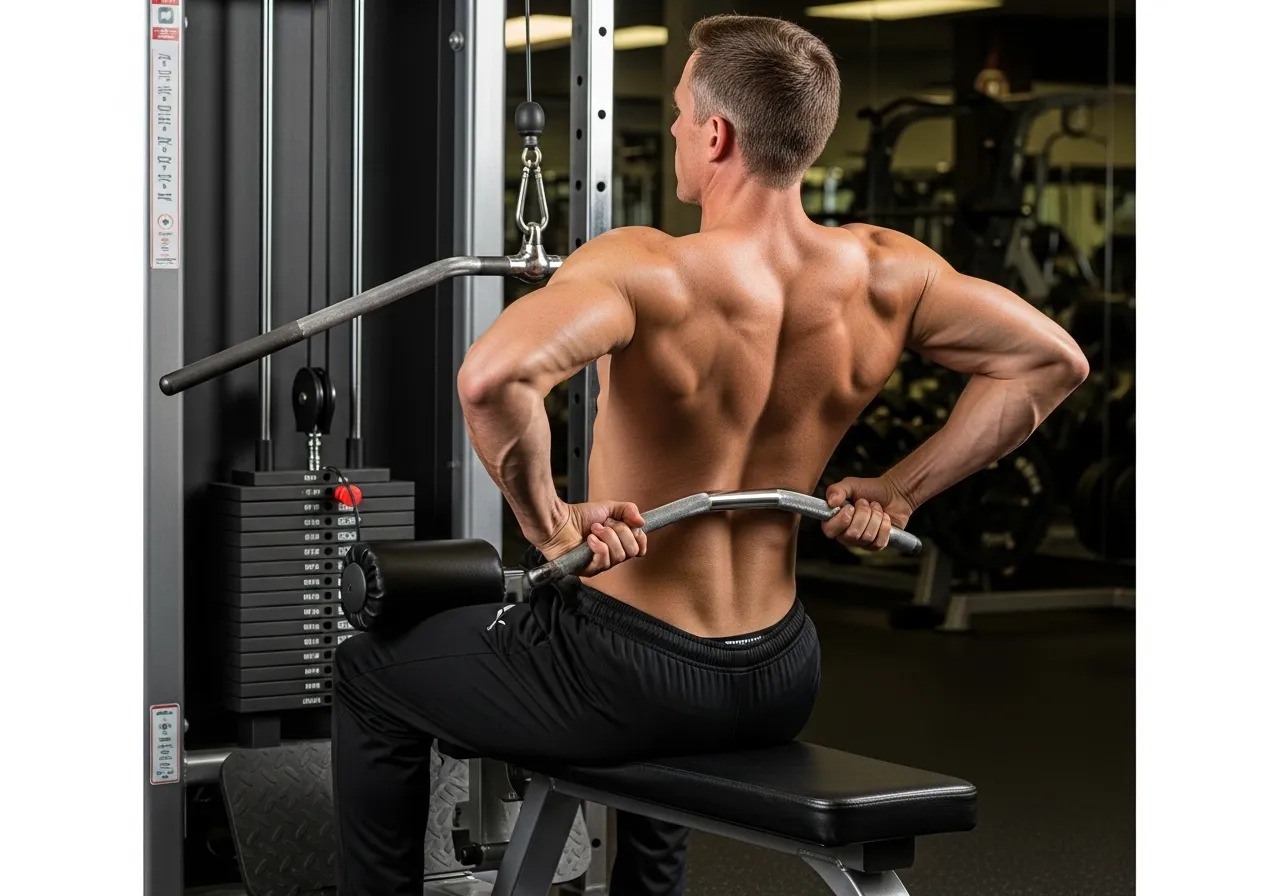
Most lifters stop their seated row when the handle approaches the torso — but the most important portion of the row is the final 3 to 5cm after apparent contact. At the finish, actively think about squeezing the shoulder blades together while simultaneously drawing the elbows slightly behind the body. This active squeeze at the finish position concentrates the contraction in the rhomboids and mid-trapezius at their shortest length, maximizing the training stimulus in the muscles most commonly undertrained in this exercise. Hold the finish position for 1 second before releasing.
Chest-Supported Row vs Seated Cable Row: When to Use Each
The chest-supported dumbbell row — performed face-down on an incline bench with dumbbells — is frequently recommended as a superior alternative to the seated cable row because it eliminates lower back involvement and allows complete focus on the upper back muscles without the temptation to use momentum. This recommendation is valid but incomplete — both exercises have specific advantages that make them complementary rather than substitutable. The seated cable row’s advantages include constant tension throughout the movement (cable resistance does not reduce at the top of the row as gravity-based dumbbell resistance does), adjustable grip width and angle through different attachments, and the ability to use heavier loads that would be uncomfortable to hold in the prone position for multiple sets. The chest-supported row’s advantages include complete lower back elimination (critical for athletes with lumbar pain), freedom from the balance demand of the seated position, and the natural hip flexion that allows a more aggressive lean-forward starting position that increases the lat stretch at the beginning of each rep. Optimal back programming includes both: seated cable rows for the constant-tension, heavier-load development that drives strength and hypertrophy in the mid-back; and chest-supported rows for the postural safety, complete lumbar unloading, and superior lat stretch that prone positioning provides.
The Pause Row: The Single Best Technique for Feeling the Back Contract
The paused seated row — holding the fully contracted position (elbows behind the body, scapulae fully retracted) for two to three seconds at the end of each repetition — is the single most effective technique for developing both the mind-muscle connection with the back muscles and the specific contracted-position strength that determines the quality of all subsequent rowing. Most people who feel their rows primarily in their arms rather than their back have never paused at the contracted position long enough to feel the back muscles maintain their contraction under load. The pause forces the back muscles to hold the contracted position without the momentum assistance of the pull phase, making their contribution to the exercise unmistakable and developing the specific contracted-position strength that determines how much of the movement is controlled by the intended muscles versus other contributors. Four weeks of paused rowing at reduced loads (sixty to seventy percent of normal working weight) typically produces a fundamental shift in how the exercise is experienced and which muscles it develops — athletes who complete this paused technique phase consistently report that regular rows feel completely different afterward, with back activation that was previously absent becoming the dominant sensation. Research on isometric holds and mind-muscle connection supports the use of brief pauses at the contracted position for improving target muscle activation and hypertrophic stimulus in resistance training exercises.
Single-Arm Cable Row: The Most Effective Technique Teaching Tool
The single-arm cable row — performed with one hand on the cable handle while the opposite hand rests on the thigh or on a bench for light support — is the most effective technique development tool for the seated row because it allows simultaneous use of the non-working hand for tactile feedback. Placing the free hand on the working lat (the side of the back just below the armpit) during the single-arm row provides immediate, direct feedback about whether the lat is contracting — the muscle can be felt hardening under the hand if technique is correct, or remaining soft if the arm is doing the work without back engagement. This tactile coaching accelerates the mind-muscle connection development that makes subsequent bilateral rowing genuinely effective by providing the sensory information that the nervous system needs to learn which muscles should be firing during the movement. Most athletes who perform one to two weeks of single-arm rows with tactile feedback before returning to bilateral rows report a dramatic improvement in their bilateral row quality — the lat activation that was previously absent or intermittent becomes consistent and reliably felt, confirming that the single-arm technique practice transferred the neural pattern to the bilateral movement. Physical therapists use this tactile feedback approach routinely in rehabilitation settings, and its effectiveness in healthy athletes developing technique justifies including the single-arm cable row as a regular technique maintenance tool alongside the bilateral variation in any complete back training program.
The scapular initiation principle — retract before you pull — is the single insight that transforms the seated row from an arm exercise into a back exercise. It requires conscious attention for four to six weeks before becoming automatic, and the patience required is precisely proportional to the benefit it produces. Every session of correct scapular initiation builds the neural pathway that makes genuine back development possible.
Grip and Attachment Variations: Different Back, Different Emphasis
Close Neutral Grip (V-Bar or Narrow Parallel Handles)
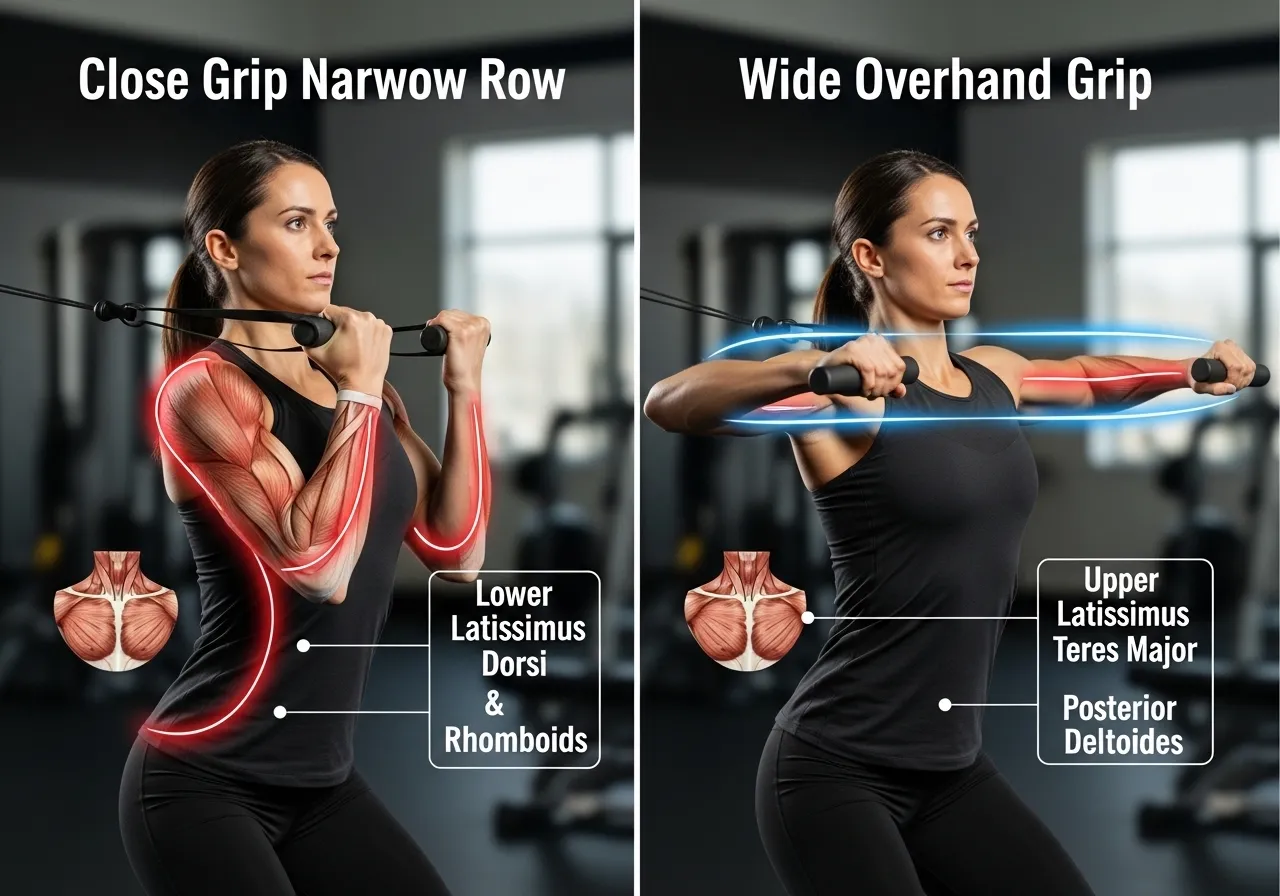
The most common seated row variation: palms facing each other, hands 10 to 15cm apart. This grip allows the elbows to travel straight back alongside the torso, maximizing lat activation and allowing the heaviest loads due to the mechanical advantage of the neutral wrist position. The close grip is the most productive general back development variation and the best starting point for lifters learning to feel the exercise correctly.
Wide Overhand Grip (Long Bar or Wide Attachment)
Wider grip with palms facing down: increased rhomboid and mid-trapezius emphasis as the wider elbow path changes the primary retraction mechanics. More similar to a bent-over row in muscle emphasis. Requires more shoulder external rotation stability. Appropriate as a secondary variation after the close grip row is technically solid, or for specific emphasis on the upper middle back.
Wide Underhand Grip (Supinated)
Wide grip with palms facing up: significantly increased bicep involvement alongside back development, similar to a supinated barbell row. Appropriate for lifters who want to simultaneously develop arms and back in a single movement. The supinated wrist position allows more natural elbow extension and a slightly different back muscle recruitment pattern.
Single Arm Cable Row
The single arm variation provides anti-rotation core demand, identifies and addresses bilateral asymmetries, and allows greater range of motion than bilateral rowing because the torso can rotate slightly toward the working side. The single arm row is the most functional back variation and produces the highest core activation of any cable row variation. Program it as a secondary variation alongside the primary bilateral row, or as the primary variation if bilateral asymmetry correction is a priority.
Common Seated Row Mistakes That Shift Load Away from the Back
Several technique errors consistently shift load away from the intended back muscles and toward the arms, lower back, or momentum. The most common and most consequential: using too much weight, which forces the trunk to lean back aggressively during the pull phase, converting the horizontal row into a partial deadlift for the lower back. The fix is straightforward — reduce the load until the trunk can remain relatively upright with minimal backward lean during the pull. The second most common error: allowing the scapulae to protract fully and the shoulders to round forward at the end of the eccentric phase, which eliminates the stretch position that pre-loads the rhomboids and middle trapezius for the subsequent concentric pull. A controlled eccentric to a position of mild scapular protraction, rather than full collapse into maximum protraction, maintains the muscle engagement through the eccentric phase that drives greater hypertrophy and sets up a stronger concentric phase. The third error: pulling with a wide elbow flare rather than keeping the elbows close to the body and driving them behind the torso — wide elbows shift load to the posterior deltoid and away from the lats and mid-back. Elbows that travel close to the ribcage and finish pointing behind the torso place the load in the intended muscles. Addressing all three errors simultaneously requires a significant load reduction for most people — a reduction that initially feels like a setback but produces better back development within four to six weeks of correct technique practice.
Programming Seated Rows for Strength and Hypertrophy
The seated row responds differently to different rep ranges in ways that guide programming decisions. At low reps (three to six), the exercise develops the horizontal pulling strength that directly supports barbell rowing, deadlifting from the floor, and any activity requiring sustained back tension under heavy load. At moderate reps (eight to twelve), it drives hypertrophy in the rhomboids, middle trapezius, and lats through the combination of mechanical tension and metabolic stress that produces the greatest muscle growth stimulus. At high reps (fifteen to twenty-five), it develops the muscular endurance that maintains back posture during prolonged daily activities and athletic movements. Most intermediate lifters benefit from programming the seated row at eight to fifteen reps per set — moderate rep ranges that develop both strength and hypertrophy without the joint stress of very heavy low-rep rowing. Weekly sets: eight to sixteen sets of horizontal pulling per week (including all row variations) produces continued back hypertrophy for most intermediate lifters; fewer than eight sets per week maintains existing muscle; more than twenty sets per week typically exceeds recovery capacity. Distributing this volume across two to three sessions per week provides more frequent muscle protein synthesis stimulation than single weekly sessions and produces better hypertrophic outcomes for equivalent total volume. According to NSCA hypertrophy programming guidelines, frequency of two to three sessions per week targeting a given muscle group consistently produces superior hypertrophic outcomes compared to single weekly sessions with equivalent volume.
Seated Row for Athletic Transfer: Beyond Aesthetic Development
The seated row’s athletic transfer extends well beyond the aesthetic improvement of back development to the functional strength that supports athletic performance across sports. The horizontal pulling strength developed through seated rows directly transfers to rowing sports (kayaking, rowing, dragon boat), climbing (rock climbing, rope climbing), and any activity requiring pulling movements against resistance. In team sports, the mid-back strength from rowing training improves the stability under contact that athletes in football, basketball, and rugby require — the ability to maintain position and continue productive movement when another athlete applies force requires the same mid-back tension that heavy seated rowing develops. For combat sports athletes, horizontal pulling strength from rowing directly contributes to clinch work, takedown defense, and any grappling situation requiring pulling force against a resisting opponent. Research on functional strength transfer from resistance exercises to sport performance consistently finds that horizontal pulling exercises show stronger transfer to sport-relevant tasks than isolated machine exercises, because the stability demands and movement pattern of cable and free weight rowing more closely replicate the stability-under-load conditions of actual athletic competition. Research on resistance training transfer to athletic performance supports the seated row’s inclusion in athletic performance programs across sports that require horizontal pulling or mid-back stability under external loading conditions.
The Seated Row’s Relationship to Deadlift Performance
The connection between seated row strength and deadlift performance is one of the most practically valuable relationships in strength training — stronger rowers are typically stronger deadlifters, because the mid-back strength that rows develop is a primary limiting factor in conventional deadlift performance at intermediate and advanced levels. The lats, rhomboids, and middle trapezius must maintain the spine’s neutral position against the enormous hip extension force of the deadlift — the “lat lat lat” cue that powerlifting coaches use to instruct athletes to engage the lats during the deadlift reflects the critical contribution of these muscles to spinal stability under maximum load. Improving seated row strength — specifically the ability to maintain scapular retraction and lat tension at the contracted position of the row — develops the same lat and mid-back engagement that protects the spine and improves mechanical efficiency in the deadlift. Many powerlifters who address a deadlift plateau by improving their rowing strength find that adding two to three sets of heavy seated rows per week produces deadlift improvements within four to six weeks without any additional deadlift training — confirming the direct carryover from horizontal pulling strength to spinal stability under axial load. This relationship makes the seated row particularly valuable for any serious strength athlete who performs heavy deadlifting, as it develops the mid-back capacity that deadlift variations alone cannot develop as specifically or safely at the loads required.
The grip variation approach — rotating between close neutral, wide overhand, and underhand grips across training weeks — ensures that the complete back musculature receives comprehensive development from the seated row, preventing the accommodation that single-grip training produces and developing the full range of pulling strength that athletic performance and functional capacity require.
Programming the Seated Row for Maximum Back Development
Rep Ranges and Loading
The back muscles respond well across rep ranges, but the seated row is most commonly programmed in the 8 to 15 rep range for hypertrophy and the 5 to 8 rep range for strength development. At heavy loads (5 to 8 reps), the technique degradation from trying to use maximum weight frequently compromises the back activation that makes the exercise valuable — the torso swings, the biceps dominate, and the row becomes a full-body momentum exercise. Most lifters produce superior back development from moderate-to-heavy loading (8 to 12 reps) with strict technique than from maximum loading with technique compromise.
Paused and Tempo Rows
Adding a 1 to 2 second pause at the finish position (elbows behind body, shoulder blades retracted and depressed) dramatically increases back muscle activation and time under tension compared to continuous-movement rows. Implementing a 3-second eccentric (controlled release) adds the stretched-position loading that the lats respond to most strongly. A practical tempo: 1 second concentric, 2 second pause at finish, 3 second eccentric. This tempo produces significantly more back development per set than the same exercise performed at normal speed, without requiring any additional load.
Volume Recommendations
The back is a large muscle group with high recovery capacity. Research on back training volume suggests 12 to 20 sets per week across all rowing and pulling movements produces optimal hypertrophy for most intermediate lifters. The seated row can contribute 6 to 9 of these sets within a well-structured program. Distributing back volume across two to three sessions per week rather than concentrating it in a single session produces more consistent muscle protein synthesis and typically better development over time. NSCA resources on resistance training volume provide detailed guidance on set and volume recommendations for major muscle groups at different training levels.
The Back Development Formula: Vertical Pull Plus Horizontal Pull
Comprehensive back development requires both vertical pulling (lat pulldown, pull-up) and horizontal pulling (seated row, barbell row) because the lats and the mid-back musculature respond to fundamentally different movement patterns. Vertical pulling primarily develops the lats through the overhead-to-neutral shoulder adduction range, producing the back width (the V-taper appearance when viewed from behind) that comes from well-developed lat bellies. Horizontal pulling primarily develops the mid-back thickness — the rhomboids, middle trapezius, and the mid-portion of the lower trapezius — that creates the back depth and density that distinguishes a developed back from a merely wide one. Programs that emphasize vertical pulling without horizontal pulling develop the lat width but lack the mid-back thickness; programs that emphasize horizontal pulling without vertical pulling develop mid-back density but limit lat development. The ideal back program distributes approximately equal volume between vertical and horizontal pulling, with the specific ratio adjusted based on whether back width or thickness is more underdeveloped relative to the other. For most beginners and intermediate athletes who have trained exclusively with bench pressing and minimal back work, both vertical and horizontal pulling represent significant developmental priorities, justifying equal emphasis from the beginning of a comprehensive back development program.
Seated Row and Shoulder Health: The Pressing Balance
The seated row’s role in shoulder health mirrors the face pull’s but through a different movement pattern. While face pulls primarily develop the external rotators and posterior deltoid through a small-range, light-load movement, seated rows develop the middle and lower trapezius, rhomboids, and lats through a large-range, heavier-load movement. Both contribute to the posterior shoulder chain development that counterbalances the anterior dominance of pressing, but through mechanisms that are complementary rather than redundant. Research on upper extremity injury prevention consistently finds that athletes who maintain a one-to-one ratio of pulling to pressing sets — one set of rowing or face pulling for every set of bench pressing or overhead pressing — have significantly lower rates of shoulder injury than those whose programs are pressing-dominant. The seated row is the most practical primary pulling exercise for achieving this ratio, as it allows the progressive loading and volume accumulation that shoulder health maintenance across years of pressing development requires. A practical implementation: for every three to four sets of pressing in a session, perform two sets of seated rows and one to two sets of face pulls — maintaining the balance that protects the shoulder while developing the complete upper body musculature that pressing programs alone cannot develop. Research on push-pull training balance and shoulder injury prevention confirms that maintaining approximately equal pushing and pulling volume significantly reduces shoulder injury incidence in strength athletes performing high-volume pressing programs.
The Seated Row and Mind-Muscle Connection: A Training Skill
The mind-muscle connection — the ability to deliberately direct attention to and enhance activation of the target muscle during exercise — has been shown in research to meaningfully increase muscle activation and hypertrophic outcomes in isolation exercises and exercises where technique allows selective attention to specific muscles. The seated row is one of the exercises most amenable to mind-muscle connection enhancement because the back muscles are large and their contraction is perceptible with focused attention, unlike smaller or deeper muscles whose activity is difficult to consciously sense. Developing the mind-muscle connection with the lats during seated rows: place one hand on the lat (side of the back, just under the armpit) while performing the row with the other hand using a single-arm cable or dumbbell variation — the tactile feedback from the hand feeling the lat contract dramatically accelerates the development of conscious lat activation that is then transferable to bilateral rowing. Research on mind-muscle connection and EMG-measured muscle activation finds that athletes with a strong mind-muscle connection in an exercise show fifteen to twenty percent greater target muscle activation at equivalent loads compared to athletes without this specific connection — a meaningful activation difference that compounds into greater hypertrophic stimulus over hundreds of training sessions. Research on mind-muscle connection and muscle activation confirms that deliberate attentional focus on the target muscle during exercise produces measurably greater activation than external focus or no specific focus at equivalent training loads, validating the investment in developing this training skill specifically for the seated row.
Deconstructing Back Anatomy for Better Rowing Results
Understanding back anatomy provides the roadmap for making the seated row genuinely develop each portion of the back that it is theoretically designed to train. The latissimus dorsi — the largest back muscle — originates from the lower six thoracic vertebrae, all lumbar vertebrae, the iliac crest, and the lower three or four ribs, inserting on the bicipital groove of the humerus. This broad origin explains its powerful influence on thoracolumbar posture and its function in both shoulder extension and adduction. During the seated row, the lat contracts most powerfully at the point where the elbow is driven behind the torso — maximizing adduction and extension simultaneously — which is why achieving full elbow travel behind the body (not just to the body) is essential for maximum lat engagement. The rhomboids (major and minor) originate from the spinous processes of T2-T5 and insert on the medial border of the scapula — retracting the scapula when they cont
Seated Row Periodization for Long-Term Back Development
Periodizing the seated row — systematically varying load, rep range, and variation across planned training cycles — produces superior long-term back development compared to maintaining the same approach indefinitely. A four-phase annual seated row periodization: phase one (twelve weeks), hypertrophy emphasis at eight to twelve reps with close neutral grip, focusing on technique quality and progressive load; phase two (eight weeks), strength emphasis at four to six reps with heavier loads, developing the maximum pulling strength that increases the potential loading for subsequent hypertrophy phases; phase three (eight weeks), variation phase using wide overhand grip, single-arm rows, and paused rows at moderate loads to develop back musculature from different angles and prevent accommodation; phase four (four weeks), deload and assessment, reducing volume and intensity while evaluating technique quality and planning the next annual cycle. This periodized approach develops back strength, hypertrophy, movement variety, and technique quality across the training year in a way that linear progression at one rep range cannot provide. The annual cycle provides enough variation to prevent accommodation while maintaining sufficient consistency for each phase’s specific adaptation to develop fully. Athletes who implement this periodization consistently report more comprehensive back development than those who train at the same rep range indefinitely — the combination of strength and hypertrophy phases, variation phase, and deload produces a complete stimulus set that back development at a single intensity cannot replicate across a training year. NSCA periodization guidelines consistently support annual cycle periodization as producing superior long-term hypertrophy and strength outcomes compared to non-periodized training in intermediate and advanced athletes.
Programming the seated row as a permanent fixture in the training program — present in every upper body training phase, periodized across rep ranges, and maintained across years of training — produces the compound back development that intermittent rowing cannot approach. The back that develops from years of consistent, well-executed seated rows is a genuinely impressive physical achievement that reflects the patience and technical dedication its development required.
Seated Row vs Other Back Exercises: When to Use Which
Seated Row vs Barbell Row
The barbell bent-over row allows heavier absolute loading and develops the lower back erectors as a stabilizer, but requires significant hip hinge mobility and produces higher spinal loading. The seated cable row eliminates the spinal loading of the bent-over position, allows the back muscles to be trained in isolation from the lower back stabilizers, and provides constant cable tension through the full range of motion. Both have value: the barbell row for maximum loading and posterior chain integration, the seated row for isolated back muscle development and higher-rep volume work without spinal fatigue accumulation.
Seated Row vs Lat Pulldown
Lat pulldown: vertical pulling plane, primarily develops lat width and upper back. Seated row: horizontal pulling plane, primarily develops back thickness (mid-back, rhomboids, mid-trapezius). Complete back development requires both planes — vertical pulling for width and horizontal pulling for thickness. Programs that include only one are leaving half the back underdeveloped. The classic “wide back, thick back” distinction in bodybuilding refers precisely to this: lat pulldowns build the wide lats seen from the back, seated rows build the thick mid-back seen from the side.
Building the Program
A complete back program combining both planes: Day 1 — lat pulldown or pull-up (vertical pull primary), seated cable row close grip (horizontal pull secondary). Day 2 — barbell or dumbbell row (heavy horizontal pull), straight arm pulldown or single arm cable row (volume). This structure ensures both pulling planes receive adequate volume and that the heavier loaded movements and the more isolated cable movements complement rather than duplicate each other. The seated row is most productively positioned as the complete-back-development complement to the width movements that most programs already include. ACSM resistance training guidelines support training all major movement patterns through their full range of motion for comprehensive muscular development.
Frequently Asked Questions About the Seated Cable Row
Why do I feel seated rows in my lower back instead of my mid-back? Lower back dominance during seated rows almost always indicates excessive torso swing — leaning back at the start and throwing the torso forward during the row. Reduce the weight significantly and perform the exercise with a deliberately fixed, upright torso for two to three sessions until the muscle activation pattern shifts to the intended mid-back. If lower back sensation persists with good technique, the lower back is working as a stabilizer and the sensation should be mild and non-painful. Sharp or painful lower back sensation warrants cessation.
How wide should my grip be for seated rows? Close grip (hands 10 to 15cm apart, neutral grip) is the most versatile starting point and produces the best balance of lat and mid-back activation for most people. Wider grips shift emphasis toward the upper mid-back. Narrower grips emphasize the lower lats. Experiment with different attachments to find which produces the most direct back sensation — the grip that makes you feel the exercise most directly in the mid-back is correct for your anatomy.
Should I use straps for seated rows? Straps eliminate grip fatigue that would otherwise limit the back training before the back muscles are adequately stimulated. For sets where grip is failing before back fatigue, straps are appropriate to ensure the back receives its intended training stimulus. For lighter sets where grip is not the limiting factor, training without straps develops the grip strength that reduces the need for straps over time. Use straps on the heaviest work sets; avoid them on warm-up and lighter volume sets.
Can seated rows replace pull-ups? No — seated rows and pull-ups train different primary mechanics (horizontal versus vertical pulling) and different muscle emphasis. Seated rows develop the horizontal pulling strength of the rhomboids, mid-trapezius, and rear deltoid; pull-ups develop the vertical pulling strength of the lats and biceps. Both are necessary for complete back development. If pull-ups are not currently achievable, lat pulldowns (the seated cable equivalent of pull-ups) replace them as the vertical pulling movement while pull-up strength is developed.
Frequently Asked Questions About the Seated Cable Row
Why do I feel seated rows more in my biceps than my back?
Bicep dominance in the seated row results from arm-first initiation rather than scapular-first initiation — the arms begin pulling before the scapulae have retracted, forcing the biceps to do work that the back muscles should be performing. The fix: before each set, practice the isolated scapular retraction by sitting upright and deliberately squeezing the shoulder blades together without bending the elbows at all, feeling the rhomboids and middle trapezius contract. Then, beginning each rep with this same scapular retraction before the elbows bend — the arms should feel like they are following the scapulae rather than leading the movement. Additionally, reduce the load by twenty to thirty percent to give the nervous system the bandwidth to practice this new sequence without the automatic compensation to arm-dominance that heavy weights produce. Most people who implement this approach report feeling their back in the row for the first time within one to three sessions, after years of rows that primarily fatigued their biceps. Research on exercise technique and muscle activation confirms that initiation sequence significantly affects which muscles are recruited during horizontal pulling movements.
How wide should my grip be on seated rows?
Grip width changes which portion of the back receives primary emphasis. A close, neutral grip (V-bar attachment) positions the elbows close to the body and drives them behind the torso during the row — maximizing lat and lower trapezius activation. A wide, overhand grip (straight bar attachment, hands wider than shoulder width) positions the elbows away from the body and develops the posterior deltoid and upper trapezius more prominently. A close, underhand (supinated) grip emphasizes the lower lats and biceps due to the supination’s effect on elbow flexion mechanics. For general back development, rotating between close neutral and wide overhand grip across training blocks provides the most comprehensive back development by addressing different portions of the back complex. For someone new to proper rowing technique, the close neutral grip is the easiest to perform with correct scapular initiation and elbow path, making it the best starting point before introducing grip variations.
How heavy should I row relative to my bench press?
A useful strength standard for balanced upper body development: the seated cable row working weight at eight to ten reps should be approximately seventy to eighty percent of the bench press working weight at the same rep range. If you bench press eighty kilograms for eight reps, you should be able to seated row sixty to sixty-five kilograms for eight reps with good technique. A larger discrepancy — bench press significantly exceeding this ratio — suggests that back development and horizontal pulling have been neglected relative to pressing, which is both a performance limitation and a shoulder health risk factor. Bringing the row up to the appropriate ratio relative to the bench press typically requires a dedicated period of increased row volume and frequency while maintaining but not aggressively increasing bench press volume — a temporary rebalancing that produces long-term benefits for both back development and shoulder health.
ract. The middle trapezius originates from T1-T5 spinous processes and inserts on the scapular spine — also contributing to scapular retraction and providing stability for the scapula’s position during the row. The lower trapezius originates from T6-T12 and inserts on the scapular spine — depressing the scapula and contributing to the downward rotation that allows the humeral head to clear the acromion during pulling movements. Each of these muscles contributes to the complete seated row when the exercise is performed with scapular initiation, full retraction, and elbow travel behind the torso — the complete technique that develops all components of the middle and lower back simultaneously. Understanding which muscle contributes at which portion of the row allows targeted technique adjustments: insufficient rhomboid development calls for more aggressive scapular retraction at the end position; insufficient lat development calls for greater elbow travel behind the torso; insufficient lower trapezius development calls for conscious scapular depression during the pull. Research on back muscle anatomy and function during horizontal pulling provides the anatomical basis for the technique emphases described throughout this article.
Programming Seated Rows in the Context of a Complete Back Program
The seated cable row functions most effectively as a component of a complete back training program rather than as the sole back exercise. A well-structured back program for intermediate athletes: two to three weekly sessions, each including one vertical pull (lat pulldown or pull-up, three to four sets), one horizontal pull (seated cable row or barbell row, three to four sets), and one posterior chain exercise that addresses both lower back and upper back (face pull or band pull-apart, two to three sets). This combination develops the complete back musculature from the lats through the mid-back to the posterior shoulder chain in a single session structure that is sustainable across years of training. The seated row’s placement in this structure — as the primary horizontal pull — makes it the exercise with the largest individual contribution to mid-back development, justifying the technical investment required to perform it with the scapular initiation and full range that make it genuinely effective. Lifters who establish the correct seated row technique as the foundation of their horizontal pulling program consistently develop better mid-back thickness, better posture, and better shoulder health than those whose horizontal pulling consists of arm-dominant rows that primarily develop the biceps. The technical foundation is the investment that all subsequent back development builds on — making it the highest-priority element of seated row training for anyone at any stage of their back development journey.
The seated row’s contribution to overall athletic capacity extends far beyond the aesthetic improvement of a thicker back — it develops the horizontal pulling strength, spinal stability, and mid-back endurance that make every other athletic activity safer and more effective. Making it a permanent fixture in the training program, performed with the technique quality that makes it genuinely effective, is one of the highest-impact decisions available in back training programming.
The seated row’s technical mastery — the scapular initiation, the full range of retraction, the elbow travel behind the torso — is the training investment that separates lifters who develop genuine back thickness from those who develop well-fatigued biceps. Accept the technique development timeline and the temporary load reduction it requires; the back development that follows repays the patience many times over across years of subsequent training.
Advanced Rowing Techniques for Experienced Lifters
Experienced lifters who have mastered standard seated row technique can access additional development stimulus through advanced variations. The dead-stop row — releasing the weight stack fully at the bottom of each rep and pausing for one second before the next concentric — eliminates the elastic stretch-shortening cycle contribution from the eccentric phase and forces the back muscles to generate force from a dead stop, dramatically increasing the training demand at equivalent loads. The underhand grip row with supination emphasis — deliberately supinating the forearms throughout the pull and actively rotating the hands to a palms-up position at the end range — activates the biceps’ supination function in addition to flexion, producing a more complete arm contraction that increases the total exercise stimulus. The iso-hold row — performing a standard rep, then holding the contracted position for five seconds before completing the eccentric — develops the contracted-position strength and mind-muscle connection that standard continuous rowing cannot develop as effectively. Each of these techniques increases training demand without requiring additional load, making them valuable during phases when technique quality is the limiting factor or when joint stress management prevents load increases while additional development stimulus is still desired. According to ACSM resistance training guidelines, technique variations that increase demand at specific positions of the strength curve or that improve mind-muscle connection can produce greater hypertrophic stimulus than equivalent load increases that do not address these specific training dimensions.
The Long-Term View: Building Excellence Through Consistent Practice
Excellence in any resistance training exercise develops through the accumulation of hundreds of high-quality training sessions rather than through any individual session breakthrough. The face pull and seated row — the two exercises most important for complete upper body development and shoulder health — reward consistent, patient practice more than almost any other gym exercise because their technique development is ongoing and the rewards of technical mastery are greatest for exercises where the difference between good and poor technique determines whether the exercise develops the intended muscles at all. An athlete who performs face pulls and seated rows with excellent technique twice per week accumulates over one hundred technique-reinforcing sessions per year — each session building the neural patterns and muscle memory that make the technique increasingly automatic and the exercises increasingly effective. Over five years, this accumulation produces the deeply ingrained movement quality that allows near-maximum loading with complete technique control, generating the development stimulus that translates into the back thickness, shoulder health, and physical capability that years of arm-dominant rows never produced. The patience required for this long-term approach is the same patience that produces all meaningful physical development — the willingness to prioritize quality over quantity, technique over load, and the consistent accumulation of excellent repetitions over the intermittent performance of impressive weights with compensated technique. According to NSCA skill acquisition research, motor pattern development in resistance training follows the same principles as skill acquisition in sport — requiring hundreds to thousands of quality repetitions to establish the automatic movement patterns that produce consistent high performance under varying conditions including fatigue, heavier loads, and competitive or high-stakes training environments.
Tracking Progress in Posterior Chain Development
Progress in face pulls, seated rows, and posterior chain development is measured differently than progress in primary strength lifts. Rather than tracking one-rep maximums, posterior chain development is best measured through: the load sustainable at fifteen to twenty reps with complete technique quality (including the external rotation quality in face pulls and the scapular initiation in rows); shoulder health indicators including reduction in anterior shoulder pain during pressing, improved posture measured by a training partner’s observation or a photo comparison across months, and reduced shoulder girdle fatigue after pressing sessions; and performance in primary lifts that depend on the posterior chain — overhead press stability, deadlift grip endurance, and barbell row strength all benefit from well-developed posterior shoulder chain, providing indirect progress indicators. The most reliable overall progress indicator: repeating the technique evaluation process described for each exercise every three to four months and assessing whether the technique errors identified earlier have been resolved. Improvements in technique quality, even without proportional load increases, represent genuine neural and muscular development in the posterior chain that accumulates into meaningful physical development across months and years of consistent practice. Research on technique-based progress measurement in resistance training validates the use of technique quality as a primary progress metric for exercises where technique determines stimulus effectiveness more than load magnitude.
The seated cable row’s compound return — back development, postural improvement, shoulder health contribution, and deadlift carryover — makes it the back exercise with the broadest training benefit per session invested. Mastering it transforms back training outcomes more comprehensively than any other single programming change available to athletes whose back development has been limited by arm-dominant rowing technique.
Every training career needs a foundation of well-executed horizontal pulling, and the seated cable row is the most accessible, progressive, and comprehensive tool for building that foundation. Commit to mastering it and the back development that follows will reflect the investment across years of continued training.
The Seated Row as a Foundation for All Back Training
Mastering the seated cable row — specifically, developing the scapular initiation sequence, the full range of scapular retraction and protraction, and the lat activation at the finish position — provides the movement literacy that makes all subsequent back training more effective. The technical elements of good seated rowing transfer directly to barbell rows, dumbbell rows, cable rows with different attachments, and ultimately to the technique awareness that makes any horizontal pulling exercise genuinely develop the back. Lifters who first learn proper seated row technique with the cable’s constant tension and adjustable load, then progress to barbell rows, consistently develop better back technique in the barbell row than those who began with barbell rows without the cable row foundation. The cable’s forgiving nature — allowing load adjustment in small increments and providing resistance that does not require balancing a barbell — creates the optimal learning environment for the scapular sequence and back activation that must be established before heavy free-weight rowing can be performed with the technique quality that produces genuine back development. Investing the time and reduced ego required to develop proper seated row technique is the investment that makes all back training more productive for years of subsequent development.
The seated cable row, mastered with the scapular initiation sequence and full range of motion that make it genuinely effective, is the back exercise that most directly determines mid-back development, posture quality, and the shoulder health that allows decades of productive pressing. Invest in its technical mastery — accept the temporary ego cost of lighter weights while building the correct movement pattern — and the compound returns across years of subsequent training will make the investment one of the best decisions in your training career.
The seated cable row, mastered through patient technical development and consistent progressive loading, is the most comprehensive mid-back development exercise available in standard gym training. Its combination of constant tension, multiple grip options, and adjustable resistance makes it uniquely adaptable to every training goal and development phase — from technique-focused light work through maximum-effort strength development through high-rep hypertrophy emphasis. Every training career that prioritizes back development should place the seated cable row at its foundation, performed with the scapular initiation and full range that transforms it from an arm exercise into the back builder it is designed to be.
⚠️ Fitness Disclaimer: The information in this article is for general educational purposes only and does not constitute professional fitness or medical advice. Always consult a qualified healthcare professional before starting any new exercise program, especially if you have existing injuries or medical conditions. The Leg Press: An Honest Assessment of What It Does Well…
Warning Fitness Disclaimer: The information in this article is for general educational purposes only and does not constitute professional fitness or medical advice. Always consult a qualified healthcare professional before starting any new exercise program, especially if you have existing injuries or medical conditions. The Most Versatile Piece of Equipment in the Gym That Most…
⚠️ Fitness Disclaimer: The information in this article is for general educational purposes only and does not constitute professional fitness or medical advice. Always consult a qualified healthcare professional before starting any new exercise program, especially if you have existing injuries or medical conditions. The Exercise That Changed How I Understood Glute Training For the…
⚠️ Fitness Disclaimer: The information in this article is for general educational purposes only and does not constitute professional fitness or medical advice. Exercise carries inherent risks. Always consult a qualified healthcare professional or certified personal trainer before starting or modifying any exercise program, especially if you have a pre-existing medical condition, injury, or health…
⚠️ Fitness Disclaimer: The information in this article is for general educational purposes only and does not constitute professional fitness or medical advice. Always consult a qualified healthcare professional before starting any new exercise program, especially if you have existing injuries or medical conditions. The Lat Pulldown: The Most Underestimated Back Builder in the Gym…
⚠️ Fitness Disclaimer: The information in this article is for general educational purposes only and does not constitute professional fitness or medical advice. Always consult a qualified healthcare professional before starting any new exercise program, especially if you have existing injuries or medical conditions. The Machine That Gym Culture Can’t Seem to Agree On No…