⚠️ Fitness Disclaimer: The information in this article is for general educational purposes only and does not constitute professional fitness or medical advice. Always consult a qualified healthcare professional before starting any new exercise program, especially if you have existing injuries or medical conditions.
Why the Overhead Press Is the Most Neglected Compound Lift in Modern Training
I trained for five years before I took the overhead press seriously. My bench press climbed steadily, my squat got strong, my deadlift progressed — but the overhead press was always an afterthought, something I did at moderate weight after the “real” pressing was done. It wasn’t until I committed to making the press a primary movement for twelve weeks that I understood what I had been missing: shoulder stability that transferred to every other pressing movement, upper back development that no other exercise produced equivalently, and a core demand that made my heaviest sets feel like a full-body event.
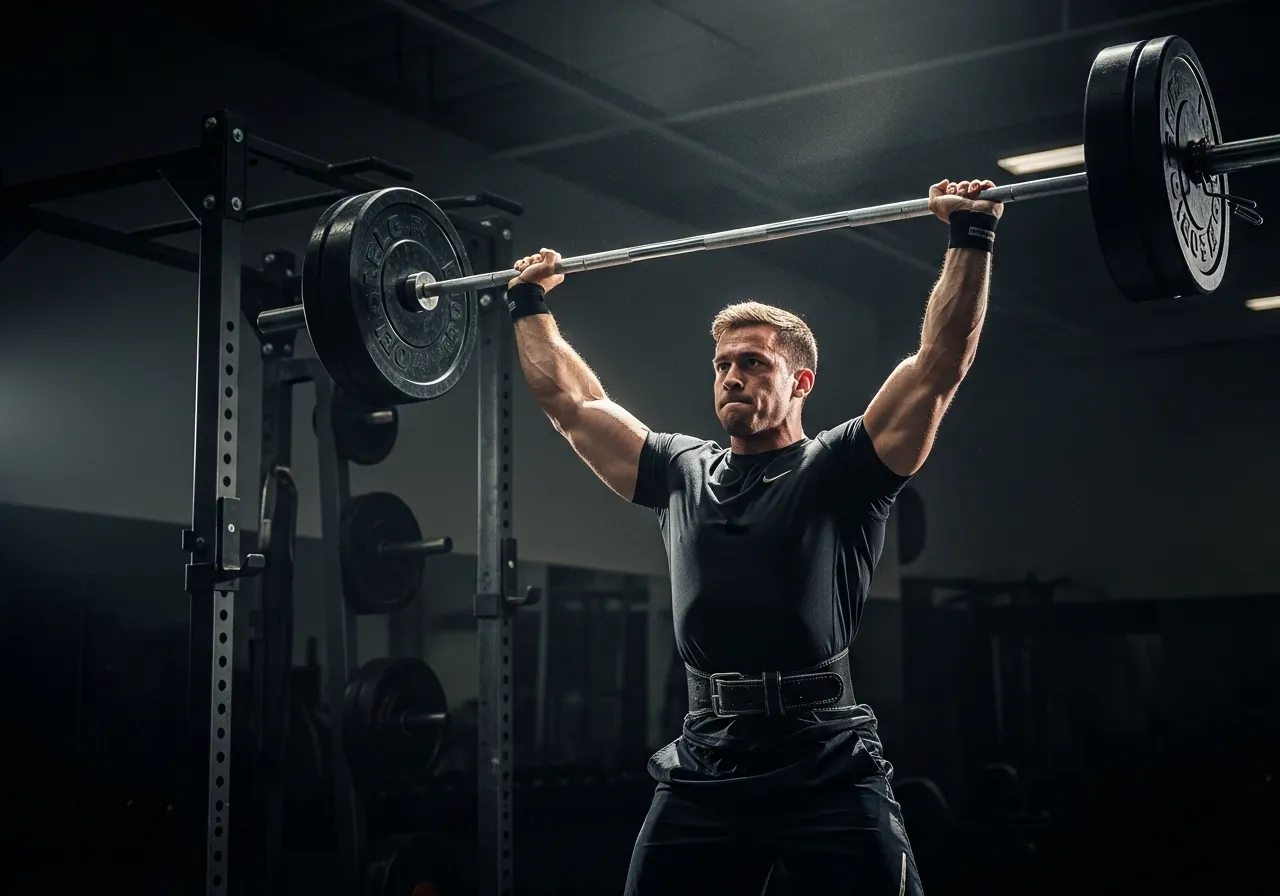
The standing barbell overhead press — also called the military press or shoulder press — is the most complete upper body strength exercise available. It trains the deltoids, triceps, upper trapezius, serratus anterior, and core stabilizers in a single loaded pattern that requires the entire body to work as a coordinated unit. Yet most gym programs either skip it entirely in favor of seated variations or treat it as accessory work after bench pressing. This article makes the case for the standing press as a primary lift and provides the programming framework to develop it systematically.
The Anatomy of the Overhead Press
The standing barbell overhead press is initiated by the anterior deltoid and upper chest (clavicular head of pectoralis), which drive the bar off the shoulders. As the bar passes the face, the triceps take over elbow extension while the deltoids continue driving shoulder elevation. At lockout, the upper trapezius and serratus anterior complete full shoulder elevation and upward rotation. Throughout the entire movement, the core — specifically the obliques and transverse abdominis — contracts isometrically to prevent the spine from hyperextending under the overhead load. No seated variation replicates this full systemic demand.
Standing vs Seated: Why It Matters
Seated overhead pressing eliminates the core stabilization demand by using the seat back as support. This allows heavier loading but removes the spinal stability training that makes the standing press uniquely valuable. Research comparing standing and seated overhead press finds significantly higher core muscle activation in standing variations, confirming that the standing press trains the torso as well as the shoulders. For shoulder health and athletic transfer, standing is superior; for maximum load and deltoid isolation, seated has advantages. Both belong in a complete program, but the standing press deserves primary treatment.
The Historical Significance of the Overhead Press
Before the bench press became the dominant upper body strength standard in the mid-20th century, the overhead press was the king of upper body strength. Olympic weightlifting competitions included the press as one of three lifts until 1972, when it was removed due to judging inconsistencies around the degree of back bend permitted. The athletes who competed in the press era — Paul Anderson, Doug Hepburn, Bill March — had overhead pressing numbers that remain impressive by modern standards, achieved through a dedicated focus on overhead strength development that today’s gym culture has largely abandoned in favor of horizontal pressing.
The loss of the overhead press from Olympic competition contributed to its decline in recreational gym programming — the bench press, with its greater cultural visibility and easier spotting logistics, became the dominant measure of upper body strength. The consequences of this shift are visible in the epidemic of shoulder impingement, rotator cuff injuries, and poor overhead mobility that characterize modern gym training populations. The pressing muscles of the anterior shoulder are trained extensively through bench pressing; the stabilizing muscles that allow safe overhead movement are ignored. Bringing the overhead press back as a primary lift corrects this imbalance and develops the shoulder health that bench-press-exclusive upper body programming systematically undermines.
Overhead Press vs Bench Press: Understanding the Complement
The overhead press and bench press are often framed as alternatives or competitors, but they develop different qualities and benefit from being trained together rather than substituting one for the other. The bench press develops horizontal pressing strength — the pushing pattern relevant to blocking in football, pushing in wrestling, and any activity requiring horizontal force application. The overhead press develops vertical pressing strength — the pattern relevant to throwing, swimming, climbing, and any activity requiring force application above the head. These patterns use overlapping but distinct muscle groups and develop different aspects of shoulder function.
The relationship between bench press and overhead press performance is informative: most lifters can bench press approximately 140-150% of their overhead press maximum. This ratio reflects the mechanical advantage of horizontal pressing (more muscle groups contributing, shorter range of motion) over vertical pressing. When this ratio becomes much larger — bench press exceeding 170% of overhead press — it indicates that overhead-specific shoulder strength and mobility is a weak link that limits both overhead performance and long-term shoulder health. Regular overhead pressing maintains this ratio in a healthy range by developing the overhead-specific strength that bench pressing does not build. Many experienced coaches consider a balanced bench-to-overhead ratio as important a health indicator as any mobility or flexibility assessment.
Why the Overhead Press Should Be Your Priority Lift
The argument for treating the overhead press as a primary lift rather than a supplemental exercise rests on three pillars: functional necessity, shoulder health, and athletic transfer. Functional necessity: the ability to press objects overhead is a fundamental human movement pattern used in daily life (placing objects on shelves, overhead carries, pushing open elevated mechanisms) and in sport (throwing, swimming, gymnastics, climbing). Developing this capability through progressive loading maintains the strength and mobility that functional overhead use requires across the lifespan. Shoulder health: the overhead press, trained consistently with correct technique, develops the rotator cuff, serratus anterior, and posterior shoulder musculature that protect the shoulder under all loading conditions. The epidemic of shoulder injuries in fitness populations is partly attributable to the predominance of horizontal pressing over vertical pressing — developing the pressing muscles without the overhead stabilizers creates the imbalance that produces impingement and rotator cuff damage. Athletic transfer: virtually every athletic movement involving the upper extremity benefits from the overhead stability, shoulder girdle strength, and thoracic position that overhead pressing develops. The overhead press is not just a shoulder exercise — it is a systematic developer of the upper body function that athletic movement requires. These three pillars justify treating the overhead press as a foundational movement deserving primary program status rather than relegating it to accessory work that gets programmed when time permits. Athletes who prioritize the overhead press for 6-12 months consistently report that their shoulder health improves, their other pressing movements improve, and their general upper body athletic capability increases — outcomes that bench-press-exclusive upper body programming rarely produces simultaneously. Research comparing standing and seated overhead press confirms significantly higher core and stabilizer activation in the standing variation, validating its role as a comprehensive upper body development tool.
Training for Health vs Performance: Understanding the Distinction
The training demands required for health benefit and for athletic performance are dramatically different — a distinction that allows most people to achieve excellent health outcomes with far less training volume and intensity than competitive athletes require. Research on the dose-response relationship between exercise and health outcomes finds that the largest health improvements occur in the transition from sedentary to lightly active, with diminishing returns as training volume and intensity increase. The difference in cardiovascular disease risk between a completely sedentary person and one who performs 150 minutes of moderate-intensity exercise per week is enormous; the difference between 150 minutes and 300 minutes per week is meaningful but much smaller; the difference between 300 minutes and 600 minutes per week is smaller still. This diminishing returns relationship means that optimizing training for health requires far less training than optimizing for athletic performance — and that the health-focused recreational exerciser who trains 3-4 hours per week achieves most of the health benefit available from any training volume.
For people training primarily for health and quality of life rather than athletic performance, this research context provides liberating permission: the pressure to optimize every training variable, match elite training volumes, or progress to advanced techniques is not justified by health goals that can be fully achieved with consistent moderate training. The most health-promoting training practice for most people is not the most elaborate or most intense but the most consistently executed over the longest period. Establishing and maintaining a consistent moderate training practice across decades produces more cumulative health benefit than any period of intense training followed by abandonment. The exercise that is most consistently performed is the most health-promoting exercise — not the exercise that is theoretically most effective when performed optimally. This principle should guide training decisions for health-motivated individuals more than any performance optimization consideration. ACSM physical activity guidelines confirm that health-related benefits are achievable with moderate training volumes and that additional benefits from higher volumes are meaningful but incrementally smaller than the initial health gains from transitioning from sedentary to active.
Overhead Press Technique: Every Detail That Matters
The Setup
Grip the bar slightly wider than shoulder-width — the forearms should be vertical when viewed from the front, which positions the elbows directly below the bar. Unrack the bar from a rack at approximately upper-chest height by dipping slightly and driving upward. The bar rests on the front deltoids and upper chest, not in the hands — the wrists will be slightly extended, which is correct. Feet hip-width apart, slightly toed out, knees soft but not bent. Brace the core as if preparing to take a punch to the stomach. Squeeze the glutes. This full-body tension is not optional — it is what makes the standing press safe under maximal loads.
The Press
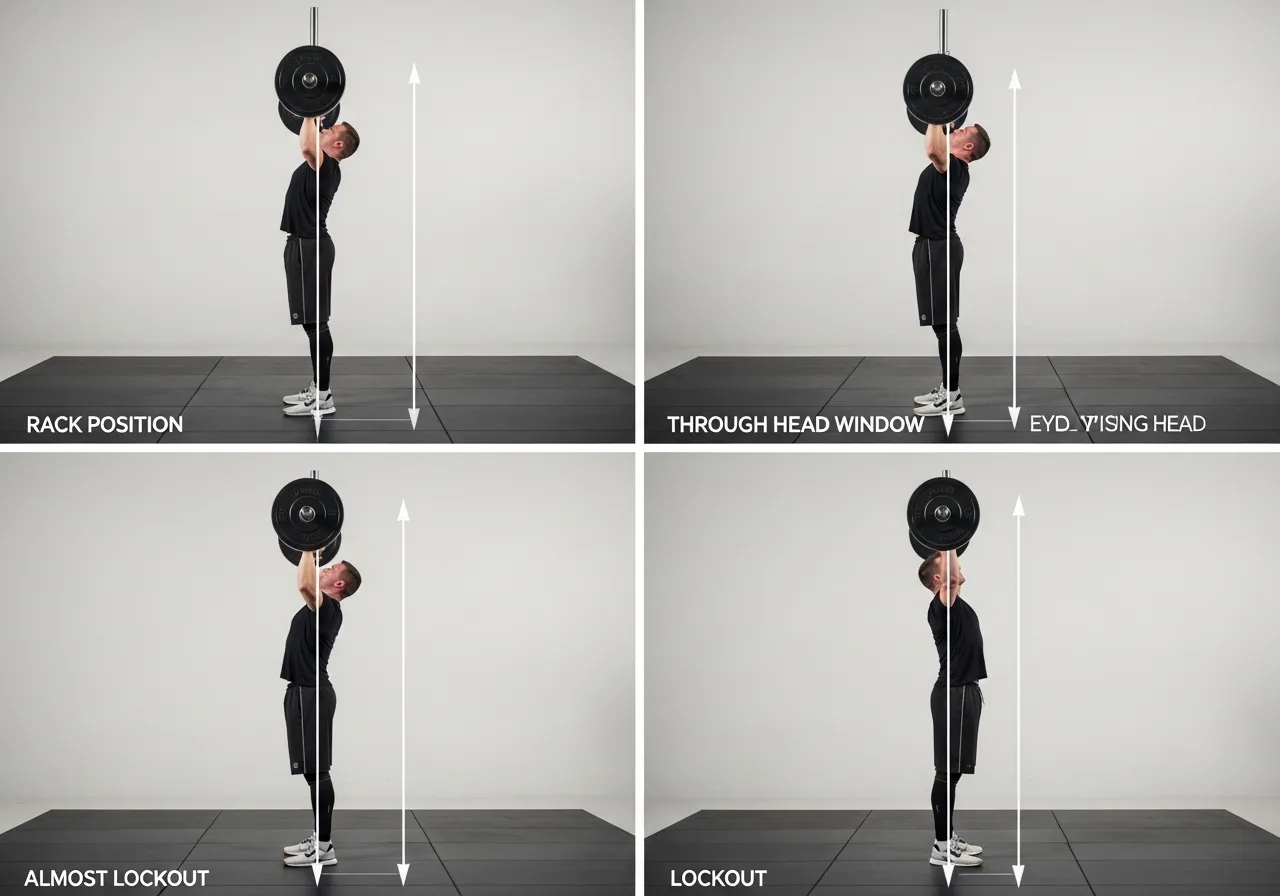
Press the bar vertically. As the bar passes the forehead, drive the head slightly forward through the “window” created by the arms — this brings the ears in front of the biceps at lockout, which is the correct finish position. Many lifters make the error of pressing the bar forward and away from the body to avoid the face, producing an inefficient angled bar path. The bar path should be straight vertical or very slightly back. At lockout, the bar should be directly over the mid-foot when viewed from the side, with the elbows locked and the shoulders fully elevated.
The Descent
Lower the bar under control to the front deltoids. Do not bounce the bar off the shoulders — a controlled touch allows immediate re-press without momentum assistance. The eccentric phase of the press is underutilized for strength development; slowing the descent to 2-3 seconds increases the training stimulus without requiring additional load.
The Hip Drive Technique
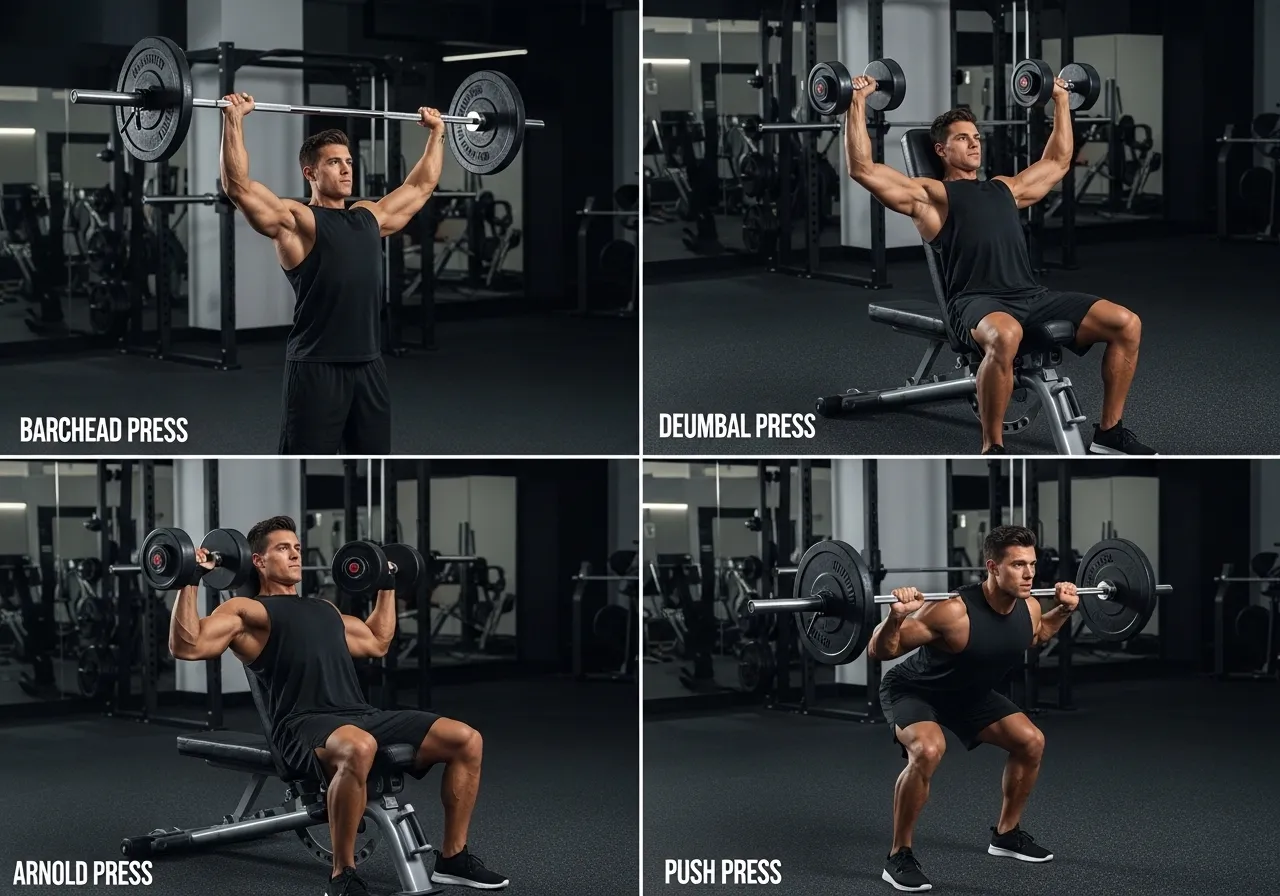
Once loads exceed approximately 80% of 1RM, a slight hip drive (also called push press technique) becomes a productive tool for overload. From the press starting position, perform a small dip (3-4 cm of hip and knee flexion) and immediately drive upward, using the leg drive momentum to accelerate the bar past the sticking point. The push press allows 15-25% more load than strict pressing and builds the pressing strength needed to improve strict press performance over time. It is a training tool, not a cheat — competitive strongmen and weightlifters use hip drive deliberately to develop overhead strength.
Grip Width Optimization: Finding Your Best Press
Grip width significantly affects overhead press efficiency, joint stress, and muscle recruitment. A grip too narrow (hands touching) places the wrists in excessive flexion and the elbows in a mechanically disadvantaged position — the bar travels too far from the body’s center of mass and the triceps are forced to work at a poor angle. A grip too wide (hands at the barbell collars) creates shoulder impingement risk by placing the humeral head in internal rotation at the starting position, compressing the rotator cuff tendons against the acromion throughout the press. The optimal grip falls between these extremes: forearms vertical when viewed from the front at the starting position, which places hands 1.0-1.5 times shoulder width apart for most people.
Individual anatomy determines the exact optimal grip. Lifters with wider shoulders typically need a slightly wider grip than those with narrower builds. Lifters with shoulder impingement history benefit from experimenting with a slightly closer grip that allows the elbows to stay below the bar more consistently, reducing subacromial space compression. The test for optimal grip: set the grip so that the forearms are perfectly vertical when the bar is in the rack position at the front deltoids. From this position, the bar will travel vertically as the most efficient path and the shoulder will be in its most mechanically favorable position throughout the press.
Breathing and Bracing: The Safety Foundation
Breathing and bracing technique in the overhead press is the single most important safety element, yet it receives less attention than technique elements like bar path and head position. The correct bracing sequence: take a deep breath into the belly (diaphragmatic breath, not chest breath), hold it, brace the core as if preparing for a punch to the abdomen, squeeze the glutes, and only then initiate the press. This intra-abdominal pressure brace stabilizes the entire spine against the overhead loading, preventing the hyperextension that produces lower back injuries during heavy pressing.
The breath should be held through the sticking point of the press and can be released at the top of the lift or during the controlled descent. For sets of 5+ reps, breathing at the top of each rep (rather than holding for the entire set) maintains adequate oxygen delivery while preserving bracing for each individual press. For singles and very heavy doubles, the Valsalva maneuver (complete breath hold through the entire rep) provides maximum intra-abdominal pressure and is appropriate for the brief duration of the single lift. Learning proper breathing and bracing before attempting heavy overhead pressing prevents the lower back injuries that disproportionately affect lifters who neglect this element.
The Press and Shoulder Girdle Architecture
The shoulder girdle is the most mobile joint complex in the human body, requiring a balance of mobility and stability that the overhead press both demands and develops. The glenohumeral joint (the ball-and-socket shoulder joint) achieves its extraordinary range of motion at the cost of inherent instability — it is the most frequently dislocated major joint for this reason. Stability comes from the rotator cuff muscles (supraspinatus, infraspinatus, teres minor, subscapularis) that hold the humeral head centered in the glenoid, and from the scapular stabilizers (serratus anterior, lower and middle trapezius) that position the scapula optimally for shoulder movement. The overhead press, performed with correct technique and progressive loading, strengthens all of these stabilizers simultaneously alongside the prime movers, producing the integrated shoulder stability that protects against injury.
The serratus anterior — a muscle running along the lateral ribs that protracts the scapula and holds it flat against the thorax — is directly trained during the overhead press’s lockout position. Weakness in the serratus anterior produces scapular winging (the scapula lifting away from the rib cage), which directly impairs overhead pressing mechanics and creates rotator cuff impingement risk. The regular overhead pressing load at full lockout is one of the most effective serratus anterior exercises available, explaining why consistent overhead pressers typically display excellent scapular stability and shoulder health despite the high loads involved.
Progressive Overload: The Engine of All Long-Term Improvement
Every meaningful improvement in physical performance results from progressive overload — the systematic increase of training demands over time. The body’s adaptation mechanism is fundamentally conservative: it adapts to meet imposed demands, not to exceed them. This means that training at a constant level produces initial adaptation followed by maintenance, not continued improvement. Only by progressively increasing training demands — more load, more volume, higher intensity, shorter rest — does the body continue adapting beyond the initial plateau. This principle applies universally to cardiovascular training (adding
Setting Realistic Training Goals and Expectations
Unrealistic training expectations — derived from fitness media, social media athletes using performance-enhancing drugs, or exceptional genetic outliers — are one of the primary causes of exercise program abandonment. When expected results don’t materialize on the timeline presented by fitness marketing, people commonly conclude that the program is ineffective, that they are personally incapable of achieving the results, or that the effort required exceeds the benefit. In most cases, the problem is not the program, the individual, or the effort — it is the expectation. Evidence-based rates of physical developmen
Programming the Overhead Press for Consistent Progress
Why the Overhead Press Progresses Slowly
The overhead press progresses more slowly than any other major barbell lift because the limiting muscles — the deltoids — are relatively small compared to the posterior chain and quadriceps driving squat and deadlift progress. A novice lifter might add 2.5 kg per session to the squat; adding 2.5 kg to the overhead press every two weeks is strong progress for an intermediate. Expecting squat-like progress on the press produces frustration and program-hopping that prevents the patient accumulation of volume and intensity the press requires.
Linear Progression for Beginners
Beginners: 3 sets of 5 reps, adding 2.5 kg every session until progress stalls. This simple approach produces rapid initial progress — most beginners can add 2.5 kg every workout for 4-8 weeks before requiring more sophisticated programming. When progress stalls on the simple 3×5 approach, transition to the intermediate structure.
Intermediate Programming: Weekly Undulation
Heavy day: 4×4-5 at 80-85% 1RM. Volume day: 4×8 at 65-70% 1RM. These two sessions per week produce both the strength stimulus of the heavy day and the hypertrophic volume of the lighter day. Rotating between them develops the deltoids, triceps, and upper back more completely than training at a single intensity. NSCA strength training guidelines recommend varied intensity training for intermediate and advanced lifters to continue progress beyond the novice stage.
Bench Press Relationship
Most lifters find that their overhead press maximum is approximately 60-70% of their bench press maximum. This ratio serves as a progress benchmark: if the overhead press has fallen significantly below this ratio, it is likely underdeveloped. Many lifters find that improving the overhead press improves the bench press — the shoulder stability and upper back development from pressing overhead carry over directly to the bench.
Programming Overhead Press Frequency: One Day vs Two Days vs Three Days
The question of how frequently to overhead press per week depends on training experience, recovery capacity, and the role of the press in the overall program. One day per week: appropriate for advanced athletes using the overhead press as an accessory to the bench press, or for intermediate athletes with significant other upper body pressing volume. Single weekly press exposure limits development rate but manages cumulative shoulder fatigue from multiple pressing modalities. Two days per week: the most commonly recommended frequency for intermediate lifters making the overhead press a priority. One heavy session and one volume session (as described in the programming section) provides both the strength stimulus and the hypertrophic volume that consistent improvement requires. Two sessions per week allows sufficient recovery between the shoulder-intensive sessions while providing enough practice frequency for technique to reinforce. Three days per week: appropriate for beginners on linear progression who can recover from and improve with the same workout performed three times per week, and for competitive strength athletes in programs specifically designed for high-frequency overhead pressing. At this frequency, session intensity must be carefully managed — three heavy overhead press sessions per week produces shoulder overuse if all three are max-effort sessions.
Assistance Exercises for Overhead Press Development
The overhead press’s progress is supported by specific assistance exercises that develop the muscles limiting performance. Lateral raises (dumbbell or cable) develop the medial deltoid that contributes to the initial drive off the shoulders. Face pulls develop the posterior deltoid and external rotators that maintain shoulder health under pressing load. Tricep work (close-grip bench press, overhead tricep extension, dips) develops the triceps that drive the final extension phase of the press. Front raises specifically develop the anterior deltoid that initiates the press. The most efficiently programmed overhead press sessions include one or two targeted assistance exercises after the main press work — typically lateral raises and face pulls for most intermediate lifters, as these address the most commonly undertrained muscles relative to the pressing muscles that bench and overhead pressing heavily develop.
The Zydrunas Savickas approach — the world record holder in the log press and one of the strongest overhead pressers in history — emphasized tricep development as the primary limiting factor in overhead pressing beyond a certain strength level. His training included heavy board presses, close-grip bench pressing, and heavy tricep extensions alongside the overhead press itself. For most recreational athletes, the limiting factor is deltoid strength rather than tricep strength, but as overhead press numbers advance past intermediate levels (bodyweight+ overhead press), tricep development becomes progressively more important. Adjusting assistance work emphasis based on where the overhead press fails — near the bottom indicating deltoid weakness, near the top indicating tricep weakness — directs effort toward the actual limiting factor rather than training all assistance exercises equally.
Common Plateau Strategies for the Overhead Press
The overhead press plateau — where the weight on the bar stops increasing despite consistent training — is one of the most common frustrations in strength training. Several strategies specifically address press plateaus. Micro-loading: adding 1 kg or less per session using fractional plates (0.25 kg, 0.5 kg per side) extends the linear progression phase significantly beyond what standard 2.5 kg increments allow. The difference between pressing 50 kg and 52.5 kg may feel enormous on a given day; the difference between 50 kg and 51 kg is negligible. Micro-loading turns a stalled 50 kg press into a 55-60 kg press within 10-20 weeks without any other program changes. Pause reps: pressing with a 2-3 second pause at the sticking point (typically just above the forehead) eliminates the elastic stretch-shortening cycle contribution at the sticking point and forces the muscles to generate force from a dead stop, dramatically increasing the training demand at the limiting position. Two to three pause rep sets per week alongside regular pressing develops specific strength at the position where most press attempts fail. Cluster sets: 2-3 reps, 15-20 seconds rest, 2-3 more reps, repeat. This allows more total quality reps at near-maximum intensity than single continuous sets and produces strength development that continuous-set training plateaus cannot. A cluster protocol of (3+2+2+1) at 90% 1RM provides 8 quality reps at a weight normally manageable for only 3 continuous reps.
Overhead Press Variations for Complete Shoulder Development
Dumbbell Overhead Press
Dumbbell overhead pressing provides independent arm movement that identifies and corrects bilateral asymmetries the barbell conceals. The greater range of motion available with dumbbells — arms can travel further inward at the top and further down at the bottom — produces a longer training range and greater deltoid stretch. Programming: seated dumbbell press for maximum load and isolation, standing dumbbell press for additional core demand. Use as a secondary pressing variation after barbell work, or as a replacement when barbell pressing is unavailable.
Arnold Press
The Arnold press adds a rotational component to the dumbbell press — beginning with palms facing the body at the bottom and rotating to palms facing forward at the top. This rotation recruits all three deltoid heads through their respective functions during a single movement. The Arnold press is particularly effective for front and lateral deltoid development and is a productive variation for lifters seeking complete deltoid development beyond the anterior dominance of standard pressing.
Landmine Press
The landmine press — pressing a barbell anchored at one end at a diagonal angle — provides a pressing pattern that is gentler on the shoulder than strict vertical pressing. The angled bar path allows natural shoulder rotation during the press, making it appropriate for lifters with shoulder impingement or limited overhead mobility. The landmine press also has a significant core rotation demand that overhead barbell pressing lacks, making it a productive rotational power exercise for athletes in throwing and striking sports.
Z-Press
The Z-press is performed seated on the floor with legs extended in front of the body. This position eliminates all leg drive and seat back support, forcing the core to stabilize completely and requiring significant hip flexor flexibility. The Z-press is an advanced pressing variation that reveals and addresses the mobility and core stability limitations that the standing press can partially compensate for. It is a diagnostic tool as much as a training exercise — if Z-press technique is solid, standing press technique is almost certainly good.
Overhead Press for Different Athletic Populations
The overhead press’s relevance to athletic performance varies by sport but is universally beneficial for overhead function and shoulder health. For throwing athletes (baseball pitchers, quarterbacks, javelin throwers), the overhead press develops the shoulder girdle stability and overhead strength that supports throwing mechanics and reduces injury risk. Throwing sports produce enormous rotational and deceleration forces on the shoulder — the infraspinatus and teres minor must decelerate the arm after ball release with forces far exceeding what the small muscles can generate on their own without the structural foundation of well-developed shoulder musculature. Overhead pressing builds this structural foundation. For swimmers, the overhead press develops the pulling and pushing strength that propels the body through water, with particular relevance to butterfly and freestyle strokes that require repeated overhead force application. For gymnasts and calisthenics athletes, the overhead press develops the pressing strength that underlies handstands, ring support, and overhead bodyweight skills.
Team sport athletes (basketball, volleyball, handball) who make overhead movements in competition benefit directly from overhead press training — the developed deltoids, triceps, and shoulder girdle stabilizers improve both the power and injury resistance of overhead athletic movements. Basketball players who overhead press develop better shot mechanics under defensive pressure, as the trained muscles maintain positioning when opponents apply contact. Volleyball players who overhead press develop the shoulder stability that protects against the repetitive overhead impacts of setting and attacking. These sport-specific benefits extend the overhead press’s value beyond the general strength and shoulder health benefits applicable to all populations.
Overhead Press Benchmarks: Standards for Lifters at Every Level
Strength standards provide context for overhead press development and motivational targets for progress. For men: bodyweight overhead press (pressing your own weight once) represents excellent strength for a recreational athlete and is achievable within 2-3 years of dedicated training for most people starting from scratch. 1.25× bodyweight represents advanced strength; 1.5× bodyweight places a lifter among the strongest overhead pressers in any general population gym. For women: 0.65× bodyweight represents excellent strength; 0.75× bodyweight represents advanced level; bodyweight overhead press places a woman among exceptional overhead pressers. These standards assume strict technique — standing, no momentum from leg drive, controlled descent. Specific benchmarks by training level: beginner men (first year of training) should aim for pressing 40-50% of bodyweight; intermediate men (1-3 years) 60-80%; advanced men (3+ years) 90-110%. These standards help identify whether overhead press development is appropriate for current training age or represents an area requiring specific focus.
Overhead Press for Shoulder Health and Injury Prevention
The Rotator Cuff and Overhead Pressing
Concern about overhead pressing and shoulder injury is common — many lifters avoid the movement entirely after hearing that it stresses the rotator cuff. The reality is more nuanced: overhead pressing with correct technique and appropriate loading develops the rotator cuff rather than damaging it. The supraspinatus, infraspinatus, teres minor, and subscapularis all activate during overhead pressing to maintain the humeral head centered in the glenoid under load. This demand, progressed appropriately, produces rotator cuff resilience rather than injury.
The overhead press movements that do cause problems are typically performed with excessive lumbar hyperextension (arching the lower back to get the bar overhead rather than pressing the bar), flared elbows creating anterior shoulder impingement, or loads progressed faster than the stabilizers can adapt. Each of these is a technique and programming problem, not an inherent property of the overhead press itself.
Pre-Press Shoulder Preparation
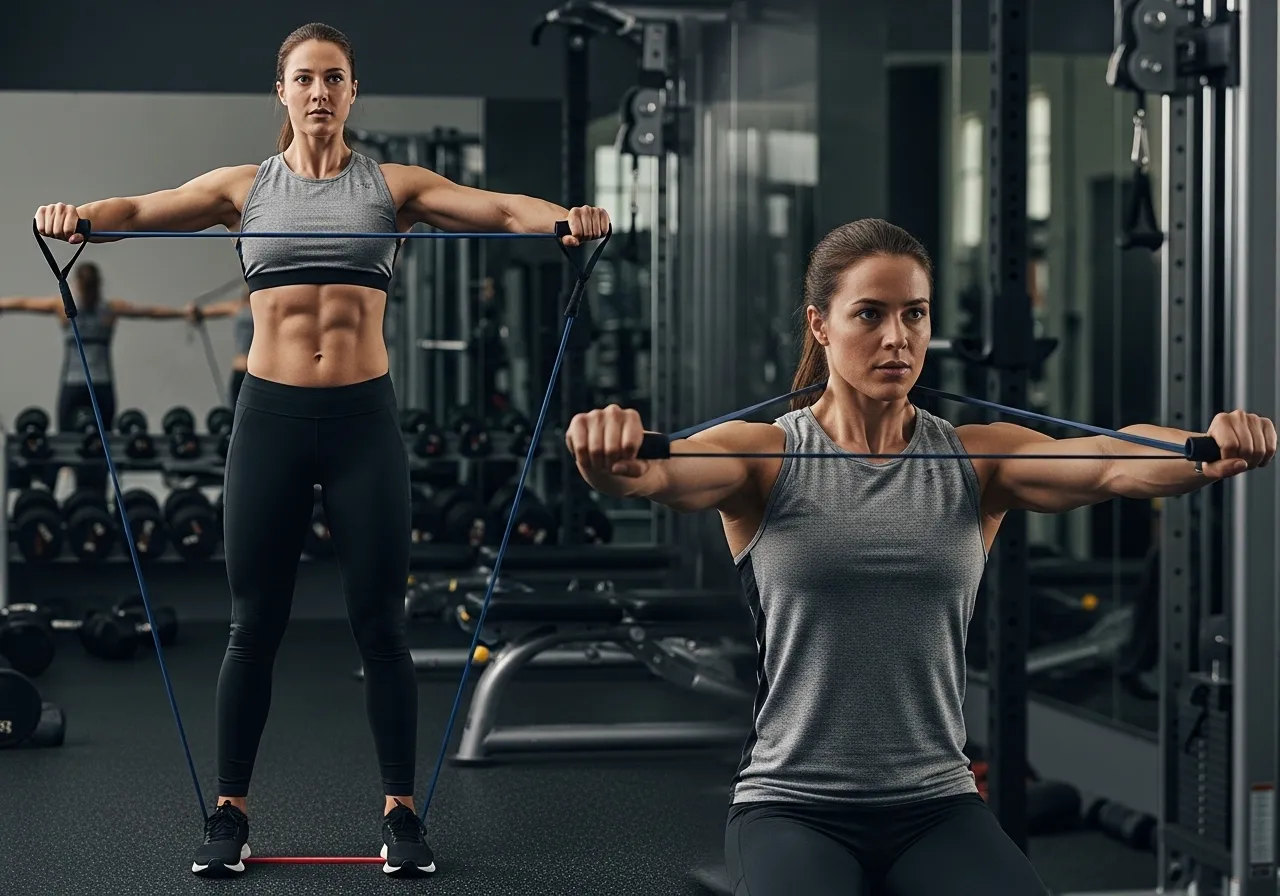
Five minutes of shoulder preparation before overhead pressing reduces injury risk and improves pressing performance. Band pull-aparts (2×20): retract the shoulder blades against band resistance, activating the posterior deltoid and rhomboids. Face pulls (2×15): pull a rope attachment to face height with elbows flared high, training the external rotators. Wall slides (2×10): press the arms against a wall and slide them overhead, training serratus anterior and upper trapezius activation patterns. This preparation activates the muscles that stabilize the shoulder during pressing and establishes the motor patterns that make the press safer under heavy loads.
Frequently Asked Questions About the Overhead Press
Why does my lower back hurt during overhead pressing? Lower back pain during the overhead press indicates excessive lumbar hyperextension — the lower back is arching too aggressively to compensate for limited shoulder mobility or weak core bracing. Fix: reduce load, brace the core more aggressively before pressing, and squeeze the glutes throughout the set. Adding thoracic mobility work and lat stretching also addresses the mobility limitations that force the lower back to compensate.
Should I press with a wide grip or narrow grip? Most lifters press most effectively with hands slightly wider than shoulder-width, which positions the forearms vertically under the bar. A very wide grip limits range of motion at the top; a very narrow grip increases the wrist extension demand. Experiment within the range of 1.0-1.5 times shoulder-width and settle on whatever position produces the strongest bar path with the least shoulder discomfort.
Can I overhead press with a Smith machine instead? The Smith machine overhead press is a useful variation for learning the pressing pattern or training around shoulder injuries, but it produces meaningfully different muscle activation from the free barbell press. The fixed bar path of the Smith machine prevents the natural slight arc the barbell follows during pressing and reduces core activation significantly. Use it as a supplement or modification, not a direct replacement.
How often should I overhead press per week? Two sessions per week is the standard productive frequency for intermediate lifters — one heavy session and one volume session, as described in the programming section. Beginners can press three times per week during linear progression. Advanced lifters sometimes press four times per week in specialized overhead press programs, but this frequency requires careful volume management to prevent shoulder overuse. ACSM resistance training guidelines recommend 2-3 sessions per week for major muscle groups with adequate recovery between sessions.
My press stalled but my bench keeps going up. What should I do? The overhead press and bench press stall at different rates because they share the triceps but use different primary movers. When the press stalls but the bench continues, the limiting factor is usually deltoid strength rather than tricep strength. Adding lateral raises, face pulls, and pressing volume at moderate loads (4×10 at 65-70% 1RM) provides additional deltoid stimulus that heavy-only pressing doesn’t provide.
Managing Shoulder Discomfort During Overhead Press Training
Shoulder discomfort during overhead pressing is common and typically manageable without discontinuing training. The first step is identifying the discomfort type and location. Anterior shoulder pain at the start of the press usually indicates subacromial impingement — the rotator cuff tendons being pinched as the arm elevates. Addressing grip width (slightly narrower), elbow angle (slightly less flared), and thoracic mobility (more extension) resolves most anterior impingement patterns within 4-6 weeks of consistent modification. Posterior shoulder pain at lockout usually indicates posterior capsule tightness — the back of the shoulder capsule restricting full elevation. Posterior shoulder stretching (cross-body stretch, sleeper stretch) resolves this pattern. AC joint pain (the bump at the top of the shoulder) at the top of the press requires reducing overhead pressing load, addressing shoulder elevation patterns, and typically resolving the underlying shoulder mechanics that create AC joint stress before resuming heavy pressing.
Pain that is sharp, electric, or radiating (shooting into the arm or neck) warrants immediate training cessation and professional evaluation before any overhead pressing resumes — these patterns suggest nerve involvement (brachial plexus, cervical nerve root) that requires diagnosis before loaded training continues. Dull aching that warms up and resolves during training is typically safe to train through with technique modifications; pain that increases during training or persists significantly after training warrants load reduction and professional consultation. The general rule: manage mild discomfort with technique modification and load adjustment; seek professional evaluation for moderate-to-severe pain, any pain that increases with training, or pain that doesn’t respond to 2-3 weeks of conservative modification.
The Press in Powerlifting and Strongman Training
While the overhead press is not a competitive powerlifting lift (the three competitive lifts are squat, bench press, and deadlift), it is a foundational strength exercise in powerlifting programs for shoulder health and pressing muscle development that carries over to the bench press. Most powerlifting programs include overhead pressing as an accessory exercise on upper body days — typically 3-4 sets of 6-10 reps at 50-65% of overhead press maximum. The overhead press develops the anterior deltoid, long head of the triceps, and upper trapezius in specific ways that bench pressing at angles cannot replicate, and these developments support bench press performance by providing a stronger structural shoulder base.
In strongman competition, the overhead press is a primary event — the log press, axle press, and dumbbell press are regular competition events that require substantial overhead pressing strength. Strongman athletes typically overhead press with hip drive (push press or jerk technique) and with implements heavier than strict pressing allows, using the leg drive to accelerate the bar past the sticking point. The strength required for competitive strongman overhead pressing — elite competitors regularly log press 200+ kg — requires years of dedicated overhead pressing development that dwarfs the strength benchmarks applicable to general fitness training. For general fitness athletes, the strongman approach informs programming in one specific way: heavy push press training (1-3 reps at maximum, once per week) develops overhead pressing strength above the strict press maximum and produces strength improvements that carry back to strict pressing performance.
Long-Term Physical Development: The 5-Year Perspective
The most meaningful perspective on physical training is the 5-year view rather than the 12-week program cycle that fitness marketing emphasizes. In 5 years of consistent, progressive training — training that accumulates rather than restarts with each new program — the physical changes achievable exceed anything a 12-week transformation could produce. Five years of consistent strength training typically produces: 15-30 kg of additional muscle mass for men, 8-15 kg for women; strength improvements of 200-400% from starting levels across major lifts; significant improvements in movement quality, body composition, and functional capacity that persist throughout the subsequent lifespan if training continues. Five years of consistent cardiovascular training typically produces: VO2max improvements of 20-40%; cardiovascular disease risk reduction approaching that of lifelong athletes; measurably reduced biological aging markers compared to sedentary age peers.
These 5-year outcomes are achievable not through the most sophisticated programming but through the most consistent execution of sound basic principles. The athletes who achieve the most dramatic 5-year physical development are rarely those who found the most optimized program — they are those who showed up consistently, progressed loads systematically, recovered adequately, and adapted their training to their life circumstances rather than abandoning training when optimal conditions weren’t available. The secret of long-term physical development is no secret at all: it is the patient, consistent accumulation of training stimulus over years, guided by sound principles and adapted to individual circumstances. Understanding this at the beginning of a training journey — rather than discovering it after years of program-hopping — saves years of misdirected effort and produces the compounding physical development that consistency alone generates.
Environmental and Contextual Factors in Training Success
Physical training outcomes are influenced by factors beyond training programming, nutrition, and recovery — the environmental and social context in which training occurs significantly affects both performance quality and long-term adherence. Training environment quality (lighting, temperature, equipment availability, noise level) affects acute performance: research on environmental conditions and exercise performance finds that slightly cool temperatures (15-20°C) produce better endurance performance than hot conditions, that familiar training environments produce better strength performance than novel ones (due to reduced cognitive load from navigation and equipment unfamiliarity), and that social presence (training with others or in a populated gym versus alone) tends to increase effort level through social comparison and motivation mechanisms. These environmental effects are smaller than training, nutrition, and recovery in their impact on outcomes but are worth considering when training environment choices are available.
The social and cultural context of training shapes the behaviors and expectations that drive long-term outcomes. Fitness communities — whether competitive sports teams, CrossFit affiliates, running clubs, or online training groups — create social norms around training frequency, intensity, and recovery that members tend to conform to. Joining communities with healthy training norms (progressive training, appropriate intensity management, injury prevention awareness) produces better long-term outcomes than training in isolation because the community’s norms function as an external accountability system that supplements individual motivation. The selection effect — people who join fitness communities may be more intrinsically motivated than those who train alone — is partially responsible for community exercisers’ better outcomes, but experimental research on social support and exercise adherence confirms that the social environment itself contributes meaningfully to training consistency beyond individual motivation differences. NSCA resources consistently recognize that training context and social environment influence long-term athletic development alongside the purely technical programming variables that exercise science research primarily studies.
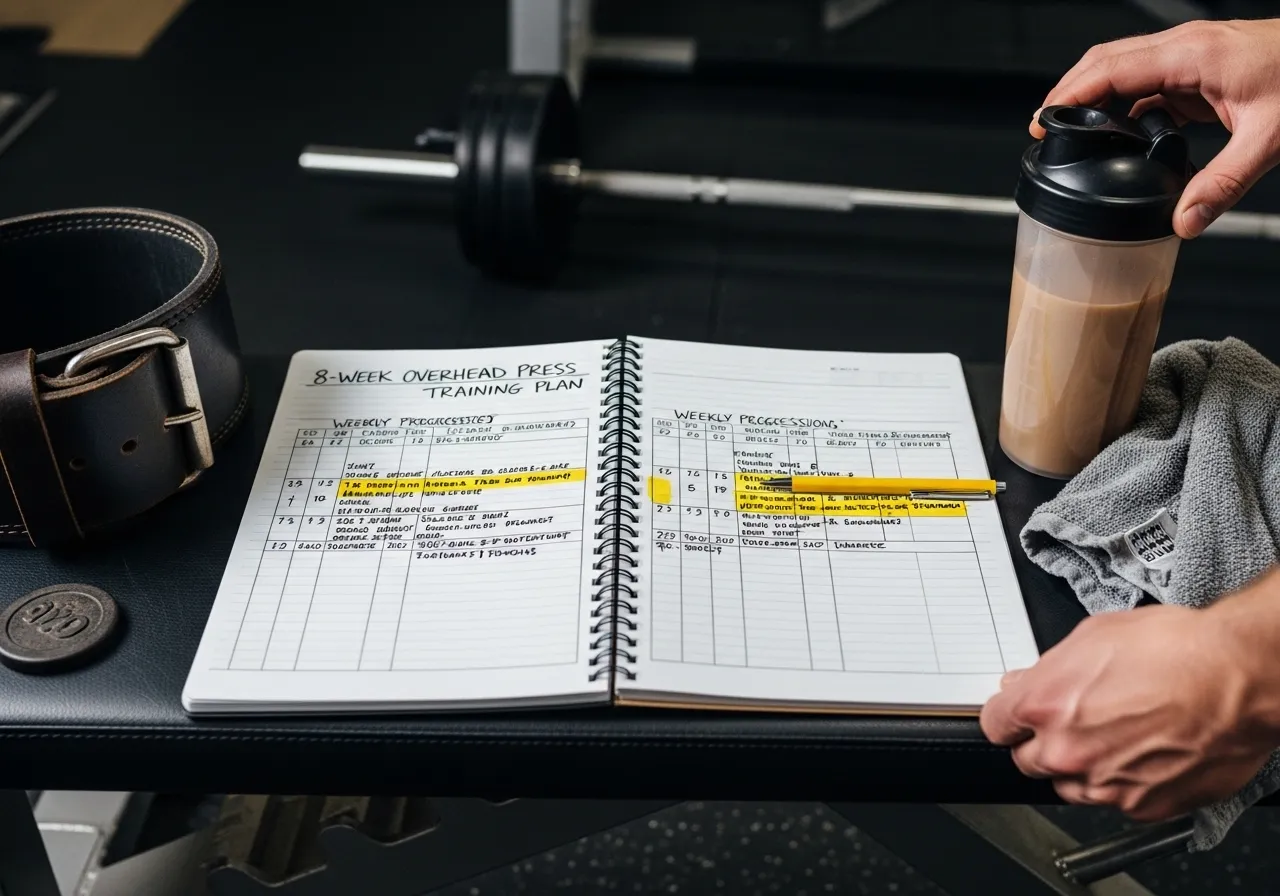
Building Your Overhead Press Program: 8-Week Template
Weeks 1-2: Technical Foundation
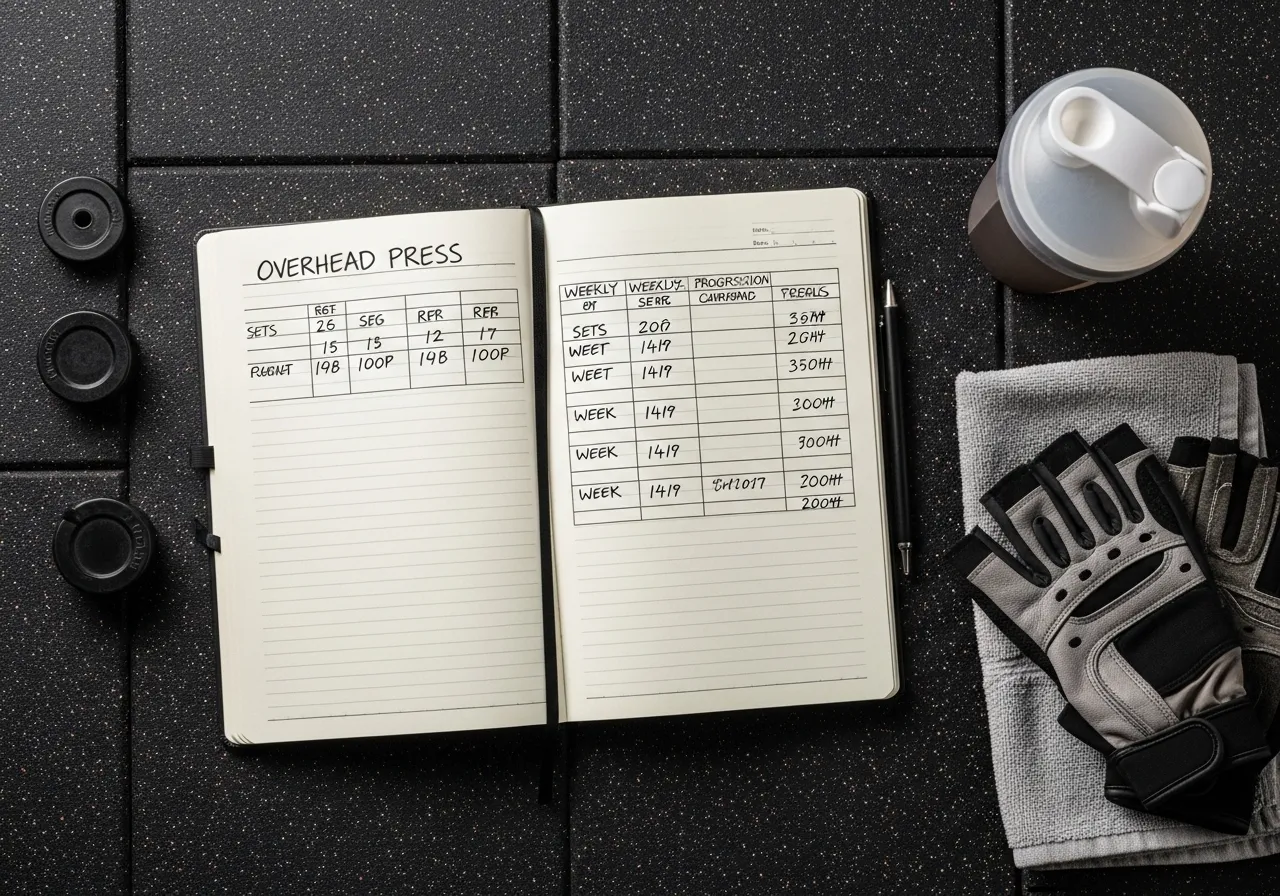
Focus: perfect technique before adding intensity. Press 4×6 at 70% of estimated 1RM. Record every set on video and review for bar path, head position, and core bracing. Any technical breakdown is addressed before adding load. Supplementary work: 3×12 dumbbell lateral raise, 3×15 face pull, 3×10 push-up.
Weeks 3-5: Strength Accumulation
Heavy day: 4×4 at 80-85% 1RM. Volume day: 4×8 at 65% 1RM. Progress heavy day by 2.5 kg every two weeks when all 4 sets of 4 are completed with solid technique. Volume day stays at the same relative percentage. This phase builds the strength base that weeks 6-8 will express.
Weeks 6-7: Intensification
Heavy day: 5×3 at 85-87% 1RM. Volume day: 3×10 at 60% 1RM plus 3×5 push press at 90% strict 1RM. The push press overload in weeks 6-7 develops pressing strength above the strict press maximum — handling loads heavier than can be strictly pressed builds the neural drive and shoulder stability that carry over to strict press performance.
Week 8: Test Week
Monday: work up to a heavy single at estimated 95% 1RM. Wednesday: 3×3 at 80%. Friday: attempt a new 1RM or 3RM. Most lifters completing this 8-week template add 5-10% to their overhead press maximum — modest by squat or deadlift standards, but substantial for the overhead press where progress is earned slowly.
Overhead Press and Thoracic Mobility: The Inseparable Relationship
The overhead press is the exercise most directly limited by thoracic spine mobility. A rounded, kyphotic upper back mechanically prevents the shoulder from achieving full elevation — the scapula cannot rotate upward fully when the thoracic spine is in flexion, because scapular rotation depends on the thoracic spine’s extension to provide the base from which the scapula can tilt and rotate. Attempting to press overhead with restricted thoracic extension forces one of two compensations: the lumbar spine hyperextends excessively to achieve the appearance of overhead positioning (producing lower back pain and risk), or the elbow flares to the side to navigate around the impingement created by poor scapular position (producing anterior shoulder impingement).
For many lifters who report lower back pain during overhead pressing or who cannot achieve strict vertical arm position at lockout, the cause is not a pressing technique problem but a thoracic mobility problem. Adding 10 minutes of thoracic mobility work (foam roller extension, thread-the-needle rotation, cat-camel with segmentation) before overhead press sessions consistently produces immediate improvement in pressing mechanics for lifters with restricted thoracic spines. The improvement in available range allows the shoulder to elevate more vertically, reduces the lumbar compensation required, and often resolves the shoulder impingement that occurred at the compensated end range. Treating thoracic mobility as a prerequisite for overhead pressing — not optional warm-up — is the approach that prevents the chronic shoulder and lower back issues that grinding through restricted overhead pressing produces. Research on regional interdependence confirms that thoracic restrictions predictably produce shoulder and lumbar compensations that resolve when the thoracic restriction is addressed.
Overhead Press Records and Elite Performance Context
Understanding elite overhead pressing performance contextualizes what is achievable with dedicated training and genetic potential. The world record in the strict overhead press (no leg drive, competition standards) stands at approximately 212 kg (467 lbs) for men at superheavyweight, set by Zydrunas Savickas. At lighter weight classes, the relative strength achievements are equally impressive — lifters pressing 1.7-2× their body weight in strict competition standards. In the push press (leg drive permitted), world records exceed 220 kg in superheavyweight classes, demonstrating the additional load capacity that hip drive provides. For drug-free natural lifters, elite strict press numbers are approximately 130-150 kg for superheavyweight men and 70-85 kg for elite women — still extraordinary achievements relative to recreational standards. These records provide perspective: pressing 80-100 kg as a male recreational lifter, while excellent, represents approximately 50-65% of what the most extraordinary genetic overhead pressers can achieve with elite training and nutrition. This context should inspire rather than discourage — the overhead press rewards patient, consistent progressive work with strength development that compounds across years.
Long-Term Physical Development: The 5-Year Perspective
The most meaningful perspective on physical training is the 5-year view rather than the 12-week program cycle that fitness marketing emphasizes. In 5 years of consistent, progressive training — training that accumulates rather than restarts with each new program — the physical changes achievable exceed anything a 12-week transformation could produce. Five years of consistent
Overhead Press Periodization: 6-Month Development Plan
Months 1-2: Technical Mastery Phase
The foundation of long-term overhead press development is technique — specifically the bar path, head position, core brace, and shoulder blade positioning that makes each rep maximally effective and minimally injurious. During this phase, perform 4×6 at 70% of estimated maximum, recording every set on video for side and front-view analysis. Common technique issues to identify and correct: bar path that drifts forward (should be nearly vertical), elbows that flare excessively at the start (should point roughly 45 degrees forward), and lumbar hyperextension at lockout (should lock out with glutes contracted and core braced, not by throwing the lower back backward). Address one technical issue per week rather than attempting multiple simultaneous corrections — motor pattern changes require focused repetition to consolidate.
Months 3-4: Strength Accumulation Phase
With technical foundation established, increase loading progressively over 8 weeks using a simple periodization structure. Heavy day (once per week): work up to a top set of 4-5 reps at approximately 82-87% 1RM, then perform 2-3 back-off sets at 75% for 6-8 reps. Volume day (once per week): 4×8 at 65-70% 1RM. The heavy day builds the neural intensity that drives strength progress; the volume day develops the muscle mass that supports the heavy day’s demands. Add 2.5 kg to the heavy day top set every 2 weeks when the prescribed reps are completed with solid technique. This conservative progression accumulates to 5-7.5 kg of overhead press improvement over two months — meaningful for an exercise that progresses slowly.
Months 5-6: Intensification and Peak Phase
The final two months push intensity above previous maximum while managing accumulated fatigue. Week 1-4: increase heavy day to 5×3-4 at 85-90% 1RM, add push press 3×5 at 95% of strict 1RM for neurological overload training. Week 5-6: reduce volume by 30% (deload) to allow accumulated fatigue to dissipate. Week 7-8: test new maximum — work up to a heavy single in increments and attempt a new personal record. Most athletes completing this 6-month program increase their overhead press maximum by 10-15%, with some athletes achieving 20%+ improvement depending on starting level and consistency. The overhead press rewards patient, consistent progressive work more than any other compound lift. ACSM guidelines on periodization support progressive periodization as the most evidence-based approach to long-term strength development.
Deload Weeks: Why Less Leads to More
Deload weeks — periods of reduced training volume and intensity every 4-8 weeks — are among the most poorly understood and most underutilized aspects of effective programming. During high-intensity training phases, fatigue accumulates faster than it dissipates, gradually masking the fitness that has been built. A deload week reduces accumulated fatigue, allowing the underlying fitness improvements to express themselves in the subsequent training block. Athletes who skip deloads typically plateau at the end of the fourth to sixth week of a hard training block; athletes who include deloads often achieve personal records in the week or two following the reduced-volume period. For the overhead press specifically — where accumulated shoulder and tricep fatigue from week-over-week pressing limits performance — strategic deloads are particularly impactful in revealing the strength that consistent training has built.
Nutrition and Recovery for Optimal Results
Training stimulus produces adaptation only when nutritional support is adequate. Research consistently identifies 1.6-2.2 grams of protein per kilogram of body weight per day as the range that maximizes muscle protein synthesis. Consistently sleeping 7-9 hours per night maximizes adaptation from every training session, as muscle protein synthesis and growth hormone secretion peak during sleep. Dietary Guidelines for Americans provide evidence-based nutritional recommendations supporting athletic performance and overall health.
Equipment Selection for Overhead Pressing
The standard Olympic barbell (20 kg, 2.2 meters, 28-29mm diameter) is the most appropriate implement for heavy overhead pressing. The 28-29mm diameter provides optimal grip security for most hand sizes without requiring excessive grip tension. Standard barbells (lower quality, often with fixed knurling that doesn’t rotate) can be used for lighter overhead pressing but become problematic at heavier loads where the bar’s inability to rotate creates wrist torque. Specialty bars designed for overhead pressing include the Rogue Ohio bar and similar competition-quality bars with moderate knurling appropriate for pressing (not so aggressive that it damages the hands during the repeated rep contact of a pressing session).
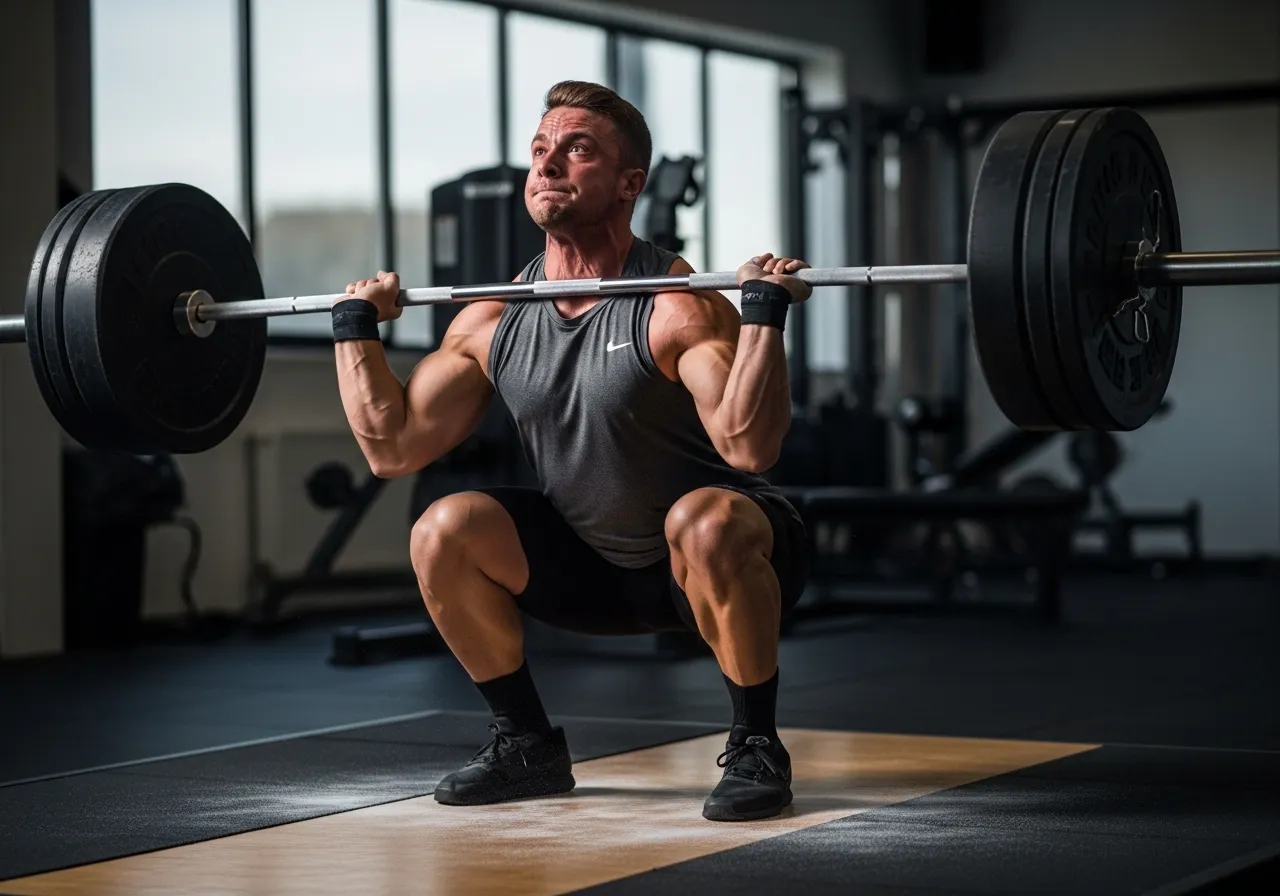
Wrist wraps provide joint support during heavy overhead pressing by limiting wrist extension and reducing the stress on the wrist joint under loaded positions. They are particularly useful for lifters with wrist discomfort during pressing or during very heavy loading phases. The caution: wrist wraps should support rather than compensate for wrist weakness — using wraps on every set at every weight prevents the wrist from developing the strength that would make wraps unnecessary for moderate loads. Use wraps on the heaviest working sets and max-effort work; allow the wrists to train freely during warm-up and lighter accessory work. Lifting belts can be used during heavy overhead pressing to increase intra-abdominal pressure support, though their benefit is less pronounced than in squatting and deadlifting because the overhead press’s spinal loading is lower. For most recreational athletes, a belt is optional for overhead pressing unless lower back discomfort is present during heavy sets. ACSM exercise guidelines support appropriate equipment use as an element of safe and effective resistance training practice.
Maintaining Overhead Press Progress Through Life Stages
The overhead press, like all strength exercises, requires adaptation of training approach as life circumstances and physical capacity change across decades. In the 20s and early 30s: recovery capacity is maximal, allowing higher training frequencies (2-3 overhead press sessions per week) and faster load progression. This is the period for establishing the heavy strength foundation that supports decades of subsequent training. In the 30s and 40s: recovery slows gradually, making session management more important than in younger years. Reducing frequency slightly (1-2 sessions per week) while maintaining intensity, adding thoracic and shoulder mobility work as session components, and emphasizing technique quality over maximum loading progression becomes increasingly important. In the 50s and beyond: shoulder joint health becomes the primary programming consideration. Reducing absolute loading, increasing emphasis on perfect technique and shoulder stability work, and prioritizing overhead mobility maintenance over maximum strength development preserves the function that allows overhead training to continue benefiting health and performance across the full lifespan. The goal shifts from maximum overhead press development to maintaining sufficient overhead strength and mobility for functional independence and quality of life — a goal that moderate overhead pressing, performed consistently and safely, supports excellently across all decades.
Consistency over time is the most powerful force in physical development. The athlete who trains three times per week for five years accumulates more than 700 training sessions. The knowledge, the physical adaptation, and the habitual practice that accumulates across those 700 sessions — each building incrementally on the ones before it — produces transformative physical and cognitive development that no short-term program can replicate. The first year of consistent training produces visible results; the second year produces structural changes that support the first year’s adaptations; the third year reveals capabilities that the first year’s physiology could not support; the fourth and fifth years express the full potential that patient, consistent development has built. Training with this multi-year perspective — treating each session as one of hundreds rather than the first of a 12-week program — produces both better immediate performance and better long-term outcomes. The willingness to trust the process, to train consistently during periods of apparent plateau, and to take the long view of physical development is the psychological quality that most reliably predicts extraordinary physical outcomes among people of equal genetic potential and training access.
The practical translation: show up consistently, progress systematically, recover adequately, and take a longer view of your development than any marketing-driven program encourages. The results that consistency produces over years are genuinely extraordinary — and they are available to anyone willing to commit to the patient accumulation that physical development requires. ACSM long-term physical activity recommendations support sustained, progressive exercise across the lifespan as the most evidence-based approach to both performance development and long-term health maintenance for all populations.
Consistency over time is the most powerful force in physical development. The athlete who trains three times per week for five years accumulates more than 700 training sessions. The knowledge, the physical adaptation, and the habitual practice that accumulates across those 700 sessions — each building incrementally on the ones before it — produces transformative physical and cognitive development that no short-term program can replicate. The first year of consistent training produces visible results; the second year produces structural changes that support the first year’s adaptations; the third year reveals capabilities that the first year’s physiology could not support; the fourth and fifth years express the full potential that patient, consistent development has built. Training with this multi-year perspective — treating each session as one of hundreds rather than the first of a 12-week program — produces both better immediate performance and better long-term outcomes. The willingness to trust the process, to train consistently during periods of apparent plateau, and to take the long view of physical development is the psychological quality that most reliably predicts extraordinary physical outcomes among people of equal genetic potential and training access.
The practical translation: show up consistently, progress systematically, recover adequately, and take a longer view of your development than any marketing-driven program encourages. The results that consistency produces over years are genuinely extraordinary — and they are available to anyone willing to commit to the patient accumulation that physical development requires. ACSM long-term physical activity recommendations support sustained, progressive exercise across the lifespan as the most evidence-based approach to both performance development and long-term health maintenance for all populations.
Warning Fitness Disclaimer: The information in this article is for general educational purposes only and does not constitute professional fitness or medical advice. Always consult a qualified healthcare professional before starting any new exercise program. The Cardio Method That Changed Everything I Thought I Knew About Training For most of my training life, I believed…
⚠️ Fitness Disclaimer: The information in this article is for general educational purposes only and does not constitute professional fitness or medical advice. Always consult a qualified healthcare professional before starting any new exercise program, especially if you have existing injuries or medical conditions. The Machine That Gym Culture Can’t Seem to Agree On No…
Warning Fitness Disclaimer: The information in this article is for general educational purposes only and does not constitute professional fitness or medical advice. Always consult a qualified healthcare professional before starting any new exercise program, especially if you have existing injuries or medical conditions. The Most Versatile Piece of Equipment in the Gym That Most…
⚠️ Fitness Disclaimer: The information in this article is for general educational purposes only and does not constitute professional fitness or medical advice. Always consult a qualified healthcare professional before starting any new exercise program, especially if you have existing injuries or medical conditions. The Posterior Chain Exercise Debate That Every Serious Lifter Faces I…
⚠️ Fitness Disclaimer: The information in this article is for general educational purposes only and does not constitute professional fitness or medical advice. Always consult a qualified healthcare professional before starting any new exercise program, especially if you have existing injuries or medical conditions. Core Stability vs Core Strength: Why Most People Train the Wrong…
⚠️ Fitness Disclaimer: The information in this article is for general educational purposes only and does not constitute professional fitness or medical advice. Always consult a qualified healthcare professional before starting any new exercise program. ⚠️ Medical Disclaimer: This article is for general informational purposes only and does not constitute medical advice. If you are…