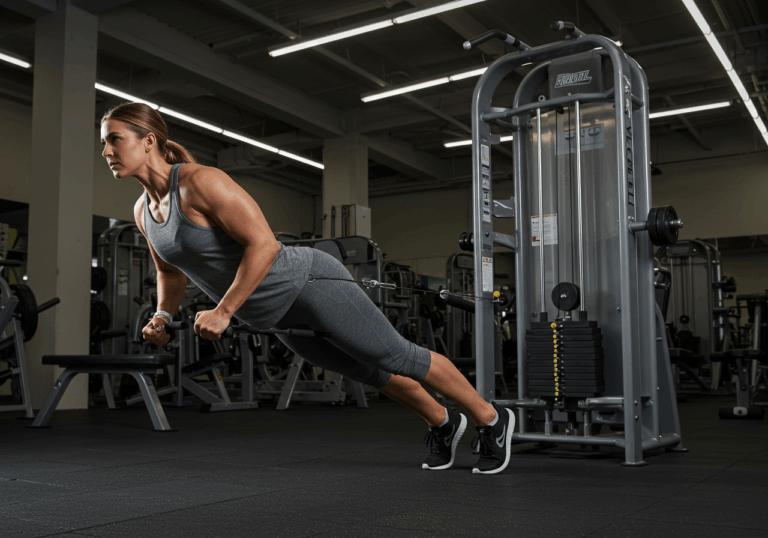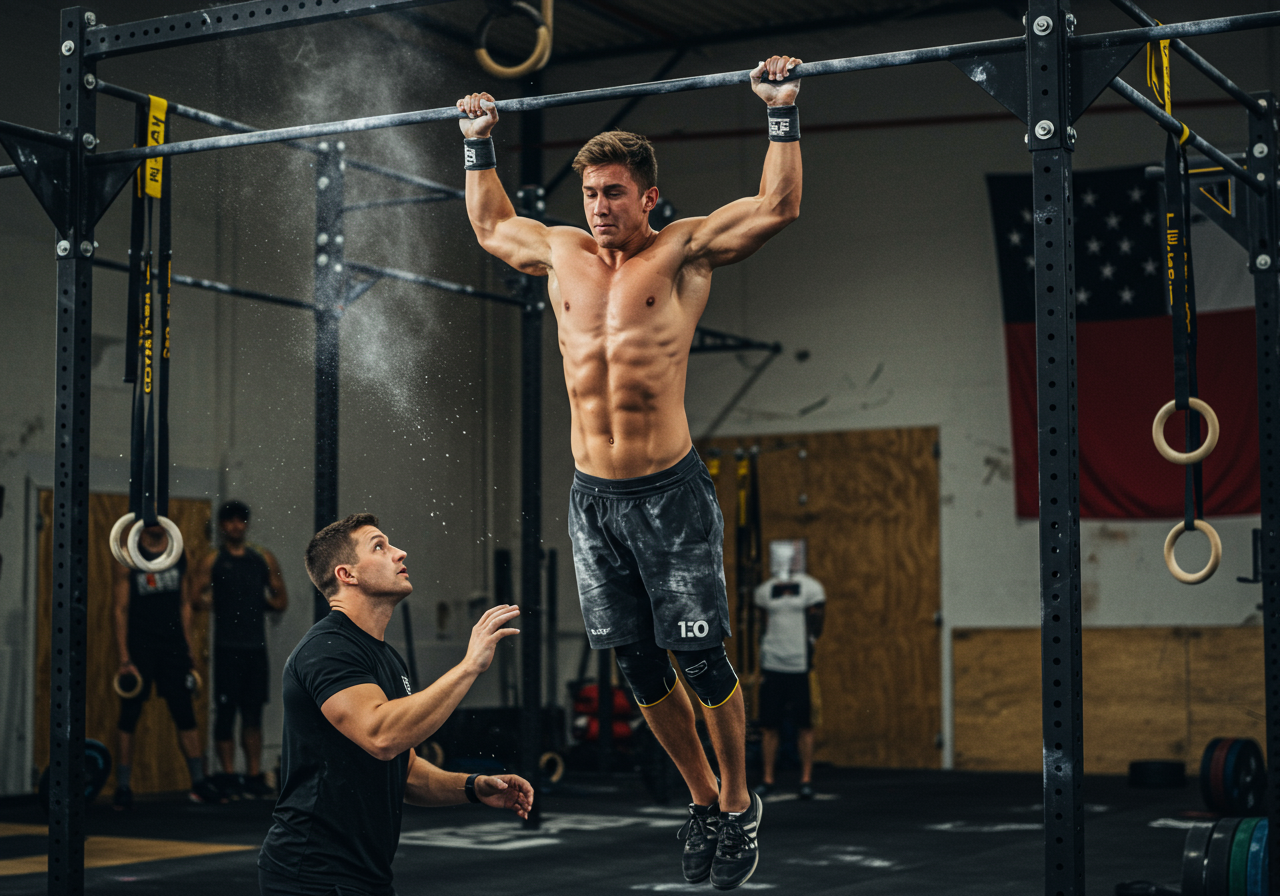
Toes to Bar: Core & Back Strength on Bar
Bar-Core System Blueprint for Powerful Toes to Bar

Design a simple, strong system for toes to bar
This system builds core strength, back power, and bar control together. It fits beginners and progresses safely.
– Skill first, strength second, volume last.
– Own hollow and arch shapes under control.
– Depress and pack the scapula before every rep.
– Progress tempo, range, then load or density.
– Train grip and hip compression every week.
This plan stacks four pillars for complete development. It blends skill, strength, mobility, and grip.
| Day | Focus | Main Work | Accessory | Conditioning |
|---|---|---|---|---|
| A | Pull + Core | Hanging knee raise, controlled tempo | Lat pulldown or banded pull-down | Zone 2 bike 12–20 minutes |
| B | Mobility + Grip | Hamstring and lat mobility circuit | Farmer carry | Brisk walk 20–30 minutes |
| C | Skill + Core | Hollow-to-arch swings, kip timing | Strict leg raises on floor | EMOM 10: 2–4 reps skill |
| D | Full-Body + Density | Deadlift or RDL light to moderate | Hanging tuck hold intervals | Row Zone 2 10–15 minutes |
This structure supports strength system design effectively. It respects recovery and builds repeatable technique.
– Squeeze glutes and ribs down before hanging.
– Push the bar away to lift legs.
– Exhale as hips close.
I used this split to reach 15 unbroken kipping reps. My grip recovered faster with Day B.
Step-by-Step Progressions from Zero to Advanced

Climb progressions with clear checkpoints
These steps move you safely from floor work to strict reps. They also prepare a clean kip.
| Beginner Drill | Sets x Reps | Tempo | Rest | Advance When |
|---|---|---|---|---|
| Dead bug with band pull-down | 3 x 10/side | 2-0-2 | 60 sec | No low-back lift |
| Hollow hold on floor | 5 x 20–30s | Hold | 45 sec | 30s easy |
| Hanging knee raises | 4 x 6–10 | 2-1-2 | 90 sec | 10 clean reps |
| Intermediate Drill | Sets x Reps | Tempo | Rest | Advance When |
|---|---|---|---|---|
| Hanging leg raises to 90° | 5 x 5–8 | 2-1-2 | 90 sec | 8 strict reps |
| Toes-to-bar negatives | 4 x 3–5 | 0-3-3 | 120 sec | No swing |
| Hollow-arch kip swings | EMOM 10: 3–5 | Smooth | — | Stable rhythm |
| Advanced Drill | Sets x Reps | Tempo | Rest | Advance When |
|---|---|---|---|---|
| Strict toes to bar | 6 x 2–4 | 2-1-2 | 120 sec | 4 reps easy |
| Kipping toes to bar | EMOM 10: 3–6 | Crisp | — | 10 unbroken |
| Weighted hanging leg raise | 4 x 5 | 2-1-2 | 150 sec | 5 strict reps |
– Minute 1: 20s hollow hold.
– Minute 2: 5 scap pull-ups.
– Minute 3: 5 knee raises.
– Repeat 3 rounds.
I progressed clients by tempo first. They gained control and avoided wild arching.
Recovery, Mobility, and Fuel for Faster Skill Learning

Recover smarter to grow faster
| Drill | Purpose | Dose |
|---|---|---|
| Banded lat stretch | Overhead mobility | 2 x 45–60s/side |
| Hamstring floss on box | Posterior chain length | 2 x 10–12 reps/side |
| Hip flexor lift-offs | Active compression | 3 x 6–8 reps |
| Scap pull-ups | Scapular control | 3 x 8–10 |
Nutrition fuels stronger pulls and better recovery. It also keeps energy steady across sessions.
| Target | Guideline | Example at 70 kg |
|---|---|---|
| Calories | Bodyweight x 28–33 kcal | 1960–2310 kcal |
| Protein | 1.6–2.2 g/kg | 112–154 g |
| Carbs | 3–5 g/kg on training days | 210–350 g |
| Fats | 0.6–1.0 g/kg | 42–70 g |
I track intake with MyFitnessPal for accuracy. I keep protein consistent daily for recovery.
I monitor sleep and HRV with Garmin. I adjust volume when HRV trends downward.
My biggest mistake was skipping warm-ups once. I strained my calf during swings and lost a week.
Better breathing improved my kips. I exhale into compression and brace before each backswing.
MyFitnessPal helps tracking. Garmin helps recovery decisions.
Eight-Week Implementation with Real Logs and Metrics

Apply the plan with measured steps
This eight-week path balances practice, strength, and recovery. It remains friendly for beginners throughout.
| Weeks | Skill Focus | Strength Focus | Metrics |
|---|---|---|---|
| 1–2 | Hollow, arch, scap pull-ups | Knee raises 4 x 8–10 | Dead hang 20–30s |
| 3–4 | Kip timing EMOM | Leg raises 5 x 5–8 | 90° raise 6–8 reps |
| 5–6 | Negatives and tight backswing | RDL 3 x 6 light | First kipping doubles |
| 7–8 | Link 3–6 kipping reps | Strict 6 x 2 | Set of 5–10 unbroken |
– Warm-up 8 minutes: breathing, scap, hollow.
– Strength 20 minutes: progression table.
– Skill EMOM 10 minutes: kipping control.
– Finisher 8–12 minutes: Zone 2 row or walk.
I tracked heart rate with Garmin. I kept finishers in Zone 2 for recovery support.
I logged volume and RIR in Google Sheets. I increased only one variable each week.
My results after eight weeks were clear and measurable. I improved durability and technique steadily.
| Metric | Week 1 | Week 8 |
|---|---|---|
| Dead hang | 28 seconds | 68 seconds |
| Kipping TTB unbroken | 0 reps | 12 reps |
| Strict TTB best set | 0 reps | 3 reps |
| VO2 max estimate | 44 ml/kg/min | 48 ml/kg/min |
VO2 max improved by about 8 percent. Zone 2 work supported recovery without fatigue.
Client Ana started with one knee raise. She reached six kipping reps by week seven.
Client Rick improved grip from 15 to 50 seconds. He linked four strict reps by week eight.
Performance Tips, Common Pitfalls, and Safe Progress

Refine technique and avoid stalls
Strong technique protects shoulders and boosts rep quality. Clean timing creates light, repeatable reps.
– Start every set with scap depression and hollow.
– Push the bar away as hips close.
– Keep legs straight once strong enough.
– Use a hook grip or chalk for consistency.
– Over-swinging to reach toes early.
– Shrugging during the backswing.
– Skipping hollow work and losing midline tension.
| Issue | Fix | Drill |
|---|---|---|
| Swinging or missing bar | Reduce kip amplitude | Beat swing with pause |
| Hip compression weak | Add active flexor work | Parallettes L-sit tucks |
| Grip fails early | Rotate pairings | Farmer carry intervals |
Every 2 minutes for 16 minutes: 2–4 strict leg raises, then 20s hang. Stop before form breaks.
HIIT reduced fat faster than steady-state for me. However, it stalled bar recovery when overused.
I now use HIIT once weekly only. I place it far from heavy pulling work.
Breathing matters under fatigue most. I exhale as toes rise to keep ribs down.
Validate Outcomes, Troubleshoot Plateaus, and Sustain Momentum

Evidence of progress and long-term result interpretation
Results must show in reps, control, and recovery. Logs and wearable data confirm honest improvement.
| Outcome | Measurement | Target |
|---|---|---|
| Technique quality | No knee bend early | 90% of reps clean |
| Strength capacity | Strict reps per set | 3–5 reps |
| Endurance | Unbroken kipping set | 10–15 reps |
| Recovery | Resting HR and HRV | Stable for two weeks |
Client Ana reported better posture and less back fatigue. She now maintains tight hollow under pressure.
Client Rick noticed fewer hand tears. He planned deloads and rotated grips intelligently.
– Cut total sets by 30% for one week.
– Swap one session to tempo negatives only.
– Add isometric 10s holds at 90°.
– Change grip width slightly.
– Track streaks in a simple calendar.
– Use a buddy EMOM once weekly.
– Film one set for cues.
Overtraining signs include joint ache, poor sleep, and falling HRV. Reduce hanging volume immediately if noted.
Return from irritation with floor leg raises and ring support holds. Progress carefully back to hanging.
This framework integrates strength, mobility, and smart conditioning. It builds a resilient, athletic core over time.