⚠️ Fitness Disclaimer: The information in this article is for general educational purposes only and does not constitute professional fitness or medical advice. Always consult a qualified healthcare professional before starting any new exercise program, especially if you have existing injuries or medical conditions.
Why Two Straps Changed What I Thought Training Equipment Needed to Be
I was deeply skeptical of TRX when a colleague showed it to me — it looked like a glorified set of handles on a rope, the kind of thing fitness influencers sold to people who didn’t know better. The trainer put me through a 20-minute session that afternoon. The next day, I had delayed onset muscle soreness in muscle groups I hadn’t been aware of using — particularly the core, posterior chain, and shoulder stabilizers. The session had produced genuine training stimulus through a mechanism I hadn’t fully appreciated: every exercise on the TRX requires the entire body to resist the instability created by the suspended straps, engaging stabilizers that conventional equipment with fixed external support doesn’t challenge.
Three years later, a TRX hangs in my home training space and accompanies me when I travel. It has not replaced barbell training — nothing does what barbells do for maximum strength development — but it fills a specific niche that no other equipment covers as efficiently: complete, portable, scalable full-body training with zero infrastructure requirements beyond a door or solid anchor point.
The Physics of Suspension Training
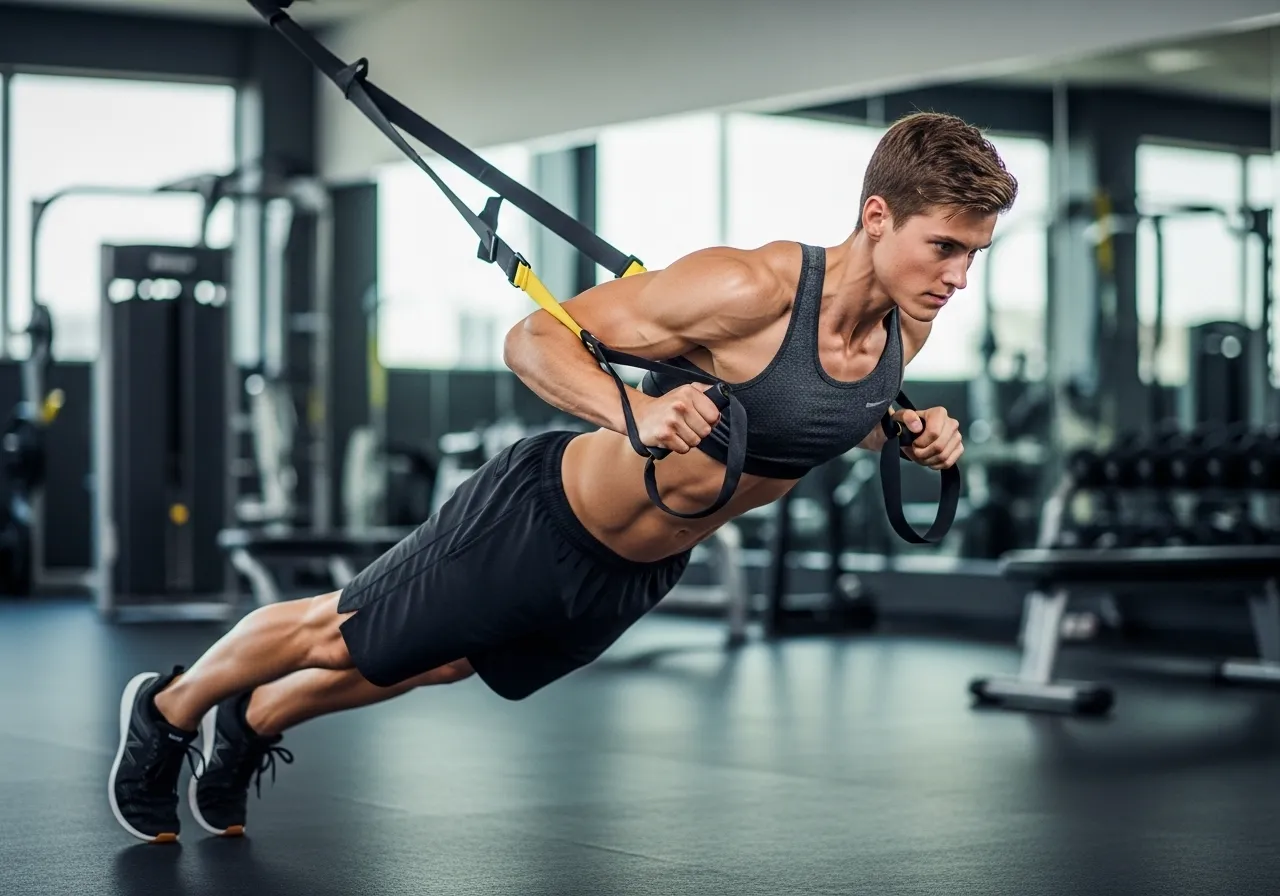
The TRX’s training effect derives from the instability of the suspended anchor point — your body weight provides the resistance, but the moving attachment point means every exercise requires constant balance and stabilization that fixed-anchor exercises don’t demand. During a TRX row, not only are the lats and biceps pulling your body toward the anchor, but the core, glutes, and shoulder stabilizers are working continuously to prevent lateral deviation, rotation, and hip sagging. Every TRX exercise is inherently compound and cannot fully isolate any single muscle because the system requires the entire body to function as a coordinated unit.
Research on Suspension Training
Research comparing muscle activation during TRX exercises and equivalent stable-surface exercises consistently finds 20-50% higher core activation during TRX versions — TRX push-ups versus floor push-ups, for example, produce significantly greater abdominal and lumbar stabilizer engagement. This doesn’t mean TRX exercises are categorically better than stable-surface exercises — for maximum loading, stability is an advantage. But for developing functional strength, stability under load, and core integration into movement, the TRX’s inherent instability is a genuine training feature. ACSM’s guidelines include neuromotor exercise — which suspension training primarily develops — as a recommended component of complete fitness for all adults.
Setting Up the TRX: Everything You Need to Know
Anchor Point Selection
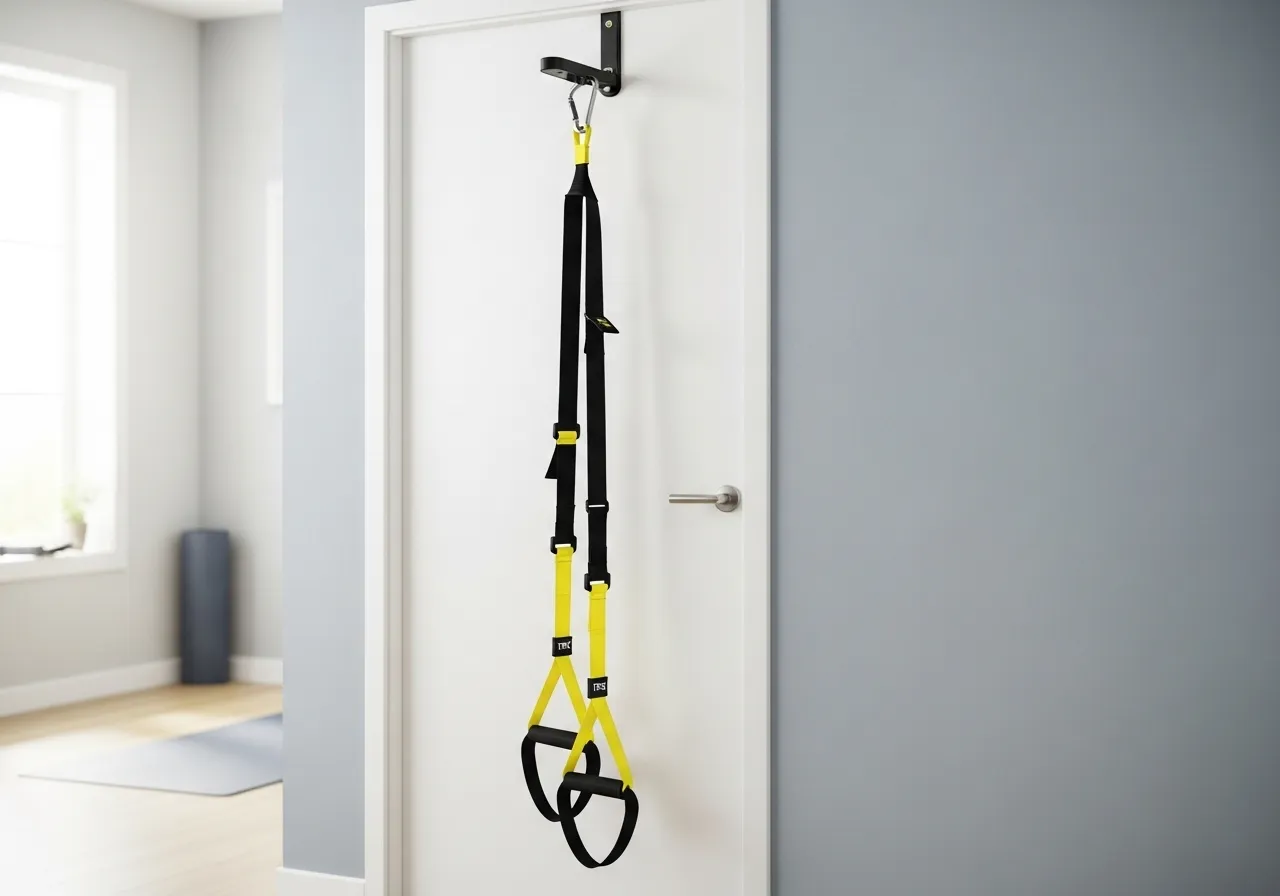
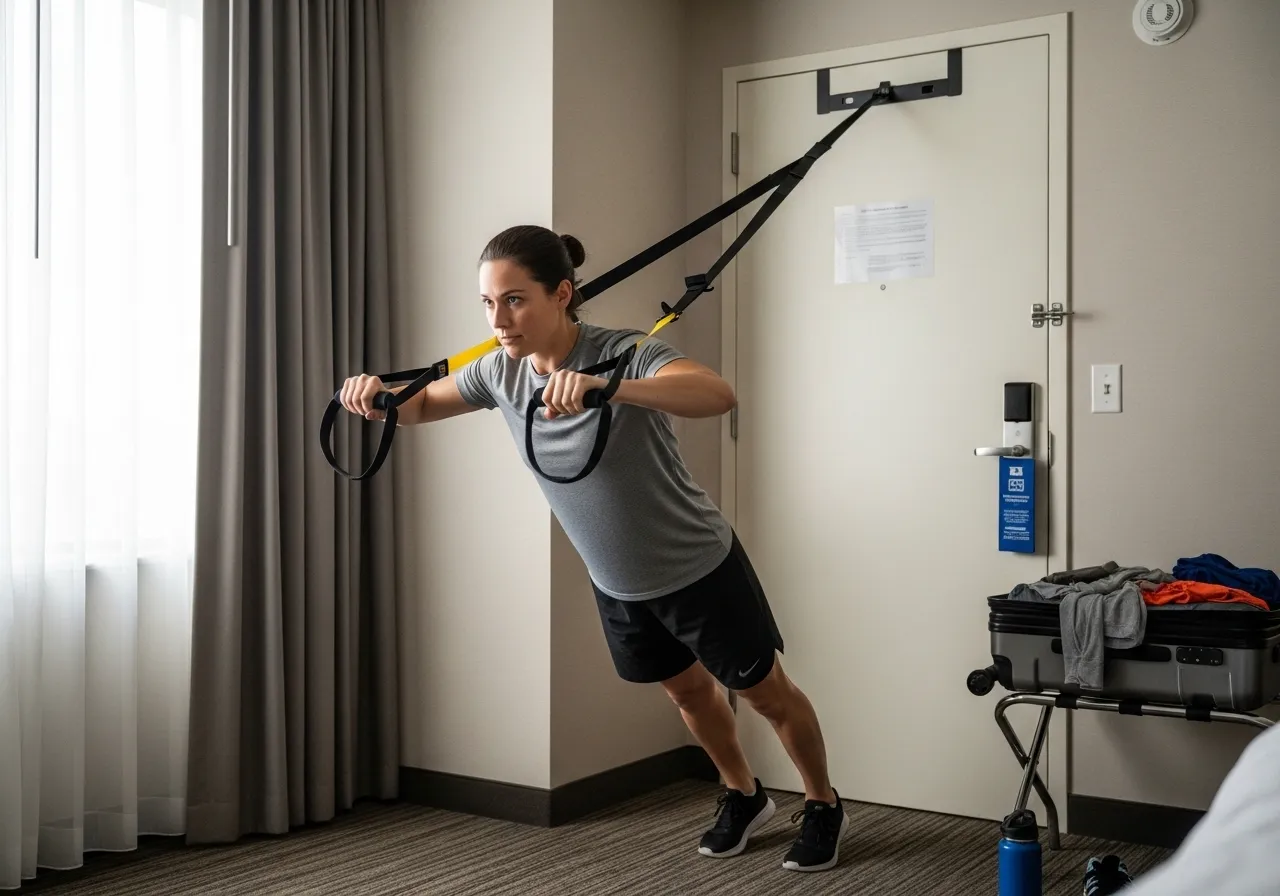
The TRX anchor must support your entire body weight plus the dynamic forces of exercise — significantly more than static body weight. Door anchors (the strap that goes over the door, which is then closed) work for most exercises on solid doors with reliable latches. Studs, ceiling hooks, and pull-up bars provide superior security for higher-intensity work. Never anchor to drywall alone, hollow core doors, or any structure that cannot hold 3-4× your body weight under dynamic loading. Test any anchor with gradual loading before applying full bodyweight.
Strap Length Adjustments
Strap length determines the angle of your body during exercises and therefore the difficulty. Shorter straps (body more vertical) are easier for rowing movements. Longer straps (body more horizontal) are harder for rows and easier for pushes. Adjust strap length so exercises feel challenging within your target rep range, and change length when exercises become too easy. The built-in difficulty adjustment means a single TRX can challenge beginners and experienced athletes in the same session by adjusting angle rather than changing weight.
Foot Position as Difficulty Modifier
For lower body TRX exercises, moving feet closer to the anchor increases difficulty. For upper body exercises, the body angle (more horizontal = harder) controls difficulty. This double adjustment mechanism — strap length and body position — gives the TRX more difficulty variability per exercise than most gym machines provide, making it genuinely scalable from complete beginner to advanced athlete.
The Essential TRX Exercise Library
TRX Row: Foundation of Upper Body Pulling
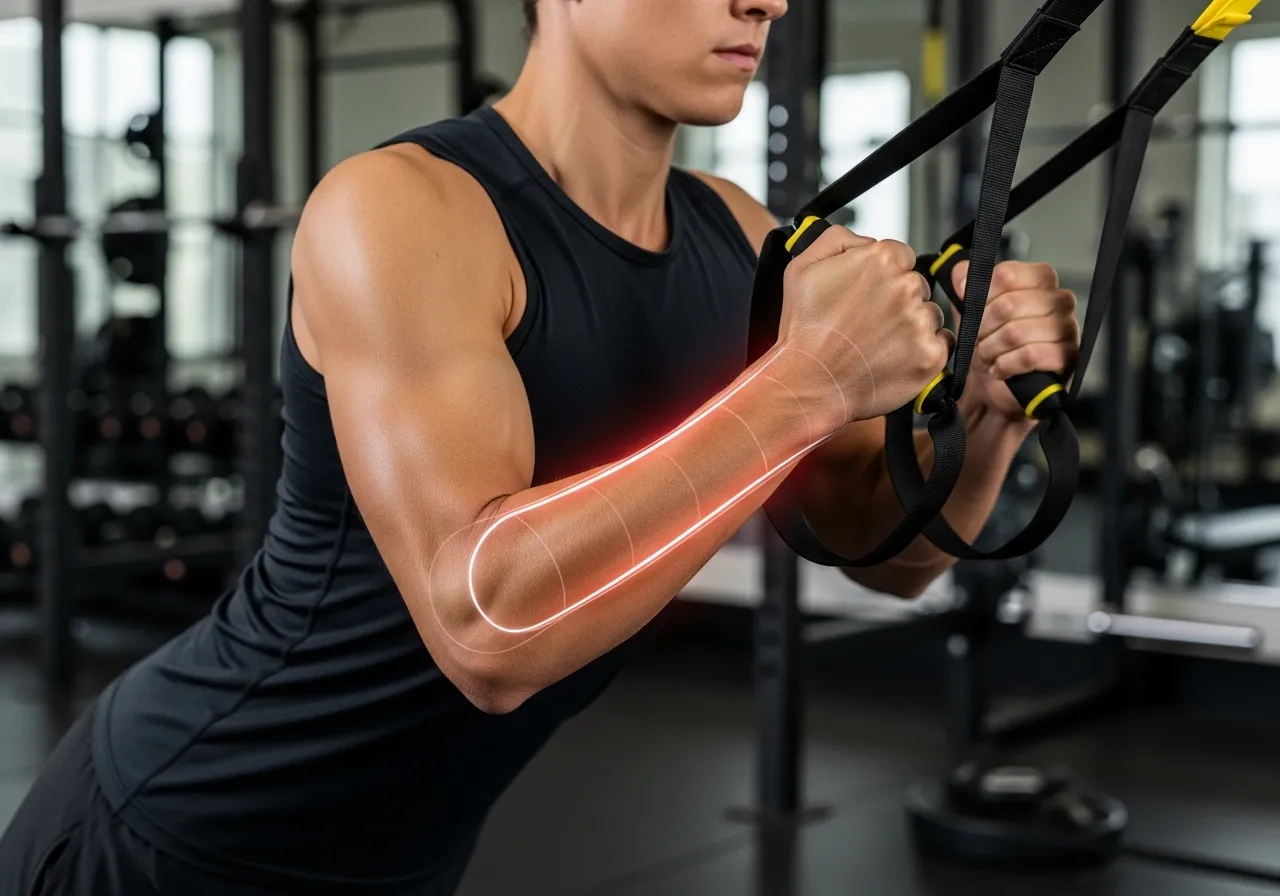
Face the anchor, lean back with arms extended holding the handles. Pull your chest toward the handles by retracting the shoulder blades and driving elbows back — think about pulling elbows toward your hip pockets to maximize lat activation. Maintain a plank position throughout — no sagging hips, no bent knees. Adjust angle from more vertical (easier) to more horizontal (harder). The TRX row is one of the most complete upper back exercises available because it simultaneously trains the lats, rhomboids, rear deltoids, and core in a movement that fully mimics the strength demands of real-world pulling.
TRX Push-Up: Chest, Shoulder, Tricep Training
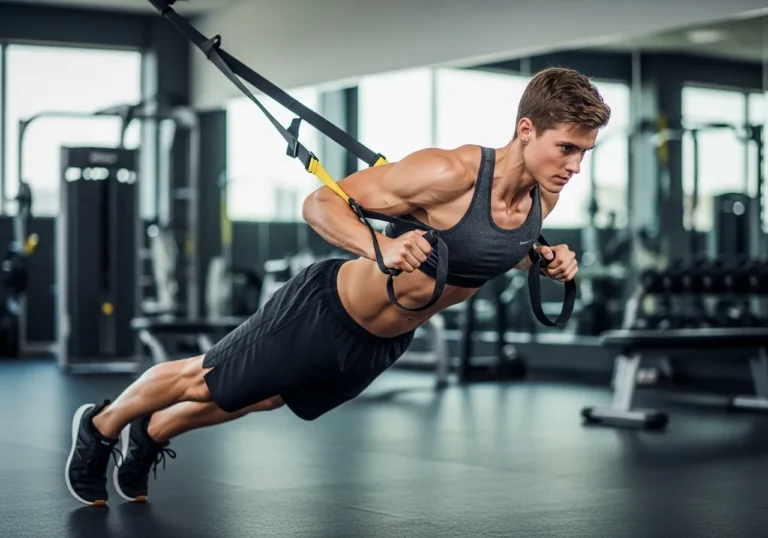
Face away from the anchor, hold the handles, lean forward into a push-up position with hands in the handles rather than on the floor. The suspended handles rotate freely — hands naturally supinate slightly during the push, producing a more shoulder-friendly pressing pattern than fixed-hand push-ups. Lower the chest between the handles, pause, then press back to start. TRX push-ups activate the core significantly more than floor push-ups due to handle instability. Progress by walking feet further back (more horizontal = more difficult).
TRX Body Saw: Premium Core Training
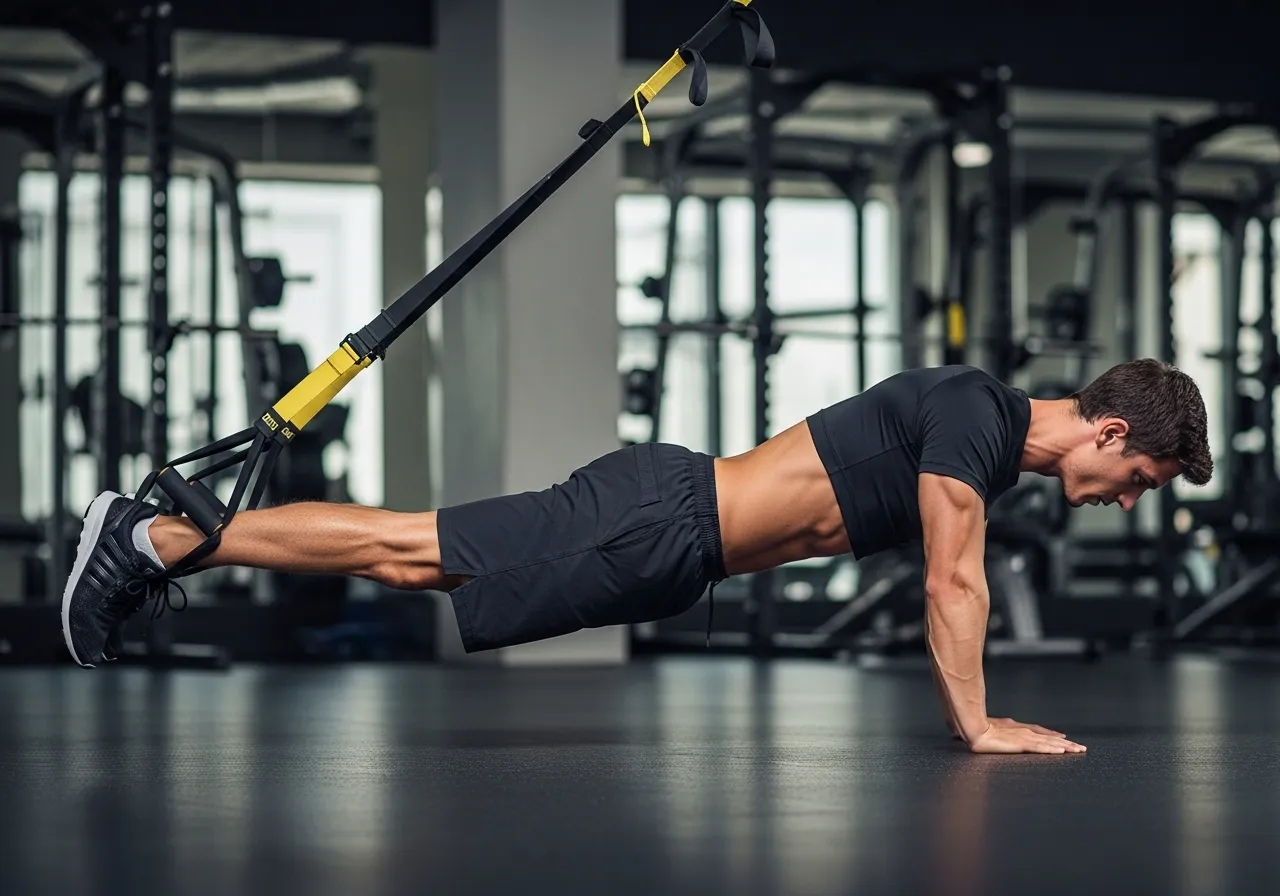
Place feet in the foot cradles, assume a plank position with forearms on the floor. From the TRX plank, push your body backward (away from the anchor) by pressing through the forearms, then return. This anti-extension core exercise is one of the most effective core stability exercises on the TRX — training the same anti-extension function as the ab wheel but with better shoulder positioning. Keep the hips level and core braced throughout; the body moves as a rigid plank, not by bending at the hips.
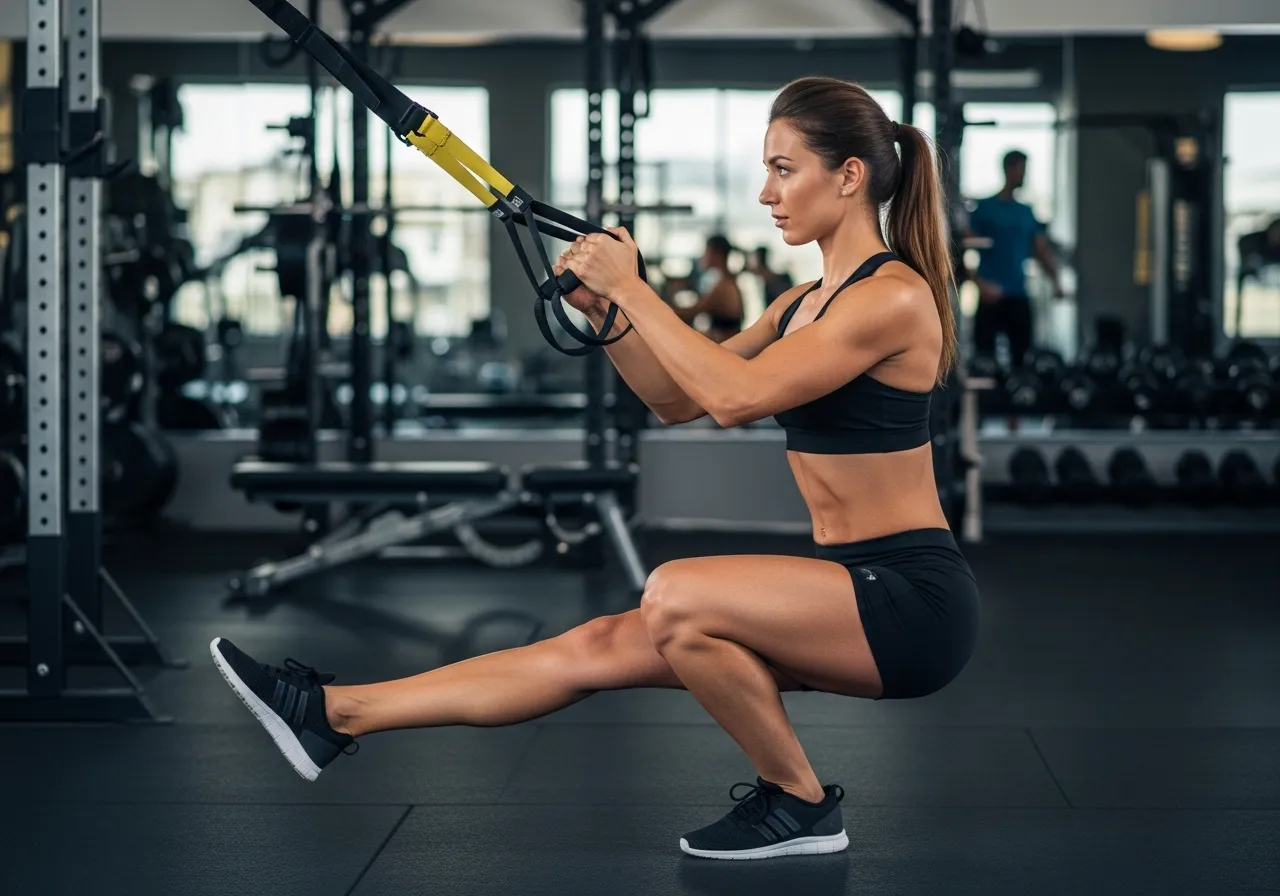
TRX Assisted Pistol Squat
The TRX-assisted pistol squat is the most effective leg exercise on the system — developing single-leg strength, balance, and hip mobility simultaneously. The TRX handles provide just enough support to maintain balance during the single-leg squat without removing the strength demand, making pistol squats accessible to people who cannot perform them unassisted. Begin with significant handle support, gradually reducing reliance as single-leg strength develops over weeks.
Building a Complete TRX Program
The 30-Minute Full-Body Session
Warm-up (5 minutes): TRX assisted deep squat holds (30 seconds × 3), TRX face pulls (10 reps × 2), TRX Y-W-T shoulder activation (8 reps × 2). Main session (20 minutes): TRX row (4×10), TRX push-up (4×10), TRX squat (3×12), TRX body saw (3×10), TRX reverse lunge (3×8 each side). Cool-down (5 minutes): TRX supported hip flexor stretch (30 seconds × 2 each side), TRX lat stretch (30 seconds × 2). This session covers all major movement patterns in 30 minutes appropriate for travel days or supplementary training.
Progressive Overload on the TRX
Progressive overload operates through body angle, tempo, and exercise complexity rather than added weight. Progression sequence: increase reps (8→12), increase difficulty by changing angle (more horizontal), add pause at peak contraction, add tempo manipulation (3 seconds down, 2 seconds up), advance to more challenging exercise variation (two-leg squat → split squat → assisted pistol squat). This framework provides months of advancement without additional equipment.
TRX as Gym Supplement
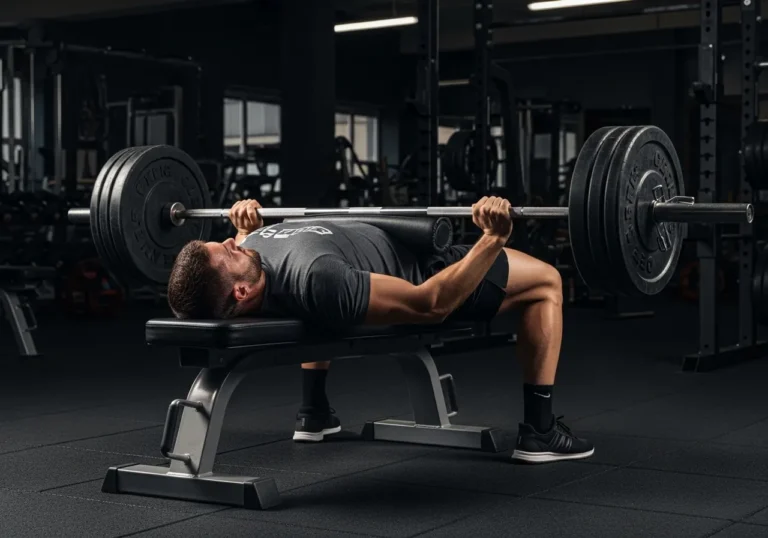
For athletes with full gym access, TRX works best as supplementary work: TRX rows after barbell rows for additional pulling volume with less spinal loading, TRX push-ups as shoulder warm-up before bench pressing to activate stabilizers, TRX single-leg exercises for balance and proprioceptive training that barbell work doesn’t address. This integration captures the TRX’s specific advantages alongside the barbell’s advantages in a comprehensive program.
TRX for Specific Populations and Frequently Asked Questions
TRX for Beginners
The TRX is an excellent starting point for beginners because the suspension provides immediate balance assistance for movement patterns they haven’t developed fully. A beginner TRX squat allows the trainee to lean into the handles for balance support while developing the hip and ankle mobility that free squatting requires. TRX rows can be performed at very gentle angles (nearly vertical) for individuals who cannot perform any pull-ups — providing upper body pulling training without requiring the bar strength a pull-up demands. The TRX essentially makes many advanced movements accessible to beginners through adjustable assistance.
TRX for Travel Fitness
The TRX’s portability (approximately 800 grams, fits in a small bag) makes it the most complete portable training tool available for travelers who need to maintain fitness without gym access. The door anchor works in virtually every hotel room. A 30-minute TRX session maintains strength, cardiovascular conditioning, and mobility during extended travel when gym training is impossible. Nothing else provides equivalent training completeness at its portability and simplicity — this is the TRX’s clearest and most distinctive advantage over all other training tools.
Can I build significant muscle with just TRX? TRX training produces muscular endurance and some hypertrophy, particularly in upper body muscles trained against substantial body weight resistance. Maximum muscle building requires progressive overload with external weights that TRX alone cannot provide indefinitely. TRX is most effective for hypertrophy when combined with some form of external loading.
Is the TRX worth the price? The genuine TRX system (~$150-200) provides quality and safety certifications for commercial use. For home use with travel, it represents a reasonable investment in the most versatile portable training tool available. Cheaper suspension trainers vary significantly in quality and safety ratings — for solo training where a failure would result in a fall, safety ratings matter.
Can I do TRX every day? TRX training at moderate intensity can be performed daily. The bodyweight loading and multi-muscle coordination exercises don’t accumulate the muscle damage that heavy barbell training does. High-intensity TRX sessions (very challenging angles, close to muscular failure) require 48 hours of recovery like any intense training.
How does TRX compare to gymnastics rings? Rings provide similar instability training but allow a wider range of gymnastic-specific movements (ring dips, muscle-ups, iron cross progressions). Rings are harder to adjust for difficulty than TRX and require more space. TRX is more accessible for general fitness; rings are better for gymnastic strength development specifically. Both develop similar stabilization and functional strength qualities.
What anchor do you recommend for home use? The TRX door anchor works reliably for most exercises on solid doors. For more permanent installation, ceiling hooks or wall-mounted anchors provide superior security and allow exercises the door anchor doesn’t accommodate. Install permanent anchors only into structural studs or ceiling joists — drywall anchors alone cannot safely support dynamic bodyweight loading.
Warning Fitness Disclaimer: The information in this article is for general educational purposes only and does not constitute professional fitness or medical advice. Always consult a qualified healthcare professional before starting any new exercise program. The Cardio Method That Changed Everything I Thought I Knew About Training For most of my training life, I believed…
⚠️ Fitness Disclaimer: The information in this article is for general educational purposes only and does not constitute professional fitness or medical advice. Always consult a qualified healthcare professional before starting any new exercise program, especially if you have existing injuries or medical conditions. The Posterior Chain Exercise Debate That Every Serious Lifter Faces I…
⚠️ Fitness Disclaimer: The information in this article is for general educational purposes only and does not constitute professional fitness or medical advice. Always consult a qualified healthcare professional before starting any new exercise program, especially if you have existing injuries or medical conditions. Why Two Straps Changed What I Thought Training Equipment Needed to…
Warning Fitness Disclaimer: The information in this article is for general educational purposes only and does not constitute professional fitness or medical advice. Always consult a qualified healthcare professional before starting any new exercise program, especially if you have existing injuries or medical conditions. The Most Versatile Piece of Equipment in the Gym That Most…
⚠️ Fitness Disclaimer: The information in this article is for general educational purposes only and does not constitute professional fitness or medical advice. Always consult a qualified healthcare professional before starting any new exercise program, especially if you have existing injuries or medical conditions. The Exercise That Changed How I Understood Glute Training For the…
⚠️ Fitness Disclaimer: The information in this article is for general educational purposes only and does not constitute professional fitness or medical advice. Always consult a qualified healthcare professional before starting any new exercise program, especially if you have existing injuries or medical conditions. The Debate That Every Gym Member Has an Opinion On Ask…