Why Your Bench Press Has Stalled: 7 Proven Fixes That Actually Work
The Bench Press Plateau Nobody Talks About Honestly
I hit 100kg on the bench press and then — nothing. For four months, I showed up, I pressed, I failed, I tried again. The weight that once moved smoothly now sat immovable on my chest like it had grown roots. I tried adding more sets, switching to dumbbells, even watching every technique video I could find. Nothing worked.
Then a powerlifting coach watched me press for exactly thirty seconds and identified three separate problems I had never considered. Within six weeks of fixing them, I pressed 107.5kg. The plateau wasn’t about effort. It was about understanding what had actually stopped working and why.
A bench press plateau isn’t a single problem with a single fix. Research published in Sports Medicine identifies that training plateaus occur when anabolic signaling pathways become progressively refractory to the same loading stimulus — meaning your body has simply adapted to exactly what you’re doing and stopped responding. Research on muscle growth plateaus confirms that the body’s adaptive ceiling requires deliberate variation to overcome, not simply more of the same training.
The seven fixes in this article address the seven most common plateau causes — and critically, they are specific enough to actually diagnose your situation rather than generic advice that sounds helpful but produces nothing.
How to Diagnose Which Fix You Need
Before applying any fix, identify where your bench press fails. A miss at the bottom indicates chest and anterior deltoid weakness at the stretched position. A miss at mid-range indicates a transition weakness between chest drive and tricep takeover. A miss near lockout indicates tricep weakness. Your failure point tells you which fix applies most directly to your situation.
Why Most Plateau Advice Fails
Generic plateau advice fails because it treats all plateaus as identical. A lifter stalling because of tricep weakness needs entirely different interventions than one stalling because of poor leg drive or suboptimal grip width. The specificity of the diagnosis determines the effectiveness of the fix. Everything that follows is organized around the actual cause rather than the symptom.
The Neurological Adaptation Phase: Why Beginners Progress and Intermediates Stall
The rapid strength gains beginners experience during their first six to twelve months of bench pressing occur primarily through neurological adaptation rather than muscle growth. The nervous system learns to recruit more motor units simultaneously, improves the synchronization of muscle firing patterns, and reduces inhibitory signals that limit maximum force production. This neurological learning happens quickly and produces dramatic strength increases with minimal muscle mass change — beginners often double their bench press while barely changing their physique. Once these neurological gains are largely exhausted, which happens somewhere between six months and two years of consistent training depending on the individual, strength progress becomes driven by actual muscle tissue growth and structural adaptations to the tendons and bones. This transition is why intermediate lifters feel like their progress has hit a wall — they have crossed from the neurologically-driven rapid gain phase into the slower biology-driven muscle growth phase. The fixes that break intermediate plateaus are therefore different from what helped beginners improve: they target the specific muscles and movement patterns that limit force production at the individual’s current neurological competency level.
Identifying Your Specific Bench Press Sticking Point
The location where your bench press fails reveals exactly which muscles need development. A press that fails at the chest — immediately off the start — indicates primary pectoralis major weakness or insufficient leg drive contribution. A press that fails at the midpoint — approximately halfway up — indicates anterior deltoid weakness or poor bar path that creates excessive horizontal movement. A press that fails near lockout — in the final third of the movement — indicates tricep weakness, specifically the long head and medial head that drive the final extension. Identifying your sticking point transforms plateau breaking from guesswork into targeted development: midpoint failures call for overhead pressing and front raises to develop the anterior deltoid; lockout failures call for close-grip bench pressing, board presses, and heavy tricep extensions. Many lifters spend months adding general bench press volume when their plateau would resolve in four to six weeks if they identified and specifically addressed the actual limiting muscle. According to research from NCBI on muscle activation during bench press, the triceps contribute approximately 37% of the total force during the bench press, making tricep weakness one of the most common limiting factors in intermediate plateau situations.
The Touch-and-Go vs Pause Press Debate for Plateau Breaking
Most recreational bench pressers use touch-and-go technique — allowing the bar to briefly contact the chest and immediately reversing direction without a full pause. This technique allows heavier loads because the elastic energy stored in the compressed chest muscles during the brief contact contributes to the concentric drive off the chest. Paused bench pressing — where the bar is held motionless on the chest for one to three seconds before the concentric drive — eliminates this elastic contribution and forces the pectoralis major and anterior deltoid to generate force from a dead stop at the weakest mechanical position. Four to six weeks of paused bench pressing consistently improves touch-and-go strength beyond what touch-and-go training alone produces, because the pause develops the specific bottom-position strength that determines how much weight can be driven through the sticking point. Competitive powerlifters use paused pressing exclusively in competition; incorporating it periodically in training produces strength improvements that carry directly into competition performance or general pressing strength goals.
Why Elbow Angle Matters More Than Most Lifters Realize
The angle between the upper arm and the torso during the bench press — the elbow flare angle — is one of the most consequential and least discussed technique variables. Flaring the elbows to ninety degrees (perpendicular to the torso) maximizes pectoralis major stretch and activation but places the shoulder in internal rotation at the most mechanically stressed position of the movement, compressing the subacromial space and increasing long-term injury risk. Tucking the elbows fully (parallel to the torso, pointing toward the feet) maximizes tricep contribution and protects the shoulder but reduces pectoralis activation to the point where the exercise barely trains the chest. The optimal elbow angle of forty-five to seventy-five degrees represents a biomechanical compromise that maximizes total force output by balancing the pectoralis major and tricep contributions while keeping the shoulder in a mechanically safe position. Most successful natural bench pressers land somewhere in this range intuitively, but lifters stuck at a plateau often benefit from deliberately examining and adjusting their elbow angle, as small changes of ten to fifteen degrees often produce immediate technique and strength improvements.
Filming your bench press from the side and checking your elbow angle at the bottom position takes less than two minutes and often reveals the specific adjustment that immediately unlocks stalled progress. Small technical details, consistently applied across thousands of reps, produce the cumulative technical refinement that separates lifters who progress for years from those who plateau indefinitely at the same weight.
Consistent attention to the fundamentals — proper elbow angle, scapular retraction, leg drive, and progressive loading — produces the cumulative bench press development that separates lifters who break plateaus from those who remain stuck indefinitely at the same weight.
Every detail of your bench press technique compounds across thousands of training sessions to produce either progress or stagnation — choose to train with intention.
Fix 1 and 2: Your Grip Width and Tricep Weakness Are Stealing Strength
The Grip Width Problem
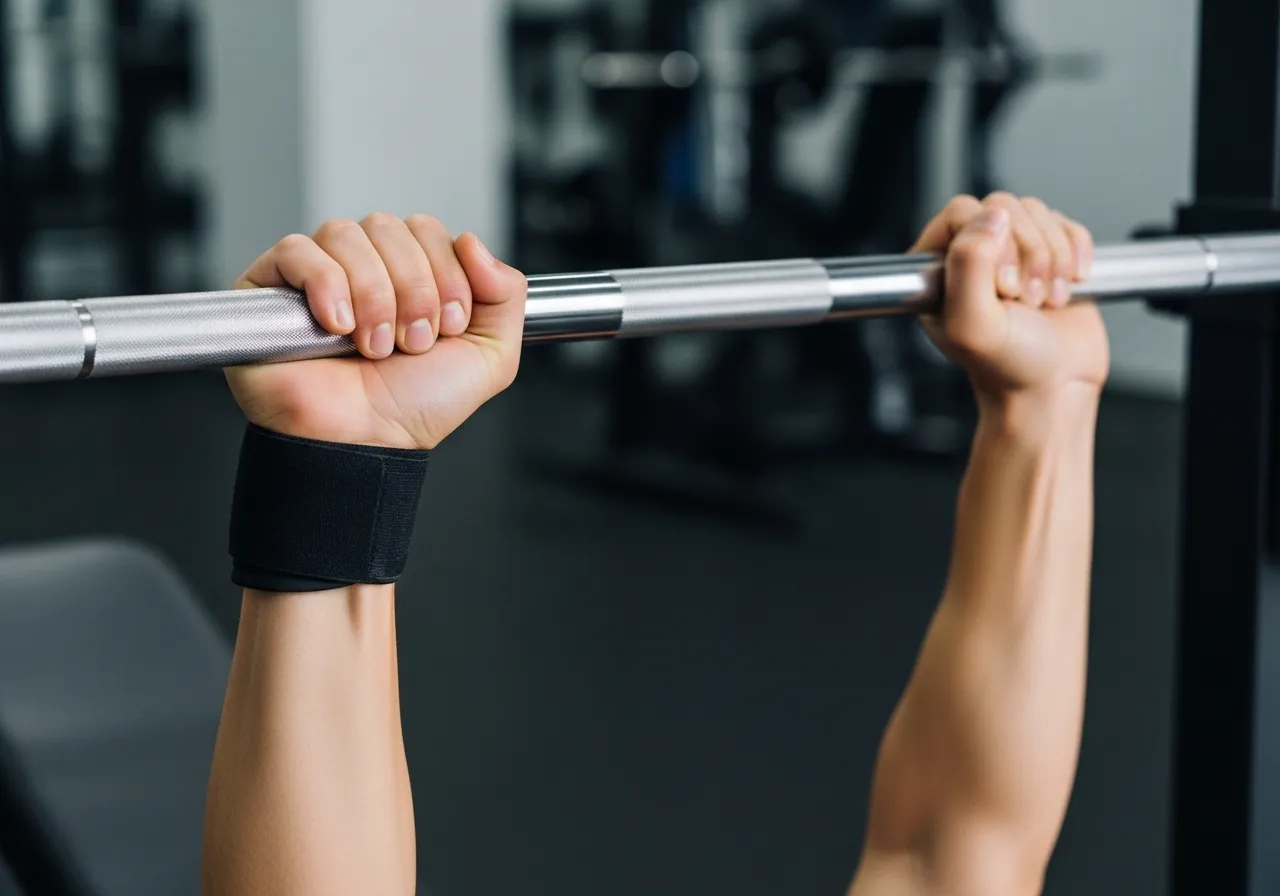
Grip width is the most commonly misunderstood technical variable in the bench press. Most recreational lifters use a grip that is either too narrow or inconsistent between sessions — and both kill progress without any obvious visible sign. A 2022 study in the Journal of Strength and Conditioning Research examined how grip width affects elbow and shoulder joint loads during the bench press. Research on bench press grip width and biomechanics found that narrower grips increase elbow joint loads and tricep activation, while wider grips increase shoulder joint loads and pectoral activation.
The practical test: at the bottom of the press, your forearms should be vertical or within five degrees of vertical when viewed from both the front and side. Forearms angling inward means your grip is too wide. Forearms angling outward means it is too narrow. Mark your grip position on your wrists or use the knurling rings as reference points, and place your hands identically every single rep. Athletes who standardize their grip often report immediate strength improvements without changing anything else.
The Tricep Weakness Fix
If your bench press fails in the top third — the final push to lockout — your triceps are the limiting factor, not your chest. The chest drives the bar off the chest. The triceps lock it out. A strong chest attached to undertrained triceps produces exactly the plateau profile most people experience: moving heavier weights off the chest but stalling before lockout. Add close-grip bench press as a primary secondary movement after your main bench work. Grip the bar with hands approximately shoulder-width apart and perform 3 sets of 5 to 8 reps at approximately 65 to 70 percent of your regular bench maximum. Most lifters who add this movement break their plateau within four to six weeks.
Action Point
Film yourself from the side during a warm-up set. Check forearm angle at the bottom position. If your forearms are not vertical, adjust grip width by half a finger width per session until they are. Add close-grip bench press for 3 sets of 6 after your main bench sets for the next four weeks.
Board Press and Partial Range Techniques for Lockout Development
The board press involves pressing a barbell to a wooden board placed on the chest rather than to the chest itself, reducing the range of motion and allowing heavier loads to be used specifically in the upper range. A two-board press (approximately five centimeters of board thickness) starts the concentric drive from the midpoint of the bench press; a three-board press starts near lockout. By working with weights exceeding the full-range maximum in the specific range where lockout strength is limiting, board pressing develops the tricep strength required to complete full-range attempts at maximum loads. Sets of three to five reps with board press loads ten to fifteen percent above full-range maximum, performed once weekly over a six-week specialization block, consistently produce full-range bench press improvements of five to ten percent in lifters whose plateau is located at or near lockout.
Arch Technique and Its Role in Bench Press Performance
The bench press arch — maintaining a natural curve in the lower spine rather than pressing with a flat back — reduces the range of motion by elevating the chest toward the bar, allows greater leg drive contribution by improving foot contact mechanics, and places the shoulder in a more mechanically favorable position by retracting the scapulae against the bench. Competitive powerlifters develop extreme arches that dramatically shorten the pressing range; recreational lifters benefit from a moderate natural arch that maintains lower spine curve without forcing an exaggerated position. The debate about whether arching is dangerous is largely settled in exercise science: the spinal position during a bench press arch is within normal physiological range and places no unusual stress on spinal structures. The controversy exists primarily among people unfamiliar with the biomechanics, not among researchers who have studied pressing mechanics. Learning to maintain a stable natural arch with retracted scapulae improves bench press performance and shoulder health simultaneously — it is not a competition trick but a sound biomechanical principle for all pressers.
Managing Bench Press Shoulder Pain: The Training-Through Protocol
Shoulder discomfort during bench pressing is nearly universal among intermediate and advanced lifters and ranges from minor anterior shoulder aching to significant rotator cuff stress. The most common cause is subacromial impingement from internal rotation of the humerus during the eccentric phase. The solution is rarely to stop bench pressing but to modify technique and add targeted shoulder health work. Technique modifications: ensure the elbows are at 45-75 degrees rather than flared to 90 degrees, which keeps the humerus in a safer position throughout the movement; retract the scapulae and maintain this retraction through the entire set. Supplementary work: add three sets of face pulls and three sets of band pull-aparts before each bench press session. These external rotation exercises directly counterbalance the internal rotation demand of pressing and address the muscle weakness that creates impingement risk. Most bench press shoulder pain resolves within four to six weeks of technique correction and consistent supplementary external rotation work, without requiring training interruption.
How to Test Your True One-Rep Maximum Safely
Testing a true bench press one-rep maximum is a meaningful training milestone that reveals actual strength and provides accurate percentage-based programming targets. Done correctly, it is also safe and produces no greater injury risk than regular heavy training. The protocol: perform the standard warm-up sequence, then work up to approximately 90% of your estimated maximum for one rep, rest five minutes, add five kilograms and attempt the maximum, rest five more minutes if successful and attempt five more kilograms for a new maximum. Stop at the first failed attempt — attempting the same weight again immediately after failure is dangerous and unnecessary. Always test in a rack with safeties set at chest height, never without spotting protection. Test your maximum no more than once every six to eight weeks — more frequent testing accumulates fatigue without providing additional useful data and can psychologically undermine confidence if tested during a fatigued state that produces a below-true-maximum performance. The testing day should follow at least two days of rest from upper body pressing, with good sleep the preceding two nights, and adequate carbohydrate intake in the meals before testing.
Fix 3 and 4: Leg Drive and Rep Range Variation
You Are Leaving 10 to 15 Percent on the Bar With No Leg Drive
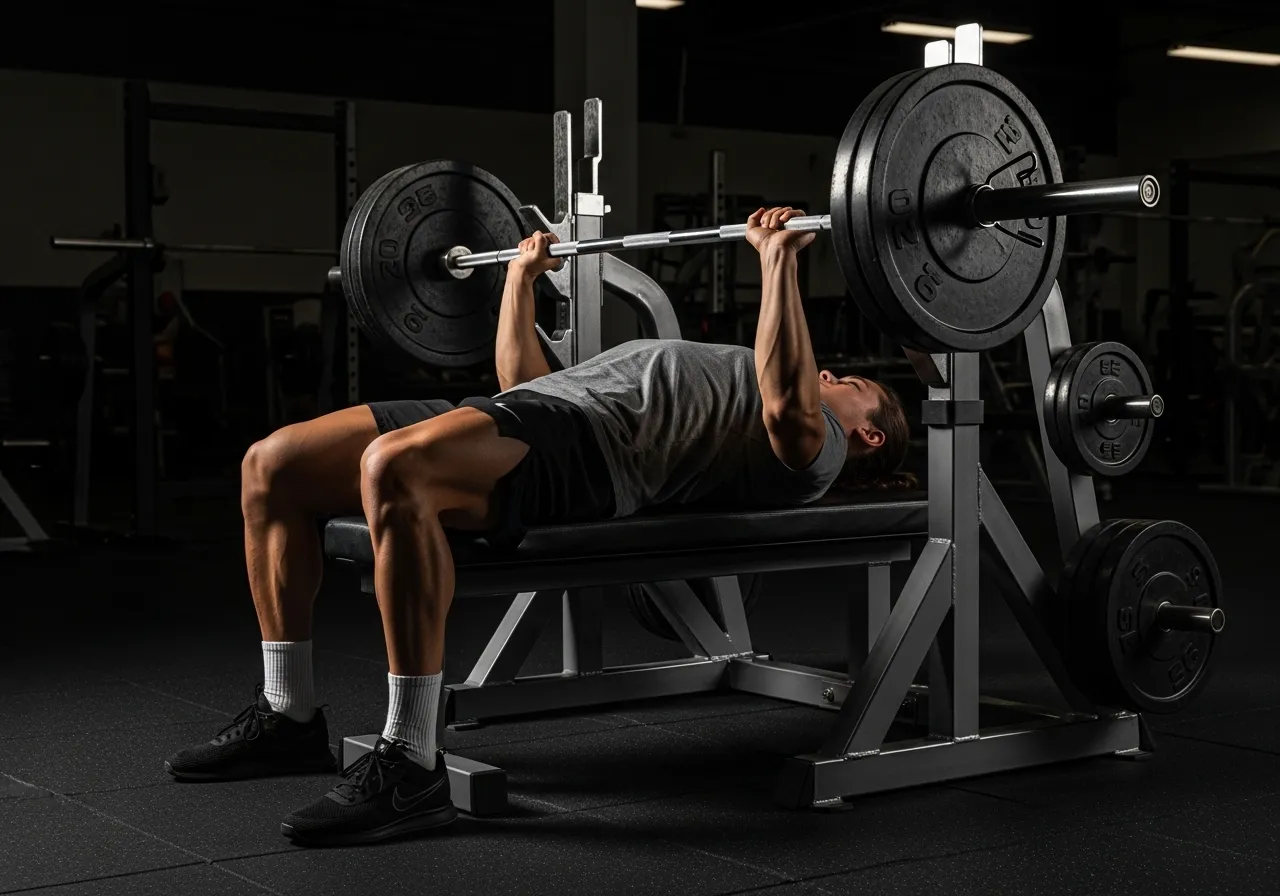
Effective leg drive creates full-body tension that transfers force from the floor through the body to the bar. Feet drive into the floor, activating the glutes and lower body, which stabilizes the torso against the bench, which creates a more rigid pressing platform. Studies on bench press performance consistently show that full-body tension produces higher maximum force outputs than isolated upper body pressing. Most lifters who add leg drive correctly report immediately pressing 5 to 10 percent more weight on the first session they apply it. NSCA bench press technique standards include full-body tension as a fundamental component of safe and effective pressing mechanics for all levels.
Set your feet flat on the floor before unracking, drive them into the floor and feel the tension travel up through your glutes into your lower back. Maintain this tension throughout the entire set — it should feel like you are trying to leg press the floor away from you while simultaneously pressing the bar. If your hips are rising off the bench you are applying the drive incorrectly — the tension should stabilize the body, not lift it.
You Are Training in the Same Rep Range Every Session
The most common bench press program structure for plateaued lifters is identical: 3 to 4 sets of 8 to 10 reps, same weight, every session, week after week. Research on bench press adaptations demonstrates that the body adapts specifically to the stimulus applied. A 2022 study in the Journal of Strength and Conditioning Research found that full range bench press produced significantly greater neuromuscular adaptations than partial execution after prolonged training, highlighting that variation matters for continued progress. Daily undulating periodization (DUP) rotates rep ranges across training sessions: Session A — 4 sets of 5 reps at 82 to 87 percent (heavy strength). Session B — 4 sets of 8 reps at 72 to 77 percent (hypertrophy). Session C — 3 sets of 12 to 15 reps at 60 to 65 percent (volume). Lifters who switch from single-rep-range training to DUP typically report new strength records within six to eight weeks.
Action Point
On your next warm-up set actively drive your feet into the floor before and during every rep. Separately, introduce at least one heavy session of 4 to 5 reps and one lighter session of 12 to 15 reps per week alongside your normal training for the next four weeks.
The Role of Spotter Communication in Maximum Bench Press Performance
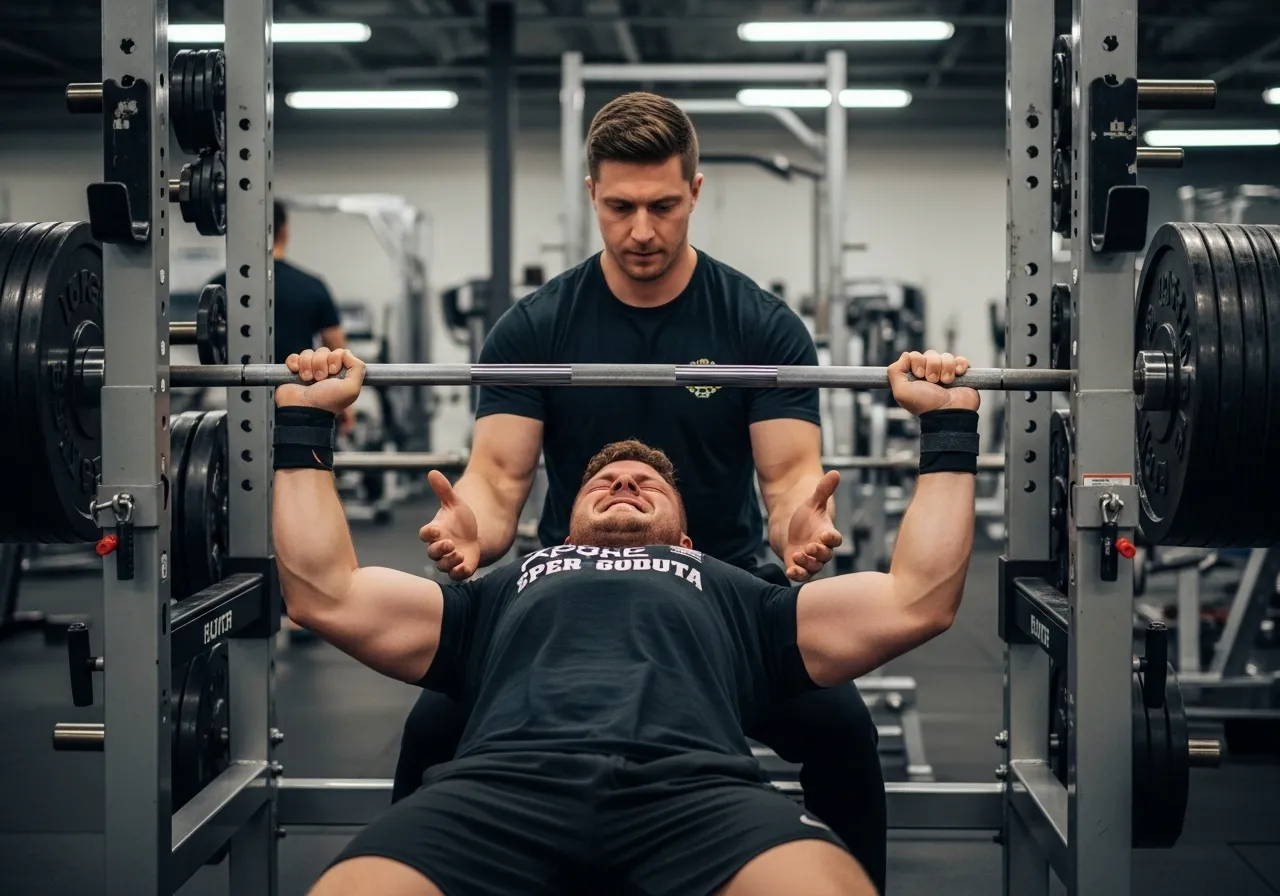
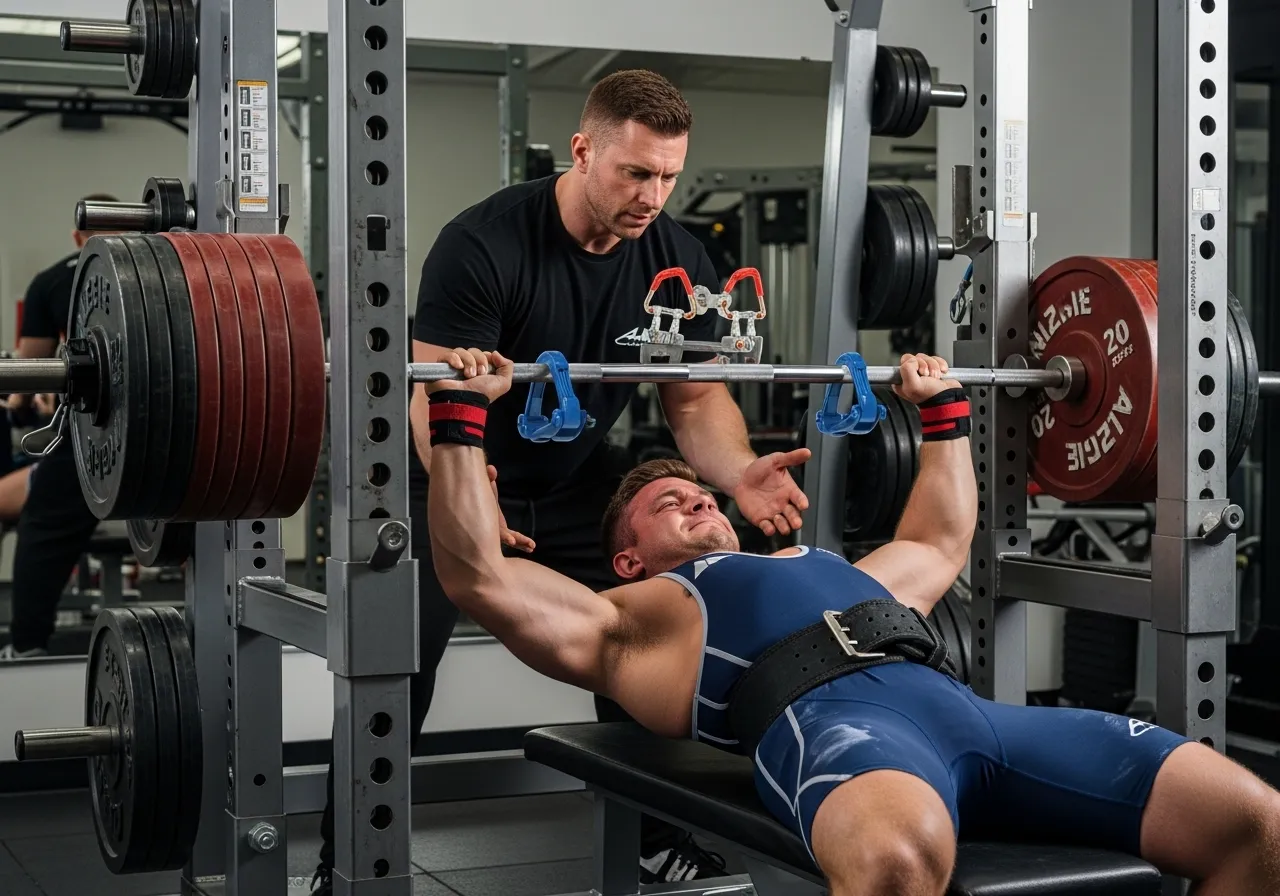
A skilled spotter contributes meaningfully to bench press performance beyond the obvious safety function. Clear communication before the set — specifically agreeing on whether the spotter will provide a lift-off and exactly how many reps are planned — eliminates the cognitive load of uncertainty that reduces performance on heavy sets. The best spotters provide verbal encouragement during the set without physically touching the bar unless the lifter clearly cannot complete the rep, because any physical contact from the spotter immediately changes the psychological dynamic and can ruin an otherwise completable rep by reducing the lifter’s sense of independent effort. Learning to request and receive ideal spotting is a trainable skill that improves heavy set performance, particularly in the psychological dimension of willingness to commit to genuinely maximum effort attempts.
Bench Press and Shoulder Blade Positioning: The Foundation of All Pressing Strength
The position of the scapulae during the bench press determines not only the mechanical efficiency of the pressing muscles but also the safety of the shoulder joint throughout the movement. Retracted and depressed scapulae — squeezed together and pulled down, away from the ears — create a stable platform against the bench that prevents the humerus from internally rotating into impingement territory and allows the pectoralis major to develop full tension across its attachment range. Many intermediate lifters who feel their bench press is primarily driven by their shoulders rather than their chest are experiencing this as a direct consequence of inadequate scapular retraction — the pectoralis major cannot generate its maximum force contribution when the shoulder blade is protracted forward rather than retracted back. Practicing the scapular set position with an empty bar before loading, and actively cuing scapular retraction at the start of each working set, immediately shifts the feeling of the press from shoulder-dominant to chest-dominant for most lifters and directly addresses one of the most common contributors to bench press plateaus.
Bench Press Warm-Up Protocols That Actually Prepare You for Maximum Effort
The warm-up to a heavy bench press session is not merely time filling — it determines the quality of every working set that follows. An effective bench press warm-up activates the specific muscles used in pressing, raises the temperature of the shoulder and elbow joints, and prepares the nervous system for maximum effort without creating fatigue. An evidence-based warm-up sequence: two minutes of light cardiovascular activity to raise body temperature; ten reps of band pull-aparts and ten reps of face pulls to activate the posterior shoulder and external rotators; ten reps of scapular push-ups to activate the serratus anterior; empty bar bench press two sets of eight with deliberate technique focus; then pyramid up to working weight: 50% for eight reps, 65% for five reps, 75% for three reps, 85% for one rep, then begin working sets. This fifteen-minute investment produces significantly better performance on working sets compared to jumping directly from cold to working weight. ACSM warm-up guidelines support this structured approach for all resistance training involving maximal or near-maximal loads.
Implementing a Six-Week Bench Press Specialization Block
A specialization block temporarily increases bench press training frequency, volume, and intensity focus above normal levels for a defined period, producing accelerated strength gains that establish a new baseline before returning to standard programming. A six-week bench press specialization block structure: session one (Monday), heavy strength work — five sets of three at 85-90%, followed by three sets of close-grip bench press at 70%, followed by three sets of face pulls; session two (Thursday), volume work — four sets of eight at 72-75%, followed by three sets of incline dumbbell press at moderate load, followed by three sets of tricep cable pushdowns. Deload in week six by reducing all loads by 20% and volume by 40%. After the deload, test a new five-rep maximum. Most intermediate lifters complete a specialization block to find their bench press has improved five to ten percent over six weeks, which represents months of progress compressed into a focused development phase. After the specialization block, return to normal programming at the new higher baseline and allow other muscle groups to receive proportional attention before the next specialization phase.
Addressing Bilateral Asymmetry in the Bench Press
Many lifters develop a left-right strength imbalance in the bench press — one side of the chest, shoulder, or tricep is stronger than the other, causing the bar to drift toward the weaker side during heavy presses. This asymmetry is extremely common and often goes unnoticed until loads become heavy enough to make the drift visible. Identifying asymmetry requires video from directly above or from the foot end of the bench, showing whether the bar travels perfectly vertically or drifts horizontally during the press. Once identified, asymmetry can be addressed by adding unilateral dumbbell pressing to the program — three sets of eight to ten per side, deliberately working the weaker side with equal or greater focus than the stronger side. Over eight to twelve weeks, the bilateral dumbbell press typically normalizes the strength difference and eliminates the drift in the barbell press. Failing to address bilateral asymmetry allows it to worsen with heavier training loads and eventually produces the rotator cuff and shoulder joint issues that accompany chronic asymmetrical loading patterns.
Fix 5 and 6: Technical Inefficiencies and Accumulated Fatigue
Your Arch, Scapular Position, and Bar Path Are Wrong
Three technical elements cause the majority of technique-related plateaus: insufficient scapular retraction, inconsistent bar path, and poor arch position. Before every bench press rep, the shoulder blades should be retracted — pulled together — and depressed — pulled down and away from the ears. This creates a stable platform for the shoulders and reduces the distance the bar must travel by bringing the chest higher. Lifters who press with unretracted loose shoulder blades are pressing from an unstable base, and instability directly reduces force output.
A common misconception is that the bar should travel in a perfectly vertical line. Optimal bench press bar path actually follows a slight diagonal: the bar lowers to the lower chest at approximately nipple line and presses back up and slightly toward the face to lockout over the shoulders. This diagonal path keeps the bar over the body’s center of mass throughout the movement and maximizes the mechanical efficiency of both the chest drive and the tricep lockout.
Accumulated Fatigue Is Masking Your Actual Fitness
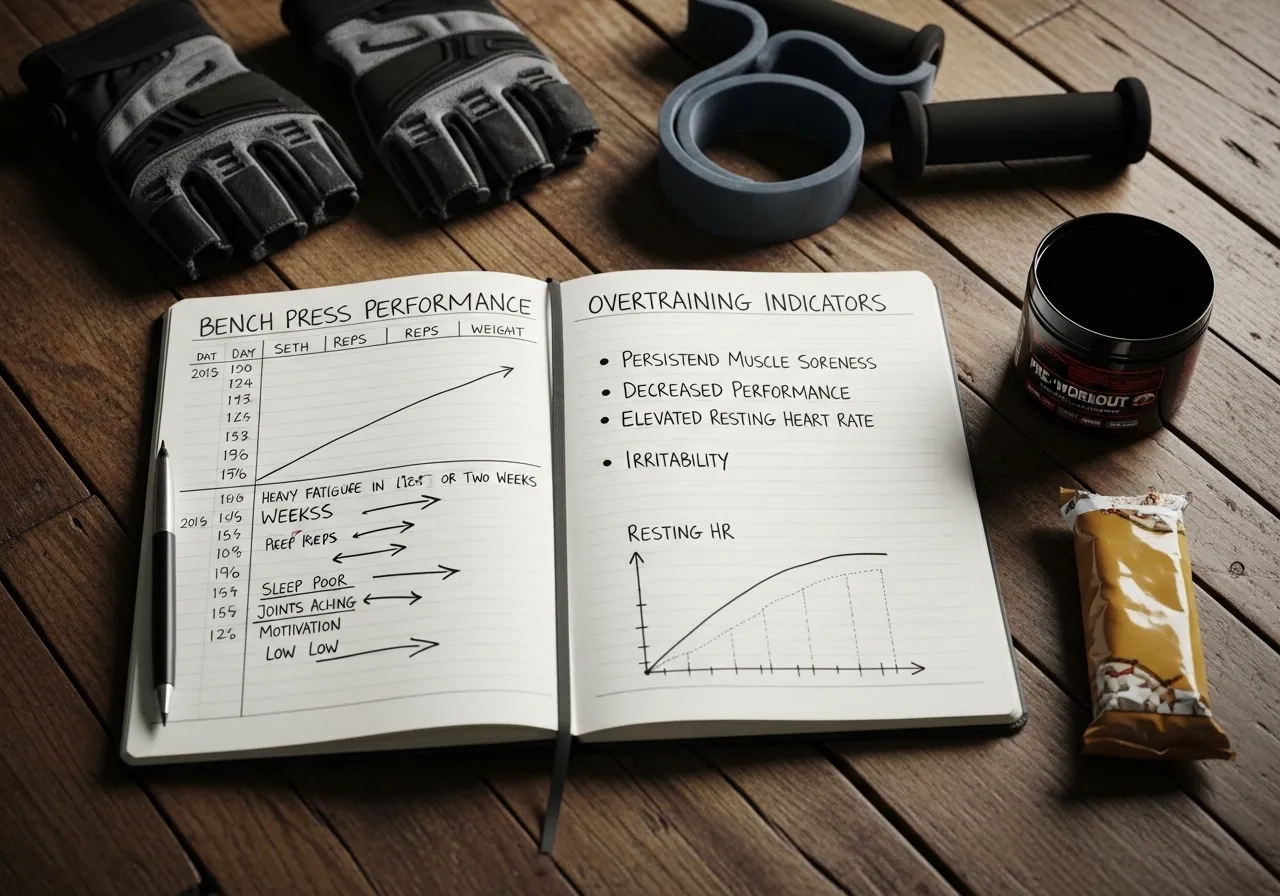
Sometimes a bench press plateau is not a strength deficit at all — it is accumulated fatigue masking the fitness that actually exists. If you have been training consistently for more than six weeks without a reduction in volume or intensity, the fatigue you have accumulated is almost certainly suppressing your performance below your true current capability. A productive deload: reduce training volume by 40 to 50 percent for one week while maintaining intensity. Most lifters return from a proper deload and immediately press more weight than they did before — confirming that the plateau was fatigue-based rather than a genuine strength ceiling.
Action Point
Before your next heavy set, spend 60 seconds actively retracting and depressing your shoulder blades on the bench before unracking. Count the weeks since your last intentional training reduction. If it has been more than six weeks, take a deload week before concluding you need to change your program.
Nutrition Timing for Bench Press Performance
Pre-training nutrition directly affects bench press performance through glycogen availability and neuromuscular function. Training sessions performed in significant carbohydrate deficit — such as first thing in the morning after overnight fasting, or after a very low carbohydrate meal — produce measurably lower strength output than sessions with adequate carbohydrate availability. For maximum bench press performance, consuming 30-60 grams of carbohydrate two to three hours before training, or 20-30 grams of easily digestible carbohydrate sixty to ninety minutes before training, ensures glycogen stores are sufficient for high-intensity pressing work. Creatine monohydrate supplementation at three to five grams daily is the single most evidence-supported performance supplement for strength training, with dozens of controlled studies demonstrating five to fifteen percent improvements in maximum strength performance across multiple pressing exercises. Unlike most supplements marketed to strength athletes, creatine’s mechanism of action is well understood — it increases phosphocreatine availability for ATP regeneration during maximal effort contractions — and its safety profile over decades of research is excellent. According to NCBI research on creatine supplementation, creatine consistently improves maximal strength by five to fifteen percent across upper and lower body exercises in resistance-trained athletes.
Sleep and Recovery Between Bench Press Sessions
The bench press improvements that training sessions stimulate are built during recovery — specifically during the deep sleep stages where growth hormone secretion peaks and muscle protein synthesis rates are highest. Consistently sleeping fewer than seven hours per night measurably reduces strength gains from bench press training, independent of training volume, nutrition, and other variables. Athletes sleeping six hours versus eight hours per night show approximately thirty percent slower strength development over twelve-week training periods in controlled studies, a massive difference that dwarfs the effect of most training optimizations. The practical implication: if your bench press is stuck and you are sleeping six hours per night, fixing your sleep will likely do more for your pressing progress than any technique fix or programming change. Recovery between sessions matters too — the minimum recovery period between heavy bench press sessions is forty-eight hours, and seventy-two hours is often better for intermediate and advanced lifters whose sessions are sufficiently intense to create significant muscle damage requiring time to repair.
The Close-Grip Bench Press as a Primary Plateau Tool
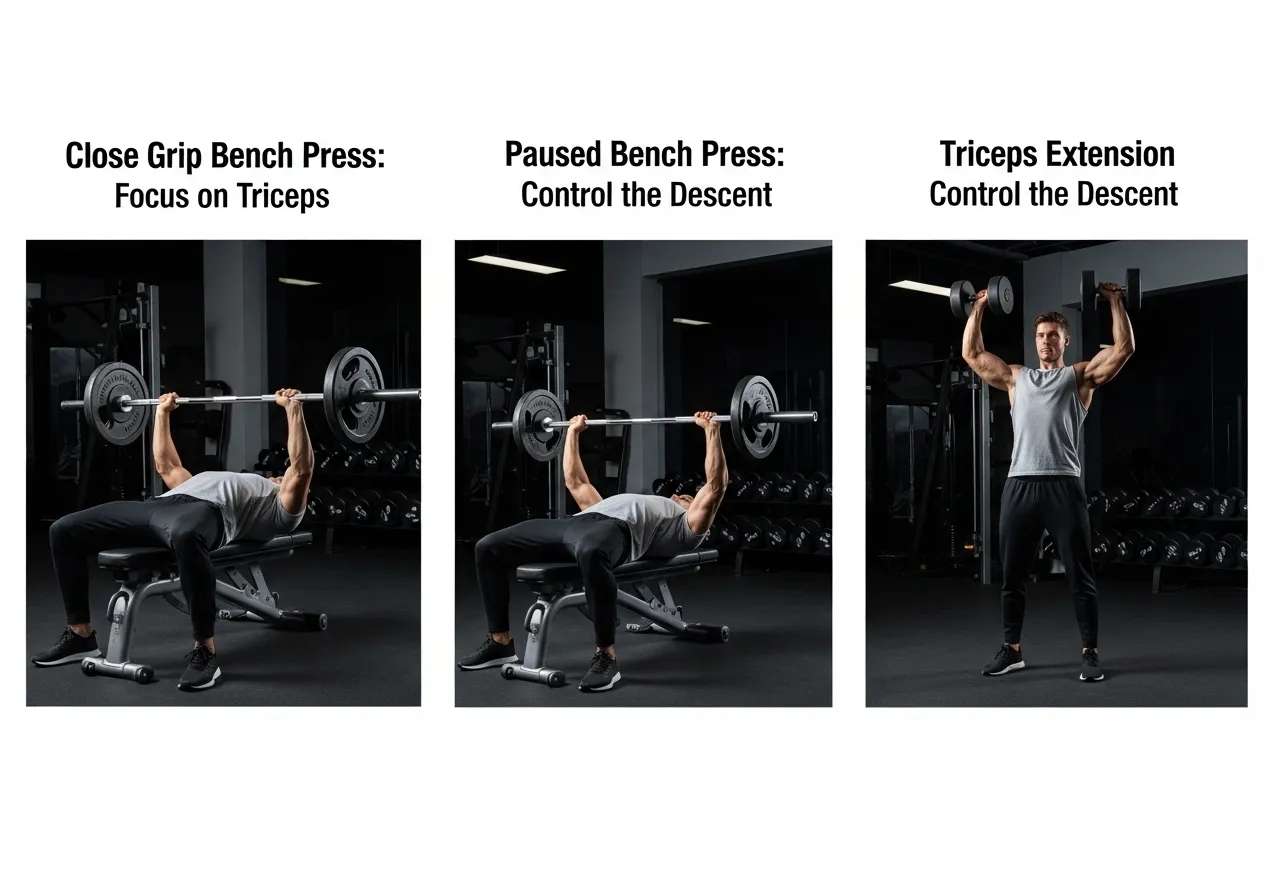
The close-grip bench press — performed with hands positioned approximately shoulder-width apart rather than the wider grip used in standard pressing — shifts the primary loading emphasis from the pectoralis major toward the triceps and anterior deltoid. For lifters whose bench press fails near lockout due to tricep weakness, the close-grip variation is the single most effective plateau tool available. Programming close-grip bench press as the secondary pressing exercise on the same day as regular bench press (after regular bench press working sets are complete) allows both movements to benefit from the same warm-up and activation while targeting the specific weakness with sufficient volume and intensity. A practical close-grip protocol: after completing regular bench press working sets, perform three sets of five to eight reps with close-grip at approximately 70-75% of regular bench press maximum. The lighter relative load is appropriate because the reduced mechanical advantage of the close grip means less absolute weight is moved despite similar muscular effort. Over eight to twelve weeks of this supplementary close-grip pressing, lifters with tricep-limited bench presses typically see their lockout strength improve sufficiently to break through the previous plateau at regular grip width. This is one of the most time-tested plateau solutions in powerlifting history, used by virtually every successful intermediate and advanced bench presser at some point in their development.
Competition Bench Press vs Training Bench Press: Understanding the Difference
Even if you never compete in powerlifting, understanding competition bench press standards illuminates important technique elements that improve training performance. Competition requires a complete pause at the chest before the press command, a controlled descent that demonstrates intentional rather than dropped bar movement, and a finish with locked elbows and the bar returned to the uprights under control. Training with competition-legal technique — even without competitive intentions — develops the complete movement pattern that includes the deliberate pause and controlled descent that most recreational training skips. The paused technique builds the specific bottom-position strength that is often the limiting factor in maximum attempts, even for non-competitors, because the habit of touch-and-go reduces practice at the hardest part of the movement. Incorporating one session per month of competition-standard paused pressing, even at reduced loads, develops the complete bench press movement pattern and often reveals technique issues invisible in touch-and-go training.
Fix 7: Your Accessory Work Does Not Match Your Weakness
Most plateaued lifters perform the same accessory exercises regardless of where their bench press actually fails. This scattergun approach to assistance work develops muscles generally but never addresses the specific weakness causing the plateau. Targeted accessory selection based on failure point is the seventh and final fix — and it synthesizes everything that comes before it.
Bottom Position Weakness: What to Train
If the bar won’t leave the chest, the chest and anterior deltoid at their most stretched position are limiting you. Exercises that load these muscles in the stretched position: dumbbell flyes with a full stretch at the bottom, incline dumbbell press (30 degrees produces maximum upper pec activation according to EMG research), and cable crossovers from a low pulley position. These exercises specifically develop the stretched-position strength that the flat barbell bench press can’t adequately train at very heavy loads because the range of motion is mechanically limited.
Mid-Range Weakness: What to Train
If the bar stalls two to four inches off the chest, the transition from chest-dominant to tricep-dominant pressing is your weakness. Board presses (pressing to a board placed on the chest that reduces range of motion to the sticking point) and pin presses from the mid-range position train this exact transition. Setting a barbell in a squat rack with pins at the sticking point height and pressing from a dead stop eliminates stretch-shortening cycle assistance and forces the muscles to generate force from scratch at the hardest position.
Lockout Weakness: What to Train
If the bar slows in the final third, close-grip bench press (as described in Fix 2), overhead tricep extensions with a barbell or EZ bar, and skull crushers all develop the lockout strength that flat pressing cannot specifically target. The overhead position in extensions places the tricep’s long head in a stretched position that flat press movements don’t reach, developing the complete tricep strength that lockout demands.
Building Your Weakness-Specific Program
Identify your primary failure point. Select one exercise from the corresponding category above. Add it as the first accessory exercise after your main bench press work for four weeks, performing 3 sets of 8 to 12 reps. After four weeks, reassess whether the plateau has resolved. If it has, maintain the exercise. If not, check whether a secondary weakness has become the new limiting factor and address it with a second targeted accessory. ACSM resistance training guidelines support systematic weakness identification and targeted accessory programming as evidence-based approaches to overcoming training plateaus in intermediate and advanced athletes.
Advanced Bench Press Programming and Periodization
If you have been stuck at the same bench press weight for more than four weeks, the problem almost certainly lies in your programming structure rather than your effort or technique. Most lifters train their bench press the same way every session — same sets, same reps, same intensity — and then wonder why the bar refuses to move. The human body adapts to specific stress and then plateaus. Breaking through requires understanding how to systematically vary the demands placed on the pressing muscles across weeks and months.
Linear Periodization for Intermediate Lifters
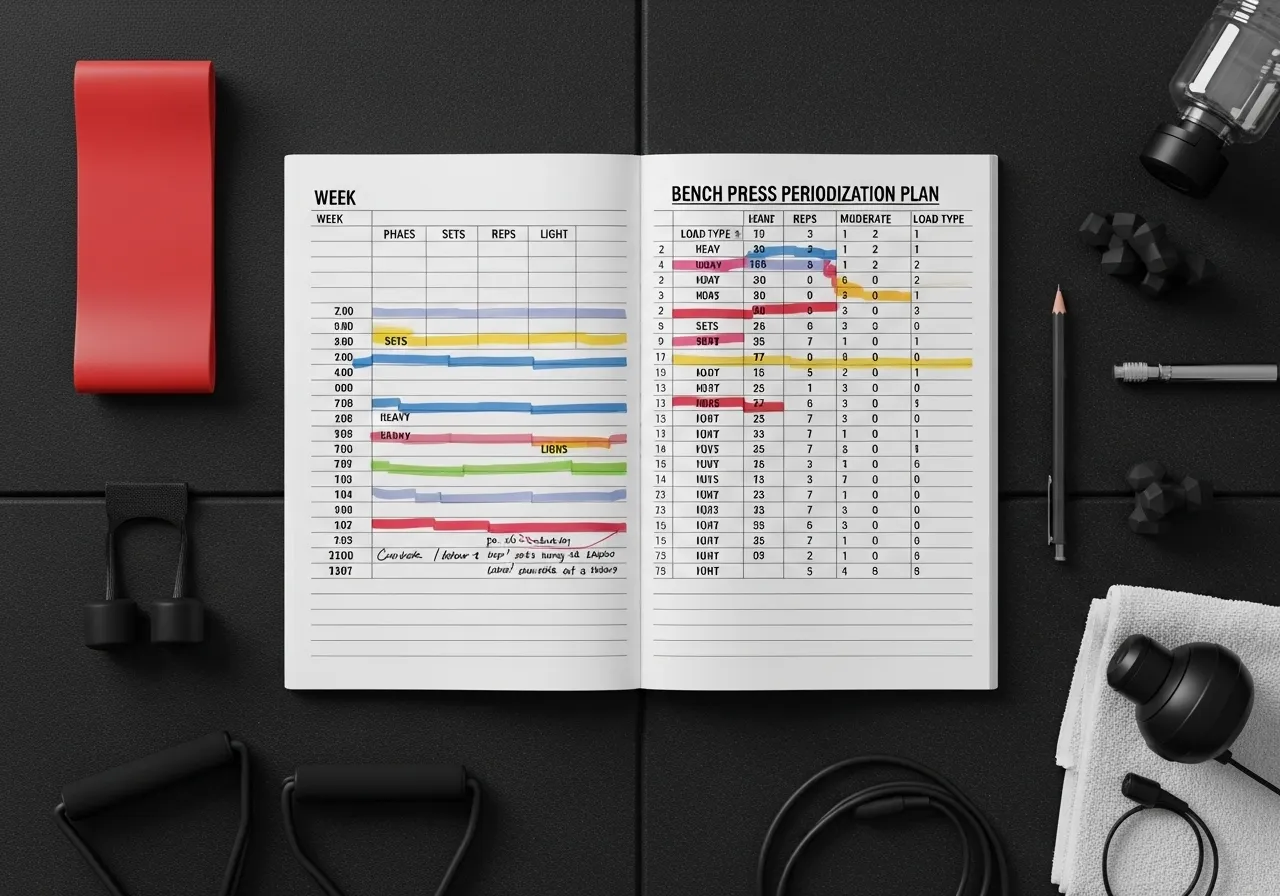
Linear periodization means starting each training block with higher volume and lower intensity, then progressively shifting toward lower volume and higher intensity across the weeks. A classic four-week linear bench press block looks like this: week one, four sets of ten at 70% of your one-rep maximum; week two, four sets of eight at 75%; week three, four sets of five at 80%; week four, two sets of three at 87%, plus a single at 90% to test progress. After four weeks, add two to five kilograms to all working weights and repeat the cycle. Research published in the Journal of Strength and Conditioning Research consistently finds that periodized training produces 10-15% greater strength gains than constant-load training over 12-week periods.
Undulating Periodization: Varying Intensity Within the Week
Daily undulating periodization varies the training stimulus between sessions within the same week rather than across weeks. A bench press lifter using this approach might press for strength on Monday (five sets of three at 85%), for hypertrophy on Wednesday (four sets of eight at 72%), and for muscular endurance on Friday (three sets of twelve at 65%). This approach prevents adaptation to any single stimulus and is particularly effective for intermediate-to-advanced lifters whose nervous systems have already adapted to standard linear loading. Studies comparing linear and undulating periodization find that undulating approaches produce superior strength outcomes over 12-week training periods, though both outperform non-periodized training substantially.
The Deload Week: Why Planned Rest Accelerates Progress
Every four to six weeks of progressive bench pressing should be followed by a deload week where training volume is reduced by 40-50% while intensity is maintained at 60-70%. During the deload, the accumulated fatigue from the training block dissipates, allowing the fitness adaptations that were developing throughout the block to fully express. Most lifters report that their bench press feels noticeably stronger in the session immediately following a proper deload, confirming that the deload revealed fitness that fatigue was masking. Skipping deloads might feel productive in the short term but consistently produces the grinding plateaus that make lifters feel permanently stuck.
Volume Landmarks: How Much Bench Press Is Enough?
Research on training volume for chest and pressing muscle hypertrophy suggests that most intermediate lifters need 12-20 sets of horizontal pressing per week to drive continued muscle growth. Fewer than 10 sets per week maintains existing muscle but does not drive new growth. More than 25 sets per week often exceeds recovery capacity and produces diminishing returns or regression. Distributing this volume across two to three sessions per week (rather than doing all sets in a single session) produces better hypertrophic outcomes through more frequent muscle protein synthesis stimulation. A practical intermediate bench press program might include two dedicated bench press sessions per week, each featuring four to six sets of bench press at varying intensities, supplemented by two to three sets of incline pressing and three sets of tricep work per session.
Action point: Write down your last four weeks of bench press numbers right now. If you see the same weight for more than two weeks in a row, your periodization is broken. Add the deload, change the rep range, or add load — any systematic change will restart progress.
The Mental Game of Heavy Bench Pressing
Maximum bench press attempts have a significant psychological component that technique and programming alone cannot address. Fear of failure — specifically the fear of being trapped under a heavy bar — creates a self-limiting ceiling that prevents true maximum effort on working sets. This fear is entirely rational and should be managed through environmental design rather than willpower. Training in a power rack with properly set safety pins eliminates the trapped-bar scenario completely, allowing uninhibited maximum effort. Practicing deliberate misses — intentionally failing with light to moderate loads to experience and normalize the safety pin catch — removes the fear of the unknown and allows full commitment to heavy attempts. Pre-lift mental routines (a consistent sequence of physical cues and focus words before each heavy set) activate the heightened arousal state that produces maximum force output. Elite powerlifters almost universally develop these pre-lift routines not as superstition but as evidence-based performance optimization. The three to five seconds before unracking a maximum attempt determine whether the lift succeeds or fails as surely as the months of training that preceded it.
Long-Term Bench Press Development: What Five Years of Consistent Pressing Produces
Understanding what is realistically achievable through five years of consistent, well-programmed bench pressing provides both motivation and calibration for intermediate lifters frustrated by short-term plateaus. Natural male lifters starting from scratch typically achieve the following benchmarks across training years: after one year, bodyweight bench press; after two years, 1.25 times bodyweight; after three years, 1.5 times bodyweight; after five years, 1.75 times bodyweight. Natural female lifters typically achieve: after one year, 60% of bodyweight; after two years, 75% of bodyweight; after three years, 90% of bodyweight; after five years, bodyweight bench press. These standards assume consistent training, adequate nutrition, and progressive programming. They are not guarantees — individual genetics, training history, and commitment produce significant variation. But they demonstrate that the intermediate plateau encountered at two to three years of training is not a permanent ceiling but a temporary barrier that dissolves with the patient application of the techniques described throughout this article. The bench press rewards those who approach it as a long-term development project rather than a short-term outcome target, compounding strength gains across years in ways that short training cycles never reveal.
More Frequently Asked Questions
How long should I expect to be stuck before trying these fixes?
If you have been stuck at the same weight for more than three weeks with consistent training and good sleep and nutrition, it is time to actively address the plateau. A one to two week plateau often resolves with a deload week alone. A plateau lasting three weeks or more typically requires identifying and addressing a specific limiting factor — grip width, tricep weakness, leg drive, or programming structure. Do not wait six months hoping the plateau resolves itself. The fixes described in this article work, but only if you apply them deliberately rather than passively hoping for improvement.
Should I bench press more than twice a week to break the plateau?
For most intermediate lifters, two dedicated bench press sessions per week provides sufficient stimulus for continued progress without exceeding recovery capacity. A third session can be added if the additional volume is at reduced intensity — treating one of the three sessions as a technique and volume session at 60-65% rather than a third heavy session. Three heavy bench press sessions per week is appropriate for advanced powerlifters with the recovery infrastructure to support it, but typically produces overuse for recreational lifters. ACSM resistance training guidelines recommend allowing 48-72 hours of recovery between sessions targeting the same muscle groups, which limits most people to two to three pressing sessions per week maximum.
My bench press goes up, then comes back down. What is happening?
This pattern — progress followed by regression to previous levels — typically indicates accumulated fatigue masking genuine fitness. You are strong enough to achieve the new weight occasionally but not consistently, because fatigue fluctuates across days and weeks. The solution is a proper deload followed by a more conservative loading progression that adds load more slowly than your current approach. If you are trying to add five kilograms per session, switch to two to three kilograms per session or even one kilogram using fractional plates. Slower, consistent progress that stays at each weight level for two to three sessions before advancing produces more reliable long-term development than aggressive loading that bounces up and down.
I can bench press more with a spotter. What does that mean?
If you can lift five to ten kilograms more with a spotter present, you have a confidence and safety perception issue rather than a pure strength limitation. The spotter’s presence eliminates the psychological cost of potential failure, allowing full effort. Solutions: perform heavy singles and doubles in a power rack with safeties set at chest height, which replicates the safety of a spotter and allows uninhibited effort; practice touch-and-go singles at current maximum to build confidence at heavy loads; and gradually work closer to true maximum in training rather than always leaving a large safety buffer. The gap between spotter-assisted and solo performance typically closes within four to six weeks of consistent heavy solo training in a rack with safeties.
Does the bench press angle (flat, incline, decline) matter for plateau breaking?
Yes, and this is an underutilized plateau-breaking tool. If your flat bench press is stuck, temporarily shifting primary pressing emphasis to the incline bench for four to six weeks develops the upper chest and anterior deltoid in ways that directly transfer back to flat bench performance. Many lifters return from an incline specialization block to find their flat bench has improved without any flat bench training, because the incline work addressed a weak link in the pressing chain. The reverse is also true — lifters whose upper chest limits their pressing ability benefit from incline specialization; those whose lower chest and triceps limit performance benefit from close-grip flat pressing emphasis. Research on pressing angle muscle activation confirms that incline pressing produces significantly greater upper chest activation than flat pressing, making it a valuable complement rather than a replacement.
Equipment That Actually Helps Bench Press Progress
The equipment market for bench pressing contains a mix of genuinely useful tools and expensive gadgets with minimal performance impact. The tools with meaningful evidence behind them are few and specific. A quality wrist wrap provides joint support during maximum effort pressing by limiting wrist extension, reducing the compressive stress on the wrist joint that causes pain during heavy loads. Wrist wraps are appropriate for sets at 85% or above and should not be worn for every set, as this prevents the wrist from developing the strength that would make wraps unnecessary for moderate loads. A lifting belt increases intra-abdominal pressure during the setup and execution, providing additional spinal support during heavy bench pressing — its benefit is smaller than in squatting and deadlifting but present for lifters pressing at or near maximum. A designated bench press shirt worn during training — not the specialized powerlifting equipment shirt but a close-fitting athletic shirt — eliminates the slipping that loose clothing can cause on the bench pad and provides consistent tactile feedback for bar positioning on the chest.
The most important piece of equipment for bench press development costs nothing: a training log. Recording every set, every rep, and every weight creates the data that reveals whether programming is producing progress or stagnation, identifies which accessory exercises correlate with bench press improvement for the individual, and provides the objective evidence base for making informed training decisions. Lifters who train by feel and memory consistently make slower progress than those who track their training systematically, because feel and memory are notoriously unreliable for detecting the slow, gradual progress that defines intermediate strength development. A training log transforms subjective impressions into objective trend data that accurately reflects what is and is not working. According to ACSM resistance training guidelines, systematic tracking of training variables is one of the most evidence-supported practices for ensuring progressive overload and continued adaptation in resistance training programs.
When to Seek Coaching for Your Bench Press
Self-coaching through video analysis and this type of guidance resolves most intermediate bench press plateaus. Situations that warrant in-person coaching from a qualified strength coach or powerlifting coach include: persistent shoulder pain that does not resolve with the technique modifications described here; a plateau that has lasted more than three months despite trying multiple programming approaches; specific competition preparation where technical optimization is essential; and inability to identify the sticking point or limiting factor despite video analysis from multiple angles. A single session with an experienced coach often identifies the specific technical issue that months of self-coaching missed, producing an immediate breakthrough that training logs alone could not generate. The investment in professional coaching pays for itself many times over in training time saved and progress accelerated. Organizations like the NSCA maintain directories of certified strength and conditioning specialists who can provide this type of targeted technical coaching for bench press development.
Frequently Asked Questions About Bench Press Plateaus
How long should I try one fix before concluding it isn’t working? Give any single change at least four weeks of consistent application before evaluating. Technique changes require several sessions to become automatic, and strength adaptations from program changes take three to four weeks to measurably appear. Evaluating after one or two sessions is too early to draw conclusions from any single fix.
My bench press stalls at the same weight every time. Is this a mental block? Psychological barriers do exist in strength training, but they are usually secondary to physical causes. Before attributing a plateau to mindset, systematically work through the technical and programming fixes in this article. Most perceived mental blocks dissolve when the underlying physical limitation is addressed — the mental barrier is frequently a symptom of knowing, at some level, that the setup or approach is not optimal.
Should I switch to dumbbell pressing when my barbell bench stalls? Using dumbbell pressing as a temporary training variation while your barbell bench recovers is productive — dumbbells provide greater range of motion and independent arm loading that can address asymmetries. However, dumbbell pressing does not directly train the barbell bench press motor pattern, so an extended absence from barbell pressing will require a re-adaptation period when you return. Use dumbbells as a supplement, not a permanent replacement.
How important is arch for breaking a plateau? Arch optimization is meaningful but usually not the primary plateau cause unless your technique has significant deficiencies. Fix grip width, leg drive, and rep range variation first — these typically produce larger gains faster. Arch optimization then contributes additional technical efficiency once the larger variables are addressed.
My bench press has been stuck for over a year. Does that mean I’ve reached my genetic limit? A one-year plateau at intermediate strength levels almost certainly does not represent a genetic limit. It represents a training approach that has been fully adapted to and needs more significant restructuring. Consider working with a qualified strength coach for an in-person assessment — a single session identifying your specific technical and programming deficiencies is worth more than months of self-directed trial and error.
Fix 7 Detailed: Building the Specific Accessory Work Map for Your Weakness
The seventh and most individualized fix is creating an accessory exercise map that directly targets your identified weakness. This is not generic accessory work but a specific prescription based on where your bench press fails. For bottom-position failures (fails immediately off the chest): primary accessories are paused bench press two sets of three at 85%, dumbbell chest flyes three sets of twelve to develop pectoralis stretch strength, and cable crossovers three sets of fifteen for constant tension chest work. For midpoint failures (fails halfway up): primary accessories are seated dumbbell press three sets of ten for anterior deltoid development, overhead press three sets of five for shoulder strength, and incline bench press three sets of eight for upper chest and anterior deltoid strength through a similar movement pattern. For lockout failures (fails in the final third): primary accessories are close-grip bench press three sets of five with 85% of close-grip maximum, skull crushers three sets of ten with a two-second eccentric, and cable pushdowns three sets of fifteen for tricep endurance development. Implementing this specific accessory map for eight weeks while maintaining regular bench pressing typically produces ten to twenty percent improvement in the specific limiting position and translates to measurable full-range bench press improvement. The key is specificity: generic accessory work that does not target the actual limiting position produces generic results.
The Specificity Principle Applied to Bench Press Plateau Breaking
The specificity principle — that training adaptations are specific to the exact demands of the training performed — has direct implications for bench press plateau breaking that most lifters ignore. If your bench press is stuck at a specific weight, the most specific possible training stimulus for breaking that plateau is pressing that exact weight, or weights very close to it, more frequently and with better technique than you currently do. Generic volume accumulation at 60-70% does not specifically develop the strength at 90%+ that you need to break the plateau. This is why the plateau-breaking program prescribes heavier loads, board presses, and pause presses at near-maximum loads rather than simply adding more sets at moderate weights. The nervous system needs to practice operating at near-maximum intensity to develop the specific recruitment patterns and rate of force development that maximum pressing requires. Research from NCBI studies on training specificity confirms that strength gains are highly specific to the load range trained, with heavy training producing disproportionate strength gains at heavy loads and vice versa. Applying this research means spending meaningful training time at 85-95% of maximum, not just occasionally testing at those loads while accumulating most volume at 60-75%.
Tracking Progress Beyond the One-Rep Maximum
The one-rep maximum is the ultimate measure of bench press strength but is not the only useful progress metric and is not safe to test frequently. More practical weekly tracking metrics include: the load used for five reps across multiple sets (the five-rep max), which can be tested every two to three weeks without significant fatigue cost; the total volume lifted per session (sets times reps times weight), which should trend upward across training blocks even when the five-rep max is temporarily stagnant; and technique quality ratings from video review, which can improve even during load plateaus. Tracking multiple metrics prevents the discouragement of a flat one-rep maximum from obscuring meaningful progress in volume capacity and technique quality that will eventually translate into a higher one-rep maximum. The bench press plateau that looks completely flat when measured only by one-rep maximum often reveals clear upward trends in volume and technique metrics that confirm adaptation is occurring and the plateau will soon resolve.