⚠️ Health & Fitness Disclaimer This article is for general educational purposes only and does not replace professional medical advice. If you have cardiovascular, respiratory, or musculoskeletal conditions, please consult a qualified healthcare professional before beginning a swimming program.
Swimming is one of the most physiologically complete forms of exercise available — simultaneously developing cardiovascular fitness, whole-body muscular endurance, flexibility, and lung capacity while placing virtually no compressive load on the joints. (Related: Zone 2 training guide) (Related: heart rate zones) (Related: HIIT vs steady-state cardio) (Related: VO2 max guide) (Related: rowing machine guide)
Its unique combination of low impact and high training potential makes it suitable across the widest range of individuals of any cardio modality — from elite triathletes to post-surgical rehabilitation patients, from children learning their first strokes to older adults maintaining functional independence.
This guide covers the cardiovascular research on swimming, the biomechanics and muscle activation of the four competitive strokes, how to structure swim training effectively, and a complete 8-week program for beginners and intermediate swimmers.
Swimming and Cardiovascular Health: What the Research Shows
The prone and supine body positions of swimming produce a distinct cardiovascular challenge compared to upright exercise modalities. In the horizontal position, the heart does not need to pump blood against gravity to the same degree as in standing exercise — the circulatory demand shifts from overcoming hydrostatic pressure in the lower limb veins to maintaining cardiac output against the hydrostatic pressure of the water on the thorax.
The net effect is a meaningfully lower heart rate during swimming compared to running or cycling at equivalent oxygen consumption — meaning that swimmers working at the same cardiovascular intensity as runners will experience a lower heart rate. This needs to be accounted for in heart rate-based training zone calculations: swimming heart rate targets are typically 10–13 beats per minute lower than equivalent land-based exercise intensities.
Blood Pressure, Lipids, and Metabolic Health
Research consistently documents swimming’s beneficial effects on cardiovascular disease risk factors:
Blood pressure: Regular swimming training has been associated with meaningful reductions in systolic and diastolic blood pressure in individuals with mild hypertension — with some studies reporting reductions comparable to those achieved with antihypertensive medications at moderate doses
Lipid profile: Swimming training is associated with increases in HDL cholesterol (high-density lipoprotein — the protective cholesterol that transports excess cholesterol from tissues back to the liver) and reductions in triglycerides (blood fats associated with cardiovascular risk when elevated)
Insulin sensitivity: Like other aerobic exercise, regular swimming may improve insulin sensitivity (the efficiency of cellular glucose uptake in response to insulin) — contributing to metabolic health and type 2 diabetes prevention
Caloric Expenditure in Swimming
Caloric expenditure in swimming varies substantially with stroke, intensity, efficiency, and body weight — more so than most other cardio modalities:
Stroke
Moderate Pace
Vigorous Pace
Freestyle (front crawl)
~400 kcal/hr (70 kg)
~600 kcal/hr (70 kg)
Butterfly
~500 kcal/hr
~700+ kcal/hr
Breaststroke
~350 kcal/hr
~550 kcal/hr
Backstroke
~350 kcal/hr
~500 kcal/hr
These estimates are approximate — poor swimming efficiency (excess drag from body position) increases caloric expenditure per distance but reduces the ability to sustain training intensity. Improving technique simultaneously improves both efficiency and the ability to train at higher intensities for longer — making technique development directly performance-relevant.
Aquatic Physiology: Why Water Is a Unique Exercise Environment
Water’s physical properties create a training environment that differs fundamentally from land-based exercise in several physiologically significant ways:
Buoyancy: Water reduces apparent body weight by approximately 90% when submerged to shoulder depth — removing the gravitational loading on joints that makes land exercise contraindicated for many conditions. The same individual who cannot walk without significant knee pain may swim without discomfort.
Hydrostatic pressure: The pressure of water on the body surface at depth provides a compression effect similar to graduated compression garments — supporting venous return, reducing peripheral oedema (fluid accumulation in tissues), and enhancing circulation from the periphery toward the heart. This is partly why aquatic therapy is used for conditions involving lower limb swelling.
Viscous resistance: Water is approximately 800 times denser than air — movement through water at any speed encounters resistance proportional to the square of velocity. This means that swimming faster requires disproportionately more energy per unit of speed increase, creating a natural intensity ceiling that prevents the runaway velocity that can lead to form breakdown in land-based sprinting.
Thermal regulation: Most pool temperatures (26–29°C) are below body temperature — the body continuously loses heat to the water, creating a thermoregulatory demand that adds to total energy expenditure while simultaneously preventing the overheating that limits high-intensity land exercise in warm conditions.
Understanding these aquatic properties explains why swimming produces distinct physiological adaptations from land-based exercise and why it may be preferable for certain individuals and health conditions rather than simply a substitute for running or cycling.
Swimming for Mental Health and Stress Reduction
Swimming occupies an unusual position among exercise modalities in its reported psychological benefits — the sensory environment of the pool (the rhythmic sound of water, the tactile immersion, the visual simplicity of the lane line) creates conditions that many regular swimmers describe as uniquely meditative and stress-reducing.
Proposed mechanisms for swimming’s psychological benefits include:
The rhythmic, bilateral movement pattern of swimming activates similar neural pathways to the bilateral stimulation used in certain trauma-processing therapies — the alternating left-right arm movements in freestyle have been described as producing a calming effect on the nervous system beyond what the physical exertion alone would generate
The breathing pattern required by swimming — controlled exhalation underwater, inhalation at specific moments — functions as structured breath control practice with effects comparable to diaphragmatic breathing exercises used in stress management
The sensory reduction of underwater swimming (reduced visual input, muted auditory environment) may allow the prefrontal cortex to disengage from the constant environmental monitoring that contributes to anxiety and mental fatigue in daily life
Comparison to Other Cardiovascular Modalities
Understanding swimming’s position relative to other cardiovascular options helps trainees make informed programming decisions:
Modality
Joint Impact
Upper Body
VO2max Potential
Equipment Need
Swimming
None
High
High
Pool access
Running
High
Minimal
Very high
Shoes only
Cycling
Very low
Minimal
High
Bike/pool
Rowing machine
Very low
Moderate
Very high
Machine
The Four Strokes: Biomechanics, Muscles, and Programming Uses
Freestyle (Front Crawl): The Foundation of Swim Training
Freestyle is the fastest and most mechanically efficient competitive stroke — and the foundation of virtually all swim fitness programs. Its alternating arm pull combined with a continuous flutter kick produces the highest sustainable speed at a given effort level.
Primary muscles activated:
Latissimus dorsi: The primary power generator of the freestyle pull — the large back muscle drives the arm from extended overhead to hip during the underwater catch and pull phase
Pectoralis major: Assists the lat in the pull-through phase — particularly active in the early pull
Triceps brachii: Extends the elbow during the push phase — the final force application before hand exit
Deltoids: Recovery phase — lifting the arm out of water and extending forward for the entry
Quadriceps, glutes, and hamstrings: Flutter kick — the downbeat provides propulsion and the upbeat recovers position
Backstroke: The Shoulder-Friendly Variation
Backstroke uses an alternating arm action similar to freestyle but performed on the back — the only competition stroke swum in a face-up position. The supine position significantly reduces shoulder impingement risk compared to freestyle for individuals with anterior shoulder sensitivity.
Training applications:
As an active recovery stroke between harder freestyle or breaststroke sets — the change in body position and stroke mechanics allows partial recovery while maintaining pool session continuity
For swimmers with shoulder discomfort during freestyle — the different arm entry angle and rotation pattern redistributes shoulder loading
As a thoracic extension and shoulder mobility exercise — the backstroke catch position (arm extended overhead while on the back) counters the anterior shoulder tightness that frequent freestyle can develop
Breaststroke: The Accessible Power Stroke
Breaststroke is the slowest competitive stroke but the most commonly chosen by recreational swimmers for its breathing accessibility — the head remains above water during the breath, eliminating the rotational breathing challenge of freestyle. Its simultaneous arm pull and frog kick create a distinctive glide phase between cycles.
Breaststroke has a higher metabolic cost per lap than freestyle despite lower speed — the out-sweeping arm action, wide leg recovery, and the drag-inducing knee bend between kicks all increase the energy cost per unit of distance. For calorie-focused training, breaststroke is moderately effective despite its lower speed.
Butterfly: The High-Intensity Stroke
Butterfly is the most technically demanding and physically taxing stroke — requiring simultaneous arm pull, dolphin kick, and a full-body undulation that demands significant core strength, shoulder power, and hip flexibility simultaneously. It is rarely swum in training by recreational swimmers but invaluable as a high-intensity interval tool once basic technique is established.
Even 25-metre butterfly repeats at maximum effort create an exceptionally high cardiovascular and muscular stimulus — the butterfly’s energy cost per metre is the highest of any stroke. For fit swimmers seeking high-intensity interval training without equipment, butterfly repeats with extended rest may be the most effective tool available in a pool.
The Role of Breathing Technique in Swimming Performance
Breathing is the technical element that most differentiates swimming from land-based cardio — the ability to exhale completely underwater and inhale efficiently during the brief window of head rotation is a skill that requires specific development and directly limits performance until it becomes automatic.
The most common breathing error in beginner freestyle swimmers is holding the breath or exhaling too slowly — arriving at the breath rotation with residual air in the lungs that must be expelled before inhalation can occur. This leaves insufficient time for a full breath and creates the “gasping” sensation that makes swimming feel harder than it needs to be.
The correct pattern: exhale continuously through the nose and/or mouth throughout the non-breathing strokes, so that lungs are nearly empty when the head rotation for the breath begins. The inhale is then explosive and efficient — the mouth opens, air enters immediately, and the head returns to the neutral position ready to exhale again. Developing this pattern typically requires 4–8 weeks of conscious practice in beginners before it becomes automatic.
Mastering this breathing pattern through dedicated practice sessions — such as 10 × 25m focusing exclusively on the exhale timing rather than speed — produces faster long-term improvements than attempting to correct breathing while also managing stroke mechanics and pace simultaneously.
Is Swimming Effective for Weight Loss?
The Research Perspective
Swimming is effective for cardiovascular fitness and has meaningful caloric expenditure — but the research on swimming specifically for fat loss is more nuanced than for land-based cardio:
Water temperature may stimulate appetite — the body’s thermoregulatory response to cool water increases post-exercise hunger in some individuals compared to equivalent land-based exercise, potentially partially offsetting the caloric deficit that the swimming session creates
The horizontal position and buoyancy reduce post-exercise perceived exertion — some research suggests swimmers may unconsciously compensate for caloric expenditure through food intake more than runners at equivalent cardiovascular intensities
These effects are individual and context-dependent — many regular swimmers manage weight effectively through swimming, particularly when combined with appropriate nutritional awareness
The most practical perspective: swimming is an excellent caloric-expenditure exercise that produces real fat loss when combined with a controlled dietary intake and appropriate training intensity. Its advantages for individuals with joint pain, high body weight, or injuries that preclude high-impact land cardio make it particularly valuable for these populations where other cardio options are limited.
Maximising Caloric Expenditure in Swimming
Several training strategies increase the caloric demand of swim sessions beyond simple lap counting:
Interval training: Alternating high-intensity efforts (near-maximum speed for 25–50 metres) with active recovery intervals produces significantly higher total energy expenditure than steady-state swimming at matched duration — and creates an elevated post-exercise oxygen consumption that extends the caloric impact beyond the session
Stroke variety: Butterfly and freestyle at vigorous intensity burn substantially more calories per lap than leisurely breaststroke — varying strokes within a session increases total metabolic demand
Paddles and resistance equipment: Hand paddles (flat surfaces worn on the hands to increase surface area) significantly increase the load per stroke — developing pulling strength and increasing session intensity simultaneously
Swimming vs. Running: The Honest Comparison
Variable
Swimming
Running
Joint impact
Virtually zero
2–3× bodyweight per step
Caloric expenditure
Comparable at matched intensity
Slightly higher per minute on average
Bone density
Minimal stimulus (non-weight-bearing)
Significant osteogenic stimulus
Upper body development
Comprehensive
Minimal
Accessibility
Requires pool
Minimal equipment, anywhere
Rehabilitation utility
Excellent — used post-surgery
Limited when joint-loading is contraindicated
Open Water Swimming vs. Pool Swimming
For swimmers considering outdoor and open water training — in lakes, rivers, or the sea — several practical differences from pool swimming require preparation:
Sighting: Unlike pool lane ropes and black lines, open water has no navigation aids. Regular sighting — briefly lifting the head to look forward every 6–10 strokes — is a skill that must be specifically practiced to maintain course without excessive deviation
Wetsuit buoyancy: Wetsuits substantially increase buoyancy in cold open water, changing the body position and reducing the hip drop that cold water and non-wetsuit open water creates. This may improve speed and reduce fatigue but also requires adaptation of stroke mechanics
Conditions variability: Waves, currents, and cold water all change the physiological demand of open water swimming — beginners should always start with protected calm water, never swim alone, and ensure familiarity with pool swimming before attempting open water environments
Advanced swimmers may also consider bilateral breathing (breathing on both sides alternately) in open water to aid orientation and reduce the asymmetric neck and shoulder strain that exclusive unilateral breathing can create over long distances.
Common Freestyle Drills for Technique Development
Drill sets — swimming with modified technique to isolate and develop specific components of the stroke — are the primary tool for technique improvement in pool training:
Catch-up drill: One hand remains extended in front while the other completes the full stroke cycle — slows the stroke to allow attention to the catch and pull before the second arm enters. Develops timing and high-elbow catch technique.
Fingertip drag: During the recovery phase (arm out of water), drag the fingertips along the water surface — promotes a high-elbow recovery that reduces shoulder strain and positions the hand correctly for entry
Fist swimming: Close the hands into fists during the pull — removes the paddle surface and forces the forearm to become the primary catch surface, developing the high-elbow catch that maximises pull effectiveness
Side kick: Swimming on the side with the lower arm extended and the upper arm at the hip — teaches the lateral body position and rotation that efficient freestyle requires
Swim Training Structure: Intervals, Distance, and Periodisation
The Building Blocks of Swim Training
Structured swim training breaks sessions into sets — specific combinations of distance, repetitions, rest intervals, and target intensity. Understanding the basic vocabulary of swim training allows more productive session planning:
Repeat: A single effort of a specified distance — e.g., a “100m repeat” is one continuous 100-metre swim
Set: A group of repeats — e.g., “4 × 100m” means four 100-metre repeats with rest between each
Rest interval: The rest between repeats — “4 × 100m on 2:00” means starting each 100m at 2-minute intervals, with the remaining time after completing the 100m as rest
Pace: Target speed — expressed as seconds per 100 metres
Training Intensities in Swimming
Due to the 10–13 BPM lower heart rate during swimming compared to land exercise, swimming intensity zones require different heart rate targets:
Zone
Swim HR (% max)
RPE (1–10)
Training Application
Easy/recovery
<65%
2–4
Warm-up, cool-down, active recovery
Aerobic base
65–75%
4–6
Long sets, aerobic endurance
Threshold
76–85%
6–8
Interval sets, tempo work
High intensity
85–93%
8–9
Short repeats, sprint sets
Maximum
>93%
10
25m sprints, all-out efforts
Session Structure: Warm-Up, Main Set, Cool-Down
Every effective swim session follows a three-phase structure:
Warm-up (15–20% of session distance): Easy pace, mixed strokes, focus on smooth technique before building effort. The warm-up gradually raises core temperature, activates the shoulder girdle musculature, and transitions breathing mechanics from land patterns to swim-specific breathing rhythm.
Main set (60–70% of session): The primary training stimulus — the specific combination of distance, intensity, and rest intervals that achieves the session’s training goal (aerobic endurance, threshold, intervals, or technique).
Cool-down (15–20%): Easy backstroke or freestyle, gradually reducing intensity — restoring heart rate toward resting, flushing metabolic byproducts, and preventing the post-exercise stiffness that follows stopping abruptly after intense effort.
Swimming for Cross-Training
Swimming serves as one of the most effective cross-training modalities for land-based athletes — developing cardiovascular fitness and muscular endurance while resting the impact-loaded structures that land training stresses:
For runners: Aqua jogging (running in deep water with a flotation belt) maintains running fitness during injury with zero impact loading — the cardiovascular and muscular demands closely approximate those of running without the ground reaction forces that injured tissues cannot tolerate
For strength athletes: Pool sessions on rest days maintain cardiovascular conditioning without the muscle damage that would impair recovery between strength sessions — the buoyancy-assisted recovery effect may even accelerate muscle soreness resolution through enhanced blood flow and gentle active range of motion
For cyclists: Swimming develops the upper body strength and endurance that cycling neglects — a practically well-balanced combination for individuals seeking comprehensive whole-body development from their cardiovascular training
8-Week Swimming Program: Beginner to Intermediate
Prerequisites and Program Design
This program assumes basic freestyle technique — the ability to swim 25 metres of front crawl without stopping, with bilateral breathing (breathing on both sides) or at least consistent unilateral breathing (breathing consistently to one side). Beginners who cannot yet swim 25 metres continuously should work with a swimming instructor on stroke technique before beginning structured training.
Phase 1 — Weeks 1–2 (Foundation, 3 sessions/week):
Warm-up: 4 × 25m easy freestyle (100m total)
Main set: 6 × 50m freestyle, rest 45–60 sec between each
Cool-down: 100m easy backstroke Total: 500m | Focus: Stroke technique, breathing rhythm, comfortable pace
Phase 2 — Weeks 3–4 (Endurance Build, 3 sessions/week):
Warm-up: 200m easy (mix of freestyle and backstroke)
Main set A: 4 × 100m freestyle, rest 30–40 sec
Main set B (alternate): 8 × 50m freestyle, rest 20 sec
Cool-down: 100m easy breaststroke Total: 700–800m | Focus: Building continuous distance, reducing rest
Phase 3 — Weeks 5–6 (Intensity Introduction, 3–4 sessions/week):
Warm-up: 300m easy
Drill set: 4 × 25m kick only with board (developing leg power)
Main set: 6 × 75m (50m threshold pace + 25m sprint) rest 45 sec
Conditioning: 200m continuous aerobic pace
Cool-down: 100m easy Total: ~1,000m | Focus: Introducing pace variation and sprint efforts
Phase 4 — Weeks 7–8 (Performance, 4 sessions/week):
Session A (Endurance): 1,500m continuous at aerobic pace
Session B (Intervals): 10 × 100m on 2:00 (benchmark pace)
Session C (Mixed): 400m warm-up → 8 × 50m sprint with 30 sec rest → 400m cool-down
Session D (Technique): Drill-focused — 4 × 50m of each: catch-up drill, single arm, fingertip drag Total per week: 3,000–4,000m
Dryland Training for Swimmers: Complementary Strength Work
Competitive and fitness-oriented swimmers benefit significantly from complementary dryland training — strength, mobility, and stability exercises performed outside the pool that address the muscular and structural demands of swimming:
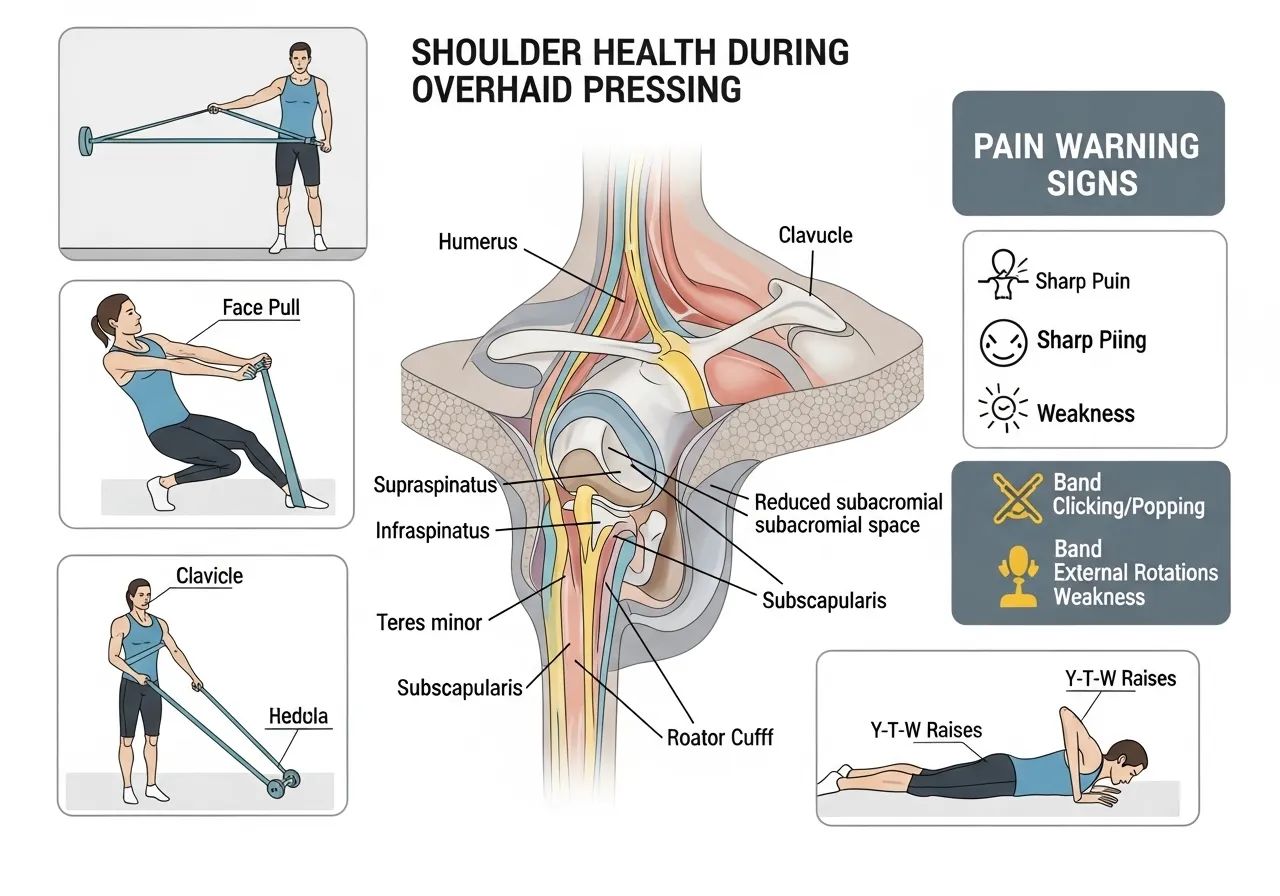
Rotator cuff strengthening: Face pulls, band external rotations, and prone Y-T-W raises develop the shoulder external rotators and lower trapezius that stabilise the glenohumeral joint during the high-volume repetitive loading of freestyle and butterfly strokes. Shoulder injuries are the most common swimming overuse complaint, and rotator cuff work is the most direct preventive measure.
Core training: The dolphin kick of butterfly and the hip-driven rotation of freestyle both require significant core stability — dead bugs, hollow body holds, and anti-rotation work develop this directly. A stronger core also improves the sustained body position quality that reduces drag over long swim sessions.
Hip flexor and thoracic mobility: The hip extension and thoracic rotation required for efficient freestyle and backstroke benefit from targeted mobility work — particularly for swimmers who spend significant time in sedentary postures outside the pool that tighten the hip flexors and thoracic rotators.
Two to three dryland sessions per week of 20–30 minutes, focused on these priority areas, may improve swimming performance and reduce injury risk more cost-effectively than additional pool time for most fitness-level swimmers.
Swimming for Special Populations and Cross-Training
Swimming for Injury Rehabilitation
Swimming is one of the most widely prescribed exercise modalities in rehabilitation medicine — its combination of complete joint unloading, resistance-based muscular training, and cardiovascular stimulus provides a training environment that few injuries preclude entirely:
Lower limb injuries: Fractured bones, post-surgical recovery from knee and hip procedures, and stress reactions all typically allow swimming with arm-only techniques (using a pull buoy — a buoyancy device held between the thighs that allows arm-only swimming without the need to kick) within weeks of injury, maintaining cardiovascular fitness through an otherwise sedentary recovery period
Lower back pain: The horizontal decompressed spine position during swimming reduces the gravitational loading on the lumbar discs that makes standing and walking painful for many people with back conditions — making backstroke and freestyle at easy intensity a frequently prescribed activity for lower back pain management
Arthritis: Warm-water aquatic therapy and swimming are among the most consistently recommended activities for people with both osteoarthritis and rheumatoid arthritis — the buoyancy eliminates joint-loading while the resistance provides muscular stimulus and the warm water temperature may reduce joint inflammation and stiffness
Swimming as Cross-Training for Other Sports
For athletes in land-based sports, swimming provides cardiovascular maintenance during overuse injury periods and serves as active recovery between high-intensity training cycles:
Runners: Pool running (deep-water running with a buoyancy belt) and freestyle swimming maintain running-relevant cardiovascular fitness during injury rehabilitation without impact loading
Cyclists: Swimming adds upper body development and full-body cardiovascular training that cycling cannot provide — addressing the anterior shoulder tightness that extended cycling positions create and developing the posterior chain muscles underloaded in cycling
Strength athletes: Light to moderate swimming on recovery days provides active recovery (low-intensity activity that promotes blood flow and metabolic byproduct clearance without generating additional tissue damage) while maintaining cardiovascular function during strength-focused training blocks
Swimming Gear: What Is Actually Necessary
Effective pool training requires minimal equipment, but a few items meaningfully improve training quality:
Goggles: The single most important item — comfortable, leak-free goggles allow training to focus on performance rather than eye discomfort. Anti-fog coating and UV protection are worth the small additional cost.
Pull buoy: A foam or EVA (ethylene-vinyl acetate — a lightweight closed-cell foam) floatation device held between the thighs — allows arm-only training sets that develop pull strength without kick involvement
Kickboard: A buoyant flat board held with the arms extended — supports the upper body during kick-only training sets
Swim cap: Reduces hair-water drag marginally for performance purposes, but primarily protects hair from chlorine damage and keeps hair from obscuring vision during freestyle breathing
Nutrition and Hydration for Swimmers
A common misconception among recreational swimmers is that swimming does not cause significant dehydration — the immersion in water reduces the perception of sweating and thirst, but fluid losses still occur. Swimmers may lose 0.5–1.5 litres per hour during moderate-to-vigorous pool sessions without perceiving the extent of their sweat rate due to the pool water masking the sensation.
Practical nutrition guidelines for swimming:
Hydrate adequately in the 2 hours before pool sessions — arriving well-hydrated prevents the performance decline that even mild dehydration produces
For sessions over 45–60 minutes, drinking 300–500ml during the session is advisable despite the absence of obvious sweating sensation
Post-swim protein intake (20–40g) supports the muscular adaptation from the shoulder and core loading that swim sessions produce — particularly relevant for swimmers using paddles, buoys, or high-volume interval training
Carbohydrate timing: a moderate carbohydrate meal 2 hours before longer or high-intensity swim sessions ensures adequate glycogen availability for threshold and interval work
Swimming FAQ
Why do I feel so exhausted after swimming even short distances?
Several factors contribute to the disproportionate fatigue that many beginners and irregular swimmers experience compared to equivalent-intensity land-based exercise:
Breathing mechanics: Coordinating bilateral breathing with arm stroke timing while maintaining head-down body position requires significant neuromuscular coordination that is not well-established in new swimmers — the cognitive and physical demand of managing breathing adds substantially to perceived exertion
Full-body engagement: Swimming engages muscles that most land-based exercise does not — the shoulder girdle stabilisers, thoracic extensors, and hip flexors all work continuously in swimming but are rarely trained to swimming-specific endurance in gym-based programs
Thermoregulation: Cool pool water continuously draws heat from the body — the thermoregulatory effort adds to total energy expenditure and can increase fatigue relative to matched-intensity exercise in a thermally neutral environment
The solution is simply swimming frequency — the technique, breathing coordination, and stroke-specific muscular endurance develop rapidly with consistent practice, and the disproportionate fatigue typically diminishes noticeably within 3–4 weeks of regular swimming.
Does swimming build muscle as well as other forms of exercise?
Swimming develops meaningful muscular endurance and moderate hypertrophy in the upper body — particularly the latissimus dorsi, pectoralis major, triceps, and shoulder musculature — and in the core. Elite competitive swimmers develop substantial upper body muscularity through high training volumes.
For maximum muscle mass development, swimming alone is less effective than progressive resistance training — the progressive overload mechanism available to swimmers (increasing speed and training volume) does not produce the same absolute loading magnitudes as progressive resistance training. For general fitness goals, swimming provides excellent muscular development alongside its cardiovascular benefits, particularly in the upper body and core.
How do I improve my freestyle technique on my own?
The highest-impact self-coaching tool for freestyle technique is underwater video — most modern phones can be positioned at the pool edge or on the lane rope to record stroke from the front, side, and above. Reviewing footage identifies errors that cannot be felt from inside the movement.
The most common beginner freestyle technique errors, in order of impact on efficiency and speed:
Head position too high (lifting the chin to breathe) — causes the hips to sink, dramatically increasing drag
Insufficient hip rotation — reduces the power available from the larger hip and trunk muscles that should contribute to each stroke
Early arm pull before full extension — reduces the length of the pull arc and the lat’s contribution to propulsion
Crossing the midline on hand entry — causes the body to sway and reduces stroke efficiency
✅ Key Takeaways
Swimming produces significant cardiovascular improvements including reduced resting heart rate, lower blood pressure, improved lipid profile, and enhanced aerobic capacity
Swimming heart rate is 10–13 BPM lower than land-based exercise at equivalent intensity — heart rate zone targets must be adjusted accordingly
Butterfly burns the most calories per metre; freestyle allows the highest sustainable pace; backstroke is most shoulder-friendly; breaststroke is most accessible for beginners
Swimming’s near-zero joint impact makes it uniquely valuable for rehabilitation, arthritis, high body weight, and any condition where impact loading is contraindicated
The primary limitation of swimming for overall fitness is its lack of bone density stimulus — weight-bearing exercise should be included alongside a swimming-focused program
⚠️ Health & Fitness DisclaimerThis article is for general educational and informational purposes only.It does not replace professional medical or fitness advice.If you have any pre-existing shoulder, neck, or upper back condition — please consult a qualified healthcare professional or certified personal trainer before starting or modifying any pressing program. The overhead press guide is…
Most recreational endurance athletes train by feel. Some days hard, some days easy. Occasionally very hard. They improve for the first six months, plateau, and then wonder why more miles are not producing better results. The answer is almost always the same: they are training in the middle. Not easy enough to build aerobic base….
⚠️ Health & Fitness DisclaimerThis article is for general educational and informational purposes only. It does not replace professional medical or fitness advice. If you have any pre-existing condition, injury, or health concern — consult a qualified healthcare professional or certified personal trainer before starting or modifying any exercise program. Sandbag training occupies a unique…
Why Running Is the Most Accessible and Most Misstarted Fitness Activity Running has the lowest barrier to entry of any fitness activity — it requires no equipment beyond supportive shoes, no gym membership, and no specific skill level to begin. It is also the fitness activity most commonly attempted and abandoned within the first few…
Most recreational athletes choose one form of cardio and repeat it. Runners run. Cyclists cycle. Swimmers swim. This is not a strategic decision. It is the path of least resistance: the familiar equipment, the practised movement, the social group tied to the activity. The repetition accumulates a specific cardiovascular adaptation to one mode of exercise…
⚠️ Health & Fitness DisclaimerThis article is for general educational and informational purposes only and does not replace professional medical or fitness advice.Kettlebell training involves ballistic movements that require proper technique. If you have any pre-existing back, shoulder, or joint condition — please consult a qualified healthcare professional or certified instructor before beginning. The kettlebell…