⚠️ Health & Fitness Disclaimer
This article is for general educational and informational purposes only.
It does not replace professional medical or fitness advice.
If you have any pre-existing condition, injury, or health concern — please consult a qualified healthcare professional or certified personal trainer before starting or modifying any exercise program.
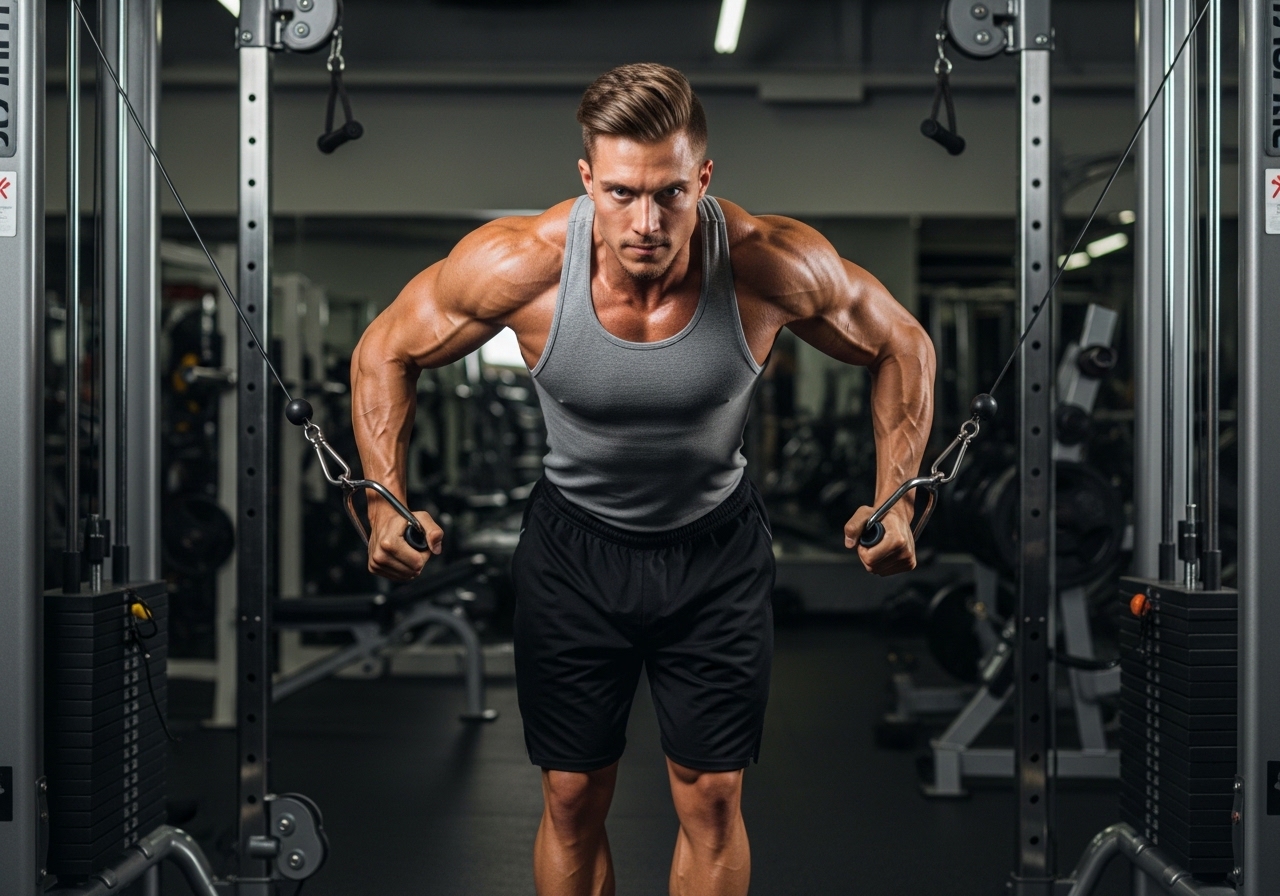
The cable fly is often treated as an optional finishing exercise — added at the end of a chest session after pressing work is done.
There may be a compelling mechanical case, however, for treating it as a core component of chest training — not an afterthought.
This guide breaks down the biomechanics, the technique, and a practical programming approach based on training level and goal.
Why the Cable Fly Offers a Different Stimulus Than Pressing
The Two Functions of the Pectoralis Major
The pectoralis major (the large fan-shaped muscle covering the chest) performs two distinct actions at the shoulder joint:
Shoulder flexion — driving the arm forward (the pressing pattern)
Horizontal adduction — drawing the arm across the body toward the midline (the fly pattern)
Pressing exercises — bench press, push-up, dumbbell press — train shoulder flexion with elbow extension as the primary movement.
Horizontal adduction is recruited during pressing, but it is never the primary driver of force.
This means pressing-dominant programs may leave one of the chest’s two core functions systematically undertrained over time.
The Resistance Curve Problem With Dumbbell Flies
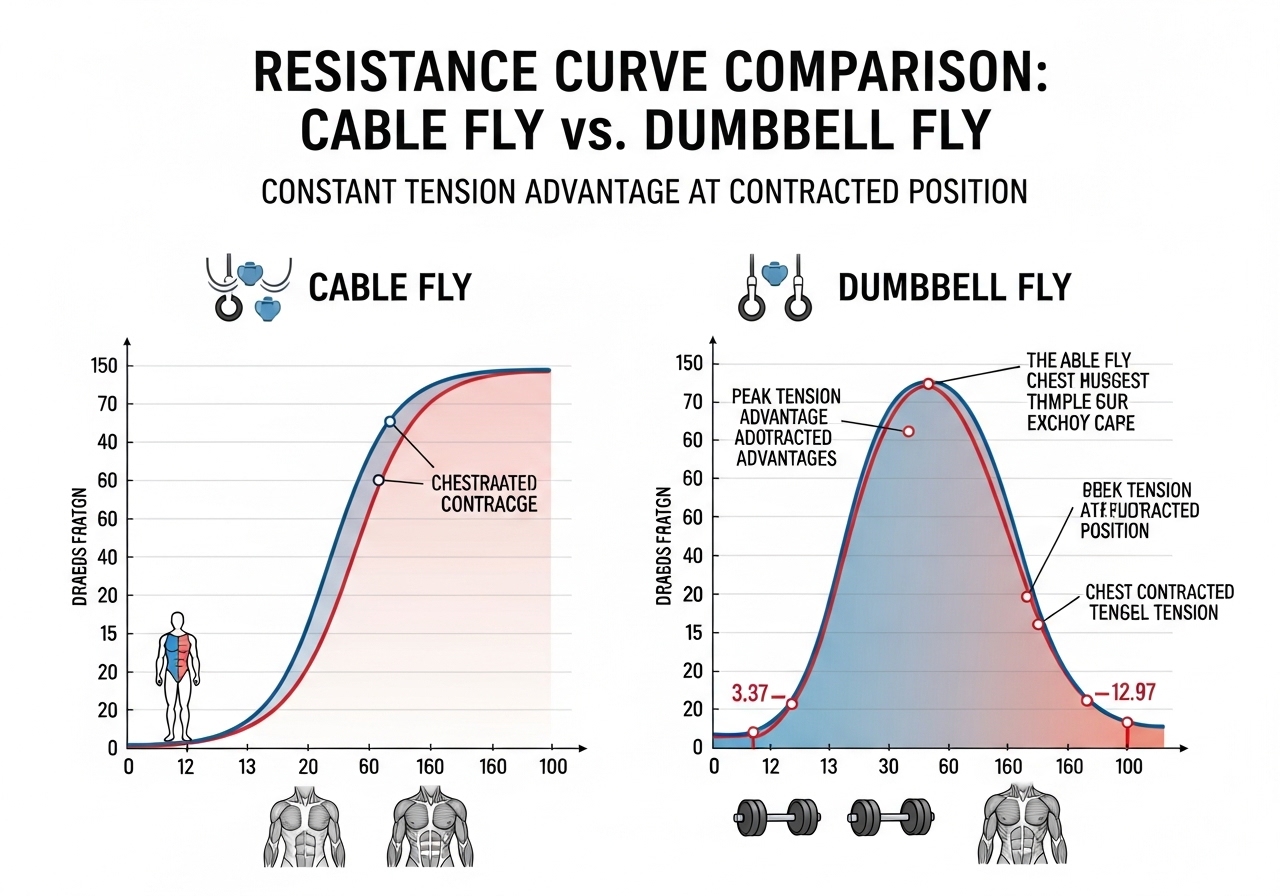
In a dumbbell fly, all resistance comes from gravity pulling the weights downward.
This creates the following resistance curve (the pattern of how much load the muscle must work against throughout the movement):
Dumbbell Fly — Resistance at Each Phase:
🔴 Arms wide / stretched position → HIGH resistance
🟡 Arms at 45° → MODERATE resistance
🟢 Hands together / contracted position → NEAR ZERO resistance
At the moment of peak pectoral contraction — the point where the hands meet — a dumbbell fly provides almost no meaningful resistance against the muscle.
How Cables Change This
Cable resistance pulls from a fixed anchor point rather than straight down under gravity.
This means the tension vector remains active throughout the entire arc of the movement:
Cable Fly — Resistance at Each Phase:
🟢 Arms wide / stretched position → MODERATE–HIGH resistance
🟢 Arms at 45° → CONSISTENT resistance
🟢 Hands together / contracted position → STILL ACTIVE resistance
This constant tension at the contracted position is the cable fly’s primary mechanical advantage over both dumbbell flies and pressing variations.
Standing cable flies also recruit the serratus anterior (a serrated muscle along the outer ribcage that stabilizes and protracts the shoulder blade).
Bench-supported pressing partially fixes the scapula (shoulder blade) against the bench, reducing serratus demand.
In a standing cable fly, the scapula must be actively stabilized throughout — making it a more complete shoulder girdle exercise than bench-supported alternatives.
Why This Matters for Long-Term Chest Development
Pressing movements do develop the pectoral through horizontal adduction — but as a secondary action, not a primary one.
Over months of pressing-only training, the horizontal adduction capacity of the chest may remain consistently undertrained relative to its pressing capacity.
Cable flies address this specific gap — not by replacing pressing, but by directly training the function that pressing cannot fully develop.
This provides a research basis for including both pressing and fly-pattern exercises in a complete chest training program, rather than relying on a single exercise category.
How to Know If Your Chest Is Undertrained Through the Fly Pattern
A practical self-assessment: perform a light set of cable flies at mid-height and pay attention to where you feel the effort.
If the anterior deltoid (front shoulder) or triceps fatigue significantly before any chest contraction is felt — this may indicate that the horizontal adduction function of the pec is currently undertrained and would benefit from dedicated fly-pattern work.
A qualified personal trainer or coach can assess your individual movement quality and suggest specific modifications based on your anatomy and training history.
Moment Arm Analysis: Why the Numbers Support Cables
The mechanical advantage of cables over dumbbells can be illustrated with a simple moment arm (the perpendicular distance between the line of force and the joint’s axis of rotation) analysis.
In a dumbbell fly with the arm at 90° extension (fully open):
Gravity acts straight down → moment arm is large → HIGH resistance
Arm at 45° → moment arm at roughly 70% of maximum
Arms together (hands meeting) → moment arm approaches zero → NEAR-ZERO resistance
In a cable fly with pulleys set at shoulder height:
Arm at 90° extension → cable tension pulls outward → meaningful resistance present
Arm at 45° → consistent cable tension still pulling outward
Arms together → cable still pulling outward against the contraction → ACTIVE resistance
This difference — approximately 50–70% more resistance at the contracted position in cables compared to dumbbells at the same starting weight — is why the two exercises feel and perform differently despite appearing similar.
Combining Cable Flies With Pressing in One Program
A practical integration principle: treat pressing as the primary strength stimulus and cable flies as the specific horizontal adduction volume that pressing cannot adequately provide.
Trying to replace pressing with only cable flies would sacrifice the compound strength, tricep development, and anterior deltoid work that pressing delivers.
Trying to replace cable flies with only pressing would consistently undertrain the contracted-position horizontal adduction function of the pectoralis major.
Both are necessary — and neither is redundant with the other.
For individuals new to chest isolation training, starting with the mid-height variation at a light, manageable load allows the nervous system to learn the arc pattern before load is progressively increased.
A certified personal trainer can assess your current movement quality and recommend which variation and load level is most appropriate for your individual anatomy and training background.
Cable Fly Technique: Setup, Execution, and Common Errors
The Three Height Variations and Their Targets
Variation
Pulley Height
Primary Target
High-to-Low
Pulleys above shoulder height
Sternal head — lower and mid pec mass
Mid-Height
Pulleys at shoulder level
Full pectoral — balanced development
Low-to-High
Pulleys near the floor
Clavicular head — upper pec fullness
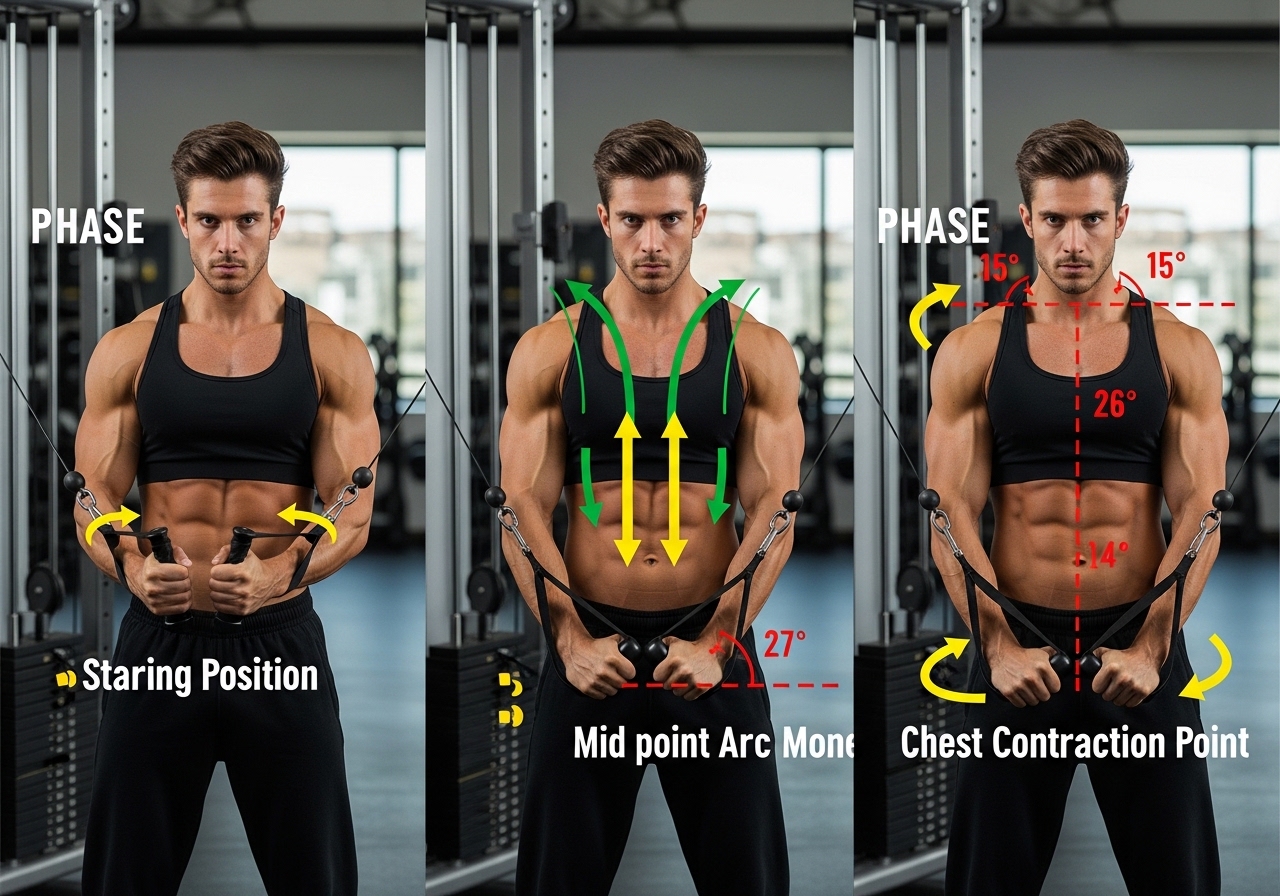
Step-by-Step: High-to-Low Cable Fly
1. Setup: Set pulleys to their highest position. Grasp handles with a neutral or slightly supinated (palms slightly upward) grip. 2. Starting position: Step forward to create cable tension. Lean forward 10–20° from vertical. Neutral spine throughout. 3. Arm position: Arms extended outward, elbows softly bent at 10–15°. This angle stays fixed — do not change it during the movement. 4. The arc: Drive hands downward and inward in a wide, sweeping arc. Think “hugging a large barrel.” 5. Contraction: Hands meet at chest height. Pause 1 second. Consciously squeeze the pectorals. 6. Return: Control the return phase over 2–3 seconds. Resist the cable pull — do not let it snap the arms open.
Most Common Technique Error: Turning a Fly Into a Press
When the elbows straighten during the movement, the exercise shifts from horizontal adduction (fly pattern) to shoulder flexion with elbow extension (press pattern).
At that point, the chest is no longer being isolated through its fly function — the triceps and anterior deltoid take over.
❌ Error: Elbows straightening mid-movement → becomes a standing press
✅ Correction: Lock elbows at the same soft bend from start to finish — every rep
Additional Errors to Avoid
Too much weight: Anterior deltoid (front shoulder muscle) compensates for the chest — reduce load until the chest is clearly the working muscle
Standing fully upright: Without the forward lean, the movement becomes a front raise pattern — the shoulder works more than the chest
Rushing the eccentric (the return phase): The stretched position under cable tension carries training value — a fast return discards it and increases pectoral tendon strain risk
A Note on Load Selection
Cable flies are most productive at moderate loads — approximately 60–70% of the weight you could lift for one maximum rep.
Unlike compound pressing where heavier loads drive strength development, the cable fly’s value lies in the quality of tension through the range — not maximum absolute load.
Breathing Pattern During Cable Flies
A consistent breathing pattern helps maintain core stability and avoid unnecessary breath-holding:
🔵 Inhale as the arms open (eccentric / return phase)
🔴 Exhale as the hands come together (concentric / closing arc)
Avoid prolonged breath-holding during the contraction — particularly when using heavier loads, as this may cause unnecessary increases in blood pressure.
Individuals with cardiovascular concerns should consult a healthcare provider regarding appropriate exercise intensity and breathing practices before training with heavier loads.
Grip Options and Wrist Position
The standard grip is neutral to slightly supinated (palms facing partially upward).
A pronated grip (palms facing downward) shifts some emphasis toward the anterior deltoid and may reduce the sense of chest contraction — generally not recommended for fly training specifically.
If wrist discomfort occurs, check that the wrist remains in a neutral position throughout — excessive wrist flexion or extension under load may contribute to discomfort over time.
Adjusting for Individual Shoulder Anatomy
Shoulder anatomy varies significantly between individuals — some people may find that a wider elbow angle feels more natural, while others prefer a more adducted starting position.
The key principle: the movement should feel like a smooth arc that loads the chest throughout — not a shoulder impingement (pinching sensation) or sharp discomfort at any point in the range.
If any sharp pain, clicking, or catching occurs in the shoulder during cable flies, stop the exercise and consult a sports medicine physician or physical therapist before continuing.
Foot Stance and Core Engagement During Cable Flies
The standing cable fly requires deliberate core activation throughout — without it, the cable pull may cause excessive lumbar extension (lower back arching) or lateral lean toward the cable stack.
💡 Core setup cue before each set:
→ Take a breath into the belly (diaphragmatic breath)
→ Brace the abdominals as if preparing for light contact
→ Maintain this throughout the set — breathe rhythmically without losing the brace
A staggered stance (one foot slightly forward) is often more stable than a parallel stance for taller individuals or those newer to cable fly training.
The foot position does not change the pectoral stimulus — choose whichever stance allows you to maintain a stable, upright (10–20° forward lean) torso throughout.
Unilateral vs. Bilateral: Which to Choose
The bilateral (two-arm) cable fly is appropriate for most situations — it allows heavier combined load and is time-efficient.
The unilateral (single-arm) variation becomes a valuable addition when:
A strength or size asymmetry between sides is suspected or confirmed
Greater range of motion at the midpoint crossing is desired
Core rotation challenge is a secondary training goal
A reasonable protocol for addressing asymmetry: perform bilateral flies as the main set, then add one extra unilateral set on the weaker side per session.
Always prioritize movement quality over load progression.
Programming Cable Flies: Volume, Frequency, and Session Placement
Cable Fly Does Not Replace Pressing
This distinction matters for program design: cable flies complement pressing exercises — they do not replace them.
Heavy compound pressing (bench press, incline press) develops multi-joint strength, total chest mass, and upper body pressing power that isolation work cannot replicate.
Cable flies address the horizontal adduction stimulus and contracted-position tension that pressing leaves undertrained.
Both serve distinct, non-overlapping roles in a complete chest program.
Session Placement by Goal
Goal
Placement in Session
Sets × Reps
Rest Between Sets
General hypertrophy
2nd or 3rd exercise
3–4 × 10–15
60–75 seconds
Pec activation focus
1st (pre-exhaustion)
2–3 × 12–15
45–60 seconds
Metabolic finisher
Last exercise
2–3 × 15–20
30–45 seconds
Weekly Volume Starting Point
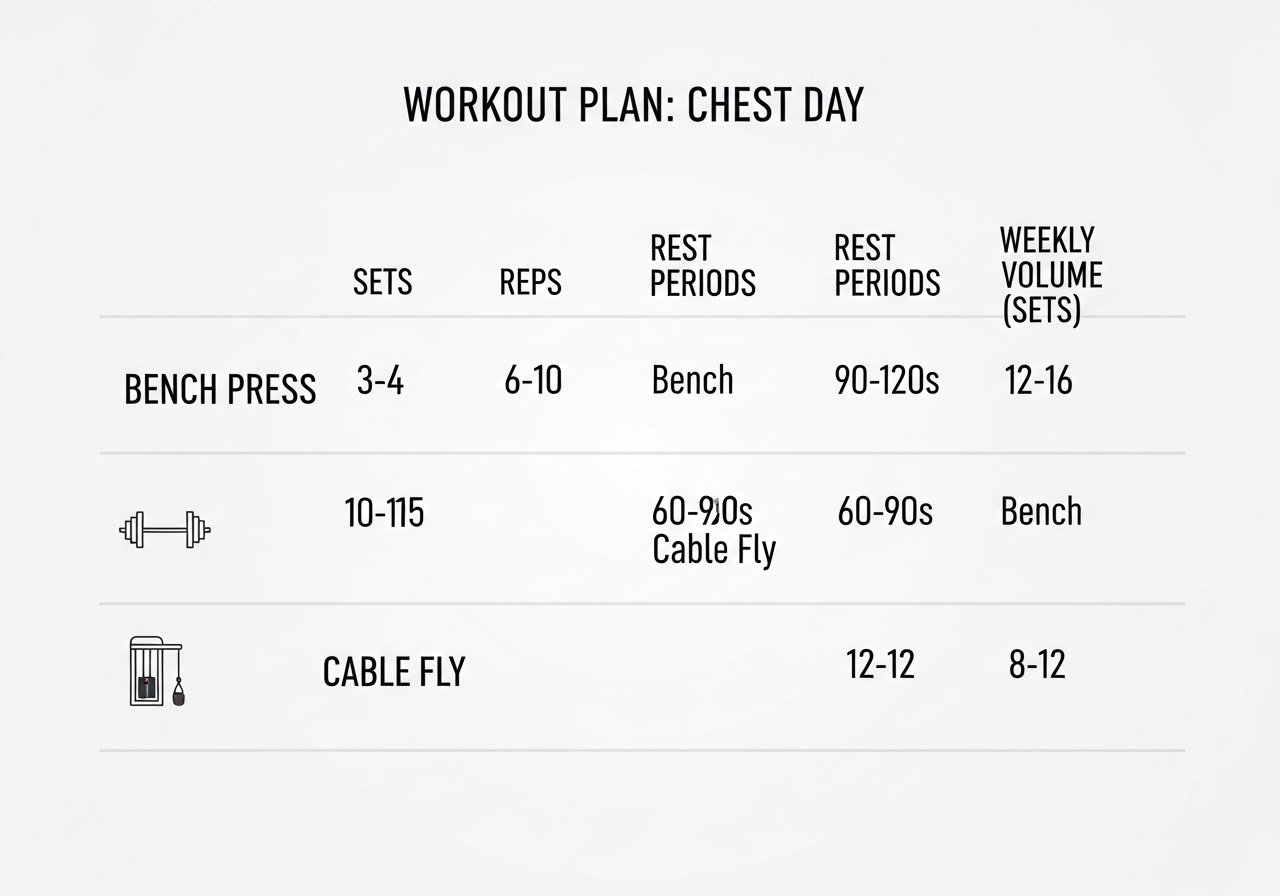
📊 Total weekly chest sets (pressing + fly combined): 12–20 sets
📊 Cable fly portion: 6–10 sets per week
📊 Recommended split: 3–5 cable fly sets per session across 2 chest sessions/week
These are general starting estimates — individual recovery capacity, training history, and overall program volume may require adjustments.
Beginning at the lower end of the range and adding sets over 4–6 weeks as recovery allows is a more conservative and sustainable approach than starting at maximum volume.
This suggests that performing cable flies after compound pressing may actually produce superior pec activation during the fly itself — supporting the standard programming approach of pressing first, then cable flies.
Pre-exhaustion (fly first) may increase anterior deltoid compensation during the fly, according to the same study — making it a less pec-specific approach despite the intuitive logic of pre-fatiguing the target muscle.
Chest Day B (Hypertrophy emphasis):
1. Incline Barbell Press — 3 × 8–10
2. Weighted Dips — 3 × 8–10
3. Low-to-High Cable Fly — 3 × 12–15
4. Mid-Height Cable Fly — 2 × 15 (drop set on final set)
Tracking Progress in Cable Fly Training
Unlike compound lifts where load progression is the primary metric, cable fly progress is usefully tracked across multiple dimensions:
Metric
How to Track
What Improvement Looks Like
Load
Training log — weight × sets × reps
Same reps achievable at higher weight with strict arc
Activation quality
Subjective — where fatigue is felt
Chest clearly fatigues before shoulder or arms
Contraction pause
Tempo adherence
1-second pause maintained at heavier loads
Variation rotation
Program log
All three heights trained across 12–18 week period
Integrating Cable Flies With Periodization
Periodization (the planned variation of training variables over time to drive continued adaptation) applies to cable fly programming in straightforward ways.
A simple approach that many intermediate trainees find effective:
Weeks 1–4: 3 × 12–15 at moderate load (volume accumulation) Weeks 5–8: 4 × 10–12 at slightly heavier load (progressive overload) Weeks 9–10: 2 × 15–20 at reduced load (deload — active recovery) Week 11+: Rotate to a new height variation and repeat
This structure provides volume stimulus, progressive overload, and systematic recovery — the three elements research most consistently associates with sustained hypertrophy over time.
Deload and Recovery Considerations for Cable Flies
Cable flies — as an isolation exercise — generate less systemic fatigue than compound pressing.
However, the pectoral tendons (connective tissue) and anterior shoulder structures may accumulate stress over high-volume training blocks.
A planned deload week every 4–8 weeks — reducing volume by 40–50% and load by 20–30% — allows connective tissue recovery that may reduce cumulative injury risk over longer training periods.
⚠️ Signs that a deload may be needed sooner than scheduled:
→ Persistent low-grade anterior shoulder discomfort that does not resolve between sessions
→ Noticeable decrease in the quality of the chest contraction feel
→ Inability to complete the same sets/reps that were achievable two weeks prior
If any of the above signs are present for more than one week, reducing training volume — rather than pushing through — is the more prudent approach.
Persistent discomfort that does not resolve with a deload week warrants evaluation by a licensed sports medicine physician or physical therapist.
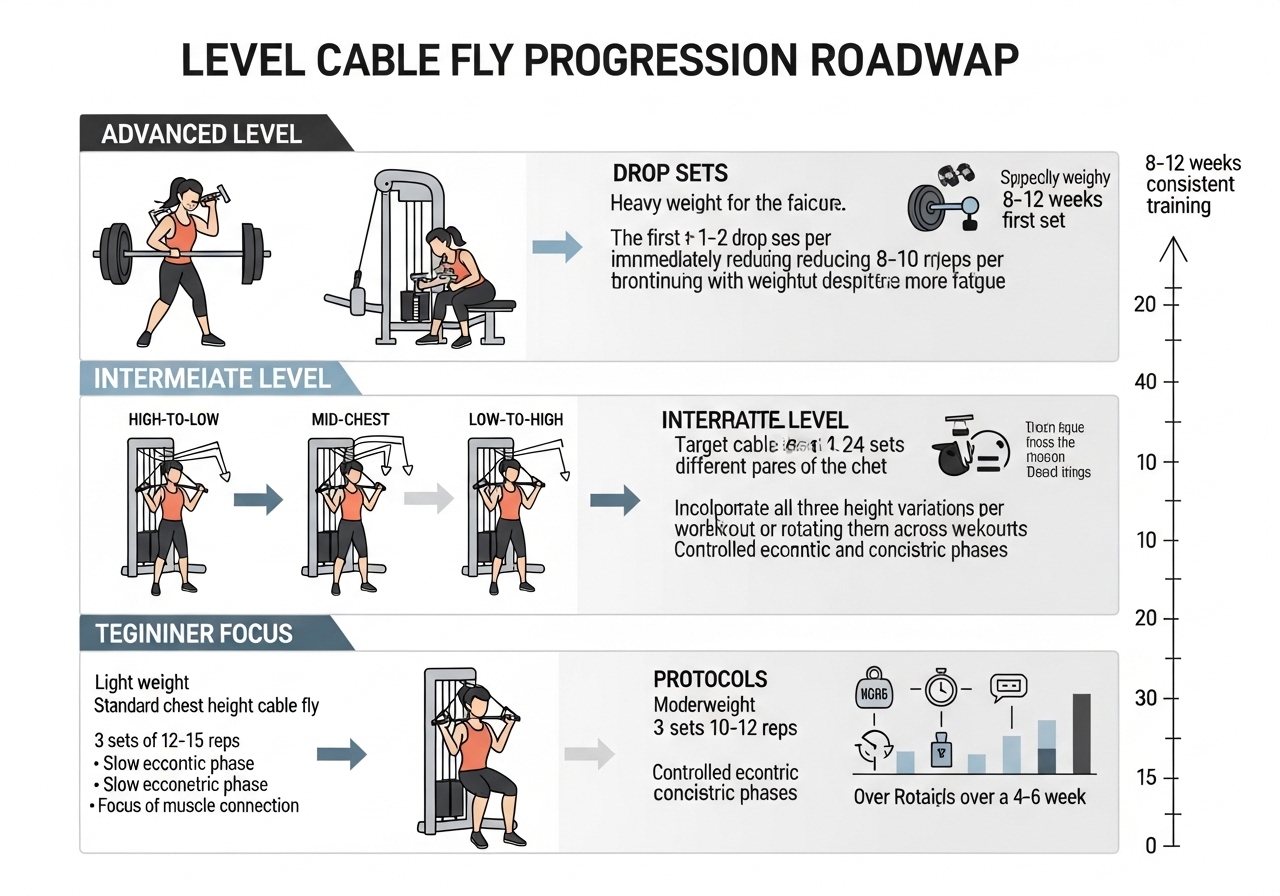
Cable Fly Progression: A 3-Level Roadmap
Level 1 — Building the Feel (Weeks 1–6)
The goal at this stage is developing the mind-muscle connection (the ability to deliberately activate a target muscle during an exercise) in the chest during the fly arc — not maximizing load.
Variation: Mid-height cable fly Load: 50–60% of estimated maximum Sets × Reps: 3 × 12–15 Tempo: 2 sec down / 1-sec pause at contraction / 2 sec return Key cue: “Feel the squeeze across the chest as hands meet — not a push from the shoulder”
If the shoulder dominates and no chest contraction is felt, reduce load further.
Two to three weeks of focused technique work at light loads typically produces a clear improvement in pec activation before progressing to heavier work.
Level 2 — Systematic Region Development (Weeks 7–18)
Rotate through the three height variations across successive training blocks:
Block A (4–6 weeks): High-to-Low Cable Fly → sternal pec emphasis Block B (4–6 weeks): Mid-Height Cable Fly → balanced full pec Block C (4–6 weeks): Low-to-High Cable Fly → clavicular / upper pec
Progress load by the smallest available increment when all target reps are completed with strict arc technique across all sets in a given session.
Level 3 — Advanced Techniques
Single-arm cable fly: Removes bilateral compensation (where the stronger side unintentionally carries more load), challenges the core to resist rotation, and allows a greater crossing range at the midpoint.
Drop sets: Reduce weight immediately after reaching failure and continue for additional reps — cable machines make this adjustment fast and practical.
Example drop set structure:
12 reps at working weight → reduce by 30–40% → 8–10 additional reps
⚠️ Use drop sets sparingly: once per session, final set only — excessive use accumulates fatigue quickly
When to Add Load vs. When to Focus on Technique
Signal
Action
All target reps completed, chest clearly working
Add smallest available load increment
Shoulder dominating, chest not felt
Reduce load — prioritize arc quality
Elbows bending excessively on return
Reduce weight — control eccentric phase
Plateau for 3+ sessions at same weight
Switch variation or adjust rep range
Cable Fly for Specific Populations
Beginners: The mid-height cable fly at light load is accessible and provides immediate feedback on the chest contraction feeling. Prioritize technique over load for the first 4–6 weeks.
Trainees with anterior shoulder discomfort during bench pressing: The cable fly’s movement path and load type is often tolerated when bench pressing causes shoulder discomfort. However, any exercise that causes pain should be evaluated by a qualified healthcare provider before continuing.
Older adults: The controlled, machine-assisted nature of cable flies — with its adjustable load and guided movement — may make it a more appropriate chest training tool than heavy free-weight pressing for some older trainees. Consult a qualified fitness professional to determine what is appropriate for your individual health status and goals.
Cable Fly vs. Pec Deck: Key Differences
Feature
Cable Fly
Pec Deck (Butterfly)
Movement path
Free — adapts to individual anatomy
Fixed — may not suit all shoulder structures
Height variation
Three options (high, mid, low)
Fixed height only
Learning curve
Moderate — requires technique practice
Low — guided path simplifies technique
Best for beginners
Yes, but technique focus needed
Yes — easier starting point
For most intermediate and advanced trainees, cable flies offer greater versatility and programming options than the pec deck.
Rotating between both over different training phases is a reasonable approach for stimulus variety and accommodation prevention.
Common Questions Before Starting Cable Fly Training
Is cable fly training appropriate if I have never done chest isolation work before?
Yes — cable flies at light load with a focus on technique are accessible for beginners.
Starting with the mid-height variation at 50% of estimated maximum for 3 × 12–15 reps is a reasonable entry point that prioritizes learning the arc and contraction feel before adding load.
Should both height variations (high-to-low and low-to-high) be trained in the same session?
This is possible but generally not necessary for most trainees.
Rotating between variations across training blocks — rather than doing all three in a single session — tends to be more practical and provides a clearer stimulus variation over time.
In a session where time is limited, choosing one variation that addresses the current training priority (e.g., low-to-high if upper pec development is the focus) is a more focused approach.
Can cable flies be done every training day?
Daily cable fly training is generally not recommended.
Like all resistance exercises, the pectoral requires adequate recovery between stimulus sessions — typically 48–72 hours minimum.
Two chest sessions per week (each including cable fly work) is the commonly suggested starting frequency for most intermediate trainees.
This 12-week structure may be repeated across multiple training cycles, with the height variation rotated each time to ensure continued stimulus variety and progressive pectoral development.
Safety, Anatomy, and Practical Answers for Cable Fly Training
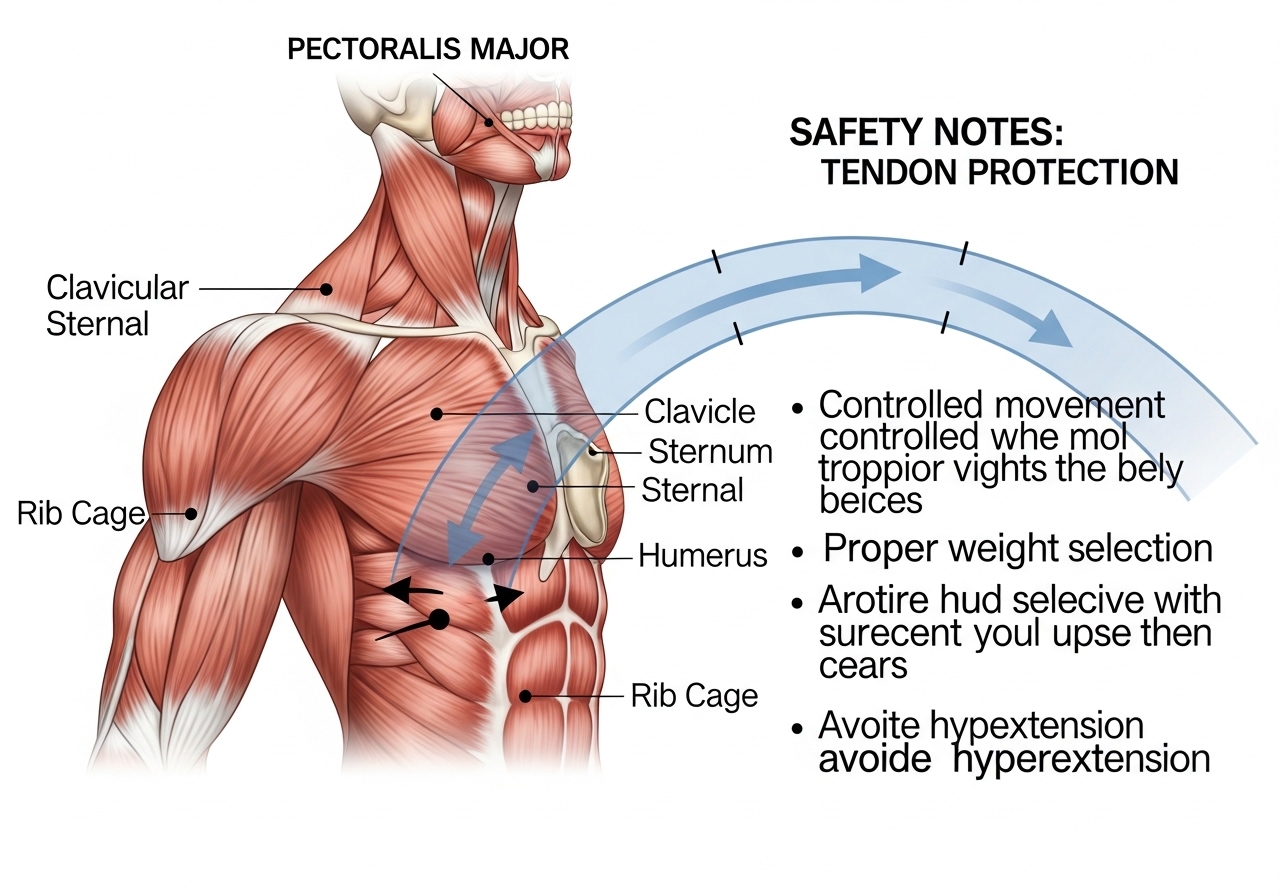
Understanding the Pectoralis Major’s Two Portions
Portion
Location
Best Trained By
Clavicular head (upper pec)
Originates from medial clavicle (collarbone)
Incline press + low-to-high cable fly
Sternal head (lower/mid pec)
Originates from sternum (breastbone) and ribs
Flat press + high-to-low cable fly
Pectoral Tendon Safety
The most common cable fly injury involves too much weight combined with a rapid, uncontrolled return phase.
This places the pectoral tendons (the connective tissue anchoring the muscle to the humerus bone of the upper arm) under sudden high-load stretch — a risk factor for strain.
⚠️ If you experience anterior shoulder or pectoral tendon discomfort during cable flies:
→ Reduce load immediately
→ Shorten the range of motion temporarily
→ If pain persists beyond one session, consult a licensed sports medicine physician or physical therapist before continuing
Complete Chest Program Reference
✅ Flat Bench Press — overall pressing strength, sternal pec mass
✅ Incline Press — clavicular head development
✅ High-to-Low Cable Fly — sternal contraction under constant tension
✅ Low-to-High Cable Fly — upper pec contraction under constant tension
✅ Weighted Dips — pec stretch, lower chest development
Bands anchored at an appropriate height provide a reasonable approximation of cable fly mechanics.
The tension profile differs slightly — bands increase resistance as they stretch, while cables maintain more consistent resistance throughout — but the key advantage over gravity-dependent dumbbell flies (some tension at the contracted position) is preserved.
For home training, bands at three anchor heights may effectively replicate all three cable fly variations.
How do I know if I’m using too much weight?
Two reliable signals that the weight may be too heavy:
The elbows begin to straighten on the concentric phase (the closing arc)
The shoulder — not the chest — is the primary source of fatigue after the set
Reduce load until both signals resolve before attempting to increase weight again.
How long before visible chest improvements appear?
Neuromuscular adaptations (improvements in the nervous system’s ability to activate the target muscle) often appear within 2–4 weeks — you may feel the chest working more effectively during the exercise.
Visible structural changes in chest muscularity generally require 8–12 weeks of consistent training combined with adequate nutrition and recovery.
Timelines vary considerably between individuals — factors including genetics, training history, sleep quality, and caloric intake all influence the rate of visible change.
Is the pec deck machine comparable to cable flies?
The pec deck (butterfly machine) and cable fly both train horizontal adduction, but they differ in key ways:
The pec deck’s fixed movement path may not accommodate all shoulder anatomies and can cause discomfort for some individuals at end ranges
Cable flies offer more height variation, free movement path, and adaptability to individual anatomy
For beginners: the pec deck’s guided path may be easier to learn — it is a reasonable starting point before transitioning to cables
✅ Key Takeaways
Cables maintain tension at the contracted position — where dumbbell flies and pressing drop to near-zero resistance
The pectoralis major has two core functions; pressing-only programs train one more completely than the other
Three height variations allow systematic targeting of different pectoral regions across training blocks
Cable flies complement pressing — they do not replace it
A 2–3 second controlled return is both a performance and injury prevention practice
How Cable Fly Complements the NSCA and ACSM Chest Training Guidelines
Both the National Strength and Conditioning Association (NSCA) and the American College of Sports Medicine (ACSM) recommend including varied exercise selections that train muscles through their full range of motion as part of a comprehensive resistance training program.
According to the NSCA’s resistance training program design guidelines, exercise selection should address all primary movement functions of the target muscle — reinforcing the rationale for combining pressing (shoulder flexion function) with fly-pattern training (horizontal adduction function) for complete chest development.
The ACSM’s resistance training position stand supports multi-angle training for major muscle groups to maximize functional and hypertrophic adaptation — which cable fly height variations (high-to-low, mid, low-to-high) directly address within a single exercise category.
Progressive Overload Applied to Cable Flies: A 12-Week Snapshot
Phase
Weeks
Sets × Reps
Load Target
Focus
Technique
1–3
3 × 12–15
50–60% max
Arc quality, contraction feel
Volume
4–7
4 × 12–15
65–70% max
Volume accumulation
Overload
8–11
4 × 10–12
70–75% max
Progressive load increase
Deload
12
2 × 15
50% max
Active recovery
After week 12, rotate to a different height variation and restart the cycle — this systematic rotation ensures all three pectoral regions receive progressive training stimulus over time.
Rotating through all three height variations over a 12–18 week training period ensures that both the clavicular and sternal portions of the pectoralis major receive targeted training stimulus — an approach that pressing-only programs cannot replicate.
If you are unsure which variation to prioritize first, the high-to-low cable fly targeting the sternal head may be a practical starting point, as the sternal head constitutes the majority of pectoral mass and responds well to this movement pattern.
⚠️ Fitness Disclaimer: The information in this article is for general educational purposes only and does not constitute professional fitness or medical advice. Exercise carries inherent risks. Always consult a qualified healthcare professional or certified personal trainer before starting or modifying any exercise program, especially if you have a pre-existing medical condition, injury, or health…
⚠️ Fitness Disclaimer: The information in this article is for general educational purposes only and does not constitute professional fitness or medical advice. Always consult a qualified healthcare professional before starting any new exercise program. ⚠️ Cardiovascular Health Notice: If you have a history of heart disease, high blood pressure, or any cardiovascular condition, obtain…
Warning Fitness Disclaimer: The information in this article is for general educational purposes only and does not constitute professional fitness or medical advice. Always consult a qualified healthcare professional before starting any new exercise program. The Cardio Method That Changed Everything I Thought I Knew About Training For most of my training life, I believed…
⚠️ Fitness Disclaimer: The information in this article is for general educational purposes only and does not constitute professional fitness or medical advice. Always consult a qualified healthcare professional before starting any new exercise program. ⚠️ Cardiovascular Health Notice: If you have a history of heart disease, high blood pressure, or any cardiovascular condition, obtain…
⚠️ Health & Fitness DisclaimerThis article is for general educational and informational purposes only. It does not replace professional medical or fitness advice. If you have any pre-existing condition, injury, or health concern — consult a qualified healthcare professional or certified personal trainer before starting or modifying any exercise program. Hip flexor tightness is one…
⚠️ Health & Fitness DisclaimerThis article is for general educational and informational purposes only. It does not replace professional medical or fitness advice. If you have any pre-existing condition, injury, or health concern — consult a qualified healthcare professional or certified personal trainer before starting or modifying any exercise program. The Romanian deadlift (RDL) is…