Why TRX and Suspension Training Belong in Every Serious Training Program
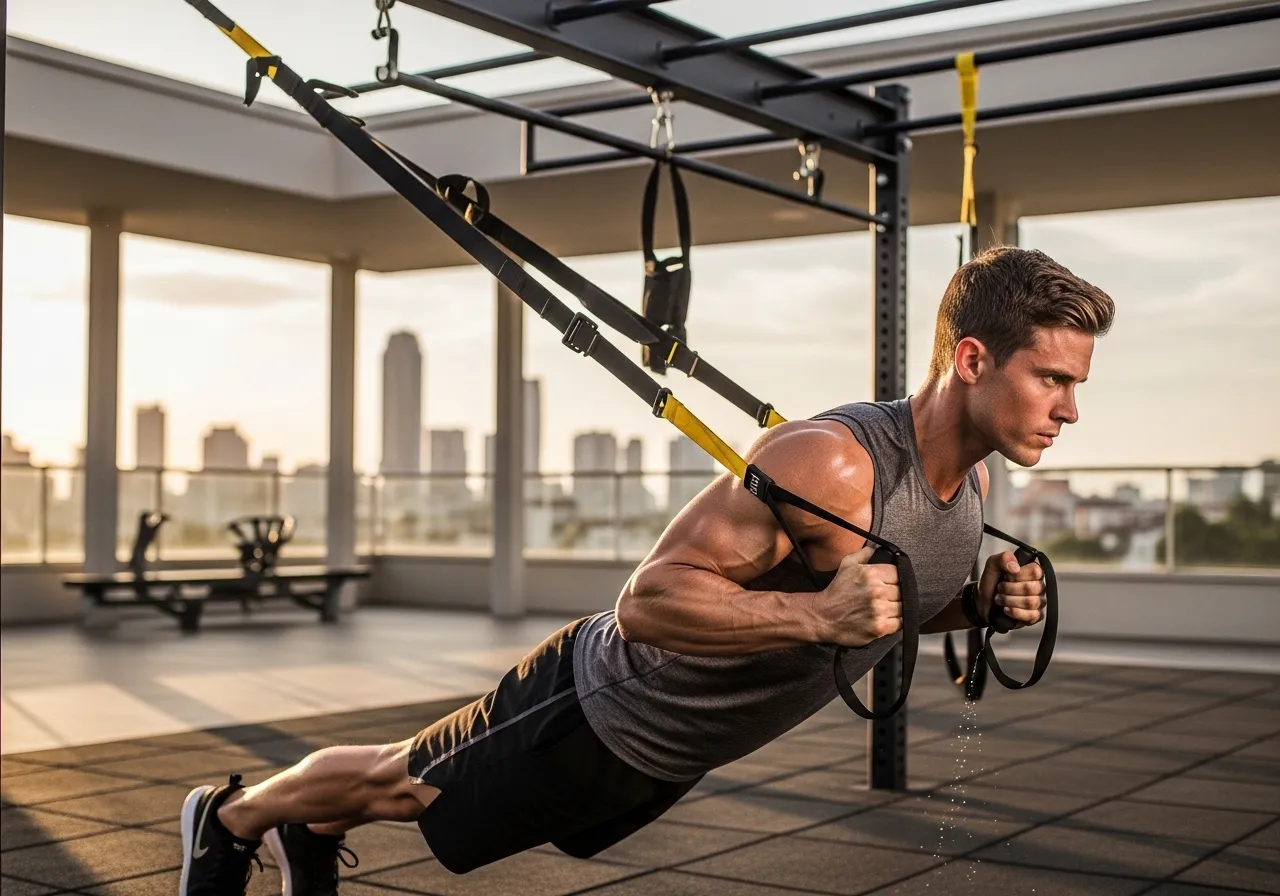
The TRX suspension trainer — two adjustable straps with handles anchored to a single point, allowing the exerciser to use their own bodyweight and gravity as resistance through an infinite range of angles and positions — has earned a permanent place in professional athletic training, physical therapy, and military fitness programs worldwide. Despite this professional adoption, it remains underutilized in recreational gym training, where most athletes pass it by in favor of familiar machines and barbells without recognizing what the suspension trainer uniquely offers.
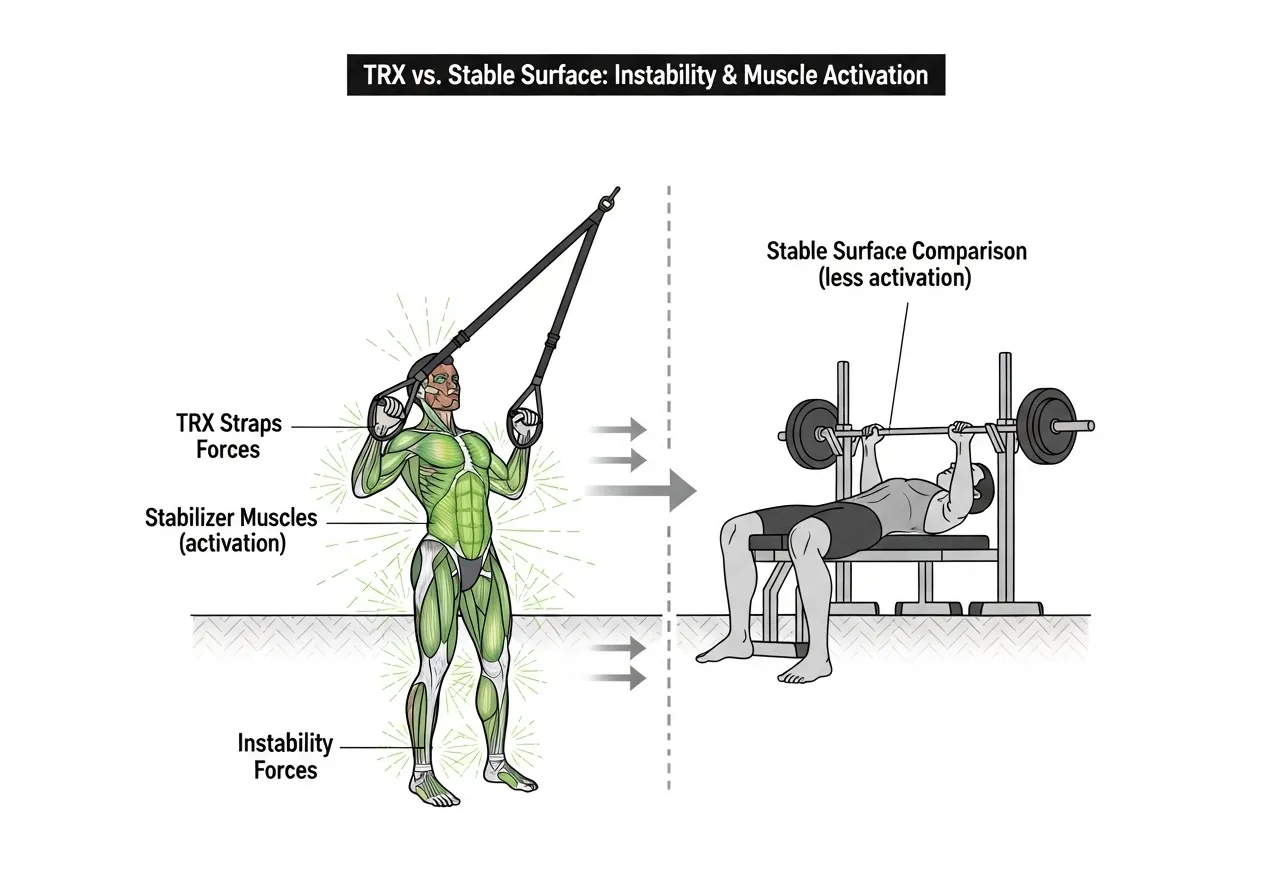
The TRX’s defining characteristic is its instability demand: every exercise performed on the suspension trainer requires the core, shoulder girdle, and hip stabilizers to maintain body position against the destabilizing forces that the freely moving straps create. This stabilization demand — absent in most machine exercises and reduced in many barbell exercises — develops the functional stability that athletic performance, injury prevention, and daily functional capacity all require. The result is an exercise tool that simultaneously develops strength, stability, and mobility in every movement, making each exercise more comprehensively challenging than its stable-surface equivalent.
The Science of Suspension Training
Research on TRX training and muscle activation consistently finds that suspension trainer exercises produce equivalent or greater core and stabilizer activation compared to equivalent stable-surface exercises at matched loads. The TRX push-up produces greater serratus anterior and core activation than the floor push-up; the TRX row produces greater scapular stabilizer activation than the seated cable row; the TRX squat produces greater hip stabilizer and proprioceptive demand than the barbell squat. These activation differences reflect the genuine additional stabilization work that the suspension trainer’s instability imposes rather than merely perceived difficulty. According to research on TRX exercise and core muscle activation, suspension trainer exercises produce significantly greater core activation than equivalent stable-surface exercises, validating their specific application for core and stabilizer development alongside primary strength work.
Action point: Find the TRX straps in your gym (most commercial gyms have them, typically near the functional training area) and perform ten TRX rows with correct form. Notice the difference in posterior shoulder and mid-back engagement compared to your usual cable row — this immediate qualitative difference demonstrates the suspension trainer’s unique stimulus.
TRX Setup and Safety: Getting Started Correctly
Proper TRX setup is essential for both exercise effectiveness and safety. The standard anchor height — approximately seven to eight feet (210-240 centimeters) — is appropriate for most exercises, with the straps adjusted so the handles hang at approximately hip or chest height when the straps are fully extended. Lower anchor points (for exercises like TRX push-ups from handles) require the handles at a height that allows the body to be horizontal when gripping. The anchor point must be load-rated to support dynamic forces that exceed the exerciser’s body weight — a squat rack post, wall-mounted anchor, or pull-up bar is appropriate; a desk drawer or cabinet handle is not. The door anchor — for home use — must be used with a closed, inward-opening door with the anchor wedge on the opposite side from the exerciser, tested with firm pulling before loading body weight. Before each session, check that the carabiner connections are secure and that the strap length adjusters are locked in position. These setup checks take thirty seconds and prevent the equipment failures that incorrectly assembled suspension training systems occasionally produce. According to TRX training safety guidelines, anchor point integrity is the primary safety variable for suspension training — all equipment can fail under dynamic loading if the anchor is inadequate for the forces imposed.
TRX vs Gymnastic Rings: Understanding the Differences
Gymnastic rings — the Olympic gymnastics apparatus that suspension training is loosely derived from — provide a more challenging and more functionally demanding training tool than the TRX for athletes whose fitness has advanced beyond what the TRX’s constrained movement range can challenge. The primary difference: TRX handles maintain a fixed distance apart (the width of the human grip on each handle), while gymnastic rings are independent and can move freely in all directions, creating a three-dimensional instability that the TRX’s bilateral handle constraint prevents. Ring dips, ring push-ups, and ring rows are dramatically more difficult than their TRX equivalents because the rings’ complete freedom of movement requires active stabilization in all directions simultaneously. For intermediate athletes who have developed basic suspension training competency on the TRX, progressing to gymnastic rings provides the next level of stability challenge that continues driving adaptation beyond what the TRX can produce. For beginners, the TRX’s more constrained movement is more appropriate — the rings’ instability exceeds what beginners can safely manage while also learning the movement patterns. The progression from TRX to rings represents a legitimate athletic development pathway for athletes who want to develop the strength and body control that gymnastic ring training specifically produces.
Building a Complete Athlete With TRX: The Integration Philosophy
The most effective training philosophy treats the TRX not as an alternative to conventional training but as a complement that fills the specific gaps that barbell and machine training cannot address. Heavy barbell training develops maximum force production and structural muscle; conventional cardiovascular training develops aerobic capacity; TRX training develops the stabilizer strength, movement quality, and proprioceptive integration that connects these physical qualities into the functional athletic capability that sport and daily life demand. Athletes who train with all three components — heavy compound lifting for strength, structured cardiovascular work for endurance, and TRX-based functional training for stability and movement quality — develop the most complete physical capability that recreational training can produce. This integration philosophy is identical to what elite athletic programs in professional sports, military special operations, and Olympic sport development use — not coincidentally, as these programs have invested extensively in identifying the training combinations that produce superior athletic outcomes. The recreational athlete who applies the same three-component integration on a smaller scale produces superior results to any single-component approach, confirming that the philosophy scales from elite to recreational training contexts effectively. NSCA athlete development guidelines consistently identify multi-modal training programs that address strength, endurance, and functional stability as producing superior long-term athletic outcomes compared to single-modality approaches.
The TRX’s genius is its simplicity — two straps, one anchor point, and infinite exercise variety that challenges the complete athlete from the first session through years of progressive development that the suspension trainer’s scalability consistently enables.
The Core TRX Exercises: Building a Complete Training System
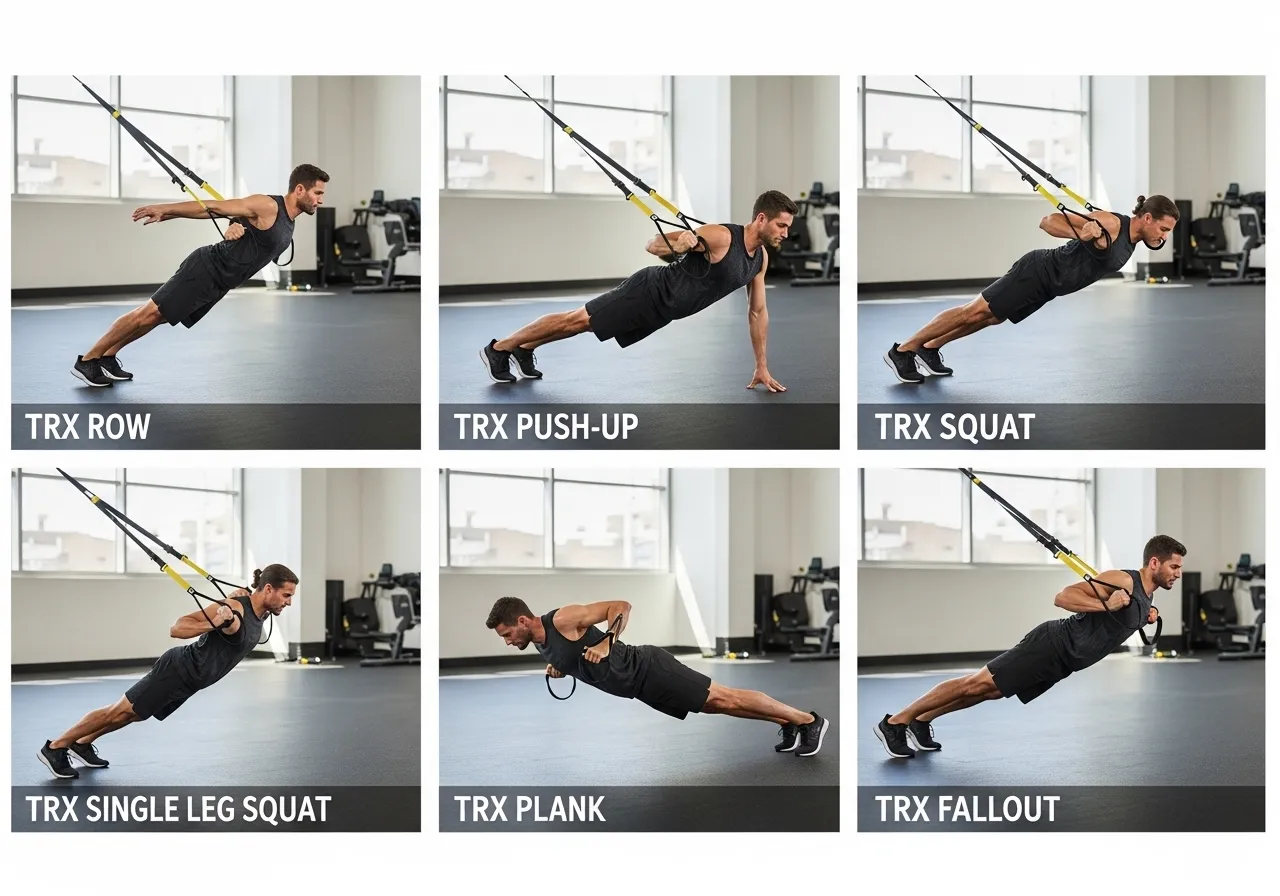
The TRX’s versatility allows a complete training program addressing all major movement patterns. Understanding the primary exercises and their specific contributions enables the suspension trainer to replace or supplement conventional gym equipment comprehensively.
TRX Row (Horizontal Pull)
The TRX row — holding the handles and leaning back at an angle, then pulling the chest to the handles — develops the mid-back, rhomboids, and posterior deltoid through horizontal pulling with exceptional scapular stabilizer engagement. Intensity adjustment is simple: walk the feet forward (increasing body angle toward horizontal) to increase difficulty, or step back (decreasing angle) to reduce it. The TRX row produces greater scapular stabilizer and posterior deltoid activation than the seated cable row at equivalent perceived effort, making it the superior back exercise for stabilizer development even if the cable row allows heavier absolute loading. Three sets of ten to fifteen reps, adjusted to an angle producing genuine effort, delivers the mid-back stimulus that the TRX row most specifically provides. According to NSCA functional training guidelines, unstable surface pulling exercises produce superior scapular stabilizer activation compared to stable alternatives.
TRX Push-Up (Horizontal Push)
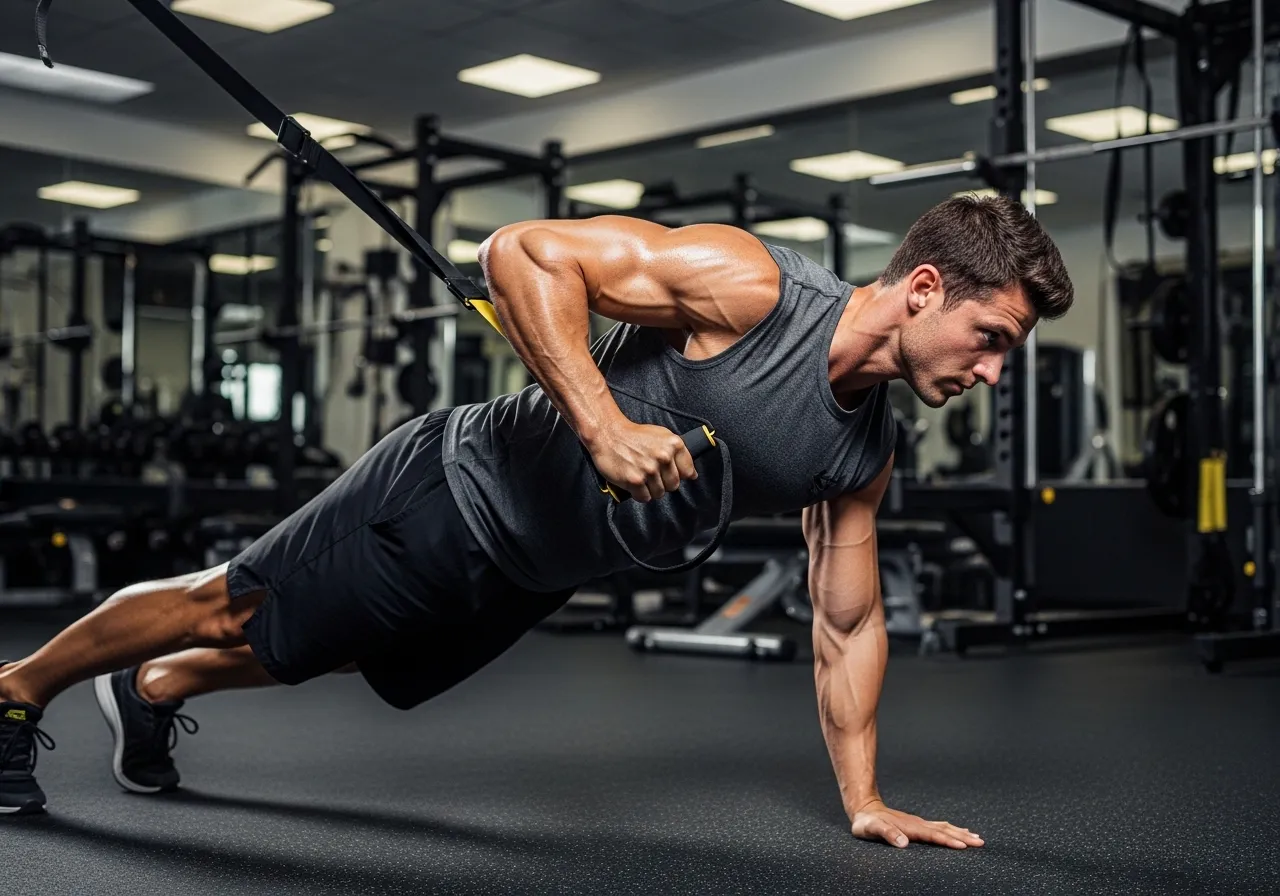
The TRX push-up — feet in the straps while performing push-ups with hands on the floor, or hands in the straps while feet remain on the floor — develops the chest, anterior deltoid, and tricep through horizontal pressing with significantly greater core and serratus anterior demand than floor push-ups. The foot-elevated variation (feet in straps) increases difficulty beyond standard floor push-ups by adding instability and a decline angle that shifts emphasis toward the upper chest and anterior deltoid. The hand-supported variation (hands in straps) is actually more difficult than the foot variation, demanding extreme shoulder stability throughout. Both provide pressing stimulus that serves as a productive complement to barbell bench pressing.
TRX Squat and Single-Leg Squat
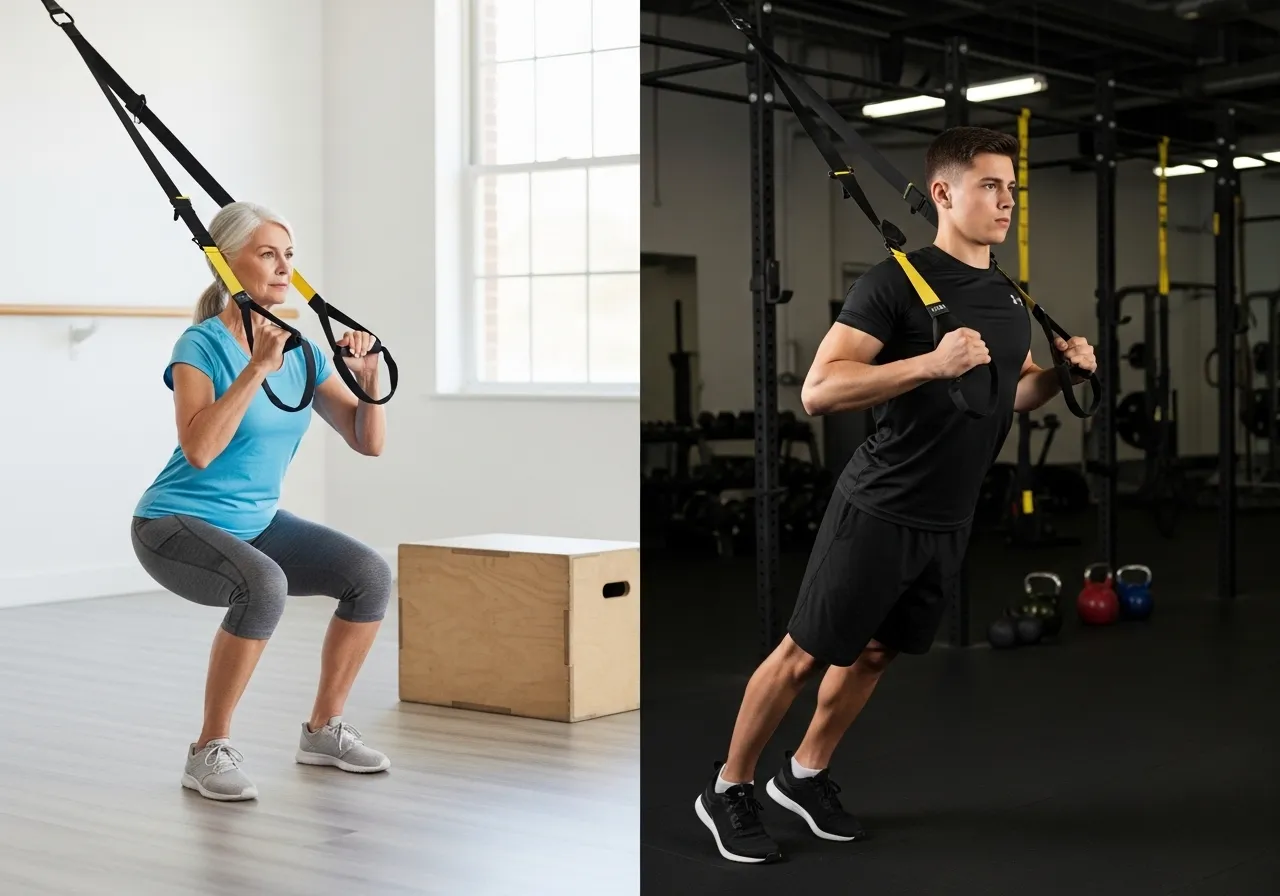
The TRX squat — holding the handles for balance assistance while performing squats — allows deeper range of motion than most people can achieve unassisted, making it an excellent mobility development tool and a productive squat variation for athletes whose ankle mobility or balance limits free squat depth. The TRX single-leg squat (pistol squat) — one of the most challenging lower body exercises available — becomes accessible with the TRX’s balance assistance for athletes who cannot yet perform an unassisted pistol squat, providing a progressive tool for developing the extreme single-leg strength that the pistol requires.
TRX Plank and Fallout (Core)
The TRX plank (feet in straps, body horizontal) produces greater core activation than the floor plank by adding the instability of the suspended feet to the anti-extension demand. The TRX fallout — starting in a plank position and allowing the arms to extend forward (like an ab wheel rollout) — is among the most demanding core exercises available, requiring maximum anti-extension strength from the entire core musculature through a large range of motion. Three sets of ten TRX fallouts provide a core stimulus equivalent to significantly higher volumes of floor-based core work.
Action point: Build a complete ten-minute TRX workout this week: two sets of TRX rows, two sets of TRX push-ups, two sets of TRX squats, and two sets of TRX planks. This sequence addresses all major movement patterns and provides immediate evidence of the suspension trainer’s comprehensive training capability.
TRX Face Pull: The Suspension Trainer’s Shoulder Health Exercise
The TRX face pull — holding the handles at face height and leaning back, then pulling the handles toward the face while externally rotating the shoulders — replicates the cable face pull’s posterior shoulder and external rotator development with the added stabilization demand of the suspended handles. The TRX version requires greater rotator cuff stabilization than the cable version because the handles move freely rather than tracking on the cable’s fixed path, producing greater posterior shoulder activation that the cable version cannot replicate as specifically. For athletes using TRX training as their primary upper body work, the TRX face pull is the essential shoulder health exercise that prevents the anterior dominance that pressing creates — exactly as the cable face pull serves this function in conventional gym programs. Three sets of fifteen to twenty TRX face pulls performed before every pressing session — using the TRX anchored at face height with the body leaning back at a slight angle — takes three minutes and provides the posterior chain activation that protects the shoulder throughout the subsequent pressing work. Athletes who incorporate TRX face pulls consistently into their training programs report the same shoulder health improvements as those using cable face pulls, confirming the TRX’s adequacy for this critical shoulder health function without requiring dedicated cable machine access.
The TRX and Body Composition: What to Expect
TRX training’s contribution to body composition improvement results from the combination of muscle development (which increases resting metabolic rate), high metabolic demand during sessions (which creates caloric expenditure), and the EPOC (excess post-exercise oxygen consumption) that high-intensity suspension training circuits produce. A vigorous thirty-minute TRX circuit session burns approximately two hundred to three hundred calories during the session and elevates metabolic rate for several hours afterward — a total energy expenditure comparable to conventional resistance training sessions of equivalent duration and intensity. TRX training’s body composition advantage relative to conventional training is not in caloric expenditure (which is similar) but in the comprehensive muscle group recruitment that the stability demands impose — virtually every TRX exercise recruits the core and stabilizers in addition to the primary muscles being targeted, producing greater total muscle recruitment per exercise than many conventional alternatives. This comprehensive recruitment produces the full-body metabolic demand that makes TRX training effective for body composition improvement beyond what the caloric expenditure alone would suggest. Athletes who use TRX as their primary or exclusive training modality alongside appropriate nutrition consistently achieve meaningful body composition improvements that the suspension trainer’s comprehensive muscle recruitment and challenging nature make achievable even within shorter training sessions than conventional gym programs typically require.
TRX Training Anywhere: The Portability Advantage
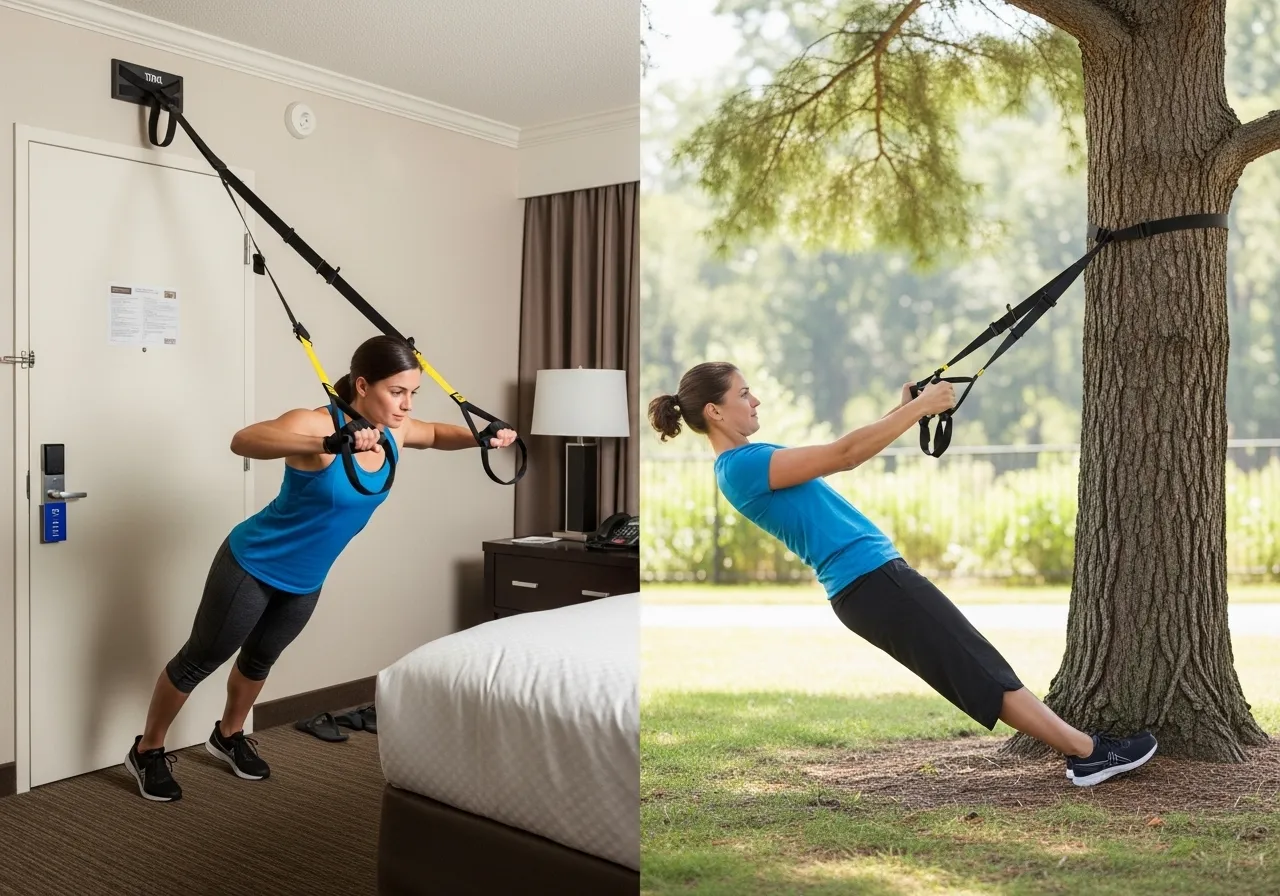
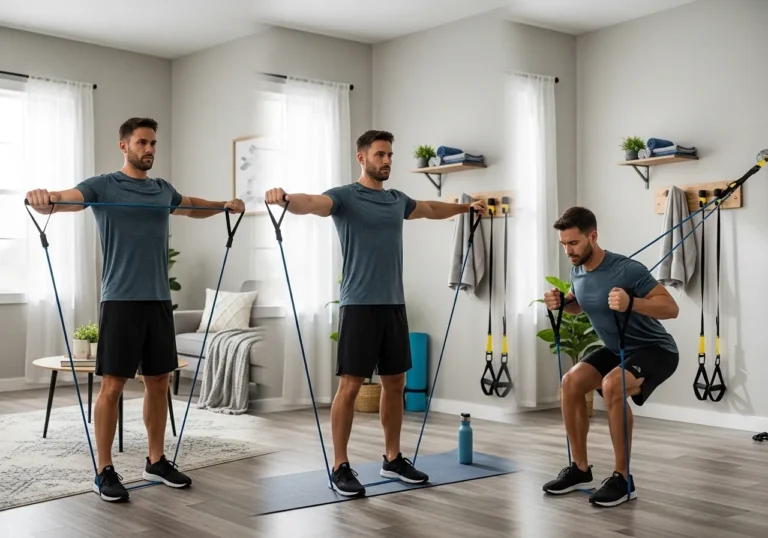
The TRX’s most practically significant advantage is its portability — the entire training system weighs approximately 450 grams, fits in a small bag, and can be set up anywhere with a sturdy anchor point (a pull-up bar, a door frame with the door anchor attachment, a tree branch, or a squat rack) within sixty seconds. This portability makes comprehensive strength training genuinely available in hotel rooms, outdoor parks, home garages, and any location where a traditional gym is unavailable.
Home Training Applications
For home gym athletes, a TRX suspension trainer provides the horizontal pulling exercise that is the most difficult movement pattern to train at home without dedicated equipment. Pushups, squats, and lunges are easily performed with bodyweight; pull-ups require a bar; but rows require either a barbell with a rack, a cable machine, or a TRX anchored to a door. The TRX’s door anchor — a small piece of foam that wraps around the top of a closed door — creates an immediate, stable anchor that allows rows, face pulls, and all pulling exercises within any room with a standard door. A complete home training program using only a TRX and a door: TRX rows for back, TRX push-ups for chest and shoulders, TRX squats and lunges for legs, TRX planks and fallouts for core — all of these can be performed in a small space with no additional equipment. Research on home training programs using suspension trainers confirms equivalent fitness outcomes to gym-based training programs in populations with home TRX access, validating the suspension trainer as a legitimate comprehensive training system rather than merely a travel convenience. According to research on bodyweight and suspension training effectiveness, progressive suspension training produces strength and fitness improvements equivalent to traditional gym-based resistance training when exercises are loaded appropriately through angle adjustment.
Travel Training Solutions
For athletes who travel regularly and struggle to maintain training consistency during travel, the TRX eliminates the gym dependence that makes travel training impractical. A TRX in the suitcase and a hotel room door provides the training system for a complete strength workout within fifteen minutes of arrival — no gym location research, no day pass fees, no equipment availability uncertainty. The consistency that this portability enables — training in hotel rooms rather than skipping training during travel weeks — produces the compounding fitness development that travel-interrupted training cannot achieve. Athletes who commit to traveling with and using a TRX during work trips consistently report better fitness maintenance during high-travel periods than those who rely on finding appropriate hotel gyms.
Action point: If you travel regularly for work, add a TRX to your regular packing list alongside your laptop and phone charger. The investment of eighty to one hundred and fifty dollars for the suspension trainer produces training consistency during travel that prevents the fitness regression that travel weeks otherwise impose.
TRX for Endurance Athletes: Cross-Training Benefits
Runners, cyclists, and swimmers increasingly incorporate TRX training as cross-training that develops the specific strength and stability qualities that their primary sport underemphasizes. Runners benefit from TRX single-leg work (single-leg squats, single-leg deadlifts, pistol progressions) that develops the hip stability and single-leg strength that running demands under load — developing these qualities through TRX work allows runners to address their functional strength weaknesses without the impact stress of additional running. Cyclists benefit from TRX upper body work that counterbalances the forward-hunched cycling position — TRX rows, face pulls, and thoracic extension exercises reverse the postural adaptations that cycling creates. Swimmers benefit from TRX pulling exercises that develop the lat and mid-back strength that the water’s resistance develops in competition but that dryland training often neglects. Research on cross-training for endurance athletes consistently finds that functional strength training addressing the sport-specific stability demands produces performance improvements that cardiovascular training alone cannot generate — confirming TRX training’s specific value for endurance athlete development beyond the purely cardiovascular focus that most endurance programs maintain. According to research on strength training and endurance performance, functional strength training that addresses sport-specific stability and movement quality produces significant endurance performance improvements in athletes who have previously neglected this training component.
TRX Programming: Integration With Conventional Training
The TRX integrates into conventional gym training most effectively as a supplementary tool that addresses the stabilization and functional movement qualities that barbells and machines underemphasize, rather than as a complete replacement for the heavy compound training that maximum strength development requires.
TRX as Warm-Up Tool
TRX exercises performed at low intensity before conventional training sessions prepare the joint stabilizers and movement patterns that the subsequent training demands. TRX rows before barbell rows activate the scapular stabilizers and posterior deltoid in the movement pattern they will perform under heavier load; TRX squats before barbell squats develop the hip stability and range of motion that heavy squatting requires; TRX push-ups before bench pressing activate the serratus anterior that provides the scapular stability that safe pressing demands. This warm-up application requires five to ten minutes, adds no recovery demand to the training session, and consistently produces better performance quality in the subsequent conventional exercises by ensuring the stabilizers are activated and the movement patterns are established before heavy loading begins.
TRX as Accessory and Finisher
After primary strength training, TRX exercises provide additional training volume at lower absolute loads that accumulate metabolic stress without the heavy joint loading that additional barbell sets would impose. TRX rows after heavy barbell rows add mid-back volume that accelerates hypertrophy development without the spinal compressive load of additional barbell rowing. TRX single-leg squats after heavy bilateral squatting add unilateral strength and balance development that bilateral squatting cannot provide. TRX fallouts after heavy compound training provide the core volume that the training session’s compound movements did not specifically address. This accessory use of the TRX — lower load, higher stability demand, addressing the stabilizer and unilateral qualities that heavy compound work underemphasizes — produces more complete physical development than compound-only training programs that leave the stabilizer qualities unaddressed.
Complete TRX-Only Training Programs
For home training contexts or travel periods where conventional equipment is unavailable, a complete TRX-only training program produces meaningful strength and fitness development. A three-day-per-week full-body TRX program: session A — TRX row (3×12), TRX push-up (3×12), TRX squat (3×15), TRX plank (3×30 seconds); session B — TRX single-arm row (3×10 per side), TRX decline push-up (3×10), TRX reverse lunge (3×12 per side), TRX fallout (3×8); session C — TRX face pull (3×15), TRX pike push-up (3×10), TRX pistol squat (3×8 per side), TRX body saw (3×12). This program addresses horizontal and vertical pulling, horizontal and vertical pushing, bilateral and unilateral lower body work, and targeted core training — the complete training stimulus that comprehensive fitness development requires, achievable with a single piece of portable equipment. According to ACSM program design guidelines, programs that address all major movement patterns produce comprehensive fitness development regardless of the specific equipment used, validating TRX-only programs as genuinely complete training approaches.
Action point: Design your next week’s training to include TRX rows before every pulling session, TRX push-ups before every pressing session, and TRX planks or fallouts at the end of every training session. Track the qualitative change in stabilizer activation during the conventional exercises that follow the TRX warm-up sets.
Advanced TRX Exercises: Developing Elite-Level Strength and Control
Athletes who have mastered the foundational TRX exercises have access to an advanced exercise library that challenges elite-level strength and body control. The TRX atomic push-up — combining a push-up with a knee tuck from the feet-in-straps position — requires exceptional core strength and shoulder stability simultaneously. The TRX clock press — starting in the standard push-up position and rotating one arm to point directly to the side (like a clock’s hand at nine o’clock) while the other maintains the plank — develops extreme unilateral shoulder stability. The TRX muscle-up transition — moving from a row position below the handles through the transition point to a dip above — requires the explosive pulling strength and coordination that few athletes can achieve without dedicated practice. The TRX L-sit — maintaining the legs extended horizontally while supporting the body weight through the handles — demands extreme hip flexor and core strength that even strong athletes find initially impossible. These advanced exercises provide years of continued challenge for athletes who master the foundational movements, confirming that the TRX’s progression ceiling is not a limitation for most recreational athletes who typically find the intermediate exercises sufficiently challenging throughout their training careers. The advanced exercises serve as long-term aspirational goals that motivate continued practice and provide objective measures of physical development that the foundational exercises eventually become too easy to assess.
TRX Training Myths Debunked
Several persistent myths about TRX training prevent athletes from giving it the serious consideration that its training value deserves. Myth one: “TRX is only for beginners or rehabilitation.” The advanced exercises described above — and the general difficulty of any TRX exercise at sufficient body angle — provide genuine challenge for even elite athletes. Professional sports teams and military special operations units use TRX training not as beginner work but as sophisticated functional training that conventional equipment cannot replicate as specifically. Myth two: “TRX cannot build serious muscle because it uses only bodyweight.” As discussed throughout this article, the research is clear: progressive suspension training at sufficient intensity produces muscle hypertrophy equivalent to conventional resistance training. The “only bodyweight” characterization misses the reality that bodyweight can produce substantial training intensity at the body angles that make TRX exercises genuinely challenging. Myth three: “TRX is just glorified yoga.” The instability, progressive loading capacity, and high metabolic demand of vigorous TRX training share nothing with yoga’s static, low-intensity, flexibility-focused practice beyond superficial visual similarity of some body positions. The physiological demands and training adaptations are entirely distinct. Myth four: “You need a special TRX class to learn it.” The core exercises described in this article can be learned from video demonstrations and practiced independently within a single session, with quality improving through consistent practice without requiring formal instruction. ACSM suspension training guidance consistently identifies TRX as a legitimate, evidence-supported training modality appropriate for athletes across all fitness levels and training goals.
TRX for Rehabilitation and Special Populations
The TRX’s adjustable intensity (through body angle), load-sharing mechanics, and supported movement patterns make it one of the most versatile rehabilitation and special population training tools available. Physical therapists, sports medicine physicians, and exercise physiologists increasingly prescribe TRX exercises for populations whose joint conditions, fitness levels, or rehabilitation status makes conventional resistance training inappropriate or inaccessible.
Lower Back Rehabilitation
Athletes recovering from lumbar disc issues or sacroiliac dysfunction who cannot safely perform axially loaded exercises (squats, deadlifts) often find TRX exercises immediately tolerable — the suspension trainer’s angle-based loading eliminates the spinal compressive forces that conventional loading imposes while still providing the muscle activation that prevents deconditioning during rehabilitation. TRX squats with the straps providing partial body support allow progressive lower body loading from zero (full body weight support) through graduated fractions of body weight to full body weight as rehabilitation progresses, providing the precise load titration that disc herniation recovery requires. Research on TRX use in lumbar rehabilitation confirms its effectiveness for maintaining lower body strength and function during periods when conventional loading is contraindicated.
Older Adults and Balance Development
TRX training for older adults provides both the strength development that prevents the sarcopenia (muscle loss) of aging and the balance and proprioceptive development that reduces fall risk — the primary cause of injury-related death in adults over 65. The TRX’s handles provide a stability assist during exercises that allows older adults to perform squats, lunges, and single-leg exercises through greater ranges than their balance would otherwise allow, developing the strength and stability simultaneously that fall prevention requires. Research on TRX training in older adults finds significant improvements in lower body strength, balance, and functional performance that conventional seated machine training cannot achieve as specifically due to the TRX’s upright, functionally relevant movement patterns. According to research on suspension training and functional fitness in older adults, TRX-based programs produce significant improvements in balance, strength, and fall prevention measures in adults over 60, validating suspension training as a particularly appropriate exercise modality for this population.
Youth Athletic Development
Youth athletes (ages twelve to eighteen) benefit from TRX training’s development of the fundamental movement quality, joint stability, and body control that athletic performance requires as its foundation. The TRX’s bodyweight-relative loading automatically adjusts to the athlete’s size — a twelve-year-old performing a TRX row at the same angle as an adult loads their muscles proportionally relative to their body weight, making the exercise self-scaling without the equipment adjustment that conventional resistance training requires for each individual. Youth athletes who develop movement quality through TRX training — the body control, proprioception, and functional stability that suspension training specifically develops — perform better when they transition to conventional strength training because the movement foundation that heavy barbell training demands is already established.
Action point: If you know an older adult who avoids strength training due to balance concerns or equipment complexity, introduce them to TRX training with the straps providing balance support during squats and lunges. The immediate accessibility of this entry point — challenging movement performed safely with the stability assist that the straps provide — often converts exercise-avoidant older adults into regular practitioners within a few sessions.
The TRX suspension trainer is the training tool most likely to transform your opinion of bodyweight training — from a limited, equipment-free compromise to a legitimate, challenging, and uniquely effective training system that develops the stability, strength, and movement quality that conventional equipment leaves systematically unaddressed. Give it three weeks of consistent, serious application and discover what professional athletes, physical therapists, and military fitness specialists have known for years: the suspension trainer is not a beginner’s toy or a rehabilitation device but a sophisticated training system that produces physical development that no other portable, affordable piece of equipment can approach. The straps are simple; the training they enable is anything but. Commit to learning the exercises correctly, progress the difficulty through the angle and tempo manipulations described, and let the compound physical adaptations — strength, stability, body composition, and movement quality — accumulate across the consistent practice that this remarkably versatile tool deserves and consistently rewards.
Frequently Asked Questions About TRX and Suspension Training
Can TRX build real muscle, or is it just for cardio and stability?
TRX training builds genuine muscle hypertrophy when exercises are performed at sufficient intensity — specifically, when the body angle creates enough resistance that the final two to three reps of each set require genuine effort. Research comparing TRX training to conventional resistance training for muscle development finds equivalent hypertrophic outcomes when relative intensities are matched, confirming that the mechanical tension that drives muscle growth is achievable through suspension training at appropriate difficulty levels. The practical limitation: very strong athletes eventually outgrow the loading capacity of bodyweight exercises at any angle, requiring added resistance (weight vests, weighted backpacks) to continue providing the progressive overload that hypertrophy requires. For most recreational athletes whose strength levels have not exceeded what bodyweight can provide, TRX training produces genuine muscle development that compound gym exercises produce through different mechanics but equivalent physiological mechanisms. According to ACSM hypertrophy training guidelines, mechanical tension is the primary driver of muscle hypertrophy regardless of the source — bodyweight via suspension training produces this tension as effectively as external load via barbells and dumbbells when exercise intensity is sufficient.
What is the difference between TRX and other suspension trainers?
TRX is the original and most widely distributed suspension training brand, with the largest library of exercises, the most research, and the most widespread availability in commercial gyms. Other suspension trainers — Jungle Gym, Monkii Bars, and various generic brands — provide equivalent exercise functionality at lower price points. The primary differences are build quality (TRX’s nylon straps and metal hardware are more durable than some generic alternatives), handle comfort (TRX’s foam handles are consistently comfortable; cheaper alternatives vary), and anchor system reliability (TRX’s door anchor and various mounting systems are proven across millions of users; generic alternatives may be less reliable under sustained loading). For commercial gym use, TRX equipment is standard; for home purchase, TRX’s quality justifies its premium price over generic alternatives for athletes who will use it intensively across years, while generic alternatives provide adequate quality for occasional use or travel applications.
How do I progress on TRX exercises when I can’t add weight?
TRX progression follows several pathways beyond the primary angle adjustment that most users know. Tempo manipulation — slowing the eccentric phase to three to five seconds — dramatically increases the training demand without changing the body angle. Pause at the end range — holding the fully contracted position for two to three seconds before returning — eliminates elastic rebound and increases time under tension. Range of motion increase — deliberately extending the range slightly beyond the standard position — increases the mechanical demand at the lengthened position where hypertrophic stimulus is greatest. Single-limb progression — transitioning from bilateral to unilateral exercises (two-arm TRX row to single-arm TRX row) — doubles the relative load without any equipment change. Adding external load — a weight vest or weighted backpack — provides the conventional progressive overload for athletes who have exhausted bodyweight progression options. These five progression strategies provide years of continued TRX development beyond what angle adjustment alone can sustain.
Is TRX appropriate for complete beginners?
Yes — TRX is actually more beginner-friendly than most conventional resistance training equipment because its intensity is immediately adjustable to any fitness level through body angle and foot position changes that require no weight selection or equipment adjustment. A complete beginner can start TRX rows at a very steep angle (body nearly upright, minimal load) and progress to a more horizontal position as strength develops, providing a smooth continuum from zero experience to advanced training without the load selection challenges of barbell training. The TRX’s instability initially challenges beginners but also develops the motor control and proprioception that makes all subsequent training more effective — beginners who start with TRX consistently develop better movement quality faster than those who start with machines that guide movement without requiring active stabilization.
The suspension trainer rewards every athlete who gives it genuine, committed attention — delivering the functional strength, stability, and movement quality that distinguish athletes who train comprehensively from those who rely on heavy loading alone to produce the physical development that complete training programs require.
TRX suspension training bodyweight strength anywhere portableThe TRX delivers what training promises — genuine physical development through honest effort applied to effective exercise — and it does so anywhere, anytime, with equipment that fits in your pocket.
⚠️ Fitness Disclaimer: The information in this article is for general educational purposes only and does not constitute professional fitness or medical advice. Always consult a qualified healthcare professional before starting any new exercise program, especially if you have existing injuries or medical conditions. Resistance Bands: The $30 Training Tool That Belongs in Every Serious…
Why the Landmine Is the Most Versatile and Underused Training Tool in the Gym The landmine — a barbell anchored at one end in a pivot device or wedged into a corner, with the free end loaded with plates — is one of the most versatile training tools available in any gym and one of…
⚠️ Fitness Disclaimer: The information in this article is for general educational purposes only and does not constitute professional fitness or medical advice. Exercise carries inherent risks. Always consult a qualified healthcare professional or certified personal trainer before starting or modifying any exercise program, especially if you have a pre-existing medical condition, injury, or health…
⚠️ Fitness Disclaimer: The information in this article is for general educational purposes only and does not constitute professional fitness or medical advice. Always consult a qualified healthcare professional before starting any new exercise program, especially if you have existing injuries or medical conditions. Why the Kettlebell Is the Most Efficient Training Tool in Existence…
⚠️ Fitness Disclaimer: The information in this article is for general educational purposes only and does not constitute professional fitness or medical advice. Always consult a qualified healthcare professional before starting any new exercise program, especially if you have existing injuries or joint conditions. Why Strength Alone Will Never Make You Truly Explosive I squatted…
⚠️ Fitness Disclaimer: The information in this article is for general educational purposes only and does not constitute professional fitness or medical advice. Always consult a qualified healthcare professional before starting any new exercise program, especially if you have existing injuries or medical conditions. The Ball That Made My Conventional Training Feel Incomplete I added…