Heart Rate Zones Explained: How to Train Smarter and See Faster Results

Why Training by Feel Is Keeping You From Getting Fitter
For two years I ran “hard enough” on my cardio mistakes days. Some days hard meant genuinely difficult. Other days it meant moderately uncomfortable. My fitness improved for the first few months and then — nothing. I was putting in the time, generating the sweat, feeling the effort, and going absolutely nowhere in terms of measurable cardiovascular improvement.
The problem, a sports physiologist told me, was that I was training almost exclusively in the middle — a moderate intensity range that is simultaneously too hard to provide the aerobic base adaptations of true low-intensity training and too easy to provide the VO2max stimulus of genuine high-intensity training. I was in the metabolic gray zone: doing a lot of work and getting the adaptations from almost none of it.
Heart rate zones provide the objective intensity calibration that transforms cardio training from effortful habit into precisely targeted physiological development. Understanding them changes not just how hard you train but which specific physiological systems you’re actually developing — and why training at the right intensity for the right purpose produces results that undifferentiated effort cannot.
What Heart Rate Zones Actually Measure
Heart rate zones are ranges of exercise intensity defined as percentages of maximum heart rate (MHR). Each zone corresponds to a different metabolic state — different energy systems predominating, different physiological adaptations occurring, different training purposes being served. Training in each zone produces specific physiological changes that other zones cannot replicate, which is why understanding zones transforms training from generic cardio into targeted physiological development.
The Maximum Heart Rate Foundation
All zone calculations begin with maximum heart rate. The standard formula — 220 minus age — provides a population average with significant individual variation. A 40-year-old’s estimated MHR is 180 bpm, but their actual MHR may range from 165 to 195 bpm. For precision training, a maximal exercise test (performed under medical supervision for those with cardiovascular risk factors) provides the actual individual MHR from which accurate zones can be calculated. For recreational athletes, the formula provides a reasonable starting approximation that can be refined through observed performance at known intensities.
The Problem With the 220 Minus Age Formula
The 220 minus age formula for estimating maximum heart rate is one of the most widely used and most inaccurate tools in exercise science. The formula was derived from a rough extrapolation of data in the 1970s and was never intended to be applied to individual athletes — its developer, Dr. William Haskell, has publicly stated that the formula was a rough population average for epidemiological research, not a prescription tool. The actual variation in maximum heart rate among people of the same age is enormous — standard deviation is approximately 10-12 beats per minute, meaning that two people of the same age could have maximum heart rates differing by 20-24 beats per minute and both be perfectly normal. This variation translates directly into heart rate zone errors: if your actual maximum heart rate is 185 but the formula predicts 175, your calculated Zone 2 training guide range of 105-122 is actually well below true Zone 2, meaning you would need to work harder than the formula suggests to achieve genuine Zone 2 training stimulus. Testing actual maximum heart rate through a properly administered maximal exercise test, or using the Karvonen formula that incorporates resting heart rate for more individualized zone calculation, produces significantly more accurate training zones than the age-based formula. According to research published in NCBI on maximum heart rate prediction, age-based formulas have standard errors of 10-12 beats per minute, making them insufficiently precise for individualized training zone prescription.
Why Perceived Exertion Alone Is Insufficient for Zone Training
Perceived exertion — how hard an effort feels — is a valuable training tool but an unreliable standalone guide for heart rate zone training. Numerous factors cause perceived exertion to diverge from actual physiological intensity: fatigue causes an effort to feel harder than its heart rate indicates; caffeine and stimulants cause efforts to feel easier than their heart rate indicates; heat and humidity increase perceived exertion without equivalent heart rate changes at the beginning of a session; and individual variation in pain tolerance and effort perception means that the same perceived exertion corresponds to different heart rate percentages in different people. A recreational athlete who trains by feel alone consistently makes the same systematic errors: training too hard on easy days (because Zone 2 feels insufficiently effortful), not hard enough on hard days (because maximum effort is uncomfortable to sustain), and spending most training time in the gray-zone moderate intensity that produces the least training stimulus per hour. Heart rate monitoring corrects these systematic errors by providing objective real-time feedback that accumulated training experience and subjective effort perception alone cannot provide. The investment in understanding and consistently using heart rate zone monitoring produces better training decisions that compound into superior cardiovascular development over the months and years of consistent training that meaningful fitness improvement requires. Research comparing RPE and heart rate as training intensity guides confirms that objective heart rate monitoring produces more appropriate training intensity distribution than subjective effort perception in recreational athletes across multiple studies.
Heart rate zone training transforms cardio from guesswork into a precise, data-driven practice that consistently produces the specific physiological adaptations each zone is designed to develop — the foundation of cardiovascular fitness improvement that effort alone cannot guarantee.
Heart rate zones provide the precision that transforms cardiovascular training from effort-based activity into targeted physiological development — the difference between working hard and working smart that determines long-term results.
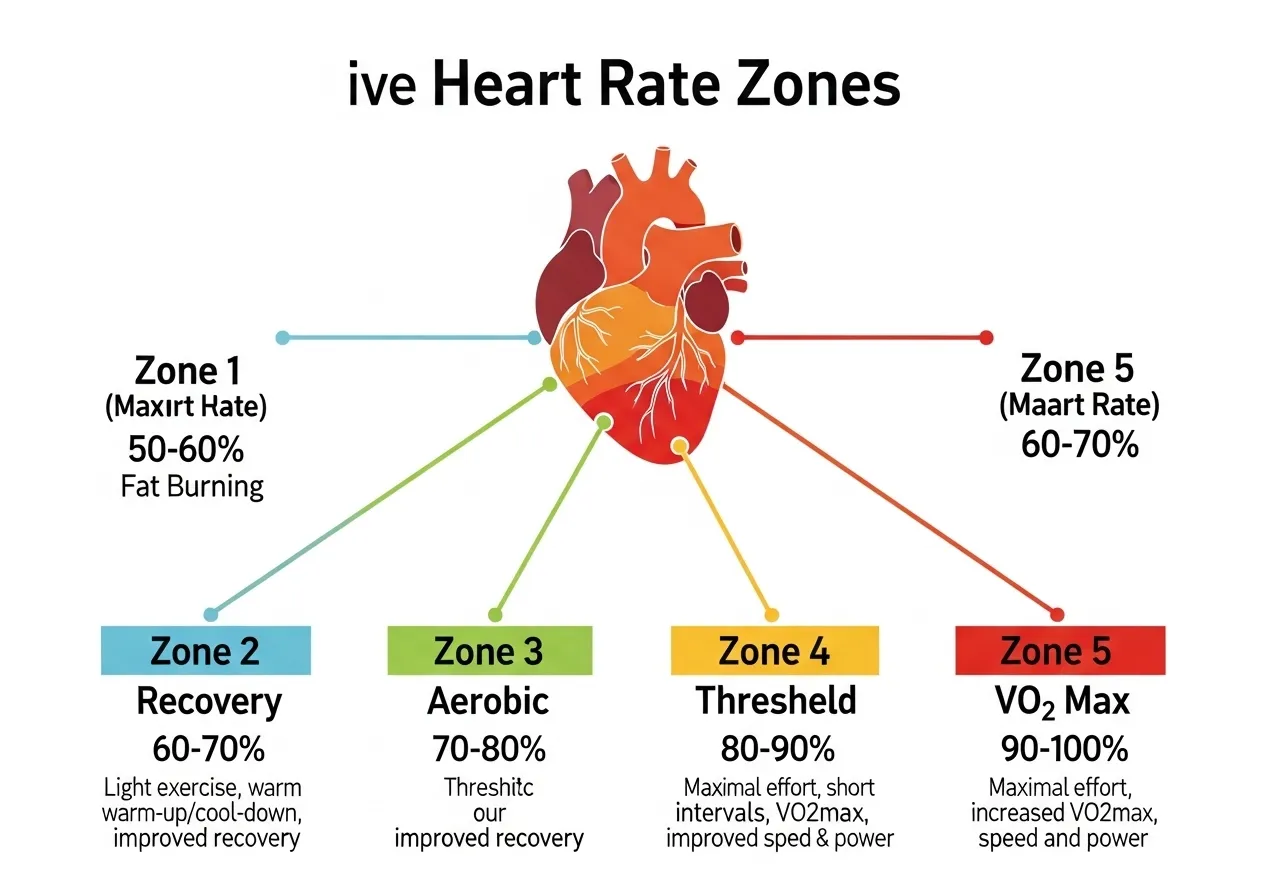
The Five Heart Rate Zones: What Each One Does to Your Body
Zone 1: Active Recovery (50 to 60% MHR)
Zone 1 is the walking, easy cycling, gentle movement zone where the cardiovascular system is barely elevated above resting. The physiological stimulus is minimal for trained individuals, but Zone 1 serves a genuine purpose: it facilitates active recovery by increasing blood flow to muscles without imposing additional training stress. Zone 1 sessions accelerate clearance of metabolic byproducts from harder training days, reduce muscle soreness, and maintain the movement habit on days when full training isn’t appropriate. For beginners with very low baseline fitness, Zone 1 may represent a genuine aerobic development stimulus — but for most recreational athletes, it functions as recovery rather than training.
Zone 2: Aerobic Base (60 to 70% MHR)
Zone 2 is the conversation zone — effort where you can speak full sentences without significant breathlessness. It is the primary zone for aerobic base development, mitochondrial biogenesis (the creation of new mitochondria that perform aerobic energy production), and fat oxidation capacity. Research on endurance training intensity consistently identifies Zone 2 as the primary zone used by elite endurance athletes — typically 70 to 80 percent of their total weekly training volume. Research on training intensity distribution in endurance athletes confirms that this disproportionate Zone 2 emphasis produces superior long-term aerobic development compared to moderate-intensity dominant training distributions. Zone 2 feels genuinely easy to most people — uncomfortably so for those accustomed to harder training — which is why most recreational athletes dramatically undertrain this zone.
Zone 3: Aerobic Development (70 to 80% MHR)
Zone 3 is the comfortably hard zone — breathing is noticeably elevated, conversation requires effort. This zone develops aerobic capacity and endurance but through mechanisms different from Zone 2. It is metabolically demanding enough to significantly deplete glycogen and accumulate lactate but not intense enough to produce the VO2max stimulus of Zones 4 and 5. Zone 3 is the most commonly overtrained zone for recreational athletes — it is the effort level that feels like “a real workout” while producing moderate adaptations at high fatigue cost. Elite endurance coaches often call this the “junk zone” — too hard for Zone 2’s aerobic base development, too easy for Zone 4’s VO2max stimulus.
Zone 4: Lactate Threshold (80 to 90% MHR)
Zone 4 is the sustainably hard zone — effort that can be maintained for 20 to 60 minutes for trained athletes. Physiologically, Zone 4 trains the lactate threshold: the intensity at which lactate accumulation begins to exceed clearance capacity. A higher lactate threshold means you can sustain higher absolute intensities before fatigue accumulates — the primary training adaptation that improves performance in events lasting 20 to 60 minutes. Lactate threshold training in Zone 4 is highly productive for performance but demanding — it requires more recovery than Zone 2 training and cannot be accumulated at the same volume.
Zone 5: VO2 max guide (90 to 100% MHR)
Zone 5 is maximal intensity — effort that is sustainable only for 30 seconds to several minutes. Training in Zone 5 develops VO2max: the maximum rate at which the cardiovascular system can deliver and the muscles can use oxygen. VO2max is the single best predictor of long-term cardiovascular health and athletic endurance performance. Research on exercise intensity and VO2max development confirms that high-intensity Zone 5 work is the most efficient single stimulus for improving VO2max, though it requires adequate Zone 2 base to be sustainable and productive over time.
Zone 2 Training: The Most Underused Zone in Recreational Fitness
Zone 2 training — sustained effort at 60-70% of maximum heart rate, a pace where you can hold a full conversation — is simultaneously the most evidence-supported and most neglected training zone in recreational fitness. The reason it is neglected is psychological: Zone 2 feels too easy. Recreational athletes who train with effort-based intuition consistently push into Zone 3 (the moderate intensity gray zone) because Zone 2 feels insufficiently challenging to be productive. This intuition is wrong. Zone 2 is where the greatest mitochondrial biogenesis occurs — the creation of new mitochondria that expands aerobic capacity over time. It is where fat oxidation rates are highest, contributing to body composition improvements. And it is where aerobic base development occurs — the foundation of cardiovascular efficiency that determines how well the body performs at all higher intensities. Elite endurance athletes spend 80% or more of their training volume in Zone 2 precisely because their coaches and physiology support understand what recreational athletes often do not: the base determines the ceiling. Research from Dr. Iñigo San Millán at the University of Colorado, whose work on Zone 2 training has influenced elite athletes across multiple endurance sports, confirms that Zone 2 training produces metabolic adaptations measurable in mitochondrial function, lactate clearance capacity, and fat oxidation efficiency that higher-intensity training cannot replicate. Research on Zone 2 training adaptations confirms these adaptations across multiple study populations.
Translating Heart Rate Zone Research to Practical Training Plans
The gap between exercise science research on heart rate zones and practical training implementation often leaves recreational athletes uncertain about how to apply academic findings to their weekly schedules. The translation is straightforward when the core principles are understood. Zone 2 training requires enough time at the appropriate intensity to stimulate mitochondrial adaptation — sessions shorter than twenty minutes provide insufficient stimulus, while sessions of thirty to sixty minutes at Zone 2 provide the duration that drives meaningful adaptation. Frequency matters more than individual session duration for Zone 2 adaptation — four thirty-minute Zone 2 sessions per week produces better aerobic base development than two sixty-minute sessions, because the four-session frequency provides more frequent mitochondrial stimulus signals without requiring dramatically more total time. High-intensity Zone 4-5 work requires adequate recovery between sessions — forty-eight to seventy-two hours of lower-intensity training or rest between hard interval sessions prevents the accumulated neuromuscular fatigue that compromises interval quality and reduces the training stimulus. Applying these three principles — appropriate session duration, sufficient weekly frequency for Zone 2, and adequate recovery between Zone 4-5 sessions — translates the research evidence into a practical training structure that produces the adaptations the research describes for any recreational athlete regardless of sport or fitness goal. ACSM exercise prescription guidelines provide comprehensive frameworks for translating cardiovascular exercise research into practical training programs across all fitness levels and health goals.
.

How to Calculate Your Personal Heart Rate Zones
Step 1: Estimate or Measure Maximum Heart Rate
Formula method: subtract your age from 220. A 35-year-old gets an estimated MHR of 185 bpm. Apply the zone percentages to this number: Zone 1 is 93 to 111 bpm, Zone 2 is 111 to 130 bpm, Zone 3 is 130 to 148 bpm, Zone 4 is 148 to 167 bpm, Zone 5 is 167 to 185 bpm. These numbers are starting approximations — if they feel misaligned with your perceived effort during exercise (Zone 2 feeling extremely hard, for example), your actual MHR likely differs from the formula estimate.
Step 2: Calibrate With Perceived Effort
Zone 2 should allow full-sentence conversation without stopping. If you cannot speak full sentences at your calculated Zone 2 heart rate, your actual MHR is likely higher than the formula predicts — shift your zones up by 5 to 10 bpm. If Zone 2 feels trivially easy rather than comfortably sustained, your actual MHR may be lower than predicted — shift zones down. The calibration process takes two to three sessions of honest assessment and produces zones that are genuinely individual rather than formulaically approximate.
Step 3: Use Technology Appropriately
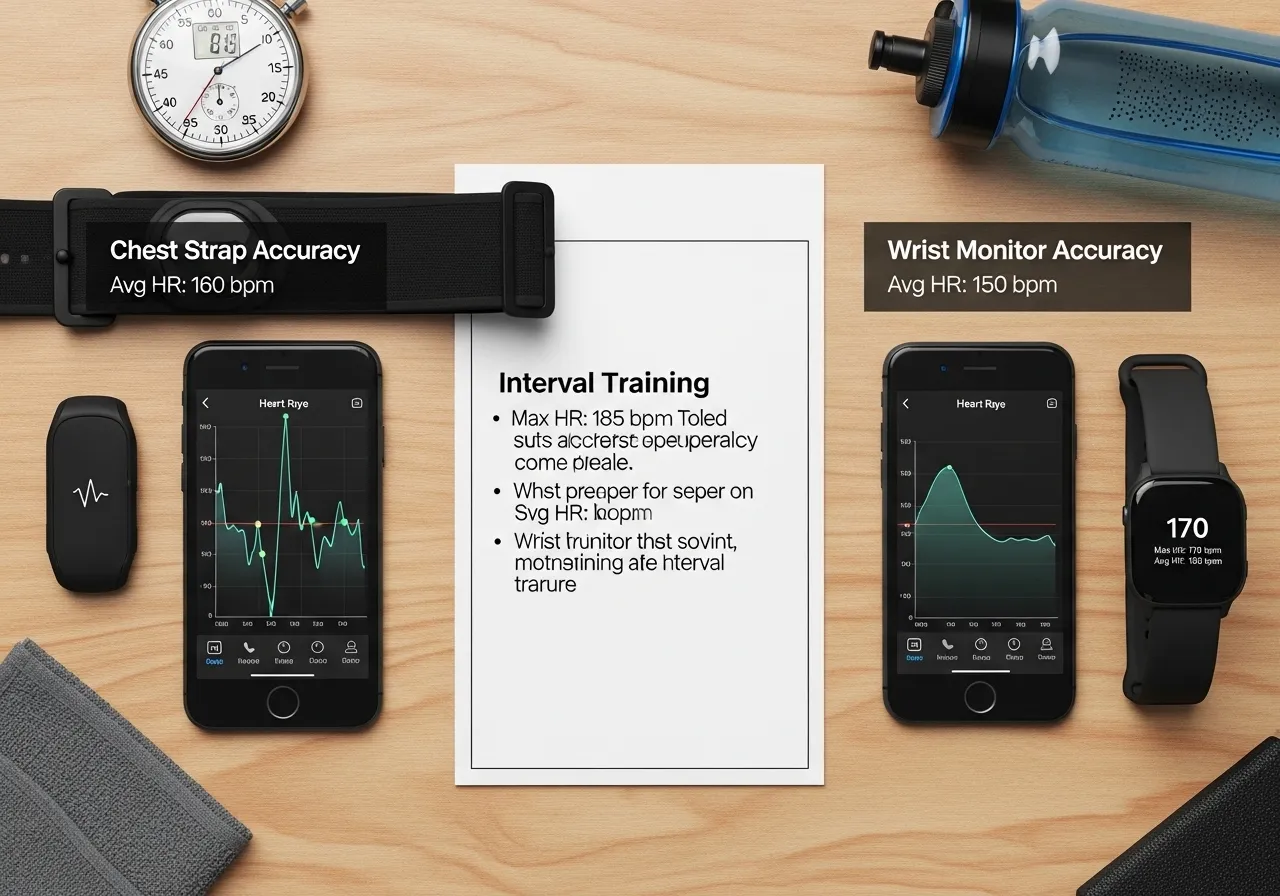
Chest strap heart rate monitors provide the most accurate real-time measurement, with accuracy within 1 to 2 bpm during most exercise intensities. Wrist-based optical heart rate monitors (smartwatches and fitness trackers) are convenient but less accurate, particularly during high-intensity exercise where arm movement creates signal artifacts. For Zone 2 training where intensity management is critical, a chest strap is significantly more reliable than wrist-based monitoring. For Zone 5 high-intensity work where exact bpm precision is less critical (you will know you are at maximum intensity without needing precise numbers), wrist monitoring is adequate.
The Cardiac Drift Problem
Heart rate at a given exercise intensity increases over the duration of prolonged exercise — a phenomenon called cardiac drift — due to dehydration, heat accumulation, and fatigue. A 45-minute Zone 2 run that begins at 125 bpm may end at 140 bpm even at the identical pace. Accounting for cardiac drift: either slow your pace to maintain the target heart rate range throughout, or use pace rather than heart rate as the primary metric for longer Zone 2 sessions once you have established the correlation between pace and Zone 2 heart rate for your current fitness level.
The Lactate Threshold and Why Zone 4 Training Changes Everything
The lactate threshold — the exercise intensity at which blood lactate accumulation begins to exceed the body’s ability to clear it — is the single most important physiological determinant of endurance performance beyond VO2 max. Athletes who can sustain high intensities below their lactate threshold outperform those with higher VO2 max but lower lactate thresholds, because lactate threshold determines how close to maximum capacity sustainable effort can be maintained. Zone 4 training — sustained effort at 80-90% of maximum heart rate, at or slightly above the lactate threshold — specifically develops the threshold by improving the body’s lactate clearance mechanisms, increasing the density of mitochondria in fast-twitch muscle fibers, and raising the relative intensity at which lactate accumulation begins. A well-developed lactate threshold allows athletes to sustain Zone 3-4 efforts for longer before fatiguing, directly improving performance in any cardiovascular activity lasting more than 10-15 minutes. Threshold training sessions — typically twenty to forty minute sustained efforts at Zone 4 intensity, or interval sessions with repeated Zone 4 intervals of five to fifteen minutes — should constitute approximately ten to fifteen percent of weekly training volume in a polarized approach, providing the specific threshold stimulus without dominating the training program at the expense of Zone 2 base development.
Heart Rate Drift and Its Implications for Zone Training
Cardiac drift is the progressive increase in heart rate during sustained steady-state exercise at constant effort, occurring because increasing body temperature and dehydration cause the heart to beat faster to maintain the same cardiac output as stroke volume decreases slightly. During a sixty-minute Zone 2 run, heart rate may drift five to fifteen beats per minute from start to finish despite constant effort and pace. This drift has important implications for heart rate zone training: targeting a fixed heart rate throughout a long steady-state session will cause pace to slow progressively, reducing the actual training stimulus. The solution is either to allow pace to drop slightly to maintain heart rate in zone (prioritizing heart rate), or to maintain pace and allow heart rate to drift above zone (prioritizing effort level). Neither approach is universally correct — the choice depends on whether the session goal is metabolic zone training (prioritize heart rate) or pace development (prioritize pace). Understanding cardiac drift also explains why heat and humidity make Zone 2 training feel harder than usual — the cardiovascular demand of thermoregulation in hot conditions drives heart rate higher at equivalent exercise intensities, reducing the pace sustainable at the target heart rate. Adjusting pace expectations downward in hot conditions while maintaining heart rate targets produces more appropriate training stimulus than attempting to maintain normal pace at elevated heart rates that exceed the intended zone.
Heart Rate Response to Different Environmental Conditions
Environmental conditions significantly affect heart rate at any given exercise intensity, and understanding these effects prevents misinterpretation of heart rate data and inappropriate training intensity adjustments. Heat and humidity increase heart rate at equivalent exercise intensities by five to twenty beats per minute, because the cardiovascular system must simultaneously supply working muscles with oxygenated blood and support thermoregulation through increased skin blood flow. Training in hot and humid conditions at Zone 2 heart rate therefore requires substantially slower pace than cool-weather Zone 2 training — the cardiovascular work of thermoregulation is additive to the exercise work, producing higher heart rate at equivalent speed. Altitude reduces oxygen availability, causing heart rate to increase at equivalent submaximal intensities because each breath delivers less oxygen and the heart must beat more frequently to maintain oxygen delivery. Athletes training at altitude above 1500 meters should reduce training intensity based on heart rate rather than pace until the altitude adaptation (increased red blood cell production) develops over two to three weeks. Cold conditions tend to lower exercise heart rate slightly at equivalent intensities by reducing peripheral vasodilation, allowing more blood to remain in central circulation where it maintains cardiac output at slightly lower heart rates. Understanding these environmental effects allows appropriate training adjustments that maintain zone-appropriate stimulus regardless of conditions, rather than forcing performance metrics that make sense only under standard conditions.
Understanding environmental effects on heart rate allows more accurate zone compliance across all training conditions, producing consistent cardiovascular stimulus regardless of whether sessions occur indoors or outdoors, in summer or winter, at sea level or altitude.
Building a Heart Rate Zone Training Week
The Polarized Distribution: The Evidence-Based Template
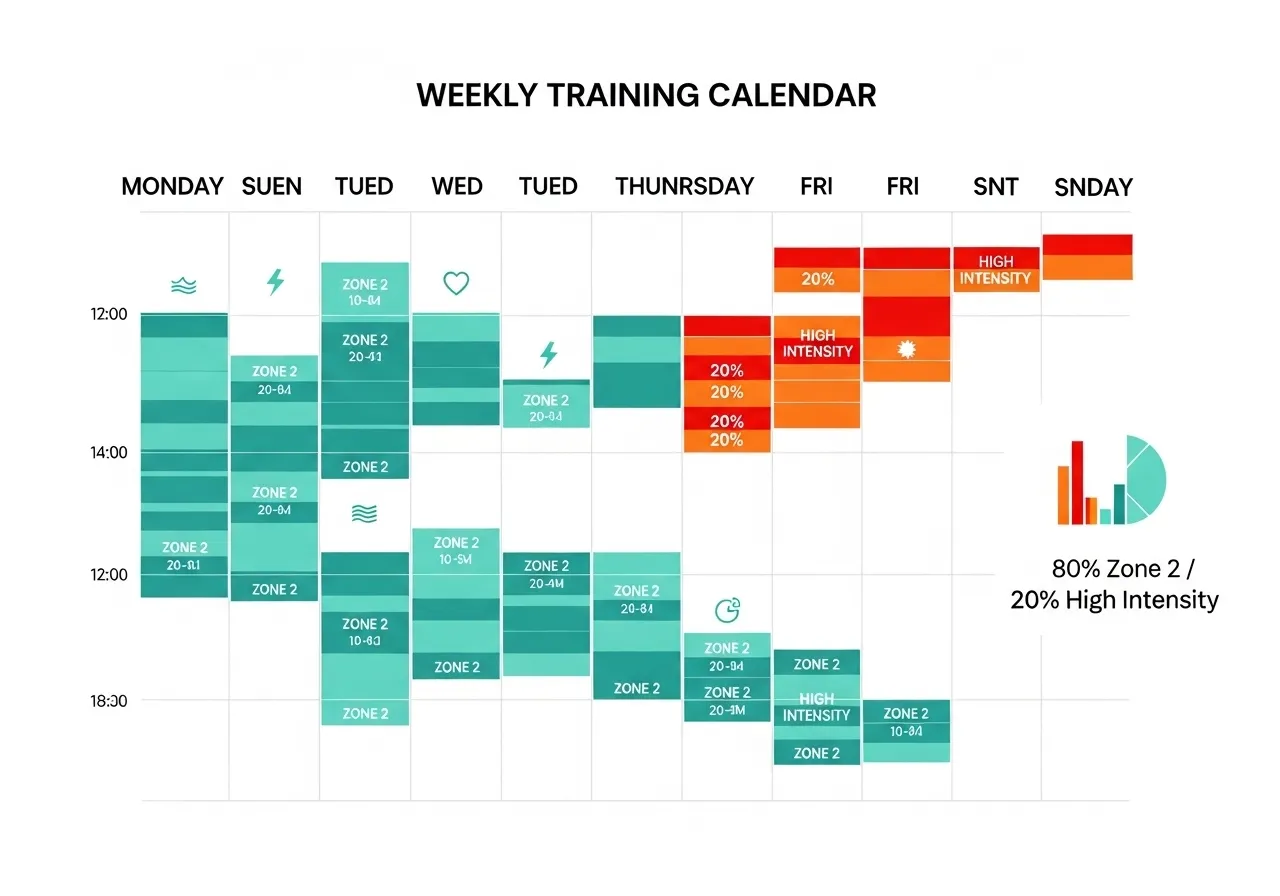
Research on optimal training intensity distribution consistently finds that elite endurance athletes perform approximately 80 percent of their training in Zones 1 to 2 and 20 percent in Zones 4 to 5, with very little time in Zone 3. This polarized distribution produces superior long-term cardiovascular development compared to moderate-intensity dominant approaches — the gray zone of Zone 3 training that most recreational athletes default to. For a recreational athlete training four cardio sessions per week, polarized distribution looks like: three Zone 2 sessions of 45 to 60 minutes each and one Zone 4 to 5 session of 25 to 30 minutes total.
Sample Weekly Structures by Goal
General cardiovascular health: Monday — rest. Tuesday — Zone 2, 45 minutes. Thursday — Zone 2, 45 minutes. Saturday — Zone 2, 60 minutes. This provides 2.5 hours of Zone 2 weekly — sufficient for significant cardiovascular health improvement without the recovery demands of high-intensity training. Cardiovascular performance improvement: add one Zone 4 session (4 times 4 minutes at 85 to 90 percent MHR with 3-minute recoveries) on Wednesday or Friday. This polarized structure develops both aerobic base and VO2max simultaneously. Weight management focus: distribute Zone 2 sessions to maximize weekly caloric expenditure — four to five sessions of 45 to 60 minutes provides 3 to 5 hours of weekly moderate-intensity cardiovascular exercise that drives consistent caloric expenditure.
When to Use Zone 3
Despite its reputation as the gray zone, Zone 3 has legitimate uses. Tempo runs and threshold workouts intentionally target Zone 3 to 4 to develop lactate threshold — a specific training goal for athletes competing in events of 20 to 60 minutes. Recreational athletes can use Zone 3 training as a time-efficient middle option when full Zone 2 sessions feel too easy and Zone 5 intervals are too demanding for current recovery capacity. The key is intentionality: entering Zone 3 deliberately for a specific purpose rather than drifting into it because Zone 2 discipline is lax.
Monitoring Progress Through Heart Rate Zones
Cardiovascular fitness improvement is most accurately tracked by heart rate response to a fixed workload. After 8 to 12 weeks of consistent zone training, the heart rate at a given running for beginners pace or cycling power output should decrease — meaning you are working less hard at the same absolute intensity. A 10 percent reduction in heart rate at a fixed workload represents significant cardiovascular improvement and confirms that zone-based training is producing the intended physiological adaptations. ACSM cardiorespiratory fitness guidelines recommend objective fitness measurement every 8 to 12 weeks to track progress and adjust training intensity appropriately.
Building Aerobic Base: The 12-Week Zone 2 Foundation Program
For anyone who has been training primarily in Zone 3 or higher, a twelve-week Zone 2 foundation program produces remarkable cardiovascular improvements that make all subsequent training more productive. The program structure: weeks one through four, four sessions per week of thirty to forty minutes at strict Zone 2 (if heart rate drifts above Zone 2, slow down until it returns); weeks five through eight, four sessions per week of forty to fifty minutes at Zone 2, adding one weekly Zone 4 interval session of twenty to thirty minutes total; weeks nine through twelve, three to four Zone 2 sessions of forty-five to sixty minutes plus one to two Zone 4 sessions per week. At the end of twelve weeks, most athletes find that the pace they can maintain at Zone 2 heart rate has improved by ten to twenty percent — they are moving faster at the same cardiovascular stress, confirming genuine aerobic base development. This pace improvement at the same heart rate is the most reliable indicator of cardiovascular adaptation, as it reflects improved economy (less energy required for a given speed) and improved mitochondrial capacity for aerobic energy production. ACSM cardiovascular training guidelines support progressive endurance base building as the foundation of all cardiovascular fitness development, particularly for recreational athletes transitioning from low-volume or high-intensity-only training approaches.
Cross-Training for Heart Rate Zone Development
Training across multiple cardiovascular modalities while targeting specific heart rate zones develops broad cardiovascular fitness that single-modality training cannot achieve. Running, cycling, swimming, and rowing each place different demands on specific muscle groups while sharing the cardiovascular adaptations of Zone 2 and Zone 4 training. A multi-modality Zone 2 week might include two running sessions, one cycling session, and one rowing session, all at Zone 2 intensity — the cardiovascular adaptations (mitochondrial biogenesis, cardiac stroke volume increase, capillary density improvement) are common across all modalities, while the muscle-specific loading is distributed across different systems. This distribution allows higher total cardiovascular training volume without the overuse injuries that single-modality training at equivalent volume would produce. Elite triathletes use this approach by design; recreational athletes can apply the same principle to simultaneously develop cardiovascular fitness and manage the cumulative tissue stress that high-volume single-sport training creates. The heart rate zone framework transfers directly across modalities — Zone 2 in running feels similar to Zone 2 in cycling in terms of breathing and effort, even though absolute heart rates may differ slightly between modalities due to the different muscle mass recruited and body position involved.
Using Heart Rate Zones to Manage Overtraining Risk
One of the most valuable applications of heart rate zone training is as an early warning system for overtraining. When accumulated training fatigue exceeds recovery capacity, heart rate responds in characteristic ways: resting heart rate rises above personal baseline by five or more beats per minute; heart rate at standard exercise intensities is higher than normal (the same effort produces higher heart rate); and heart rate recovery after exercise is slower than usual. Monitoring these three metrics alongside training volume and intensity provides objective early detection of the fatigue accumulation that, if ignored, develops into full overtraining syndrome requiring weeks of reduced training for recovery. The heart rate zone framework makes this monitoring systematic — training at the same target zone regularly and tracking the pace or power required to maintain that zone reveals the early signs of fatigue accumulation before subjective perception identifies it. Athletes who respond to these early signals by reducing training intensity or volume proactively prevent the performance decrements and recovery demands of true overtraining. Those who ignore them and train through accumulated fatigue face the consequences: deteriorating performance despite increasing effort, persistent soreness, immune suppression, and the frustrating paradox of working harder while getting worse results. Heart rate zone monitoring is therefore not merely a training optimization tool but a training protection tool that preserves the consistency that long-term development requires. Research on overtraining syndrome identifies monitoring of heart rate responses to standardized exercise as one of the most reliable early indicators of excessive training load accumulation.
Heart Rate Recovery as a Fitness and Health Biomarker
Heart rate recovery — the rate at which heart rate drops in the first one to two minutes after stopping exercise — is one of the most clinically significant cardiovascular fitness indicators, independently predictive of cardiovascular mortality risk in population studies. A heart rate drop of less than twelve beats per minute in the first minute after stopping moderate-intensity exercise is associated with significantly elevated cardiovascular risk; a drop of twenty or more beats per minute indicates good cardiovascular health. As cardiovascular fitness improves through consistent Zone 2 training, heart rate recovery speeds — the autonomic nervous system’s parasympathetic activity (which drives heart rate down after exercise) becomes more robust. Tracking heart rate recovery alongside standard fitness metrics provides a health-oriented measure of cardiovascular adaptation that performance metrics alone do not capture, and it is motivating to see this clinically meaningful marker improve as training progresses. Simple measurement protocol: immediately after stopping a standardized exercise bout, note heart rate, then note heart rate again exactly sixty seconds later. The difference is heart rate recovery. Retesting monthly tracks the improvement that consistent cardiovascular training produces in this health-relevant biomarker. Research published in NCBI on heart rate recovery as a mortality predictor established this metric as one of the most practical cardiovascular health indicators available without clinical testing equipment.
Common Heart Rate Zone Mistakes and How to Fix Them
Mistake 1: Always Training in Zone 3
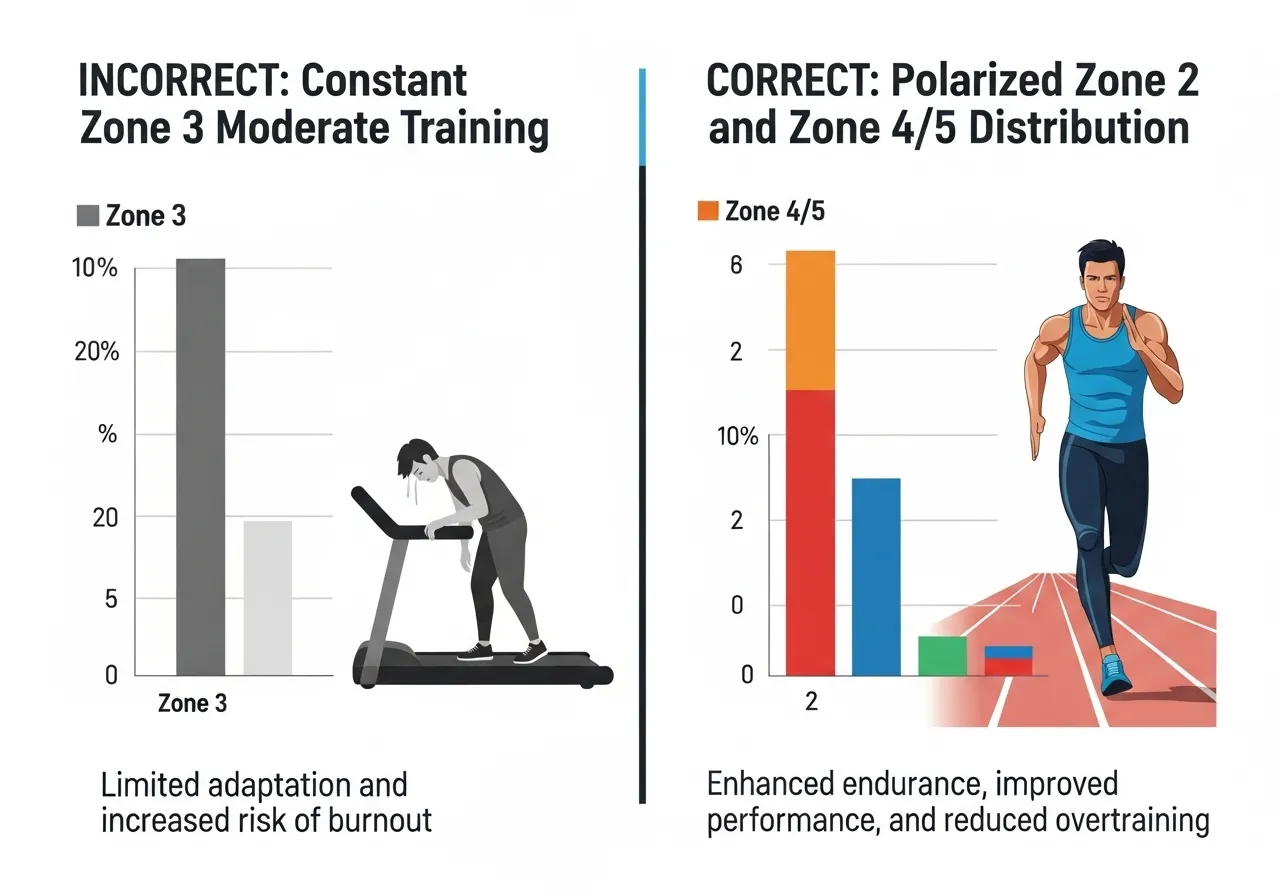
The most common heart rate zone mistake is training almost exclusively in Zone 3 — the moderate-hard intensity that feels like real effort but produces adaptations from neither the aerobic base zone nor the high-intensity zone. This happens because Zone 2 feels embarrassingly slow for most people who associate cardio with discomfort, and Zone 5 is genuinely hard enough that it takes discipline to sustain. Zone 3 is the path of least resistance — harder than easy, easier than hard — and it produces the plateau that most recreational athletes experience after initial fitness improvements from any consistent training. Fix: deliberately slow down during what you call easy sessions until you are genuinely in Zone 2. Accept that it will feel too easy for several weeks. The physiological adaptations from sustained Zone 2 training take six to twelve weeks to become measurable but are the foundation of all subsequent fitness improvement.
Mistake 2: Maximum Heart Rate Formula Errors
Using an inaccurate maximum heart rate estimate produces zone calculations that are misaligned with actual physiological states. A person whose actual MHR is 195 bpm but who calculates their zones based on an estimated MHR of 180 bpm will have a “Zone 2” that is actually Zone 3 for their physiology — training at the wrong intensity while believing they are in the right zone. Calibrate using perceived effort as described in the calculation section, and revise your zones if perceived effort and calculated zones are consistently misaligned.
Mistake 3: Ignoring Resting Heart Rate as a Recovery Indicator
Resting heart rate measured first thing in the morning is one of the most sensitive indicators of recovery status and accumulated training stress. An elevated resting heart rate — 5 to 10 bpm above your established baseline — indicates incomplete recovery from previous training and warrants a Zone 1 session or rest rather than a planned hard training day. Measuring and recording resting heart rate daily takes 60 seconds and provides objective feedback about recovery that subjective feeling sometimes obscures.
Heart Rate Zone Technology: Monitors, Apps, and What Actually Works
The heart rate zone training concept is only as useful as the accuracy of the heart rate measurement technology used to implement it. The explosion of wearable heart rate monitoring technology over the past decade has made continuous heart rate tracking available to virtually everyone, but significant differences exist between monitoring technologies in terms of accuracy, particularly during high-intensity exercise.
Chest Strap vs Wrist-Based Monitors
Electrocardiographic chest straps — the original heart rate monitoring technology used in research and clinical settings — remain the gold standard for accuracy. They detect the electrical signal of each heartbeat directly, producing measurements accurate to within one to two beats per minute under virtually all exercise conditions. Wrist-based optical monitors (found in smartwatches and fitness bands) use photoplethysmography — detecting blood volume changes in the wrist’s capillaries — which is accurate for steady-state exercise at moderate intensities but can lag significantly during rapid heart rate changes, particularly during HIIT vs steady-state cardio intervals where heart rate jumps thirty to fifty beats per minute within twenty to thirty seconds. For Zone 2 steady-state training, wrist monitors are sufficiently accurate. For HIIT and high-intensity interval work where precise interval execution at specific heart rate targets matters, a chest strap provides meaningfully better data. Research from NCBI validation studies of wearable heart rate monitors confirms this accuracy gap, particularly at intensities above 75% of maximum heart rate.
Heart Rate Variability and Zone Training Integration
Heart rate variability — the variation in time between consecutive heartbeats — provides daily readiness information that guides which heart rate zone to train in on any given day. High HRV indicates the autonomic nervous system is balanced and the body is ready for high-intensity Zone 4-5 work. Low HRV indicates accumulated stress or fatigue and suggests limiting training to Zone 1-2 work regardless of the planned program. HRV-guided training — adjusting daily training intensity based on morning HRV measurement — has been shown to produce superior cardiovascular adaptations over twelve-week periods compared to fixed-schedule programs in studies on recreational athletes. Combining HRV monitoring with heart rate zone training creates a fully individualized training system that responds to the body’s daily readiness state rather than forcing fixed intensity regardless of recovery status. Apps such as HRV4Training and Elite HRV provide validated HRV measurement and training guidance in formats accessible to recreational athletes without clinical equipment.
Training Zones Across Different Exercise Modalities
Heart rate zones established through running do not translate directly to other cardiovascular modalities. Heart rate at any given effort level is modality-specific — cycling typically produces heart rates five to ten beats per minute lower than running at equivalent perceived exertion, and swimming produces rates ten to fifteen beats per minute lower than running. This means that your Zone 2 on the bike requires a higher absolute power output than Zone 2 running to produce the same cardiovascular training stimulus. Establishing modality-specific heart rate zones — either through separate maximum heart rate tests on each modality or through modality-specific adjustments from running zones — produces more accurate training guidance than applying running zones universally. According to ACSM exercise testing guidelines, cardiovascular testing should ideally be
Heart Rate Zones for Beginners: Starting Points and Common Confusion
Beginners to heart rate zone training frequently experience confusion in the first two to four weeks because Zone 2 heart rates feel embarrassingly slow — a brisk walk may be needed to stay in Zone 2 if cardiovascular fitness is low. This is normal and expected. Untrained cardiovascular systems have limited aerobic capacity, meaning the heart must work relatively harder to sustain any given effort. As Zone 2 training develops aerobic base over six to twelve weeks, the pace sustainable at Zone 2 heart rate increases progressively — the same heart rate that initially required slow jogging will eventually require running at a pace that previously felt like Zone 3 or 4. Beginners should resist the urge to train faster than Zone 2 to feel like they are working hard enough — the adaptation that produces fitness improvement is occurring at the cellular level regardless of how the effort feels, and the patience to stay in Zone 2 during the foundational phase is what allows the cardiovascular system to build the aerobic base that makes all subsequent training more productive. Starting heart rate zone training by accepting whatever pace Zone 2 requires, without ego interference about the speed, is the approach that produces the fastest long-term cardiovascular development.
Seasonal Periodization of Heart Rate Zone Training
Structuring heart rate zone training across an annual cycle — varying the zone distribution seasonally — produces superior long-term cardiovascular development compared to maintaining the same distribution year-round. A practical annual structure: late autumn through winter (base phase), emphasizing Zone 2 at 85-90% of total cardiovascular volume to build aerobic foundation; spring (build phase), introducing Zone 4 intervals at increasing volume while maintaining Zone 2 base; summer (performance phase), increasing Zone 4-5 work to maximize performance for outdoor activities, races, or athletic competitions; early autumn (transition phase), reducing intensity and volume for recovery and psychological restoration before the next base phase. This cycling prevents the chronic adaptation plateau that maintaining constant zone distribution produces and mirrors the seasonal training periodization used by elite endurance athletes. Recreational athletes without competitive seasons can create artificial periodization phases based on personal goals and life calendar — periods of high availability becoming base-building phases, periods of lower availability becoming performance-maintenance phases with brief high-intensity emphasis. The specific structure matters less than the principle of varying the zone distribution across time rather than training at the same intensity year-round. Research on periodized cardiovascular training consistently demonstrates superior long-term adaptation outcomes from varied training distributions compared to constant-distribution approaches across all fitness levels.
Measuring Cardiovascular Fitness Progress Through Zone Training
The most reliable method for tracking cardiovascular fitness improvement through heart rate zone training is the pace or power at a given heart rate — specifically, tracking how fast you can move while maintaining Zone 2 heart rate over a standardized distance or duration. As cardiovascular fitness improves, the pace sustainable at Zone 2 increases because the heart and muscles become more efficient at delivering and using oxygen. Testing this monthly — running or cycling a standardized route or duration while maintaining Zone 2 heart rate and recording the average pace — provides clear, objective evidence of cardiovascular adaptation. A pace improvement of five to fifteen percent over twelve weeks of consistent Zone 2 training is typical for recreational athletes who had previously been training at random intensities. This pace improvement at the same cardiovascular stress confirms that genuine aerobic base development is occurring, motivating continued Zone 2 commitment through periods when the training feels easy and progress seems too slow to be real. The data reveals what subjective perception cannot: consistent, compounding cardiovascular improvement that ultimately produces the dramatic fitness differences between those who train with zone discipline and those who train by feel alone. According to ACSM fitness assessment guidelines, tracking submaximal exercise performance at standardized heart rates is one of the most practical and accurate field methods for monitoring cardiovascular fitness adaptation in recreational athletes.
Heart rate zone training works best when combined with consistent measurement, honest intensity management, and patience with the slower-than-expected pace of Zone 2 training — the foundation that makes all higher-intensity work more productive and more sustainable over the long term.
performed on the same modality used for training to ensure the most accurate zone calculation for that specific activity.
Action point: If you are using a wrist monitor for HIIT training, spend one week comparing its readings to how you actually feel during intervals. If the monitor shows Zone 3 while you feel you are at maximum, the monitor is lagging — consider a chest strap for high-intensity sessions while keeping the wrist monitor for steady-state work.
Heart Rate Zone Training for Weight Loss: What the Research Actually Shows
The fat-burning zone myth — the idea that exercising at a specific low intensity burns more fat and therefore produces better weight loss — has been thoroughly addressed by exercise science research yet persists in fitness culture. Understanding what research actually shows about heart rate zone training and fat loss allows you to structure cardiovascular exercise for body composition goals with accurate expectations rather than popular misconceptions.
The Fat Oxidation Rate Reality
At lower exercise intensities (Zones 1-2), a higher percentage of the calories burned comes from fat oxidation rather than carbohydrate oxidation. At Zone 2 intensity, typically 50-65% of calories burned come from fat. At Zone 4-5 intensity, this drops to 20-35%. This is the origin of the fat-burning zone concept and it is physiologically accurate. The problem is that higher intensity exercise burns significantly more total calories per unit of time — Zone 4 training burns approximately 40-60% more total calories per minute than Zone 2 training. The product of total caloric expenditure and fat oxidation percentage determines actual fat burned, not fat oxidation percentage alone. When the mathematics are calculated, high-intensity exercise burns similar or greater absolute amounts of fat per unit of time despite its lower fat oxidation percentage, because the total caloric expenditure is much higher. The additional advantage of high-intensity training is its significant post-exercise oxygen consumption effect — elevated metabolism for two to twenty-four hours after training — which has no equivalent in low-intensity exercise.
Practical Zone Training for Body Composition
The most effective cardiovascular program for body composition combines Zone 2 base training with strategic HIIT in a polarized distribution. Zone 2 builds the aerobic base and mitochondrial density that makes all exercise more efficient. HIIT maximizes caloric expenditure and post-exercise metabolism while stimulating hormonal responses that support fat oxidation over the following twenty-four hours. The ratio of approximately 80% Zone 2 to 20% high intensity, developed from research on elite endurance athlete training distribution by physiologist Stephen Seiler and validated in multiple recreational athlete studies, produces superior body composition outcomes compared to training exclusively in either zone or spending most training time in the moderate Zone 3 gray area. According to research published in Frontiers in Physiology on polarized training, this distribution optimizes both performance and body composition adaptations simultaneously, making it the most evidence-supported cardiovascular training structure for most fitness goals.
Action point: For your next four weeks of cardio training, track which zone you actually spend time in during each session using your heart rate monitor. Most recreational athletes discover they are training almost exclusively in Zone 3 — too hard for Zone 2 aerobic base benefits and not hard enough for HIIT adaptations. Deliberately shifting to either easier or harder than your current training often produces better results than continuing the gray-zone approach.
Frequently Asked Questions About Heart Rate Zone Training
How long does it take to see results from heart rate zone training?
The first measurable cardiovascular adaptations from Zone 2 training — reduced heart rate at a given pace, improved fat oxidation, increased mitochondrial density — begin occurring within two to four weeks of consistent training. However, meaningful performance improvements that are clearly noticeable during exercise typically require six to twelve weeks of consistent Zone 2 training before they become apparent. The pace sustainable at Zone 2 heart rate typically improves five to ten percent within the first eight weeks and ten to twenty percent over the first six months. Beginners see faster relative improvements than trained athletes because they start further from their genetic ceiling. The important framing: heart rate zone training is not a rapid transformation protocol but a systematic aerobic base development approach that produces compounding improvements over months and years. The athlete who consistently trains in appropriate zones for twelve months will have developed cardiovascular capabilities that twelve weeks of high-intensity-only training cannot produce. ACSM cardiovascular adaptation timelines support four to twelve weeks as the typical timeframe for initial measurable cardiovascular adaptations from consistent aerobic training.
Can I do heart rate zone training if I have high blood pressure?
Regular moderate-intensity cardiovascular exercise is one of the most effective lifestyle interventions for reducing high blood pressure, with research showing reductions of four to nine mmHg in systolic blood pressure from consistent aerobic training. Zone 2 training is particularly appropriate for individuals with hypertension because its moderate intensity avoids the acute blood pressure spikes associated with high-intensity exercise. Medical clearance from a physician before beginning any exercise program is recommended for individuals with diagnosed hypertension, particularly those whose blood pressure is not well-controlled with medication. For individuals who have received medical clearance, Zone 2 training provides the cardiovascular health benefits of aerobic exercise at an intensity that is both safe and effective for blood pressure management. Zone 4-5 high-intensity training is generally not recommended as a starting point for individuals with poorly controlled hypertension, though it may be appropriate for well-controlled patients with physician guidance. The long-term goal — developing sufficient aerobic fitness to sustainably maintain Zone 2 training — directly supports cardiovascular health outcomes that benefit blood pressure management as a secondary effect of the fitness development itself.
Is heart rate zone training better than just training by feel?
For most recreational athletes, heart rate zone training produces better long-term cardiovascular development than training by feel alone because it corrects the systematic intensity errors that subjective perception consistently produces. The most important correction is preventing gray-zone training — most people who train by feel spend most of their time in Zone 3, which is too hard to allow the recovery that Zone 2 requires and too easy to provide the stimulus of Zone 4. Heart rate zones prevent this by providing real-time feedback that subjective perception cannot. That said, perceived exertion remains a valuable complementary tool — learning to recognize what each zone feels like reduces monitor dependence and develops the body awareness that makes all training more intuitive over time. The ideal approach combines heart rate monitoring for zone verification with developing subjective effort perception that independently calibrates to the zones established through monitoring.

Frequently Asked Questions About Heart Rate Zone Training
Do I need a heart rate monitor to train by zones? A heart rate monitor significantly improves zone training precision, but the talk test provides a reasonable Zone 2 approximation without technology: if you cannot speak full sentences, you are above Zone 2. For Zone 5 high-intensity work, perceived effort (you are working at maximum sustainable capacity) is sufficient without precise heart rate data. A chest strap monitor is the most cost-effective investment for accurate zone training.
Why does my heart rate during Zone 2 feel slower than my friends who run the same pace? Different individuals have different heart rate responses to identical workloads due to training age, genetics, cardiovascular efficiency, and actual MHR variation. A faster runner who is better trained will have a lower heart rate at the same pace — their higher cardiovascular efficiency allows the same work to be done with less cardiac effort. Your zones are individual to you, not comparable to other people’s zones at the same pace.
How long until I see results from zone training? Heart rate at a fixed workload typically begins declining within 4 to 6 weeks of consistent Zone 2 training, indicating improving cardiovascular efficiency. Measurable VO2max improvements from Zone 5 training appear within 6 to 8 weeks. Significant changes in resting heart rate take 8 to 12 weeks of consistent training. Patience is required — zone-based training develops the physiological infrastructure that produces lasting fitness rather than the temporary performance elevation of high-intensity training performed without an aerobic base.
Can I do strength training and zone-based cardio in the same week? Yes — zone-based cardio, particularly Zone 2, produces minimal interference with strength training when performed on separate days or at least 6 hours apart from strength sessions. Zone 5 high-intensity intervals carry more interference potential and are best separated from heavy strength training by at least 24 hours. The combined approach of strength training and polarized cardiovascular training produces comprehensive fitness development that neither alone achieves.
Heart Rate Zone Training for Different Cardiovascular Fitness Goals
Different fitness goals require different heart rate zone distributions, and understanding these differences allows training to be targeted more precisely than generic exercise recommendations permit. For general cardiovascular health and longevity: 150 minutes per week of Zone 2 activity meets the minimum threshold for cardiovascular disease risk reduction established by the American Heart Association, with additional benefits from time spent in Zone 3-4 on top of the Zone 2 foundation. For weight loss and body composition: a combination of Zone 2 sessions for fat oxidation and metabolic conditioning with two Zone 4-5 HIIT sessions per week maximizes both the direct caloric expenditure and the post-exercise metabolism elevation that optimizes body composition outcomes. For endurance sport performance: the polarized approach of 80% Zone 2 and 20% Zone 4-5 produces superior performance outcomes compared to moderate-intensity-dominated training, based on research from elite endurance athlete populations. For cardiovascular rehabilitation: Zone 1-2 only, with progression guided by cardiologist or exercise physiologist monitoring, provides safe stimulus for cardiovascular system strengthening after cardiac events or procedures. Understanding which distribution matches the actual training goal prevents the common mistake of using a single training approach for all goals, regardless of which goal it is actually optimized for.
Monitoring Resting Heart Rate as a Recovery and Fitness Indicator
Resting heart rate — measured first thing in the morning before rising, ideally after a consistent sleep duration — provides two types of valuable information. Over months, a declining resting heart rate indicates improving cardiovascular fitness as the heart’s stroke volume increases from training, requiring fewer beats per minute to maintain cardiac output at rest. Week-to-week fluctuations in resting heart rate indicate recovery status — a resting heart rate five or more beats per minute above personal baseline indicates accumulated stress, poor sleep, or onset of illness that warrants training intensity reduction regardless of the planned program. Tracking resting heart rate requires nothing more than a watch and thirty seconds of attention upon waking. Logging this daily measurement alongside training data creates a continuous readiness indicator that, over months of data collection, reveals the personal patterns of adaptation and fatigue that guide intelligent training decisions. Athletes who systematically track resting heart rate consistently make better training decisions than those who rely on subjective readiness assessment alone, because subjective feeling is a poor indicator of physiological readiness — you can feel motivated on a day when resting heart rate reveals accumulated fatigue that makes high-intensity training counterproductive. Research on resting heart rate as a training readiness biomarker validates its use as a practical tool for managing training load in recreational and competitive athletes across all cardiovascular fitness levels.
Advanced Heart Rate Zone Applications: Threshold Intervals and Vo2 Max Work
Once the Zone 2 aerobic base is established, incorporating structured threshold intervals and VO2 max work produces the additional performance adaptations that Zone 2 training alone cannot achieve. Threshold intervals — sustained efforts of ten to twenty minutes at Zone 4 heart rate — develop the lactate clearance capacity that determines how long high intensities can be maintained. A practical threshold workout: after twenty minutes of Zone 2 warm-up, perform three twelve-minute intervals at Zone 4 with four-minute Zone 1 recovery between intervals, followed by ten minutes of Zone 2 cool-down. VO2 max intervals — shorter maximal efforts of three to five minutes at Zone 5 — develop peak aerobic power and push the cardiovascular ceiling upward. A VO2 max workout: four to six repetitions of three to four minutes at maximal sustainable effort (Zone 5, very hard) with equal recovery time. Both interval types should be performed no more than once or twice per week each, with the remaining training volume in Zone 2, to prevent the accumulated fatigue that high-intensity training produces when overdone. The sequencing principle: perform VO2 max work on the freshest days, threshold work on moderately rested days, and Zone 2 on the remaining days — allowing the body to deliver its best effort to the sessions that require it most while using Zone 2 as active recovery from the higher-intensity sessions.
Zone Training for Indoor vs Outdoor Cardiovascular Exercise
The transition between indoor and outdoor cardiovascular training introduces heart rate zone complications that many athletes do not anticipate. Indoor cycling on a stationary bike or treadmill running allows precise, repeatable training conditions — the same speed or power output produces the same physiological demand session to session. Outdoor running and cycling introduce variables including terrain, wind, gradient, and surface that make heart rate a more appropriate training guide than pace or power, because these variables change the physiological demand at any given speed. A runner targeting Zone 2 on a hilly outdoor route should allow pace to vary with gradient — slowing on uphills to maintain Zone 2 heart rate and naturally speeding on downhills — rather than maintaining constant pace at variable heart rate that spends half the session in Zone 3-4. This heart-rate-first approach to outdoor training applies the zone framework more accurately than pace-based training in variable outdoor conditions. Indoor training by contrast benefits from pace and power targets alongside heart rate monitoring, because the controlled conditions mean that pace and power directly correspond to heart rate zones in reproducible ways that allow objective progress tracking across sessions. Switching between indoor and outdoor training while maintaining zone-based intensity guidelines preserves training appropriateness across both environments.