⚠️ Health & Fitness Disclaimer This article is for general educational purposes only and does not replace professional medical advice. If you have any shoulder, wrist, or lower back conditions, please consult a qualified healthcare professional before beginning suspension training.
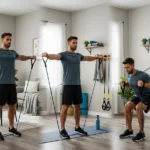
Suspension training — using adjustable straps anchored overhead to leverage bodyweight as resistance — offers a unique training stimulus that no barbell, dumbbell, or machine can replicate: every exercise simultaneously challenges the primary movers and the stability systems that support them, because the unstable anchor point requires the body to control movement in multiple planes at once. (Related: kettlebell training guide) (Related: sandbag training guide)
Originally developed for military conditioning and rehabilitation, suspension training has become one of the most versatile and portable training systems available — a single anchor point and two straps unlock hundreds of exercises adaptable from beginner to elite athletic levels without any additional equipment.
This guide covers the EMG research on suspension training muscle activation, explains how instability amplifies the training stimulus, details the most effective exercises for each body region, and provides a complete 8-week program.
Suspension Training Research: What the EMG Studies Show
Greater Stabiliser Activation Than Stable-Surface Exercise
The mechanism is straightforward: the straps can swing in any direction, requiring the body to actively resist unintended movement throughout every repetition. This omnidirectional instability demand activates stabilising muscles that floor-based exercises do not challenge — particularly the deep core muscles, rotator cuff, and scapular stabilisers.
This research directly addresses the common question of whether suspension training is “enough” for strength development — the answer is that the intensity is substantial at appropriate body angles, and the training stimulus is genuine.
The Instability Advantage: How It Changes the Training Stimulus
The instability inherent in suspension training creates training adaptations that stable exercises cannot fully replicate:
Proprioceptive development: Every set challenges the sensory systems that detect and correct unwanted movement — developing the body awareness and reactive stabilisation that transfers to sport performance and fall prevention
Core integration in every exercise: The suspended position requires the core to maintain neutral spine alignment throughout all exercises — push-ups, rows, squats, and hinges all become simultaneously core exercises when the straps introduce instability
Shoulder girdle coordination: The rotator cuff (the four muscles stabilising the humeral head in the shoulder socket) and scapular stabilisers work continuously during suspension pressing and rowing to prevent unwanted shoulder movement — developing the shoulder health qualities that conventional pressing and rowing exercises undertrain
The Neuromuscular Adaptation Mechanism: Why Instability Training Works
The neuromuscular adaptations from suspension training differ qualitatively from those of conventional resistance training, explaining why the two approaches produce complementary rather than identical benefits:
Anticipatory postural adjustments (APAs): The brain generates APAs — preparatory muscle activations that stabilise the body before a planned movement begins — as a protective mechanism. Suspension training’s unpredictable instability trains these APAs to be faster and more comprehensive than stable-surface training alone.
Co-contraction refinement: During unstable surface exercise, agonist and antagonist muscles around joints co-contract simultaneously to prevent unwanted movement. This co-contraction pattern — which conventional training does not specifically develop — is directly relevant to joint stability and injury prevention during sport and daily activity.
Motor unit synchronisation: The complex neuromuscular demands of maintaining position during suspension exercises may develop motor unit synchronisation (the timing coordination of multiple motor units firing together) more effectively than simple stable-surface exercises — contributing to the improved coordination and body awareness that suspension training practitioners consistently report.
Suspension Training and Athletic Performance Transfer
The instability and whole-body integration demands of suspension training show meaningful transfer to athletic performance in multiple contexts:
Team sports: The rotational stability developed in single-arm suspension rows and rotating push-up variations transfers directly to the contact resistance and force production relevant to rugby, basketball, and soccer
Swimming: Suspension training for shoulder and core stability training is widely used in competitive swimming dryland programs — the shoulder girdle stability developed by suspension pressing and rowing protects against the repetitive stress injuries that limit high-volume swimmers
Gymnastics and martial arts: The body tension and midline stability required for suspension exercise directly develops the qualities that define elite gymnastics and grappling performance
This combination of EMG-verified training benefits and practical versatility positions suspension training as one of the most evidence-supported adjuncts to any training program.
How to Adjust Suspension Training Intensity
Body Angle: The Primary Resistance Variable
Unlike conventional resistance training where weight is the intensity variable, suspension training uses body angle relative to vertical. This makes it uniquely accessible — every exercise can be made easier or harder simply by moving the feet forward or backward relative to the anchor point:
Body Angle
% Bodyweight Loaded
Difficulty
Example
70° from vertical
~34%
Beginner
Upright row, slight lean
45° from vertical
~71%
Intermediate
Standard push-up, mid-lean
30° from vertical
~87%
Advanced
Deep lean row, steep angle
Feet elevated
Body weight + hip-angle load
Advanced
Feet in cradles, horizontal
Additional Intensity Levers Beyond Body Angle
Unilateral variations: Single-arm and single-leg versions of exercises dramatically increase the load per limb while adding a rotational stability challenge — the body must resist twisting toward the working side throughout the movement
Tempo manipulation: Slowing the eccentric phase to 3–5 seconds massively increases time under tension without changing body angle — adding significant stimulus without requiring a more extreme position
Reduced base of support: Moving the feet together, standing on one foot, or placing feet in the cradles reduces the stability base and increases the core demand at any given body angle
Pause reps: Adding a 2–3 second pause at the most difficult point in the range forces an isometric hold at maximum mechanical disadvantage — substantially increasing the peak stabilisation demand
Strap Length and Setup
Correct strap setup is essential for both safety and training effectiveness:
Anchor height: For most exercises, the anchor should be at approximately 7–9 feet (210–270 cm) above the floor — too low reduces range of motion in pressing exercises; too high makes foot cradle exercises uncomfortable
Strap length: Adjust for each exercise category — mid-length (handles at approximately chest height when standing) works for most upper body exercises; longer straps (handles near knee height) are needed for lower body cradle exercises
Handle vs. foot cradle: Most upper body exercises use the handles; lower body exercises (hamstring curl, pike, mountain climber) use the foot cradles — knowing when to switch is the setup knowledge that matters most for beginners
Building a Progressive Suspension Training Practice
The progression logic in suspension training differs from conventional weight training in a way that beginners need to understand:
In conventional training, the same exercise becomes harder by adding weight
In suspension training, the same exercise becomes harder by changing the body angle, reducing the base of support, or adding movement complexity
A practical progression hierarchy for the most common exercises:
Core progression: Plank feet on floor → plank feet in cradles → pike → single-leg plank → roll-out
Understanding this body-angle resistance relationship allows trainees to self-regulate intensity in real time during sessions — reducing difficulty when fatigued to maintain technique quality, and increasing it when performance feels strong, without requiring any equipment changes or rest for load adjustment.
The 10 Most Effective Suspension Training Exercises
Upper Body Push
TRX Push-Up: Handles at a height that creates the target body angle. Key cues: maintain a rigid plank position throughout — sagging hips convert the push-up into a hip extension exercise and reduce the chest stimulus. The instability demand increases the serratus anterior and stabiliser activation significantly compared to floor push-ups at the same relative intensity.
TRX Chest Press (Standing): Stand facing away from the anchor, handles at chest height. Fall forward and press back to start — the standing position adds a complete core anti-extension demand to the chest and anterior deltoid stimulus.
Upper Body Pull
TRX Inverted Row: Face the anchor, walk feet forward until horizontal, and pull the chest to the handles. The most versatile back exercise in suspension training — adjustable from a nearly vertical beginner angle to a fully horizontal advanced version at virtually full bodyweight. The instability forces the scapular retractors and rotator cuff to work significantly harder than a barbell row at equivalent load.
TRX Face Pull: Face the anchor, palms facing down, pull the hands toward the temples with elbows high and wide — developing the posterior deltoid and external rotator activation that protects against shoulder impingement in pressing-heavy programs.
TRX Single-Arm Row: One handle only — the body rotation required to row with one arm while maintaining spinal alignment challenges the obliques and thoracic rotators alongside the standard row muscles.
Core
TRX Plank: Feet in cradles, arms extended — maintaining plank position with the feet suspended dramatically increases the deep core stabilisation demand compared to floor plank. The pendulum effect of the suspended feet requires constant micro-adjustments from the transverse abdominis and multifidus.
TRX Pike: Feet in cradles in plank position, then drive the hips upward while keeping the legs straight — the hip flexion demand on the rectus abdominis and hip flexors at this lever length produces an intense abdominal stimulus.
TRX Hamstring Curl: Lie on your back with heels in the cradles, drive the hips up, and curl the heels toward the buttocks — combining hip extension (gluteus maximus and hamstrings) with knee flexion (hamstrings) in a single integrated movement. One of the most effective posterior chain exercises in suspension training.
Lower Body
TRX Squat: Face the anchor holding the handles, lean back slightly — the straps provide balance assistance that allows deeper depth without the ankle mobility limitation that limits barbell squat depth for many beginners. The leaning position maintains continuous core activation.
TRX Single-Leg Squat (Pistol Progression): Face the anchor, one leg extended forward, squat on the standing leg with strap support — a safe progressive tool for building toward the full pistol squat while maintaining the appropriate hip and knee mechanics from the first session.
Suspension Training for Upper Back Posture
The forward-rounded shoulder posture associated with prolonged desk work and smartphone use — characterised by protracted (forward-shifted) shoulder blades, internally rotated humeri, and forward head position — responds well to suspension training because the exercises that best address it are naturally favoured by the suspension training format:
Suspension rows performed with full scapular retraction at the top develop the rhomboids and middle trapezius that directly pull the shoulder blades back and down into healthy position
Suspension face pulls specifically target the posterior deltoid and external rotators that are lengthened and weakened in forward-shoulder posture
The plank and core exercises prevent the anterior pelvic tilt that accompanies thoracic kyphosis in many individuals with desk-based posture problems
Including 3–4 suspension pulling exercises per session — alongside conventional training — may address postural imbalances more comprehensively than conventional rowing alone because of the higher scapular stabiliser activation that suspension training produces.
Incorporating at least two pulling exercises for every pushing exercise in suspension training sessions helps maintain the anterior-posterior balance that prevents the shoulder impingement pattern that develops in pushing-dominant training programs.
How Does Suspension Training Compare to Free Weights?
What Suspension Training Does Better
Core integration: Every exercise automatically engages the core as a stabiliser — making it practically impossible to perform a poor suspension exercise without noticing the core instability immediately
Shoulder girdle health: The serratus anterior and lower trapezius activation during suspension pressing is significantly higher than in floor push-ups or barbell pressing — making suspension training particularly valuable for shoulder health and rehabilitation
Portability and accessibility: A suspension trainer weighs less than 500g, fits in a small bag, and can be anchored to any horizontal structure capable of supporting bodyweight — a ceiling beam, door frame, playground equipment, or tree branch
Scalability: The same strap accommodates virtually any fitness level through angle adjustment — a feature no barbell or dumbbell can replicate without extensive equipment investment
Where Free Weights Maintain Advantages
Absolute loading: Progressive overload through load increase — adding kilograms to a barbell — is more straightforward than adjusting body angle incrementally. For advanced strength athletes, the load ceiling of suspension training (body weight) may be reached relatively quickly for lower body movements
Lower body compound loading: Heavy barbell squats and deadlifts load the entire posterior chain under axial compression in ways suspension training cannot replicate — for maximum lower body strength development, free weights maintain a clear advantage
Specificity for strength sports: Powerlifting and Olympic weightlifting require barbell-specific motor patterns and joint loading that suspension training can supplement but cannot replace
Optimal Integration: Suspension as Complement, Not Replacement
The most effective approach combines both modalities — using suspension training for:
Warm-up and activation before heavy compound work
Accessory volume with higher shoulder health benefit than equivalent barbell accessories
Travel and home training where barbells are unavailable
Rehabilitation and return-to-training periods where loaded exercises are inappropriate
Active recovery sessions at lighter angles between heavy training days
Nutrition Considerations for Suspension Training Programs
Suspension training sessions, though often performed without heavy external loads, produce significant metabolic demand — particularly when complex movements, supersets, and minimal rest intervals are used:
Total session caloric expenditure is comparable to moderate-intensity circuit training — higher than conventional strength training of the same duration due to the continuously elevated core and stabiliser demand
The multi-joint, whole-body nature of suspension sessions produces systemic fatigue that benefits from the same post-workout protein and carbohydrate strategies as conventional resistance training
Adequate hydration is important — suspension training in warm environments produces significant sweat rates due to the continuous full-body engagement and elevated heart rate that the instability demand creates
Suspension Training as a Warm-Up Protocol
Light-angle suspension exercises at 20–30% of maximum effort serve as an excellent full-body warm-up before heavier training sessions. The combination of dynamic range of motion and gentle core activation prepares the shoulder girdle, thoracic spine, and hip complex more comprehensively than isolated static stretching:
2 × 10 light TRX rows at a high angle warm up the posterior shoulder, scapular stabilisers, and biceps for subsequent pressing and pulling work
2 × 10 TRX squats with strap support warm up the hips, ankles, and knees through full squat range before loaded lower body work
30-second TRX plank activates the core stabilisers before any compound barbell lift
A 5–8 minute suspension warm-up sequence requires no weight changes, no warm-up plate loading, and no multiple machine adjustments — making it one of the most time-efficient pre-training activation protocols available.
8-Week Suspension Training Program
Program Structure
Three sessions per week, 35–45 minutes each. All sessions are full-body — the nature of suspension training makes muscle-group isolation programming inefficient. Rest 60–90 seconds between sets. Intensity is managed through body angle adjustment — beginners position themselves more upright; advanced trainees lean further from vertical or elevate the feet.
How long before I see results from suspension training?
Most beginners notice improvements in core stability, body awareness, and exercise quality within 2–4 weeks of consistent practice — these early gains reflect neural adaptations (the nervous system becoming more efficient at managing the instability) rather than structural muscle changes.
Visible strength and muscle mass improvements typically become apparent after 6–10 weeks of consistent training at appropriate intensity — the same timeline as conventional resistance training at matched volume and effort levels.
Periodisation for Suspension Training
Applying structured periodisation to suspension training maximises long-term progress and prevents the plateau that occurs when the same exercises at the same angles are repeated indefinitely:
Volume phase (weeks 1–4): Higher rep ranges (12–15), moderate angles, shorter rest periods — accumulating volume and developing the endurance base
Intensity phase (weeks 5–8): Lower rep ranges (6–10), steeper angles or feet elevated, longer rest — developing maximum strength at the available bodyweight load
Deload week: Every 6–8 weeks, reduce angle difficulty and volume by 40% — allowing connective tissue and joint recovery before the next loading cycle
Suspension Training for Rehabilitation, Older Adults, and Travel
Rehabilitation Applications
Suspension training has been used in clinical rehabilitation for shoulder, knee, and lower back conditions. Its advantages in this context include:
The variable load (through body angle) allows progressive loading from minimal to substantial without requiring any additional equipment changes — making it particularly easy to adjust in a rehabilitation setting where load changes must be made quickly based on patient response
Suspension pushing and pulling exercises naturally position the wrist and shoulder in comfortable orientations without forcing the fixed positions that barbell exercises require — relevant for patients with wrist or shoulder pathology
The TRX hamstring curl and plank are among the most commonly prescribed suspension exercises in lower back rehabilitation — their core activation profiles make them well-suited for progressive loading in this population
Older Adults and Sarcopenia Prevention
Suspension training is particularly appropriate for older adults for several reasons beyond the research evidence already cited:
The ability to perform exercises standing (rather than lying under a bar) may make it more accessible for older adults with limited floor mobility
The strap provides a safety mechanism — if balance is lost during a single-leg exercise, the hands gripping the straps prevent a fall
The scalability allows exercise intensity to be adjusted moment-to-moment based on daily fluctuations in energy and capacity that are more variable in older populations than in younger trainees
Travel Training: The Anchor Solution
A suspension trainer represents the single most complete travel training toolkit available:
The entire system weighs under 500g and fits in a small bag — suitable for carry-on luggage without weight restriction concerns
Hotel room doors, fixed ceiling beams, outdoor structures, and hotel gym equipment all serve as valid anchor points
The full exercise library covers pushing, pulling, hinging, squatting, and core — providing a more complete training stimulus than resistance band training or bodyweight alone
A 20–30 minute full-body suspension session in a hotel room maintains training adaptations during travel periods without requiring any gym access
Common Suspension Training Mistakes and How to Fix Them
Several errors consistently reduce the effectiveness of suspension training and increase injury risk:
Sagging hips during push-ups and planks: The most common error — collapsing the lumbar spine removes the core challenge and loads the lower back passively. Fix: squeeze the glutes, brace the core 360°, and maintain a straight line from ears to heels throughout the entire movement.
Using momentum to complete rows: Swinging the body backward to create momentum at the start of each rep reduces the time under tension and converts an eccentric-concentric row into a ballistic movement. Fix: start each rep from a dead stop, pause 1 second at the top.
Neglecting the eccentric phase: Allowing the straps to pull the body back to the starting position without muscular control in both push and pull movements wastes the eccentric loading opportunity. Fix: control the return over 2–3 seconds.
Incorrect angle for the exercise goal: Using too easy an angle (body nearly upright) produces minimal stimulus; too difficult an angle causes form breakdown. Fix: select the angle where the last 2–3 reps of each set are genuinely challenging but technically clean.
Skipping warm-up: Beginning suspension training with cold shoulders and wrists — particularly the rotator cuff, which works hard in all pressing and pulling exercises — increases acute injury risk. Fix: 5 minutes of light cardiovascular activity and dynamic shoulder rotation before any suspension session.
Suspension Training for Children and Adolescents
Suspension training has been applied in youth sports conditioning and physical education contexts with generally positive outcomes. Its bodyweight-based nature makes it inherently appropriate for developing bodies — the loads are limited to what the child can support, and the exercises naturally scale to the individual’s strength level.
Key considerations for youth suspension training:
Anchor height and strap length require adjustment for smaller body dimensions — most commercial suspension trainers accommodate this through their adjustment range
Supervision and technique emphasis are more important in youth populations where body awareness and movement vocabulary are still developing
The fun, novel quality of suspension training may provide a motivational advantage over conventional resistance training for adolescents who find gym-based training uninspiring — adherence being more important than technical optimality for youth fitness outcomes
Suspension Training FAQ
Common Suspension Training Mistakes and How to Fix Them
Several errors consistently reduce the effectiveness of suspension training and increase injury risk:
Sagging hips during push-ups and planks: The most common error — collapsing the lumbar spine removes the core challenge and loads the lower back passively. Fix: squeeze the glutes, brace the core 360°, and maintain a straight line from ears to heels throughout the entire movement.
Using momentum to complete rows: Swinging the body backward to create momentum at the start of each rep reduces the time under tension and converts an eccentric-concentric row into a ballistic movement. Fix: start each rep from a dead stop, pause 1 second at the top.
Neglecting the eccentric phase: Allowing the straps to pull the body back to the starting position without muscular control in both push and pull movements wastes the eccentric loading opportunity. Fix: control the return over 2–3 seconds.
Incorrect angle for the exercise goal: Using too easy an angle (body nearly upright) produces minimal stimulus; too difficult an angle causes form breakdown. Fix: select the angle where the last 2–3 reps of each set are genuinely challenging but technically clean.
Skipping warm-up: Beginning suspension training with cold shoulders and wrists — particularly the rotator cuff, which works hard in all pressing and pulling exercises — increases acute injury risk. Fix: 5 minutes of light cardiovascular activity and dynamic shoulder rotation before any suspension session.
Suspension Training for Children and Adolescents
Suspension training has been applied in youth sports conditioning and physical education contexts with generally positive outcomes. Its bodyweight-based nature makes it inherently appropriate for developing bodies — the loads are limited to what the child can support, and the exercises naturally scale to the individual’s strength level.
Key considerations for youth suspension training:
Anchor height and strap length require adjustment for smaller body dimensions — most commercial suspension trainers accommodate this through their adjustment range
Supervision and technique emphasis are more important in youth populations where body awareness and movement vocabulary are still developing
The fun, novel quality of suspension training may provide a motivational advantage over conventional resistance training for adolescents who find gym-based training uninspiring — adherence being more important than technical optimality for youth fitness outcomes
TRX suspension training guide EMG research exercises intensity adjustment 8-week program
Most athletic training focuses on going faster: building power for acceleration, developing explosive force for jumping, increasing speed across distances. Training to slow down receives a fraction of this attention, despite the fact that most non-contact ACL injuries occur during deceleration, not acceleration. Deceleration is the act of rapidly reducing speed during running, landing, or…
⚠️ Health & Fitness DisclaimerThis article is for general educational purposes only and does not replace professional medical advice. If you have any lower limb, knee, or ankle conditions, please consult a qualified healthcare professional before beginning plyometric training overview training. Plyometric training — exercise that uses the stretch-shortening cycle (the rapid lengthening of a…
Most training programmes develop either strength or power. Powerlifters squat heavy and get strong. Sprinters sprint fast and get explosive. The two qualities rarely develop in the same session, in the same set pairing, or even in the same training block. Contrast training challenges this separation. By pairing a heavy compound lift with an explosive…
⚠️ Health & Fitness DisclaimerThis article is for general educational purposes only and does not replace professional medical advice. If you have any pre-existing shoulder, wrist, or back conditions, please consult a qualified healthcare professional before beginning medicine ball training. The medicine ball is one of the oldest and most versatile training implements in existence…
⚠️ Shoulder, Spine, and Core Safety NoteLandmine exercises involve rotational and asymmetric loading that stresses the shoulder in an oblique pressing pattern and the lumbar spine in lateral and rotational planes. Individuals with active shoulder impingement, rotator cuff tears, lumbar disc herniation, or diagnosed spinal instability should obtain medical clearance before landmine training. During rotation-based…
There is no neat way to flip a tire. It does not fit into a defined movement category. It is not a deadlift. It is not a push press. It is all of them simultaneously, in a sequence, against an implement that shifts weight as it moves. This awkwardness is the point. Every clean movement…