Every serious upper body pressing programme eventually arrives at the same limitation: the lockout. Chest and anterior deltoid strength builds quickly with standard bench pressing. Triceps strength, specifically the capacity to drive the bar from mid-range to full extension, develops more slowly and becomes the bottleneck at heavier loads.
The close-grip bench press directly addresses this. By narrowing the grip, the exercise shifts moment arm distribution toward the elbow joint and away from the shoulder, increasing triceps demand per repetition relative to the standard grip.
This guide covers what the EMG research actually shows about grip width and muscle activation, the correct technique for the close-grip bench press, how it differs mechanically from the standard press, and how to programme it alongside conventional bench pressing for complete pressing development.
What the EMG Research Shows About Grip Width and Muscle Activation
The Conventional Wisdom vs the Research
Conventional gym wisdom states that narrow grip targets the triceps and wide grip targets the chest. The EMG research produces a more nuanced picture that challenges this clean division.
📌 Key Finding
EMG research does not fully support the claim that narrow grip dramatically shifts activation from chest to triceps. The biomechanical advantage of close-grip bench pressing for triceps development comes from the increased elbow moment arm and range of motion, not from a wholesale muscle activation shift.
📌 Key Finding
Wide grip reduces triceps activation relative to medium and narrow grips in trained individuals. Close-grip bench pressing maintains or increases triceps stimulus while reducing absolute load capacity by 5 to 11% compared to standard grip bench pressing. The trade-off is deliberate: more triceps stimulus per unit of load.
Competitive Bench Press Variations: What Elite Data Shows
The close-grip bench press advantage for triceps development comes from biomechanics rather than purely from EMG amplitude changes. With a narrow grip, the elbow remains closer to the body at the bottom position and must travel through a greater range of elbow flexion and extension than in the wide-grip press.
Greater elbow range of motion means greater triceps mechanical work per repetition. The triceps works through a longer functional range, producing more total muscle stress per set even at the same or lower load. This is why close-grip bench pressing remains a primary triceps developer despite the EMG data showing less dramatic activation shifts than the conventional wisdom predicts.
Close-Grip vs Standard Bench Press: The Mechanical Differences
Joint Moment Distribution
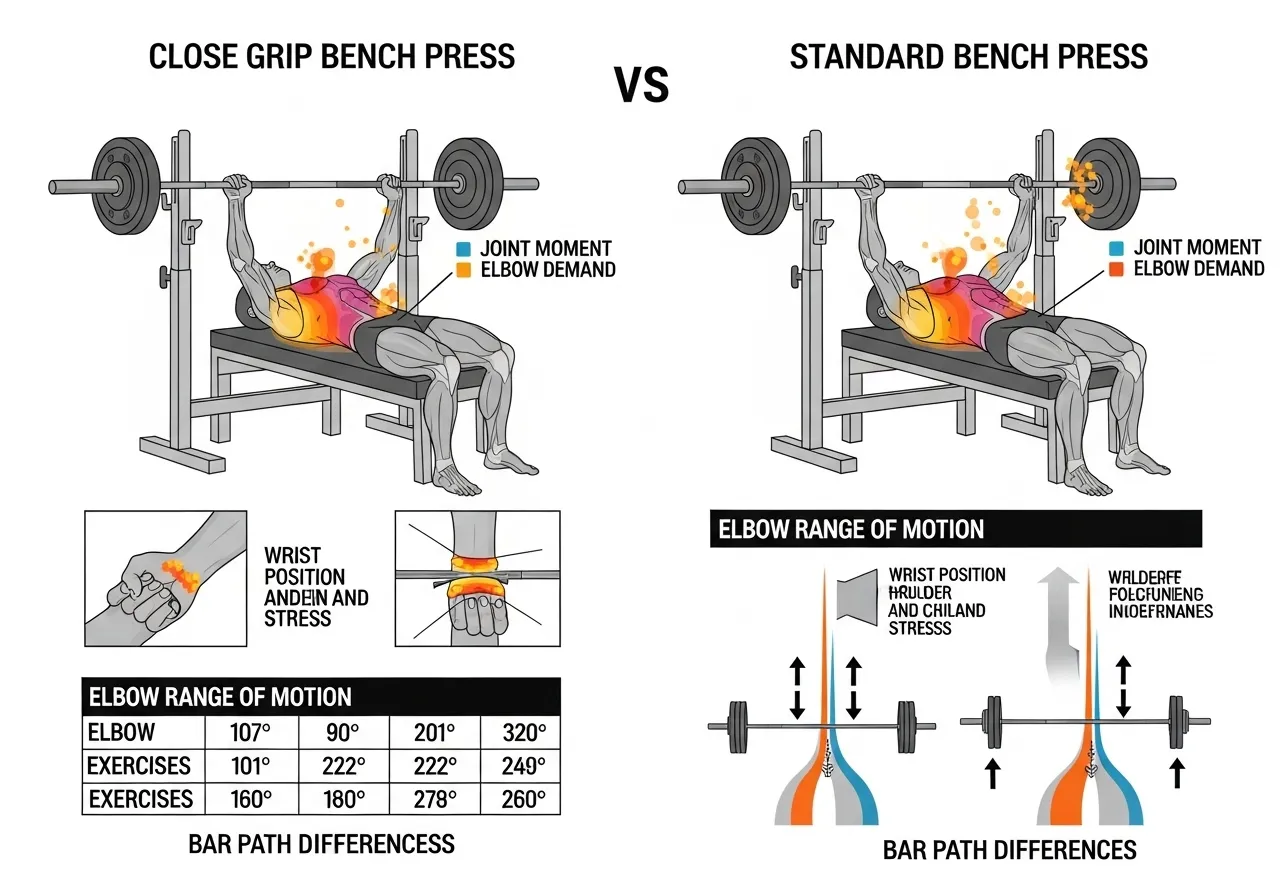
In the standard bench press with a wide grip, the shoulder joint produces a large horizontal adduction moment while the elbow produces a smaller extension moment. The chest and anterior deltoid do proportionally more work because the bar path is longer horizontally and the shoulder moment arm is maximised.
In the close-grip press, the elbows stay closer to the torso throughout the movement. The horizontal shoulder adduction moment decreases. The elbow extension moment increases because the elbow is at a greater angle of flexion at the bottom and must extend further to complete the lift. The triceps contribution to the overall pressing force increases not because of greater EMG amplitude per unit of muscle, but because the elbow extension task is proportionally larger relative to the shoulder adduction task.
Bar Path and Wrist Mechanics
The close-grip bench press bar path travels in a slightly more vertical line than the standard press. With elbows tucked, the bar moves more directly down toward the lower chest or sternum rather than following the angled path of a flared-elbow wide-grip press.
The wrists must remain neutral throughout the close-grip press. A common error is allowing the wrists to extend backwards under the load, particularly as fatigue increases. Wrist extension under close-grip loads creates a long lever that stresses the wrist joint directly and reduces force transfer efficiency. The wrists should be stacked directly over the bar throughout the set.
Comparison Table
Factor
Standard Grip
Close Grip
Primary shoulder demand
High (horizontal adduction)
Moderate
Triceps elbow range
Moderate
Greater
Absolute load capacity
Maximum
5 to 11% lower
Elbow position
Wider, 45 to 75 degrees
Tucked, 20 to 45 degrees
Wrist stress
Lower
Higher if technique breaks
Transfer to lockout strength
Moderate
High
Close-Grip Bench Press Technique: Setup and Execution
⚠️ Wrist and Elbow Safety Note The close-grip bench press places increased stress on the wrist and elbow joints compared to standard bench pressing. Individuals with active wrist impingement, medial epicondylitis, or elbow tendinopathy should obtain assessment before loading the close-grip position. Neutral wrist position is non-negotiable throughout the movement. Any sharp elbow or wrist pain signals a technique issue or a contraindication requiring attention before continuing.
Grip Width: What “Close Grip” Actually Means
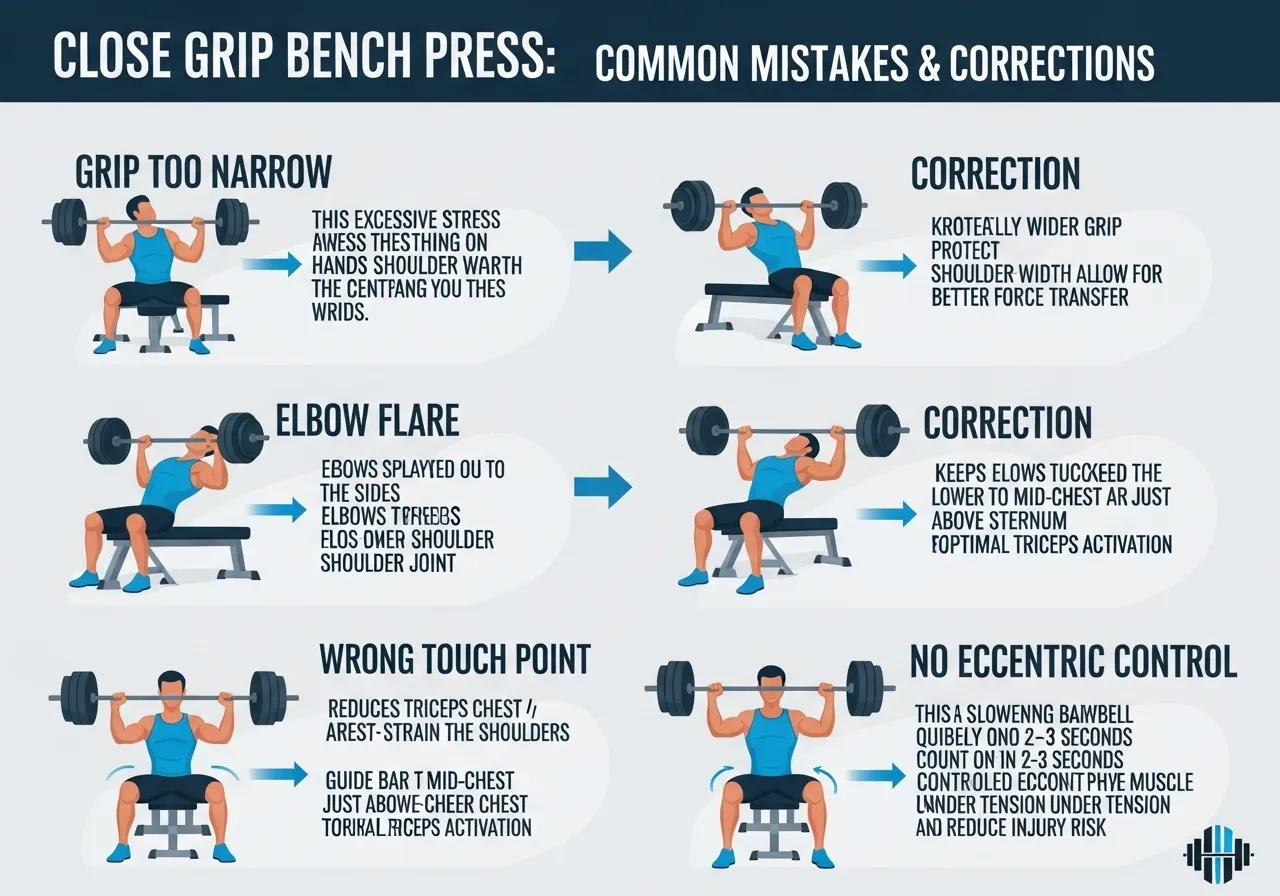
Close-grip bench press is often performed with hands touching or very close together. This is incorrect and creates unnecessary wrist and elbow stress without additional triceps benefit.
The correct close-grip width is approximately shoulder-width or slightly narrower: hands at roughly 95% of biacromial distance (the width between the outer edges of the shoulder joints). For most trainees, this places the hands 30 to 45 cm apart. This is wide enough to maintain wrist and elbow joint health but narrow enough to produce the elbow tuck and increased triceps demand that distinguishes it from the standard grip.
Setup: 5 Points Before Unracking
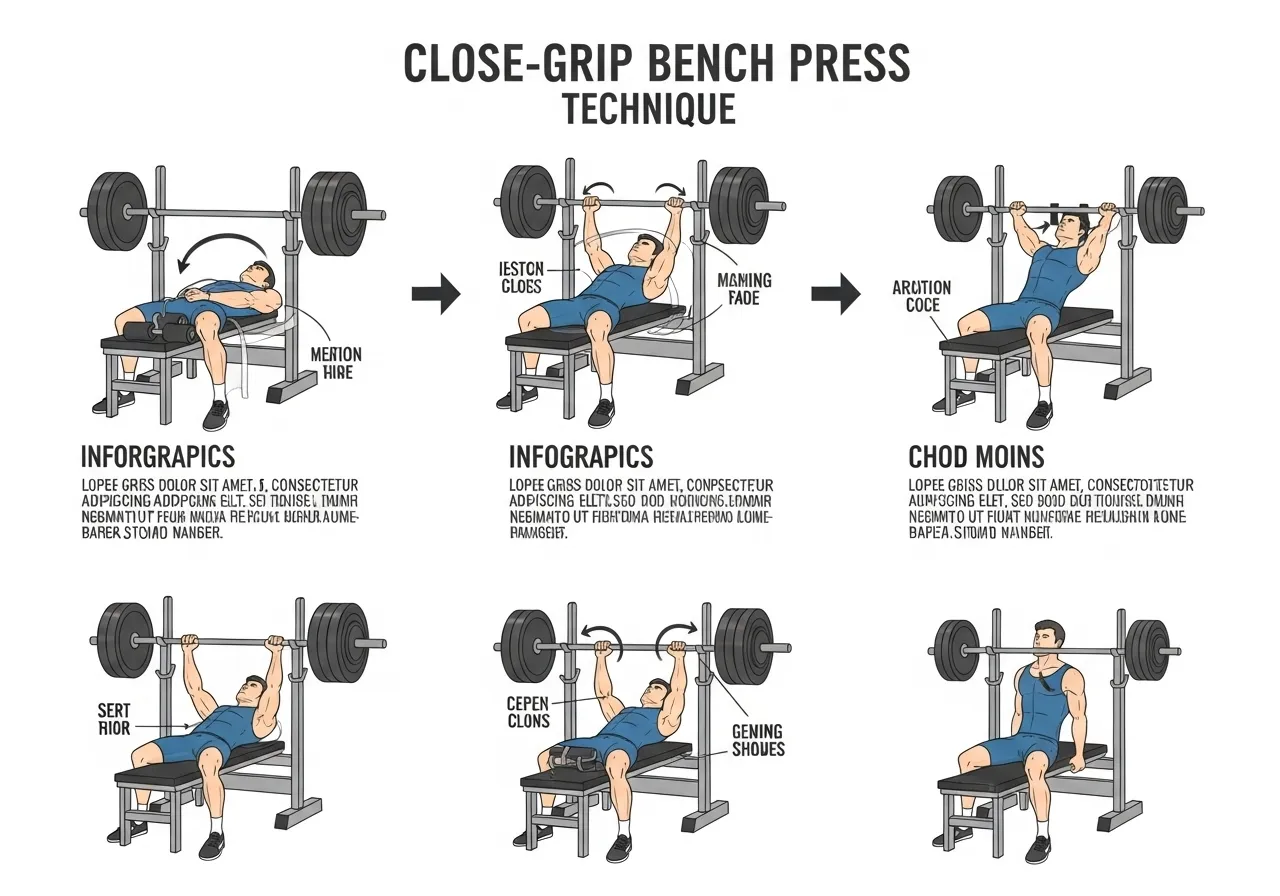
1. Grip: Hands at shoulder-width or slightly narrower. Full grip around the bar, not a thumbless grip. Wrists neutral and stacked directly over the bar. 2. Arch and shoulder position: Retract and depress the shoulder blades before unracking. This creates a stable base and protects the shoulder joint during the close-grip movement. 3. Foot position: Feet flat on the floor or on plates for smaller trainees. Maintain leg drive throughout the set as in standard bench pressing. 4. Bar position: Set the rack at a height allowing unracking with slight elbow bend. Too high and you unrack from a compromised shoulder position; too low and you waste energy. 5. Brace: Full 360-degree core brace before unracking. Maintain throughout.
The Descent and Ascent
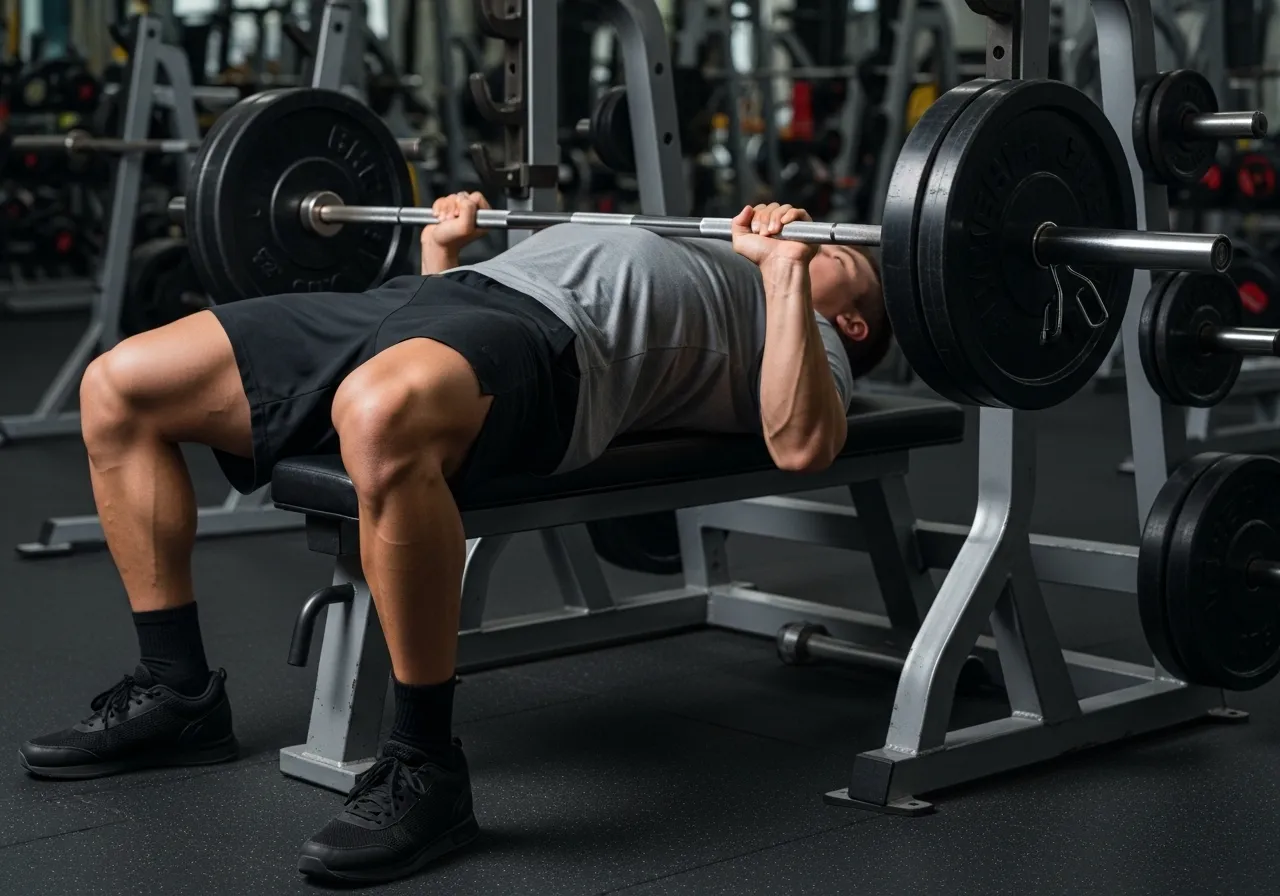
Lower the bar to the lower chest or upper abdomen, approximately 2 to 5 cm lower than in standard bench pressing. The tucked elbow position and narrower grip naturally direct the bar to a lower touch point.
Keep the elbows tucked throughout. The elbows should travel at 20 to 45 degrees from the torso, not flared to 90 degrees as in some wide-grip styles. At the bottom position, the forearms should be approximately vertical when viewed from the side.
Drive the bar upward while maintaining the elbow tuck. The elbows should extend fully at the top without locking out aggressively. A controlled lockout at the top ensures the triceps completes the range of motion under load rather than relying on passive joint locking.
Programming the Close-Grip Bench Press for Triceps and Pressing Development
As a Primary Triceps Developer
The close-grip bench press is the most mechanically efficient barbell exercise for triceps strength development. It allows heavier loading than any isolation triceps exercise and trains the triceps in its functional role as an elbow extensor under pressing load, which transfers directly to bench press, overhead press, and dip performance.
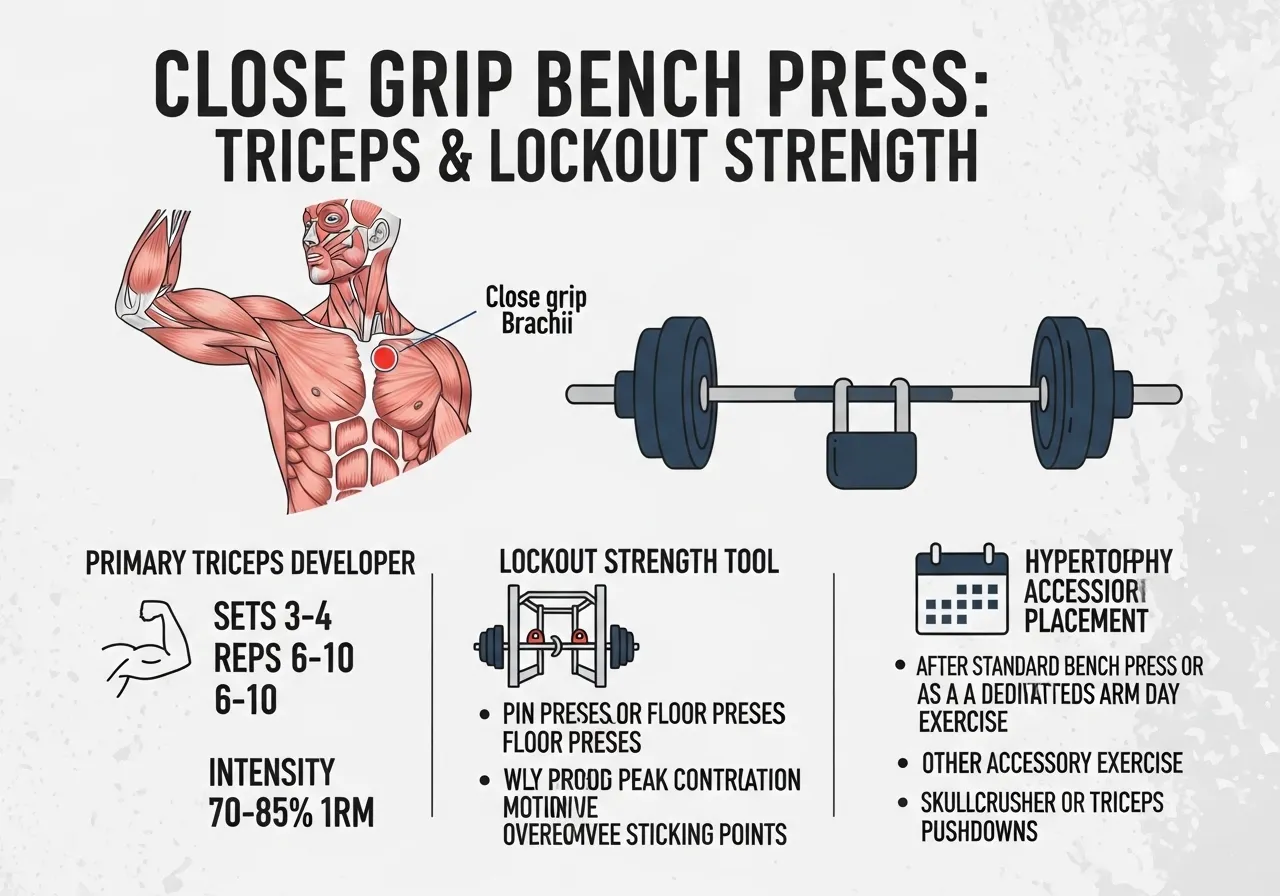
Placed as a primary secondary movement after the main bench press in a session, 3 to 4 sets of 6 to 10 reps at 70 to 80% of 1RM close-grip load provides the triceps stimulus that isolation movements cannot match at equivalent effort. For a complete triceps training programme covering all three heads, the tricep training guide covers long head science and EMG research across all triceps exercises.
As a Lockout Strength Developer
Powerlifters and strength athletes specifically use close-grip bench pressing to address lockout weakness. When the standard bench press fails consistently at the top 10 to 20% of the range of motion, the limiting factor is almost always triceps strength rather than chest or anterior deltoid strength.
Close-grip bench pressing at 75 to 85% of 1RM standard bench press load, performed for sets of 5 to 6 reps with emphasis on controlled lockout, directly targets this weakness. The load is sufficient to produce strength adaptation in the triceps at the range of motion that matters for standard pressing performance.
As an Accessory in Hypertrophy Blocks
In hypertrophy-focused training blocks, close-grip bench pressing fits well as a secondary chest and triceps exercise after the primary flat or incline press. At 10 to 15 rep ranges, it provides substantial triceps volume and maintains chest stimulus at a lighter absolute load that allows higher total volume without excessive systemic fatigue.
The close-grip press also serves as a joint-friendly alternative to dips for trainees whose shoulder anatomy makes dipping uncomfortable. The mechanics differ but both exercises train the triceps through full elbow extension under significant load. The full dip EMG data and programming comparison is covered in the dip guide.
The Common Close-Grip Bench Press Errors
Error 1: Grip Too Narrow
The most common error is gripping too narrowly, with hands close together or touching. A grip this narrow forces extreme wrist extension as the bar approaches the chest and creates high medial elbow stress throughout the movement.
At a very narrow grip, the forearms cannot maintain a vertical position at the bottom of the press. They angle inward, creating a mechanical disadvantage that reduces the total weight that can be lifted while simultaneously increasing joint stress. The exercise becomes harder and more injurious without producing additional triceps benefit.
The shoulder-width grip, approximately 95% of biacromial distance, provides all the mechanical advantages of the close-grip position while keeping the forearms in a structurally sound orientation throughout the range of motion.
Error 2: Flaring the Elbows
The elbows should remain tucked at 20 to 45 degrees from the torso throughout the close-grip press. Allowing them to flare outward to 60 to 90 degrees transforms the movement into a standard bench press with a narrow grip, which is less efficient than either the standard or close-grip press performed correctly.
Elbow flare during close-grip pressing also places the shoulder joint in the impingement-prone position that the tucked elbow technique avoids. The shoulder impingement risk of the close-grip press is primarily elbow flare combined with a narrow grip, not the close-grip itself when performed with correct elbow position.
Error 3: Touching Too High on the Chest
The standard bench press typically touches at the lower pectoral line. The close-grip press, due to the tucked elbow position, should touch 2 to 5 cm lower, at the lower chest or upper abdomen. Trainees who maintain the same touch point as their standard press while tucking the elbows create a mechanically awkward position at the bottom that stresses the anterior shoulder without producing triceps benefit.
Lowering the bar path by allowing it to travel further toward the sternum while maintaining the elbow tuck produces the mechanically optimal bottom position for the close-grip press. This requires a deliberately different bar path than the standard press and must be consciously practised rather than assumed.
Error 4: Neglecting the Eccentric
The eccentric phase of the close-grip press is where the most mechanical work is done and where significant strength adaptation occurs. Many trainees drop the bar rapidly to the chest and use the elastic energy from the chest touch to drive the concentric phase. This reduces time under tension and eliminates the controlled eccentric stimulus.
A 2 to 3 second controlled descent to chest contact, brief pause, and then controlled concentric drive produces substantially more triceps hypertrophy stimulus per set than a rapid touch-and-go style. The controlled pause also eliminates the momentum contribution from the bounce, forcing the triceps to generate force from a dead stop at the bottom position.
How Close-Grip Fits Into a Complete Pressing Programme
The close-grip bench press and standard bench press are not competing for the same adaptation. They complement each other in a well-constructed upper body programme by training the same movement pattern with different joint emphasis.
A common and effective structure: standard bench press as the primary pressing movement at the beginning of the session, close-grip bench press as the secondary pressing movement immediately after. The standard press maximises chest and anterior deltoid stimulus at heavier loads. The close-grip press extends the triceps volume and develops lockout strength at a load that is manageable after the primary work is done.
This pairing means neither exercise cannibalises the other’s training effect. The standard press uses the triceps as a secondary mover. The close-grip press uses the chest and deltoid as supporting muscles while placing the triceps in the primary role. The sequence allows both muscle groups to accumulate appropriate stimulus within a single pressing session without requiring separate training days.
Trainees who also train overhead pressing will find that close-grip bench strength transfers directly to overhead press lockout because both movements require forceful elbow extension against resistance. Including close-grip bench work in an overhead press programme addresses the triceps lockout strength that overhead pressing alone can underserve at heavier loads. The programming interaction between horizontal and vertical pressing benefits significantly from treating the close-grip bench as a bridging exercise between the two movement planes.
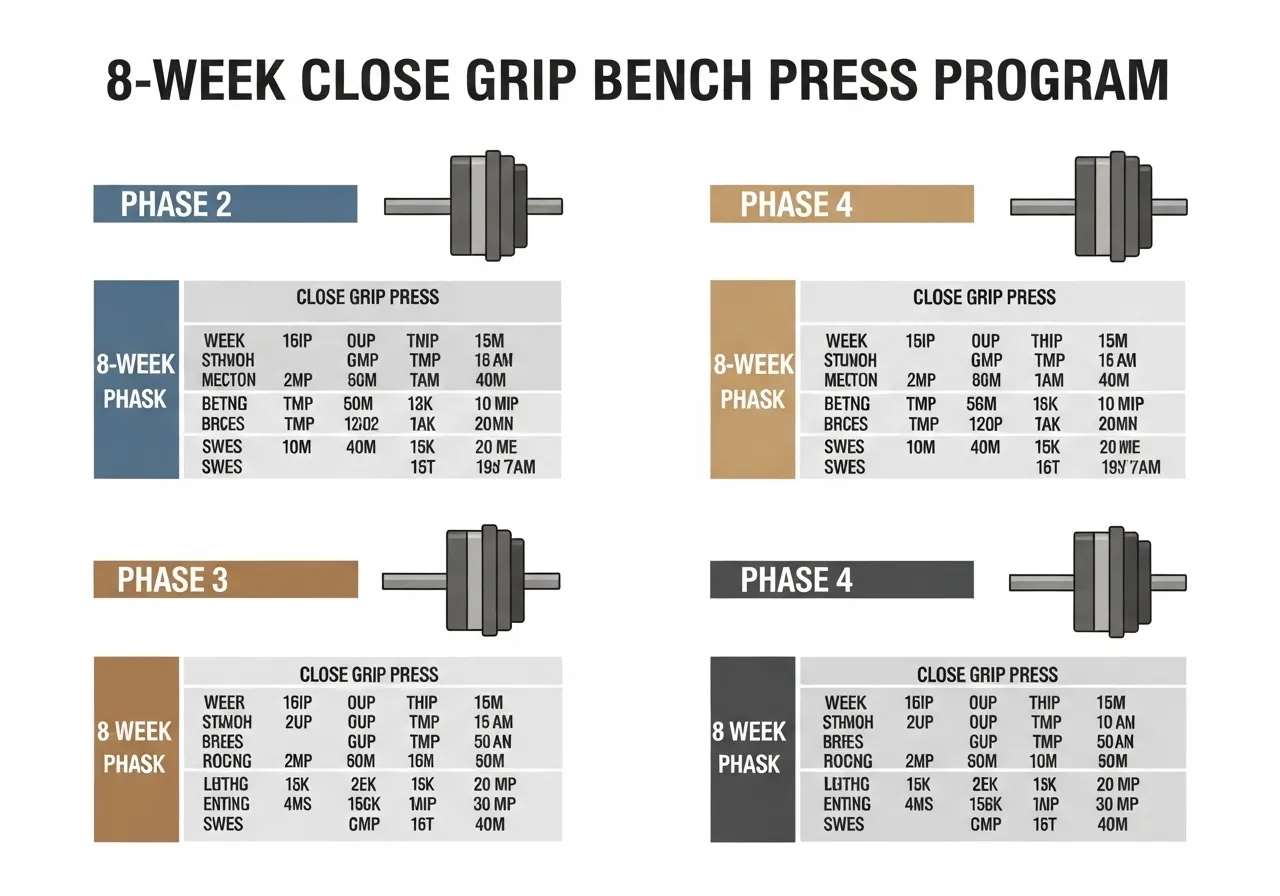
8-Week Close-Grip Bench Press Programme
📅 Phase 1: Weeks 1 to 2: Technique and Load Establishment
Close-grip bench press: 3 sets of 10 reps at 65 to 70% of standard bench 1RM
Focus: shoulder-width grip, elbow tuck at 30 degrees, wrist neutral throughout
Placed after primary bench press in the session
2 to 3 second controlled descent each rep
Focus: Establish correct technique before progressing load. The grip, elbow position, and touch point must be consistent before intensity increases.
📅 Phase 2: Weeks 3 to 4: Volume Accumulation
Close-grip bench press: 4 sets of 8 reps at 70 to 75% of standard bench 1RM
Add 1 to 2 sets of tricep dips or overhead tricep extension after close-grip sets
Rest 2 to 3 minutes between close-grip sets
Focus: Build triceps volume capacity. The additional isolation work addresses the long head that close-grip bench pressing underserves due to the shoulder position.
📅 Phase 3: Weeks 5 to 6: Strength Focus
Close-grip bench press: 4 sets of 5 to 6 reps at 78 to 82% of standard bench 1RM
1 back-off set of 10 reps at 65%
Option: add pin press at mid-range lockout position for specific lockout strength
Focus: Develop close-grip strength. The heavier loads train the triceps at higher force outputs. The back-off set maintains volume for hypertrophy stimulus.
📅 Phase 4: Weeks 7 to 8: Peak and Test
Close-grip bench press: 5 sets of 3 to 5 reps at 82 to 85% of standard bench 1RM
Week 8: test 3RM close-grip bench press and compare to Phase 1 starting load
Expected outcome: 8 to 15% strength increase on close-grip from Weeks 1 to 8
Re-test standard bench press 1RM: lockout improvement should reflect in overall pressing strength
Focus: Establish close-grip strength benchmark. Standard bench press improvement is the secondary marker of programme success.
Frequently Asked Questions About the Close-Grip Bench Press
How much less should I lift on close-grip compared to standard bench press?
Most trainees lift 80 to 90% of their standard bench press on close-grip when technique is established. Early in close-grip training, the figure is typically closer to 75 to 80% while the grip and elbow position are being learned.
A close-grip bench that exceeds 90% of your standard bench press usually indicates the grip is not narrow enough to meaningfully change the exercise mechanics. A close-grip significantly below 75% of standard suggests either a technique issue, elbow or wrist discomfort limiting range of motion, or very underdeveloped triceps relative to chest strength.
Can close-grip bench press replace dips for triceps development?
Close-grip bench press and dips develop the triceps through different movement patterns and load profiles. The close-grip press trains the triceps in a horizontal pressing pattern with the shoulder in an anteriorly fixed position. Dips train the triceps with the shoulder in extension, which loads the long head of the triceps differently.
For complete triceps development, both exercises contribute meaningfully. Trainees with shoulder pathology that makes dipping uncomfortable often find close-grip bench pressing a viable substitute for the elbow extension stimulus. Trainees who cannot bench press due to wrist or shoulder issues often substitute weighted dips as their primary pressing strength developer. Neither fully replaces the other for comprehensive triceps programming.
Should I use close-grip bench as my primary pressing exercise?
Close-grip bench press is most effective as a secondary pressing movement rather than the primary one. It allows 5 to 11% less load than standard bench pressing, which reduces the overall pressing stimulus per set compared to standard grip bench at the same proximity to failure.
The exception: trainees whose specific goal is triceps hypertrophy or lockout strength development, who already have well-developed chest and anterior deltoid from standard pressing. For these trainees, periodically making close-grip the primary pressing movement for a 4 to 6 week block while maintaining standard bench as the secondary makes structural sense. The complete programming context for how standard bench press and close-grip interact is covered in the barbell bench press guide.
Is the close-grip bench press safe for the wrists?
The close-grip bench press is safe for the wrists when the grip width is at approximately shoulder width and the wrists remain neutral throughout the movement. The most common wrist problem in close-grip pressing is using an excessively narrow grip that forces wrist extension under load.
Trainees with existing wrist discomfort during standard bench pressing should resolve that issue before adding close-grip work. The narrow grip amplifies any wrist loading issues that are already present. Wrist wraps can provide additional support during close-grip pressing at heavy loads but should not be used to compensate for a grip width that is too narrow for the individual’s wrist mechanics.
Key Takeaways
EMG research shows grip width produces less dramatic muscle activation shifts than commonly believed. The close-grip advantage for triceps development comes from increased elbow range of motion and moment arm, not wholesale muscle recruitment changes.
Wide grip reduces triceps activation by 10.6% compared to medium grip in resistance-trained individuals. Close-grip maintains or increases triceps stimulus while reducing absolute load capacity by 5 to 11%.
Correct close-grip width is approximately shoulder-width, not hands-touching. Excessively narrow grip increases wrist and elbow stress without additional triceps benefit.
Keep elbows tucked at 20 to 45 degrees from the torso. Flaring to 90 degrees converts the exercise into a standard bench press with a narrow grip, which is less efficient than either variation performed correctly.
Close-grip bench pressing is most effective as a secondary pressing movement after standard bench press, targeting lockout strength and triceps hypertrophy in a single barbell exercise.
Why the Close-Grip dumbbell vs barbell bench Is the Most Underrated Upper Body Exercise Ask most gym-goers how they train their triceps and you will hear a familiar list: cable pushdowns, overhead extensions, skull crushers. Ask them about the close-grip bench press stall fixes and you will typically get a blank stare or a vague…
⚠️ Health & Fitness DisclaimerThis article is for general educational purposes only and does not replace professional medical advice. If you have any lower back, hip, or knee conditions, please consult a qualified healthcare professional before beginning a hip thrust program. The barbell hip thrust has become one of the most researched and most debated…
Back-Dominant pull-up mastery programme Blueprint This framework targets maximal back growth with safe shoulder mechanics. It builds pulling strength and total stability. Key principles:– Depress and retract the scapula before pulling.– Pull elbows toward ribs, not behind the torso.– Maintain a slight hollow body for core tension.– Progress volume and intensity in planned waves.– Track…
⚠️ Fitness Disclaimer: The information in this article is for general educational purposes only and does not constitute professional fitness or medical advice. Always consult a qualified healthcare professional before starting any new exercise program, especially if you have existing injuries or medical conditions. The Exercise That Separated Me From the Athletes I Trained With…
The barbell squat is the king of lower body exercises. Nobody argues this. But the squat trains both legs simultaneously, allows the stronger leg to compensate for the weaker, and does not replicate the single-leg mechanics of every sport, every staircase, and every walking stride. The barbell lunge addresses what squatting leaves untrained. It loads…
⚠️ Shoulder and Rotator Cuff Safety NoteThe lateral raise elevates the arm through shoulder abduction — a movement that narrows the subacromial space and can provoke impingement in individuals with existing rotator cuff pathology or AC joint irritation. Those with diagnosed supraspinatus tears, active shoulder impingement syndrome, or a history of shoulder surgery should obtain…