⚠️ Health & Fitness Disclaimer This article is for general educational purposes only and does not replace professional medical advice. If you have any pre-existing shoulder, wrist, or back conditions, please consult a qualified healthcare professional before beginning medicine ball training.
The medicine ball is one of the oldest and most versatile training implements in existence — used for developing explosive power, rotational strength, and sport-specific conditioning across virtually every athletic discipline. (Related: battle ropes guide)
Unlike barbells and dumbbells, medicine balls can be thrown, slammed, and caught — enabling ballistic training (movement performed at maximum velocity through the full range of motion) that develops the rapid force production qualities that conventional resistance training cannot replicate.
This guide covers the research on medicine ball training benefits, explains the stretch-shortening cycle that underpins explosive training, details the most effective exercises and their programming, and provides a complete 8-week power development program.
The distinction between strength and power gains in this research is significant: both groups increased maximum strength (1RM), but only the medicine ball group showed superior power improvements — confirming that ballistic training develops the rate of force development (the speed at which force is generated) that conventional slow-tempo resistance training does not optimally train.
Explosive Force Production and Athletic Assessment
This correlation between upper body medicine ball throw performance and lower body explosive power (vertical jump) reflects the whole-body nature of explosive training — the coordinated sequencing of lower body drive through the core to upper body release that characterises both throwing and most athletic power movements.
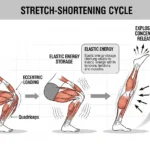
The Stretch-Shortening Cycle: The Physiological Basis of Medicine Ball Power
Medicine ball training specifically targets SSC function because throws, slams, and chest passes all involve a brief countermovement (loading phase) that stretches the relevant muscles immediately before the explosive release — training both the elastic energy storage and the neural timing that maximises its use.
Core and Rotational Power: The Most Undertraining Area
Rotational power — the ability to generate force through the transverse plane (horizontal rotation around the vertical axis) — is among the most sport-relevant physical qualities and among the most undertrained in conventional gym programs.
Most standard resistance exercises operate in the sagittal plane (forward and backward movements like squats, deadlifts, and presses). Rotational medicine ball throws directly train the obliques (the diagonal abdominal muscles responsible for trunk rotation), the thoracic rotators (the muscles between the vertebrae of the upper back that produce and control spinal rotation), and the hip external rotators — the kinetic chain that generates power in throwing, striking, swinging, and change-of-direction movements.
Both medicine balls and kettlebells are commonly used for explosive and sandbag training — but they address distinct qualities and should be understood as complementary rather than interchangeable:
Medicine ball: The implement can be released — enabling genuinely ballistic training at maximum velocity through the full range. Superior for developing throwing power, rotational power, and upper body rate of force development at high velocities.
Kettlebell: The implement cannot be released (in standard training) — limiting maximum velocity in the same way barbells and dumbbells do. The kettlebell’s offset centre of mass and swing-based exercises develop hip hinge power and grip endurance in ways medicine balls do not.
A comprehensive power and conditioning program may include both — medicine balls for upper body and rotational ballistic work, kettlebells for hip hinge power and metabolic conditioning. Each addresses gaps in the other’s training stimulus.
How Medicine Ball Training Transfers to Sport Performance
The transfer of medicine ball training to sport performance has been documented across multiple research contexts:
Throwing sports (baseball, handball, javelin): Medicine ball overhead and rotational throws train the deceleration-to-acceleration sequence that characterises all throwing movements — the eccentric loading phase that stretches the posterior shoulder and core before the concentric explosive release
Racket sports (tennis, badminton, squash): Rotational side throws specifically develop the hip-driven rotational power that generates racket head speed — more sport-specifically than any conventional gym exercise
Contact sports (rugby, American football, martial arts): Chest pass throws and pushing medicine ball exercises develop the horizontal pushing power relevant to blocking, tackling, and striking
Court sports (basketball, volleyball): Vertical squat-press throws and backward scoop throws develop the leg-to-arm power chain relevant to shooting, passing, and jumping
Developing this coordinated power chain through targeted rotational medicine ball training may produce athletic performance improvements that neither barbell pressing nor isolated abdominal exercises can achieve independently.
Why Can’t Conventional Resistance Training Replicate Medicine Ball Benefits?
The Force-Velocity Relationship
The force-velocity relationship is a fundamental principle of muscle physiology: as the speed of muscle contraction increases, the force the muscle can produce decreases — and vice versa. Maximum strength training (slow, heavy lifts) develops force production at low velocities. Medicine ball training develops force production at high velocities — the two training stimuli address different portions of the force-velocity curve.
For most sporting movements — throwing a ball, swinging a racket, jumping, sprinting — the relevant portion of the force-velocity curve is the high-velocity end. Maximum strength from barbell training transfers to high-velocity performance only partially; direct high-velocity training with medicine balls develops this quality more specifically.
Ballistic Loading vs. Traditional Resistance Exercises
A key distinction between medicine ball exercises and conventional resistance training is the ability to release the implement:
In a barbell bench press, the bar must be decelerated as it approaches lockout — the trainee cannot release it. This deceleration reduces the power output achievable in the final portion of the movement.
In a medicine ball chest throw, the ball is released at the point of maximum velocity — there is no deceleration phase. The entire movement can be performed at genuinely maximal intent throughout the full range.
This distinction means medicine ball throws develop maximal power output across the complete range of motion — a quality that barbell and dumbbell exercises, by their nature, cannot fully replicate. Ballistic intent (attempting to accelerate throughout the entire movement) is the training quality that transfers most directly to athletic power expression.
Movement Pattern Specificity
Medicine balls allow training in movement patterns that conventional gym equipment cannot easily replicate:
Rotational throws: The rotational chest pass and side throw train the exact movement sequence used in throwing sports — hip rotation driving through the core to the shoulder
Overhead slams: The overhead slam trains the shoulder flexion-to-extension power sequence relevant to spiking, overhead striking, and many sport-specific motions
Horizontal chest pass: Trains the pushing pattern at high velocity — applicable to blocking, passing, and contact sport demands
Scoop throw: Trains the hip extension and upward drive sequence of jumping and Olympic lifting movements
Selecting Medicine Ball Types: Rubber, Leather, and Slam Ball
Medicine balls are available in several construction types, each suited to specific training applications:
Rubber medicine ball (moderate bounce): The most versatile general-purpose option — appropriate for wall throws, partner exercises, and most gym-based exercises. The moderate bounce allows wall rebound exercises (rotational throws, chest passes) that require catching the return.
Slam ball (minimal bounce): Dense rubber construction specifically designed to absorb floor impact without rebounding dangerously. Essential for overhead slam exercises where a high-bounce ball would create a safety hazard from unpredictable rebound direction. Not appropriate for wall rebound exercises.
Leather medicine ball: Traditional construction with minimal bounce — used in many rehabilitation settings and for partner toss exercises where controlled catching is required. Less suitable for floor slam exercises.
Wall ball (soft, large): Larger diameter, softer construction specifically designed for wall ball exercises (squat-press throw to a target) — the soft exterior allows catching without the impact discomfort of harder balls when receiving a rebound.
Warming Up for Medicine Ball Training
Because medicine ball throws are performed at maximum velocity, the quality of the warm-up directly affects both performance and injury risk. A thorough dynamic warm-up specifically preparing the shoulders, thoracic spine, hips, and core takes 8–12 minutes and substantially increases the power output achievable in the subsequent training session:
Medicine ball specific warm-up sequence:
Arm circles (forward and backward): 15 each direction
Thoracic rotation stretch in seated position: 10 each side
Hip flexor lunge with rotation: 8 each side
Band pull-apart: 20 reps
Light medicine ball chest pass (50% effort): 8 reps
Light rotational toss (50% effort): 6 each side
Build to 75% effort: 3 throws each exercise
Full working intensity: session begins
Progressing through intensity levels — 50%, then 75%, then full effort — within the warm-up ensures the neuromuscular system is fully activated before maximal throws are attempted. Skipping directly to maximum-effort throws from a cold start is a primary mechanism of acute muscle strain in the shoulder and oblique complex.
The 8 Most Effective Medicine Ball Exercises
1. Chest Pass Throw
The foundational medicine ball upper body push exercise — hold the ball at chest height, step forward, and explosively extend the arms to throw the ball into a wall or to a partner at maximum velocity.
Power quality trained: Horizontal pushing power and rate of force development
Cue: Brief countermovement (slight pull back before throwing) to load the SSC — then release explosively
2. Rotational Side Throw
Stand sideways to a wall, rotate away from the wall loading the hips and core, then explosively rotate and throw the ball against the wall. Catch the rebound and immediately repeat.
Primary muscles: External and internal obliques, thoracic rotators, hip external rotators, pectoralis major
Power quality: Rotational power — the most sport-specific medicine ball exercise
Key point: The power should originate from hip rotation, not arm swing — the arms follow the hip and core rotation rather than driving it
3. Overhead Slam
Raise the ball overhead with arms fully extended, then slam it explosively downward to the floor with maximal force. Catch on the rebound or retrieve and repeat.
Power quality: Overhead flexion-extension power; core anti-extension under load
Note: Requires a rubber “slam ball” — standard medicine balls may not withstand repeated floor impacts
4. Squat and Press Throw
Hold the ball at chest height, squat to parallel, then explosively extend the legs and press the ball upward — releasing it at the top of the movement toward the ceiling or over a target height.
Power quality: Full-body triple extension power — the leg-to-core-to-arm power chain used in jumping and overhead sport movements
5. Backward Overhead Scoop Throw
Stand with feet shoulder-width apart, squat slightly, and swing the ball backward between the legs before explosively extending the hips and releasing the ball overhead behind you.
Power quality: Hip extension power — directly trains the posterior chain power that drives jumping and sprinting
6. Wall Ball Shot
Hold the ball at shoulder height, squat to depth, then explosively stand and press the ball to a target high on the wall. Catch the returning ball as you descend into the next squat.
Power quality: Full-body power-endurance — the continuous catch-squat-throw cycle develops both power and conditioning simultaneously
7. Kneeling Chest Pass
Kneeling eliminates leg drive, isolating upper body and core power. Throw the ball explosively against a wall from a kneeling position — developing the trunk-to-arm power transfer without lower body compensation.
8. Lateral Bound with Medicine Ball Hold
Hold the medicine ball at chest height while performing lateral bounds — the added load increases the lateral stability demand and trains lateral power with the coordination challenge of managing an external implement.
Medicine Ball Training for Rehabilitation and Injury Prevention
Beyond athletic performance, medicine ball training has documented applications in rehabilitation and injury prevention contexts:
Shoulder rehabilitation: Light medicine ball exercises (1–2 kg) in the late stages of shoulder rehabilitation progressively reintroduce ballistic loading to the shoulder girdle — developing the deceleration strength and rotator cuff coordination needed for return-to-sport throwing activities
Lower back rehabilitation: Controlled medicine ball rotation exercises, performed with appropriate weight and range, may develop the core stability and rotational control that reduces lumbar spine vulnerability during daily and sporting activities
Fall prevention in older adults: Reaction-based medicine ball exercises — catching a ball thrown from various directions — develop the rapid neuromuscular responses that prevent falls by improving balance reaction time
For any rehabilitation application, appropriate exercise selection and progression should be guided by a physiotherapist or sports medicine professional rather than applied independently from general programming guidelines.
Tracking Medicine Ball Training Progress
Unlike conventional resistance training where weight lifted is the primary progress metric, medicine ball training progress is most meaningfully tracked through:
Throw distance: For wall-independent throws (backward overhead scoop, overhead forward throw), measuring the distance thrown with a standard ball weight provides an objective power benchmark. Progress of 10–20% over an 8-week program is a reasonable expectation for beginners.
Wall rebound speed: The speed and authority with which the ball returns from the wall after a throw is a qualitative indicator of throw power — a ball thrown with genuinely maximal effort returns with noticeably more force than a half-effort throw
Movement quality: Video analysis of throws — even informal phone recording — reveals technical improvements in hip rotation initiation, sequencing, and follow-through that are difficult to assess by feel alone
How to Select Medicine Ball Weight and Progression
Weight Selection Principles
Medicine ball weight selection follows a different logic from conventional resistance training — the goal is maximum velocity and power expression, not maximum load. Too heavy a ball reduces movement velocity and shifts the training stimulus away from power toward strength.
Exercise Category
Beginner
Intermediate
Advanced
Upper body throws (chest pass, rotational)
2–3 kg
4–6 kg
6–9 kg
Overhead slam
4–6 kg
6–9 kg
9–12 kg
Full-body (squat press, scoop throw)
4–6 kg
6–8 kg
8–12 kg
Wall ball (conditioning)
4–6 kg
6–9 kg
9–14 kg
The Velocity Test
A practical weight selection test: perform 3 throws at the candidate weight. If the ball feels heavy and the movement is slow, reduce the weight. If velocity feels genuinely maximal with control maintained, the weight is appropriate. A good cue — if an observer watching the throw cannot tell that you are trying to throw as hard as possible (because the ball barely travels quickly), the weight is too heavy for power development.
Progression Methods
Load progression: Increase ball weight by 1–2 kg when throws feel fast and controlled — typically after 4–6 weeks at a given weight
Volume progression: Add sets or reps before adding weight — building throwing volume ensures the movement pattern is well-established before additional load is introduced
Complexity progression: Progress from stationary throws to throws with a step, from bilateral to unilateral stance, and from simple to rotational patterns as coordination and power develop
8-Week Medicine Ball Power Development Program
Program Design
Two dedicated medicine ball sessions per week, positioned at the start of training sessions when the neuromuscular system is freshest — power quality degrades when performed under fatigue. Rest 60–90 seconds between sets to allow full neuromuscular recovery between explosive efforts. Each throw should be performed with maximal intent.
Phase 1 — Weeks 1–2 (Foundation, 2 sessions/week):
Chest pass throw: 3 × 6 (moderate weight, technique focus)
Overhead slam: 3 × 6
Rotational side throw: 3 × 6 each side
Squat and press throw: 3 × 6
Focus: Movement quality, SSC timing, controlled landing/catch
Phase 4 — Weeks 7–8 (Integration, 2 sessions/week):
Complex pairing A: Barbell squat 3 × 4 heavy → Squat press throw 3 × 5 immediately after
Complex pairing B: Bench press 3 × 4 heavy → Chest pass throw 3 × 5 immediately after
Rotational side throw: 4 × 6 each side
Overhead slam: 3 × 8 (maximal effort)
Note: Complex training — pairing a heavy resistance exercise with a ballistic medicine ball exercise — may potentiate (acutely enhance) power output through post-activation potentiation (PAP), where heavy loading activates additional motor units that remain available for the subsequent explosive effort
What surface is best for medicine ball training?
For overhead slams and floor-based exercises, a rubber or turf floor surface is ideal — absorbing some of the ball’s impact and reducing noise. Concrete and tile floors are functional for slam work but harder on the ball’s exterior over time and may produce higher rebound velocity from certain ball types.
For wall throw exercises, a solid concrete or brick wall is the most durable surface — plasterboard or drywall may not withstand repeated medicine ball impact. Many commercial gyms have dedicated medicine ball walls (reinforced concrete sections) or rubber wall targets for this purpose. Outdoors, a solid building wall or purpose-built throwing wall provides equivalent function.
Integrating Medicine Ball Training Into Strength and Conditioning Programs
Session Placement: Power First
Medicine ball throws are neural quality exercises — they demand peak neuromuscular readiness. The optimal placement within any session is at the beginning, after a thorough dynamic warm-up but before any significant fatigue has accumulated.
Programming medicine ball work at the end of a session — after heavy compound lifts have depleted neuromuscular resources — converts power training into conditioning work. While this produces metabolic stimulus, it does not develop the rate of force development that makes medicine ball training uniquely valuable.
Pairing With Strength Exercises: Complex Training
Complex training — pairing a heavy resistance exercise with a biomechanically similar explosive medicine ball exercise — is among the most effective methods for simultaneously developing both maximum strength and explosive power:
Barbell bench press → Chest pass throw: The heavy press potentiates the subsequent throw — the motor units recruited during the heavy set remain partially activated, amplifying power output in the explosive exercise
Back squat → Squat press throw or backward scoop: Lower body compound loading followed by lower-body-driven ballistic exercise
Deadlift → Overhead slam: Hip extension heavy loading followed by hip extension ballistic exercise
A rest period of 3–8 minutes between the heavy exercise and the ballistic exercise may optimise the PAP (post-activation potentiation — the transient enhancement of muscle function following maximal or near-maximal contractions) window — long enough for fatigue to partially dissipate while potentiation remains elevated.
Medicine Balls for Warm-Up and Activation
Lower-intensity medicine ball exercises function effectively as dynamic warm-up tools — progressively increasing movement velocity and joint range of motion before heavier training:
Light rotational chest passes (2–3 kg) progressively warm the shoulder girdle before pressing exercises
Hip hinge patterns with a light ball prepare the posterior chain before deadlift-pattern work
Overhead passes activate the scapular stabilisers and thoracic extensors before upper body pulling work
Volume and Recovery Guidelines
Training Level
Throws/Session
Sessions/Week
Rest Between Sets
Beginner
40–60 total
1–2
60–90 sec
Intermediate
60–100 total
2–3
60–90 sec
Advanced
80–120 total
2–4
90–120 sec
Nutrition and Recovery for Power Training
Power training — particularly the explosive, multi-joint medicine ball exercises — places significant demand on the phosphocreatine energy system (the immediate energy pathway that powers short, maximal-effort contractions lasting 1–10 seconds) and the neuromuscular system.
Key nutritional considerations for optimising power training adaptation:
Carbohydrate availability: The phosphocreatine system regenerates rapidly between sets (80% recovery within 3 minutes), but glycogen (the stored form of carbohydrate in muscle cells) supports the overall training session energy demands. A moderate carbohydrate intake in the meal preceding power training sessions may improve session quality by ensuring glycogen stores are not depleted.
Creatine supplementation: Creatine monohydrate (a naturally occurring compound that accelerates phosphocreatine regeneration between explosive efforts) has the most consistent research support of any performance supplement for power-based training — studies consistently showing improvements in peak power output, particularly in repeated sprint and explosive exercise protocols.
Protein intake: While medicine ball training has a lower hypertrophic stimulus than traditional resistance training, the neuromuscular adaptations it produces (improved motor unit synchronisation, enhanced rate coding — the rate at which the nervous system signals muscle fibres to fire) are supported by adequate protein intake of 1.6–2.0 grams per kilogram of bodyweight per day.
Medicine Ball Training FAQ
What type of medicine ball should I buy first?
For general training including slams, the rubber slam ball (a dense rubber ball that absorbs floor impact without bouncing excessively) is the most versatile first purchase — it can be used for all exercises including overhead slams. Standard leather or vinyl medicine balls are not designed for slam exercises and may split on repeated floor impacts.
For wall throw exercises requiring rebound (rotational throws, chest passes against a wall), a standard rubber medicine ball with moderate bounce is more appropriate — slam balls are too dead-bounce to use effectively for wall rebound training.
Starting with a single slam ball of appropriate weight for full-body exercises (4–6 kg for most beginners) and a lighter standard ball (2–3 kg) for upper body throws provides coverage for the full exercise library at manageable cost.
Is medicine ball training appropriate for older adults?
Yes — medicine ball training may be particularly valuable for older adults due to the power and rate of force development qualities it develops, which decline more rapidly with age than maximum strength and are strongly associated with fall prevention and functional independence.
The key modifications for older adults are reduced weight (beginning at 1–2 kg for upper body work), reduced throw velocity in the initial weeks, emphasis on technique and balance during rotational exercises, and selection of exercises that keep both feet on the ground until rotational stability is well-established.
How does medicine ball training compare to plyometric training guide box training for power development?
Medicine ball training and plyometric (jump-based) training develop overlapping but distinct power qualities:
Medicine ball training develops upper body, rotational, and pushing power — qualities that box jumps and depth jumps do not directly train
Plyometric box training develops lower body power, reactive strength, and ground contact mechanics — qualities that medicine ball throws do not directly train
A comprehensive power development program includes both — the combination produces more complete athletic power development than either alone
✅ Key Takeaways
Medicine ball training develops rate of force development and high-velocity power that conventional slow-tempo resistance training cannot replicate
The stretch-shortening cycle — loading the muscle eccentrically before immediate concentric release — is the physiological basis of medicine ball power and must be trained with brief, intentional loading movements
Rotational side throws are the most sport-specific medicine ball exercise — training the hip-to-core-to-arm power sequence that drives throwing, striking, and change-of-direction performance
Medicine ball work should be placed at the beginning of sessions when the neuromuscular system is freshest — not at the end when fatigue degrades power quality
Complex training — pairing heavy resistance exercises with medicine ball throws — may enhance power output through post-activation potentiation
The Long-Term Role of Medicine Ball Training in a Comprehensive Program
Medicine ball training is not a standalone fitness system — it is a specialised power development tool that produces its greatest benefit when integrated systematically within a broader strength and conditioning framework. The athletes and trainees who benefit most from medicine ball work are those who already possess a solid foundation of basic strength and movement quality, allowing the explosive training to express the neuromuscular potential that baseline strength has developed.
For beginners, a period of 8–12 weeks of foundational strength training before introducing medicine ball throws may produce better power development outcomes — the body needs a minimum strength base from which explosive training can amplify performance. For intermediate and advanced trainees, periodic medicine ball training blocks (4–8 weeks of emphasis) placed within annual training cycles may prevent the power stagnation that often accompanies exclusive focus on maximum strength development, maintaining the high-velocity end of the force-velocity spectrum alongside continued strength work.
⚠️ Shoulder, Spine, and Core Safety NoteLandmine exercises involve rotational and asymmetric loading that stresses the shoulder in an oblique pressing pattern and the lumbar spine in lateral and rotational planes. Individuals with active shoulder impingement, rotator cuff tears, lumbar disc herniation, or diagnosed spinal instability should obtain medical clearance before landmine training. During rotation-based…
Rucking is walking with a weighted pack. That description makes it sound simple. The physiological demand it creates is not. Carrying 15 to 20% of your bodyweight on your back while walking at a brisk pace elevates heart rate to Zone 2 to Zone 3 intensity, loads the posterior chain continuously, compresses the spine under…
⚠️ Health & Fitness DisclaimerThis article is for general educational purposes only and does not replace professional medical advice. If you have any lower limb, knee, or ankle conditions, please consult a qualified healthcare professional before beginning plyometric training overview training. Plyometric training — exercise that uses the stretch-shortening cycle (the rapid lengthening of a…
Power is not the same as strength. A trainee can deadlift 200 kg but be unable to jump 50 cm if they have never trained for explosive force production. The gap between strength capacity and power expression is where box jump training operates. The box jump trains the stretch-shortening cycle: the rapid eccentric loading and…
The farmer’s walk may be the most honest exercise in strength training. You pick up something heavy in each hand, walk until you cannot continue, and put it down. There is no technique to hide behind, no momentum to exploit, and no machine to stabilise the load. If the grip fails, the set ends. If…
⚠️ Health & Fitness DisclaimerThis article is for general educational purposes only. It does not replace professional medical advice. If you have cardiovascular, joint, or lower back conditions, consult a qualified healthcare professional before starting sled training. The training sled is one of the most underused tools in general fitness — despite being standard in…