⚠️ Health & Fitness Disclaimer This article is for general educational and informational purposes only. It does not replace professional medical or fitness advice. If you have any pre-existing condition, injury, or health concern — consult a qualified healthcare professional or certified personal trainer before starting or modifying any exercise program.
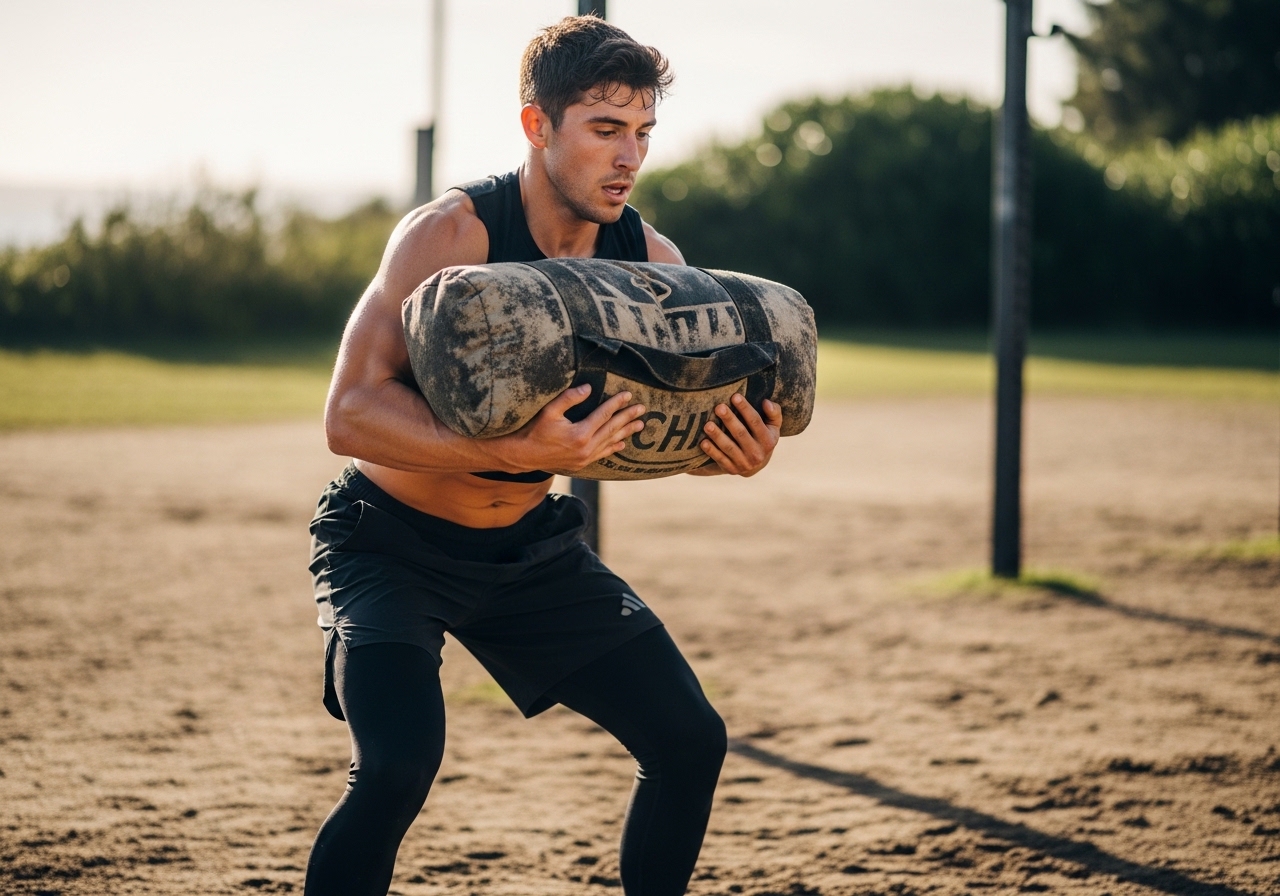
Sandbag training occupies a unique mechanical niche that barbells, dumbbells, and machines cannot replicate — a shifting, unstable load whose center of mass changes with every single repetition.
This guide explains the physiological basis of sandbag training, breaks down the six essential exercises, and provides a complete programming structure for beginners through advanced trainees.
Why Sandbag Training Produces a Different Stimulus Than Fixed Implements
The Shifting Load Principle
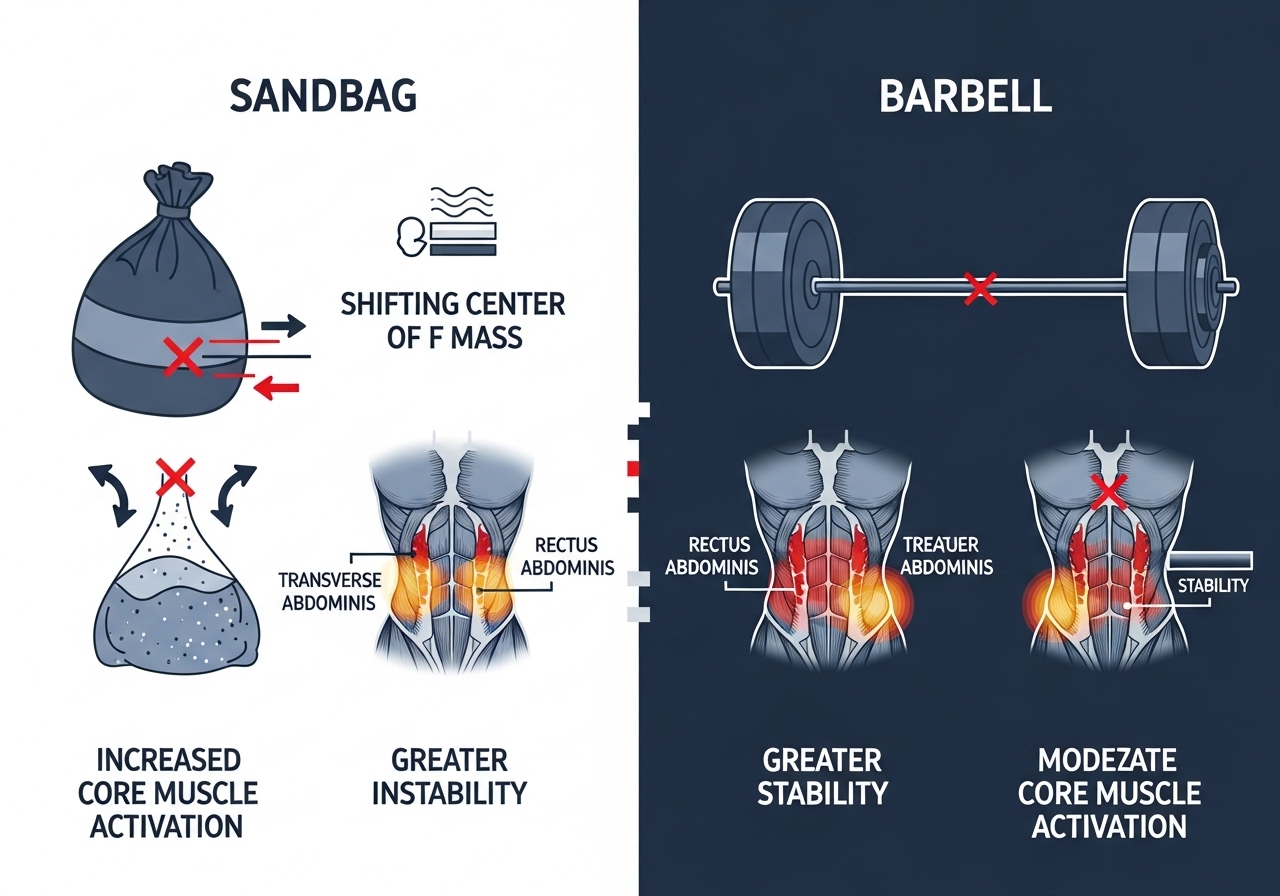
Every time you lift a barbell, the load’s center of mass is fixed and predictable throughout the movement. A sandbag’s center of mass shifts continuously as sand redistributes inside the bag — no two repetitions feel exactly alike.
This forces the body to continuously detect and respond to small position changes, elevating demand on stabilizing musculature in ways that fixed-implement training cannot replicate.
A 50 kg sandbag draped over the shoulder behaves differently from 50 kg on a barbell — it shifts, deforms, and has no standardized grip position. This awkwardness mirrors the physical demands of manual labor, combat sports, and athletic scramble positions, where odd-object strength transfers more directly than barbell strength alone.
Grip and Forearm Development
Sandbag fabric handles, open-palm bear hugs, and shoulder carry positions challenge the grip in ways a standardized barbell knurl does not. Trainees who add regular sandbag carries frequently report improvements in deadlift and row performance within 4–8 weeks — driven by the grip capacity that was previously the limiting factor in those barbell lifts.
Neurological Demands of an Unstable Load
With a fixed barbell, the nervous system develops highly specific motor programs (pre-planned sequences of muscle activation that become increasingly automatic with practice) for that exact movement. With a sandbag, the shifting load prevents complete motor program automation — the nervous system must remain in a more active, responsive state throughout each repetition.
This produces advantages in proprioception (the body’s sense of its own position and movement) and reactive stabilization that are particularly valuable for athletes in contact sports, field sports, or any activity involving unpredictable external forces.
What Sandbag Training Cannot Do
It is worth being honest about the limits of sandbag training alongside its benefits.
The instability that makes sandbags valuable for stabilizer development also limits maximum absolute loading. A highly trained powerlifter cannot replace their conventional deadlift with a sandbag RDL and maintain the same strength development — the instability necessarily reduces the load that can be safely used, which limits the absolute strength stimulus compared to a fixed barbell.
Similarly, precise progressive overload — adding 1.25–2.5 kg increments week over week — is less practical with a sandbag than with a barbell and microplates. The “imprecision” of sandbag loading (adding a kilogram or two of sand at a time) is not a significant problem for general fitness but would be limiting for competitive strength athletes who require precise overload management.
Understanding these limitations helps trainees use sandbag training where it is most appropriate — as a complement to, rather than a replacement for, barbell training for most strength and performance goals.
The Long-Term Case for Sandbag Training
Many experienced trainees who began sandbag work as a supplementary conditioning tool report that it gradually became a permanent fixture in their programming — not because it replaced other training, but because the specific adaptations it produces (grip endurance, lateral core stability, carry capacity, and rotational power) are not adequately developed by any other single tool at comparable time investment.
The combination of low equipment cost, outdoor applicability, and the functional nature of the training stimulus makes sandbag work particularly sustainable over years of consistent practice — there is no plateau in the sense that there is always a heavier load, a longer carry, or a more complex combination of exercises to progress toward.
Viewed as a long-term practice rather than a short-term program, sandbag training may represent one of the most sustainable and broadly applicable functional fitness investments available to trainees at any experience level.
The evidence base for sandbag training continues to expand as unstable load training research matures, and the practical track record accumulated by strength coaches across military, competitive strength, and athletic training contexts over decades provides additional support for the distinct value this implement provides within a complete functional fitness program. that available implement.
The 6 Core Sandbag Exercises: Execution and Programming Notes
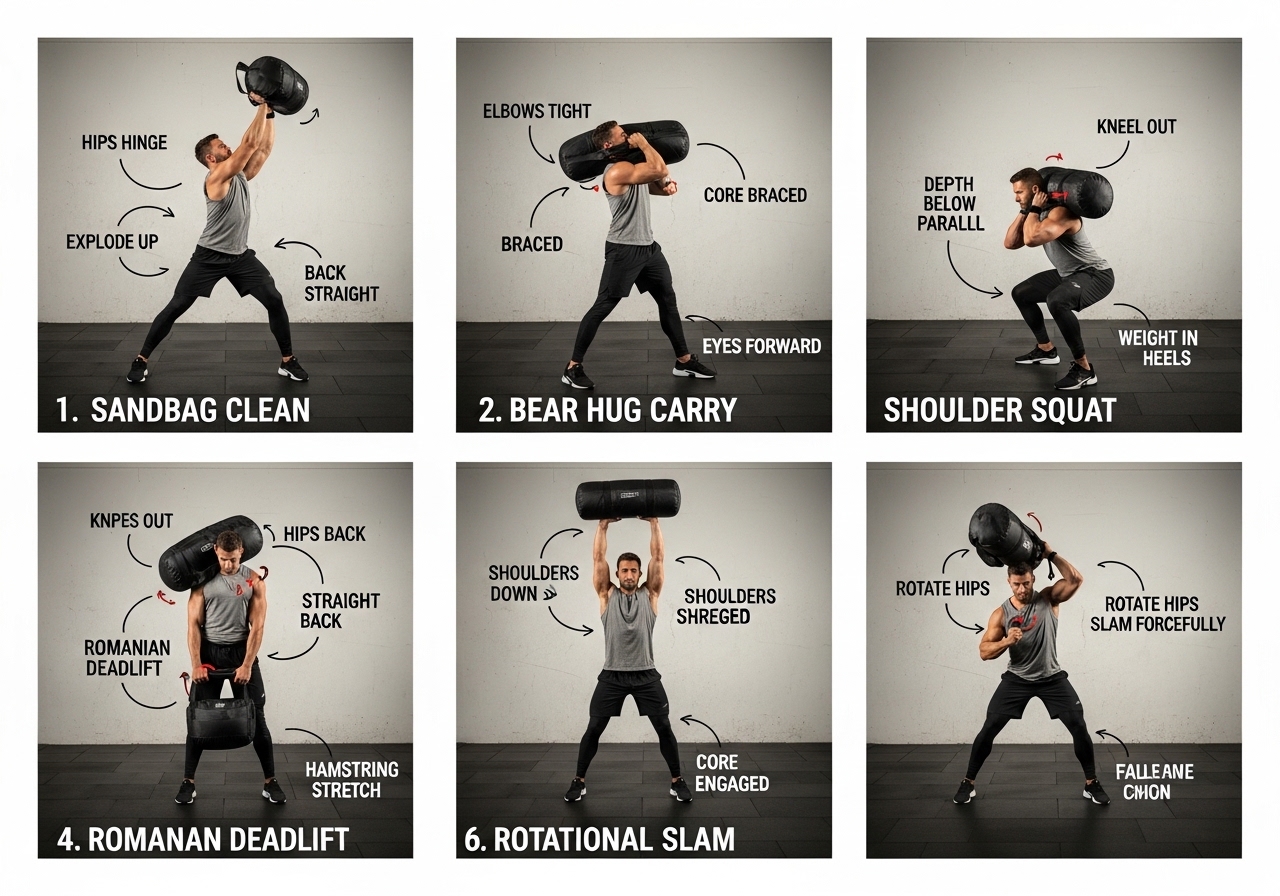
1 — Sandbag Clean
The sandbag clean trains explosive hip extension (the rapid forward driving of the hips to generate upward momentum) and upper body receiving position — identical in principle to the barbell power clean, but with an unstable implement that demands active stabilization at the catch phase.
Execution: Hinge at hips, grip handles on either side of the bag. Explosively extend hips and use that momentum to pull the bag upward. Receive it on one shoulder (shoulder clean) or at the chest. Common error: Using the arms to pull rather than relying on hip drive to generate the momentum. Reduce the load if the bag is being muscled up rather than explosively driven.
2 — Bear Hug Carry
One of the most metabolically demanding loaded carry variations available. The bear hug carry simultaneously demands effort from the anterior core (abdominal wall and hip flexors), thoracic extensors (mid-back muscles resisting forward fold), and grip — against a load that presses outward and downward while shifting with each step.
Execution: Wrap both arms around the bag and hold it against the chest. Walk for a set distance (20–50 m) or time (20–40 sec). Keep the spine upright — consciously resist the urge to lean backward as the bag pushes outward.
3 — Shoulder Squat
Placing the bag on one shoulder creates asymmetric loading (uneven weight distribution between sides) that the lateral core — particularly the obliques and quadratus lumborum (the deep lateral back muscle resisting side-bending) — must resist throughout the full squatting movement. This unilateral demand directly addresses side-to-side stability imbalances that bilateral barbell squats cannot expose.
Programming note: Alternate which shoulder carries the load between sets to develop both sides equally. 3–4 sets of 6–8 reps per side is a commonly effective range for most intermediate trainees.
4 — Sandbag Romanian Deadlift
The hip hinge pattern performed with a sandbag — held in a bear hug or by the fabric handles — develops hamstring and glute strength through the same eccentric-dominant (muscle-lengthening under load) pattern as a barbell RDL, with the additional challenge of the shifting bag requiring continuous micro-adjustments to maintain position during the descent.
5 — Overhead Press
Pressing a sandbag overhead requires the rotator cuff (the four-muscle group that stabilizes the shoulder joint) and scapular stabilizers to actively control the shifting load throughout the entire pressing movement — producing a greater shoulder stability demand than pressing a fixed barbell or dumbbell at equivalent weight.
6 — Rotational Slam
Lifting the bag overhead and slamming it to the ground on one side trains rotational power (the ability to generate force through trunk rotation) — a movement pattern that most standard gym exercises do not directly address. Rotational power is directly relevant to field sports, throwing sports, and combat sports, making the sandbag slam one of the most sport-transferable exercises in this implement category.
Sets, Reps, and Rest: Quick Reference
Exercise
Sets × Reps / Distance
Rest
Primary Stimulus
Clean
4 × 4–5
2–3 min
Power, explosive hip drive
Bear Hug Carry
3 × 30–50 m
90 sec
Core, grip endurance
Shoulder Squat
3–4 × 6–8 per side
90 sec
Legs, lateral core
Romanian Deadlift
3 × 8–10
90 sec
Hamstrings, glutes
Overhead Press
3 × 6–8
90 sec
Shoulder stability
Rotational Slam
3 × 6–8 per side
60 sec
Rotational power
Session Structure Principles for Sandbag Training
Several structural principles apply specifically to sandbag sessions:
Power before endurance: Cleans and explosive work must precede carry work — performing power exercises under accumulated carry fatigue significantly increases injury risk and reduces power output quality
Unilateral after bilateral: Shoulder carries and single-arm work should follow bilateral exercises — establishing bilateral stability before introducing asymmetric demands
Complexes last: Multi-exercise complexes should be placed at the end of a session as a conditioning finisher — not at the beginning when strength-focused work has not yet been completed
Nutrition Considerations for Sandbag Training
Sandbag training — particularly complex and carry work — places significant demands on both the muscular and cardiovascular systems.
Pre-session (1–2 hours before): A mixed meal with carbohydrates and protein supports performance during metabolically demanding carry and complex work
Post-session protein: 20–40 g of protein within 1–3 hours supports the muscle repair process stimulated by the training
Hydration: Carry work and complex training elevate sweat rates — arriving well-hydrated and replacing fluids during sessions longer than 30 minutes is particularly important
These are general guidelines — a registered dietitian can provide personalized nutrition guidance based on your specific training load, body size, and dietary requirements.
Understanding the Metabolic Demand of Carry Work
Loaded carry training — bear hug carries, shoulder carries, and farmer’s walks — produces a uniquely high metabolic demand relative to training duration.
A 30-second bear hug carry with a moderately heavy sandbag elevates heart rate significantly while simultaneously loading the grip, core, and lower body musculature — producing both cardiovascular and strength training stimulus in a single movement that most gym exercises cannot replicate.
This metabolic efficiency is one reason loaded carry work has become central to functional fitness, strongman preparation, and general conditioning programs — it provides an outstanding work-to-time ratio that makes it practical even for trainees with limited training time available each week.
Heart rate during heavy bear hug or shoulder carry work frequently reaches 75–85% of maximum heart rate in moderately fit individuals — placing it in the cardiovascular training zone associated with aerobic fitness development even without any running or cycling involved. This makes sandbag carry training genuinely cross-modal — developing both muscular and cardiovascular fitness simultaneously within a single training format.
Sandbag Programming: 3-Day Full-Body Program and Integration With Barbell Training
Starting Weight Guidelines
A critical rule for beginners: always start at 50–60% of the bag’s maximum capacity. The instability makes sandbags significantly harder than their weight suggests — most new sandbag trainees underestimate this and start too heavy.
Level
Recommended Starting Weight
Primary Focus
Beginner
10–20 kg
Movement pattern learning, stability development
Intermediate
25–45 kg
Strength and conditioning development
Advanced
50–80+ kg
Maximum functional strength and power
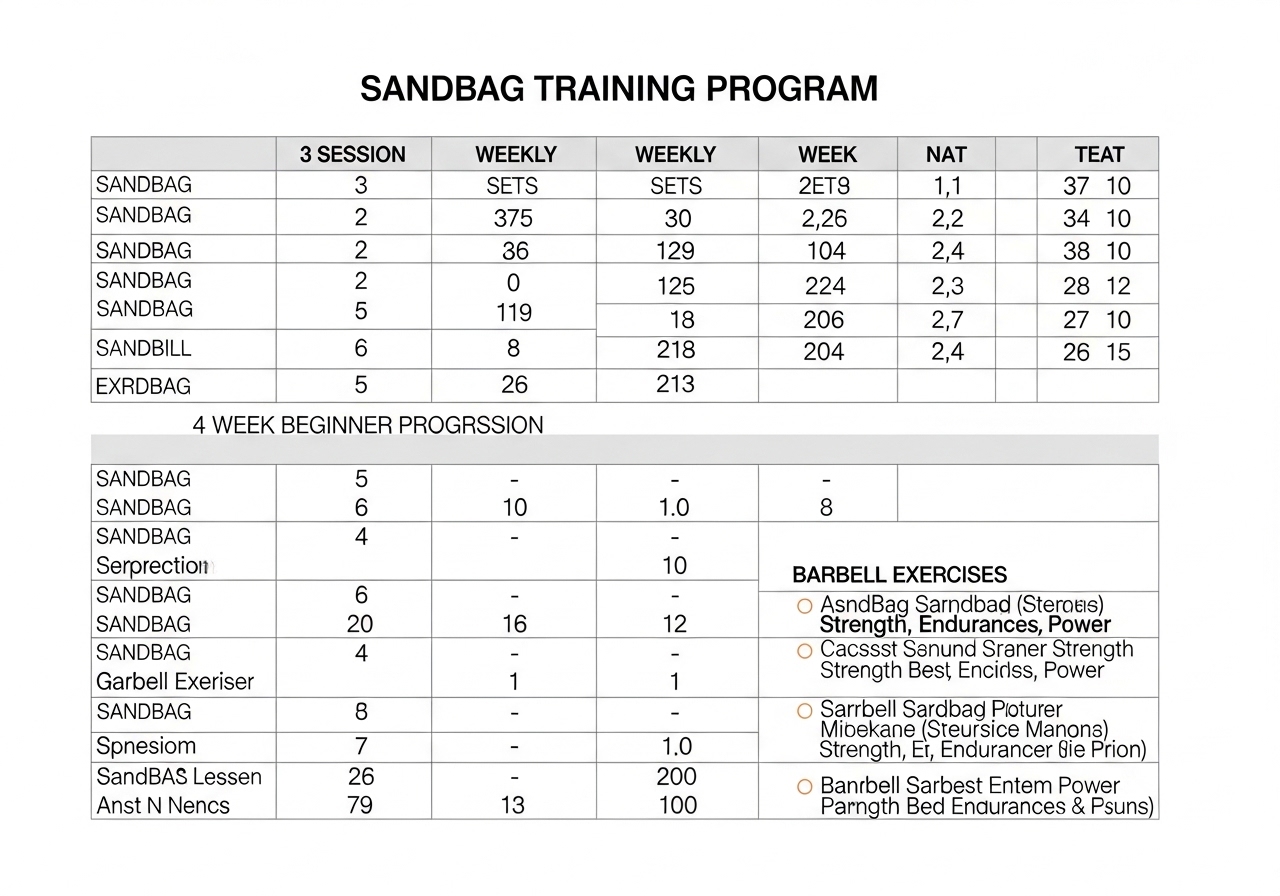
3-Day Full-Body Sandbag Program
Session A — Power and Strength:
Sandbag Clean — 4 × 5 (focus on hip drive quality)
Shoulder Squat — 3 × 6 per side
Bear Hug Carry — 3 × 30 m
Session B — Strength and Carry:
Romanian Deadlift — 4 × 8
Overhead Press — 3 × 8
Shoulder Carry — 3 × 20 m per side
Session C — Conditioning:
Rotational Slam — 3 × 8 per side
Bear Hug Squat — 3 × 10
Beginner Complex* — 2 rounds
*Beginner Complex (no rest between exercises): Clean × 3 → Front Squat × 3 → Romanian Deadlift × 3 | Rest 90 sec between rounds
4-Week Progressive Plan for Beginners
Week 1: Hip hinge drill, bear hug position, shoulder carry | Load: 50% of target weight Week 2: Add RDL × 3 × 8 and Bear Hug Carry × 3 × 20 m | Load: 60% Week 3: Add Clean × 3 × 4 and Shoulder Squat × 3 × 6 per side | Load: 65–70% Week 4: All 6 exercises + beginner complex × 2 rounds at end of one session
Integrating Sandbag Work With Barbell Training
Training Goal
Recommended Sandbag Role
Frequency
Strength (barbell primary)
GPP carry work on recovery days
1× per week
General fitness
Primary tool or supplement to other training
2–3× per week
Athletic performance
Carry and slam work for sport transfer
1–2× per week
Conditioning / fat loss
Complexes and conditioning circuits
2–3× per week
Sandbag Conditioning Complex
A sandbag complex — multiple exercises performed back-to-back without setting the bag down — is one of the most time-efficient conditioning formats available. The combination of muscular load, cardiovascular demand, and the instability of the implement creates a stimulus that most standard training formats approach differently.
Most sandbag exercises can be performed on grass, rubber flooring, or any stable outdoor surface. Specific surface recommendations:
Carries: Flat, even surface is safest — uneven terrain (uphill, gravel) adds difficulty but requires careful footing assessment before loading
Cleans and slams: Rubber flooring or firm grass — these exercises involve dropping the bag, which damages some hard flooring and creates noise concerns in shared spaces
Squats and presses: Any stable, flat surface is appropriate
Training outdoors with a sandbag during mild weather months provides fresh air and varied terrain, making it one of the more psychologically engaging training options available for home or outdoor use.
When to Seek Professional Guidance
A certified strength and conditioning specialist (CSCS) or qualified personal trainer can provide individualized technique assessment and program design that self-directed training cannot fully replicate. Seeking professional guidance is particularly recommended if:
You have existing lower back, shoulder, or knee conditions that may be affected by dynamic or loaded movements
You have not done any resistance training previously — establishing baseline movement quality before adding sandbag instability reduces injury risk
You are training for a specific athletic goal and want to optimize how sandbag training integrates with your overall program
Combining Sandbag Training With Other Modalities
Sandbag training integrates well alongside most other fitness modalities without creating excessive recovery demand, provided the total weekly training load is managed appropriately:
With running: 1–2 sandbag carry sessions per week as cross-training adds strength and grip work without the impact load of additional running
With yoga or mobility work: The functional strength demands of sandbag training complement flexibility-focused practices by building the active strength to utilize the range of motion developed in yoga
With team sports: In-season sandbag work — particularly carries and cleans — provides strength maintenance with lower recovery cost than heavy barbell sessions
Equipment Selection, Safety, and Progressive Overload
Choosing a Sandbag
Multiple handles: Top, side, and end handles allow a wider variety of grip positions and exercises — strongly preferable to single-handle bags
Filler bags: Quality sandbags include inner filler bags that can be partially filled — start at 50–60% capacity and increase weight progressively as strength and technique improve
Seam reinforcement: Heavy-duty stitching at all stress points is essential — poor quality bags split under repeated drop impacts or heavy loaded carries
Material: Heavy-duty canvas or military-grade cordura for durability under repeated high-load use
Safety Considerations Before Starting
⚠️ Important safety guidelines:
→ Learn the hip hinge and core bracing patterns with bodyweight before adding any load
→ Start significantly below your perceived maximum — unstable loads are much harder than equivalent stable weights
→ Never perform cleans, slams, or dynamic movements on wet or slippery surfaces
→ Avoid sandbag overhead work with existing shoulder injuries — consult a healthcare provider or physiotherapist first
→ Lower back pain during any sandbag exercise is a signal to stop, reduce load, and evaluate technique before continuing
Progressive Overload Methods
Method
How to Apply It
Add filler weight
Increase bag fill by 2–5 kg when all target reps and distances are completed with good form
Increase carry distance
Add 5–10 m per week at the same weight before increasing load
Reduce rest periods
Same work volume with less recovery increases the conditioning demand without changing load
Add complexity
Progress from single exercises to multi-exercise complexes as individual exercises become manageable
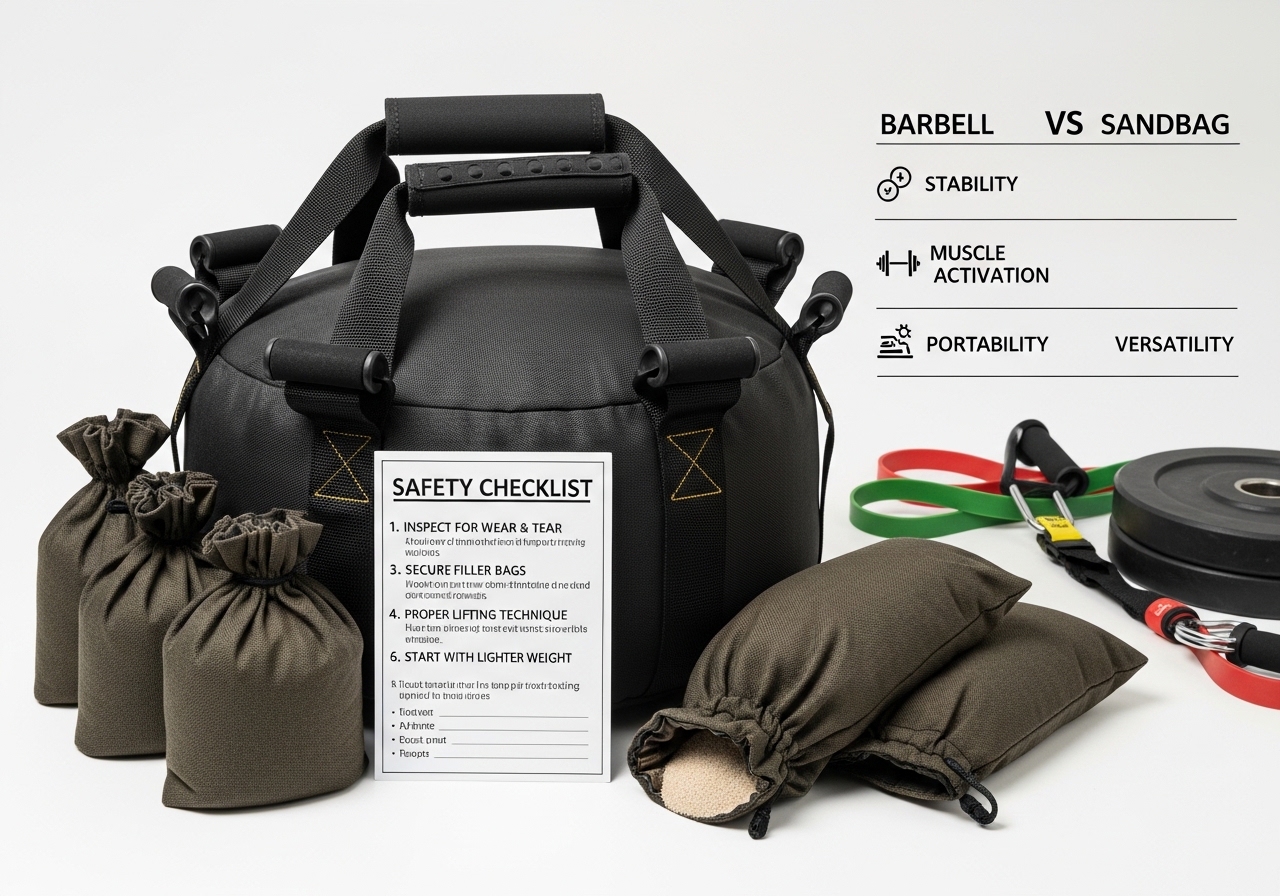
Sandbag vs. Barbell: Understanding Complementary Roles
The most effective approach for most trainees combines both implements:
Factor
Sandbag Advantage
Barbell Advantage
Stabilizer development
Higher — shifting load demands more
Primary mover loading maximized
Grip training
Varied, functional grip demands
Standardized, easier precise overload
Sport transfer
Higher for irregular contact situations
Higher for absolute strength/power sports
Equipment cost
Lower upfront investment
Greater load range available
Barbell training provides systematic strength progression and maximum load development. Sandbag training addresses functional carry work, stabilizer development, grip training, and metabolic conditioning. Using both produces more complete functional fitness than either tool alone.
Long-Term Sandbag Training: Periodization, Recovery, and Sustainable Practice
Understanding the First Month of Adaptation
New sandbag trainees consistently report that the first 2–3 weeks are harder than anticipated relative to the weight used. This is normal and expected — the instability and grip demands make even moderate loads challenging for those primarily accustomed to fixed implements.
What to expect across the first 4 weeks:
Week 1–2: Significant grip and forearm soreness from carry work. Core fatigue more prominent than expected. Normal adaptation.
Week 3–4: Soreness reduces significantly. Movement patterns feel more familiar. Carry distances begin improving noticeably.
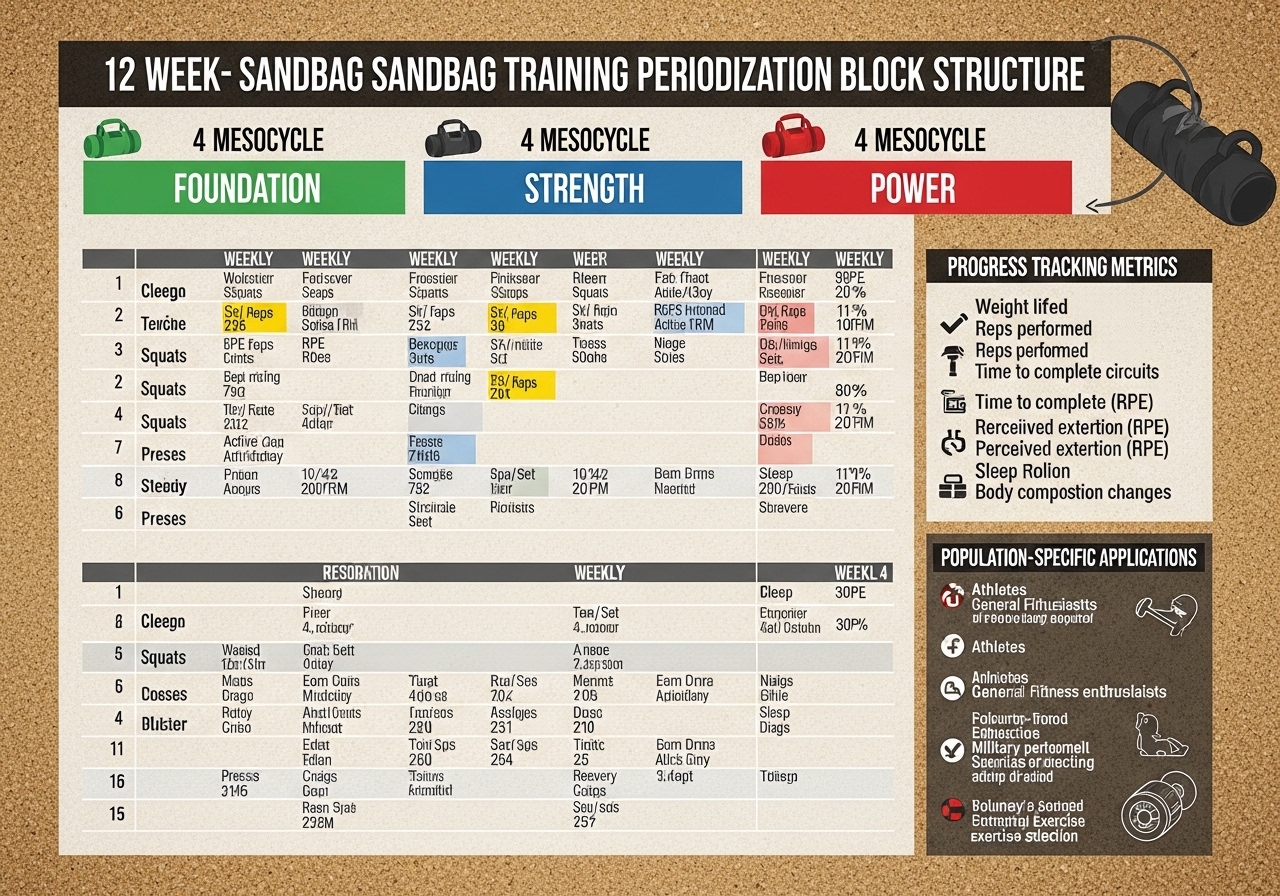
12-Week Block Periodization
Weeks 1–4 (Foundation): 2 sessions/week | Focus on movement quality, 50–65% load Weeks 5–8 (Development): 3 sessions/week | Increase load and carry distances Weeks 9–12 (Conditioning): 3 sessions/week | Complexes, maximum carries, conditioning circuits
Session Recovery Guidelines
Session Type
Duration
Recovery Between Sessions
Strength-focused (cleans, squats, presses)
30–45 min
48–72 hours
Carry-focused (GPP, conditioning)
20–35 min
24–48 hours
Complex-focused (metabolic)
20–30 min
48 hours minimum
Start with 2 sessions per week rather than daily training. Sandbag carry and complex work produces significant systemic fatigue relative to session duration — the stabilizing musculature needs time to adapt before volume is increased.
When to Take a Deload Week
Plan a deload week (reduce volume by 40–50% and load by 20–30%) every 4–6 weeks, or earlier if you notice any of these signals:
Grip consistently failing before the target carry distance is reached
Clean power output declining — the bag no longer being driven as high as in previous sessions
Persistent general fatigue that does not resolve with a rest day
Low back tightness appearing during or after sessions
Tracking Progress Without Traditional PRs
Sandbag progress is measured differently from barbell training — there are no standardized PR lifts, but carry-based metrics provide equally meaningful progress tracking:
Carry distance at a given weight: A 40 kg bear hug carry for 50 m vs. 30 m eight weeks ago is a concrete, meaningful improvement
Complex completion time: The same complex performed faster with the same load — measurable metabolic and strength adaptation
Subjective effort rating: The same session that felt 9/10 difficulty six weeks ago now feels 7/10 — the most accessible adaptation indicator
Grip endurance over distance: Completing a carry without grip failure at distances that previously required stopping
Sandbag Training for Specific Populations
For athletes: Sandbag carries, cleans, and slams are appropriate supplementary exercises for in-season conditioning when training time is limited and functional transfer to real sport demands is a priority.
For general fitness trainees: A 30-minute sandbag complex session may provide comparable cardiovascular and muscular stimulus to a longer traditional gym session — making it highly practical for time-constrained individuals.
For home trainees: One heavy-duty sandbag with multiple handles (rated 40–60 kg), filler bags starting at 50% capacity, and 3–5 meters of clear outdoor or indoor space provides sufficient equipment for a complete full-body training program at a fraction of the cost of a barbell and rack setup.
The Psychological Advantage
Many experienced trainees report that sandbag training provides a distinctive psychological challenge that barbell lifting does not replicate — controlling an uncooperative, shifting load produces a sense of functional accomplishment that translates well to practical confidence in physical tasks.
For trainees who find traditional gym training motivationally challenging, the variety, outdoor applicability, and inherently functional nature of sandbag work often supports better long-term training adherence than fixed-implement training alone.
Building a Sustainable Long-Term Practice
The most effective long-term sandbag trainees treat it as a consistent practice rather than a short-term program. Consistent 2–3 sessions per week over 6–12 months produces more complete functional adaptation than intensive 6-week blocks with long gaps between them. Varying exercise selection across months — rotating which carry variations, clean styles, and squat positions are emphasized — prevents accommodation (the gradual reduction in training response as the body adapts to a fixed stimulus) and maintains continued adaptation over the long term.
I don’t have a commercial sandbag — what can I use?
A heavy duffel bag filled with sand packed in smaller plastic inner bags, old clothing, or bags of rice can serve as a functional starting implement. The primary limitation is handle quality — commercial bags with reinforced multiple handles provide more exercise variety than improvised bags. DIY sandbags have been used in strength and conditioning for decades and remain a valid option for those not ready to invest in commercial equipment.
Can kettlebells provide the same training effect?
Kettlebells and sandbags produce overlapping but distinct adaptations. Kettlebells excel at ballistic training (swings, snatches), precise loading, and standardized grip positions. Sandbags excel at carry-specific training, bear hug mechanics, asymmetric loading, and the specific odd-object stabilization demand that neither kettlebells nor barbells can replicate. Both tools have distinct value — combining them produces more complete functional fitness than either alone.
Should I do sandbag training before or after barbell work?
For sessions combining both: perform barbell strength work first (when fresh) and sandbag carry or conditioning work afterward. The precision required for heavy barbell technique is best performed without prior fatigue, while sandbag carries and complexes can be performed productively under moderate fatigue as conditioning work.
✅ Final Summary
Sandbag training produces a distinct stimulus from fixed implements — the shifting load elevates stabilizer and core demand in ways barbells and dumbbells cannot replicate
Start at 50–60% bag capacity, master 2 sessions per week before adding a third
Bear hug carry, shoulder squat, and clean are the highest-value exercises — prioritize these when time is limited
Combining barbell strength work with sandbag carry and conditioning work produces more complete functional fitness than either approach alone
Seek professional guidance from a CSCS or physiotherapist if you have existing shoulder, lower back, or joint concerns before beginning dynamic sandbag movements
Frequently Asked Questions About Sandbag Training
Can sandbag training replace a gym entirely?
For general fitness, conditioning, and functional strength goals — a sandbag combined with bodyweight training can provide sufficient stimulus for most health and fitness objectives. For maximum absolute strength development, competition powerlifting, or sport-specific barbell strength — a sandbag alone is not an adequate substitute, and barbell training remains the more appropriate primary tool.
How heavy should my first sandbag be?
A bag rated for 40 kg filled to 20–25 kg is a practical beginner starting point for most healthy adults. Starting at full weight typically produces technique breakdown before the stabilizing muscles have had time to adapt to the unstable demands of the implement. Begin lighter and add weight progressively as movement quality improves.
Is sandbag training appropriate for older adults?
Moderate-load carry work — particularly bear hug carries — may be appropriate for many older adults due to its low-impact nature and flexible load selection. Dynamic movements such as cleans and slams require movement quality screening before inclusion in a program for older adults.
Adults over 60 or those with any joint, cardiovascular, or bone health concerns should consult a qualified exercise professional or physiotherapist before beginning sandbag training — particularly for dynamic or overhead movements.
How long before I see results from sandbag training?
Neurological adaptations — improved stabilizer activation, better movement patterns, and increased grip endurance — typically appear within 3–4 weeks of consistent training. Visible changes in body composition, functional strength, and carry performance generally require 8–12 weeks of consistent, progressive work alongside adequate nutrition and recovery. Individual variation in adaptation rate is significant and influenced by genetics, sleep quality, diet, and training history.
✅ Key Takeaways
Sandbag instability elevates core and stabilizer muscle demand compared to equivalent stable loads — supported by research on unstable load training
Bear hug carries, shoulder squats, and cleans are the highest-value exercises in this implement category
Start at 50–60% of maximum bag capacity — the shifting load makes sandbags significantly harder than their weight suggests
Sandbag training works best as a complement to barbell work for most intermediate trainees, not as a full replacement
Consult a qualified healthcare professional before overhead or dynamic sandbag work if any joint or spinal conditions are present
Is sandbag training safe for the lower back?
When performed with proper hip hinge mechanics and appropriate load selection, sandbag training is generally safe for most healthy adults without existing lower back conditions.
The instability of the bag demands active core bracing throughout each movement — a protective mechanism when maintained correctly. However, if you have existing lower back conditions (disc herniation, stenosis, or chronic pain), please consult a physiotherapist or sports medicine physician before beginning sandbag training, particularly for dynamic movements like cleans or slams with heavy loads.
Proper form and appropriate load selection from the outset remain the most important safety factors.
Why Cycling Is the Most Joint-Friendly Serious Cardio You Can Do Cycling occupies a unique position among cardiovascular training options: it provides the full cardiovascular and metabolic demands of serious cardio training with a fraction of the joint impact that running and other weight-bearing activities impose. This combination makes it genuinely exceptional for athletes who…
⚠️ Fitness Disclaimer: The information in this article is for general educational purposes only and does not constitute professional fitness or medical advice. Always consult a qualified healthcare professional before starting any new exercise program. ⚠️ Cardiovascular Health Notice: If you have a history of heart disease, high blood pressure, or any cardiovascular condition, obtain…
⚠️ Fitness Disclaimer: The information in this article is for general educational purposes only and does not constitute professional fitness or medical advice. Always consult a qualified healthcare professional before starting any new exercise program, especially if you have existing injuries or medical conditions. Why Two Straps Changed What I Thought Training Equipment Needed to…
⚠️ Health & Fitness DisclaimerThis article is for general educational and informational purposes only. It does not replace professional medical or fitness advice. If you have any pre-existing condition, injury, or health concern — consult a qualified healthcare professional or certified personal trainer before starting or modifying any exercise program. Hip flexor tightness is one…
Warning Fitness Disclaimer: The information in this article is for general educational purposes only and does not constitute professional fitness or medical advice. Always consult a qualified healthcare professional before starting any new exercise program. The Cardio Method That Changed Everything I Thought I Knew About Training For most of my training life, I believed…
⚠️ Health & Fitness DisclaimerThis article is for general educational and informational purposes only. It does not replace professional medical or fitness advice. If you have any pre-existing condition, injury, or health concern — consult a qualified healthcare professional or certified personal trainer before starting or modifying any exercise program. VO2 max is one of…