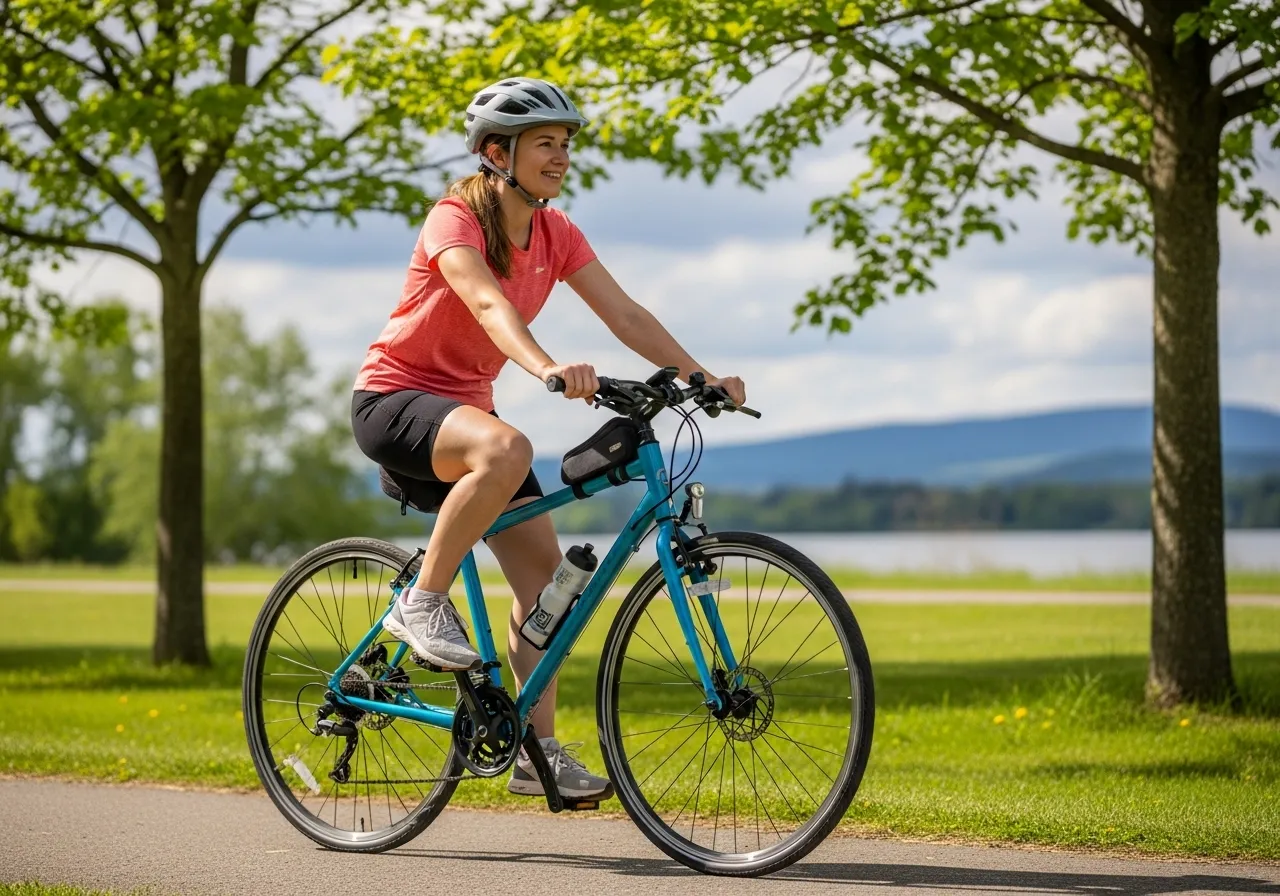
Why Cycling Is the Most Joint-Friendly Serious Cardio You Can Do
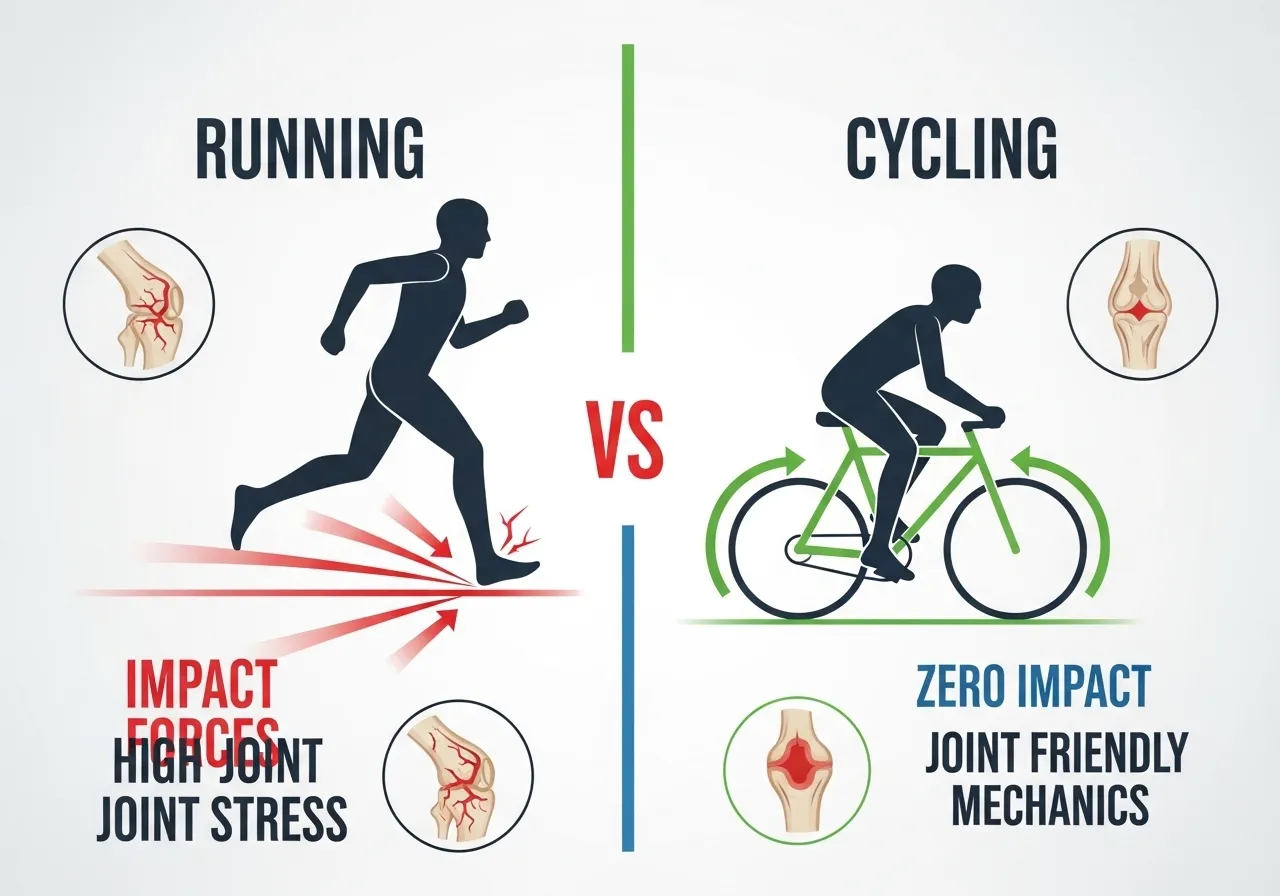
Cycling occupies a unique position among cardiovascular training options: it provides the full cardiovascular and metabolic demands of serious cardio training with a fraction of the joint impact that running and other weight-bearing activities impose. This combination makes it genuinely exceptional for athletes who want serious cardiovascular fitness development without the accumulated joint stress that high-volume running produces in the feet, ankles, shins, knees, and hips. Running impact forces reach two to three times body weight with each footstrike; cycling impact forces are negligible because the pedal supports the foot rather than the foot absorbing impact against the ground. This mechanical difference allows daily cycling training volumes that would be impossible with equivalent running, producing cardiovascular development that running-only programs cannot achieve without injury risk.
Cycling’s cardiovascular training stimulus — when training intensity is appropriately managed — matches or exceeds that of running at equivalent heart rate zones. Research comparing VO2 max guide improvements between cycling and running training programs of equivalent volume and intensity finds comparable cardiovascular adaptation, confirming that cycling develops the same aerobic fitness as running while eliminating the impact exposure that limits running volume for many athletes. This equivalence, combined with the joint-friendly mechanics, makes cycling the most practical high-volume cardiovascular training tool available for recreational athletes who want genuine fitness development without structural breakdown. According to research on cardiovascular training modalities and VO2 max development, cycling and running produce equivalent cardiovascular fitness improvements at matched training intensities, with cycling’s joint-friendly mechanics allowing higher training volumes than running in populations with joint sensitivity.
Action point: If you currently experience joint discomfort that limits running volume, try replacing two weekly runs with equivalent-duration cycling sessions at the same heart rate. Note joint comfort during and after sessions and compare cardiovascular effort quality to running at identical heart rates.
Cycling’s Cardiovascular Benefits Beyond Fitness
The cardiovascular health benefits of regular cycling extend far beyond improved VO2 max and resting heart rate into long-term health markers that determine quality of life across decades. Research on cycling and cardiovascular disease risk finds that regular cyclists have thirty to forty percent lower rates of cardiovascular disease compared to sedentary age peers — a risk reduction comparable to that from pharmaceutical interventions and significantly more comprehensive in its health effects. Blood pressure improvements from regular cycling are among the most consistent physiological adaptations documented in exercise research — twenty to forty minutes of Zone 2 training cycling five days per week produces blood pressure reductions of three to five mmHg systolic and two to three mmHg diastolic, clinically meaningful reductions that reduce cardiovascular event risk. HDL cholesterol (the protective form) increases and triglycerides decrease with regular cycling training, improving the lipid profile that determines arterial health. These metabolic improvements compound across years of regular cycling into the cardiovascular resilience that distinguishes active adults from sedentary ones in their fifties, sixties, and beyond. The investment in a regular cycling practice — even at the modest volumes of the eight-week program described in this article — produces health returns that extend decades beyond the training period during which they are accumulated. According to research on cycling and long-term cardiovascular health, regular cyclists demonstrate significantly better cardiovascular biomarkers and lower disease risk than sedentary populations across all age groups studied.
Cycling and Strength Training: The Optimal Combination
Combining cycling with strength training produces a more complete physical development profile than either modality alone, and the two activities complement each other in specific ways that make the combination more effective than sequential monoculture training. Cycling develops cardiovascular capacity and lower body muscular endurance; strength training develops maximum force production and the muscular mass that cycling’s endurance stimulus cannot build. The combination produces athletes who are both aerobically fit and structurally strong — the complete physical profile that recreational sport participation, functional aging, and aesthetic goals all benefit from. The key programming consideration for combining the two: avoid placing high-intensity cycling intervals and heavy leg strength training sessions within twelve to twenty-four hours of each other, as the accumulated lower body fatigue from both sessions compromises quality in both. Zone 2 cycling can be performed the same day as or the day after heavy lower body strength training without significant interference — the low intensity of Zone 2 work serves as active recovery rather than additional stress. Structuring the week with Zone 2 cycling adjacent to strength training days and high-intensity cycling intervals on separate days from heavy lower body lifting produces the optimal development from both modalities without the interference that scheduling them simultaneously would produce.
Indoor vs Outdoor Cycling: Understanding the Training Differences
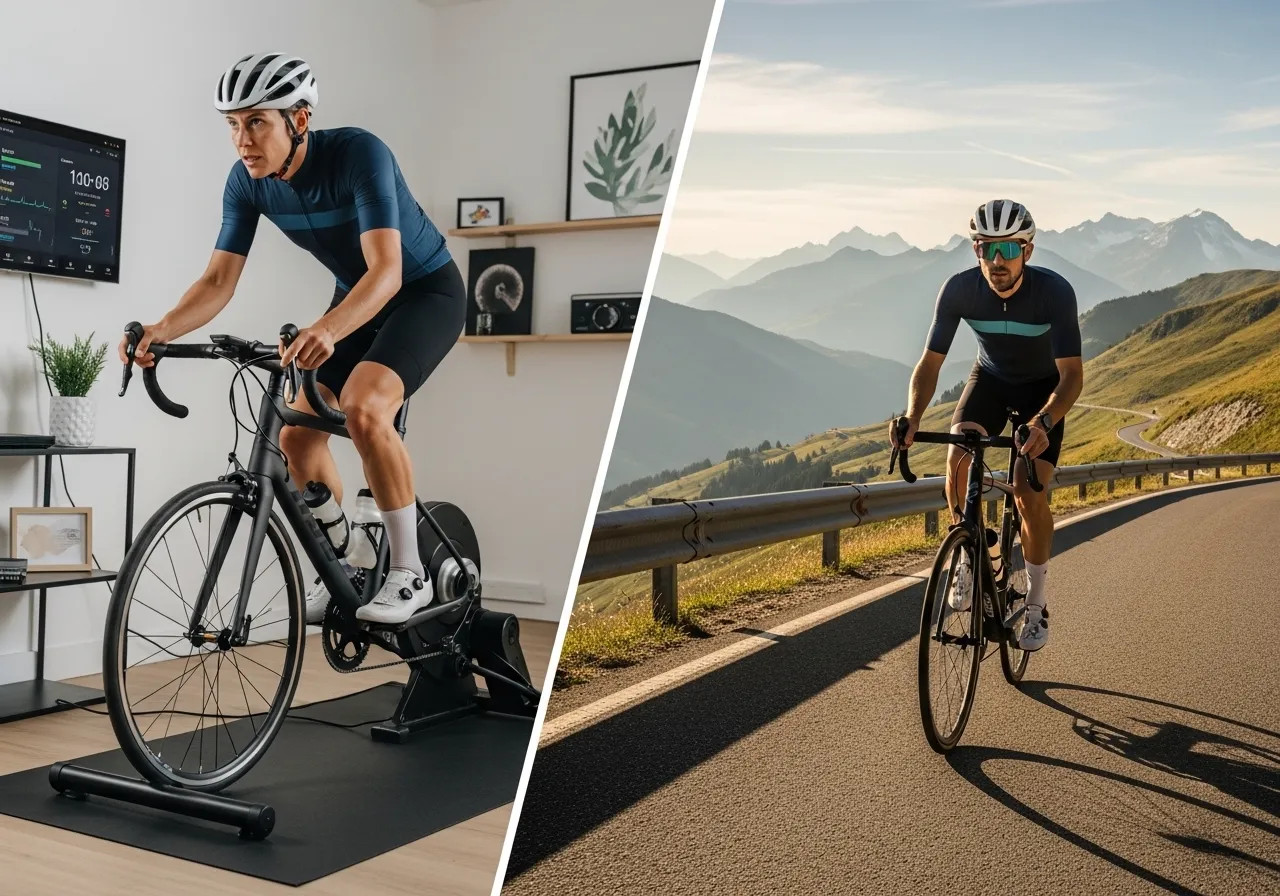
Indoor cycling (stationary bike or trainer-mounted road bike) and outdoor cycling provide distinct training experiences with different advantages that make them complementary rather than interchangeable. Understanding the specific advantages of each guides intelligent decisions about when to use each and how to structure training across both environments.
Indoor Cycling Advantages
Indoor cycling provides controlled, reproducible training conditions that make structured interval workouts more precise than outdoor cycling allows. On a stationary bike, the resistance is fixed, there are no traffic lights, no descents that eliminate pedaling demand, and no weather variables that affect effort. This consistency makes indoor cycling guide the optimal environment for Zone 2 base-building work (where maintaining a precise heart rate for extended duration produces the greatest aerobic base development) and for high-intensity intervals (where precise work-to-rest ratios and consistent resistance produce the specific cardiovascular stimulus that variable outdoor conditions prevent). Spin classes, smart trainer programs like Zwift, and structured indoor sessions consistently produce more targeted cardiovascular development per training hour than equivalent outdoor riding for most recreational cyclists, because the controlled environment maintains the intended training stimulus throughout the session without the intensity variations that outdoor terrain imposes. According to ACSM cycling training guidelines, controlled indoor training environments produce superior results for structured cardiovascular programming compared to variable outdoor conditions.
Outdoor Cycling Advantages
Outdoor cycling develops bike handling skills, terrain adaptability, and the mental engagement of variable environments that indoor cycling cannot provide. The variable terrain of outdoor riding — climbs that impose sustained high-intensity efforts, descents that provide active recovery, corners that require balance and positioning — produces a more complete athletic development than indoor cycling’s consistent flat-road simulation. The psychological benefits of outdoor riding — fresh air, changing scenery, the freedom of self-propelled travel — also contribute to the enjoyment and adherence that makes outdoor cycling sustainable as a long-term fitness practice for many athletes who find indoor training mentally taxing. The practical integration: use indoor training for structured workouts where precision matters (Zone 2 base work, interval sessions), and use outdoor riding for the longer endurance sessions and the recreational enjoyment that motivates continued cycling practice across weeks and months.
Bike Fit: The Foundation of Pain-Free Cycling
Bike fit — the adjustment of saddle height, saddle fore-aft position, handlebar height, and reach — is the most important factor in cycling comfort and injury prevention. The most common cycling overuse injuries — knee pain, lower back pain, and neck discomfort — are almost universally related to poor bike fit rather than to cycling volume. Saddle height too low creates excessive knee flexion at the bottom of the pedal stroke that produces patellofemoral stress; too high creates hip rocking and IT band irritation. A professional bike fit from a certified fitter (available at most specialty cycling shops for fifty to one hundred and fifty dollars) prevents these issues and dramatically improves both comfort and pedaling efficiency. This investment pays returns across years of pain-free cycling that self-fitted bikes frequently cannot produce. Research on cycling biomechanics and knee injury confirms that saddle height is the primary modifiable risk factor for cycling-related knee injuries, validating professional bike fitting as an injury prevention investment.
Action point: If you currently experience any discomfort during or after cycling, get a professional bike fit before increasing training volume. Most cycling overuse problems resolve completely with correct bike fit adjustments that cost far less than the physical therapy that incorrect positioning eventually requires.
Cycling Safety: What Every New Cyclist Needs to Know
Outdoor cycling safety — helmet use, road positioning, awareness of traffic, and group riding etiquette — is essential knowledge for anyone beginning an outdoor cycling program. Helmet use reduces the risk of serious head injury in cycling accidents by sixty to eighty-five percent and is non-negotiable for outdoor riding regardless of experience level or road conditions. Road positioning should maintain approximately one meter from parked cars (to avoid being hit by suddenly opened doors), ride in a predictable straight line, and use the dedicated bike lane when present or occupy a visible position in the traffic lane when no lane exists. Traffic awareness — riding predictably, making eye contact with drivers at intersections, never assuming a driver has seen the cyclist — prevents the majority of cycling-vehicle incidents that are the primary safety concern for road cyclists. Cycling lights — a white front light and red rear light — should be used whenever visibility is reduced, including dawn, dusk, and overcast conditions regardless of time of day. These safety practices require minimal time investment and dramatically reduce the injury risk that makes some people hesitant to begin outdoor cycling training. According to ACSM guidelines on cycling safety, helmet use and traffic-aware riding behaviors are the primary injury prevention strategies for recreational cyclists, with helmet compliance alone reducing head injury risk by more than sixty percent.
Cycling Training Zones: How to Train for Maximum Fitness Gains
Cycling cardiovascular development follows the same heart rate zone principles as other endurance activities, with the same polarized training approach that produces superior fitness outcomes compared to constant moderate-intensity riding. Most recreational cyclists ride almost exclusively in Zone 3 — the moderately hard “conversational effort” zone — which is comfortable enough to maintain for extended periods but too hard to build the aerobic base and too easy to develop the high-end cardiovascular capacity that significant fitness improvement requires.
Zone 2 Cycling: The Foundation
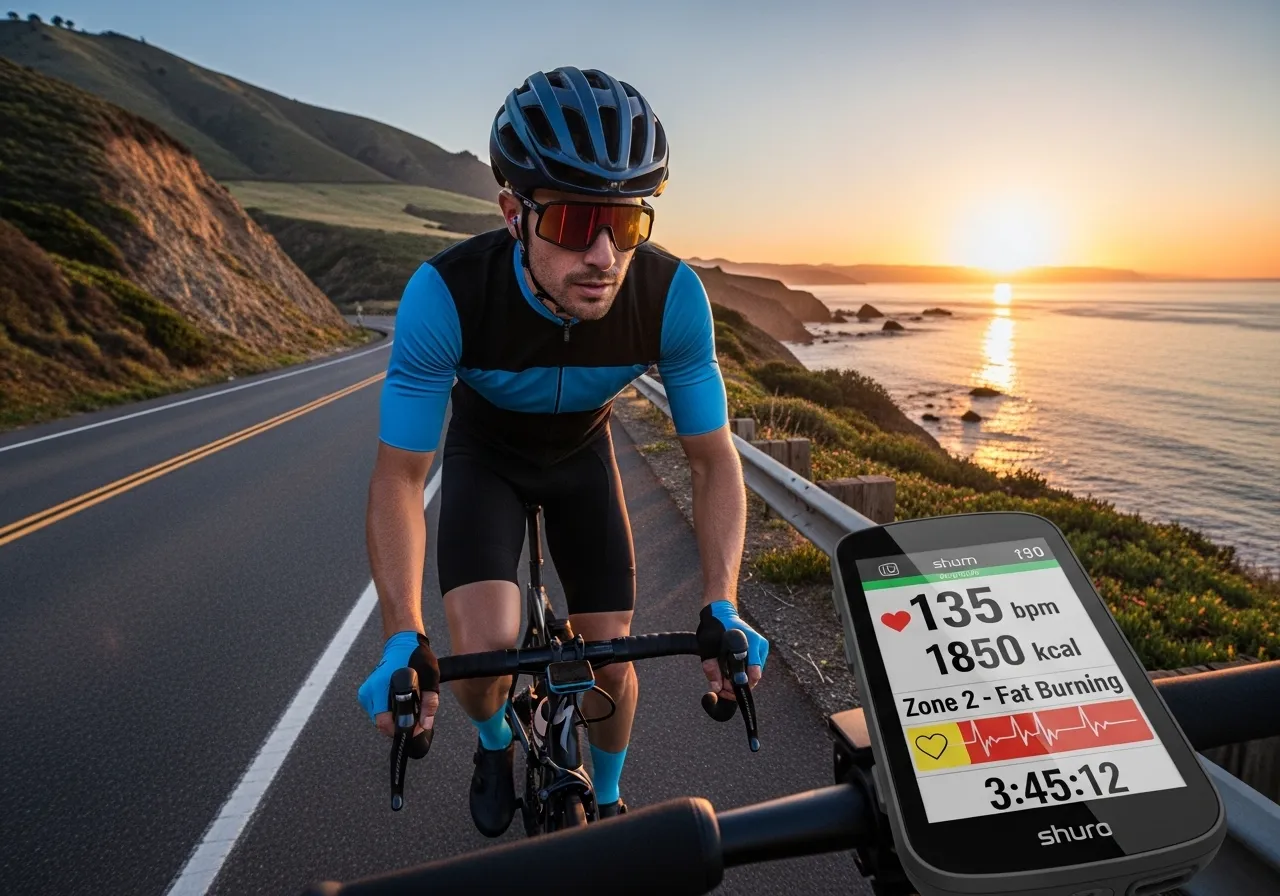
Zone 2 cycling — sixty to seventy percent of maximum heart rate, a pace where conversation is possible but not entirely comfortable — is the primary driver of the mitochondrial adaptations that underpin cardiovascular fitness. Long Zone 2 rides (sixty to ninety minutes at minimum, two to three times per week) develop the aerobic base that allows all other cycling intensities to be sustained longer and recovered from faster. Most recreational cyclists significantly underestimate how slow Zone 2 pace feels on the bike — for a moderately fit cyclist, Zone 2 corresponds to a pace that feels embarrassingly slow, far below the intensity that “feels productive.” This subjective mismatch between the correct Zone 2 intensity and the intensity that feels like genuine training is the primary reason most cyclists default to Zone 3 — it feels more like exercise. Overcoming this tendency by using heart rate monitoring to enforce Zone 2 compliance produces the fitness development that sustained Zone 3 riding consistently fails to generate. According to research on Zone 2 training and mitochondrial adaptation, consistent training at sixty to seventy percent of maximum heart rate produces the greatest mitochondrial biogenesis and fat oxidation improvements of any training intensity.
Cycling Intervals: Developing VO2 Max and Power
High-intensity cycling intervals — Zone 4 and Zone 5 efforts of one to eight minutes with recovery periods — develop the upper end of cardiovascular fitness that Zone 2 training alone cannot reach. Classic cycling interval protocols: four-minute intervals at ninety to ninety-five percent of maximum heart rate with four minutes of easy recovery, repeated four to six times; or thirty-second maximal efforts with thirty seconds of recovery, repeated ten to fifteen times (the Tabata cycling protocol). Both produce significant VO2 max improvements when added to a Zone 2 base, with the polarized combination of mostly Zone 2 plus some high-intensity intervals producing superior fitness outcomes compared to constant Zone 3 riding that most cyclists default to. One to two high-intensity sessions per week, with the remaining sessions at Zone 2, provides the training stimulus for continuous cardiovascular improvement without the recovery demands that multiple high-intensity sessions per week would impose.
Action point: For the next four weeks, slow your easy cycling rides until your heart rate stays below 70% of maximum throughout. Note the initial frustration of the reduced pace — this is normal — and track how your heart rate at a given easy pace drops week by week as Zone 2 base adaptation occurs.
Cycling for Different Athletic Populations
Cycling serves different primary functions for different athletic populations, and understanding these specific applications guides intelligent integration decisions. Runners use cycling as cross-training that maintains cardiovascular fitness during injury recovery or as supplementary aerobic volume that adds training stimulus without additional impact stress. Research on cross-training in runners confirms that cycling produces equivalent cardiovascular maintenance during running injury recovery periods, preventing the fitness loss that complete rest would impose. Team sport athletes use cycling for active recovery between intense training sessions — twenty to thirty minutes of easy Zone 2 cycling the day after hard field training sessions accelerates recovery by increasing blood flow to the legs without imposing additional neuromuscular stress. Older adults use cycling as the primary cardiovascular modality that allows daily training intensity and duration that impact-bearing alternatives cannot sustain — the joint-friendly mechanics make cycling uniquely accessible for maintaining cardiovascular fitness across the decades when joint sensitivity limits running participation. Rehabilitation populations recovering from lower extremity injuries use cycling during the early rehabilitation phases when weight-bearing activity is contraindicated but cardiovascular maintenance is essential — the non-weight-bearing nature of cycling allows cardiovascular training within days of many lower extremity injuries that would require weeks of complete rest before weight-bearing activity could resume.
Tracking Cycling Fitness Progress
Tracking cycling fitness progress requires metrics that isolate true fitness changes from the external variables (wind, elevation, temperature) that affect cycling performance on any given day. The most reliable progress metric for recreational cyclists: the average heart rate required to maintain a fixed, standardized effort (a specific flat route at a consistent pace) measured monthly under similar conditions. As fitness improves, the heart rate required for this fixed effort decreases — the direct evidence of improved cardiovascular efficiency. Alternatively, the maximum sustainable pace at a fixed heart rate (Zone 2 ceiling) measured monthly reveals fitness improvement as pace increases at the same intensity. GPS devices and cycling apps (Strava, Garmin Connect) make these measurements automatic and trackable across training history, providing the long-term dataset that reveals fitness trajectories that single-session performance cannot show. Athletes who track consistently over six to twelve months typically find their Zone 2 sustainable pace improves by fifteen to thirty percent — a dramatic fitness transformation that the weekly training sessions individually suggested but that the longitudinal data confirms unmistakably. ACSM fitness assessment guidelines support standardized periodic testing under controlled conditions as the most reliable approach to tracking cardiovascular fitness development.
The polarized approach — mostly easy Zone 2 riding plus occasional high-intensity intervals — produces cardiovascular development that most recreational cyclists never achieve because they never train easily enough on their easy days or hard enough on their hard days.
Building a Cycling Fitness Program: 8 Weeks to Serious Cardio
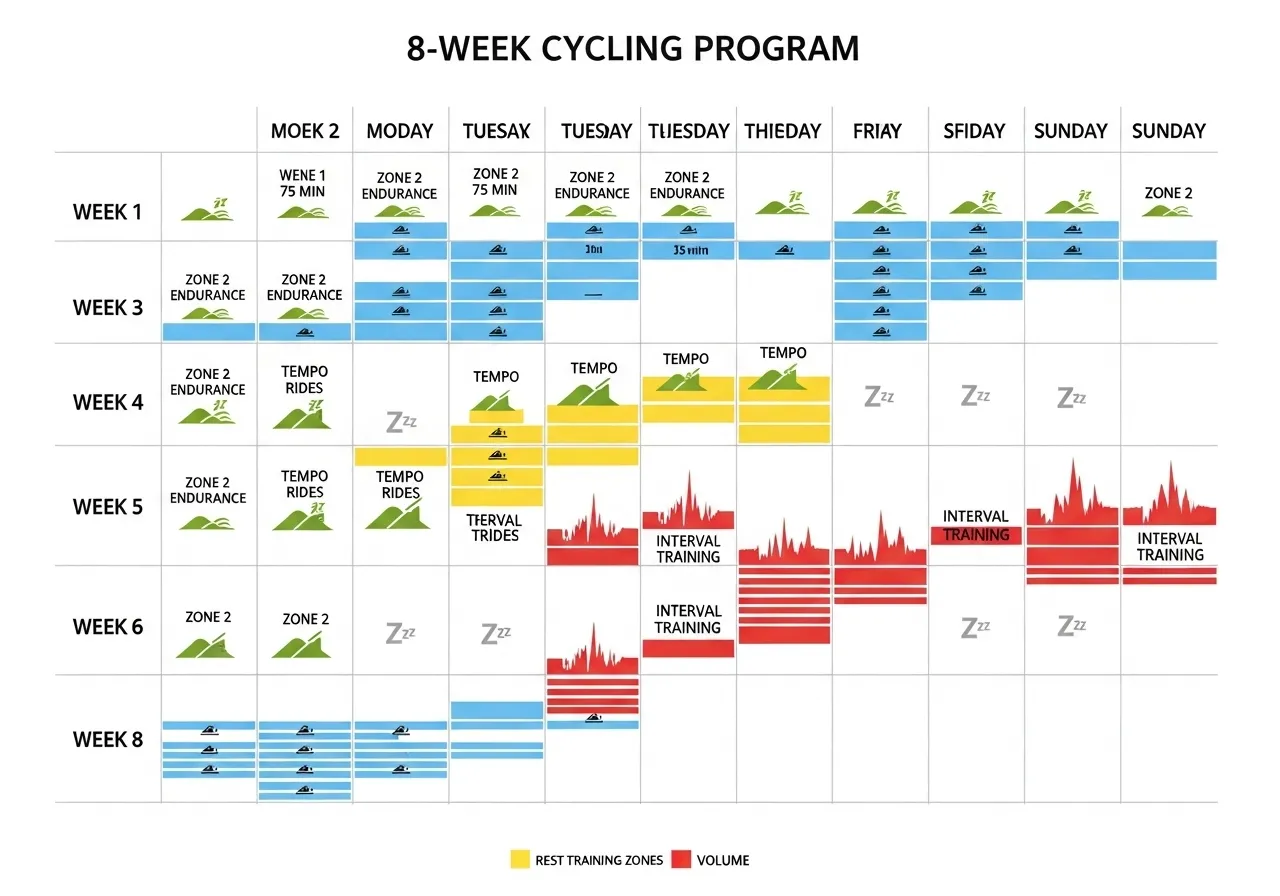
An eight-week progressive cycling program builds meaningful cardiovascular fitness from a recreational base — appropriate for athletes who currently cycle occasionally or have basic cycling fitness but want to develop more serious cardiovascular capacity.
Weeks 1-2: Base Establishment
Three sessions per week: two Zone 2 rides of 30-40 minutes, one longer Zone 2 ride of 45-60 minutes. Focus entirely on maintaining Zone 2 heart rate — reduce pace whenever heart rate exceeds the Zone 2 ceiling. The goal of weeks one and two is establishing the habit frequency and zone compliance that subsequent weeks build upon, not achieving any performance benchmark. Total weekly cycling time: approximately 100-120 minutes.
Weeks 3-4: Volume Increase
Three to four sessions per week: two Zone 2 rides of 40-50 minutes, one longer Zone 2 ride of 60-75 minutes, and one introductory interval session (three rounds of four-minute Zone 4 effort with four-minute recovery). Total weekly time: approximately 160-180 minutes. The interval session introduces the high-intensity stimulus that develops VO2 max alongside the Zone 2 base that weeks one and two established.
Weeks 5-6: Quality Development
Four sessions per week: two Zone 2 rides of 45-60 minutes, one long Zone 2 ride of 75-90 minutes, one interval session (four to five rounds of four-minute Zone 4 with four-minute recovery). Total weekly time: approximately 210-240 minutes. By week five, the Zone 2 base is sufficiently developed that high-intensity intervals produce meaningful cardiovascular improvements without excessive recovery demands.
Weeks 7-8: Peak Development
Four sessions per week: two Zone 2 rides of 60 minutes, one long Zone 2 ride of 90-120 minutes, one hard interval session (five to six rounds of four-minute Zone 4 or ten rounds of thirty-second maximum effort with thirty-second recovery). Total weekly time: approximately 270-300 minutes. By week eight, most athletes have increased their sustainable Zone 2 power by fifteen to twenty-five percent and their VO2 max capacity measurably, reflecting the cardiovascular development that the eight weeks of structured training produced. According to ACSM cardiovascular training program guidelines, progressive volume and intensity increases over eight to twelve weeks produce significant cardiovascular fitness improvements in recreational athletes beginning from moderate fitness baselines.
Action point: Before beginning week one, measure your Zone 2 pace (the cycling speed sustainable at 65% of maximum heart rate for 30 minutes) and record it. Remeasure at week four and week eight — the improvement in Zone 2 sustainable speed is the objective evidence of cardiovascular adaptation that motivates continued training.
Cycling Nutrition for Endurance Development
Longer cycling sessions (beyond sixty minutes) require nutritional attention that shorter sessions do not. During Zone 2 rides of sixty to ninety minutes, most athletes can train in a fasted or minimally fueled state because fat oxidation provides the majority of energy at this intensity without requiring exogenous carbohydrate. For rides beyond ninety minutes, consuming thirty to sixty grams of carbohydrate per hour maintains blood glucose and muscle glycogen availability that sustains training quality through the session’s later stages. Practical cycling nutrition for long rides: a banana or small energy bar every forty-five to sixty minutes provides sufficient carbohydrate without the gastrointestinal stress that more concentrated nutrition sometimes produces during exercise. Hydration: consuming 500-750ml of water per hour of cycling in moderate temperatures, increasing to 750-1000ml in hot or humid conditions, maintains the plasma volume that cardiovascular function requires and prevents the performance and safety risks of dehydration during long rides. Post-ride nutrition emphasizes protein (20-30 grams within two hours) for muscle repair and carbohydrate for glycogen replenishment — a mixed meal of adequate protein and complex carbohydrate within two to three hours of completing any cycling session longer than sixty minutes optimizes the recovery that allows the next session’s training quality to be maintained. According to Dietary Guidelines for Americans, adequate carbohydrate and protein intake supports endurance exercise performance and recovery across all activity levels and training volumes.
Mental Benefits of Regular Cycling
The psychological benefits of regular cycling — reduced anxiety, improved mood, better stress management, and enhanced cognitive function — are among the most consistently documented effects of regular aerobic exercise. The combination of rhythmic physical activity, outdoor exposure (for outdoor cyclists), and the achievement of progressive training goals produces a psychological engagement that many cyclists describe as meditative — the mind naturally quiets during sustained aerobic effort in ways that sitting meditation sometimes cannot achieve. Research on exercise and mental health consistently finds that aerobic exercise at Zone 2 and Zone 3 intensities produces the most robust mood improvements, with cycling’s accessible intensity range and controllable duration making it one of the most practically useful antidepressant activities available. The social dimension of cycling — group rides, cycling clubs, shared training routes with friends — adds the relational engagement that further multiplies the psychological benefits of the physical activity alone. Cyclists who participate in group riding consistently report higher enjoyment, greater training consistency, and better adherence to training programs than solo cyclists, confirming that the social component of cycling is a genuine performance enhancer through improved motivation and commitment rather than merely an enjoyable bonus. Research on exercise and psychological wellbeing confirms that regular moderate-intensity aerobic exercise produces significant improvements in mood, anxiety, and stress resilience that persist for hours to days after individual sessions.
The structured approach to cycling nutrition — fueling appropriately for session duration, hydrating proactively, and recovering with adequate protein — produces better training quality, faster adaptation, and more consistent performance than unstructured eating around cycling training that most beginners default to when beginning a cycling program.
Cycling for Weight Loss and Body Composition
Cycling’s high caloric expenditure — 400-700 calories per hour depending on intensity and body weight — makes it one of the most effective cardio modalities for creating the caloric deficit that drives fat loss, when combined with appropriate nutritional management. The joint-friendly mechanics allow daily cycling at durations and volumes that running cannot sustain for most people, providing the total weekly caloric expenditure that meaningful fat loss requires without the injury risk that equivalent running volumes would impose.
Fueling Cycling Training Without Undoing Fat Loss Goals
The most common error in cycling for fat loss is consuming too much during and after cycling sessions — the appetite stimulation from long moderate-intensity rides can produce caloric intake that equals or exceeds the session’s caloric expenditure. Zone 2 rides at sixty to seventy percent of maximum heart rate use fat as the primary fuel source, making additional carbohydrate intake during the session unnecessary for most rides under ninety minutes. Post-ride nutrition: consuming 20-30 grams of protein within two hours of completing a cycling session supports muscle repair without the excessive caloric intake that sports nutrition marketing encourages for recreational athletes. Total daily caloric intake remains the primary determinant of fat loss outcomes — cycling creates the deficit from the expenditure side, and nutritional management prevents the compensation from the intake side that eliminates the deficit. Research consistently finds that exercise programs produce modest fat loss when implemented without dietary management, and substantial fat loss when combined with caloric awareness. According to NCBI research on exercise and body composition, aerobic exercise combined with dietary management produces significantly greater fat loss than exercise or dietary management alone.
Cycling vs Running for Fat Loss: The Evidence
Hour-for-hour, running burns slightly more calories than cycling at equivalent effort levels — the weight-bearing nature of running imposes greater metabolic cost than the supported cycling position. However, the practical fat loss comparison favors cycling for many individuals because the joint-friendly mechanics allow the higher weekly volumes that produce greater total caloric expenditure despite the slightly lower per-hour burn rate. An athlete who can cycle five days per week without joint issues but can only run three days per week without shin or knee discomfort will lose more fat from cycling despite running’s higher hourly burn rate — the greater total volume wins. For athletes without joint limitations, combining both modalities provides variety that sustains adherence and develops complete cardiovascular fitness while distributing the impact stress of running across fewer weekly sessions.
Action point: Track your cycling sessions for two weeks without changing eating habits to establish the baseline caloric expenditure your cycling program currently provides. Then implement modest dietary adjustments that create a 300-500 calorie daily deficit beyond the cycling expenditure — this combination produces 0.3-0.5 kilograms of fat loss per week, the rate that research identifies as sustainable and predominantly fat rather than muscle mass.
Cycling’s unique combination of serious cardiovascular development, near-zero joint impact, and practical accessibility makes it one of the most valuable fitness tools available to adults at any fitness level. Whether you are managing joint conditions that limit other cardio, seeking a second cardio modality to complement running, or discovering cycling for the first time, the structured approach described in this article produces real cardiovascular fitness improvements within weeks and the foundation for decades of active, healthy living that consistent cycling enables.
The eight-week program is the beginning of a lifelong cardiovascular practice that cycling’s joint-friendly mechanics make uniquely sustainable across all the decades that regular riding enables. Begin with consistency, build progressively, and discover what serious cardio without joint destruction actually feels like.
Frequently Asked Questions About Cycling for Fitness
What type of bike should I buy for fitness cycling?
For general fitness cycling, a road bike or hybrid bike provides the best combination of efficiency and versatility. Road bikes are the most efficient for flat and rolling terrain cycling and produce the greatest cardiovascular training stimulus per hour due to their aerodynamic position and lighter weight. Hybrid bikes provide a more upright, comfortable position that suits recreational cyclists who prioritize comfort over performance. Mountain bikes are appropriate for trail riding and off-road adventure but are significantly less efficient on roads and paths — the same effort on a mountain bike produces considerably lower speeds and cardiovascular stimulus than equivalent effort on a road or hybrid bike. For indoor training, a stationary bike or a trainer that mounts an existing road bike provides the controlled environment that structured training sessions require. The most important purchase principle: buy from a specialty cycling shop where professional fitting is available, rather than from a general sporting goods retailer where bikes are sold without fitting services. A well-fitted basic bike is more beneficial for fitness and comfort than an expensive bike that fits poorly. ACSM cycling equipment guidelines emphasize proper bike fitting over equipment cost as the primary determinant of comfort and injury prevention in cycling training programs.
How long until cycling produces noticeable fitness improvements?
Noticeable cardiovascular improvements from structured cycling training typically appear within three to four weeks of consistent training — the heart rate required for a given cycling effort decreases, indicating improved cardiac efficiency, and the sustainable duration at a given intensity increases, reflecting the mitochondrial adaptations that Zone 2 training drives. Visible body composition changes from cycling combined with appropriate nutrition typically appear within four to eight weeks. The subjective sense that cycling is getting easier — that the effort that previously felt hard now feels manageable — is often the first perceived indicator of adaptation, appearing within two to three weeks of consistent training as the neuromuscular adaptations that reduce the metabolic cost of the cycling movement pattern develop. Research on cardiovascular training adaptation timelines confirms that measurable improvements in aerobic fitness appear within three to six weeks of consistent structured training across all endurance modalities.
Can cycling replace running for overall cardiovascular fitness?
Cycling develops cardiovascular fitness equivalently to running when training is structured at matched intensities and durations, but the two activities develop different aspects of physical fitness. Running develops weight-bearing bone density, lower leg musculature, and the impact tolerance that cycling cannot develop. Cycling develops leg power, cardiovascular fitness, and the specific neuromuscular patterns of pedaling that running cannot replicate. Athletes whose primary fitness goal is cardiovascular health and body composition can use cycling exclusively with equivalent results to running. Athletes with performance goals in weight-bearing activities (running races, hiking, most sports) benefit from maintaining some running training even when cycling is the primary cardiovascular modality, because the specific adaptations that weight-bearing activity produces are not fully replicated by non-impact cycling. The practical combination: cycling for the majority of cardiovascular training volume (three to four sessions per week) with one to two running sessions for weight-bearing adaptation maintenance, produces the most complete fitness development with the least joint stress accumulation.
Advanced Cycling: When and How to Progress Beyond the Basics
After completing the eight-week foundational program, athletes ready to advance their cycling fitness have several progressive options that develop specific cycling performance qualities. For those interested in improving cycling-specific power, structured training using power meters (measuring watts rather than heart rate) provides the most precise intensity control and performance tracking available. Power meter training eliminates the heart rate variability that temperature, fatigue, and caffeine produce, allowing perfectly consistent training stimuli across all conditions. For those interested in competitive cycling events — gran fondos, charity rides, or road racing — joining a local cycling club provides the group training environment and event preparation support that solo training cannot replicate. For those interested in maximizing the cross-training benefits of cycling alongside other activities, periodizing cycling volume to complement the seasonal demands of other sports — increasing cycling during off-seasons from primary sports, reducing it during competitive seasons — produces the optimal fitness development across all activities. According to NSCA advanced endurance training guidelines, power-based cycling training produces superior performance outcomes compared to heart rate-based training for experienced athletes whose fitness has developed beyond beginner and intermediate levels.
Cycling as a Lifelong Practice
Cycling’s most compelling advantage as a long-term fitness practice is its sustainability across the decades of an active life. Runners face progressively increasing injury risk with age as connective tissue resilience decreases and impact accumulation grows; cyclists face no equivalent constraint. Elite cyclists continue competing into their forties and fifties at levels that elite runners cannot maintain — the non-impact mechanics allow sustained high-volume training without the structural breakdown that weight-bearing exercise eventually imposes. For recreational athletes, this translates to the ability to maintain cycling as a primary cardiovascular practice through their sixties, seventies, and beyond, preserving the cardiovascular health, leg strength, and aerobic fitness that cycling develops without the joint deterioration that impact sports eventually produce. The cyclist who begins a regular cycling practice at thirty-five and maintains it through seventy will have accumulated decades of cardiovascular health investment that no other single exercise modality can match for joint accessibility and long-term sustainability. Treat cycling not as a temporary fitness program but as a permanent lifestyle practice and discover the compounding health returns that decades of consistent aerobic training reliably deliver.
Cycling’s unique position — serious cardiovascular training without joint destruction — makes it the single most sustainable long-term aerobic practice available to the majority of adults, whose joints eventually limit other high-impact options.
cycling fitness cardio bike training indoor outdoor joint friendly
The bike is waiting. Whether it is the stationary bike at the gym, the road bike in your garage, or the hybrid you just purchased, the cardiovascular transformation described in this article begins with the first consistent week of Zone 2 training and compounds across every subsequent session into the fitness, health, and physical quality that cycling uniquely enables. Start this week. The joint-friendly, cardiovascular-building, psychologically rewarding practice that cycling provides is available immediately and pays returns across every decade of active life that follows. The only requirement is showing up, pedaling at the right intensity, and allowing the biological adaptations that consistent cycling reliably produces to accumulate into the significant fitness transformation that eight weeks of structured training delivers — and that years of continued practice sustains indefinitely.
The cyclist who builds a regular practice discovers a training modality that returns more than it asks — cardiovascular fitness, joint health, and the psychological renewal that sustained aerobic effort consistently provides across the training sessions that produce this remarkable return on investment.
Altitude training is the gold standard endurance performance intervention for decades. The reduced oxygen partial pressure at altitude stimulates erythropoietin release, increases red blood cell mass and haemoglobin, and produces measurable improvements in VO2max and endurance performance when the athlete returns to sea level. It is also expensive, logistically complex, and inaccessible to most athletes…
⚠️ Health & Fitness DisclaimerThis article is for general educational purposes only. It does not replace professional medical advice. If you have cardiovascular, joint, or respiratory conditions, consult a qualified healthcare professional before beginning a running programme. Running is the most accessible cardiovascular exercise on the planet. No equipment, no membership, no learning curve —…
⚠️ Health & Fitness DisclaimerThis article is for general educational and informational purposes only and does not replace professional medical or fitness advice.If you have any pre-existing lower back, hip, or knee condition — consult a qualified healthcare professional before starting any deadlift program. The conventional deadlift is one of the most effective strength exercises…
Walking is underestimated. Most trainees treat it as something between exercise and not exercising, less demanding than running but more purposeful than standing. They are partly right. Unloaded walking at a comfortable pace is not a significant cardiovascular training stimulus for most fit adults. Add a weighted backpack and everything changes. The cardiovascular demand increases…
Why Running Is the Most Accessible and Most Misstarted Fitness Activity Running has the lowest barrier to entry of any fitness activity — it requires no equipment beyond supportive shoes, no gym membership, and no specific skill level to begin. It is also the fitness activity most commonly attempted and abandoned within the first few…
⚠️ Health & Fitness DisclaimerThis article is for general educational and informational purposes only. It does not replace professional medical or fitness advice. If you have any pre-existing condition, injury, or health concern — consult a qualified healthcare professional or certified personal trainer before starting or modifying any exercise program. Sandbag training occupies a unique…