Why the Barbell Row Is the Most Misunderstood Back Exercise in the Gym
I spent three years doing barbell rows without ever actually feeling them in my back. I would load up the bar, bend over, and pull — and walk away with tired biceps and a sore lower back, wondering why my back never seemed to develop. The problem was not my effort. It was my understanding of what the barbell row is actually supposed to do and which muscles should be doing the work.
The barbell row is theoretically the most complete back-building exercise available — it trains the lats, rhomboids, middle and lower trapezius, rear deltoids, and biceps through a full range of motion under heavy load. In practice, it is also the exercise most commonly performed in ways that direct all of the training stimulus away from these muscles and into the lower back, biceps, and momentum. The result is an exercise that looks productive and feels like work but fails to develop the back it is designed to build.
The Scapular Retraction Problem
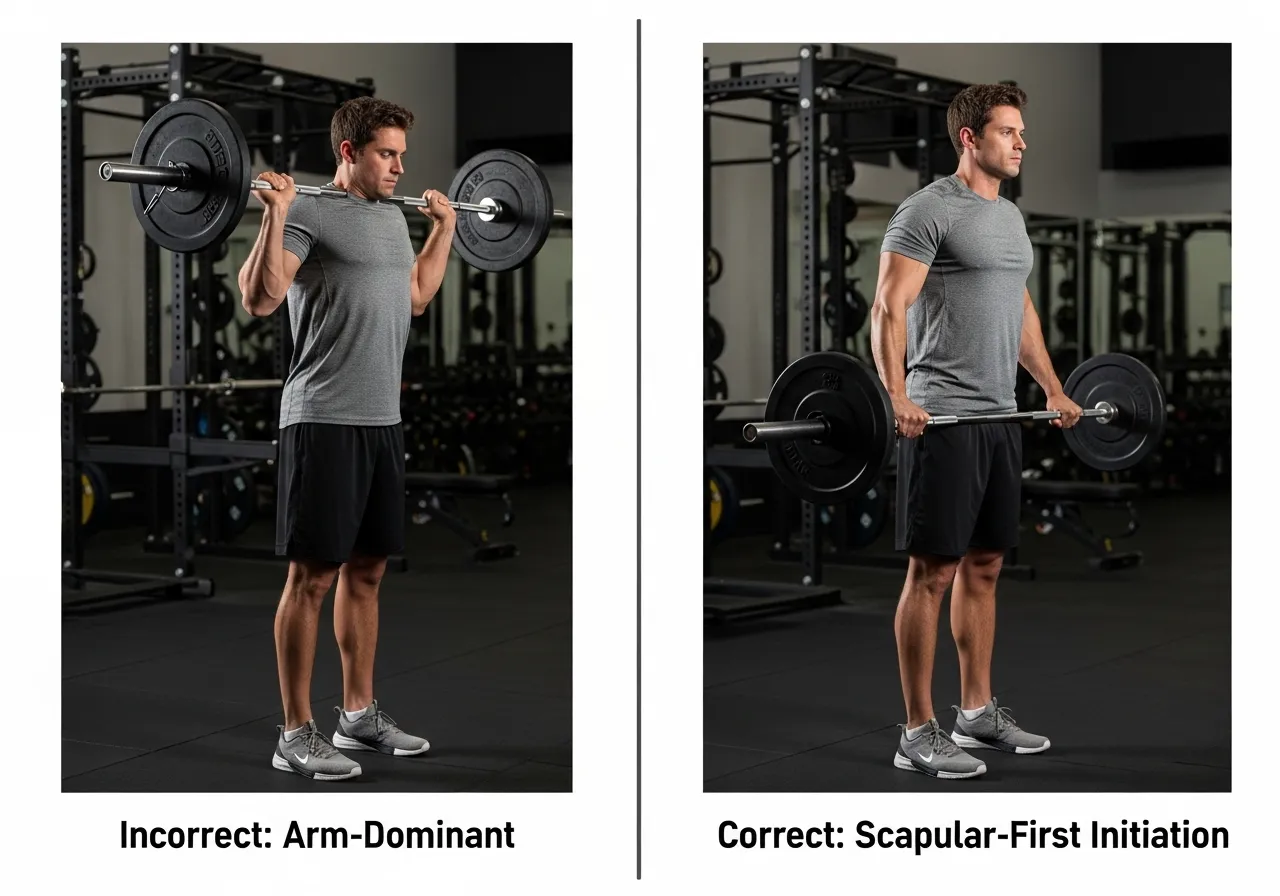
The root cause of most barbell row failure is the absence of scapular retraction — the deliberate squeezing of the shoulder blades together during the pulling phase. Without this retraction, the arms do all the work, the rhomboids and middle trapezius remain largely passive, and the lat contraction that should drive the elbow behind the torso never occurs. Most people who feel rows primarily in their biceps are experiencing the direct consequence of scapular-absent rowing — the arms compensate for the back’s non-participation by pulling the load independently, developing the biceps while leaving the intended muscles unstimulated.
Research on muscle activation during horizontal pulling movements confirms that scapular retraction initiation — deliberately squeezing the shoulder blades before and during the pull — produces significantly greater rhomboid, middle trapezius, and latissimus dorsi activation than arm-initiated pulling at equivalent loads. According to NCBI research on scapular stabilizer activation during horizontal rowing, the sequence of muscle activation during the row is as important as the load used — scapular muscles must lead for the back muscles to receive their intended training stimulus.
The Barbell Row’s Place in Training History
The barbell row was a foundational exercise in physical culture before modern cable machines and machine rows existed, precisely because it developed the thick back musculature that bodybuilding pioneers valued. Old photographs of 1950s and 1960s bodybuilders — whose back development remains remarkable by modern standards — show training programs dominated by barbell rows performed with heavy loads and complete ranges of motion. The transition away from barbell rows toward cable rows and machine alternatives in modern gym culture has coincided with a general decline in the mid-back thickness that barbel row training specifically develops. Returning to the barbell row as a primary back exercise, with the technical understanding that makes it effective, reconnects modern training with the proven development approach that built the best backs of previous generations.
Action point: Before your next back session, practice the isolated scapular retraction — standing upright, squeeze your shoulder blades together firmly without bending your elbows at all, and feel the rhomboids and middle trapezius contract. This is the initiation movement that must happen at the beginning of every productive barbell row repetition.
The Barbell Row and Its Role in Building a Complete Back
The back is the largest muscle group in the upper body, composed of muscles that span from the posterior pelvis to the base of the skull and from the spine to the outer ribs. Developing this complete musculature requires exercises that address both the vertical pulling function of the lats and the horizontal pulling function of the mid-back muscles — and the barbell row is the single most effective exercise for the horizontal pulling component that determines mid-back thickness. Lifters who focus exclusively on lat pulldowns and pull-up programme develop back width without the mid-back density that the rhomboids, middle trapezius, and lower trapezius provide — muscles that are only significantly developed through heavy horizontal pulling. The barbell row provides this horizontal pulling stimulus with the free weight loading advantage that cable and machine rows cannot replicate at equivalent intensities. Understanding the barbell row’s specific contribution to complete back development — distinct from and complementary to vertical pulling — is what motivates serious back training programs to include it as a primary exercise rather than an occasional supplement. NSCA back training guidelines consistently identify horizontal pulling exercises as essential components of complete back development programs alongside vertical pulling work.
Barbell Row and Posture: The Connection Most Lifters Miss
The barbell row’s development of the rhomboids, middle trapezius, and lower trapezius produces postural improvements that extend well beyond training performance into daily functional quality. These posterior chain muscles are chronically undertrained in people who sit for extended periods — the sustained seated position lengthens and weakens the rhomboids and middle trapezius while shortening and tightening the pectorals and anterior deltoids, producing the rounded shoulder posture that characterizes desk workers and creates the anteriorly dominant shoulder mechanics that produce impingement during overhead activities. Consistent barbell rowing reverses this pattern by developing the retraction strength that pulls the shoulders back and down into the position that supports healthy shoulder mechanics. Athletes who begin consistent barbell rowing after years of pressing-dominant training consistently report shoulder positioning improvements within six to eight weeks — the postural benefit of developing the posterior chain strength that has been chronically undertrained relative to the pressing muscles that modern training and modern posture conspire to overdevelop. This postural benefit is not merely aesthetic but functional — the shoulder position that barbell rowing develops is the position that protects the rotator cuff during pressing, reduces neck pain from forward head position, and allows the thoracic extension that overhead athletics require.
Barbell Row Setup: The Foundation That Determines Everything
The barbell row’s setup — hip hinge position, lat pulldown research, torso angle, and bar height — determines whether the exercise loads the intended muscles or creates the compensation patterns that make it ineffective and potentially injurious. Most setup errors stem from attempting to use too much weight before the body position required for effective rowing is established, which forces compensatory positions that redirect load away from the back and into structures that should be passive during the movement.
The Hip Hinge Position
A proper barbell row begins with a hip hinge — the same movement pattern as the Romanian deadlift — where the hips push back, the torso inclines forward, and the spine maintains its neutral curve throughout. The optimal torso angle for barbell rowing is approximately 45 degrees from horizontal, though individual anatomy affects this. Too upright (torso more vertical) reduces the horizontal pulling component and shifts the exercise toward a shrug; too parallel to the floor (torso near horizontal) increases lower back stress at the lumbar extensors. The 45-degree range allows the elbows to travel in a direction that maximally loads the lats while maintaining manageable spinal stress at moderate to heavy loads.
The hip hinge must be active — not simply bent forward — meaning the glutes and hamstrings are loaded throughout the set, creating the stable posterior chain that protects the lower back from the flexion moment that the barbell creates. Athletes who experience lower back pain during barbell rows almost universally have a passive rather than active hip hinge — the lower back is bearing the load that the hamstrings and glutes should be holding. Cueing the hip hinge actively (pushing the hips back and loading the hamstrings) before unracking the bar and maintaining this active position throughout the set resolves most lower back issues in barbell rowing.
Grip Width and Type
Grip width significantly changes which muscles receive the greatest training emphasis during the barbell row. A shoulder-width overhand (pronated) grip positions the elbows to travel slightly away from the body during the pull, emphasizing the upper back, rear deltoids, and rhomboids. A narrower underhand (supinated) grip positions the elbows to travel closer to the body, shifting emphasis toward the lower lats and biceps. A wide overhand grip beyond shoulder width creates a mechanically disadvantaged position for most people and increases the shoulder internal rotation that can irritate the anterior shoulder — generally not recommended as a primary barbell row grip unless specific upper back development is the explicit goal.
Most coaches recommend alternating between overhand and underhand grip across training blocks — using overhand for its upper back emphasis and underhand for its lat development — to address the complete back musculature that the barbell row can develop. According to research on grip orientation and muscle activation during horizontal pulling, supinated grip produces significantly greater bicep and lower lat activation while pronated grip produces greater posterior deltoid and upper trapezius activation, validating the complementary use of both grip orientations for complete back development.
Bar Height and Range of Motion
The barbell row begins with the bar on the floor (or from a rack at appropriate height) and ends with the bar touching or approaching the lower chest or upper abdomen. The complete range of motion — from a fully extended arm position at the bottom to elbows well behind the torso at the top — is what produces the full lat and rhomboid contraction that partial-range rowing misses. Most lifters who use too much weight automatically reduce their range of motion by only pulling the bar to mid-abdomen or even navel height, which eliminates the fully contracted lat position that drives the greatest hypertrophic stimulus. Reducing load until the full range — bar touching the lower chest or upper abdomen with elbows clearly behind the torso — can be achieved consistently produces better back development than heavier partial-range rowing.
Action point: Set up your barbell row with a lighter weight than usual and film yourself from the side. Check that your torso is approximately 45 degrees, your spine is neutral (not rounded), your hips are actively loaded with hamstring tension, and the bar reaches your lower chest at the top of each rep. Every technical deficiency revealed is a reason your back development has been limited.
Grip Strength and the Barbell Row: An Often-Overlooked Training Benefit
The barbell row develops grip strength as a secondary training effect that is valuable for athletes in any activity requiring sustained grip — deadlifting, climbing, rowing sports, and combat sports all benefit from the grip endurance that heavy barbell rows develop. Unlike isolation grip exercises that train the forearms without the back engagement context, barbell rowing develops grip strength in the specific position and endurance that pulling sports require — sustained gripping under load with the body in a flexed-spine hip hinge position. Athletes who find their deadlift grip is the limiting factor before their back strength is challenged typically find that two to three months of consistent heavy barbell rowing improves their deadlift grip endurance significantly, because the sustained grip demand of multiple heavy rowing sets develops the forearm and hand strength that the deadlift’s fewer total reps with similar loads cannot develop as comprehensively. Using straps selectively (on the heaviest rowing sets, not all sets) allows grip development during most of the session while protecting against grip failure on the most demanding work.
Advanced Barbell Row Periodization: The Strength-Hypertrophy Connection
The most sophisticated barbell row programming cycles between strength-focused and hypertrophy-focused phases in a manner that produces superior long-term back development compared to training at a single intensity indefinitely. The strength phase (three to six reps at 80-90% of maximum) develops the neural recruitment and maximum force capacity that increases the absolute load available in subsequent hypertrophy phases. The hypertrophy phase (eight to fifteen reps at 65-75% of maximum) uses the higher baseline strength to produce greater mechanical tension at moderate loads than was possible before the strength phase. This strength-hypertrophy cycling — typically six to eight weeks at each emphasis before switching — produces compound back development that neither approach alone achieves, because the strength phase raises the hypertrophy phase’s effective loading range while the hypertrophy phase accumulates the volume that drives muscle growth beyond what strength training’s lower volumes produce. Research on periodization for muscle hypertrophy consistently finds that alternating strength and hypertrophy phases produces superior long-term muscle development compared to constant-load programming at any single intensity. According to research on periodization and muscle hypertrophy, systematic variation of training intensity across phases produces significantly greater muscle development than non-periodized constant-intensity training over twelve-week and longer study periods.
The Execution Phase: What Separates Productive Rows from Back-Building Theater
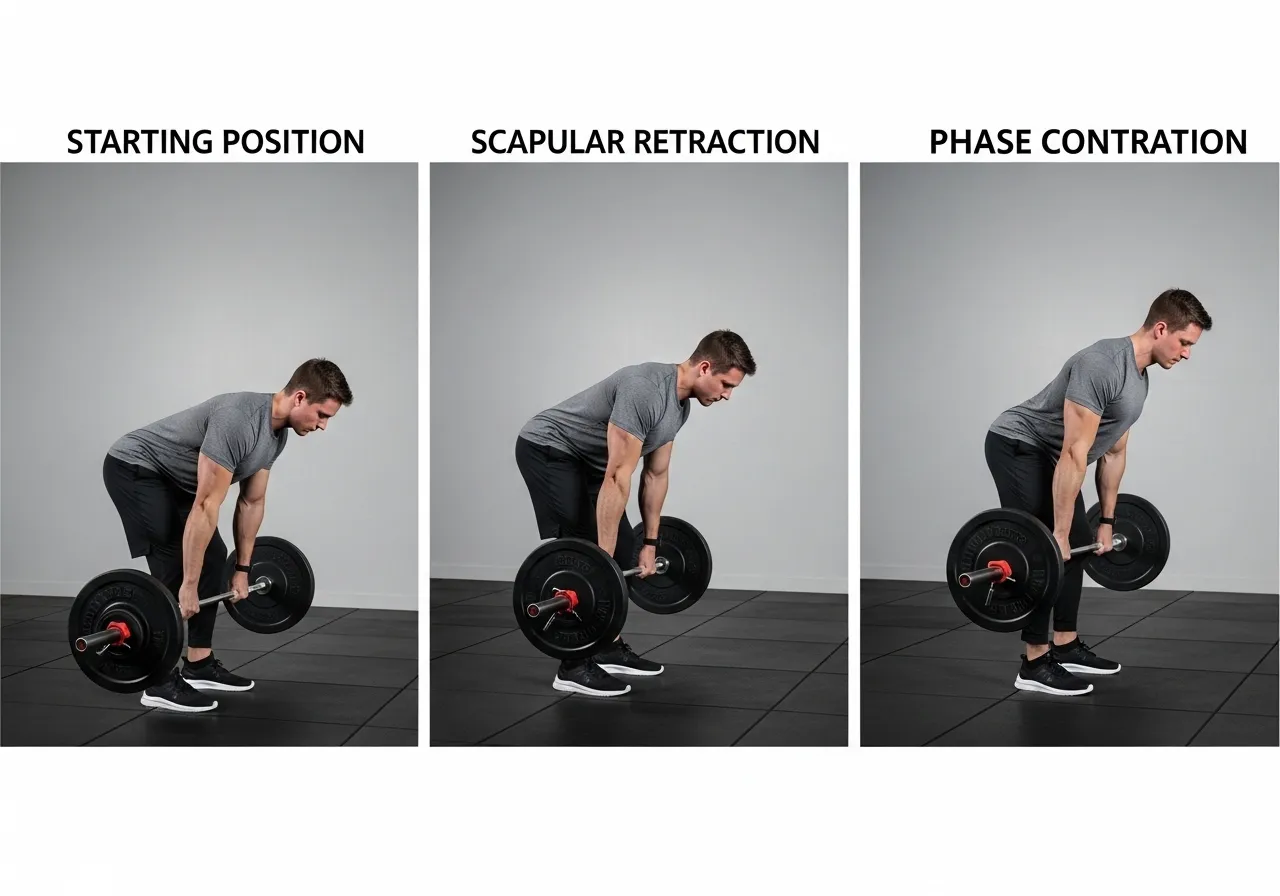
Once the setup is established, the execution of each repetition determines whether the correct muscles receive the training stimulus or whether momentum, bicep dominance, and reduced range conspire to make the effort physiologically useless for back development. The execution phase of the barbell row has three critical elements that must occur in the correct sequence: scapular initiation, lat engagement, and elbow drive.
The Three-Phase Pull Sequence
Phase one — scapular initiation: before the elbows bend at all, the shoulder blades squeeze together and down. This is a subtle but essential movement that pre-loads the rhomboids and middle trapezius, ensuring they will contribute to the subsequent pull rather than remaining passive while the arms do all the work. Most people skip this phase entirely, which is the single most common reason barbell rows fail to develop the back. Practice the isolated scapular squeeze (no elbow movement, just shoulder blade retraction) ten times before every rowing set until it becomes automatic at the start of each rep.
Phase two — lat engagement: as the elbows begin to bend, the lats engage to drive the upper arm toward the body and back. The cue that activates the lats most effectively for most people is “drive your elbows to your back pockets” or “try to put your elbows behind your torso” — directional cues that cause the lat to contract in its actual function (shoulder extension and adduction) rather than the common error of simply “pulling up” which activates the biceps primarily. Feeling the lat contract on the outer side of the back during the pull indicates correct lat engagement; feeling primarily in the front of the upper arm indicates bicep dominance that requires the technique correction of the scapular initiation and lat engagement cues.
Phase three — elbow drive: the elbows travel to a position clearly behind the torso at the peak of the pull, not merely beside the torso. This final elbow position is where the lat reaches its maximum contraction and where the rhomboids and middle trapezius are most fully loaded. Stopping the pull when the elbows are beside the body — which most lifters do when using momentum-assisted loading — eliminates the most productive portion of the movement. A two-second hold at full contraction before the eccentric phase begins develops the contracted-position strength that transforms the barbell row from a mediocre arm exercise into a genuine back builder.
The Eccentric Phase: The Undervalued Half
The controlled lowering of the bar — the eccentric phase — produces as much or more hypertrophic stimulus as the concentric pull, yet most barbell row programs treat it as a formality between the productive concentric reps. A three-second eccentric — slowly lowering the bar over three full seconds while maintaining the active hip hinge and scapular position — dramatically increases the time under tension in the back muscles and produces the eccentric muscle damage that drives muscle protein synthesis and hypertrophic adaptation. Research on tempo training consistently finds that controlled eccentric phases produce twenty to forty percent greater hypertrophic stimulus than ballistic or gravity-assisted returns to the starting position. Adding the controlled eccentric to barbell rows while reducing load by twenty percent produces more back development than standard-speed rowing at the previous load. According to NCBI research on eccentric training and hypertrophy, slow eccentric phases produce significantly greater muscle protein synthesis than equivalent concentric-focused training.
Action point: On your next barbell row set, perform each rep with deliberate scapular retraction before the elbows move, a two-second hold at full contraction (elbows clearly behind torso), and a three-second controlled eccentric. The weight you can use will drop by twenty to thirty percent — and the back development you experience over the following weeks will exceed anything your previous heavier, faster rowing produced.
The Barbell Row and Athletic Performance Transfer
The horizontal pulling strength and mid-back development from barbell rowing transfers broadly to athletic performance in ways that most athletes and coaches do not fully recognize. In rowing sports (kayaking, competitive rowing, dragon boat), the horizontal pulling pattern of the barbell row directly develops the primary power-generating musculature of the sport-specific movement. In climbing, the scapular retraction and lat strength from rowing develops the pulling capacity that determines climbing performance. In wrestling and judo, the ability to maintain clinch position against a resisting opponent requires the exact mid-back tension and horizontal pulling endurance that barbell rowing develops. Even in sports that seem unrelated to pulling — basketball, soccer, American football — the mid-back strength from rowing develops the postural stability under contact that allows athletes to maintain position and continue productive movement when opponents apply force. This broad transfer reflects the barbell row’s development of fundamental horizontal force production capacity that underlying many athletic movements regardless of sport specificity.
The Mind-Muscle Connection in Barbell Rowing
Developing the mind-muscle connection — the ability to deliberately direct attention to and enhance activation of the target back muscles during the barbell row — transforms the exercise from a general pulling movement into a precision back-development tool. Athletes who row with attention focused on the bar’s path (external focus) develop pulling coordination; those who row with attention focused on the rhomboid and lat contractions (internal focus) develop greater back muscle activation and hypertrophic stimulus. Research on attentional focus during resistance exercise finds that internal focus produces fifteen to twenty-five percent greater target muscle activation in exercises like the row, where the arms can substitute for the intended back muscles. Practical mind-muscle development for the barbell row: place one hand on the lat (outside of the back, below the armpit) during warm-up sets with the opposite arm holding the bar single-arm, feeling the lat contract and squeeze at the end of each rep. This tactile feedback accelerates the neural connection that makes the back muscles the primary movers rather than the biceps. Research on mind-muscle connection and muscle activation confirms that deliberate attentional focus on target muscles produces significantly greater activation and hypertrophic stimulus than equivalent-load training without specific attentional direction.
The barbell row is not merely an exercise but a training philosophy — the commitment to developing the posterior chain with the same seriousness that pressing culture applies to the anterior chain. Athletes who make this commitment consistently produce back development that pressing-only programs cannot achieve regardless of volume, and shoulder health that pressing-dominant athletes sacrifice over years of anterior overdevelopment. Master the barbell row, progress it systematically, and build the complete back that distinguishes genuinely developed physiques from those built by bench pressing alone.
Take the barbell row seriously — more seriously than most gyms treat it, more seriously than the culture that has replaced it with machine rows suggests is necessary. The back that results from years of heavy, strict barbell rowing is a back that reflects genuine strength investment, and that investment pays compound returns in posture, performance, and the physical capability that serious training is supposed to produce.
Barbell Row Variations: Matching the Exercise to Your Goals
The standard pronated-grip barbell row is the foundation, but several variations develop different aspects of back musculature or address specific athletic needs that the standard row cannot target as specifically. Understanding which variation to use when allows the barbell row to serve multiple training functions across different programming phases.
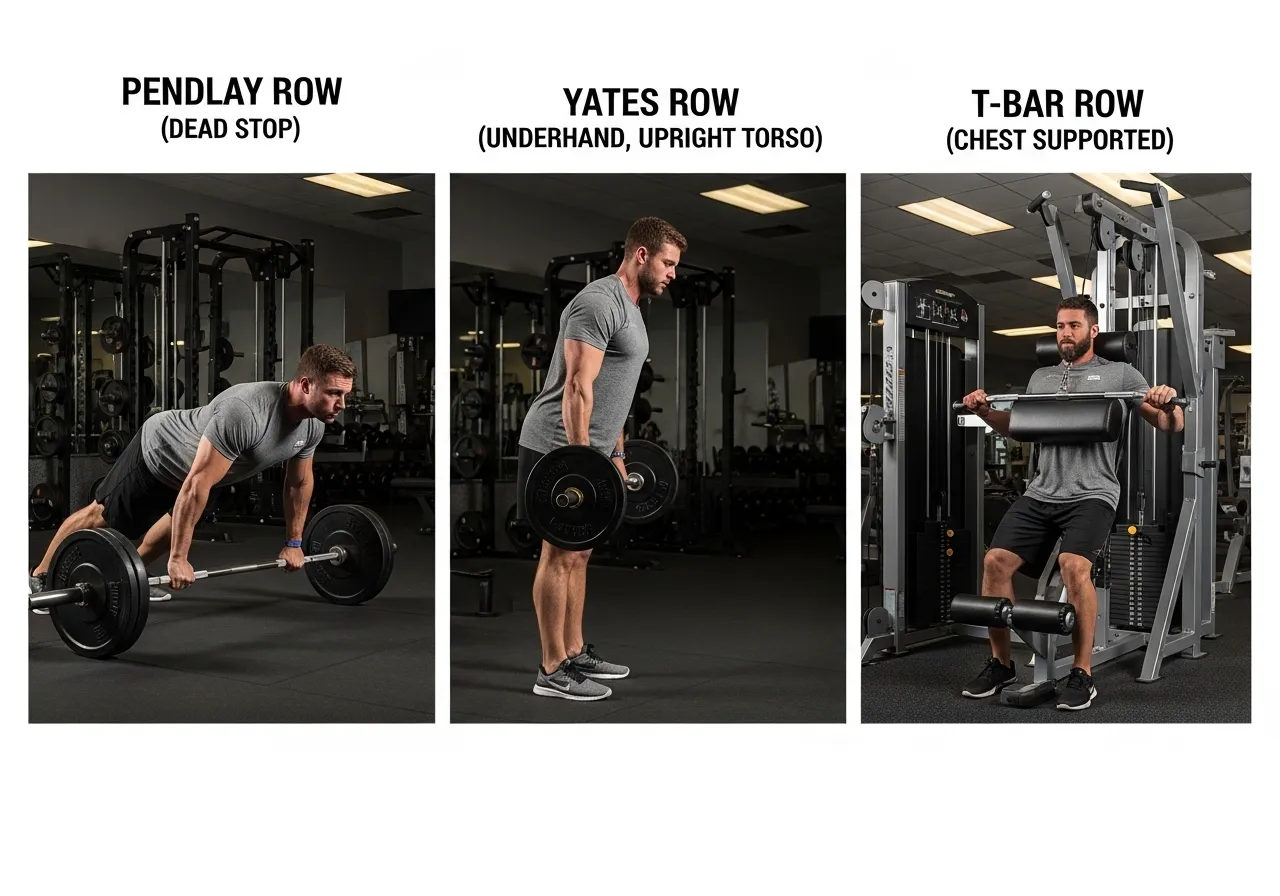
The Pendlay Row: Maximum Lat Development
The Pendlay row — named for weightlifting coach Glenn Pendlay — begins with the bar resting on the floor between each repetition rather than being held in the bottom position. The dead-stop from the floor eliminates the elastic rebound contribution from the stretch-shortening cycle, forcing the back muscles to generate force from a completely relaxed starting position. This dead-stop requirement increases the training demand at the weakest position of the movement and prevents the momentum accumulation that allows heavier loads to be used in standard barbell rows through elastic energy rather than muscle force. Research comparing Pendlay rows to standard barbell rows finds greater lat and rhomboid activation in the Pendlay variation due to the elimination of the stretch-shortening cycle assistance. Pendlay rows are particularly valuable during strength phases when maximum muscle force development is the priority, and for athletes whose standard rows have developed momentum-dependent technique that undermines the intended muscle stimulus.
The Yates Row: Upper Back Emphasis
The Yates row — popularized by six-time Mr. Olympia Dorian Yates — uses a more upright torso position (approximately 70 degrees from horizontal rather than 45 degrees) with an underhand grip. The more upright position shifts the emphasis from the lats and lower back to the upper back, rhomboids, and rear deltoids, while the underhand grip engages the biceps more completely. The reduced lower back stress of the more upright position allows heavier loads for lifters whose lower back fatigue limits standard barbell row weights, and its specific upper back emphasis makes it valuable for athletes who need greater mid-back thickness development. Dorian Yates himself credited the Yates row as the primary exercise responsible for the unprecedented back thickness that defined his competitive physique during the 1990s, validating its specific contribution to back development even for recreational athletes seeking improved mid-back musculature.
The T-Bar Row: Constant Tension Alternative
The T-bar row — performed with a barbell anchored at one end against a wall or in a landmine attachment, with plates loaded on the other end — provides a barbell rowing stimulus with a constant-tension profile similar to cable rowing. The angled loading of the T-bar maintains greater resistance at the contracted position than standard barbell rows where gravity reduces resistance at full arm extension. This constant-tension advantage makes T-bar rows particularly effective for hypertrophy-focused training where sustained muscle tension across the complete range of motion maximizes the metabolic stress that drives muscle growth. Athletes who find standard barbell rows hard on their lower back often find the T-bar row — which allows a chest-supported variation using a pad placed under the sternum — provides equivalent back development stimulus with significantly reduced lumbar stress. According to NSCA exercise selection guidelines, variation across rowing types develops the back musculature more comprehensively than any single rowing exercise performed exclusively.
Action point: Identify which aspect of your back development is most underdeveloped — lat width (use Pendlay rows), upper back thickness (use Yates rows), or mid-back density with lower back sensitivity (use T-bar rows) — and prioritize the variation that targets your specific limitation for the next eight-week training block.
Barbell Row Warm-Up Protocol for Maximum Performance
A structured barbell row warm-up that prepares the posterior chain, activates the scapular stabilizers, and establishes the hip hinge pattern before working sets produce better performance and lower injury risk than jumping directly to working weights. The optimal pre-row warm-up sequence: two minutes of thoracic mobility (foam roller extension at three positions, ten seconds each), ten band pull-aparts to activate the rhomboids and posterior deltoids, ten bodyweight good mornings to establish the hip hinge pattern and warm the hamstrings, then progressive barbell warm-up sets: empty bar for ten reps (technique focus), 40% of working weight for eight reps, 60% for five reps, 80% for three reps, then begin working sets. This fifteen-minute preparation sequence produces immediately better technique quality and better working set performance by ensuring all contributing muscles are activated and the movement pattern is established before the weights that challenge technique are used. Athletes who skip this preparation consistently perform worse in their working sets and accumulate the technique errors that limit long-term barbell row development. According to ACSM warm-up guidelines for resistance training, structured progressive warm-up protocols produce measurably better performance and technique quality in compound exercises than no-warm-up approaches across all training experience levels.
Tr
The Barbell Row and Deadlift Performance: The Overlooked Connection
One of the most significant yet underappreciated benefits of consistent barbell rowing is its direct carryover to deadlift performance. The deadlift requires the lats, rhomboids, and mid-back musculature to maintain spine-protecting tension throughout the lift — the instruction to “put your lats in your back pockets” that powerlifting coaches universally give is a cue to engage precisely the muscles that barbell rowing develops most specifically. Lifters who plateau in their deadlift despite adequate leg strength often find that addressing their horizontal pulling weakness through prioritized barbell row training produces deadlift improvements within four to eight weeks, because the mid-back tension capacity that was the limiting factor is now better developed. Research on deadlift limiting factors consistently identifies upper back and mid-back weakness — the inability to maintain lat and rhomboid tension throughout the pull — as the most common non-leg strength limiting factor in intermediate and advanced deadlifters. Adding two to three sets of heavy barbell rows per week to a program that was previously deadlift-only produces both back development and deadlift improvement simultaneously, making the barbell row the highest-leverage supplementary exercise for deadlift performance available in standard gym training.
Scapular Position and Its Effect on Barbell Row Quality
The scapula — the shoulder blade — is the foundation of all upper back training, and its position throughout the barbell row determines whether the intended muscles are loaded or whether compensation patterns redirect the stimulus into less efficient structures. The optimal scapular position for barbell rowing: slightly depressed (pulled down away from the ears) and beginning from a slight protraction at the bottom of the movement, then actively retracting and depressing during the pull phase. The common error — allowing the scapulae to elevate (shrug) during the pull — shifts load into the upper trapezius and away from the rhomboids and lower trapezius that the exercise should develop. Another common error — beginning from an already fully retracted position — eliminates the full range of scapular retraction that maximizes mid-back stimulus. Film your barbell rows from behind and observe scapular movement: the shoulder blades should move from slightly protracted at the bottom to fully retracted at the top, without significant elevation at any point. This complete scapular range of motion — combined with the elbow drive that produces it — is the mechanical basis for the barbell row’s effectiveness as a mid-back development exercise. Research on scapular stabilizer activation during rowing confirms that both scapular retraction range and lower trapezius activation are significantly greater in exercises that begin from mild protraction compared to exercises initiated from a retracted starting position.
Barbell Row Loading Progression: From Beginner to Advanced
The progression of barbell row loading follows predictably distinct phases that correspond to the training adaptations occurring at each stage. Beginner phase (first three to six months): rapid load increases of five to ten kilograms per week are achievable as the nervous system learns the movement pattern and activates previously dormant motor units. During this phase, focus entirely on technique — scapular initiation, full range, controlled eccentric — before attempting maximum loading. Intermediate phase (six months to two years): weekly load increases slow to two to five kilograms, then to monthly increases as the rapid neurological gains of the beginner phase are exhausted and structural muscle development becomes the primary driver of strength improvement. Implementing periodization — alternating strength (four to six reps, heavier loads) and hypertrophy (eight to twelve reps, moderate loads) phases — extends this progression significantly beyond what constant-rep-range training produces. Advanced phase (beyond two years of consistent training): load increases become bi-monthly or quarterly, and maintaining consistent technique quality at near-maximum loads requires more recovery management, more sophisticated periodization, and more attention to the accumulating fatigue that heavy rowing produces. The advanced barbell rower who continues improving does so through progressively more sophisticated programming rather than simple load addition, using the variation across rep ranges, variations, and training phases that the intermediate stage demonstrates is productive.
Programming the Barbell Row for Strength and Hypertrophy
The barbell row responds to periodization across rep ranges and training phases as reliably as any primary strength exercise, producing superior long-term back development when programmed with systematic variation rather than trained at the same intensity indefinitely.
Strength Phase Programming (3-6 Reps)
Heavy barbell rowing at three to six repetitions develops the horizontal pulling strength that directly supports deadlift performance, posture under load, and the structural back strength that heavier training demands. Heavy rowing sessions: four to five sets of three to five reps at 80-87% of barbell row maximum, focusing on perfect technique execution at each rep rather than grinding through technical breakdown. The strength phase’s primary value is developing the neural recruitment patterns that allow heavier loads to be used in subsequent hypertrophy phases — the strength gained translates into greater mechanical tension at moderate loads during hypertrophy training. Rest periods of three to four minutes between heavy sets allow complete neuromuscular recovery for maximum quality on each subsequent set. Research on strength development in horizontal pulling confirms that heavy low-rep training produces superior pulling strength outcomes compared to moderate-rep training at equivalent volumes. According to NSCA strength training guidelines, heavy compound rowing at 80-90% intensity should be performed two to three times per week with adequate recovery between sessions.
Hypertrophy Phase Programming (8-12 Reps)
Moderate-rep barbell rowing at eight to twelve repetitions produces the greatest hypertrophic stimulus through the combination of mechanical tension and metabolic stress that this rep range optimally provides. Hypertrophy-focused barbell row sessions: four sets of eight to ten reps at 70-77% of maximum, with a controlled two-second eccentric and a one-second pause at the contracted position. The pause at full contraction eliminates momentum contribution and maximizes the time under tension at the most contracted position — where the lats and rhomboids are most fully loaded. Weekly volume of twelve to sixteen sets of horizontal pulling (barbell rows plus other row variations) produces continued back hypertrophy for most intermediate lifters, distributed across two to three sessions per week for optimal muscle protein synthesis frequency.
Integrating Barbell Rows With Other Back Work
The barbell row functions most effectively as the primary horizontal pulling exercise in a back program that also includes vertical pulling and posterior chain work. A complete back program for intermediate athletes: barbell rows as the primary horizontal pull (three to four sets), lat pulldowns or pull-ups as the primary vertical pull (three to four sets), and face pulls or band pull-aparts for posterior shoulder health (two to three sets). This combination develops the complete back musculature from the lats through the mid-back to the posterior shoulder chain, with the barbell row contributing the heavy horizontal pulling that drives mid-back thickness and strength that other exercises cannot develop as efficiently. Attempting to replace barbell rows with machine rows or cable rows exclusively produces inferior mid-back development because these alternatives lack the stabilization demand and potential loading that free-weight barbell rowing provides. According to research on push-pull training balance and shoulder health, maintaining equal pushing and pulling volume in training programs significantly reduces shoulder injury risk in strength athletes.
Action point: Structure your next eight-week back training cycle with weeks one through four emphasizing barbell rows at eight to ten reps with controlled eccentrics, and weeks five through eight emphasizing heavier barbell rows at four to six reps with maximum technique quality. Compare your back development at the end of eight weeks to your starting point — the difference will be measurable and visible.
acking Barbell Row Progress: What to Measure and Why
Tracking barbell row progress requires multiple metrics because single-metric tracking misses important aspects of development. Primary strength metric: the load used for five repetitions with strict technique (no torso swing, bar reaching lower chest, controlled eccentric) — this “strict five” is the most reliable barbell row strength indicator because it controls the technique variables that allow momentum-dependent loads to appear heavier than back strength alone can produce. Volume metric: weekly sets multiplied by repetitions multiplied by load — tracking this total across months reveals training volume trends that predict adaptation better than any single session’s performance. Technique quality metric: monthly video review from the side to assess torso angle, bar contact point, and elbow position at peak contraction — technique improvements that do not show up in load increases still represent genuine development that future load increases will reflect. Tracking all three metrics monthly provides a complete picture of barbell row development that weight-only tracking consistently misses by failing to account for technique changes that inflate or deflate apparent strength. The athlete whose barbell row is improving in load through increasingly sloppy technique is not progressing — the athlete whose barbell row is improving in technique quality at consistent loads is building the foundation for future load improvements that technique-compromised loading prevents.
The Comparison Between Barbell Row Variations: Which Is Best
No single barbell row variation is universally superior for all athletes and all goals — each variation produces specific adaptations that determine its appropriate application. The standard pronated-grip barbell row at 45-degree torso angle produces the most complete combination of lat, rhomboid, middle trapezius, and posterior deltoid development available in a single row variation, making it the preferred choice for general back development. The Pendlay row (dead-stop from the floor) produces the greatest lat activation by eliminating elastic stretch-shortening cycle assistance, making it the best choice for athletes whose standard rows have become momentum-dependent. The Yates row (more upright torso, underhand grip) produces the greatest upper-mid back thickness development for athletes specifically targeting this area. The T-bar row provides the greatest constant-tension stimulus at the contracted position, making it the best choice for pure hypertrophy phases. The single-arm dumbbell row provides the greatest range of motion and the best opportunity to identify and address bilateral asymmetry. The optimal long-term approach rotates through these variations across training phases rather than committing permanently to any single variation — each phase’s variation provides a fresh training stimulus that prevents the accommodation plateau that single-variation training produces. A practical rotation: standard barbell row for twelve weeks (strength and hypertrophy foundation), Pendlay row for eight weeks (technique refinement and dead-stop power), Yates row for eight weeks (upper back thickness emphasis), T-bar row for eight weeks (constant-tension hypertrophy phase). This annual rotation develops all components of back thickness from multiple mechanical angles that any single variation cannot address alone.
Barbell Row for Women: The Same Exercise, Different Common Misconceptions
Women frequently avoid heavy barbell rowing due to concerns about “getting too bulky” or because they do not see heavy back training as relevant to their fitness goals. Both concerns misunderstand the barbell row’s actual effects. The back development from barbell rowing — particularly the rhomboid and middle trapezius development that improves posture — produces the upright posture and broader shoulder width relative to waist that creates the aesthetically valued V-taper, not the unwanted bulk that concerns many women. The postural improvement alone — reduced shoulder rounding, improved thoracic extension, better head position — dramatically changes the visual profile in ways that aesthetic training programs less commonly address as directly. The shoulder health and injury prevention benefits of the barbell row are equally important for women as men — the rotator cuff imbalances that pressing-dominant training creates affect female athletes as consistently as male athletes, and the barbell row’s posterior chain development provides the same protection regardless of gender. Research on resistance training in women consistently finds that back training at significant loads produces the aesthetic and functional improvements that women seek from training, without the muscle mass accumulation that concerns about bulkiness reflect. According to ACSM resistance training guidelines for women, women respond to resistance training at lower absolute loads but similar relative intensities to men, producing proportionally equivalent improvements in strength and muscle development that support the health, aesthetic, and performance goals that motivate women’s resistance training participation.
Common Barbell Row Mistakes and Their Specific Fixes
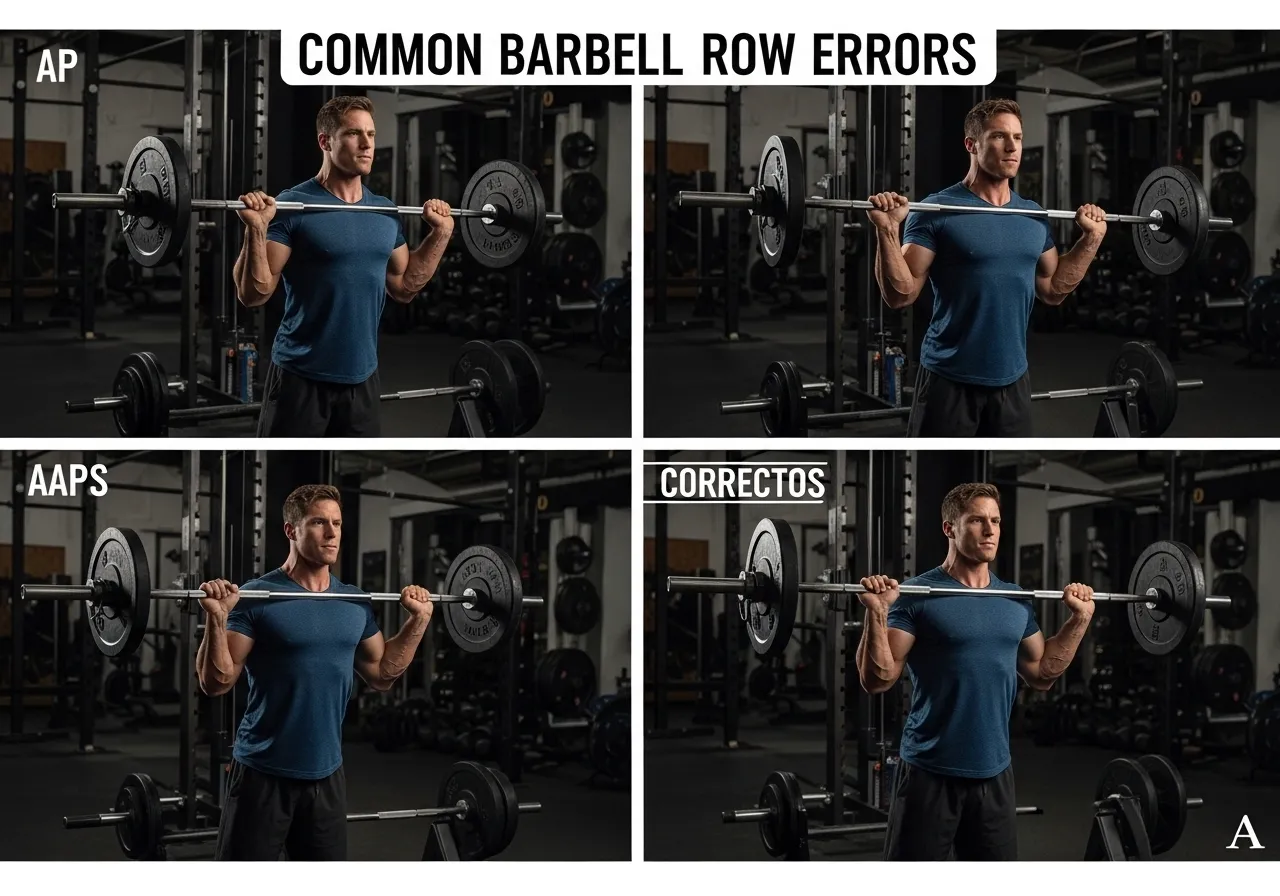
The barbell row has a higher technique failure rate than most compound exercises because its multiple technical requirements — hip hinge maintenance, scapular retraction, elbow path, range of motion — must all be executed simultaneously under load. Identifying which specific error is limiting your rowing effectiveness and addressing it directly is more efficient than generic advice to “use proper form.”
Mistake 1: Excessive Torso Swing
Torso swing — using hip extension momentum to initiate the pull — converts the barbell row into a partial Romanian deadlift followed by a shortened row, dramatically reducing the back muscles’ actual work while increasing lower back stress. The immediate fix: reduce the load by thirty percent and perform strict rows with zero torso movement. Film yourself from the side — the torso should remain at the same angle from start to finish of each rep. If the torso rises on each rep, the weight is too heavy for strict technique. Two to four weeks of strict lighter rows develops the back strength that eventually allows heavier loads to be used without swinging.
Mistake 2: Pulling to the Navel Instead of the Lower Chest
Pulling the bar to the navel rather than the lower chest reduces the range of motion by thirty to forty percent, eliminating the most productive portion of the exercise where the elbows are clearly behind the torso and the back muscles are fully contracted. This error almost always results from using more weight than technique allows and from not deliberately cueing elbow position. Fix: use a lighter load and consciously pull the bar to the sternum or lower chest with elbows driving clearly behind the torso. Place a small target (rolled-up towel) against the abdomen at sternum height and practice touching the bar to the target on each rep.
Mistake 3: Rounded Lower Back
Lower back rounding during barbell rows indicates either insufficient hamstring flexibility for the hip hinge position, excessive load that causes the posterior chain to fail before the back muscles complete the set, or inadequate hip hinge understanding. Fix: practice the hip hinge pattern with a dowel rod held along the spine (touching the back of the head, between the shoulder blades, and at the tailbone simultaneously) to establish the neutral spine position before adding load. If flexibility limits the hip hinge, elevate the bar on blocks or in a rack to reduce the range of motion required. Never row with a rounded lower back — the compressive forces on lumbar discs in this position accumulate into injury risk with repeated heavy loading. According to research on spinal loading during rowing exercises, neutral spine maintenance is the primary biomechanical factor determining safe barbell row execution under heavy loads.
Mistake 4: Bar Drifting Away From the Body
The bar should travel in a relatively vertical path, staying close to the legs throughout the pull. Bar drift — where the bar moves away from the body horizontally — increases the moment arm at the lower back and reduces the efficiency of force transfer from the back muscles to the bar. Fix: think of the bar as traveling in a straight vertical line and consciously keep the bar close to the body throughout the pull. Setting up with the bar directly over the mid-foot (as in the deadlift setup) and maintaining this relationship throughout the row prevents drift.
Action point: Film your next barbell row set from the side and check for all four errors — torso swing, pulling height, lower back position, and bar path. Address the most obvious error first with a load reduction, and correct one error per two-week period rather than attempting to fix all errors simultaneously.
Building Maximum Back Thickness: The Barbell Row as the Foundation
Back thickness — the density and depth of the mid-back musculature visible from the side — is primarily determined by the development of the rhomboids, middle trapezius, and the mid-portion of the latissimus dorsi. These muscles are significantly undertrained by vertical pulling exercises (lat pulldowns and pull-ups) that develop the lat’s lower and outer portions while leaving the mid-back relatively unstimulated. The barbell row, performed through the full range of motion with the elbow driving clearly behind the torso, is the most effective exercise for developing these mid-back muscles that determine thickness rather than width. Bodybuilders who display exceptional back thickness — the dense, layered musculature visible from the side that looks dramatically different from a merely wide back — consistently credit heavy rowing as the primary driver of this development. The practical implication: if your back appears wide from the front but flat from the side, your training is vertical-pull dominant and lacks the heavy horizontal pulling that the barbell row provides as its primary function. Adding two to three sets of heavy barbell rows to each back session and progressively loading them across months produces the mid-back thickness that lat pulldowns and pull-ups cannot develop regardless of their volume. Research on back muscle development confirms tha
Building Your Barbell Row to Elite Standards
Elite barbell row standards — the loading benchmarks that represent exceptional horizontal pulling strength — provide motivating targets and contextualize current performance accurately. For men: rowing 100 kilograms for five reps represents solid intermediate strength; 130 kilograms represents advanced; 160 kilograms or more represents elite. For women: 60 kilograms for five reps represents solid intermediate; 80 kilograms represents advanced; 100 kilograms represents elite. These standards assume strict technique — no torso swing, bar reaching lower chest, controlled eccentric — that many athletes who claim heavier rowing numbers are not actually achieving. The strict five-rep maximum provides the most reliable benchmark because it controls the technique variable: loads that can only be completed through momentum do not reflect genuine back strength. Periodically testing the strict five-rep maximum under conditions where technique is verified (video from the side) provides the objective benchmark that training logs track toward over months and years. Progress toward these standards reflects genuine back development that transfers to posture, athletic performance, injury resistance, and the functional pulling capacity that daily life and competitive athletics both reward. The barbell row, trained with patience and progressively through the years that elite strength requires, produces the back development that makes these standards not merely aspirational but achievable for the dedicated recreational athlete who commits to the long-term process that this article describes.
Frequently Asked Questions About the Barbell Row
How much should I be able to barbell row relative to my bench press?
A commonly cited strength balance standard suggests that barbell row working weight at eight to ten reps should be approximately 75-85% of bench press working weight at the same rep range. For example, if you bench press 100 kilograms for eight reps, your barbell row should be 75-85 kilograms for eight reps with good technique. A significant deficit — barbell row less than 65% of bench press — indicates substantial horizontal pulling weakness that creates shoulder injury risk and limits overall upper body development. Many lifters who have trained with pressing emphasis for years without proportional rowing find this ratio is significantly off balance, and correcting it through prioritized rowing training produces both back development improvements and shoulder health benefits within three to four months of consistent application. According to ACSM resistance training guidelines, balanced pushing and pulling strength is a fundamental indicator of upper body musculoskeletal health and injury resistance.
Should I use straps for barbell rows?
Wrist straps are appropriate for barbell rows when grip strength is the limiting factor preventing adequate back training volume — when the hands fatigue and fail before the back muscles have received sufficient stimulus. For most intermediate lifters, this occurs at heavier loads during strength phases. Straps should support grip rather than replace developing it — use straps for the heaviest one to two working sets while training without straps during warm-up and lighter accessory sets. Over-reliance on straps for all rowing prevents the grip strength development that would eventually allow strap-free rowing at these loads, so treating straps as a tool for maximum-effort sets rather than a universal solution develops both back strength and grip capacity simultaneously.
How often should I barbell row per week?
Two sessions per week provides optimal barbell row development for most intermediate athletes — sufficient frequency for strength and technique development without the recovery demand that would compete with other training priorities. One session per week maintains existing back strength and musculature but produces slower development than twice-weekly exposure. Three sessions per week is appropriate during short specialization phases (four to six weeks) when back development is the primary training priority, with session intensity carefully managed to prevent the accumulated fatigue that three heavy rowing sessions per week would otherwise produce. The most productive two-session structure: one heavier session emphasizing four to six reps for strength development, and one moderate-intensity session emphasizing eight to twelve reps for hypertrophy, separated by at least 48 hours of recovery.
Is the barbell row bad for your lower back?
The barbell row performed with correct technique — active hip hinge, neutral spine, appropriate load — is not inherently harmful to the lower back and is actually beneficial for developing the spinal extensor strength that protects the lower back during all loaded movements. The barbell row becomes problematic when performed with a rounded lower back under heavy load, when excessive torso swing creates repeated flexion-extension cycles under load, or when load progression outpaces technique development. Athletes with existing lower back conditions should consult a sports medicine physician or physical therapist before performing barbell rows and may benefit from chest-supported row variations that eliminate lumbar loading entirely while providing equivalent back training stimulus. For healthy athletes with no existing lower back issues, properly performed barbell rows are one of the safest and most effective back exercises available, with decades of use in elite strength sports confirming their safety when technical prerequisites are met.
What is the best barbell row for building a thick back?
The standard pronated-grip barbell row at 45-degree torso angle, performed with complete range of motion and controlled eccentrics, produces the most comprehensive mid-back development of any rowing variation. The Pendlay row variation is particularly effective for athletes whose standard rows have become momentum-dependent, as the dead-stop reset eliminates elastic energy assistance and forces maximum muscle contribution at every repetition. Long-term barbell row mastery — sustained across years of consistent progressive training — produces the mid-back thickness and density that distinguishes genuinely developed backs from those built exclusively on machine and cable rowing. The exercise rewards patience, technical attention, and progressive loading over years more than any short-term programming trick, making its consistent practice across training years the most reliable path to the back development that barbell row training can produce.
t horizontal pulling exercises develop the rhomboid and middle trapezius musculature that determines back thickness in ways that vertical pulling cannot replicate.
Barbell Row for Injury Prevention in Overhead Sports
Overhead athletes — baseball pitchers, swimmers, tennis players, and volleyball players — sustain shoulder injuries at dramatically higher rates than athletes in non-overhead sports, primarily because the repeated high-velocity overhead movements stress the posterior rotator cuff and posterior capsule beyond the capacity of the posterior chain to decelerate the arm safely. The barbell row addresses this injury risk directly by developing the rhomboids, middle and lower trapezius, and posterior deltoid — the muscles responsible for decelerating the arm after overhead impact and for maintaining the scapular position that protects the rotator cuff during elevation. Overhead athletes who add heavy barbell rowing to their strength training programs show significantly lower rates of shoulder injury than those who train with pressing and overhead sports only, confirming the barbell row’s specific contribution to the posterior chain strength that overhead athletic health requires. Sports medicine physicians who work with overhead athletes consistently include horizontal pulling as a mandatory component of shoulder injury prevention programs, validating the barbell row’s role not just as a performance exercise but as a structural health investment for overhead athletes at all competitive levels.
The barbell row is the exercise that most directly reveals whether a training program is balanced or pressing-dominant. Every gym has dozens of people bench pressing; very few have athletes performing heavy, strict barbell rows with the scapular initiation and full range that makes the exercise genuinely productive. The lifters who do — the ones whose rows are as serious as their bench press, as progressive as their deadlift, and as technically dialed as their squat — are the lifters whose backs develop as remarkably as their other lifts. Commit to the barbell row with the same seriousness you give to your primary lifts and discover the back development that distinguishes genuinely complete training from the pressing-dominant programs that leave the most important muscle group undertrained.
Barbell Row Programming Template: 12-Week Development Block
A structured twelve-week barbell row development block provides the systematic progression that produces meaningful back development without the stagnation of undefined training. Weeks one to four (hypertrophy foundation): four sets of ten reps at 65% of estimated five-rep maximum, with three-second eccentric and one-second pause at contraction. Load increases two kilograms per week when all four sets are completed with good technique. Weeks five to eight (strength development): five sets of five reps at 80% of five-rep maximum, with controlled but not deliberately slow eccentric. Load increases two to three kilograms every two weeks. Weeks nine to twelve (peak and volume): alternating heavy days (three sets of four at 87%) and volume days (four sets of twelve at 60%), developing both strength and hypertrophy simultaneously. Week twelve ends with a five-rep maximum test to establish the new baseline for the following twelve-week cycle. This structure produces consistent, measurable back strength development that compounds over multiple cycles into the significant mid-back thickness that serious barbell row training reliably produces. NSCA periodization guidelines support this alternating strength and hypertrophy approach as producing superior long-term muscle development compared to single-rep-range programming.
Every serious upper body pressing programme eventually arrives at the same limitation: the lockout. Chest and anterior deltoid strength builds quickly with standard bench pressing. Triceps strength, specifically the capacity to drive the bar from mid-range to full extension, develops more slowly and becomes the bottleneck at heavier loads. The close-grip bench press directly addresses…
The box squat is simultaneously one of the most effective and most misunderstood squat variations available. Its proponents claim it develops power that the conventional back squat cannot, builds the hip and posterior chain emphasis that powerlifters need, and teaches correct squat mechanics by providing a definitive depth reference. Its critics dismiss it as a…
The barbell squat is the king of lower body exercises. Nobody argues this. But the squat trains both legs simultaneously, allows the stronger leg to compensate for the weaker, and does not replicate the single-leg mechanics of every sport, every staircase, and every walking stride. The barbell lunge addresses what squatting leaves untrained. It loads…
⚠️ Fitness Disclaimer: The information in this article is for general educational purposes only and does not constitute professional fitness or medical advice. Always consult a qualified healthcare professional before starting any new exercise program, especially if you have existing injuries or medical conditions. The Exercise That Separated Me From the Athletes I Trained With…
The Zercher squat looks uncomfortable. It is. That discomfort is also precisely what makes it effective. Named after Ed Zercher, a strongman from the 1930s who reportedly squatted this way because he lacked a squat rack, the Zercher squat holds the barbell in the crease of the elbows rather than on the back or front…