Hip Thrust Guide: How to Maximize Glute Activation With EMG Research and Progressive Loading
This article is for general educational purposes only and does not replace professional medical advice. If you have any lower back, hip, or knee conditions, please consult a qualified healthcare professional before beginning a hip thrust program.
The barbell hip thrust has become one of the most researched and most debated exercises in strength training — simultaneously celebrated as the premier glute development exercise and questioned as an accessory movement that cannot match the compound benefits of the barbell squat guide and deadlift.
The EMG research is clear on one point: no other exercise consistently produces higher gluteus maximus activation across the full population of studied athletes. What remains more nuanced is how that activation translates to long-term hypertrophy, strength transfer, and programming priority relative to traditional compound movements.
This guide covers what the research demonstrates about hip thrust muscle activation and its athletic performance relevance, explains correct technique for barbell and bodyweight variations, details the gluteus anatomy relevant to programming decisions, and provides a complete 8-week glute development program.
Hip Thrust EMG Research: What the Studies Show
Gluteus Maximus Activation: Hip Thrust vs. Back Squat
A landmark PubMed study comparing the barbell hip thrust and back squat in trained women found that the barbell hip thrust elicited significantly greater mean (69.5% vs 29.4%) and peak (172% vs 84.9%) upper gluteus maximus activation, and significantly greater mean (86.8% vs 45.4%) and peak (216% vs 130%) lower gluteus maximus activation compared to the back squat — while vastus lateralis activation showed no significant difference between the two exercises — confirming that the hip thrust and back squat provide complementary rather than interchangeable lower body training stimuli.
The finding that vastus lateralis activation was comparable between the two exercises challenges the common assumption that the squat is a “quad exercise” while the hip thrust is a “glute exercise” — both activate the quadriceps substantially, but only the hip thrust activates the gluteus maximus at consistently high levels.
Hip Thrust, Sprint Performance, and Athletic Transfer
A Journal of Strength and Conditioning Research study examining the relationship between hip thrust activation and sprint mechanics found that peak gluteus maximus EMG activity was significantly higher during the barbell hip thrust than the back squat and split squat — and peak sprint velocity correlated with both anterior-posterior horizontal ground reaction force (r = 0.72) and peak ground reaction force during the barbell hip thrust (r = 0.69) — suggesting that hip thrust performance may be a meaningful predictor of maximal sprinting ability and that hip thrust training may specifically target the horizontal force production relevant to speed development.
This correlation between hip thrust performance and sprinting is mechanistically logical: sprinting involves repeated hip extension against the ground in a pattern biomechanically similar to the hip thrust — both require powerful gluteus maximus contraction at full or near-full hip extension, which is precisely the position where the hip thrust loads the muscle most heavily.
Systematic Review: Gluteus Maximus Activation Across Exercises
A PMC systematic review of gluteus maximus activation across common strength exercises found that exercises classified as producing very high gluteus maximus activation (>60% MVIC) included multiple hip thrust variations (traditional, American, rotational, and pull hip thrust), step-up variations, the hex bar deadlift, split squats, and various lunge patterns — confirming that the hip thrust is among a group of high-activation exercises rather than uniquely superior, and that exercise variety within this category may produce the most comprehensive gluteus maximus development.
The step-up producing the highest gluteus maximus activation of all studied exercises is a finding that receives less attention than the hip thrust-squat comparison, but has important programming implications — step-up variations may deserve greater inclusion in glute-focused programs than their current relative underuse suggests.
The Gluteus Maximus: Anatomy and Function
Understanding the gluteus maximus anatomy clarifies why exercise selection matters so much for its complete development:
- Upper gluteus maximus: The upper fibres originate from the posterior iliac crest and sacrum — primarily responsible for hip abduction and external rotation alongside extension. Exercises that include a hip abduction component (such as slightly externally rotated foot positioning) may provide additional upper glute stimulus.
- Lower gluteus maximus: The lower fibres attach to the greater trochanter and iliotibial band — primarily responsible for powerful hip extension, particularly from a position of hip flexion. The hip thrust loads these fibres most intensely at full hip extension.
- Gluteus medius: The lateral glute — responsible for hip abduction and stabilisation. Not the primary target of the hip thrust but trained as a stabiliser during single-leg hip thrust variations.
The Gluteus Maximus and Lower Back Pain Prevention
Gluteus maximus weakness is one of the most consistently identified contributors to lower back pain in active adults — and one of the most practically addressable. When the gluteus maximus fails to generate adequate hip extension force, the lumbar erector spinae compensate, sustaining higher loads over longer durations than they are designed to handle.
Research on lower back pain populations consistently documents reduced gluteus maximus activation and strength compared to pain-free controls — and gluteus maximus strengthening programs are among the most consistently effective non-pharmaceutical interventions for non-specific lower back pain. The hip thrust, with its exceptional gluteus maximus activation profile, may be particularly well-suited as a cornerstone of back pain prevention and management programs for individuals who can perform it without exacerbating symptoms.
Glute Activation vs. Glute Hypertrophy: Understanding the Difference
A crucial distinction in interpreting hip thrust research — and one that is frequently confused in general fitness discussions — is the difference between acute muscle activation (measured by EMG during a single session) and long-term muscle hypertrophy (measured by muscle size change over weeks and months of training).
EMG research demonstrates that the hip thrust produces higher acute gluteus maximus activation than the back squat. Hypertrophy research — using MRI and ultrasound to measure actual muscle size changes over training programs — shows that the results are much more similar between exercises than the EMG difference might predict.
The imperfect correlation between EMG activity and hypertrophy is well-documented in exercise science research: high activation does not guarantee superior growth, and lower activation does not preclude meaningful hypertrophy when volume, load, and mechanical tension are appropriately programmed. This is why training programs benefit from including both high-activation isolation exercises and compound movements rather than relying solely on EMG hierarchy to determine exercise selection.
Barbell Hip Thrust Technique: Setup, Execution, and Common Errors
Setup: The Foundation of Effective Hip Thrusting
The hip thrust setup is the most detail-dependent component of the exercise — and the source of the most common errors that reduce glute activation and increase lower back stress:
Foot position: Approximately shoulder-width apart, feet flat, toes pointing slightly outward. The key alignment marker: at the top of the movement, shins should be approximately vertical — if the feet are too close, the shins angle forward; too far, the hamstring flexibility become the dominant hip extensor at the expense of the gluteus maximus.
Bar position: Across the hip crease — not on the abdomen and not on the upper thigh. A barbell pad (foam or structured) is essentially required for comfortable loading above 60–80 kg.
Shoulder contact: The upper back rests on the bench with the shoulder blades retracted — not with rounded shoulders or the head hanging off the end. The thoracic spine should have consistent contact with the bench throughout the movement.
Execution: The Drive and Control Phases
The hip thrust execution involves more active components than its simple appearance suggests:
- Descent: Lower the hips to approximately 2–5 cm above the floor — or to the point where the hip flexion is sufficient to feel a mild stretch in the glutes without the lower back rounding under the bar
- Drive initiation: Push through the entire foot — heel, midfoot, and ball — rather than exclusively through the heels. Heel-only pressing tends to shift the weight toward the hamstrings.
- Top position: At full hip extension, the torso should be roughly parallel to the floor, with the hips driven to maximum height. The classic cue “squeeze the glutes hard at the top” is technically valid — peak gluteus maximus activation occurs precisely at this full extension position.
- Knee tracking: Knees maintain alignment over the second toe throughout — allowing them to track inward (valgus) reduces gluteus medius activation and may increase medial knee stress.
The Posterior Pelvic Tilt Debate
Whether to posteriorly tilt the pelvis (tuck the tailbone under, flattening the lumbar curve) at the top of the hip thrust is a technique nuance that affects both muscle activation and safety:
- Posterior pelvic tilt at the top may increase gluteus maximus activation by completing the hip extension through its final range — the “American hip thrust” deliberately incorporates this posterior tilt as part of the technique
- However, posterior pelvic tilt under heavy load places the lumbar spine in a flexed position that may increase intervertebral disc stress — particularly relevant for individuals with existing lower back conditions
- For most healthy trainees, a mild tilt at the top is acceptable; forceful maximum tilt under heavy loads warrants caution
Developing the habit of a deliberate one-second pause at the top position from the very first session — rather than adding it later as a technique correction — produces better long-term technique quality and higher peak gluteus maximus activation than training with continuous movement and attempting to refine the lockout position retrospectively.
Hip Thrust Variations: Building a Complete Glute Program
Bodyweight Hip Thrust and Glute Bridge: The Foundation
The bodyweight hip thrust and its floor-based cousin the glute bridge (same movement pattern but performed with the upper back on the floor rather than elevated on a bench) are the appropriate starting points for beginners and rehabilitation contexts:
- Glute bridge (floor): Upper back and feet on the floor — a shorter range of motion and lower hip flexion at the bottom reduces the demand but allows technique development without bar weight
- Bodyweight hip thrust (elevated): Upper back on a bench, feet on the floor — provides the full hip flexion range that maximises gluteus maximus stretch and subsequent activation without requiring loaded barbell setup
- Both variations are valuable warm-up tools before heavy loaded hip thrusts — activating the gluteus maximus and reinforcing the movement pattern before heavy loading
Single-Leg Hip Thrust: The Asymmetry Corrector
The single-leg hip thrust (one foot on the floor, the opposite leg extended or with knee bent at 90°) provides several advantages over the bilateral variation:
- Exposes and corrects left-right glute strength asymmetries that bilateral thrusting can mask through dominant-side compensation
- Increases the load on the working glute relative to total load used — allowing meaningful stimulus from lighter absolute loads
- Adds a hip stability demand as the non-supporting leg must be held in position — engaging the gluteus medius on the working side as a stabiliser
- Appropriate as a progression tool and as a regression for individuals who cannot yet control heavy bilateral hip thrusts with correct technique
Banded Hip Thrust: The Gluteus Medius Addition
Placing a resistance band just above the knees during the hip thrust adds a hip abduction resistance that specifically targets the gluteus medius (the lateral glute responsible for hip abduction and pelvic stability during single-leg activities):
- The band creates a valgus (inward knee collapse) tendency that the gluteus medius must actively resist — directly developing the lateral hip strength relevant to running, cutting, and landing mechanics
- Band tension should be strong enough to require conscious effort to maintain knee tracking but not so strong that it disrupts the hip thrust technique
- Combining a moderate barbell load with a strong resistance band allows simultaneous training of both the hip extension (gluteus maximus) and hip abduction (gluteus medius) functions
Cable Pull-Through and Romanian deadlift guide: The Hip Hinge Complements
The hip thrust primarily develops the gluteus maximus in the terminal hip extension range. The Romanian deadlift and cable pull-through train the gluteus maximus and hamstrings through a different portion of the hip extension range — from a deeply flexed position where the hip thrust never loads the muscle:
- Hip thrust: highest load at full extension (shortened gluteus maximus position)
- Romanian deadlift: highest load at maximum hip flexion (lengthened gluteus maximus position)
Including both exercise types in a complete posterior chain program trains the gluteus maximus across its full functional range rather than in only one positional bias — producing more comprehensive development than either alone.
Hip Thrust Warm-Up and Activation Protocol
An effective pre-hip-thrust activation sequence improves both gluteus maximus activation quality during working sets and movement pattern quality under load:
Glute bridge (bodyweight): 2 × 15 — rehearses the movement pattern and activates gluteus maximus
Banded lateral walk: 2 × 10 steps each direction — gluteus medius warm-up
Bodyweight hip thrust: 1 × 10 (focusing on full lockout and squeeze)
Light barbell hip thrust: 1 × 10 @ 30–40% working weight
Build-up set: 1 × 8 @ 60% working weight
This sequence takes 8–10 minutes and produces notably better glute activation quality in subsequent working sets compared to jumping directly to working weight — particularly for individuals who struggle with the “mind-muscle connection” (the ability to consciously feel and direct activation to the target muscle) that the gluteus maximus requires more deliberate engagement to develop than more directly accessible muscles.
The combination of the hip thrust for terminal hip extension strength and the Romanian deadlift for hip hinge strength through the lengthened position covers the two most distinct loading positions of the gluteus maximus and produces more comprehensive posterior chain development than either exercise alone could achieve within the same training volume.
Does the Hip Thrust Build More Glute Mass Than the Squat?
What the Hypertrophy Research Shows
The EMG superiority of the hip thrust over the squat for gluteus maximus activation does not automatically translate to superior hypertrophy outcomes — the relationship between acute EMG activity and long-term muscle growth is complex and imperfect.
A 9-week MRI-based RCT comparing squat and hip thrust training found that gluteus maximus cross-sectional area increases were similar across both training groups — with estimates modestly favouring the hip thrust group for lower gluteus maximus but confidence intervals overlapping, suggesting no statistically clear superiority for either exercise at matched volume.
The most evidence-based conclusion: both exercises develop the gluteus maximus meaningfully over 8–12 weeks of consistent training. The hip thrust may provide a slight advantage for the lower gluteus maximus specifically, while the squat may provide advantages in functional strength transfer to other lower body movements. A program including both exercises likely produces superior overall development than either alone.
Progressive Overload in the Hip Thrust
The hip thrust accommodates progressive overload well because it allows heavier absolute loads than most other glute-specific exercises:
| Training Level | Typical Load Range | Rep Range | Sets/Week |
|---|---|---|---|
| Beginner (0–6 months) | Bodyweight → 30–60 kg | 12–15 | 6–10 sets |
| Intermediate (6–24 months) | 60–100 kg | 8–12 | 10–16 sets |
| Advanced (2+ years) | 100–150+ kg | 6–10 | 12–20 sets |
The Hip Thrust in Athletic Strength and Conditioning
The hip thrust’s relationship with horizontal force production — confirmed by the sprint velocity correlation research — makes it a natural addition to athletic programs where speed is a performance priority:
- Sprinters, soccer players, rugby players, and other speed-dependent athletes may benefit from including hip thrusts as a specific horizontal force development exercise alongside vertical-force-dominant squats and deadlifts
- The lower spinal loading of the hip thrust compared to the squat and deadlift makes it appropriate for including in higher-frequency programs without the spinal fatigue accumulation that limits squat and deadlift frequency
- Hip thrust strength — like other measures of gluteus maximus function — is correlated with reduced ACL injury risk in female athletes, making it a relevant inclusion in injury prevention programs for this population
The Role of Hip Mobility in Hip Thrust Performance
Hip extension range of motion (the ability to move the thigh behind the body’s midline) directly affects the top position of the hip thrust — limited hip extension mobility prevents full lockout and reduces peak gluteus maximus activation at the movement’s most effective position.
Hip flexor tightness (particularly the iliopsoas — the primary hip flexor connecting the lumbar spine to the femur) is the most common mobility limitation that reduces hip thrust top position quality. When hip flexor mobility are shortened from prolonged sitting, they resist hip extension at the top of the thrust, causing the lower back to arch as compensation.
Addressing hip flexor mobility through kneeling hip flexor stretches (2 × 45 seconds each side) before hip thrust training may meaningfully improve the range of motion available at the top position — both increasing peak gluteus maximus activation and reducing the compensatory lumbar hyperextension that creates lower back stress under heavy loads.
Addressing these two mobility and stability prerequisites before loading the hip thrust heavily is the most reliable path to both safer and more effective glute development over a sustained training career.
8-Week Glute Development Program
Program Design
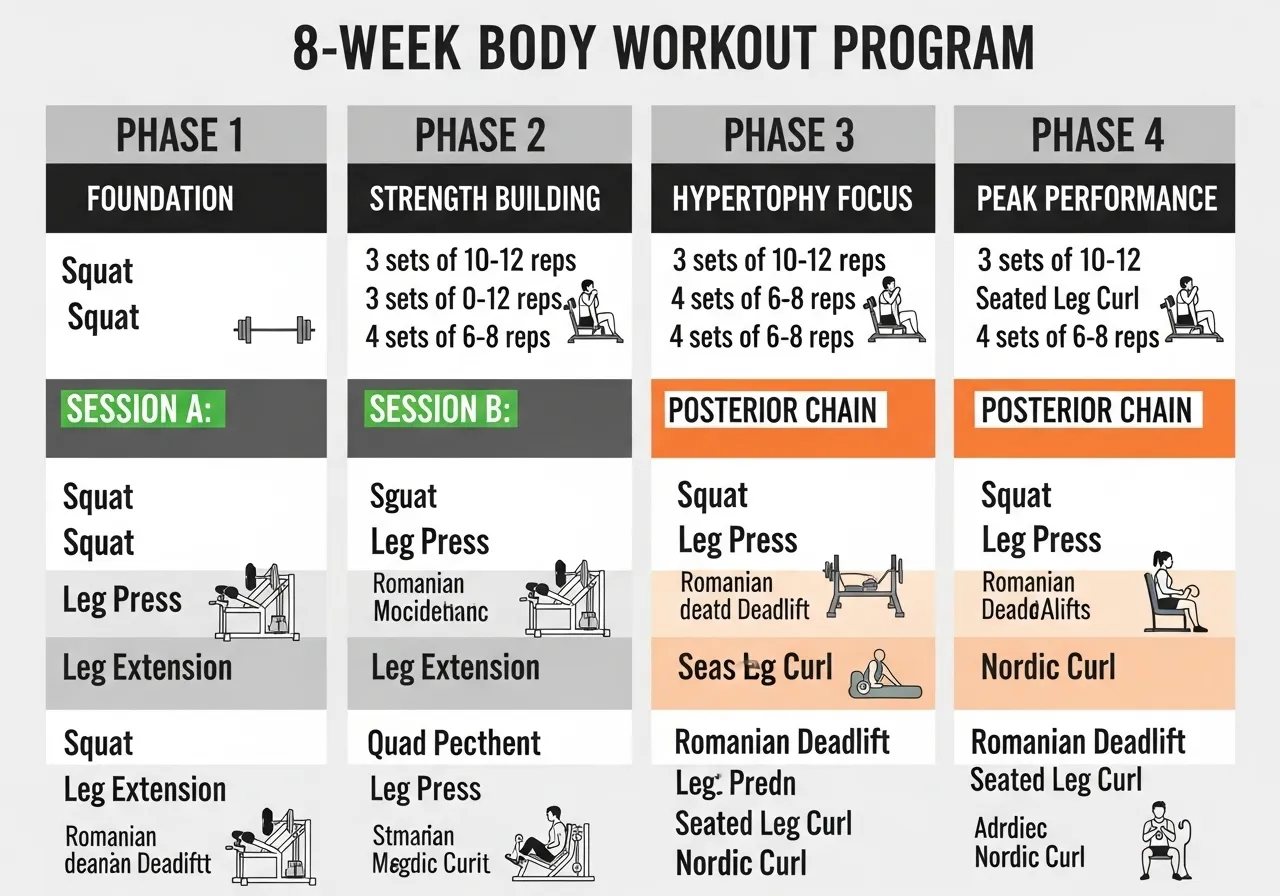
Two dedicated lower body sessions per week, each containing hip thrust as a primary exercise alongside complementary compound and isolation movements. The program progressively overloads the hip thrust from moderate to heavy loads while maintaining technique quality throughout.
Session A:
Bodyweight hip thrust: 3 × 15 (technique focus, full lockout)
Barbell hip thrust (light): 4 × 12 @ 40–60% load
Romanian deadlift: 3 × 12
Single-leg glute bridge: 3 × 12 each side
Session B:
Barbell hip thrust: 4 × 12
Bulgarian Bulgarian split squat guide: 3 × 10 each side
Banded hip thrust: 3 × 15
Cable pull-through: 3 × 12
Session A:
Barbell hip thrust: 5 × 10 @ 70%
Romanian deadlift: 4 × 10
Step-up (weighted): 3 × 10 each side
Single-leg hip thrust: 3 × 10 each side
Session B:
Barbell hip thrust (banded): 5 × 10
Back squat: 4 × 8
Hip thrust pause (2-sec top hold): 3 × 8
Lateral band walk: 3 × 20 steps each side
Session A:
Barbell hip thrust: 4 × 8 @ 77–80%
Romanian deadlift: 4 × 8 @ 75%
Step-up: 4 × 8 each side
Banded glute bridge: 3 × 20
Session B:
Barbell hip thrust: 5 × 8 @ 75–80%
Bulgarian split squat: 4 × 8 each side
Single-leg hip thrust (weighted): 3 × 8 each side
Cable pull-through: 3 × 12
Session A:
Barbell hip thrust: Work up to top set of 5 @ 85%, back-off 2 × 8 @ 72%
Romanian deadlift: Top set 5 @ 82%
Step-up heavy: 3 × 6 each side
Session B:
Barbell hip thrust: Top set of 3 @ 88%; back-off 3 × 8 @ 72%
Back squat: 4 × 5 @ 80%
Single-leg hip thrust: 4 × 8 each side (heaviest manageable)
Tracking Hip Thrust Progress: Practical Benchmarks
Meaningful hip thrust progress tracking uses a combination of load, reps, and qualitative technique assessment:
- Load-rep record: The heaviest load × reps combination achieved with controlled technique — progressing from bodyweight for 15 to 80 kg for 10 to 120 kg for 6 represents meaningful development milestones that most intermediate trainees may achieve over 6–18 months of consistent training
- Glute soreness distribution: Post-session muscle soreness concentrated in the gluteus maximus (the upper-rear part of the buttocks) rather than the lower back or hamstrings indicates correct muscle recruitment during the session — a qualitative feedback mechanism that complements load-based tracking
- Hip extension range: The ability to achieve and hold a fully horizontal torso position at the top of the movement without lower back compensation — a technique quality benchmark that improves as hip flexor mobility and gluteus maximus strength develop together
Video recording hip thrust sessions from the side view periodically — even just using a phone propped against a gym bag — provides the objective technique feedback that self-assessment in the moment rarely achieves, particularly for identifying the lumbar hyperextension and incomplete lockout errors that are difficult to feel but visually obvious.
Hip Thrust Safety, Lower Back Protection, and Common Errors
Lower Back Stress in the Hip Thrust
The hip thrust places the lumbar spine in a unique position under load — unlike squats and deadlifts where axial compression is the primary spinal stress, the hip thrust creates a bending moment at the hip-to-torso junction that can stress the lower back if technique is poor.
The primary lower back protection strategies:
- Neutral spine at the top: The classic lower back arching error — extending through the lumbar spine rather than the hips at the top of the movement — compresses the posterior lumbar vertebral joints. The top position should show hips high, torso roughly horizontal, and spine neutral — not hyperextended.
- Core bracing throughout: Maintaining intra-abdominal pressure during the entire set protects the lumbar spine from the bending forces the barbell creates. Exhale at the top; re-brace before the descent on each rep.
- Appropriate load: Excessive load relative to current strength causes technique breakdown that produces lower back stress. Keeping 2–3 reps in reserve on working sets preserves the technique quality that keeps the spine safe.
Common Hip Thrust Errors and Their Corrections
| Error | Consequence | Correction |
|---|---|---|
| Hyperextending lower back at top | Lumbar compression; lower back pain | Drive hips up, not back — neutral spine at full extension |
| Feet too close to bench | Shins angled forward; quad dominant; reduced glute activation | Move feet forward until shins are vertical at top |
| Knees caving inward | Medial knee stress; reduced gluteus medius activation | Actively push knees outward throughout; use band to cue |
| Not reaching full hip extension | Misses peak gluteus maximus activation position | Drive to maximum height; pause 1 sec at top |
| Bar rolling during movement | Discomfort; inconsistent loading position | Barbell pad essential; grip bar to prevent rolling |
Hip Thrust for Pelvic Floor and Postpartum Training
The hip thrust is frequently recommended in postpartum rehabilitation and pelvic floor rehabilitation contexts because:
- The hip extension movement pattern directly engages the pelvic floor musculature in its supportive role — the pelvic floor activates in coordination with the gluteus maximus during hip extension
- The supine-adjacent position (supported upper back) may be more comfortable than squat or deadlift positions in early postpartum stages when vertical loading tolerance is reduced
- Glute strength supports the lumbo-pelvic stability that is commonly compromised during and after pregnancy
Postpartum trainees should receive clearance from their obstetric provider before beginning loaded hip thrust training — typically no earlier than 6–8 weeks postpartum for vaginal births and 8–12 weeks for caesarean section, with individual variation dependent on recovery status and physiotherapy assessment.
Hip Thrust FAQ
Do I need a barbell to get the benefits of hip thrusts?
No — meaningful glute development from hip thrust training is achievable at all loading levels, including bodyweight. For beginners, bodyweight and banded hip thrusts provide substantial glute stimulus simply because the gluteus maximus is relatively undertrained in most people and responds to any novel loading above daily activity levels.
Progression toward barbell loading is recommended as strength develops — the barbell allows the progressive overload that drives continued adaptation. But a resistance band looped above the knees with a dumbbell or plate on the hips provides an adequate intermediate option when barbell access is limited.
How often should I perform hip thrusts per week?
Two to three hip thrust sessions per week is the most commonly recommended frequency for hypertrophy and strength development. The gluteus maximus is a large, fatigue-resistant muscle that recovers relatively quickly — most intermediate trainees can perform two heavy sessions and one lighter session per week without accumulating excessive fatigue.
The lower spinal loading of hip thrusts compared to squats and deadlifts allows higher training frequency — hip thrusts are often programmed more frequently than other lower body compound exercises precisely because they can be trained without the systemic fatigue that limits squat and deadlift frequency.
Why do I feel the hip thrust more in my hamstrings than my glutes?
Hamstring-dominant hip thrusts almost always reflect a foot placement error — specifically, feet positioned too far from the bench. When the feet are too far forward, the hip cannot achieve full extension at the top of the movement, and the hamstrings become the dominant hip extensors rather than the gluteus maximus.
The correction is to move the feet closer to the bench until the shins are approximately vertical at the top of the movement — the position in which the gluteus maximus is at maximum mechanical advantage for hip extension and the hamstrings are at a less favourable angle.
- The barbell hip thrust produces significantly higher gluteus maximus EMG activation than the back squat — 69.5% vs 29.4% mean MVIC for upper glute, 86.8% vs 45.4% for lower glute
- Peak sprint velocity correlates with hip thrust ground reaction force — suggesting the exercise specifically develops the horizontal force production relevant to speed performance
- Long-term hypertrophy studies show similar gluteus maximus growth from squat and hip thrust programs — both are valuable and neither alone is sufficient for comprehensive development
- Vertical shins at the top of the movement is the key alignment marker for gluteus maximus dominance — feet too far forward shifts the load to the hamstrings
- The step-up exercise produces the highest gluteus maximus activation of all studied exercises — it belongs in every glute-focused program alongside hip thrusts