⚠️ Health & Fitness Disclaimer This article is for general educational purposes only and does not replace professional medical advice. If you have any pre-existing joint, spinal, or cardiovascular conditions, please consult a qualified healthcare professional before beginning a yoga practice.
Yoga occupies a unique position among fitness modalities — simultaneously developing flexibility, balance training guide, functional strength, and mental focus within a single practice framework that has accumulated millennia of empirical refinement and is now supported by a substantial body of clinical research. (Related: foam rolling guide) (Related: hip flexor mobility)
Yet yoga remains significantly underutilised as a physical training tool in general fitness populations — often perceived as primarily a spiritual practice, a flexibility routine for already-flexible people, or a low-intensity activity unsuitable for serious fitness goals.
This guide covers what the research demonstrates about yoga’s physical benefits, explains the major styles and their distinct training stimuli, breaks down the foundational poses with detailed technique cues, and provides an 8-week beginner program designed to build a sustainable practice from the ground up.
Yoga’s Evidence-Based Physical Benefits: What the Research Shows
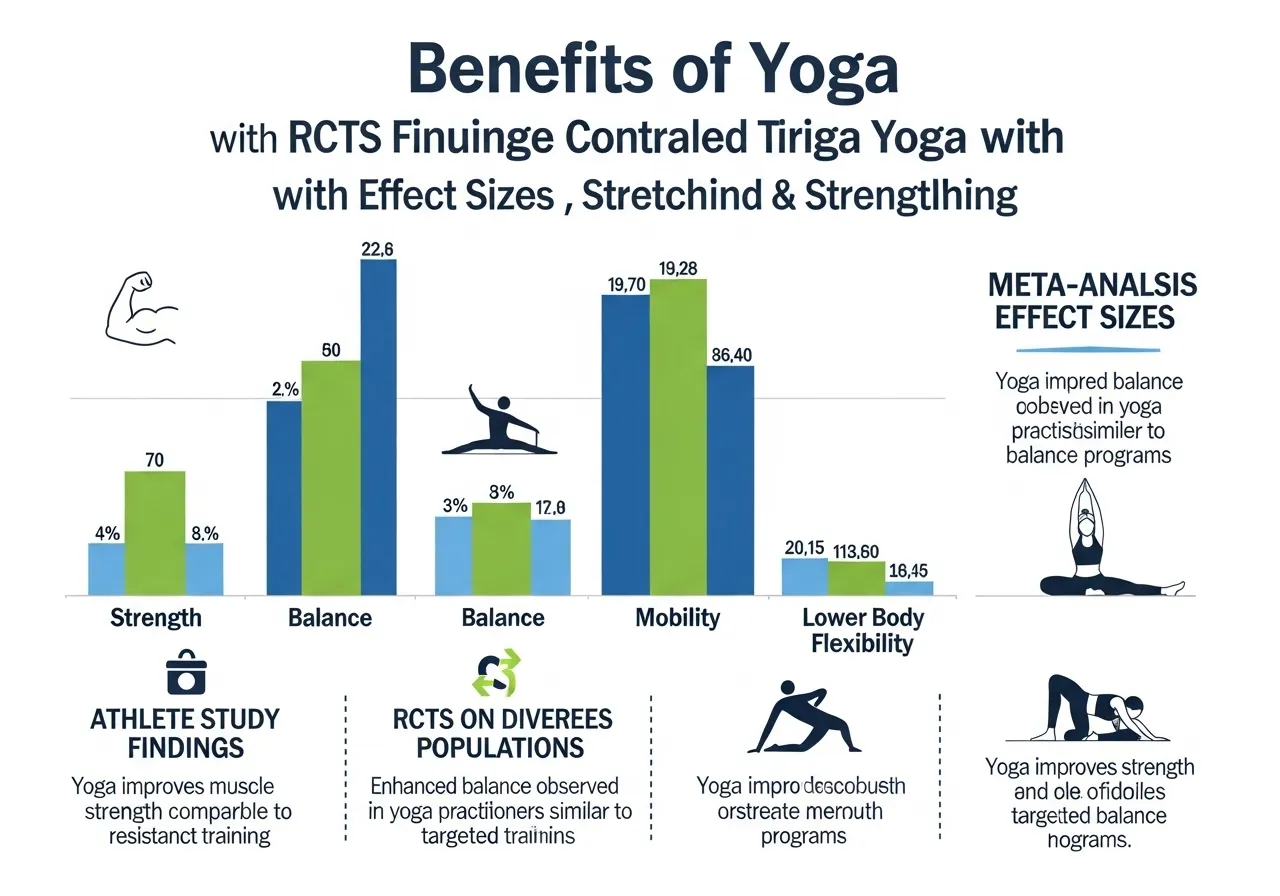
The finding that yoga produces meaningful flexibility and balance improvements even in trained athletes — a population where general fitness adaptations are typically harder to achieve than in sedentary beginners — is particularly noteworthy for strength and conditioning practitioners considering yoga as a supplementary training tool.
Mental Health and Cognitive Benefits
Beyond physical adaptations, yoga interventions have been associated with:
Reduced anxiety and stress: The combination of controlled breathing (pranayama — breath control practices that regulate the nervous system through conscious manipulation of breathing rate, depth, and rhythm) and sustained physical attention appears to activate the parasympathetic nervous system (the rest-and-digest branch of the autonomic nervous system responsible for physiological recovery and stress reduction)
Improved sleep quality: Regular yoga practice has been associated with shorter sleep latency (time to fall asleep) and greater subjective sleep quality in multiple randomised studies
Reduced symptoms of depression and anxiety: Effect sizes in multiple meta-analyses suggest yoga may produce clinically meaningful reductions in psychological distress measures — though effect magnitudes vary considerably across study designs and populations
Mechanisms Behind Yoga’s Physical Adaptations
Yoga produces physical improvements through several overlapping mechanisms distinct from conventional exercise:
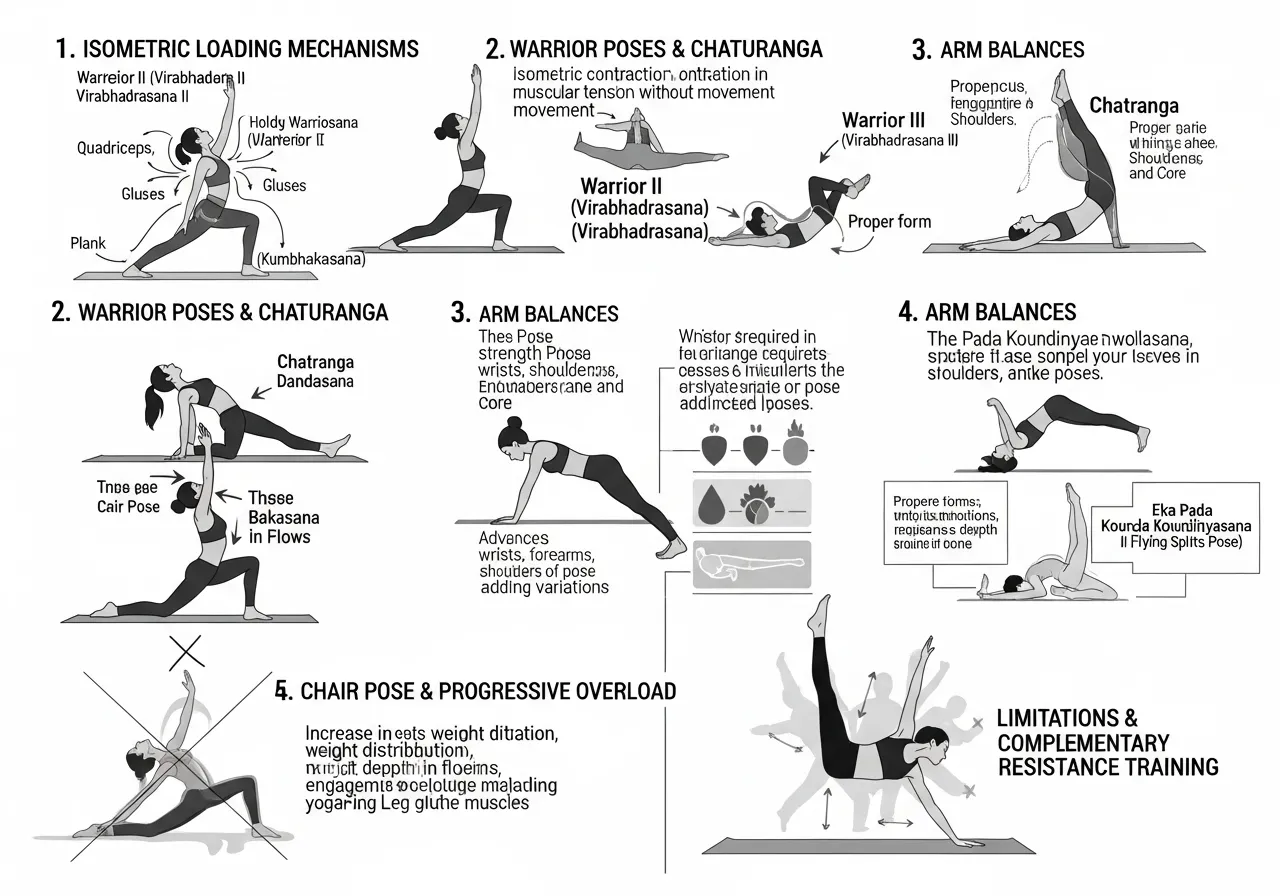
Isometric loading: Many yoga poses require sustained muscular contraction against bodyweight — warrior poses, plank, and chair pose all produce isometric loading that develops functional strength in positions conventional training rarely addresses
Eccentric-isometric combinations: Poses held at end-range positions simultaneously stretch lengthened muscles while loading them isometrically — producing both flexibility and strength adaptations simultaneously
Proprioceptive challenge: Single-leg balance poses and dynamic transitions between poses challenge the proprioceptive system (the body’s internal sense of position and movement in space) — developing the balance and coordination capacities that reduce fall risk and improve athletic movement efficiency
Connective tissue loading: Sustained holds in end-range positions stimulate the remodelling of fascia (the connective tissue network that surrounds and links muscles, tendons, and other structures) — potentially improving the passive structural flexibility that complements the neural flexibility gains from shorter-hold stretching
Yoga and Cardiovascular Health
Beyond the musculoskeletal benefits most commonly associated with yoga, research has documented cardiovascular adaptations from regular practice — particularly in individuals with elevated blood pressure or metabolic risk factors.
Proposed mechanisms include the parasympathetic nervous system activation from controlled breathing reducing resting heart rate and blood pressure, the mild cardiovascular stimulus of dynamic yoga styles contributing to aerobic conditioning, and the stress-reduction effects reducing cortisol-mediated cardiovascular risk over time.
These cardiovascular benefits are most pronounced in individuals with elevated baseline risk — for healthy, already-active individuals, yoga’s cardiovascular contribution is modest compared to dedicated aerobic training. Its value for cardiovascular health is most compelling as part of a comprehensive lifestyle approach rather than as a standalone cardiorespiratory training modality.
The Mind-Body Connection: Why Yoga’s Psychological Benefits Matter for Physical Practice
A distinctive feature of yoga compared to most conventional exercise modalities is its explicit cultivation of body awareness — the ability to notice muscular tension, breathing patterns, postural habits, and physical sensations that typically operate below conscious attention.
This developed proprioceptive sensitivity (the refined ability to accurately perceive the body’s position and state) has practical physical consequences:
Earlier detection of the muscular tension patterns that precede overuse injuries — allowing intervention before the threshold of actual injury is reached
More effective cuing of correct muscle activation during strength exercises — experienced yoga practitioners often report improved mind-muscle connection in resistance training movements following consistent yoga practice
Better breathing management under physical stress — the breath control developed in yoga practice carries over to performance under the cardiovascular and muscular demands of other training modalities
Yoga Styles: Which Type Matches Your Goals?
Hatha Yoga: The Evidence-Based Starting Point
Hatha yoga — the parent tradition from which most modern yoga styles derive — typically involves holding individual poses for 30–90 seconds with an emphasis on correct alignment and conscious breathing. Its deliberate pace makes it the most studied yoga style in clinical research and the most accessible entry point for physical fitness goals.
Most beginner yoga classes are effectively Hatha-based even when not explicitly labelled as such. The slow pace allows correct positioning to be established and refined within each pose — the technical learning phase that underlies effective long-term practice.
Vinyasa Yoga: The Cardiovascular Element
Vinyasa yoga connects poses through flowing sequences synchronised with breathing — creating a more dynamic, cardiovascular-inclusive practice than Hatha. Sun salutations (a standardised sequence of 12 poses performed as a flowing unit) form the structural backbone of most Vinyasa classes.
The continuous movement of Vinyasa elevates heart rate meaningfully — moderate-intensity Vinyasa sessions can achieve 55–70% of maximum heart rate, contributing cardiovascular training stimulus alongside flexibility and strength development.
Vinyasa is most appropriate for individuals with some movement background — the pace of transitions requires spatial body awareness that benefits from initial Hatha foundation work.
Yin Yoga: Connective Tissue and Deep Flexibility
Yin yoga involves holding passive poses for 2–5 minutes, targeting connective tissues (fascia, joint capsules, and ligaments — the dense fibrous structures that provide structural support to joints and muscles) rather than the muscular tissue that conventional yoga primarily addresses.
The long, low-intensity holds of Yin yoga produce a different flexibility adaptation than dynamic or shorter-hold practices — stimulating connective tissue remodelling that may improve passive range of motion and reduce chronic joint stiffness over weeks of consistent practice.
Yin yoga is particularly valuable as a recovery practice alongside more dynamic training modalities — the parasympathetic nervous system activation it promotes may accelerate recovery between demanding training sessions.
Ashtanga Yoga: Structured High-Demand Practice
Ashtanga yoga follows a fixed, standardised sequence of poses performed in a flowing style with a specific breathing pattern (ujjayi breath — a slightly restricted throat breath that creates an audible sound and regulates effort intensity). The primary series alone consists of approximately 75 poses.
Ashtanga is significantly more physically demanding than Hatha — requiring substantial upper body strength (particularly for the numerous transitions through chaturanga dandasana, the low push-up position) and hip mobility. It is most appropriately approached after establishing a solid Hatha or Vinyasa foundation rather than as an entry-level practice.
Restorative Yoga: Active Recovery and Nervous System Reset
Restorative yoga uses props (bolsters, blankets, blocks) to support the body completely in passive positions — allowing the muscular system to release tension without any active effort. Sessions are slow, meditative, and specifically designed to activate the parasympathetic nervous system.
From a training perspective, restorative yoga functions as active recovery — providing the physiological recovery benefits of complete rest while maintaining the training habit and connective tissue stimulation that distinguish regular yoga practice from total inactivity.
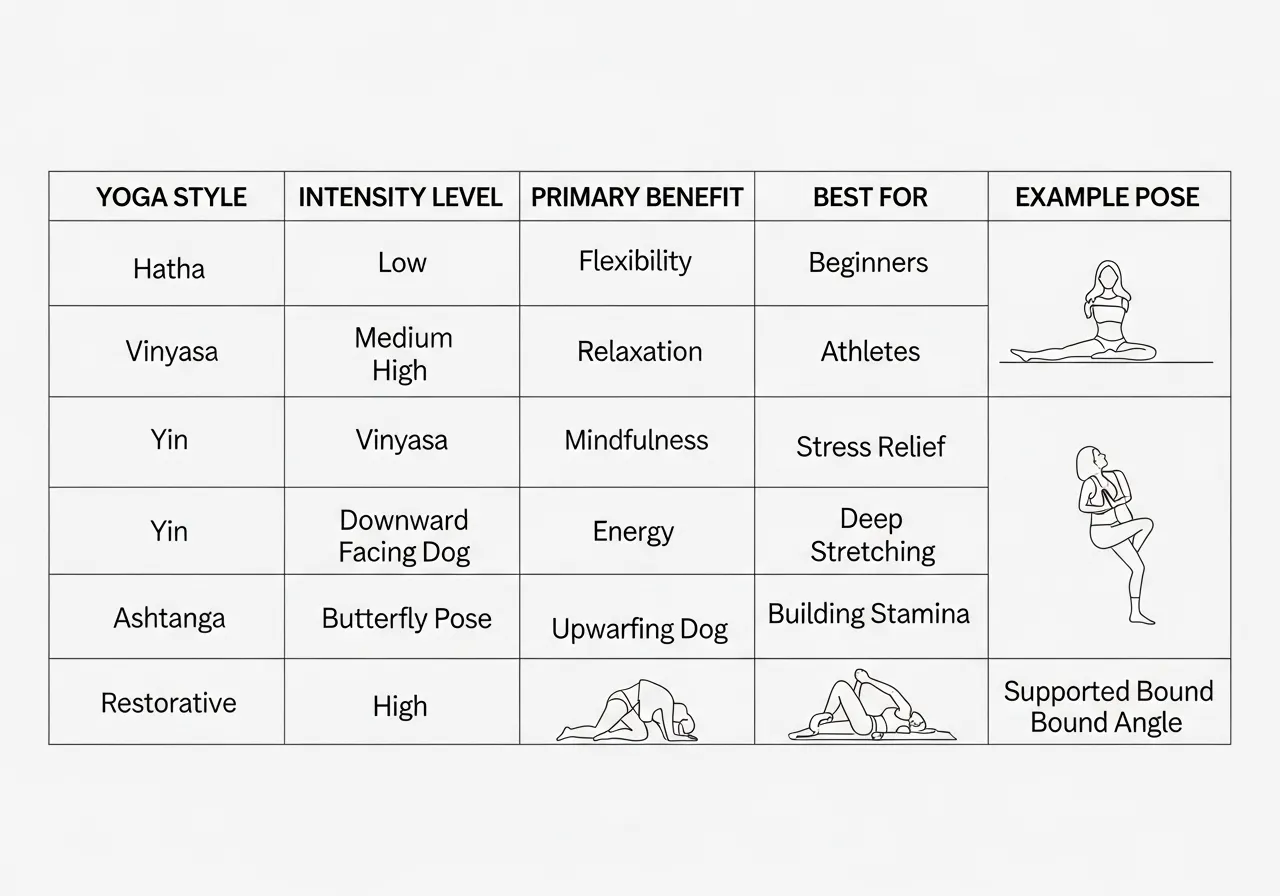
Style
Intensity
Primary Benefit
Best For
Hatha
Low–moderate
Technique, flexibility, balance
Beginners, all fitness goals
Vinyasa
Moderate–high
Cardiovascular + flexibility + strength
Intermediate; cardio supplement
Yin
Low
Connective tissue, deep ROM
Recovery; passive flexibility
Ashtanga
High
Strength, endurance, discipline
Advanced; structured progression
Restorative
Very low
Recovery, stress reduction
Active recovery; stress management
These structural limitations do not diminish yoga as a training modality — they clarify its optimal role as a complement to progressive resistance training rather than a replacement for it in programs where maximal strength or hypertrophy are primary objectives.
Does Yoga Build Functional Strength Alongside Flexibility?
Strength Development Mechanisms in Yoga
The question of whether yoga develops meaningful strength — beyond the flexibility and balance benefits — is frequently raised by strength training practitioners. The answer depends significantly on the yoga style, pose selection, and the trainee’s current strength level.
Yoga poses that produce significant isometric loading include:
Chaturanga dandasana (the low push-up position held during Vinyasa transitions): Produces anterior shoulder, pectoral, and triceps loading comparable to a paused push-up — performed multiple times per session in dynamic yoga classes
Warrior poses I, II, and III (standing lunge variations held for 30–60 seconds): The sustained quadriceps, glute, and hip flexor loading in warrior I and II produces genuine leg strength stimulus — particularly in the front leg, which maintains a 90° knee bend throughout the hold
Arm balance poses (crow pose, side crow, four-limbed staff): These poses require supporting the entire body weight on the hands — producing significant wrist, shoulder, and core strength demands that provide progressive overload as technique develops
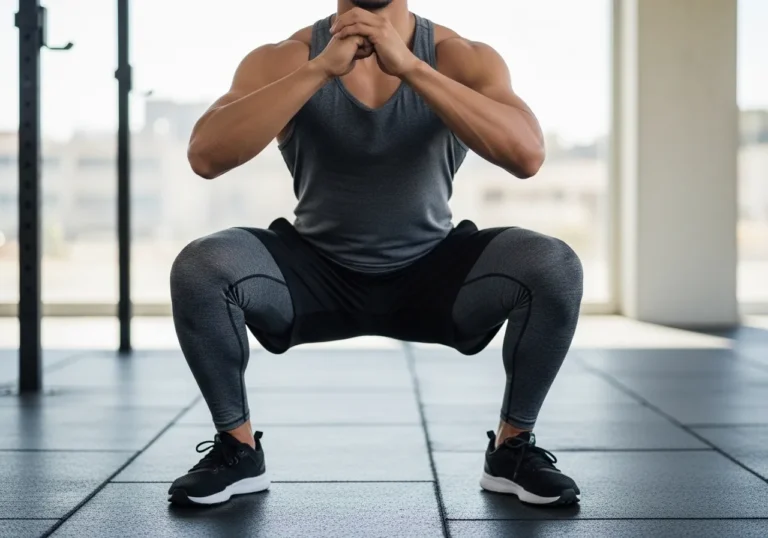
Chair pose (arms raised overhead while maintaining a deep squat position): An extended isometric squat hold that challenges the quadriceps and glutes substantially
Limitations of Yoga for Strength Development
While yoga produces functional strength improvements — particularly for beginners and those returning from inactivity — it has inherent limitations compared to progressive resistance training for maximal strength and muscle hypertrophy (growth in muscle fiber cross-sectional area):
The load is fixed at bodyweight — progressive overload through increasing external resistance is not possible within the yoga framework, limiting long-term strength development
The lower body receives less direct loading than in compound resistance exercises — squatting patterns in yoga rarely approach the training intensity of barbell squats or Romanian deadlifts
Posterior chain development (hamstrings, glutes, erector spinae) from yoga alone is modest compared to dedicated pulling and hinging exercises
The most effective approach for trainees seeking comprehensive physical development combines yoga with resistance training — yoga’s flexibility, balance, and recovery benefits complement the progressive loading of strength work in ways that neither modality fully replicates alone.
Core Stability in Yoga: A Distinctive Approach
Yoga develops core stability through a specific mechanism: bandhas (internal energy locks — the technique of engaging the pelvic floor upward and the lower abdominals inward simultaneously) maintain the spine in a neutral position throughout dynamic transitions and held poses.
This constant, low-level core engagement throughout an entire practice session may produce a different type of core endurance than the discrete sets of planks and dead bugs used in conventional core training — developing the continuous postural support that daily activities require rather than the brief high-intensity efforts that structured core exercises train.
Advanced Poses as Long-Term Goals
One of yoga’s distinctive features as a long-term practice is the virtually unlimited progression available through increasingly demanding poses — from basic standing poses to arm balances, inversions, and deep backbends.
For practitioners who develop beyond the beginner program, meaningful intermediate targets include:
Crow pose (bakasana): The foundational arm balance — supporting the entire body weight on the hands with knees resting on the upper arms. Develops significant wrist, shoulder, and core strength.
Supported headstand (sirsasana): The “king of inversions” — building cervical spine stability, shoulder strength, and the proprioceptive challenge of being fully inverted. Should be approached only after substantial shoulder and core strength development.
Full wheel (urdhva dhanurasana): A deep backbend requiring significant thoracic spine mobility, shoulder flexibility, and hip flexor length. One of the most demanding flexibility-strength combinations in the Hatha yoga canon.
These advanced poses serve as long-term motivation anchors — measurable milestones that provide the progressive challenge that sustains engagement with a yoga practice over years rather than weeks.
Foundational Yoga Poses: Technique and Alignment Guide
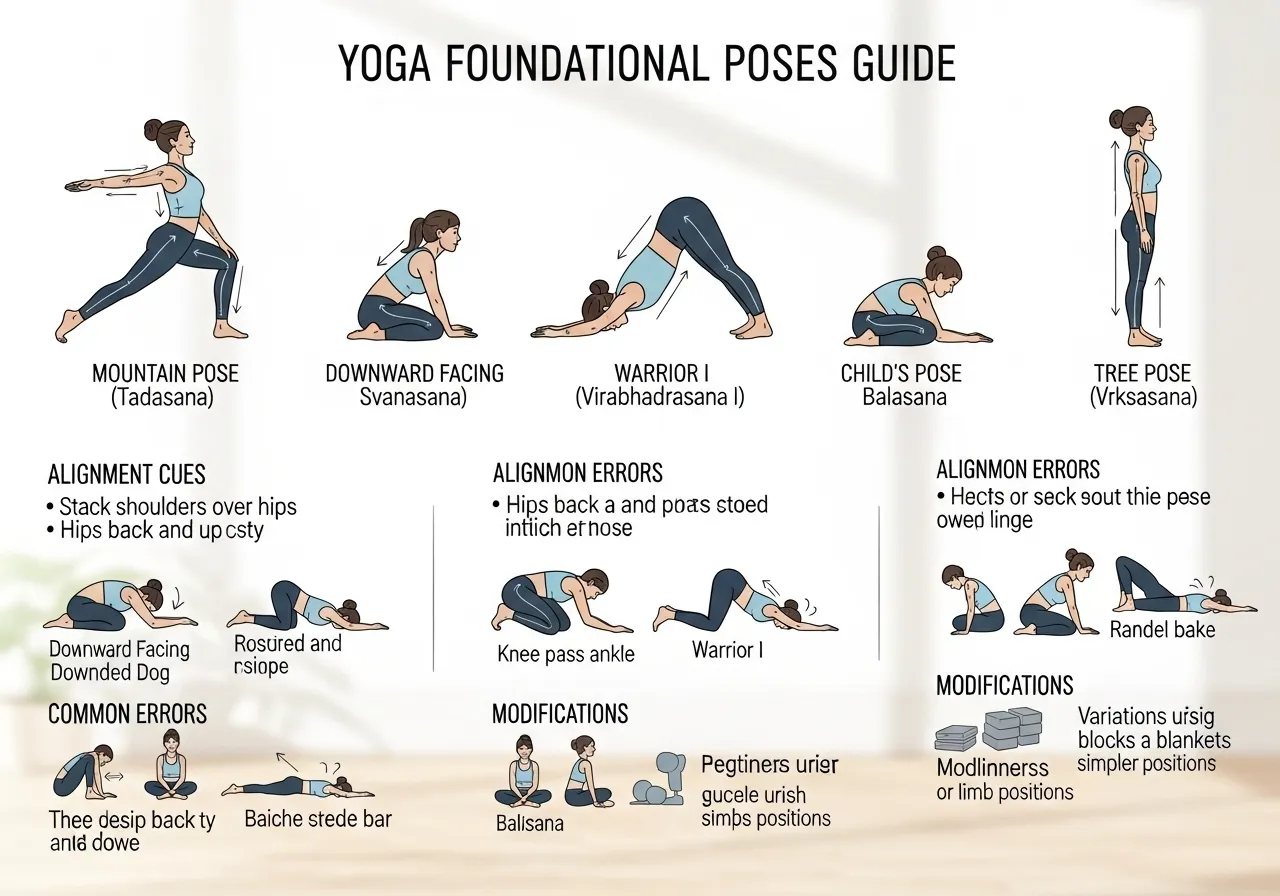
Mountain Pose (Tadasana): The Baseline of All Standing Poses
Mountain pose — standing with feet together, arms at the sides, weight distributed evenly — functions as the anatomical reference position from which all other standing poses are derived. Its technical demands are greater than they appear:
Feet: All four corners of each foot in contact with the floor — not rolling inward or outward Legs: Quadriceps gently engaged — kneecaps lifted without hyperextension Pelvis: Neutral — neither tucked under nor tipped forward excessively Spine: Natural curves maintained — not actively flattened or exaggerated Shoulders: Rolled back and down — shoulder blades on the back, not shrugged Head: Crown lifting toward the ceiling — chin level, not tilted up or down
Downward Facing Dog (Adho Mukha Svanasana)
Downward dog is the most frequently cued transition pose in yoga practice — it simultaneously stretches the hamstrings, calves, and spine while loading the shoulders in an overhead position. The pose is more demanding than it appears to beginners.
Key alignment cues:
Hands shoulder-width apart, fingers spread wide — all four corners of the palm pressing into the mat
Hips lifted toward the ceiling — the goal is an inverted V shape with the spine, not a flat back immediately
Heels pressing toward the floor — for most beginners, the heels will not touch initially due to calf and hamstring tightness. Allowing a gentle bend in the knees enables a longer spine at the expense of leg straightness — prioritise the spine length over straight legs.
Head hanging between the upper arms — not looking forward or downward strainfully
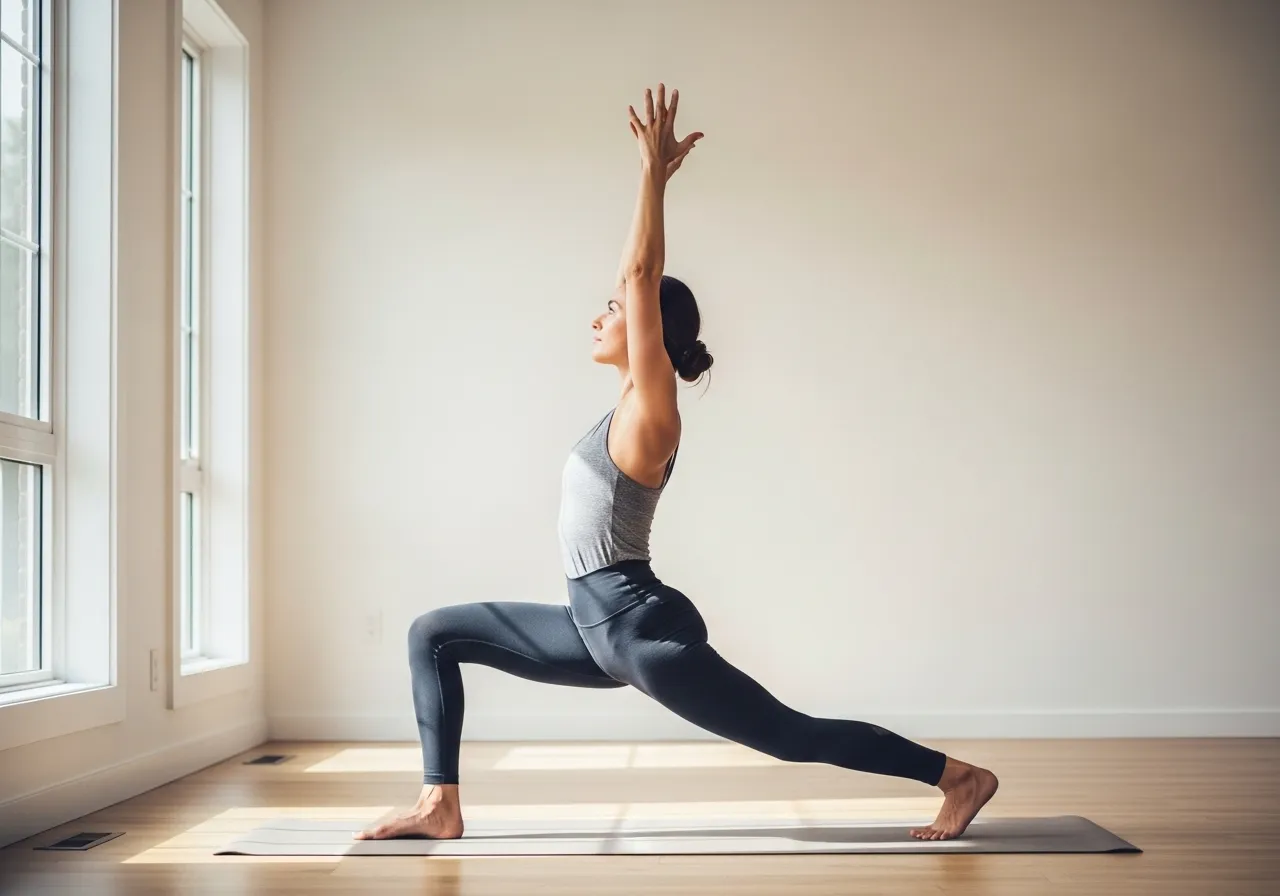
Warrior I (Virabhadrasana I)
Warrior I challenges hip flexor flexibility, quad strength, and spinal extension simultaneously. Common alignment issues in beginners:
The back foot should be turned approximately 45° — not parallel to the front foot (which rotates the pelvis excessively) and not perpendicular (which strains the back knee)
The front knee tracks over the second toe — knee valgus (inward collapse toward the midline) increases medial knee stress
Arms extend overhead without the lower back arching excessively — if the lower back arches significantly when reaching overhead, shoulder mobility or thoracic extension limitations are likely present
Child’s Pose (Balasana)
Child’s pose — kneeling with hips resting on heels and arms extended forward on the mat — is the primary rest pose in yoga practice, used between demanding sequences to allow physiological and psychological recovery.
Its physical demands include a deep hip flexion stretch, lumbar spine decompression (reduction in compressive forces on the lower back), and a gentle shoulder and thoracic stretch with arms extended. It is the appropriate resting alternative when any pose in a sequence exceeds current capacity — maintaining the practice without forcing range that is not yet available.
Tree Pose (Vrksasana): The Balance Foundation
Tree pose — balancing on one leg with the opposite foot placed on the inner thigh, calf, or ankle — is the primary balance-challenging pose in beginner yoga. It develops proprioception and single-leg stability that transfers directly to walking, running, and athletic movement.
Critical alignment note: the raised foot should never be placed directly on the standing knee joint — the lateral force on the knee in this position exceeds what the joint is designed to resist. Placement at the inner thigh or below the knee on the inner calf are both safe alternatives.
The Role of a Teacher in Yoga Development
While online yoga programs and app-based instruction provide genuinely useful introductions to yoga practice, the value of in-person instruction from a qualified teacher — particularly in the first 2–4 months — is difficult to replicate digitally.
An experienced teacher can identify and correct alignment errors that practitioners cannot see or feel independently — particularly in poses like downward dog (where minor wrist positioning errors become significant under load), warrior I (where back foot angle subtly affects knee and hip mechanics), and any inversion or arm balance where incorrect weight distribution creates injury risk rather than training benefit.
Attending even 4–6 in-person classes at the beginning of a yoga practice establishes the correct physical reference points for pose alignment that subsequent home or online practice can then maintain and develop.
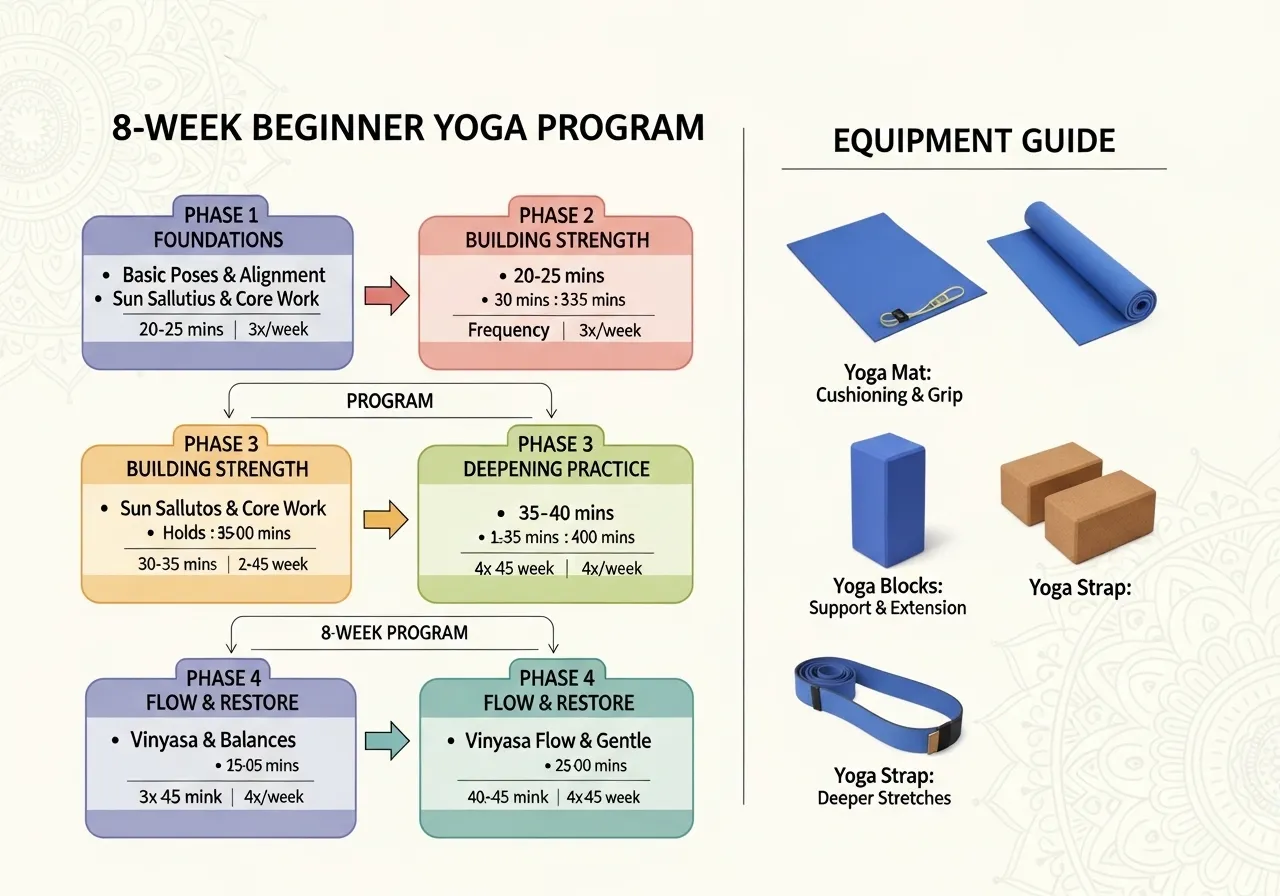
8-Week Beginner Yoga Program
Program Design Principles
An effective beginner yoga program prioritises three foundational elements over the first 8 weeks:
Alignment over depth: Achieving correct pose alignment at a reduced range of motion produces more benefit and less injury risk than forcing maximum depth with compromised structure
Breathing continuity: Maintaining smooth, continuous breathing throughout every pose — even when uncomfortable — is a more important skill target than any specific flexibility milestone
Consistent frequency over session duration: Three shorter sessions per week produce better flexibility and balance adaptations than one or two longer sessions at matched weekly volume
Weeks 1–2: Foundation
3 sessions per week, 20–25 minutes each:
Mountain pose: 1 min
Cat-cow (spinal flexion-extension cycles): 10 rounds
Child’s pose: 45 seconds
Downward facing dog: 45 seconds × 3 (30s rest between)
Low lunge: 45 seconds each side
Warrior I: 30 seconds each side
Seated forward fold: 45 seconds
Supine twist: 45 seconds each side
Savasana (final rest pose): 3–5 minutes
Focus: Breathing continuity and pose shapes — not range of motion.
Weeks 3–4: Expansion
3 sessions per week, 30 minutes each:
Add: Warrior II (30–45 sec each side)
Add: Triangle pose (trikonasana — standing with legs wide, one hand to the floor and the other reaching overhead): 30 sec each side
Add: Tree pose: 30 sec each side
Extend downward dog holds to 60 seconds
Add half sun salutation sequence at session opening (3 rounds)
Weeks 5–6: Depth and Strength
3–4 sessions per week, 35–40 minutes:
Add: Bridge pose (setu bandha sarvangasana — spine-arching backbend with hips elevated): 3 × 30 sec
Add: Boat pose (navasana — V-sit balance with legs and torso lifted): 3 × 15–20 sec
Add: Pigeon pose (hip external rotation stretch): 60 sec each side
Full sun salutation: 5 rounds at session opening
Begin chaturanga push-up transitions (or knees-down modification)
Weeks 7–8: Integration
4 sessions per week, 40–45 minutes:
Full sun salutation A and B: 5 rounds each
Warrior sequence (I, II, reverse warrior, extended side angle) both sides
Hip opening sequence (pigeon, fire log, supine figure-4)
Core sequence (boat pose, side plank, plank hold)
Yin-style holds (2 min each): seated forward fold, butterfly, reclined twist
Savasana: 5–8 minutes
Equipment: What Is Actually Necessary
A yoga practice requires minimal equipment — particularly in the early stages:
Mat: A non-slip yoga mat (4–6mm thickness) — the most essential item. A carpeted floor is an adequate substitute for home practice initially.
Blocks (2): Foam or cork blocks bring the floor closer when flexibility limitations prevent reaching it comfortably — allowing correct alignment in forward bends, triangle pose, and many other positions. Worth acquiring from the beginning.
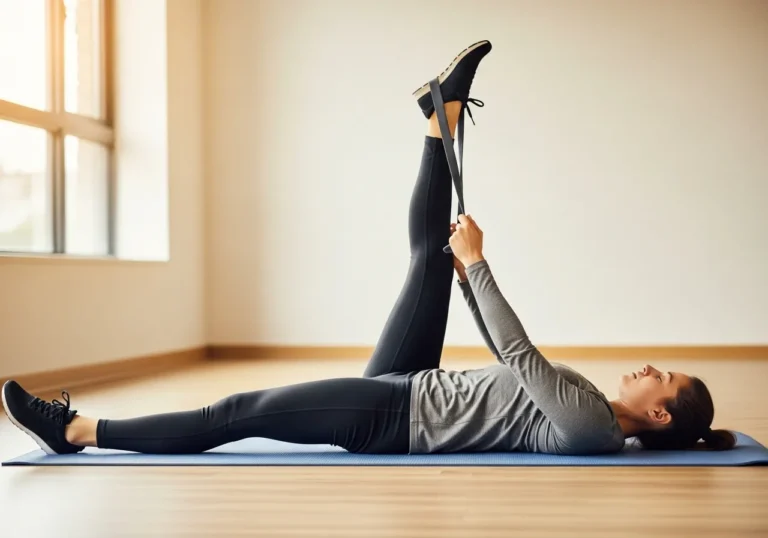
Strap: A yoga strap (or any long belt or towel) extends reach in poses where shoulder or hamstring tightness limits access to the target position.
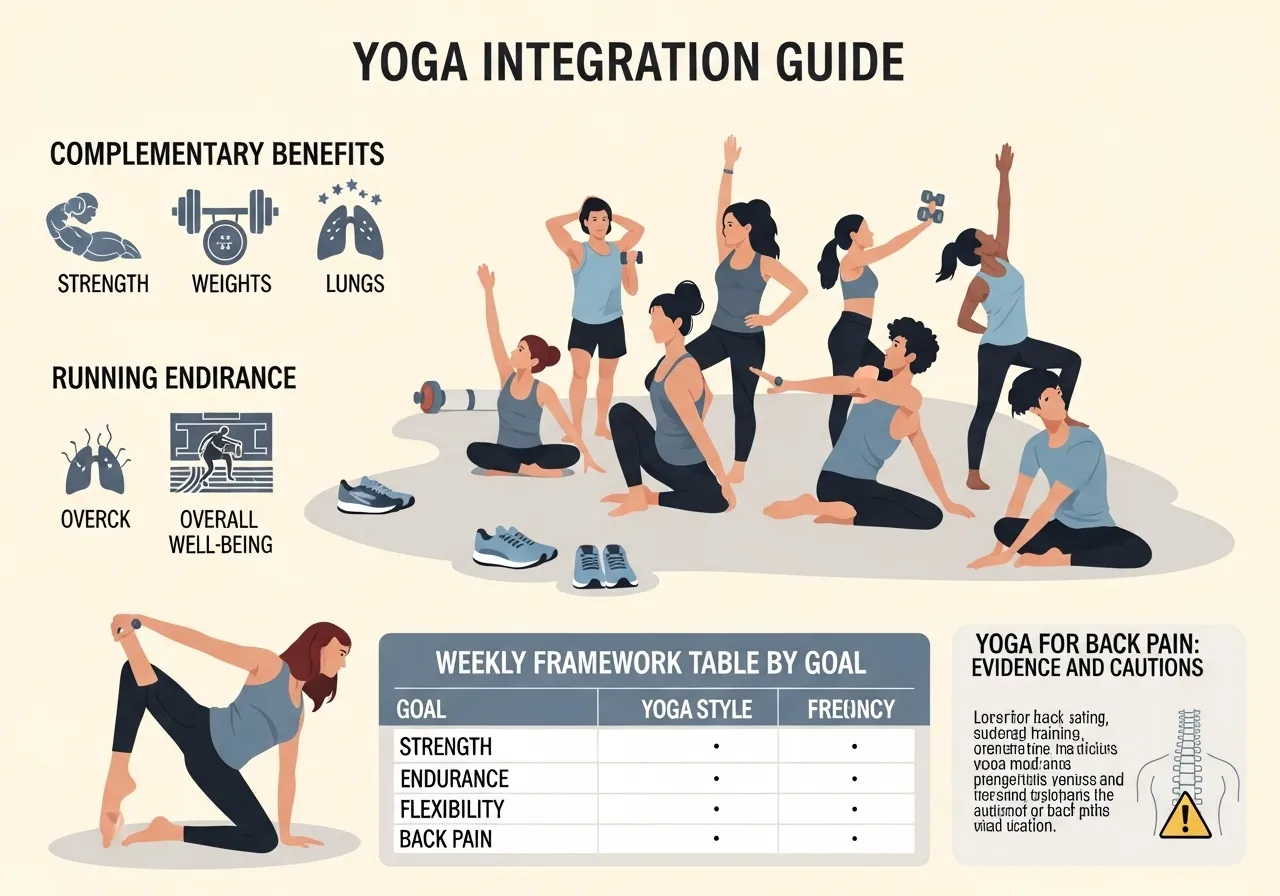
Integrating Yoga With Strength and Cardio Training
Yoga as a Complement to Resistance Training
Yoga and resistance training address distinct physical qualities — making them highly complementary rather than competing modalities:
Mobility for performance: Hip flexor, thoracic, and shoulder mobility limitations directly restrict barbell squat depth, overhead press mechanics, and deadlift positioning. Regular yoga practice addressing these areas may improve resistance training technique and performance.
Recovery: Yin and restorative yoga on rest days from lifting may accelerate recovery through parasympathetic activation and light connective tissue loading — without the muscle damage that would compromise the next resistance session
Core stability: The continuous core engagement yoga practice develops may enhance the spinal protection and energy transfer efficiency relevant to heavy compound lifts
Yoga as a Complement to Cardiovascular Training
For runners, cyclists, and other endurance athletes, yoga addresses two of the most common sources of overuse injury — hip flexor tightness and IT band (iliotibial band — the thick connective tissue running along the outer thigh from hip to knee) restriction:
The kneeling hip flexor stretches and pigeon pose of regular yoga practice directly address the hip flexor tightness that contributes to anterior knee pain and lower back loading in runners
IT band restriction responds well to yin-style holds targeting the outer hip — particularly reclined figure-4 and thread-the-needle poses
The single-leg balance poses of yoga develop the hip abductor (muscle group responsible for moving the thigh outward from the midline, primarily the gluteus medius) strength that is a common deficit in runners experiencing knee and hip pain
Practical Weekly Integration Frameworks
Primary Training Goal
Yoga Style
Frequency
Placement
Strength training
Hatha or Yin
2–3 ×/week
Rest days or post-lifting
Running/endurance
Yin or Hatha
2 ×/week
Easy training days
General fitness
Vinyasa or Hatha
2–3 ×/week
Standalone sessions
Stress management
Restorative or Yin
2–4 ×/week
Evening or rest days
Yoga for Back Pain: What the Evidence Supports
Yoga is one of the most researched non-pharmacological interventions for chronic lower back pain — with multiple randomised controlled trials demonstrating significant pain reduction and functional improvement compared to usual care.
The mechanisms likely include core stability development, hip mobility improvement that reduces lumbar compensation during movement, and the stress reduction effects that may reduce pain sensitisation (the nervous system process through which chronic pain becomes amplified beyond the original tissue stimulus).
Importantly: yoga for back pain should be approached with appropriate guidance. Specific poses can exacerbate certain spinal conditions — forward bends may worsen disc herniation symptoms, while backbends may increase pain in facet joint conditions. Working with a yoga therapist or physiotherapist familiar with yoga modifications is advisable for individuals with diagnosed spinal conditions rather than applying general yoga programming independently.
Yoga FAQ
Do I need to be flexible to start yoga?
No flexibility whatsoever is required to begin yoga — and this is perhaps the most important misconception to address for people who dismiss yoga as something they will “do once they become flexible.”
Yoga is how flexibility is developed, not a practice that requires it as a prerequisite. Every pose has accessible modifications — blocks bring the floor closer, straps extend reach, bent knees reduce hamstring demands — allowing people of all flexibility levels to participate meaningfully from the first session. Instructors in beginner classes expect and accommodate limited initial range of motion.
How often should a beginner practice yoga to see results?
Three sessions per week of 25–40 minutes produces meaningful flexibility and balance improvements within 4–8 weeks for most beginners. This frequency matches the research evidence from the studies demonstrating functional fitness improvements — and represents a sustainable commitment that can be maintained alongside other training activities.
Daily practice produces faster gains but may be difficult to sustain alongside other fitness commitments initially. Building to daily practice over 3–6 months — starting with three sessions per week and gradually adding sessions as the practice becomes habitual — may produce better long-term consistency than attempting daily sessions from the beginning.
Is yoga safe during pregnancy?
Many yoga poses are appropriate during pregnancy — and prenatal yoga classes designed specifically for pregnant practitioners are widely available and generally considered safe for healthy pregnancies. However, several categories of poses require modification or avoidance: deep twists, prone poses (lying face down), strong backbends, and any positions that create discomfort around the abdomen.
Any pregnant individual considering yoga — whether beginning for the first time or continuing an established practice — may benefit from consulting their obstetric care provider before starting, and from attending specifically designed prenatal yoga classes rather than general classes where modifications may not be automatically provided.
✅ Key Takeaways
Research supports yoga as producing equivalent functional fitness improvements to conventional stretching and strengthening exercises — with benefits across balance, strength, flexibility, and mobility
Hatha yoga is the optimal starting point for beginners — its slower pace allows proper alignment development that underlies all subsequent progress
Yoga develops functional strength through isometric loading — warrior poses, chaturanga, and arm balances all produce genuine strength stimulus
No flexibility is required to begin — blocks, straps, and pose modifications make yoga accessible at any starting flexibility level
Yoga and resistance training are highly complementary — yoga addresses the mobility and recovery limitations that frequently restrict strength training performance
⚠️ Health & Fitness DisclaimerThis article is for general educational purposes only and does not replace professional medical advice. If you have any hip, lower back, or groin conditions, please consult a qualified healthcare professional before beginning any daily hip mobility routine programme. Hip mobility — the ability of the hip joint to move freely…
Shoulder stiffness rarely announces itself with pain. It shows up as a pressing limitation, an overhead position that feels blocked, or a rack position that never quite works no matter how much you practise. Most trainees treat shoulder mobility as a warmup afterthought: a few arm circles before training, a brief band stretch after. The…
Tight hamstrings are the most commonly cited flexibility limitation in recreational athletes. They are also the most commonly treated incorrectly. The standard approach: stretch the hamstrings for 30 seconds, three times, after training. Sometimes before training. Consistently for a few weeks, then irregularly, then not at all, because nothing seems to change. The hamstrings feel…
Why Shoulder morning mobility routine Is the Foundation of Pain-Free Upper Body Training The shoulder is the most mobile joint in the human body — capable of movement in more planes and across greater ranges than any other major joint. This exceptional mobility comes at the cost of inherent instability: the glenohumeral joint’s ball-and-socket architecture…
⚠️ Breathing and Cardiovascular Safety NoteBreathing exercises involving breath-holding (Valsalva manoeuvre variants) and hyperventilation drills significantly alter blood pressure and carbon dioxide levels. Individuals with uncontrolled hypertension, a history of syncope (fainting), cardiovascular disease, or epilepsy should avoid high-intensity breath-holding exercises and obtain medical clearance before starting structured diaphragmatic breathing training. Dizziness or tingling during…
⚠️ Health & Fitness DisclaimerThis article is for general educational purposes only. It does not replace professional medical advice. If you have existing shoulder pain, rotator cuff injury, or shoulder impingement, consult a qualified healthcare professional before starting any scapular training programme. Most shoulder problems in the gym do not start at the shoulder joint…