Incline Bench Press Guide: EMG Research, Optimal Angle Science, and Upper Chest Development Plan
This article is for general educational purposes only. It does not replace professional medical advice. If you have shoulder, elbow, or wrist conditions, consult a qualified healthcare professional before starting any pressing programme.
The flat dumbbell vs barbell bench builds the chest. Everyone knows this. (see also: bench press fixes) (see also: face pull guide)
What fewer trainees understand is that the flat bench press primarily develops the sternocostal head — the lower and mid portion of the pectoralis major. The clavicular head (the upper chest, responsible for the shelf-like fullness visible above the nipple line) receives significantly less stimulus from flat pressing alone.
This guide covers the EMG research on incline angles, the optimal degree setting most trainees miss, the key variations, and an 8-week programme that builds both upper and overall chest development systematically.
The Upper Chest Gap: Why Flat Bench Alone Never Finishes the Job
The Two Regions of the Pectoralis Major
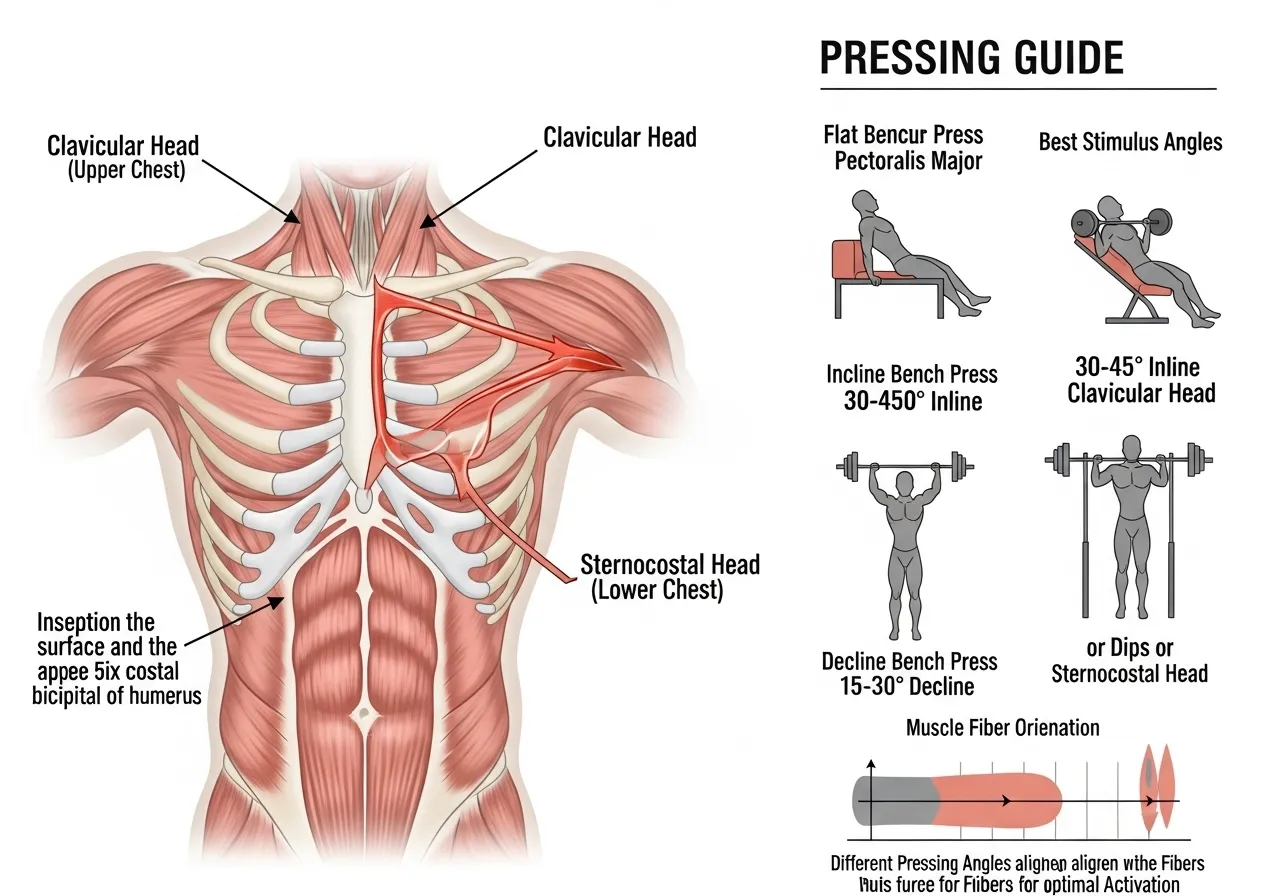
The pectoralis major (the large fan-shaped muscle covering the chest) contains two functionally distinct regions:
- Clavicular head (upper chest): Originates from the clavicle (collarbone). Performs shoulder flexion — driving the arm upward and forward. Best activated when the arm presses at an upward angle.
- Sternocostal head (lower and mid chest): Originates from the sternum and ribs. Performs shoulder horizontal adduction — driving the arm across the body. Best activated at flat and declining angles.
Flat bench press maximises sternocostal activation. The clavicular head contributes, but it never reaches its peak stimulus potential when the arm presses straight ahead on a flat surface.
What the Angle Research Finds
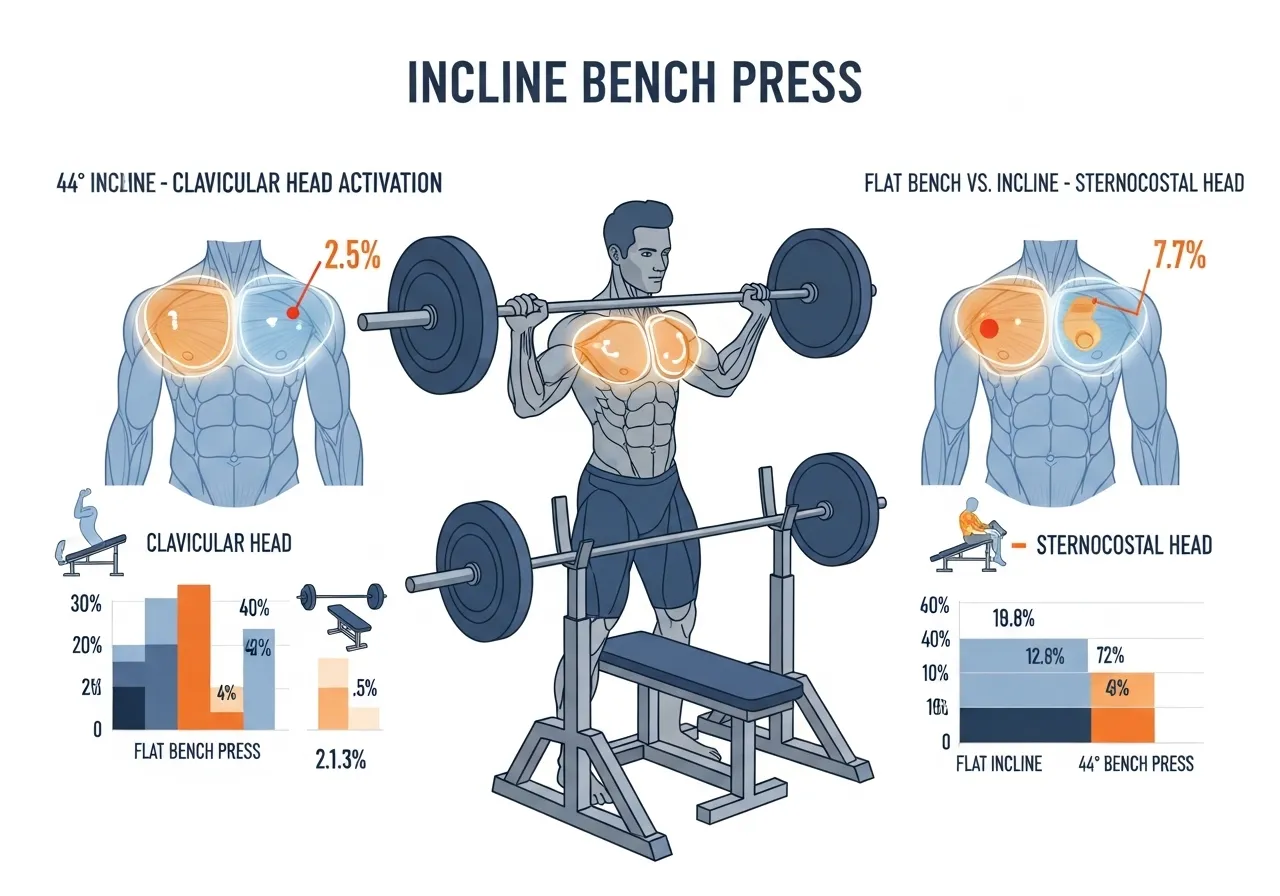
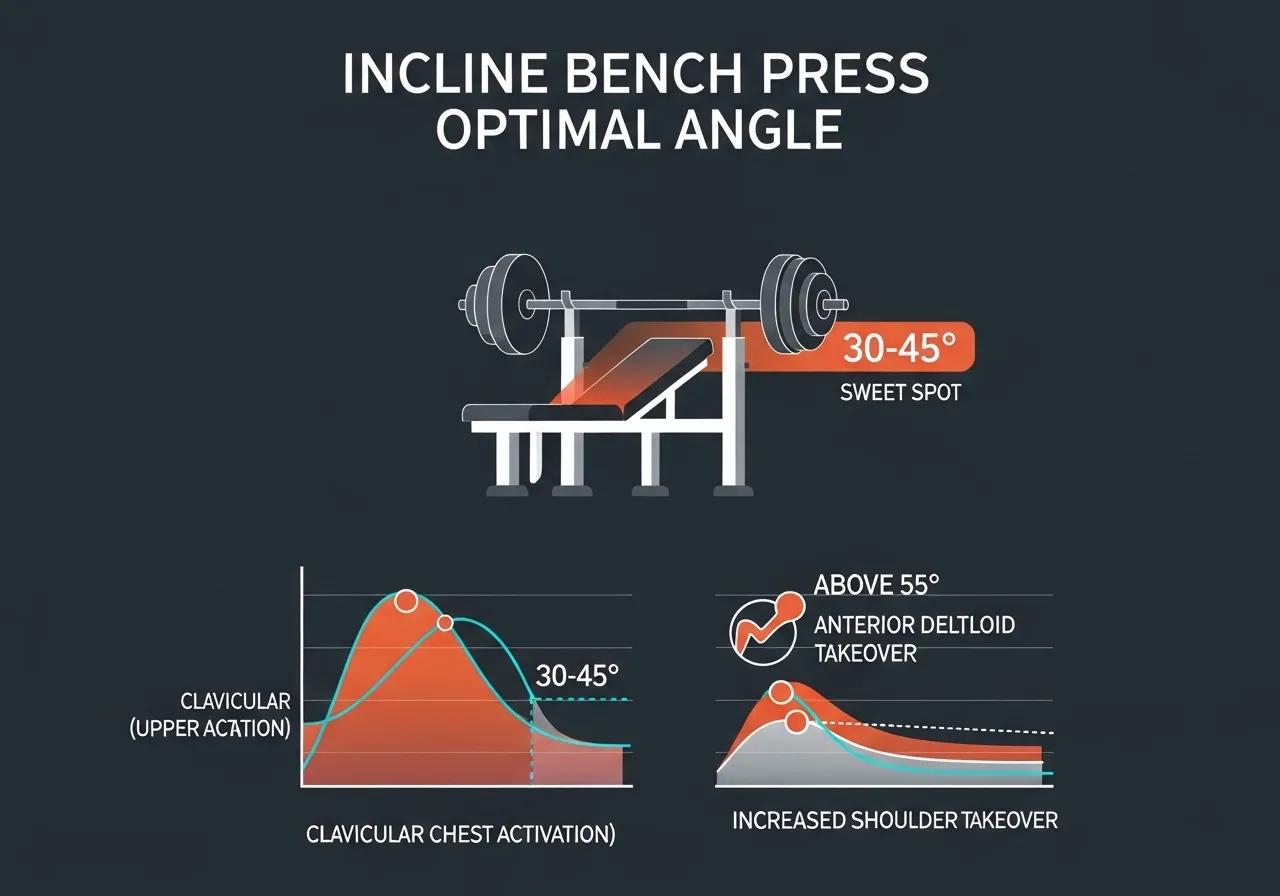
A study measuring EMG activity of three shoulder muscles during chest press at multiple angles finds that clavicular head activation at 44° was significantly greater than at 0° (flat) and at 28° — while sternocostal head activation showed the opposite pattern, being significantly greater at flat than at any incline angle — confirming that flat and incline bench press produce distinctly different pectoral activation profiles that cannot be replicated by either exercise alone.
No single bench angle trains the entire pectoralis major. Flat bench maximises the sternocostal head. A 44° incline maximises the clavicular head. Complete chest development requires both.
The 8-Week Training Evidence
A study comparing 8 weeks of horizontal bench press, incline bench press, and their combination in untrained men finds that all three groups achieved similar strength gains in both horizontal and incline bench press — with no significant differences in pectoralis major thickness changes between groups — suggesting that the incline bench press produces comparable overall chest development to flat bench press, while providing the distinct clavicular head activation advantage that the flat bench cannot match.
Incline bench press produces comparable overall strength and hypertrophy gains to flat bench press. It is not a secondary exercise — it is an equal primary movement that addresses a different region.
Why Trainees Overlook This
Flat bench press is the benchmark exercise. It feels more impressive, allows heavier loads, and dominates gym culture.
Most trainees who do incline work treat it as a warm-up or finishing exercise — 3 sets after their flat bench main work with 60–70% of the load. At this point in the session, fatigue limits the training stimulus the incline can deliver.
Effective upper chest development requires treating the incline press as a primary movement — loaded, progressed, and placed early in the session when quality is highest.
The Optimal Incline Angle: What the Research Settles
The Angle Debate — and the Data Behind It
The most common gym debate around incline pressing: is 30° or 45° better?
Research examining the effect of different incline angles (20°, 32°, and 43°) on clavicular head activation finds that performing the barbell incline bench press above 32° produces significantly higher neuromuscular activation of the clavicular head — with 43° producing the most beneficial stimulus. The 20° condition activates the clavicular head significantly less than either 32° or 43°.
A systematic review and meta-analysis of pectoralis major EMG across bench press variations confirms that inclining the bench increases clavicular head activation compared to flat pressing — while simultaneously decreasing sternocostal head activation — and that performing both flat and inclined pressing is necessary to fully recruit both heads of the pectoralis major across their respective functional ranges.
The optimal angle for clavicular head activation is ~43–45°. Below 30° is insufficient for maximal upper chest stimulus. Above 55–60° shifts emphasis away from the chest and toward the anterior deltoid.
The 60° Problem: When Incline Becomes Shoulder Press
Many gym benches default to 45° or higher — and some trainees push the back pad to 60°–70°.
At steep angles, the movement shifts from a chest-dominant pressing pattern to a shoulder-dominant one. The anterior deltoid takes over as the primary mover. The pectoralis major still contributes, but no longer drives the movement.
Anterior deltoid activation is significantly higher during incline barbell press compared to decline — and this gap widens as the angle increases beyond 45°. Beyond 55°, you are largely doing a seated overhead press with a slight backward lean.
The Practical Angle Range: 30–45°
Based on the available EMG research, the practical recommendation is:
- 30–35°: Acceptable upper chest stimulus with slightly more sternocostal contribution. Better for trainees who experience anterior shoulder discomfort at steeper angles.
- 40–45°: Maximum clavicular head activation. The research-supported sweet spot for pure upper chest targeting.
- Above 50°: Rapidly shifting toward anterior deltoid dominance. Reserve for specific shoulder-focused pressing, not chest development goals.
Does This Apply to Dumbbells and Cables Too?
Yes — the angle principle applies to all incline pressing modalities.
The bench angle determines the direction of force application relative to the clavicular head’s optimal activation angle. Whether the implement is a barbell, dumbbell, or cable, setting the bench in the 40–45° range produces the same clavicular head advantage.
Dumbbell incline pressing adds the benefit of a greater range of motion at the bottom — the hands can lower further than a barbell allows, increasing the stretch stimulus on the pectoral at the beginning of the rep. Cable incline pressing provides constant tension throughout the movement, including at the contracted top position where free weights lose resistance.
The Dumbbell Advantage: Range of Motion and the Stretch Stimulus
Barbell incline pressing stops when the bar contacts the chest. Dumbbell incline pressing allows the hands to travel past this point — dropping below the chest plane and stretching the clavicular head further into its lengthened position.
Recent hypertrophy research consistently identifies stretch-loaded training positions as producing superior muscle growth signals. The dumbbell incline press naturally provides this at the bottom of every repetition — a mechanical advantage the barbell version cannot replicate.
For trainees whose primary goal is upper chest size rather than incline press strength, dumbbell incline pressing at 40–45° with a full, controlled descent may produce superior hypertrophic stimulus per session compared to the barbell equivalent at the same relative effort level.
Grip Width on the Barbell Incline: Does It Change Activation?
The same grip width principles that apply to flat bench carry over to incline pressing.
A grip at approximately shoulder width (100% of biacromial distance — the distance between the acromion processes of the two shoulders) provides balanced activation across the clavicular and sternocostal regions. A wider grip (150–200% biacromial distance) increases overall pectoralis major involvement but raises the risk of AC joint and anterior shoulder stress at steep incline angles.
For most trainees, a grip 3–5 cm wider than shoulder width on the incline press provides maximum chest activation without creating unnecessary shoulder stress at the 40–45° angle.
Barbell, Dumbbell, or Machine Incline Press: Which Builds the Most Chest?
The Case for the Barbell
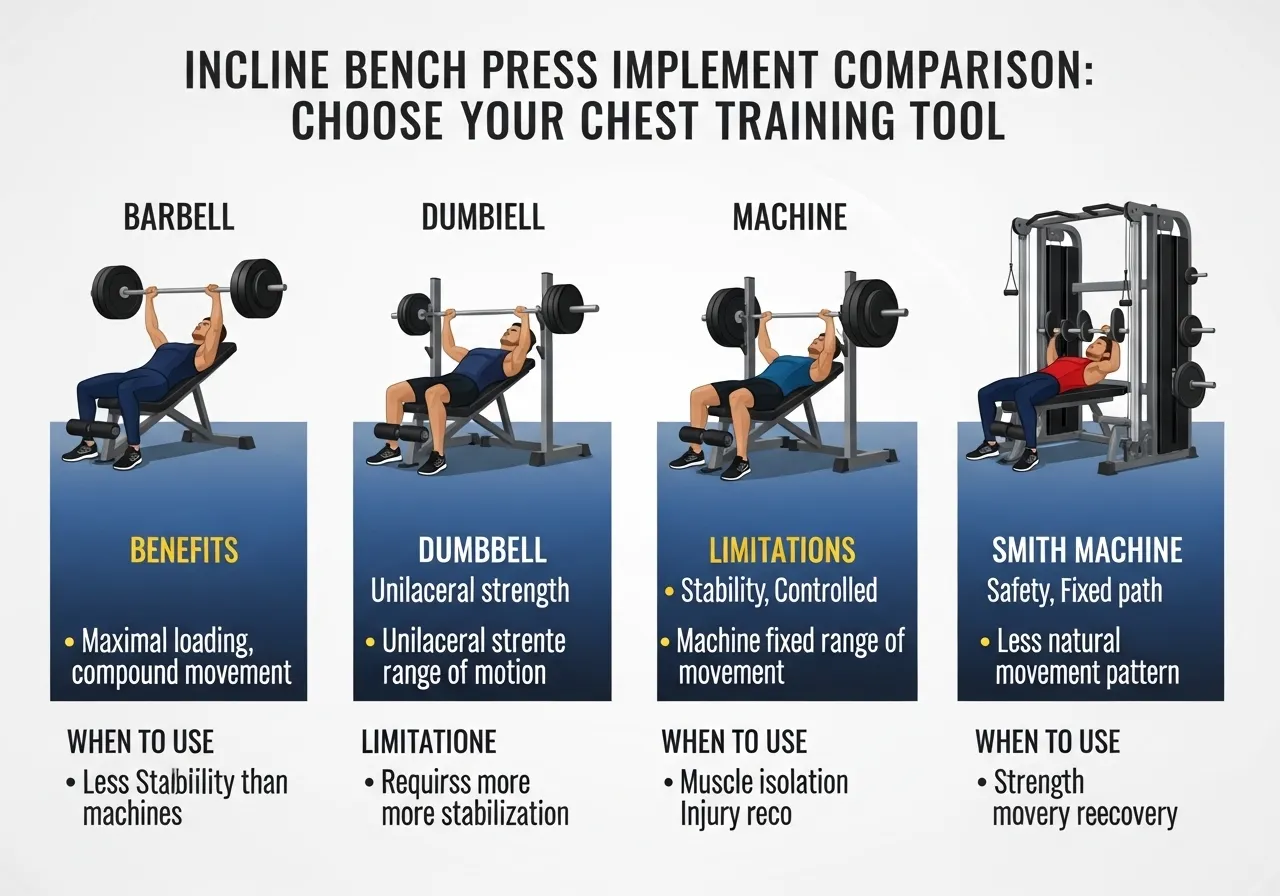
The barbell incline press allows the heaviest absolute loads and the clearest progressive overload tracking. Load increases in 2.5 kg increments are straightforward. It is the standard for strength measurement in the incline pressing pattern.
The fixed bar path limits shoulder rotation throughout the movement. Some trainees find this creates shoulder discomfort — particularly in the early lift-off and lockout phases where the shoulder is at the most mechanically compromised position under load.
The Case for Dumbbells
Dumbbell incline pressing offers three advantages the barbell cannot provide:
- Greater range of motion: The hands can travel below the bar path endpoint at the bottom of the movement, increasing pectoral stretch at the start of each rep
- Wrist rotation freedom: Natural pronation-to-neutral rotation during the press follows the shoulder’s biomechanical preference, reducing rotational stress
- Unilateral strength balance: Each arm works independently, preventing the stronger side from compensating — the most common pattern with bilateral barbell work
The trade-off: dumbbell loads jump in larger increments than barbell microplates. Moving from 30 kg per hand to 32.5 kg per hand (a 5 kg total increase) is a larger percentage jump than adding 2.5 kg to a barbell.
The Case for the Incline Machine or Smith Machine
Machines and the Smith machine remove stabilisation demand — allowing heavier loads with less balance and coordination requirement.
This is valuable when the stabilising muscles (rotator cuff, serratus anterior) are the limiting factor rather than chest strength itself. In these cases, machine pressing lets the pectoralis major train to a greater stimulus threshold than free weight pressing allows.
The Smith machine incline press also allows failure-set training without a spotter — a practical advantage for trainees who train alone and want to push intensity safely.
The Practical Answer: Use All Three in Rotation
No single implement is universally superior. The most effective approach cycles through all three across a training programme:
| Implement | Best Used For | Main Limitation |
|---|---|---|
| Barbell | Primary strength gains; heaviest loads; clear progressive overload | Fixed path; requires spotter for failure sets |
| Dumbbell | Symmetry correction; ROM advantage; shoulder-friendly rotation | Large load increment jumps; requires balance |
| Machine / Smith | High-intensity failure sets; stabiliser fatigue days; rehabilitation | Reduced stabiliser stimulus; fixed arc |
Incline Bench Press Technique: Setup, Execution, and Common Errors
Setup: The Foundation of Every Effective Set
Technique on the incline press follows the same principles as flat bench — but the inclined position changes several key setup details.
- Bench angle: Set to 40–45° as the primary working angle. Verify the angle before loading — most adjustable benches have a setting at 30° and one at 45°; use the 45° setting or the closest available to it.
- Scapular position: Retract and depress the shoulder blades before unracking. Pull them together and push them down. This creates the stable shoulder platform that protects the rotator cuff and improves force transfer throughout the set.
- Foot position: Feet flat on the floor. Unlike flat bench, the incline position shifts your centre of gravity backward — active foot contact prevents sliding under heavy loads.
- Bar path: Lower to the upper chest — not the collar bones or lower sternum. The upper chest (roughly the nipple line when the bench is inclined) is the natural landing point that aligns the pressing direction with the 40–45° angle of the bench.
Execution: The Pressing Pattern
The incline press arc is slightly more vertical than the flat bench arc. The bar travels in a slight diagonal — not straight up and down.
At the bottom position: arms at roughly 75° to the torso, elbows at 45–60° from the body. Elbows flared too wide (90° from torso) shifts load from the chest to the anterior deltoid. Elbows tucked too tight (30° from torso) reduces chest involvement and increases tricep dominance.
Press to full lockout — complete elbow extension is important on the incline. The clavicular head shortens most at full arm extension in the inclined position. Stopping short of lockout reduces the peak contraction stimulus that differentiates the incline from flat pressing.
Five Common Errors and Their Fixes
| Error | What It Causes | Fix |
|---|---|---|
| Angle too steep (60°+) | Shoulder press pattern; anterior deltoid takes over | Reset to 40–45° |
| Bar lowered to collar bones | AC joint (acromioclavicular joint) stress; missed chest contact | Lower to upper chest, not collar bones |
| Elbows flared wide | Anterior deltoid overload; reduced chest activation | 45–60° elbow angle from torso |
| No scapular retraction | Unstable shoulder; rotator cuff impingement risk | Retract and depress before every set |
| Treating incline as accessory | Fatigued upper chest receives insufficient stimulus | Programme as primary movement at least 1–2× per week |
Breathing Pattern and Intra-Abdominal Pressure
The inclined position places the upper body at an angle that changes the breathing mechanics compared to flat bench.
The standard cue remains: inhale at the top before descent, hold breath during the pressing phase (Valsalva manoeuvre — briefly increasing intra-abdominal and intrathoracic pressure to stabilise the spine and shoulder girdle under load), exhale at the top of the concentric phase.
For lighter sets (12–15 reps), continuous breathing is acceptable — exhale during the press, inhale during the descent. For heavy sets (3–8 reps), the Valsalva provides meaningful stability benefit and is the recommended approach for trainees without cardiovascular contraindications.
Why Most Trainees Never Develop Their Upper Chest
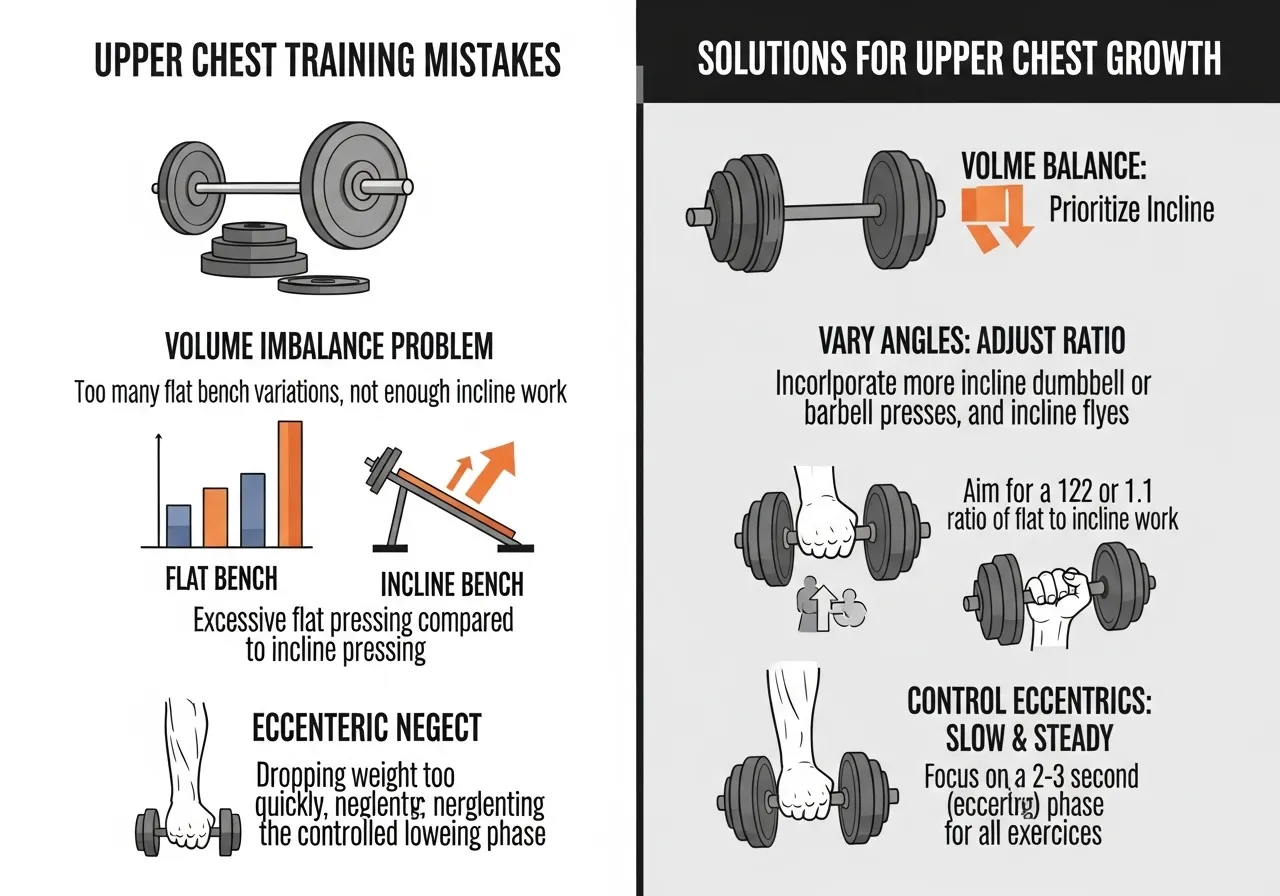
The Volume Imbalance
Most chest-focused programmes follow a predictable structure: flat bench press as the primary exercise, incline as the first accessory, and a fly or cable as the finisher.
In practice, flat bench gets 4–5 working sets at maximum effort. The incline gets 3 sets when energy is already depleted. The clavicular head never receives a fresh, high-quality training stimulus — and it shows in the chronic underdevelopment of the upper chest region even in otherwise well-trained lifters.
The fix is straightforward: periodically swap the session order. Start with incline press as the primary movement. Finish with flat bench. The upper chest develops; overall chest performance is not compromised. Research confirms that strength gains transfer equally in both directions.
Always Using the Same Angle
Setting the bench to 45° every session for months produces plateau — the clavicular head adapts to exactly that stimulus and stops responding.
Varying the incline angle between sessions (30° one week, 45° the next) maintains novelty without adding new exercises. The mechanical stress at each angle is sufficiently different to drive continued adaptation across the clavicular head’s full range.
Too Much Flat Volume, Not Enough Incline
Flat bench produces stronger results per set because absolute loads are higher — the mechanical advantage of the flat position allows 15–25% more weight than the incline.
Trainees maximise this by pouring most chest volume into flat pressing. The higher absolute load feels more productive. But it systematically undertrains the clavicular head. A programme that allocates 60% of chest volume to flat pressing and 40% to incline work produces significantly more complete chest development than a 90/10 split — even though the flat-heavy programme feels more intense.
Neglecting the Eccentric Phase
The incline press eccentric (the controlled lowering phase) stretches the pectoralis major — particularly the clavicular head — under load.
Most trainees lower the incline bar quickly, reducing time under tension in the stretched position. A deliberate 2–3 second descent increases the hypertrophic stimulus per set without changing load. It is free performance, and most trainees leave it on the table.
Shoulder Fatigue Masking the Chest Stimulus
The incline press involves more anterior deltoid activation than flat bench. Trainees who overhead press or perform heavy shoulder work earlier in the same session arrive at the incline bench with a partially fatigued anterior deltoid.
The anterior deltoid then fatigues further during the incline press — before the chest reaches its target stimulus. The session ends with a shoulder pump and a chest that was never properly challenged.
Programme incline pressing on a day separated from heavy shoulder pressing by at least 48 hours. If that is not possible, place incline pressing before shoulder work in the same session — not after.
Skipping Accessory Fly Work
The incline press trains the clavicular head through its pressing function. But the pectoralis major also performs horizontal adduction — drawing the arm across the body toward the midline.
Adding an incline fly or incline cable fly guide after pressing work targets the horizontal adduction function of the clavicular head that pressing alone never fully develops. 2–3 sets of incline flies per session at a lighter load with a controlled stretch at the bottom of each rep completes the clavicular head stimulus that pressing starts but cannot finish alone.
8-Week Incline Bench Press Programme
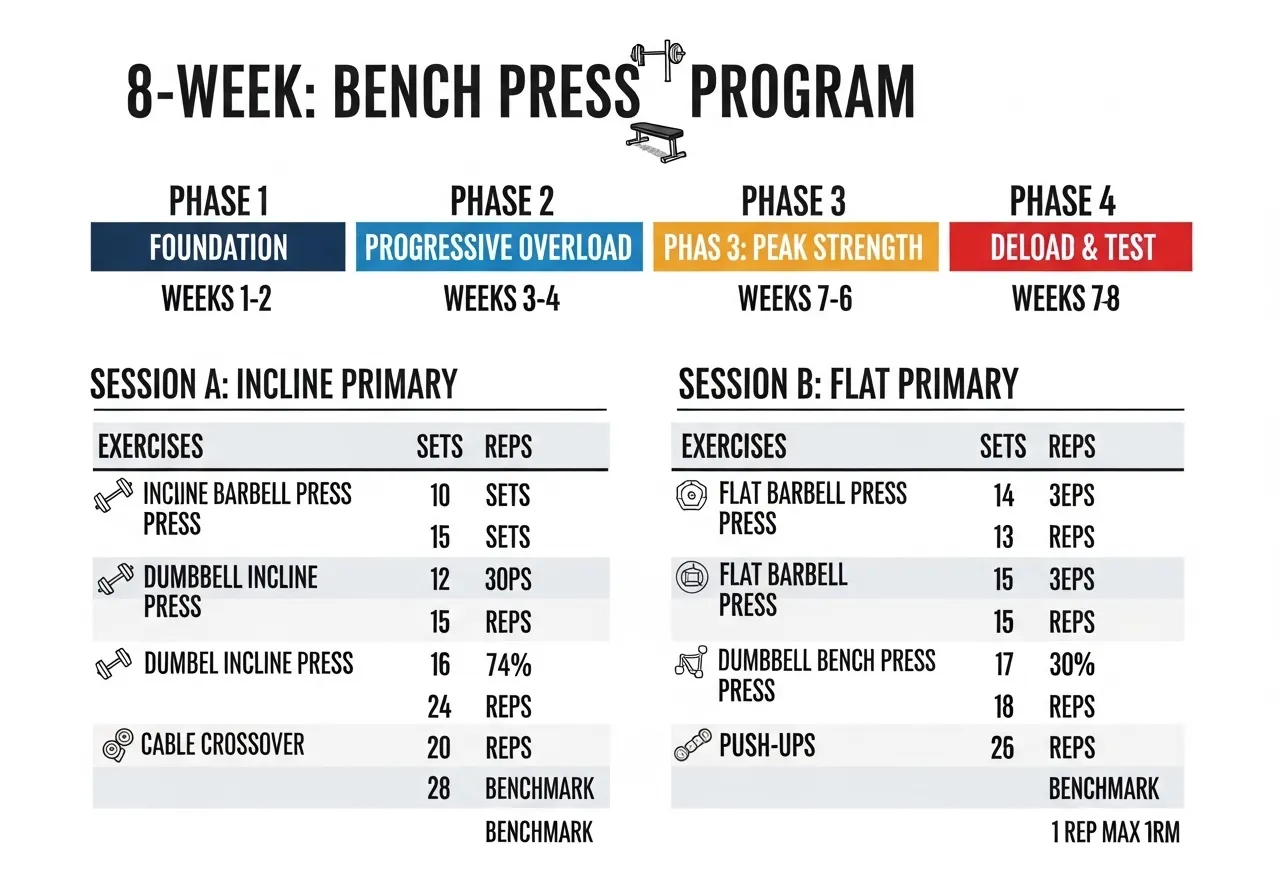
This programme runs two chest-focused sessions per week. One session leads with incline press (upper chest priority); the other leads with flat press (overall chest base). Both sessions include complementary work for the opposite head.
The programme uses three incline press variations across the 8 weeks — barbell, dumbbell, and cable — to ensure angle variety, ROM variety, and resistance curve variety.
📅 Phase 1 — Weeks 1–2: Incline Foundation
- Session A (Incline Primary): Barbell Incline Press (45°) 4×8 → Incline DB Fly 3×12 → Flat Barbell Bench 3×10 → Cable Crossover high-to-low 3×12
- Session B (Flat Primary): Flat Barbell Bench 4×8 → Incline DB Press (40°) 3×10 → Dips 3×10 → Incline Cable Fly 3×12
Focus: Establish correct 40–45° angle; apply 2-second eccentric on all pressing; note whether upper chest is fatiguing before shoulders
📅 Phase 2 — Weeks 3–4: Volume Build
- Session A: Barbell Incline Press (45°) 4×6 (heavier load) → Incline DB Fly 4×10 → Flat Bench 3×8 → Pec deck 3×15
- Session B: Flat Barbell Bench 4×6 → Incline DB Press (35°) 4×8 → Incline Cable Press 3×12 → Dips 3×max
Focus: Increase load on primary incline movement; vary angle between 35° (Session B) and 45° (Session A) to train across the range
📅 Phase 3 — Weeks 5–6: Intensity Peak
- Session A: Barbell Incline Press 4×5 (near-maximal load) → Incline DB Press (40°) 3×8 → Cable Incline Fly 3×12 → Flat Bench 3×8
- Session B: Flat Barbell Bench 4×5 → Incline DB Press (45°) 4×6 (heaviest dumbbell load to date) → Incline Machine Press 3×12 → Low-to-high cable fly 3×15
Focus: Peak incline strength; establish a 5-rep max on barbell incline for the Week 8 benchmark comparison
📅 Phase 4 — Weeks 7–8: Consolidation and Benchmark
- Session A (Week 7): Barbell Incline Press 4×8 (moderate load with full ROM focus) → Incline DB Fly 4×12 → Flat Bench 3×10
- Session A (Week 8 — Benchmark): Barbell Incline Press — work up to a new 5RM. Compare to Phase 3 Week 5 load.
- Session B (both weeks): Flat Bench 4×6 → Incline DB Press (45°) 3×8 → Cable Incline Press 3×12 → Dips 3×max
- Expected outcome: 10–20% increase in incline bench 5RM over 8 weeks is typical for consistent trainees. Upper chest visibility improvement is often noticeable by Week 6–8.
Focus: Retest incline strength; confirm the movement is now a permanent primary exercise, not an accessory afterthought
Frequently Asked Questions About the Incline Bench Press
Is the incline press harder than flat bench?
Yes — most trainees lift 15–25% less weight on the incline compared to flat bench at the same effort level. This is normal and expected. The inclined position reduces the mechanical advantage of the tricep training guide and increases anterior deltoid contribution, redistributing the load across more muscles rather than concentrating it in the chest and triceps as flat bench does.
Should I do incline press before or after flat bench?
It depends on your goal. If upper chest development is the priority, incline first. Fresh muscle and neural drive go to the primary target. If overall bench press strength is the priority, flat bench first. The answer changes depending on what you are specifically trying to develop — neither order is universally “correct.”
Can I build a good upper chest with dumbbells only?
Yes. Dumbbell incline pressing produces equivalent hypertrophy to barbell incline pressing at matched volumes. The lack of barbell is not a disadvantage for muscle development. For trainees training at home or without a barbell, consistent dumbbell incline work at 40–45° with progressive overload produces complete upper chest development.
My upper chest never grows even with incline pressing. Why?
The most likely causes: insufficient load (not close enough to failure per set), wrong angle (too shallow — below 30° or too steep — above 55°), or too little total volume dedicated to incline work relative to flat pressing. Audit each factor in order. Increasing incline work to at least 2 primary sets per session at 40–45° with loads that make the final 2 reps genuinely difficult typically produces visible upper chest change within 6–8 weeks.
Does decline bench press complement incline work?
Yes — decline bench press maximises the abdominal head of the pectoralis major (the lowest fibres, responsible for lower chest definition). Combined with incline (upper) and flat (mid), all three angles of pressing address the full pectoral from top to bottom. Trainees who include all three angles in their programme over time develop noticeably more complete chest development than those who rely on flat pressing alone.