⚠️ Health & Fitness Disclaimer This article is for general educational purposes only and does not replace professional medical advice. If you have any shoulder, back, or joint conditions, please consult a qualified healthcare professional before beginning a Smith machine vs free weights program.
The Smith machine — a barbell constrained to a vertical or near-vertical fixed track — divides the fitness community more than almost any other piece of equipment. Critics dismiss it as a “cheating machine” that develops artificial strength with no functional transfer; advocates defend it as an accessible, safe, and effective training tool that has produced real results for millions of trainees. (Related: barbell squat guide) (Related: front squat guide)
The research tells a more balanced and nuanced story than either extreme position. Understanding what the Smith machine does differently from free weights — and when those differences are advantageous versus limiting — allows trainees to deploy it strategically rather than categorically accepting or rejecting it.
This guide covers the research on Smith machine muscle activation compared to free weights, explains the specific exercises where the Smith machine excels and where it falls short, and provides an 8-week Smith machine program.
Smith Machine Research: Muscle Activation and Strength Comparisons
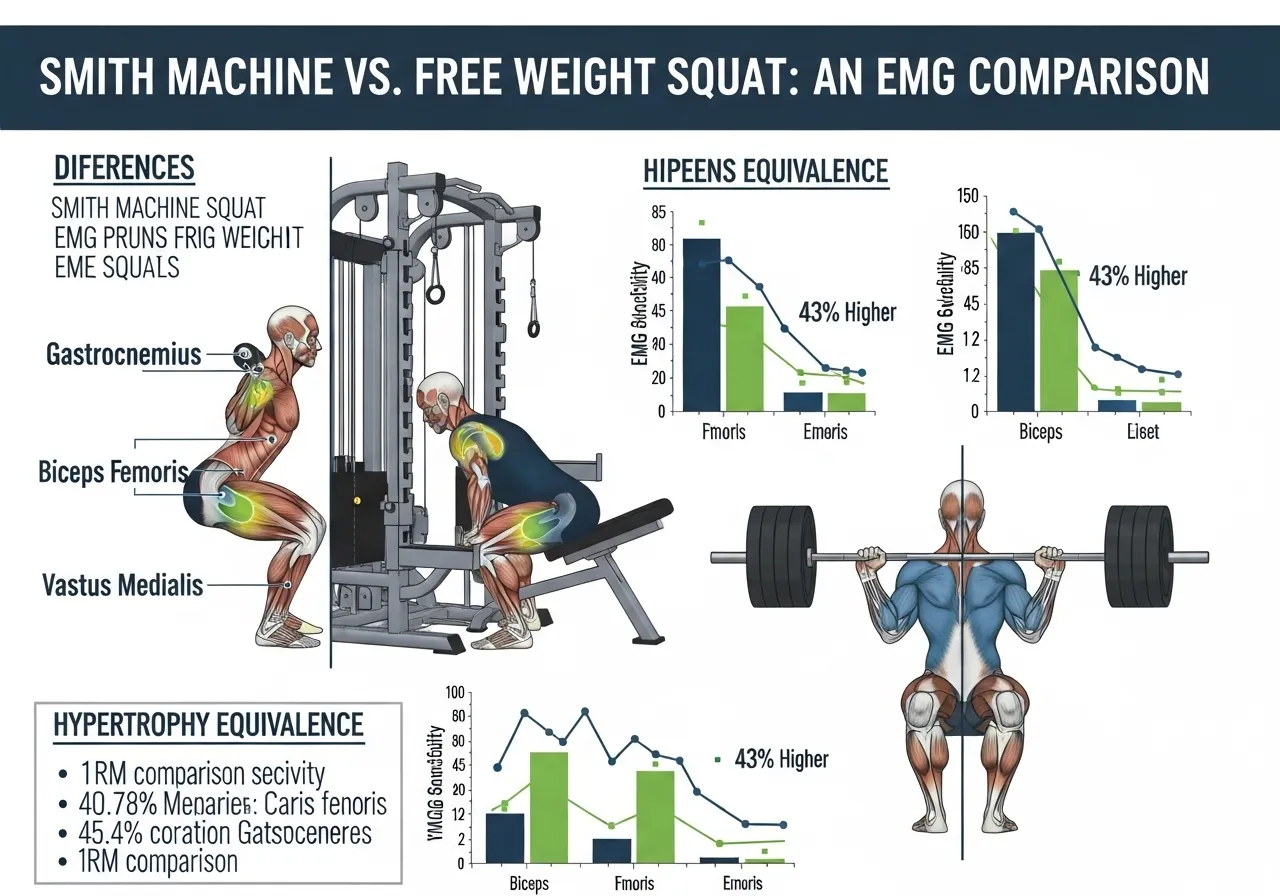
Free Weight back squat guide vs. Smith Machine Squat: The EMG Evidence
The 43% overall activation difference is substantial and reflects the stabilisation demand that the fixed track eliminates: the gastrocnemius and biceps femoris differences specifically reflect the reduced ankle and knee stabilisation requirements when the bar path is constrained to vertical movement rather than the natural arc of the free weight squat.
Free Weight vs. Machine: Long-Term Hypertrophy and Strength Outcomes
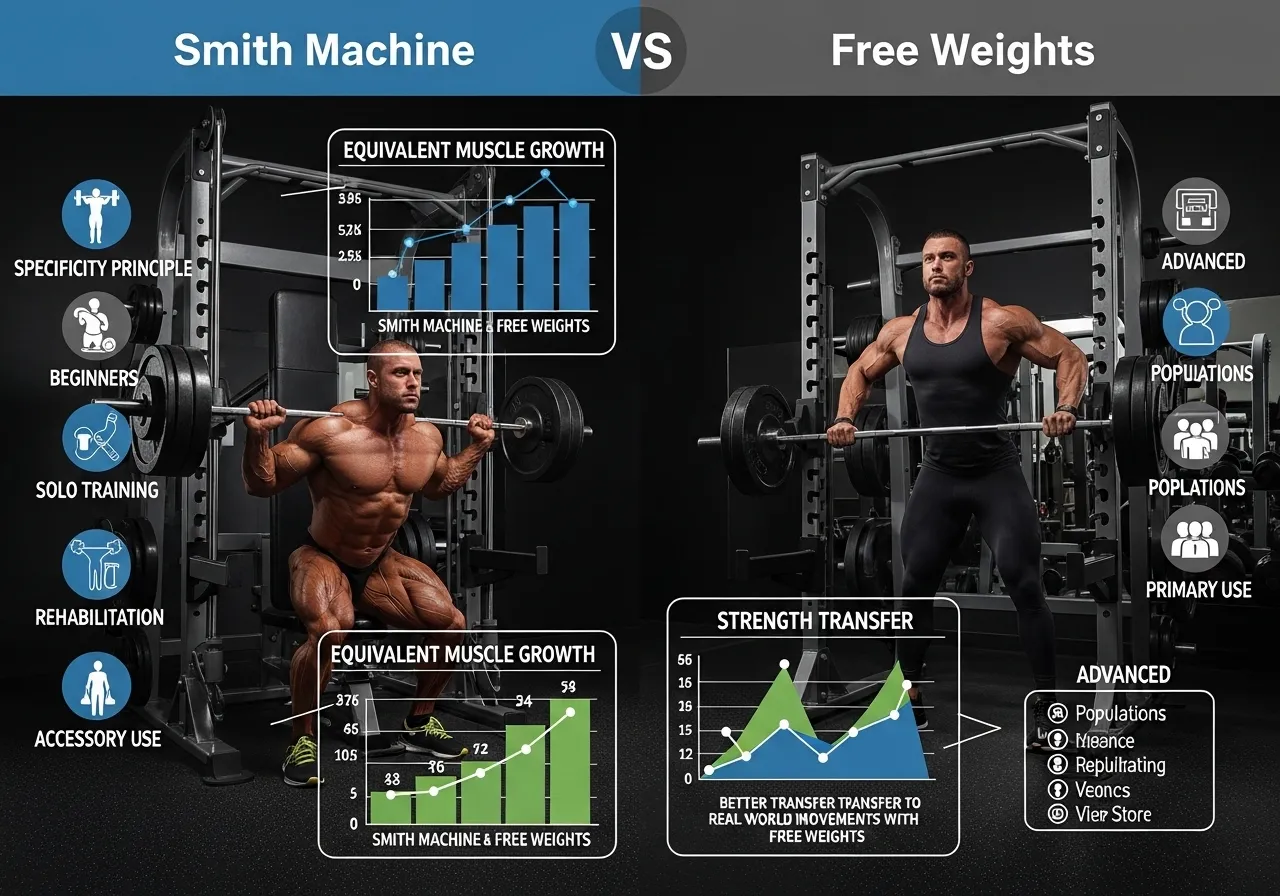
This finding is critically important for practical programming: while EMG studies show lower muscle activation during Smith machine exercises, the long-term hypertrophy and strength outcomes are equivalent when volume and effort are matched. The EMG difference at a single session level does not translate to meaningful differences in muscle growth over a training program.
1RM Differences Between Smith Machine and Free Weights
The practical implication of the squat 1RM difference: the vertical bar path of the Smith machine allows the centre of mass to be positioned differently than a free weight squat requires, enabling mechanically advantageous positions that allow greater absolute load but also change the muscle groups being primarily challenged.
The Fixed Bar Path: What It Changes and Why It Matters
The Smith machine’s defining feature — a bar constrained to move only vertically (or at a slight angle on some machines) — produces specific mechanical differences from free weight equivalents:
Variable
Free Weight
Smith Machine
Bar path
Natural arc following movement
Fixed vertical line
Stabiliser demand
High — all planes
Reduced — only in non-constrained planes
Absolute load capacity
Lower (for squat)
Higher (for squat)
Safety (no spotter)
Requires spotter or rack
Built-in safety catches
Foot position flexibility
Natural — any position
Can be placed forward of bar
Smith Machine Incline Press: A Legitimate Upper Chest Advantage
The Smith machine incline press provides specific advantages that make it a legitimate choice even for advanced trainees who prefer free weights for most training:
The incline bench press is the most effective upper pectoral exercise available, but managing a barbell on an incline bench simultaneously requires shoulder stabilisation, grip control, and balance demands that reduce the load that can be applied to the upper chest
The Smith machine eliminates the balance and stabilisation demands — allowing greater absolute loads to be used specifically for upper pectoral development at the incline angle
For trainees whose primary goal is upper pectoral hypertrophy and who train without a spotter, the Smith machine incline press allows heavier loading and closer approach to muscular failure than the free weight version safely permits
These load conversion equations have practical utility for gym members who encounter Smith machines or free weights inconsistently across facilities — allowing training load to be maintained with appropriate adjustment when equipment availability changes between sessions.
Smith Machine Squat: Technique, Foot Position, and When to Use It
Smith Machine Squat Technique
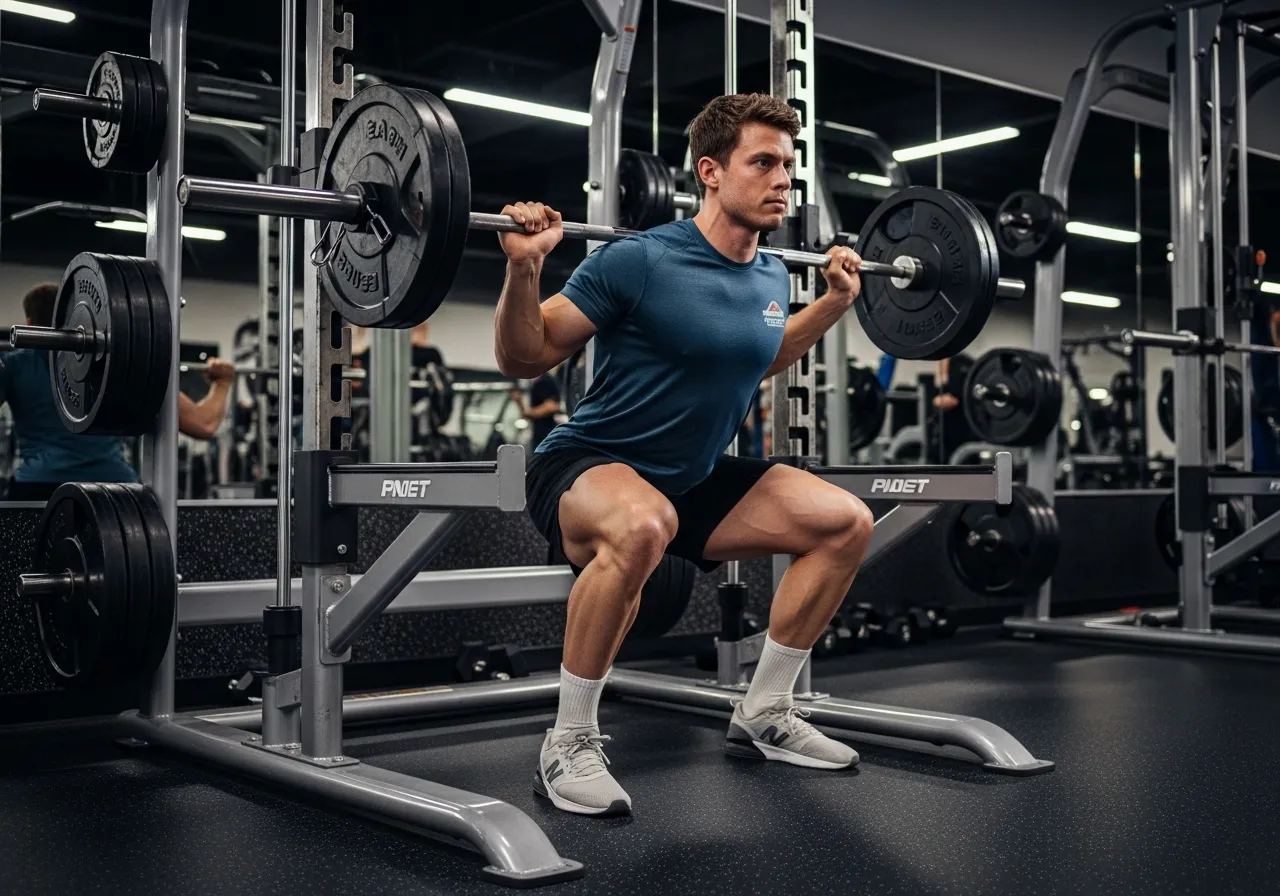
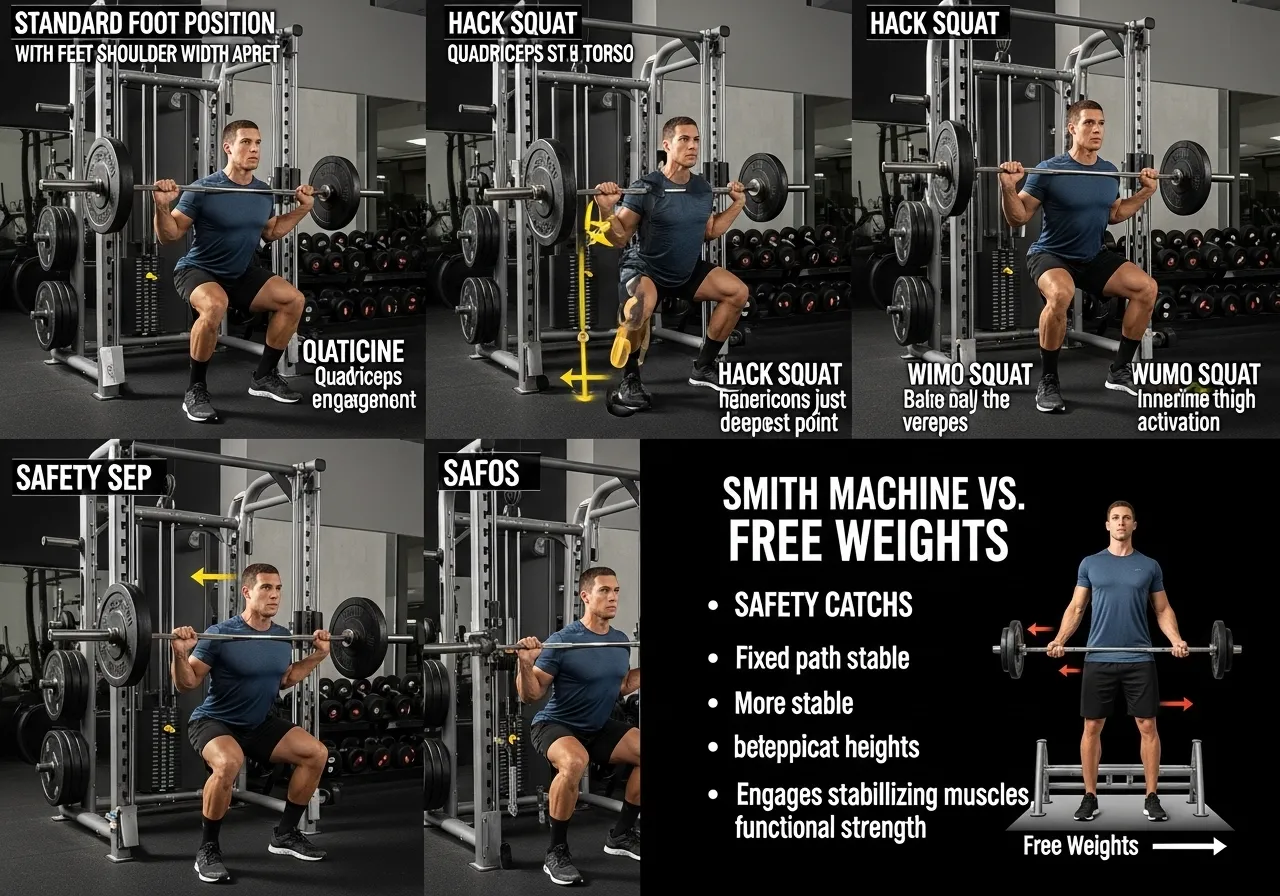
The Smith machine squat differs from the free weight squat in one critical respect that is routinely misunderstood: foot positioning. In a free weight squat, the feet must be positioned under the bar to keep the centre of mass balanced. In a Smith machine squat, the bar is mechanically supported and the feet can be moved forward of the bar — which dramatically changes the mechanics of the movement:
Standard (under-bar) position: Feet positioned similarly to a free weight squat — directly under the bar or slightly forward. Mimics free weight mechanics most closely; suitable for general strength development. Forward foot position: Feet placed 30–60 cm in front of the bar — the classic “Smith machine hack squat guide” position. The forward lean of the shin and the rearward lean of the body at the bottom position increases hip extension range, shifting emphasis toward the gluteus maximus and reducing knee flexion demand. This position is not possible with a free weight barbell. Wide stance: Similar to sumo deadlift stance — increases hip adductor and gluteus medius activation. The fixed bar provides the balance support that makes a wide-stance squat more accessible than the free weight equivalent for many individuals.
When to Choose the Smith Machine Squat Over Free Weights
Training alone without a spotter — the safety catches prevent a missed rep from becoming a safety incident
Technique development — the reduced stabilisation demand allows beginners to focus on depth, back angle, and knee tracking without simultaneously managing balance
Post-injury rehabilitation — controlled range of motion with safety catches allows progressive loading while specific healing constraints are respected
Specialised foot placement — the forward foot position unavailable with free weights can specifically target the gluteus maximus in ways free weight squats cannot replicate
High-volume training where fatigue would compromise free weight safety — late-session sets where balance may be compromised by cumulative fatigue
Programming Smith Machine Squat Variations by Goal
The foot position flexibility of the Smith machine squat makes it more versatile than it appears for targeting specific muscle groups:
Quadriceps emphasis: Standard foot position directly under or slightly forward of bar; moderate depth; high stroke rate. The vertical bar path of the Smith machine allows higher quad loading at this position than free weight mechanics permit for many body proportions.
Glute emphasis: Forward foot position (30–50 cm ahead of bar), deep descent. The posterior hip position and greater hip extension range produced by forward placement shifts emphasis dramatically toward the gluteus maximus — the exercise approaches a leg press-squat hybrid in its stimulus.
Adductor emphasis: Wide stance, toes 45° outward. The medial hip muscles work harder in this position, particularly at the bottom of the movement where hip abduction is greatest.
Understanding these three distinct quad, glute, and adductor emphases from the same machine allows a complete lower body specialisation program to be built around Smith machine squat variations without requiring any other equipment except the Smith machine and adjustable bench.
Smith Machine Bench Press: Technique and Comparison to Free Weights
Smith Machine Bench Press Technique
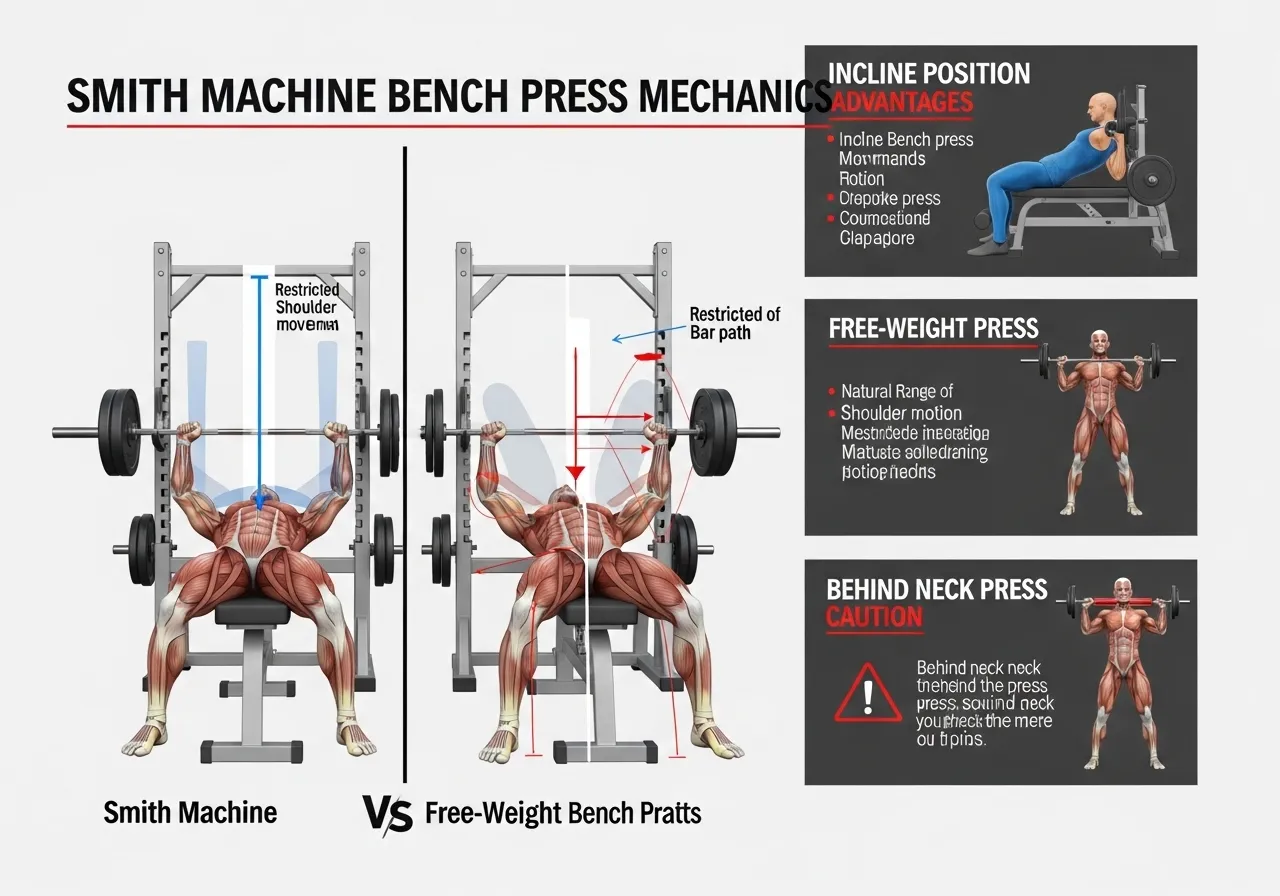
The Smith machine bench press produces a different upper body loading pattern than the free weight bench press for a different reason than the squat comparison — the bar path constraint affects the shoulder mechanics specifically:
The free weight bench press bar naturally moves in a slight arc during the press — moving toward the lifter’s chin at the top and toward the mid-chest at the bottom. This arc reflects the natural shoulder movement pattern during pressing.
The Smith machine forces the bar to travel vertically — a path that places the shoulder in a compromised position at the bottom of the press for many individuals with standard proportions. This is why Smith machine bench press 1RM tends to be lower than free weight bench press 1RM despite higher stability — the forced vertical path may actually be mechanically disadvantageous for the shoulder joint.
The adjustable incline position benefits disproportionately from the Smith machine — incline Smith machine pressing allows more precise upper pectoral targeting without the wrist and balance demands of the free weight incline barbell press.
Smith Machine Behind-the-Neck Press: Caution Required
The Smith machine behind-the-neck press — performing an overhead press with the bar traveling behind the head — is an exercise that carries genuinely elevated injury risk that the safety features of the Smith machine do not mitigate:
The forced vertical bar path of the Smith machine requires extreme cervical (neck) flexion to bring the bar behind the head — loading the cervical spine in a position that places the cervical facet joints and nerve roots at risk
The shoulder’s impingement zone is exacerbated by the behind-neck position — the humeral head impinges on the acromion in this position, particularly under loaded and repetitive conditions
The same deltoid and trapezius development that behind-neck pressing provides is achievable from the front (behind-neck’s safer alternative) without these specific risks — making it an exercise where the Smith machine’s safety features provide false reassurance
Smith Machine Romanian Deadlift: An Underutilised Application
The Smith machine Romanian deadlift is one of the most underutilised applications of the Smith machine — providing a hamstring training stimulus that the standard Smith machine squat and bench press cannot address:
Setting the bar at mid-thigh height and performing a hip hinge descent to mid-shin level — the standard RDL movement — works identically on the Smith machine as with a free barbell, but with the safety catch available if the lower back fatigues unexpectedly
Single-leg Romanian deadlifts on the Smith machine provide the balance support that makes single-leg loading accessible to individuals who cannot maintain balance on the free weight version — allowing the progressive loading that develops hamstring strength asymmetry correction
The Smith machine’s fixed vertical path is actually more limiting in the RDL than in the squat — the bar must travel straight down, while the natural RDL bar path follows the legs. Positioning the bar slightly forward of the hips addresses this limitation for most individuals.
The Smith machine also allows partial range of motion training — performing quarter squats or lockout-only pressing movements that overload specific portions of the range — as an advanced technique for addressing sticking points or developing maximum tension in the terminal range of specific movements.
Is the Smith Machine Good for Building Muscle?
Hypertrophy Evidence: What the Research Confirms
The research consistently confirms that the Smith machine builds muscle as effectively as free weight equivalents when volume and effort are matched. This finding holds across multiple studies examining different muscle groups and exercise types:
Quadriceps cross-sectional area increases are comparable between Smith machine squats and free weight squats in 8-week training studies
Pectoral hypertrophy from Smith machine bench press matches free weight bench press outcomes when rep ranges and training volume are equivalent
The lower stabiliser activation of Smith machine exercises may actually be advantageous in certain hypertrophy-focused programming — allowing higher primary muscle activation at the target muscle by reducing the fatigue that stabiliser engagement introduces
The Specificity Principle: Where It Matters
The one domain where the Smith machine’s limitations are genuinely meaningful is specificity of strength adaptation — the principle that strength gains are specific to the movement pattern trained:
Strength developed on the Smith machine squat transfers well to the Smith machine squat — but transfers less completely to the free weight squat than free weight squat training itself would
For athletes who need to perform free weight movements in sport or competition, Smith machine training alone does not fully develop the stabilisation patterns that free weight lifting requires
For general fitness goals, body composition, and recreational strength — where the specific strength transfer is not tested in competition or sport — this distinction is not practically relevant
The Smith Machine for Specific Populations
Several populations particularly benefit from Smith machine training:
Beginners: Learning squat and press mechanics with reduced stabilisation demand and built-in safety features builds movement patterns and confidence before transitioning to free weights
Solo trainees: The safety catches allow true maximal effort sets without a spotter — enabling training to failure safely on heavy compound movements
Rehabilitation clients: Controlled range of motion and adjustable safety catch height allows precise loading within physiotherapy-prescribed parameters
Advanced trainees for accessory work: Smith machine incline press, Smith machine split squat, and Smith machine Romanian deadlift provide stable platforms for high-volume accessory work when the goal is maximising primary muscle fatigue rather than developing free weight technique
The Smith Machine for Overhead Pressing: A Contested Application
The overhead press (barbell pressed from shoulder level to overhead) is one of the Smith machine applications with the most variable outcomes — ranging from genuinely useful to actively problematic depending on the individual’s shoulder anatomy and mobility:
Individuals who lack thoracic mobility may benefit from Smith machine overhead pressing — the fixed bar path eliminates the need for the overhead balance that a stiff thoracic spine may not support with a free barbell
Individuals with flexible shoulders and good overhead mechanics may find that the forced vertical path of the Smith machine creates unnatural impingement that the naturally-arcing free weight overhead press avoids
A practical test: if Smith machine overhead press produces anterior shoulder pain that free weight overhead press does not, the forced bar path is incompatible with your shoulder mechanics — switch to dumbbells or cables for overhead pressing work
These additional Smith machine applications — hip thrust, calf raise, inverted row, and calf raise — demonstrate that dismissing the machine as limited to a small number of exercises significantly underestimates its versatility as a resistance training platform, particularly in space-constrained gym environments where a single Smith machine can replace several specialised machines.
8-Week Smith Machine Program
Program Design
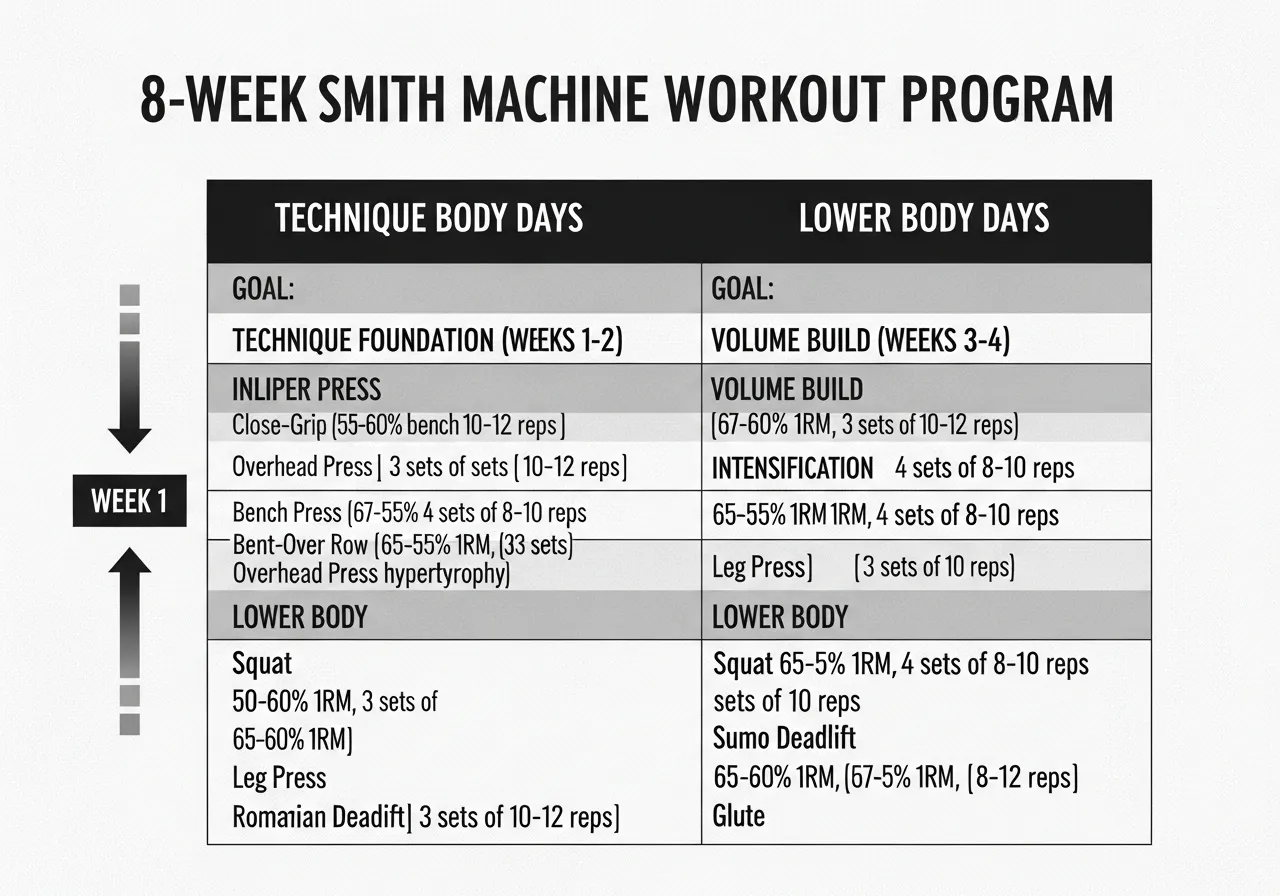
Four sessions per week in an upper/lower split. Each session emphasises one Smith machine compound movement as the primary exercise, supported by cable and dumbbell accessory work. The program is appropriate for beginners and intermediates training alone or preferring the safety features of the Smith machine.
Phase 1 — Weeks 1–2 (Technique Foundation): Session A (Lower Body):
Smith machine squat: 4 × 10 @ 60–65% (technique priority)
Smith machine Romanian deadlift: 3 × 12
Leg press: 3 × 12
Lying leg curl: 3 × 12
Session B (Upper Body):
Smith machine bench press: 4 × 10 @ 60–65%
Smith machine incline press: 3 × 12
Lat pulldown: 4 × 10
Face pull: 3 × 15
Phase 2 — Weeks 3–4 (Volume Build): Session A:
Smith machine squat (forward foot): 4 × 10 @ 67%
Smith machine hip thrust: 4 × 12
Walking lunges: 3 × 10 each side
Seated leg curl: 3 × 12
Phase 3 — Weeks 5–6 (Intensification): Session A:
Smith machine squat: 4 × 6 @ 77%
Smith machine sumo squat: 3 × 10
Romanian deadlift (free weight or Smith): 4 × 8
Leg extension: 3 × 12
Session B:
Smith machine bench press: 4 × 6 @ 78%
Smith machine overhead press: 4 × 8
Barbell row: 4 × 8
Cable face pull: 3 × 15
Phase 4 — Weeks 7–8 (Peak): Session A:
Smith machine squat: Work up to top set 4 @ 83%; back-off 2 × 8
Smith machine forward squat: 3 × 8
Hip thrust: 4 × 10
Session B:
Smith machine bench press: Work to top set 4 @ 83%; back-off 2 × 8
Smith machine incline press: 4 × 8
Lat pulldown + cable row superset: 4 × 10 each
Transitioning From Smith Machine to Free Weights
Trainees who have built their foundation on the Smith machine and wish to transition to free weights should expect a specific adaptation period:
Initial free weight loads will be meaningfully lower than Smith machine loads on the same exercises — particularly for the squat, where the fixed path advantage is largest. Expecting to squat significantly less with a free barbell than on the Smith machine is normal and not indicative of weakness.
The stabilisation muscles that the Smith machine underloads — gastrocnemius, biceps femoris, and core rotational muscles particularly — will fatigue quickly in the initial free weight sessions before they adapt to the new demand
A gradual transition — reducing Smith machine session frequency while adding free weight sessions at lighter loads — allows the stabilisation systems to adapt progressively without the movement quality breakdown that rapid full transitions often produce
8–12 weeks of consistent free weight training is typically sufficient for the stabilisation adaptations to bring performance to the level that the underlying strength from Smith machine training would predict
Tracking performance improvements across phases — noting the load used for each set each session — provides the objective progression record that confirms whether the program is driving meaningful adaptation and where load increases are appropriate for the following week.
Smith Machine Safety Features and Common Setup Errors
The Safety Catch System
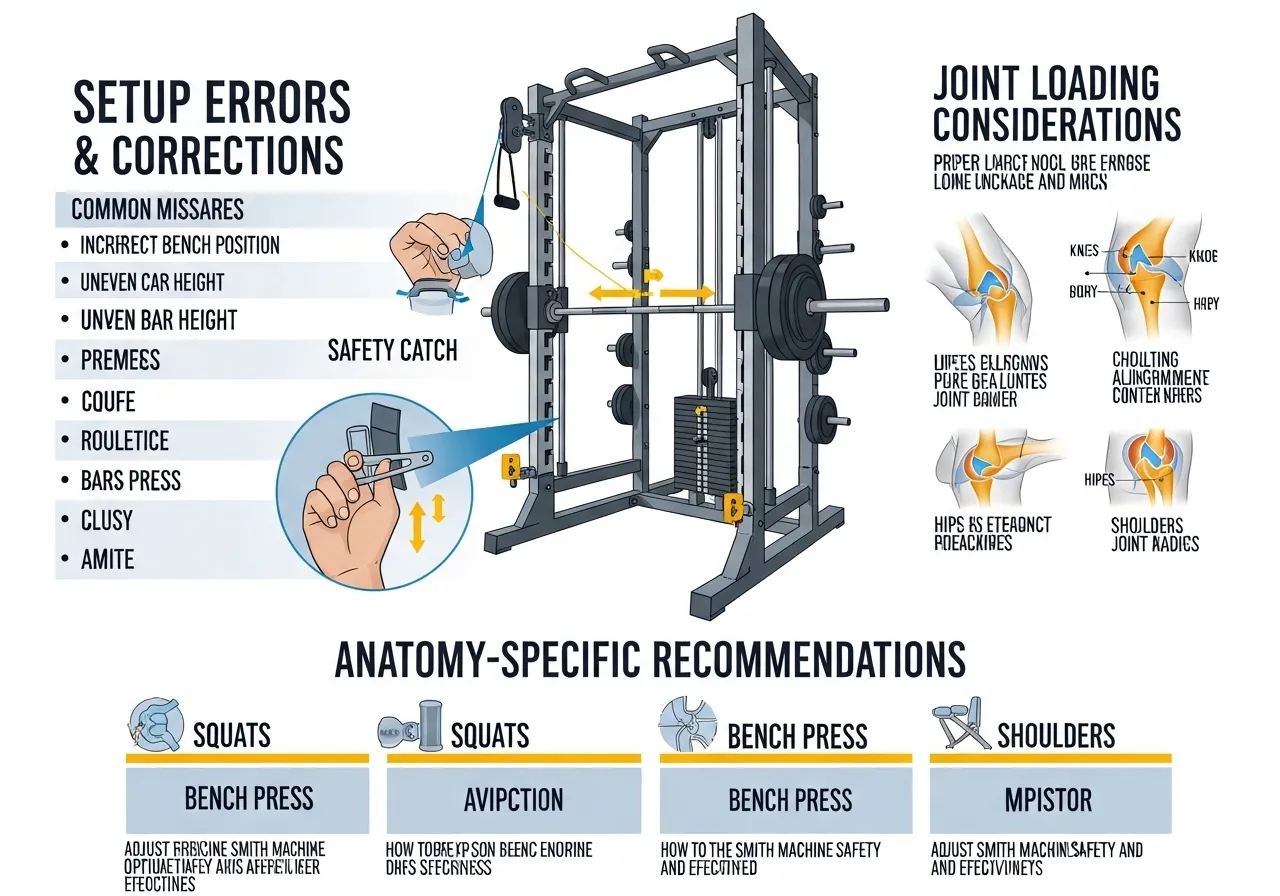
The Smith machine’s built-in safety catches (J-hooks or rotating latches) are the machine’s primary safety advantage over a free barbell:
The catch mechanism allows training to failure safely without a spotter — rotating the bar at any point engages the hooks, securing the weight immediately
The correct engagement technique is essential: a small wrist rotation forward catches the bar. Practicing this motion with no weight until it becomes automatic is the essential Smith machine safety skill
Safety catch height should be set before each exercise — for squats, at approximately the bottom position height; for bench press, at a height that allows safe catch above the chest
Smith Machine Hip Thrust: The Most Practical Application
The Smith machine hip thrust — performing the glute-focused hip thrust with the bar resting across the hips while the upper back is supported on a bench — is one of the most practical Smith machine applications for an unexpected reason: the safety catches eliminate the need to roll a loaded barbell into position, which is the most awkward and injury-prone aspect of the barbell hip thrust setup.
Setting the bar at the height corresponding to the hip thrust starting position and walking in under it eliminates the floor rolling setup that discourages heavy hip thrust training
The catch mechanism allows the bar to be secured at any point — avoiding the trapped-under-a-barbell scenario that heavy hip thrust reps occasionally create when form breaks down at the end of a set
The vertical bar path of the Smith machine is actually well-matched to the hip thrust movement — the hip extension at the top produces primarily vertical movement, making the fixed track less constraining than in squats where the natural bar path is arced
Smith Machine Calf Raise: Isolation with Loading Advantages
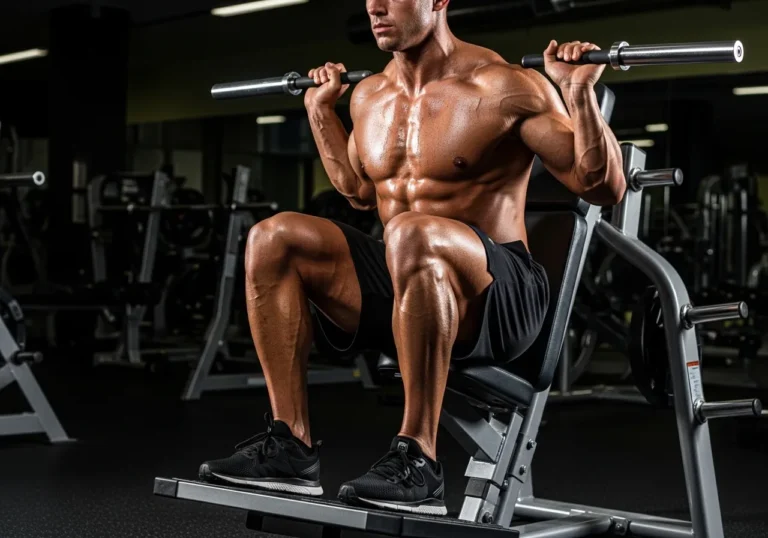
The standing Smith machine calf raise — feet on a raised platform, bar across the upper back, rising onto the toes — is a highly effective calf training method that the Smith machine facilitates particularly well:
The supported position allows maximal loading of the gastrocnemius and soleus without the balance and core demands of a standing dumbbell calf raise
The fixed vertical path of the bar is ideal for this movement — the calf raise does involve primarily vertical force production, making the fixed track non-limiting
Single-leg Smith machine calf raises provide the unilateral loading that identifies and addresses left-right calf strength asymmetries — particularly relevant for runners and jumpers where calf strength imbalances contribute to injury risk
Programming the Smith Machine for Callisthenics and Bodyweight Training
An underutilised feature of the Smith machine is its versatility for bodyweight and assisted exercises:
Inverted rows (setting the bar at waist height and rowing with the body hanging beneath it) uses the Smith machine as a fixed, adjustable-height pull-up bar alternative
The bar height can be precisely adjusted for progressive inverted row difficulty — moving the bar lower increases the body angle and the percentage of bodyweight lifted
Pike push-ups with feet on the floor and hands on the bar provide an assisted overhead pressing movement useful for beginners developing shoulder press strength
Smith Machine FAQ
Can I build real strength on the Smith machine?
Yes — the research consistently shows that Smith machine training produces strength and hypertrophy outcomes comparable to free weight training at matched volume. The strength developed is genuine and will be reflected in improved performance on Smith machine movements and, to a meaningful degree, in free weight equivalents — though the transfer from machine to free weight is less complete than free weight to free weight.
If the goal is to get stronger, build muscle, and improve body composition — and not to specifically prepare for powerlifting competition or functional sport performance — the Smith machine is a completely legitimate tool that produces the desired outcomes.
Should beginners start with the Smith machine or free weights?
Both have genuine advantages as starting points. The Smith machine’s reduced stabilisation demand and safety catches allow beginners to focus on primary movement mechanics without simultaneously managing balance — potentially accelerating initial learning of squat and press movement patterns.
The counterargument is that learning to stabilise free weights from the beginning builds the neuromuscular foundation that will be needed anyway, and that developing the stabilisation demand later after the primary pattern is learned requires re-learning rather than building sequentially. Most coaches recommend beginning with both simultaneously — Smith machine for learning primary movement mechanics and loading early in the program, alongside free weight variations at lighter loads to develop the complete movement pattern.
Is the Smith machine bad for your joints?
The Smith machine’s fixed bar path creates different joint loading than free weights — not categorically better or worse, but different. For some movements (Smith machine squat with forward foot placement), the joint angles are actually more comfortable than free weight equivalents for people with limited ankle mobility. For others (Smith machine behind-the-neck press), the forced vertical path creates problematic shoulder and cervical mechanics.
The best guidance: if a Smith machine exercise causes joint discomfort that the free weight equivalent does not, the fixed bar path may be creating a loading pattern that doesn’t match your anatomy. Modify the exercise (adjust foot position, hand position, or bench angle), change to a free weight alternative, or seek assessment from a qualified coach or physiotherapist.
✅ Key Takeaways
Free weight squat produces 43% higher overall EMG activation than Smith machine squat — but long-term hypertrophy outcomes are equivalent when volume and effort are matched
Smith machine squat 1RM is typically higher than free weight squat (especially for women) — the fixed bar path allows mechanically advantageous positioning
Free weight bench press 1RM is typically higher than Smith machine bench press — the forced vertical bar path is mechanically less natural for the shoulder during pressing
The Smith machine’s primary advantages are solo training safety, technique development support, and specific foot position variations unavailable with free weights
For general fitness and hypertrophy goals, free-weight and machine-based training produce equivalent outcomes — choose based on goals, experience, and available supervision
Which exercises on the Smith machine are actually better than free weights?
Several Smith machine exercises genuinely outperform their free weight equivalents for specific goals:
Forward-foot Smith machine squat: The glute-dominant forward foot position is not achievable with a free weight barbell — this variation targets the gluteus maximus specifically in a way that free weights cannot replicate
Smith machine hip thrust: The safety catch setup eliminates the floor-rolling problem that discourages heavy hip thrust training — making it practically superior for heavy hip thrust loading compared to setting up with a free barbell
Smith machine incline press (solo): Without a spotter, the Smith machine allows training to failure on the incline press safely — free weight incline pressing to failure without a spotter is generally inadvisable
Smith machine calf raise: The supported position allows loading beyond what standing dumbbell calf raises can accommodate, without the balance limitation that reduces the quality of unassisted standing calf raise loading
Recognising these genuinely superior applications — rather than treating the Smith machine as uniformly inferior to free weights — allows trainees to integrate it strategically for maximal programming effectiveness.
The barbell row is the standard back thickness exercise. It allows heavy loading, trains the entire posterior chain, and has decades of proven effectiveness. Most serious lifters include it and most serious lifters plateau with it eventually. The plateau often has a simple mechanical explanation: the pronated (overhand) grip and horizontal torso position of the…
The dumbbell shoulder press EMG Debate: Why Both Tools Have a Place in Your Training The dumbbell shoulder press versus barbell overhead press guide debate has persisted in training communities for decades, with advocates on each side claiming superiority for their preferred implement. The reality is more nuanced and more practically useful: the two variations…
⚠️ Health & Fitness DisclaimerThis article is for general educational and informational purposes only.It does not replace professional medical or fitness advice.If you have any pre-existing condition, injury, or shoulder concern — please consult a qualified healthcare professional or certified personal trainer before starting or modifying any exercise program. The lat pulldown mastery guide is…
Bent-over rows are one of the best back exercises in existence. They are also one of the most commonly cheated exercises in existence. Watch the average trainee perform a set of heavy bent-over rows. The torso rises with each rep. The legs drive at the bottom. The lower back extends to swing the weight through…
The Hack Squat: Why This Machine Deserves a Primary Place in Leg Training The hack squat machine sits in the corner of most gyms, largely ignored by serious lifters who dismiss machine exercises as inferior to free weights and embraced primarily by beginners who haven’t yet learned to squat. This dismissal is a training error…
⚠️ Health & Fitness DisclaimerThis article is for general educational and informational purposes only.It does not replace professional medical or fitness advice.If you have any pre-existing knee, hip, or lower back condition — please consult a qualified healthcare professional or certified personal trainer before starting or modifying any resistance training program. The leg press guide…