⚠️ Health & Fitness Disclaimer This article is for general educational purposes only and does not replace professional medical advice. If you have any elbow, shoulder, or wrist conditions, please consult a qualified healthcare professional before beginning any tricep training programme.
The triceps brachii makes up roughly two-thirds of upper arm mass — yet most trainees dedicate three times as much attention to bicep curl guide training.
Worse, the tricep work that does happen is almost always the same two exercises: rope pushdowns and the occasional skull crusher. Both are solid — but neither comes close to maximising the stimulus for the muscle that dominates arm development.
This guide covers the anatomy, the EMG research on which exercises actually work, the critical role of shoulder position in long head activation, and an 8-week programme built around the science.
The Pushdown Myth: Why Your Most-Used Tricep Exercise Is Your Least Effective One
The cable pushdown is the default tricep exercise in most gyms — approachable, low-skill, and reliably felt in the tricep. These are real virtues. But the pushdown has a structural limitation that limits its value as a primary tricep builder.
Because the pushdown is performed with the arm at the side and the shoulder at roughly 0° of flexion, the long head of the triceps — the largest of the three heads, making up the majority of upper arm thickness — is never fully stretched during the movement.
The long head crosses the shoulder joint (technically a biarticular muscle — a muscle that crosses two joints rather than one). When the arm is at the side, the long head starts in a shortened position. A muscle that starts shortened cannot reach its maximum stretch-loaded stimulus during the exercise.
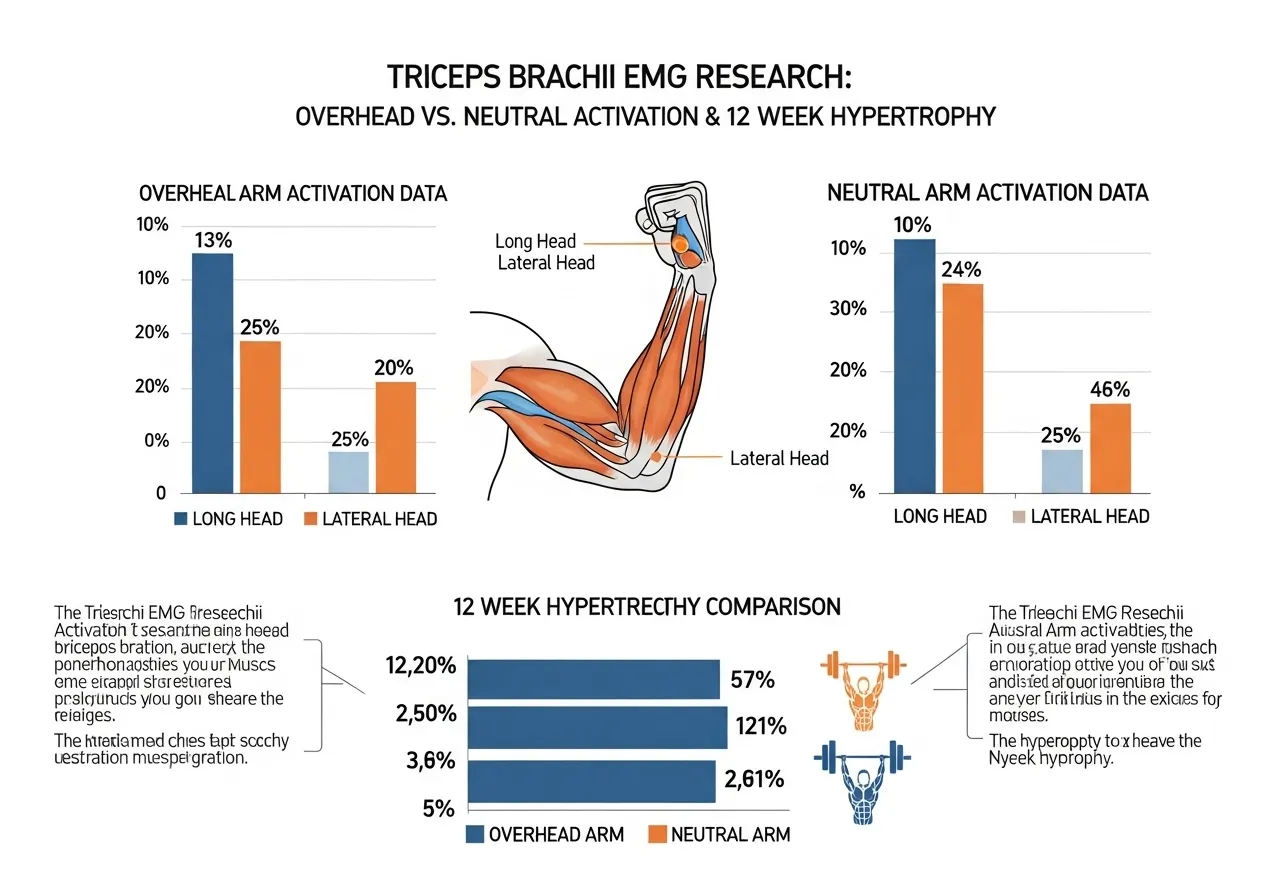
The Research Comparison: Overhead vs Neutral Position
📌 Key Finding Overhead position = long head emphasis. Neutral arm position = lateral head emphasis. Neither exercise is superior in isolation — but most trainees default to neutral-arm variations and chronically undertrain the long head.
📌 Key Finding
After 12 weeks, the overhead group grew significantly more tricep mass — driven entirely by long head hypertrophy. The lateral and medial heads grew equally in both groups.
The Practical Implication
If your programme contains only pushdowns and close-grip bench pressbench press guide, you are systemically undertreating the largest component of your triceps.
Adding one overhead tricep exercise per session — overhead extension, incline skull crusher, or overhead cable extension — directly addresses the long head gap that most programmes leave unfilled.
Triceps Brachii Anatomy: Why Three Heads Need Three Different Stimuli
The Three Heads and What They Each Do
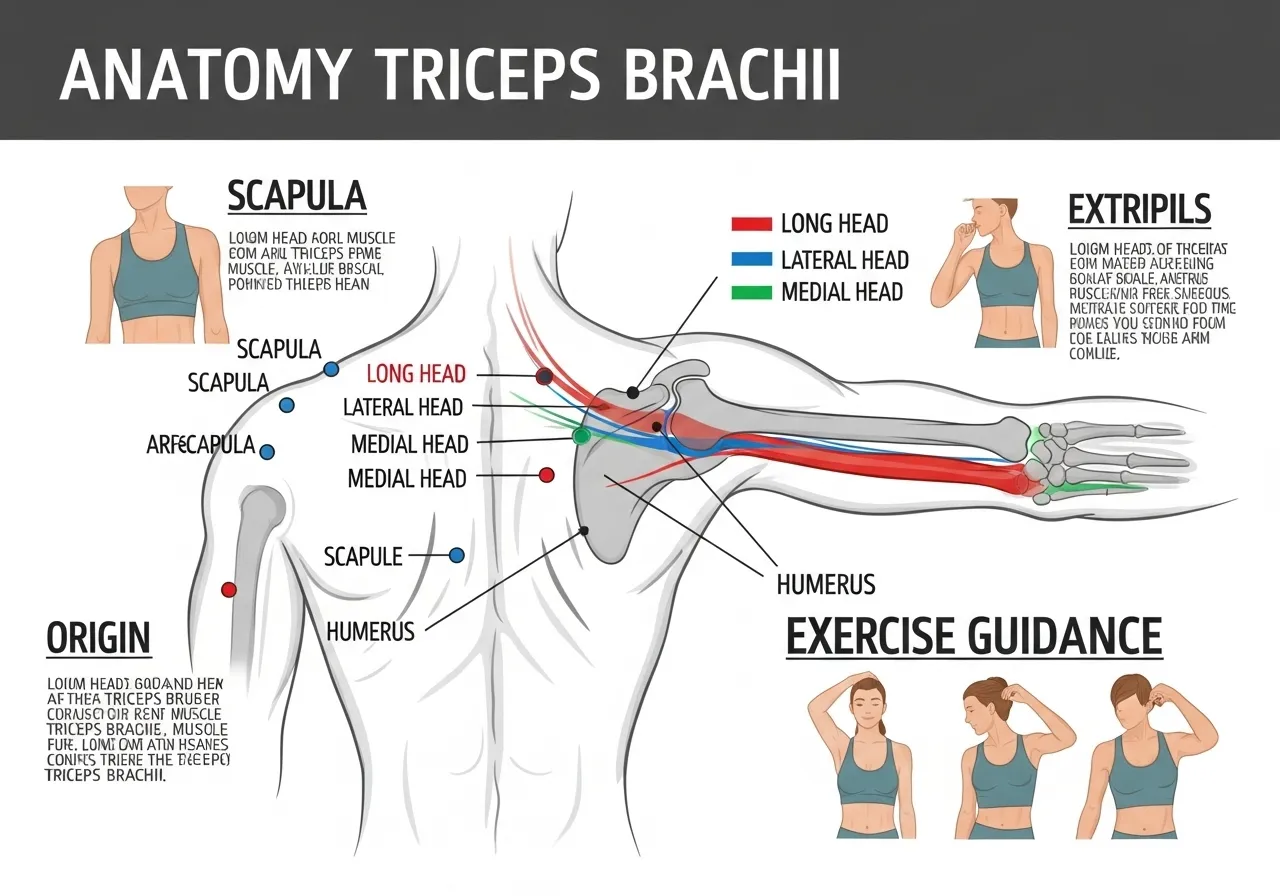
The triceps brachii (Latin: “three-headed muscle of the arm”) consists of three distinct portions that share the same distal tendon but originate from different locations:
Head
Origin
Joint Crossed
Visual Impact
Best Stimulus
Long head
Infraglenoid tubercle (scapula)
Shoulder + elbow
Inner arm thickness
Overhead position
Lateral head
Posterior humerus (upper)
Elbow only
Outer arm horseshoe shape
Neutral arm, pushdowns
Medial head
Posterior humerus (lower)
Elbow only
Deep base, not visible
Active in all elbow extension
Why the Long Head Matters Most for Size
The long head is the largest of the three heads by muscle volume — it accounts for approximately 55–60% of total tricep mass.
Because it originates from the scapula and crosses the shoulder joint, the long head’s length changes with arm position. With the arm overhead, the long head is stretched. With the arm at the side, it is shortened.
This length-tension relationship (the principle that a muscle produces greater hypertrophic stimulus when trained at a longer length) means overhead exercises are mechanically superior for long head development — exactly what the 12-week hypertrophy trial confirms.
Why the Lateral Head Still Matters
The lateral head creates the horseshoe shape (the characteristic U-shaped definition visible on the outside of the upper arm when the elbow is extended) that most trainees associate with impressive tricep development from the front view.
Pushdowns, close-grip bench press, and dips all preferentially activate the lateral head. These exercises remain essential — a programme focused only on overhead long head work would develop inner thickness without the visible outer definition.
The Medial Head: The Workhorse Nobody Trains for Directly
The medial head is active in virtually all elbow extension movements and functions as the primary stabiliser of the elbow joint. It rarely needs direct targeted work — its consistent activation across all tricep exercises provides sufficient stimulus.
The practical takeaway: programme overhead work for the long head, pushdown/compound work for the lateral head, and allow the medial head to develop through accumulated volume from both categories.
The Elbow Joint: Why Tricep Health Matters Beyond Aesthetics
The triceps brachii is the primary elbow extensor — the muscle that straightens the arm from a bent position. It produces force during every pushing movement in daily life: rising from a chair, pushing open a door, placing objects on a high shelf.
Strong triceps stabilise the elbow joint under load, protecting the joint during heavy pressing. Trainees who bench press heavily with underdeveloped triceps often find the triceps — not the chest — becomes the limiting factor first, and that elbow discomfort during heavy sets resolves as direct tricep strength improves.
Triceps and Overhead Pressing Performance
The overhead press guide depends on tricep strength at the top lockout range — the final 30–40° of elbow extension that completes the press. Many trainees stall their overhead press not from deltoid weakness but from tricep insufficiency at full extension.
Targeting the triceps with overhead extensions and skull crushers directly strengthens this lockout range. Most stuck overhead press plateaus respond to 4–6 weeks of added direct tricep volume — without any change to the press itself.
Does Grip and Elbow Position Really Change Which Head You Target?
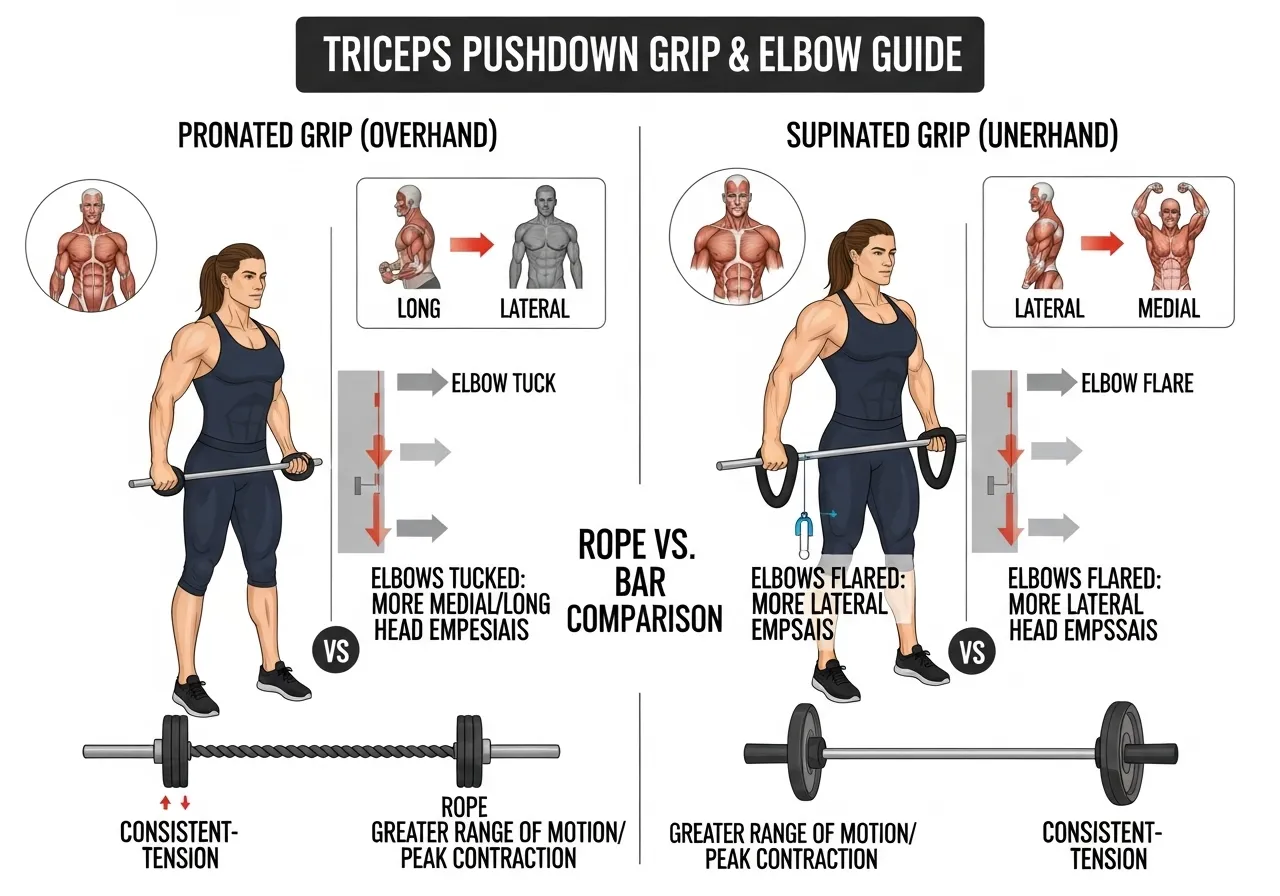
Rope vs Bar Pushdown: Does Grip Attachment Matter?
A common gym debate: is the rope pushdown superior to the bar pushdown for tricep activation?
The practical difference comes from end-range mechanics. The rope allows the hands to separate at the bottom of the movement, creating a brief moment of additional tricep contraction as the forearms externally rotate. This is a genuine mechanical advantage — but the effect is modest and primarily affects the lateral head.
📌 Key Finding Pronated grip (overhand) = lateral head emphasis. Supinated grip (underhand) = long head shift. Reversing grip on the pushdown is a simple way to vary head emphasis without changing exercise.
Elbow Flare vs Elbow Tuck During Pressing
During close-grip bench press and dips, elbow position significantly influences whether the movement emphasises the triceps or shifts load onto the chest and anterior deltoid:
Elbows tucked tight to the body (30–45° from torso): Maximises tricep contribution; minimises pectoral involvement — the preferred position for tricep-focused pressing
Elbows flared wide (75–90° from torso): Shifts emphasis toward the pectorals and anterior deltoid; reduces tricep contribution — appropriate for chest-focused pressing
Moderate flare (45–60°): The most common default position — provides a compromise between chest and tricep activation; appropriate when neither muscle is the exclusive target
Does Tricep Training Order Matter?
Programming sequence within a session affects which exercises get the best quality stimulus.
If tricep hypertrophy is the primary goal, begin with overhead extensions (long head targeted, requires the most focused attention) before moving to lateral head work (pushdowns, close-grip bench). If pressing strength is the primary goal, reverse the order — compound presses first, isolation work after.
Performing pushdowns to pre-fatigue before overhead work is a valid strategy for trainees who find the overhead position difficult to feel — but it reduces the load available for the overhead exercise, which may limit long head hypertrophy stimulus if taken too far.
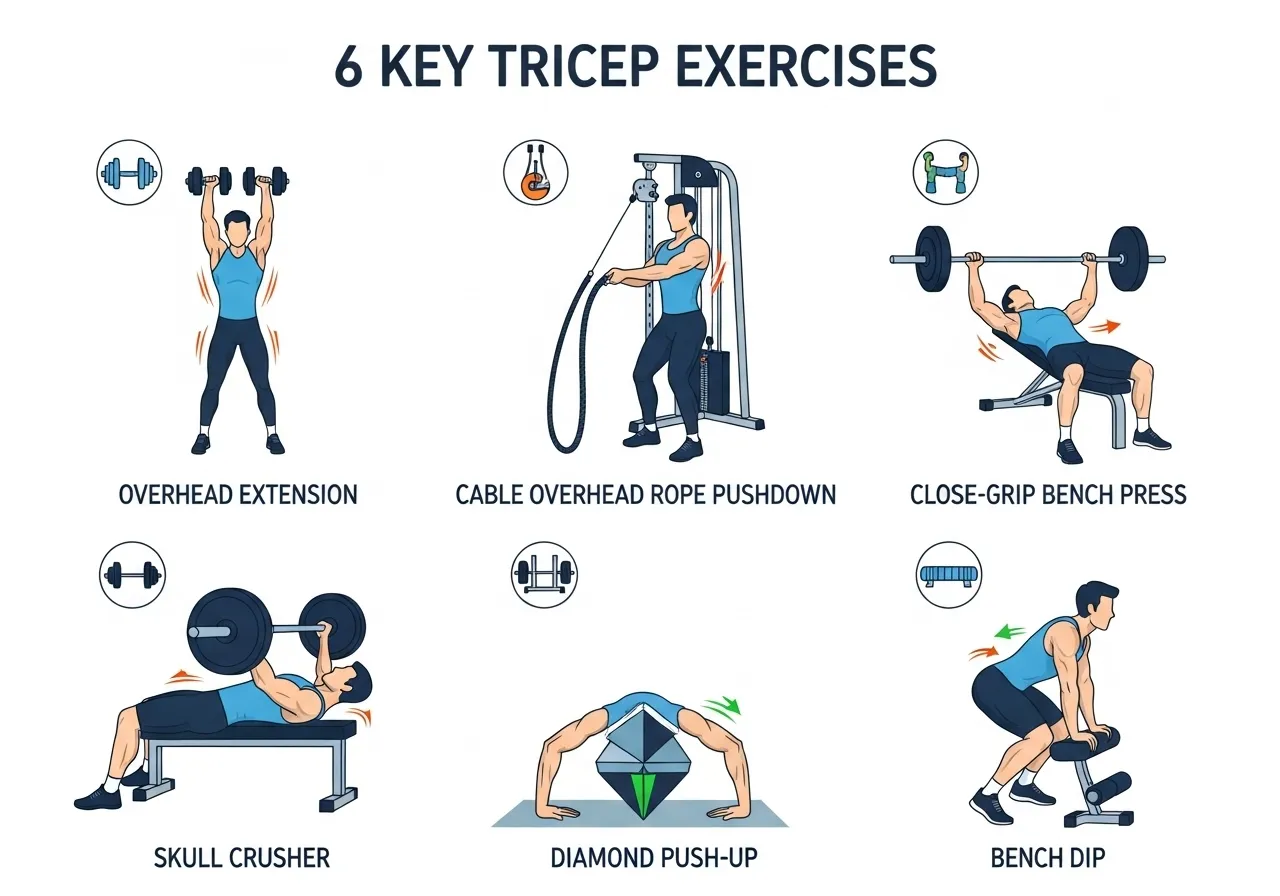
6 Key Tricep Exercises: Technique and Targeting Notes
🏋️ 1. Overhead Dumbbell Extension (Long Head Primary)
Target: Long head (stretched position), medial head secondary
How: Hold one dumbbell with both hands overhead. Lower behind the head by bending at the elbows — upper arms stay vertical throughout. Extend back to full lockout. Keep elbows pointing forward, not flaring outward.
Key point: The upper arm must stay vertical — allowing it to drift forward converts this into a partial stretch and eliminates the long head length advantage
🏋️ 2. Cable Overhead Tricep Extension (Long Head Primary)
Target: Long head (constant cable tension at stretch), medial head
How: Set a cable pulley to the lowest position. Face away, hold the rope overhead with elbows bent. Extend to full lockout while keeping upper arms vertical. The cable provides constant tension — including at the lengthened position where dumbbells lose resistance.
Key point: Superior to the dumbbell version for long head stimulus because cable tension remains high at the fully stretched position — where dumbbell resistance drops near zero
🏋️ 3. Rope Pushdown (Lateral Head Primary)
Target: Lateral head, medial head secondary
How: Set the cable to the highest position. Grip the rope with a pronated (overhand) grip, elbows tight to the sides. Push down to full elbow extension, spreading the rope ends apart at the bottom. Slowly return to starting position.
Key point: Keep elbows locked at the sides throughout — allowing them to move backward turns this into a pressing movement and reduces lateral head isolation
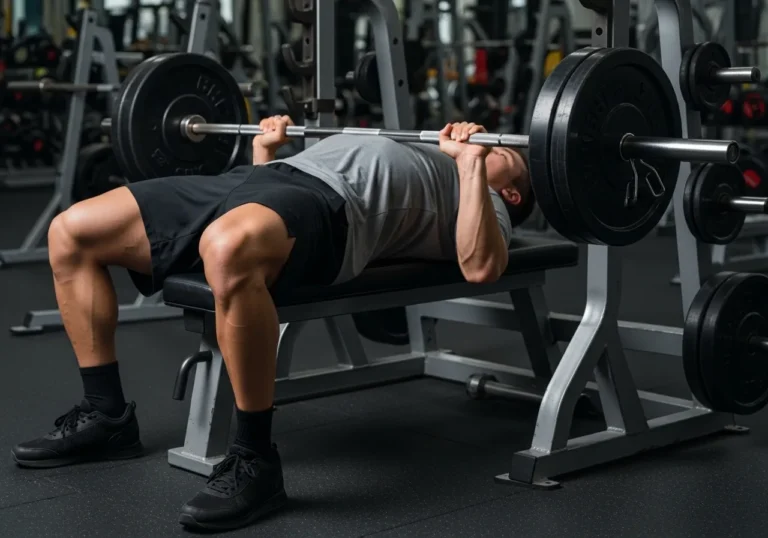
🏋️ 4. Close-Grip Bench Press (Compound — All Heads)
Target: All three tricep heads, anterior deltoid, pectoralis major (secondary)
How: Grip a barbell at shoulder width or slightly narrower. Lower to the chest with elbows tucked at 30–45° from the torso. Press to full extension. The narrower grip and tucked elbows shift emphasis from chest to triceps compared to a standard bench press.
Key point: “Close-grip” means shoulder-width — not narrowly touching. A grip too narrow creates wrist strain without additional tricep benefit
Target: Long head and lateral head; emphasis shifts with bar path
How: Lie on a bench holding an EZ-bar or dumbbells above the chest with arms extended. Lower the weight toward the forehead (or behind the head for greater long head stretch) by bending only at the elbows. Extend back to the starting position.
Key point: Lowering toward the forehead = lateral head emphasis. Lowering behind the head = greater long head stretch — closer to the overhead extension stimulus while remaining supine
How: Place hands together forming a diamond shape directly below the chest. Lower the chest toward the hands while keeping elbows close to the body. Press to full extension. The narrow hand position maximises elbow extension as the primary movement.
Key point: EMG research places diamond push-ups among the highest tricep activators in bodyweight categories — a valuable option for trainees without equipment or for high-rep metabolic work
Why Most Tricep Training Produces Disappointing Results
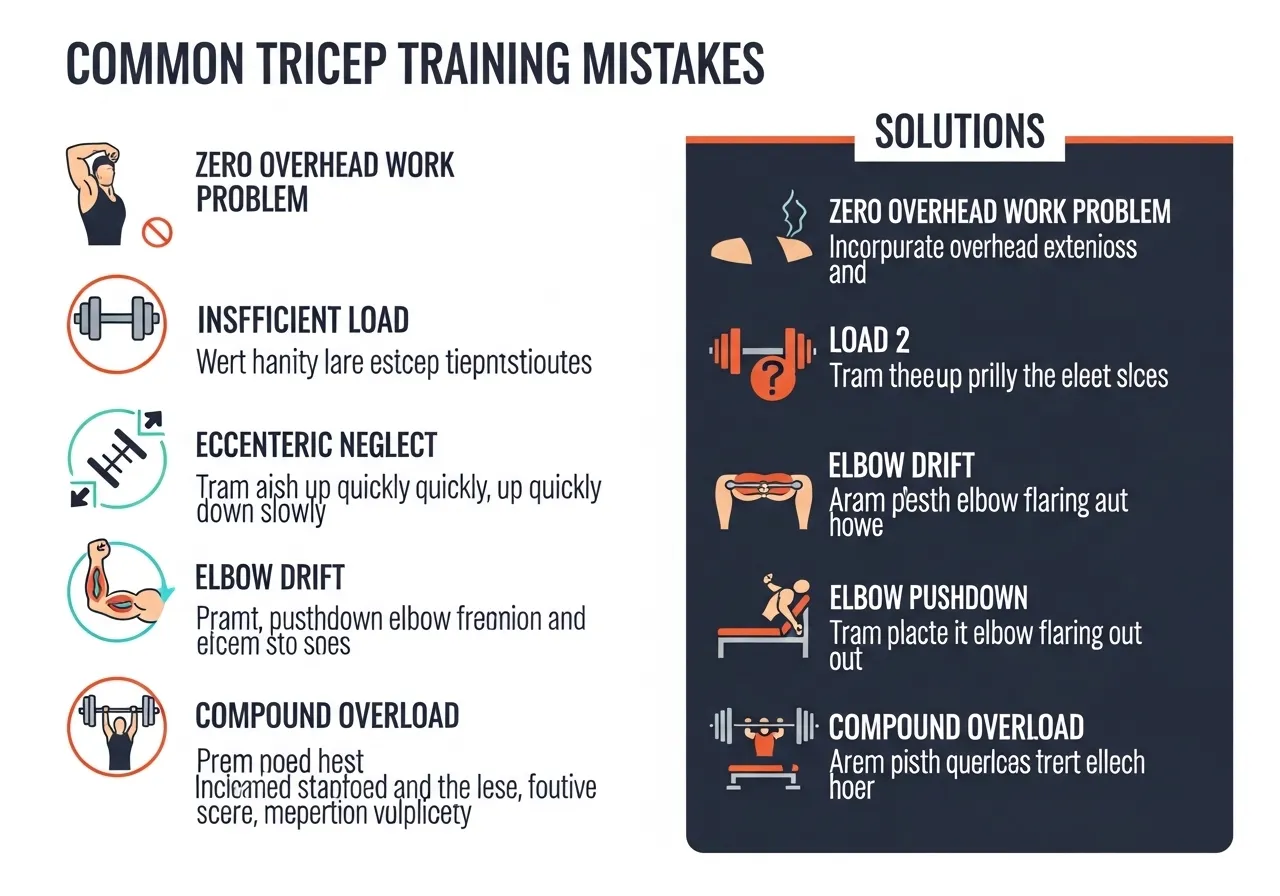
Problem 1: Zero Overhead Work in the Programme
Most gym-goers perform pushdowns, close-grip bench, and dips — all neutral-arm or elbow-at-side movements. The long head (the largest component of the triceps) is never trained in a lengthened state.
The result: the lateral head develops visibly, but the inner thickness and overall arm size that comes from long head development stalls. Adding one overhead exercise per session closes this gap — it takes 3–4 sets to address the entire long head stimulus deficit most programmes carry.
Problem 2: Insufficient Load on Isolation Exercises
Tricep isolation work tends toward excessive volume at light loads — 4 sets of 20 rope pushdowns with weight that allows sets to be completed with significant energy remaining.
Proximity to failure drives hypertrophy. A set of 12 rope pushdowns where the final 2 reps require genuine effort produces more adaptation than 20 reps where rep 20 is as easy as rep 1. Work in the 8–15 rep range with loads that make the target rep count genuinely challenging.
Problem 3: No Eccentric Control
The eccentric phase (the return phase of an extension — the slow lowering of the weight) generates the majority of muscle damage and hypertrophic signal per rep. Allowing the weight to snap back rapidly on pushdowns and skull crushers wastes the most productive part of each repetition.
A 2–3 second eccentric on every tricep isolation repetition meaningfully increases stimulus per set without changing load — and it is free to implement immediately.
Problem 4: Elbow Position Drift During Overhead Extensions
In overhead extensions, the upper arms gradually drift forward as fatigue accumulates — converting the exercise from an overhead position (long head stretched) to an inclined position (long head partially shortened). The exercise continues to feel challenging, but the long head stimulus is lost.
Performing overhead extensions seated (or against a wall for upper arm support) prevents this drift and maintains the correct position throughout the set — particularly in the later reps where form deteriorates most.
Problem 5: Overloading Compound Pressing Without Matching Isolation Volume
Triceps receive substantial stimulus from all pressing movements — bench press, overhead press, and dips all load the triceps under significant force. Trainees who press heavily three to four days per week may find that the tricep fatigue accumulated from compound work limits their isolation exercise quality.
In this scenario, place tricep isolation work after compound pressing (not before) and prioritise the long head overhead work first within the isolation block — when the muscle is freshest within the isolation sequence.
The Muscle-Mind Connection Gap
Many trainees perform tricep exercises and feel the effort primarily in the elbow joint rather than the muscle belly. This indicates one of two issues: the load is too high relative to the trainee’s ability to maintain technique, or the mind-muscle connection (the ability to consciously direct neural drive to the target muscle) needs development.
A practical solution: begin each tricep session with 2 sets of very light cable pushdowns (30–40% of working weight) and deliberately focus on squeezing the tricep at the bottom of each rep. Two sets of this priming work significantly improves tricep activation in subsequent heavier sets — a time investment of under 3 minutes that meaningfully improves the quality of the entire session.
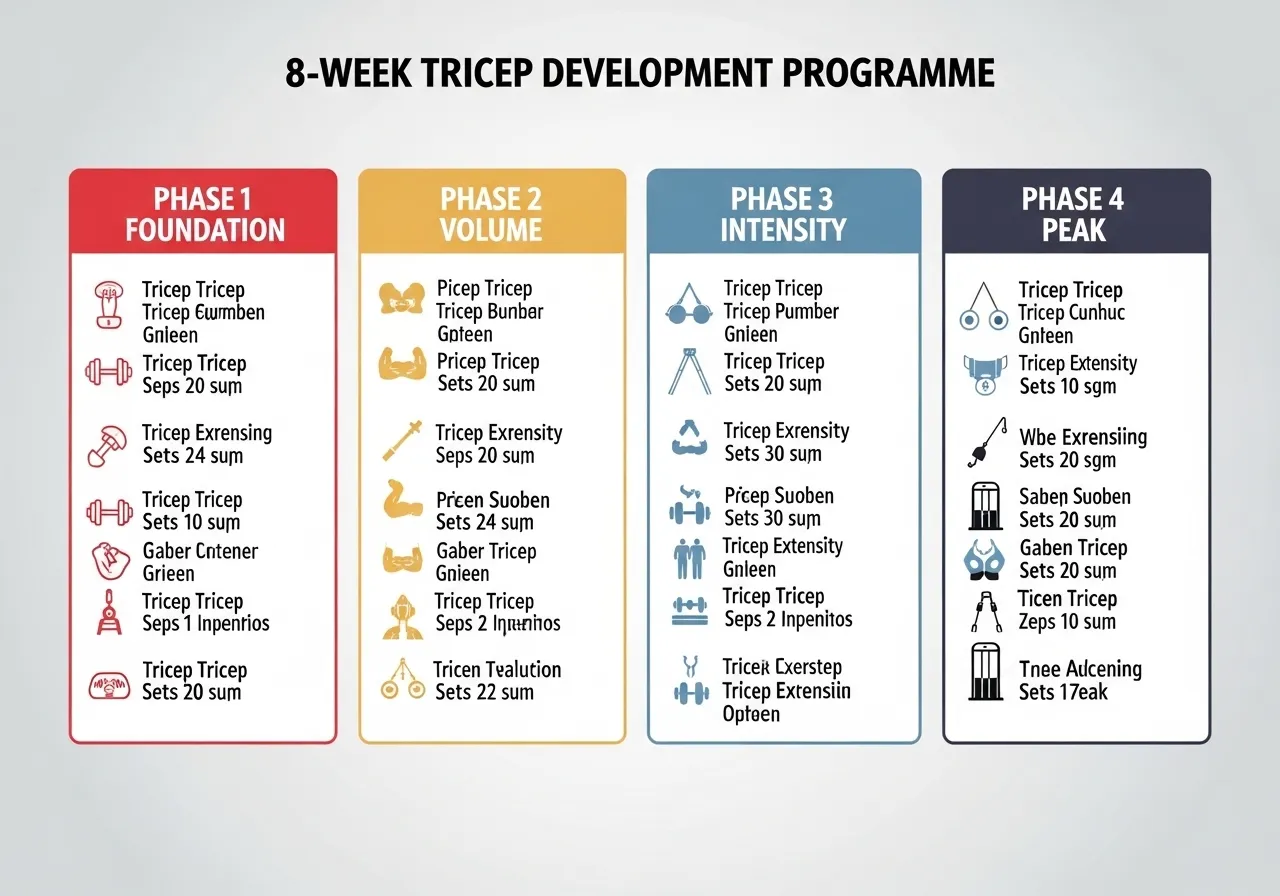
8-Week Tricep Development Programme
This programme runs three upper body sessions per week — two push-focused days where triceps receive secondary stimulus from pressing, and one direct tricep specialisation session.
The key structural principle: every session includes at least one overhead tricep exercise to ensure the long head receives consistent lengthened-position stimulus alongside the lateral head work from pressing and pushdowns.
📅 Phase 1 — Weeks 1–2: Foundation
Push Day A: Bench Press 4×8 → Cable Overhead Extension 3×12 (long head focus) → Rope Pushdown 3×12
Push Day B: Overhead Press 4×8 → Overhead DB Extension 3×12 → Diamond Push-Up 3×max
Push Day B: Overhead Press 4×4 → Overhead DB Extension 4×8 → Underhand Pushdown 3×10
Specialisation Day (Week 8 benchmark): Skull Crusher 4×5 (new 5RM) → Cable Overhead Extension 3×10 → Rope Pushdown 3×12 → Close-Grip Bench 4×5 (new 5RM)
Benchmark: Compare Week 8 skull crusher and cable overhead extension loads vs Week 1 — a 10–20% load increase over 8 weeks is a typical result
Focus: Establish new strength benchmarks; ensure overhead exercises remain a permanent fixture in all future programming
Frequently Asked Questions About Tricep Training
How many sets of tricep work do I need per week?
Most training research suggests 10–20 direct sets per week produces robust hypertrophy in the triceps — with the lower end (10–12 sets) appropriate for trainees already performing significant pressing volume, and the higher end for those with limited indirect tricep stimulus from compound work.
Count indirect stimulus from pressing: 4 sets of bench press and 4 sets of overhead press each week already provides approximately 8 indirect tricep sets. Adding 6–8 direct sets (2–3 exercises) completes a productive weekly volume.
Should I train triceps on push day or as a separate session?
Both approaches work. Training triceps after pressing (push day) benefits from the warm-up effect of pressing — the triceps are already activated and blood-filled when isolation work begins. A separate arm day allows full tricep focus without the fatigue accumulation from prior pressing.
The most important factor is consistent weekly volume and proximity to failure — not session structure.
Why do I feel tricep extensions in my elbow rather than the muscle?
Elbow discomfort during tricep extensions often comes from one of three causes: excessive load relative to current elbow tendon tolerance; too-abrupt a range of motion at the fully flexed position; or performing the exercise through a range that places the elbow under shear stress (particularly when the bar or hands travel behind the head during skull crushers).
Switching temporarily to cable overhead extensions (which provide a smoother resistance curve than free weights) and reducing load by 20–30% typically resolves extension-related elbow discomfort within 2–4 weeks.
Do dips build better triceps than pushdowns?
Dips load the triceps under greater absolute force than pushdowns and provide a stretch-loaded stimulus at the bottom position — making them a more demanding and potentially more effective exercise for overall tricep development. However, dips also significantly load the shoulder and pectoral, which may limit load if these structures fatigue first.
Pushdowns offer more isolated tricep stimulus with lower joint stress — making them a reliable complement to dips rather than a replacement for them.
Should I train to failure on tricep exercises?
Training to failure (the point where no additional reps can be completed with proper technique) is not necessary on every set — but getting within 1–2 reps of failure on at least the final set of each exercise ensures sufficient proximity to the stimulus threshold for hypertrophy. Stopping 5+ reps short of failure on every set consistently undertrains the muscle regardless of volume.
The Zercher squat looks uncomfortable. It is. That discomfort is also precisely what makes it effective. Named after Ed Zercher, a strongman from the 1930s who reportedly squatted this way because he lacked a squat rack, the Zercher squat holds the barbell in the crease of the elbows rather than on the back or front…
The box squat is simultaneously one of the most effective and most misunderstood squat variations available. Its proponents claim it develops power that the conventional back squat cannot, builds the hip and posterior chain emphasis that powerlifters need, and teaches correct squat mechanics by providing a definitive depth reference. Its critics dismiss it as a…
⚠️ Fitness Disclaimer: The information in this article is for general educational purposes only and does not constitute professional fitness or medical advice. Exercise carries inherent risks. Always consult a qualified healthcare professional or certified personal trainer before starting or modifying any exercise program, especially if you have a pre-existing medical condition, injury, or health…
Every serious upper body pressing programme eventually arrives at the same limitation: the lockout. Chest and anterior deltoid strength builds quickly with standard bench pressing. Triceps strength, specifically the capacity to drive the bar from mid-range to full extension, develops more slowly and becomes the bottleneck at heavier loads. The close-grip bench press directly addresses…
The good morning is one of the most effective posterior chain exercises in existence. It is also one of the most avoided. The name sounds casual. The movement is not. A barbell loaded across the upper back while the torso hinges forward to near-parallel creates a tremendous demand on the spinal erectors, hamstrings, and glutes…
⚠️ Fitness Disclaimer: The information in this article is for general educational purposes only and does not constitute professional fitness or medical advice. Always consult a qualified healthcare professional before starting any new exercise program, especially if you have existing injuries or medical conditions. The Posterior Chain Exercise Debate That Every Serious Lifter Faces I…