Ask most gym-goers how they train their triceps and you will hear a familiar list: cable pushdowns, overhead extensions, skull crushers. Ask them about the close-grip bench press stall fixes and you will typically get a blank stare or a vague acknowledgment that it exists somewhere in the periphery of real training. This is a training error — the close-grip bench press is not a tricep isolation exercise that happens to use a barbell. It is the most effective tricep mass builder available, the best upper chest developer most lifters are not using, and a pressing strength developer that transfers directly to the conventional bench press in ways that isolation tricep work cannot replicate.
The distinction matters because the tricep is the largest muscle in the upper arm — comprising approximately two-thirds of upper arm mass compared to the bicep’s one-third — and its development is the primary determinant of arm size for anyone who wants genuinely impressive arms rather than merely well-developed biceps. The close-grip bench press loads all three tricep heads under heavy compound stress while simultaneously developing the upper chest and anterior deltoid, making it the most muscle-per-set exercise available for the tricep that exists in standard barbell training.
The Tricep’s Role in Pressing Strength
The tricep’s contribution to bench press performance is most critical in the lockout — the final thirty degrees of elbow extension where many lifters’ reps fail under heavy load. Tricep weakness at this portion of the range is among the most common limiting factors in intermediate bench press development, and it is precisely the portion of the range that the close-grip bench press trains most specifically. Lifters whose bench press fails at lockout who add close-grip bench pressing to their training consistently report bench press improvements within four to six weeks — not from additional chest training but from developing the tricep lockout strength that was the actual limiting factor. According to research on tricep activation during bench press variations, close-grip bench press produces significantly greater tricep long head and lateral head activation than conventional bench press at equivalent loads, validating its specific application for tricep development and lockout strength.
Action point: Test your bench press lockout weakness by performing a conventional bench press set and noting where failure occurs. If reps fail in the final third of the press rather than off the chest, tricep weakness is your primary limiting factor and close-grip bench pressing is the most direct solution available.
The History and Science Behind Close-Grip Bench Pressing
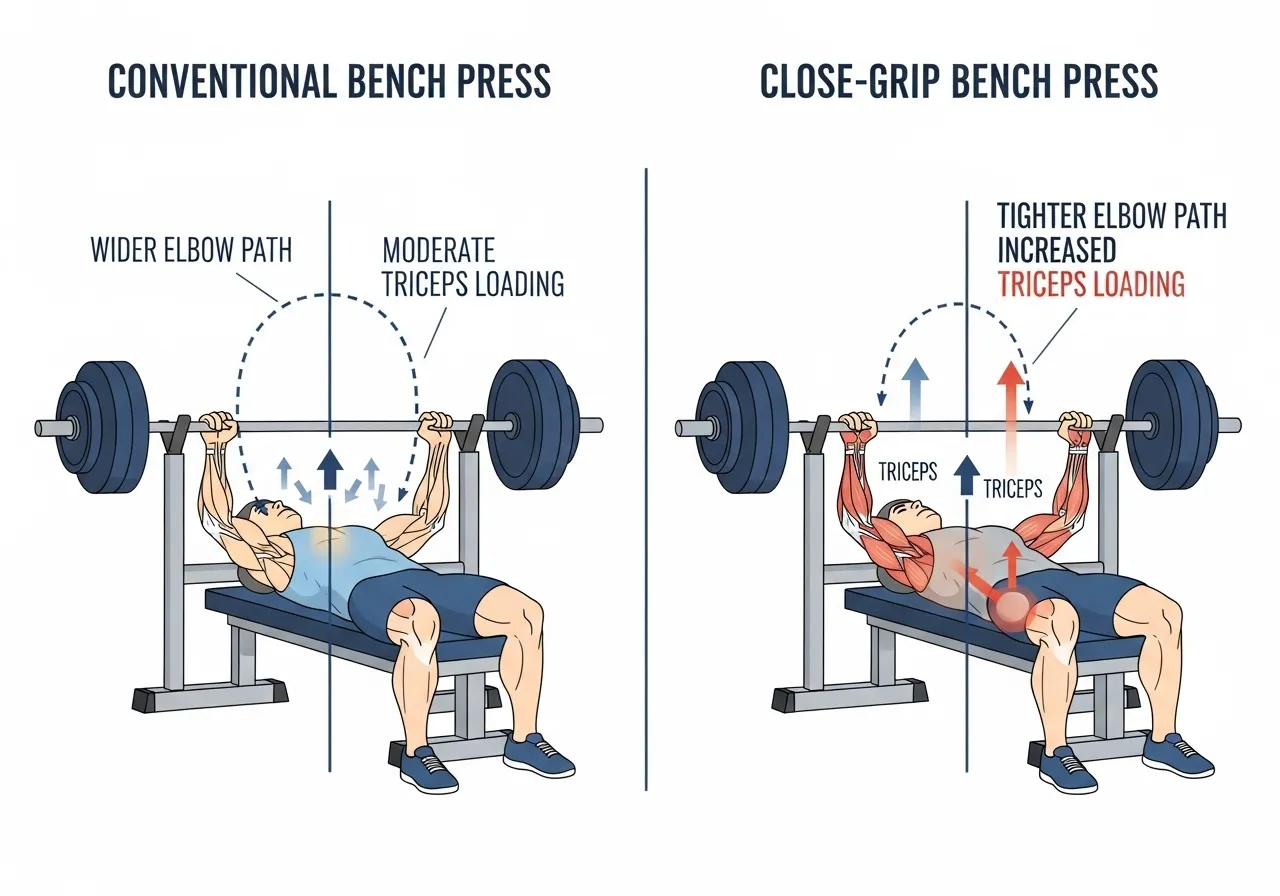
The close-grip bench press has been a cornerstone of serious strength training programs for decades, appearing consistently in the training logs of powerlifters who need lockout strength, bodybuilders who need complete tricep development, and strength coaches who understand that compound tricep training produces results that isolation work cannot match. The exercise’s effectiveness stems from basic biomechanics: the narrowed grip shifts the pressing lever arm toward the tricep by reducing the pectoral’s mechanical advantage, forcing the tricep to contribute a larger proportion of the total pressing force at all points in the range of motion. This forced contribution — not present in conventional bench pressing where the pec can dominate the pressing pattern — is why the close-grip bench press develops the tricep in ways that conventional bench pressing cannot, even at equivalent total volumes. The scientific basis is the principle of mechanical specificity: muscles develop most specifically in the movement patterns and joint positions under which they are most heavily loaded. The close-grip bench press specifically loads the tricep in its most functionally relevant position — extending the elbow under load in the pressing pattern — which produces the strength and hypertrophy that transfer most directly to pressing performance and arm development. Research comparing bench press variations and muscle activation quantifies this difference, finding that close-grip bench produces 15-20% greater tricep activation than conventional bench at equivalent loads.
Strength Standards and Progress Benchmarks
Establishing realistic close-grip bench press strength standards helps contextualize current performance and set meaningful progression targets. For men: a close-grip bench press of 80% bodyweight for five reps represents beginner-to-intermediate strength; 100% bodyweight represents solid intermediate; 130% bodyweight represents advanced. For women: 50% bodyweight represents intermediate; 70% bodyweight represents advanced. These standards assume strict technique — shoulder-width grip, full range of motion, controlled eccentric, no excessive arch beyond functional positioning. Athletes who have been performing close-grip bench pressing for less than six months should expect to be in the beginner range regardless of conventional bench strength, as the specific motor pattern and tricep-dominant pressing requires neural adaptation before strength expression matches existing pressing capacity. Tracking close-grip progress monthly — using the five-rep working weight as the benchmark — reveals the adaptation rate and identifies when programming adjustments are needed to continue progressing beyond natural accommodation. Most intermediate athletes improve their close-grip bench five-rep maximum by two to five kilograms per month during active development phases, with this rate slowing as strength approaches advanced standards that require more sophisticated periodization to continue improving. NSCA strength standards for pressing exercises provide population-based benchmarks that contextualize individual performance and guide realistic goal-setting across training experience levels.
Close-Grip Bench Press Setup and Technique: Getting It Right from the Start
The close-grip bench press shares the same fundamental setup requirements as the conventional bench press — back arch, leg drive, scapular retraction, stable bar path — but adds the specific grip width consideration that determines both its effectiveness and its safety. Getting the grip width wrong is the most common close-grip bench press error, and it produces either reduced tricep stimulus (grip too wide, approximating conventional bench) or wrist and elbow discomfort (grip too narrow, creating joint stress that the exercise is not designed to produce).
The Optimal Grip Width
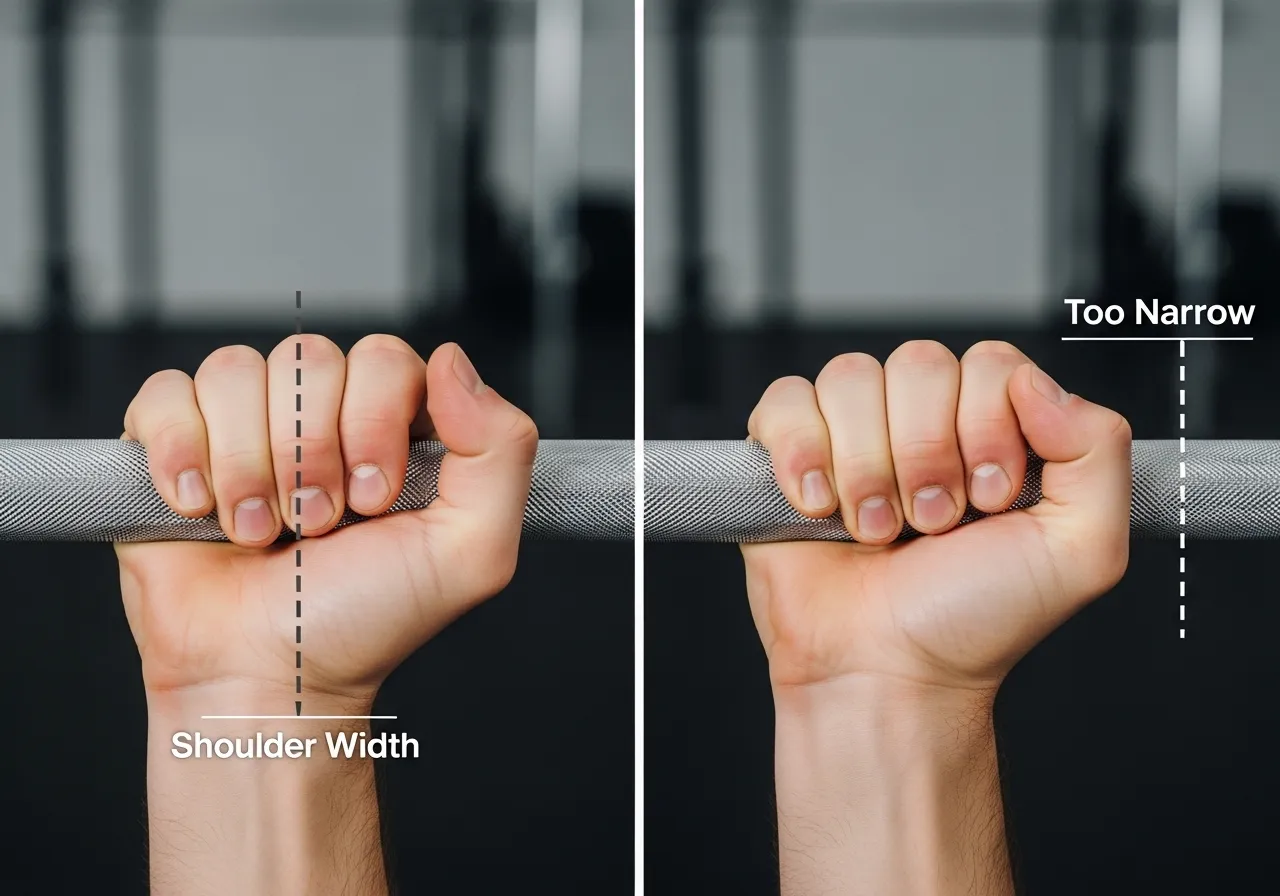
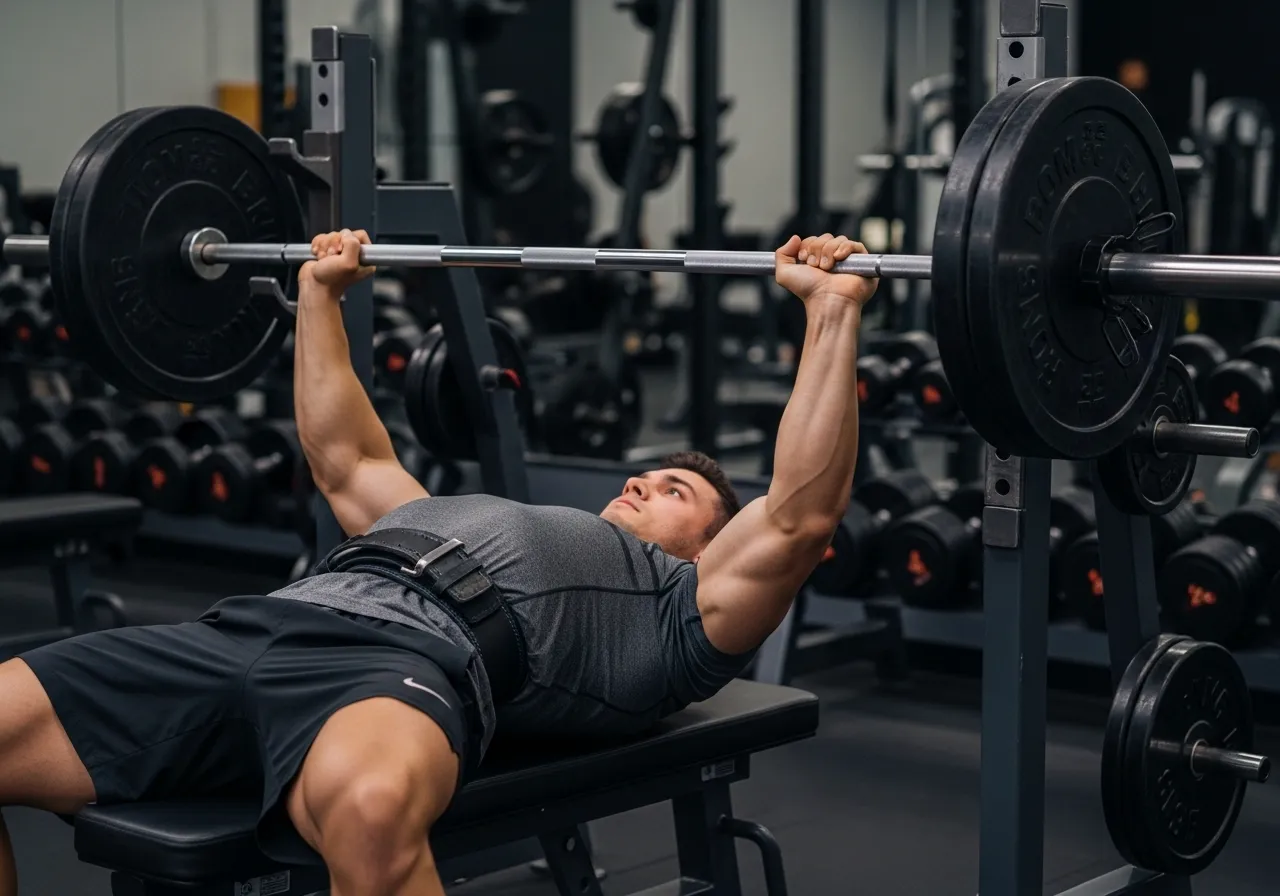
The optimal close-grip bench press grip width is approximately shoulder-width — the thumbs positioned directly below the shoulders or slightly inside, with the hands roughly 45-50 centimeters apart on the bar. This is meaningfully narrower than conventional bench press grip (typically 80-85 centimeters apart) but not the extremely narrow grip that many lifters incorrectly believe close-grip requires. The extremely narrow grip — hands touching or within 20 centimeters — creates significant wrist deviation that imposes joint stress without producing greater tricep activation than the shoulder-width grip. Research comparing tricep activation across grip widths finds that shoulder-width close-grip produces equivalent or greater tricep activation than ultra-narrow grips while eliminating the wrist and elbow stress that very narrow grips create. NCBI research on grip width and upper limb muscle activation confirms that moderate grip narrowing from conventional width maximizes tricep activation without the joint stress of extreme grip narrowing.
Elbow Path and Bar Path
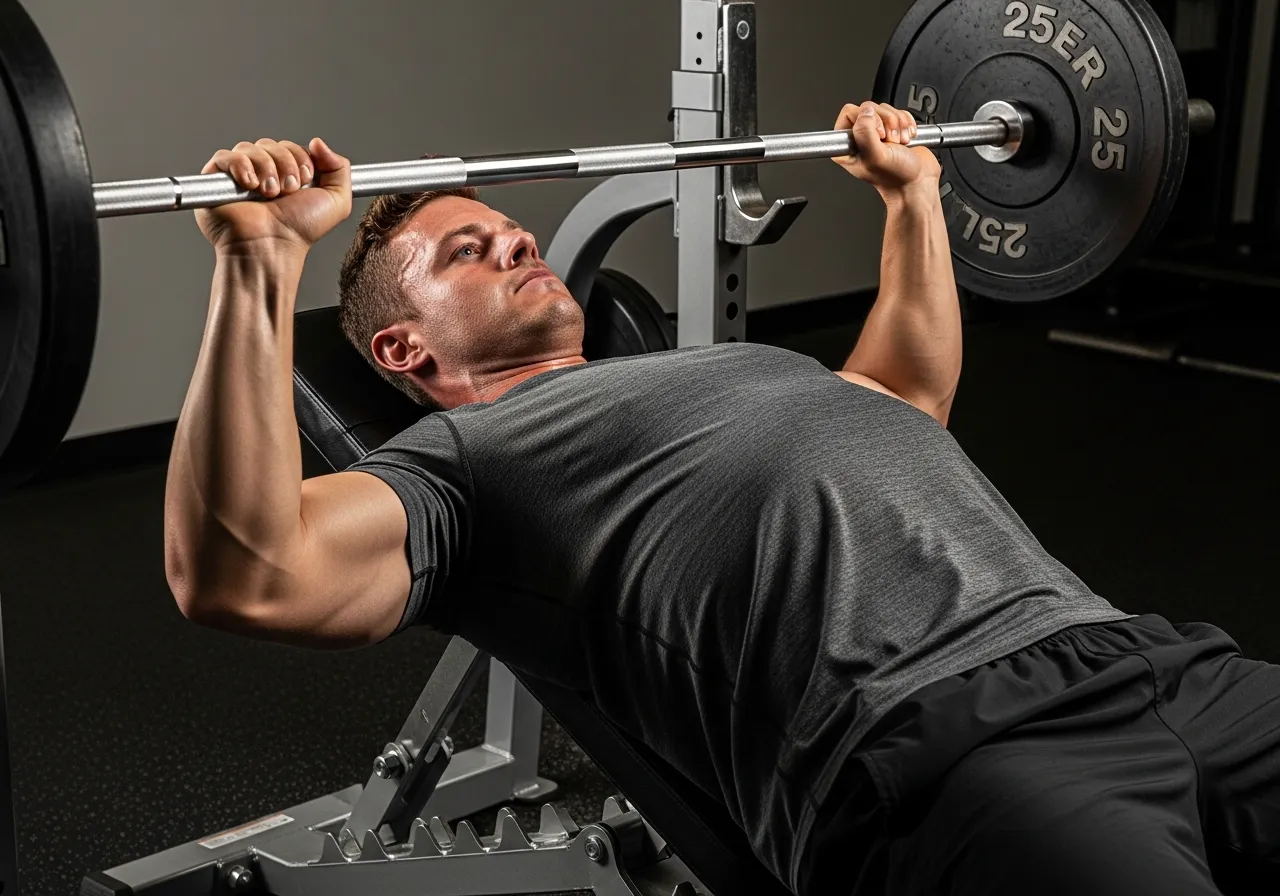
The close-grip bench press elbow path should track closer to the body than conventional bench press — elbows at approximately 45-55 degrees from the torso rather than the 70-80 degrees of wide-grip pressing. This narrower elbow path is what drives the tricep loading that makes the exercise effective. Allowing the elbows to flare outward to the conventional position converts the close-grip bench press back into a conventional bench press with a narrow grip — removing the tricep emphasis and defeating the exercise’s purpose. The bar should touch the lower chest or upper abdomen — slightly lower than the conventional bench press’s mid-chest contact point — because the narrower grip and closer elbow path create a slightly different bar trajectory that naturally descends lower. This lower touch point is correct technique, not an error to be corrected.
The Full Movement Sequence
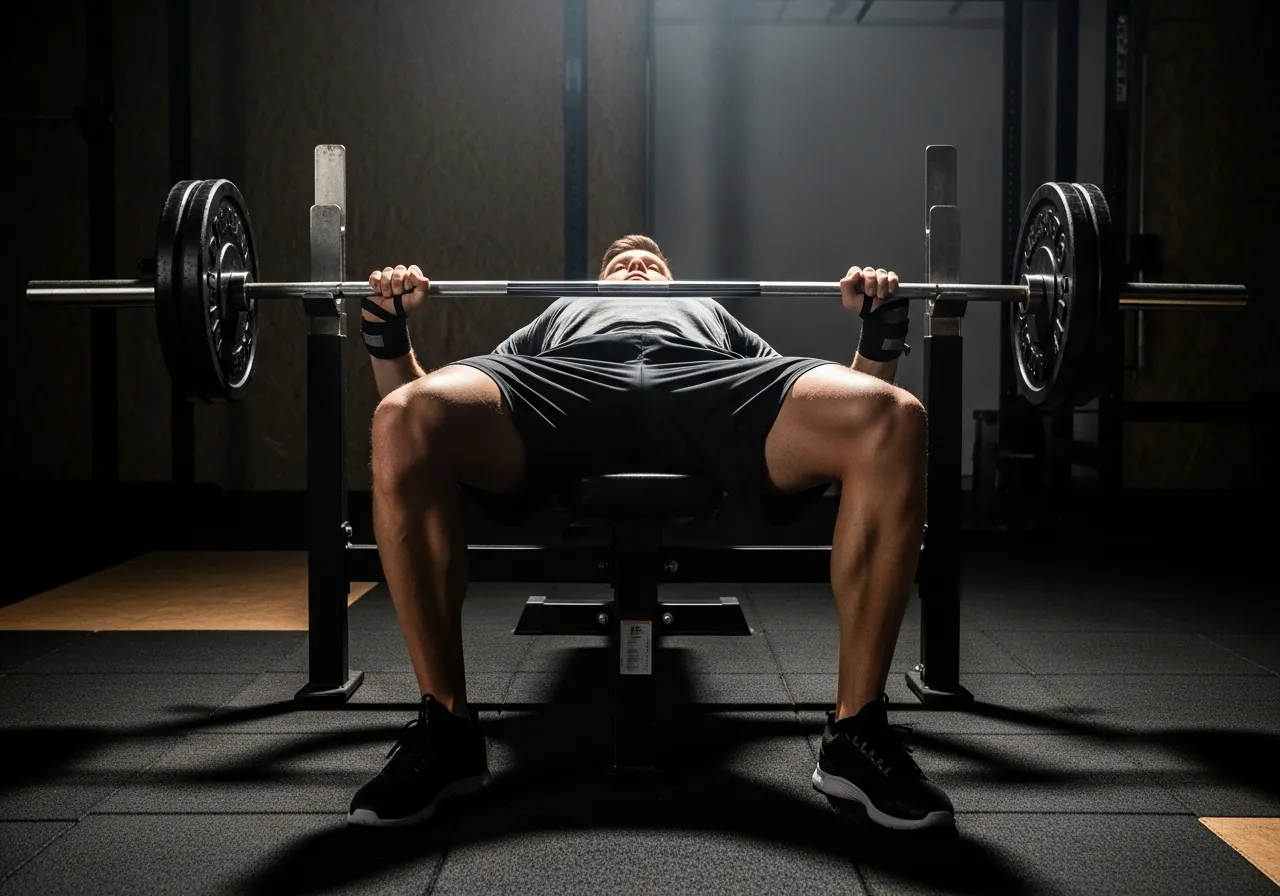
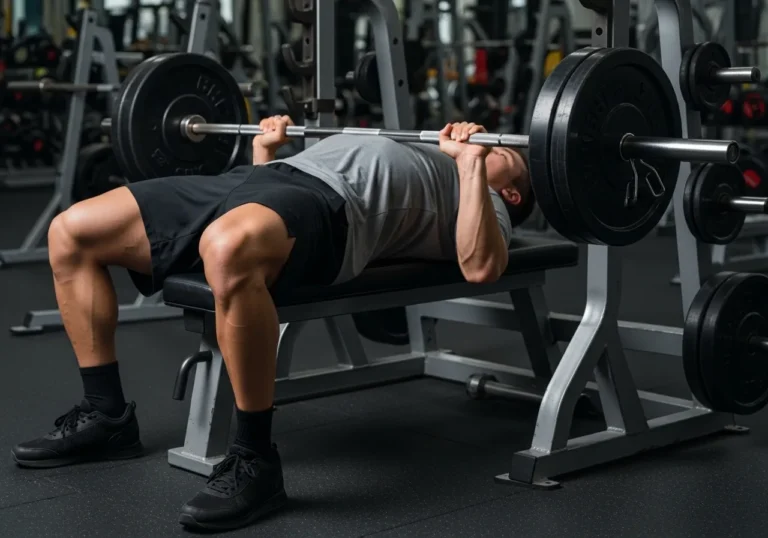
Setup: lie on the bench with the same arch, leg drive, and scapular retraction used in conventional bench pressing. Unrack the bar with the shoulder-width close grip. Descend with controlled eccentric (two to three seconds) allowing the bar to descend lower than conventional bench while keeping elbows at 45-55 degrees. Touch the lower chest or upper abdomen. Drive concentrically with maximum force, maintaining the close elbow path throughout the press. Achieve full lockout with deliberate tricep contraction at the top. The full lockout — not stopping short as many lifters do to maintain tension — is essential for developing the lockout strength that transfers to the conventional bench press plateau that close-grip training is often used to address.
Action point: Perform five close-grip bench press reps with an empty bar, focusing exclusively on maintaining the shoulder-width grip and 45-degree elbow path. Film yourself from the side to confirm elbow tracking and bar touch point before adding load.
Common Close-Grip Bench Press Errors Beyond Grip Width
Beyond the grip width error that produces wrist discomfort, several additional technique errors consistently reduce the close-grip bench press’s effectiveness. Allowing the elbows to flare outward during the press — the most common error — converts the close-grip into a standard bench press, eliminating the tricep emphasis entirely. The fix is a persistent mental cue throughout the set: “keep elbows in” or “drive elbows toward the hips” during the concentric phase. Cutting the range of motion short at the top — stopping five to ten degrees before full lockout — eliminates the tricep contraction at full extension that develops the lockout strength that is the exercise’s primary value. The fix is consciously achieving and briefly holding full lockout on every rep, regardless of the set’s fatigue level. Using excessive lat engagement — arching severely and driving the chest into the bar — reduces the tricep’s contribution by returning the exercise toward a conventional bench pattern. The fix is using a moderate, sustainable arch that maintains face pull while not eliminating the tricep-dominant mechanics of the close-grip variation. Filming from the side occasionally to verify elbow path and lockout completion catches these errors before they become entrenched technique habits that limit long-term development.
Close-Grip Bench Press for Powerlifters: The Specific Application
In powerlifting, the close-grip bench press serves as the primary supplementary exercise for addressing the lockout weakness that is the most common limiting factor in maximal bench press performance. Powerlifters typically use the close-grip bench press at 70-80% of their conventional bench maximum for three to five sets of five to eight reps, placed in the training week on an upper body day separate from the primary bench press session. This placement allows the close-grip work to develop the tricep lockout strength without fatiguing the tricep before the competition-specific conventional bench session that requires maximum expression of strength. Research on powerlifting bench press assistance exercises consistently identifies the close-grip bench press as the assistance exercise most directly correlated with competition bench press improvement, validating its priority position in serious powerlifting programs. Elite powerlifters competing at national and international levels uniformly include some form of close-grip pressing in their training programs regardless of individual variation in other assistance exercise choices — the consensus around this exercise reflects decades of practical experience confirming its specific value for the lockout strength that competition bench pressing demands.
Programming the Close-Grip Bench Press: Where It Fits and How to Progress
The close-grip bench press is most effectively programmed as a secondary pressing exercise — performed after the primary flat or incline bench press when pressing strength is already partially fatigued, which reduces the load needed for effective stimulus while still developing the tricep and upper chest. Placing it before the primary bench press risks fatiguing the tricep to the point that conventional bench performance is compromised, which is appropriate only during specific close-grip specialization phases.
Hypertrophy Programming
For tricep and upper chest hypertrophy: three to four sets of eight to twelve reps, performed as the second pressing exercise after conventional bench press. Load selection: approximately 75-80% of conventional bench press working weight, adjusted to allow complete reps through full range without form breakdown. The close-grip bench press responds extremely well to the paused variation — holding the bar at the chest for one second before pressing — which eliminates the elastic rebound that allows technique to deteriorate and forces maximum tricep contribution to the concentric phase. According to NSCA tricep development programming guidelines, compound tricep exercises at moderate loads performed after primary pressing produce superior hypertrophy outcomes compared to isolation-only tricep training.
Strength Programming for Bench Press Carryover
For direct bench press strength improvement through tricep lockout development: four to five sets of four to six reps at 80-85% of close-grip maximum. This loading produces the neural recruitment and maximum tricep force development that transfers most directly to the lockout portion of the conventional bench press. Performing this strength-focused close-grip work one to two sessions per week alongside conventional bench pressing produces the tricep strength improvements that resolve lockout weakness within four to eight weeks for most intermediate lifters.
Weekly Integration Example
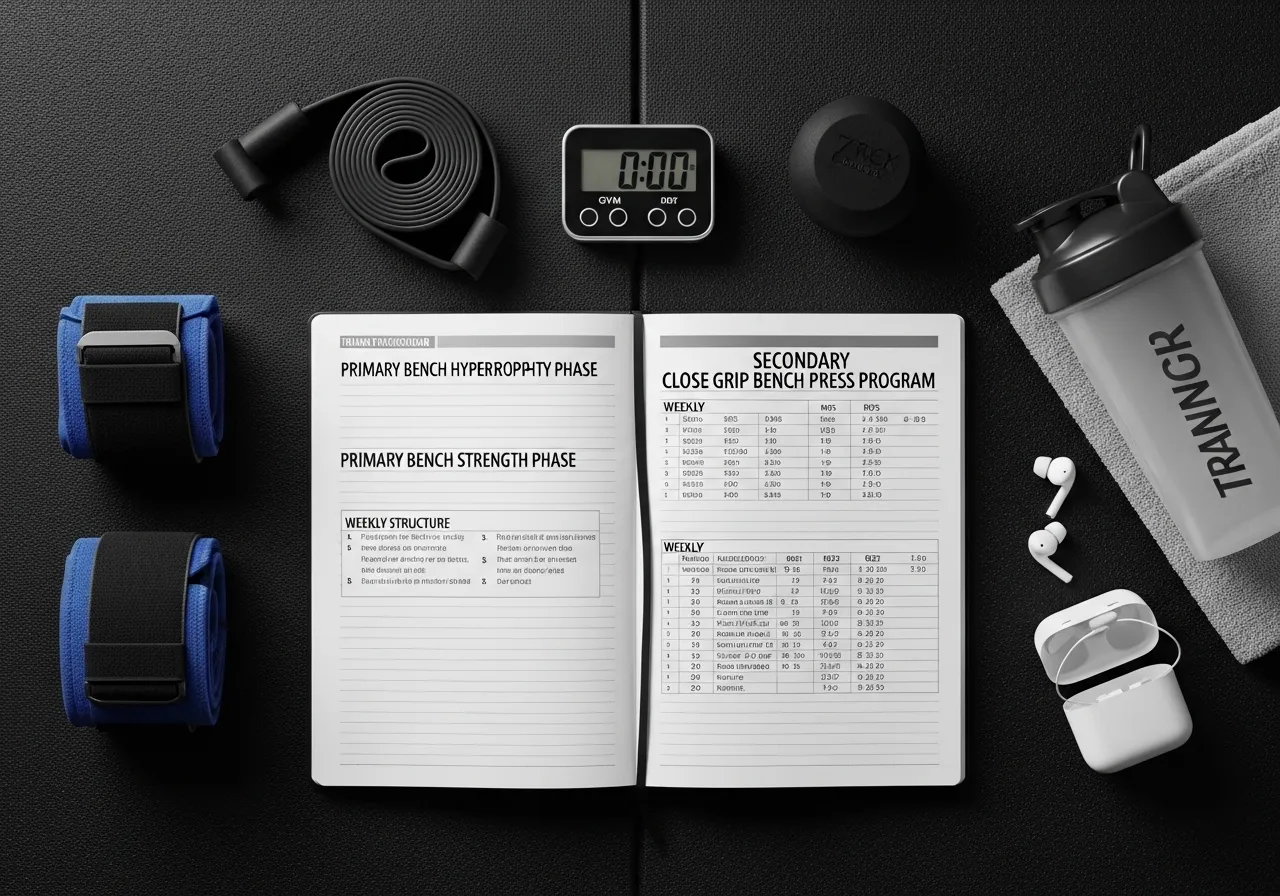
A practical weekly upper body integration: Monday — conventional bench press (primary), close-grip bench press 3×8-10 (secondary), cable fly 3×12 (tertiary). Thursday — overhead press guide (primary), close-grip bench press 4×5 (heavy, for lockout strength), dips 3×10 (tertiary). This structure provides close-grip bench stimulus twice weekly — once at hypertrophy rep range, once at strength rep range — which produces both the muscle development and the neural strength adaptations that comprehensive tricep development requires. The twice-weekly frequency for the close-grip matches the frequency research identifies as optimal for hypertrophy of any individual muscle group.
Action point: Add the close-grip bench press as the second pressing exercise in your next upper body session. Use a load approximately 20% less than your conventional bench working weight and perform three sets of ten with the paused variation. Note the tricep activation quality compared to your usual cable machine guide sets.
Incorporating Close-Grip into a Complete Upper Body Program
The close-grip bench press integrates most effectively into an upper body program that includes both pressing and pulling movements in balanced proportion. A complete upper body program for intermediate athletes that features the close-grip bench press: primary horizontal press (conventional bench press, three to four sets), secondary horizontal press (close-grip bench press, three sets), vertical pull (lat pulldown or pull-up, three to four sets), horizontal pull (barbell or cable row, three sets), and isolation accessory work (cable fly, tricep pushdown, two to three sets each). This structure develops the complete upper body musculature while emphasizing the close-grip bench’s specific tricep and upper chest development. The close-grip bench’s position as the secondary horizontal press means it receives the neural activation from the primary bench press without the fatigue that would compromise its effectiveness if placed earlier — the two-exercise horizontal pressing sequence produces more total pressing development than either exercise alone. Athletes who add the close-grip bench press to previously close-grip-free programs consistently report accelerated arm development alongside the bench press improvement that better tricep strength provides — confirming that the exercise is delivering both its primary (tricep) and secondary (pressing strength) benefits simultaneously. ACSM resistance training program design guidelines support compound secondary exercises after primary movements as the most effective structure for developing both strength and hypertrophy in targeted muscle groups.
Close-Grip Bench Press vs Other Tricep Exercises: Making the Right Choice
The tricep training landscape offers numerous exercise options — cable pushdowns, skull crushers, overhead extensions, dips, close-grip bench press — each with specific mechanical properties that determine their application. Understanding where the close-grip bench press fits relative to these alternatives guides intelligent programming decisions.
Close-Grip vs Skull Crushers
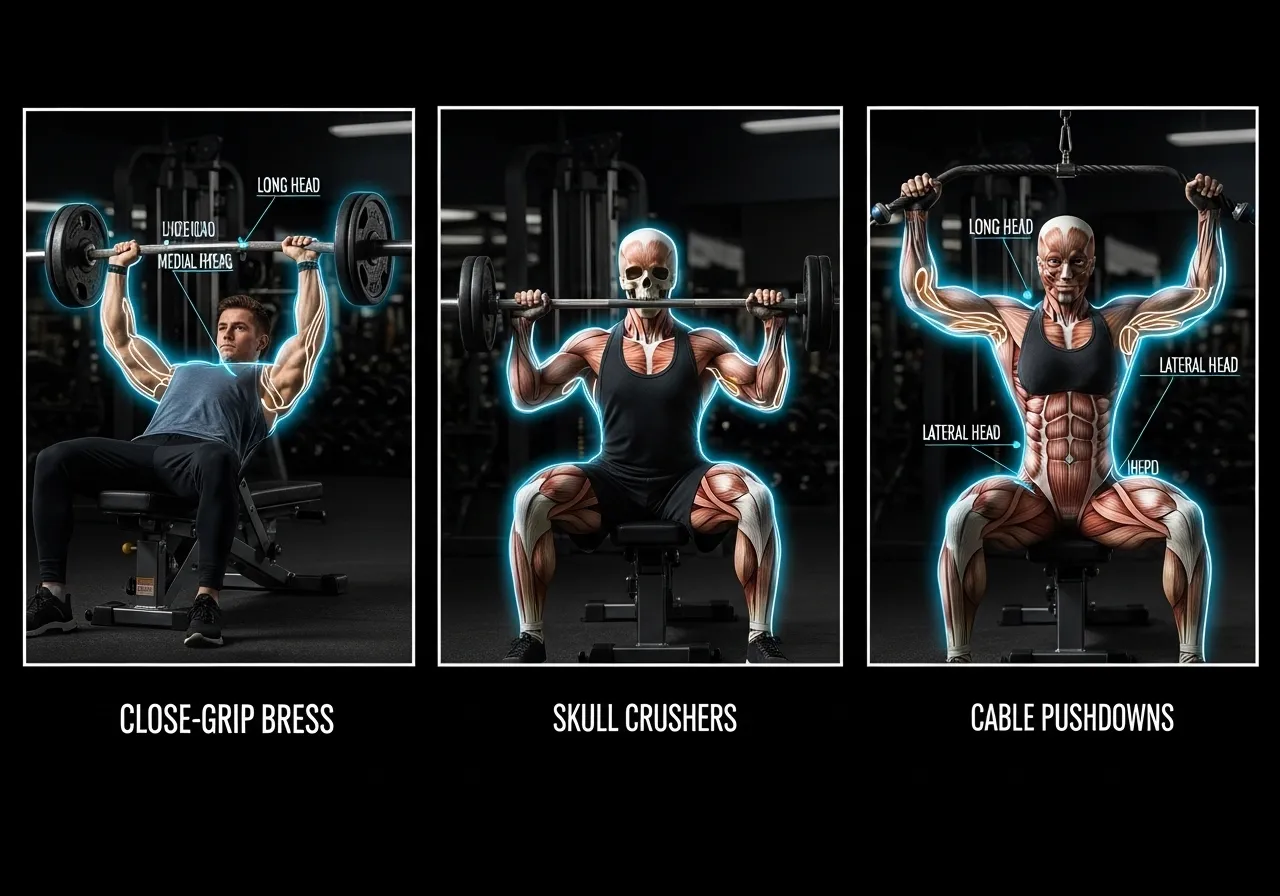
Skull crushers (lying tricep extensions) load the tricep primarily in the lengthened position — elbows bent overhead — which produces significant mechanical tension at the long head specifically. The close-grip bench press loads the tricep primarily in the mid-to-shortened position — elbows extending from 90 degrees to full lockout. These different loading angles make the two exercises complementary rather than interchangeable: skull crushers develop the long head through the lengthened position that produces the most muscle damage and hypertrophic stimulus, while close-grip bench pressing develops all three heads through the compound pressing pattern that produces the most strength transfer. The combination of both — skull crushers for long head lengthened loading, close-grip bench for compound strength development — produces more complete tricep development than either alone. Research on tricep exercise comparison confirms that different exercises produce different activation patterns across the three tricep heads, supporting varied exercise selection for complete tricep development.
Close-Grip vs Weighted Dips
Weighted dips provide similar compound pressing stimulus to the close-grip bench press but with greater shoulder extension demand and different force curve characteristics. Both exercises develop the tricep and anterior deltoid through compound pressing, but dips additionally develop the lower chest more aggressively while close-grip bench press provides more control over load and range of motion. For most athletes, both exercises in programming produces complete development, with close-grip bench providing precision loading and dips providing the functional movement pattern and bodyweight-plus-load challenge that benching cannot replicate.
Close-Grip vs Cable Pushdowns
Cable pushdowns provide constant tension through the tricep’s full range and isolate the tricep without the compound involvement of pressing muscles that close-grip bench requires. This isolation makes pushdowns effective for the metabolic stress and pump that drives hypertrophic adaptation, but limits their contribution to the pressing strength that compound close-grip work develops. The appropriate role for both: close-grip bench press as the primary tricep strength and mass developer, cable pushdowns as the accessory isolation work that adds volume and metabolic stress without significant neural fatigue. This sequencing — heavy compound first, isolation accessory second — produces more complete tricep development than either approach alone.
Action point: Restructure your tricep training for the next eight weeks: close-grip bench press as the primary tricep exercise (3-4 sets, 6-10 reps), followed by one isolation exercise of choice (skull crushers or pushdowns, 3 sets, 12-15 reps). Compare tricep development at eight weeks to your starting point.
The Close-Grip Bench Press and Shoulder Health
One of the underappreciated benefits of the close-grip bench press is its relatively more shoulder-friendly profile compared to wide-grip pressing. The narrow grip reduces the degree of shoulder horizontal abduction at the bottom of the press, decreasing the subacromial compression that makes wide-grip conventional bench pressing problematic for athletes with shoulder impingement. Athletes who experience anterior shoulder discomfort during conventional bench pressing often find the close-grip variation immediately more comfortable — the narrower elbow path simply places the shoulder in a less impinged position throughout the range. This shoulder-friendly characteristic makes the close-grip bench press a valuable training tool for athletes managing shoulder conditions who still want to develop pressing strength and tricep mass without aggravating existing shoulder pathology. Sports medicine physicians who work with athletes managing shoulder impingement frequently recommend shifting pressing volume from wide-grip conventional bench to close-grip bench as a load management strategy that maintains training productivity while reducing shoulder stress. According to research on shoulder joint stress across bench press variations, narrower grip widths produce significantly lower subacromial pressure during the pressing movement, validating the close-grip bench as a shoulder-conservative pressing alternative for athletes with existing shoulder limitations.
Long-Term Close-Grip Bench Press Development: What to Expect
The close-grip bench press rewards consistent long-term practice with compound benefits that accumulate across months and years of training: greater tricep mass that contributes to overall arm size, improved conventional bench press lockout that raises the maximum load achievable in competition and training, and the pressing volume that complements conventional bench pressing without the joint stress that additional wide-grip pressing would impose. Athletes who commit to close-grip bench pressing as a permanent component of their upper body training rather than a temporary fix for a specific weakness consistently develop the arm size and pressing strength that single-exercise bench-focused programs cannot produce as completely. The exercise’s technical simplicity — once the grip width and elbow path are established, there is very little technique refinement needed compared to more complex exercises — makes it a reliable, repeatable training stimulus that produces consistent results across years of progressive loading. Treat it with the same progressive loading discipline applied to the conventional bench press, increasing load in small increments when the prescribed reps are achieved with good technique across all sets, and the compound returns will arrive as reliably as they do for any well-executed progressive resistance training practice.
Close-Grip Bench Press for Upper Chest Development
The upper chest — the clavicular head of the pectoralis major — is the most commonly underdeveloped portion of the chest for recreational lifters, who perform far more flat bench pressing than incline work and consequently develop a lower-chest-dominant profile that lacks the fullness across the upper pec that complete chest development requires. The close-grip bench press, despite being primarily celebrated as a tricep exercise, produces significant upper chest activation that makes it a valuable upper chest developer alongside its primary tricep function.
Why Close-Grip Activates the Upper Chest
The close-grip bench press’s narrower grip and closer elbow path change the angle of force application relative to the pec’s fiber orientation. The clavicular (upper) pec fibers are oriented to produce horizontal adduction with the arm in a slightly elevated position — precisely the position that the close-grip bench press’s touch point (lower than conventional bench) and pressing trajectory create. EMG research comparing chest activation across bench press variations finds that close-grip bench press produces greater upper pectoral activation than conventional bench press at equivalent loads, placing it alongside incline bench press as one of the best upper chest developers available. This dual function — tricep primary, upper chest secondary — makes the close-grip bench press extraordinarily efficient for athletes whose training time is limited and who need to develop both structures simultaneously.
Integrating Close-Grip for Upper Chest Emphasis
For athletes prioritizing upper chest development specifically: performing close-grip bench press on a slight incline (15-20 degrees) combines the close-grip’s upper chest activation advantage with the incline’s additional clavicular fiber loading. This incline close-grip variation is used by competitive bodybuilders specifically for upper chest development and represents one of the most effective but least commonly used upper chest exercises in mainstream training. Three sets of ten to twelve incline close-grip reps, performed after flat bench pressing, addresses the upper chest development deficit that flat-bench-dominant training creates. According to ACSM resistance training guidelines for chest development, varying bench angles and grip widths is essential for complete pectoral development that single-angle, single-grip training cannot achieve.
Action point: Add the incline close-grip bench press (15-20 degree incline, shoulder-width grip) as the final pressing exercise in your next chest session. Perform three sets of twelve reps and note the upper chest activation quality compared to your standard incline bench press.
Paused Close-Grip Bench Press: The Advanced Variation
The paused close-grip bench press — holding the bar at the chest for one to two seconds before pressing — is the single most effective technique for maximizing tricep development from this exercise. The pause eliminates the elastic energy stored during the eccentric phase that allows the stretch-shortening cycle to assist the concentric press, forcing the tricep to generate force from a dead stop. This increased demand at the initial concentric phase specifically develops the starting strength component of tricep function — the ability to generate force rapidly from a relaxed starting position — that conventional continuous-rep pressing cannot develop as specifically. Powerlifters who must pause the bar at the chest in competition use the paused close-grip bench as their primary bench pressing accessory precisely because it replicates the competition demand of pressing from a dead stop without elastic assistance. For non-competitive lifters, the paused variation produces greater tricep development per set than continuous-rep close-grip pressing at equivalent loads, because the elimination of elastic rebound forces greater muscle contribution throughout the concentric phase. The practical application: reduce load by 10-15% from normal close-grip working weight and perform paused reps with one to two second holds. The initial reduction in load is temporary — most athletes match their previous continuous-rep loads within four to six weeks of paused training as the tricep strength adapts to the increased demand. According to NSCA guidelines on pause training for strength development, paused variations of pressing exercises produce greater improvements in starting strength and maximum force production than continuous-rep equivalents across strength training populations.
The Close-Grip Bench Press as a Teaching Tool
Beyond its direct training benefits, the close-grip bench press serves as an excellent teaching tool for developing proper elbow tracking in the conventional bench press. Many intermediate lifters who bench press with excessively flared elbows — a common technique error that increases shoulder stress and reduces pressing efficiency — benefit from close-grip bench pressing specifically because the exercise requires the narrower elbow path that is also optimal for conventional bench pressing. Performing several weeks of close-grip bench pressing before returning to conventional bench often produces immediate improvement in elbow tracking during the conventional exercise, because the neural pattern of keeping the elbows close to the body has been practiced and reinforced through the close-grip variation. Coaches who work with lifters struggling with elbow flare in the conventional bench press consistently find that close-grip bench press training is the most effective single intervention for correcting this technical error — more effective than verbal cues alone because it requires the correct elbow position to execute the exercise at all rather than merely suggesting it as a technique improvement.
Frequently Asked Questions About the Close-Grip Bench Press
Will the close-grip bench press hurt my wrists?
Wrist discomfort during close-grip bench pressing almost always results from grip width being too narrow rather than from the exercise itself. Athletes who use an ultra-narrow grip (hands 15-20 centimeters apart) create significant wrist radial deviation that imposes joint stress throughout the set. Using the shoulder-width grip (approximately 45-50 centimeters apart) eliminates this deviation and makes the exercise completely comfortable for the wrists in virtually all healthy athletes. If wrist discomfort persists at shoulder-width grip, using a false grip (thumbs on the same side as fingers) can reduce radial deviation further. Persistent wrist pain despite correct grip width warrants evaluation by a sports medicine physician or physical therapist to rule out pre-existing wrist pathology. According to NSCA guidelines on pressing exercise technique, grip width is the primary modifiable variable in managing wrist stress during barbell pressing exercises.
How much less should I lift on close-grip vs conventional bench?
Most athletes close-grip bench press approximately 80-90% of their conventional bench press maximum at equivalent rep ranges. The reduction reflects the narrower grip’s reduced pectoral contribution rather than reduced tricep strength — the pectorals contribute more to the conventional bench press than to the close-grip variation. Athletes with relatively stronger triceps (common in lifters who have previously emphasized tricep training) may close-grip closer to their conventional bench maximum, while those with lagging triceps may experience a larger deficit initially that decreases as close-grip training develops their tricep strength. Tracking the close-grip to conventional ratio over months reveals whether tricep development is progressing proportionally to chest strength — a ratio that improves toward the 85-90% range as training matures confirms that the close-grip work is producing the intended tricep development.
How often should I close-grip bench press per week?
Two sessions per week is optimal for most intermediate athletes — providing the frequency that drives strength and hypertrophy adaptations while allowing adequate recovery between sessions. Once per week maintains existing tricep strength and development but produces slower improvement than twice-weekly exposure. Three sessions per week is appropriate during short specialization phases when tricep development or bench press lockout improvement is the explicit priority, with careful volume management to prevent the accumulated fatigue that three pressing-focused sessions per week can produce when combined with conventional bench pressing in the same program. The most productive two-session structure: one session with higher reps (eight to twelve) for hypertrophy, one session with lower reps (four to six) for strength, separated by at least 48 hours of recovery.
Should beginners use the close-grip bench press?
Beginners benefit more from mastering the conventional bench press before adding the close-grip variation. The conventional bench press develops the foundational pressing strength, technique, and scapular control that makes the close-grip variation productive. Most coaches recommend introducing the close-grip bench press after six to twelve months of conventional bench pressing, when the lifter can handle loads sufficient to meaningfully stress the tricep and when technique is consistent enough to maintain during the additional challenge of the modified grip. Beginners who introduce the close-grip too early often find the technique challenge of maintaining grip width, elbow path, and bar touch point simultaneously with early-stage pressing mechanics produces compromised form in all three, limiting both exercises’ effectiveness.
The close-grip bench press is one of those rare exercises that delivers exactly what it promises when performed correctly — substantial tricep development, meaningful upper chest stimulus, direct bench press lockout improvement — without requiring specialized equipment, complex technique, or programming wizardry. It needs a barbell, a bench, and the willingness to reduce the load from conventional bench pressing and focus on the specific quality of the close-grip movement pattern. Athletes who give it consistent, progressive attention over months discover the training results that the exercise has been delivering to serious lifters for decades. Add it to your program this week and experience the difference that targeted tricep compound training makes to both arm development and pressing performance.
Building Your Close-Grip Bench to Elite Standards
Elite close-grip bench pressing — achieving a close-grip maximum that approaches or exceeds the conventional bench press maximum — reflects the complete tricep and upper body development that years of dedicated pressing training produce. This level represents not merely strong triceps but the complete pressing strength profile that allows every portion of the conventional bench press range to be maximally loaded, from the pec-dominant initial portion to the tricep-dominant lockout. Reaching this standard requires years of consistent training, but the path is straightforward: progressive loading of the close-grip bench press across training phases, alternating between hypertrophy and strength emphases, with regular technique refinement through video analysis and honest assessment of grip width and elbow path consistency. Each training cycle that improves the close-grip maximum by two to five kilograms brings both the bench press lockout and the tricep development one step closer to the standards that reflect genuinely elite upper body pressing development. The exercise itself is simple; the consistency required to reach elite standards is what separates those who achieve remarkable development from those who remain at intermediate levels indefinitely. According to ACSM long-term strength development guidelines, consistent progressive resistance training across years produces strength outcomes that far exceed any short-term intensive program, making patient long-term close-grip bench development the most reliable path to elite tricep and pressing strength.
The close-grip bench press delivers exactly what serious training demands: compound stimulus, measurable progression, and results that accumulate into the impressive tricep development and pressing strength that this exercise consistently produces for athletes who apply it with consistency and progressive intent.
close grip bench press tricep upper chest barbell technique
The single-arm dumbbell row is in almost every training programme. It requires no special equipment, allows heavier loading than most other unilateral back exercises, and intuitively feels like it should build back thickness. Yet it is one of the exercises where the gap between what trainees think they are doing and what they are actually…
⚠️ Fitness Disclaimer: The information in this article is for general educational purposes only and does not constitute professional fitness or medical advice. Always consult a qualified healthcare professional before starting any new exercise program. Why One Leg at a Time Builds More Muscle Than Two For the first three years of serious training, I…
⚠️ Health & Fitness DisclaimerThis article is for general educational purposes only and does not replace professional medical advice. If you have any pre-existing shoulder, neck, or rotator cuff conditions, please consult a qualified healthcare professional before beginning any overhead pressing program. The overhead press guide — driving a barbell or dumbbell from shoulder height…
The front squat is the most technically honest squat in any strength programme. The barbell sits on the front of the shoulders. The elbows point forward. The torso stays vertical. When the technique is correct, it works. When one element breaks, whether wrist immobility, collapsed elbows, or forward lean, the bar rolls forward and the…
Every serious upper body pressing programme eventually arrives at the same limitation: the lockout. Chest and anterior deltoid strength builds quickly with standard bench pressing. Triceps strength, specifically the capacity to drive the bar from mid-range to full extension, develops more slowly and becomes the bottleneck at heavier loads. The close-grip bench press directly addresses…