The lateral raise is the only exercise that directly targets the medial deltoid head, the muscle responsible for shoulder width. Every pressing movement loads the anterior deltoid heavily. No pressing movement meaningfully loads the medial deltoid.
Yet most trainees perform lateral raises as an afterthought: a few sets of dumbbell swings at the end of a shoulder session, often with too much weight and too much momentum. The exercise becomes almost entirely a front deltoid and upper trap movement at that point.
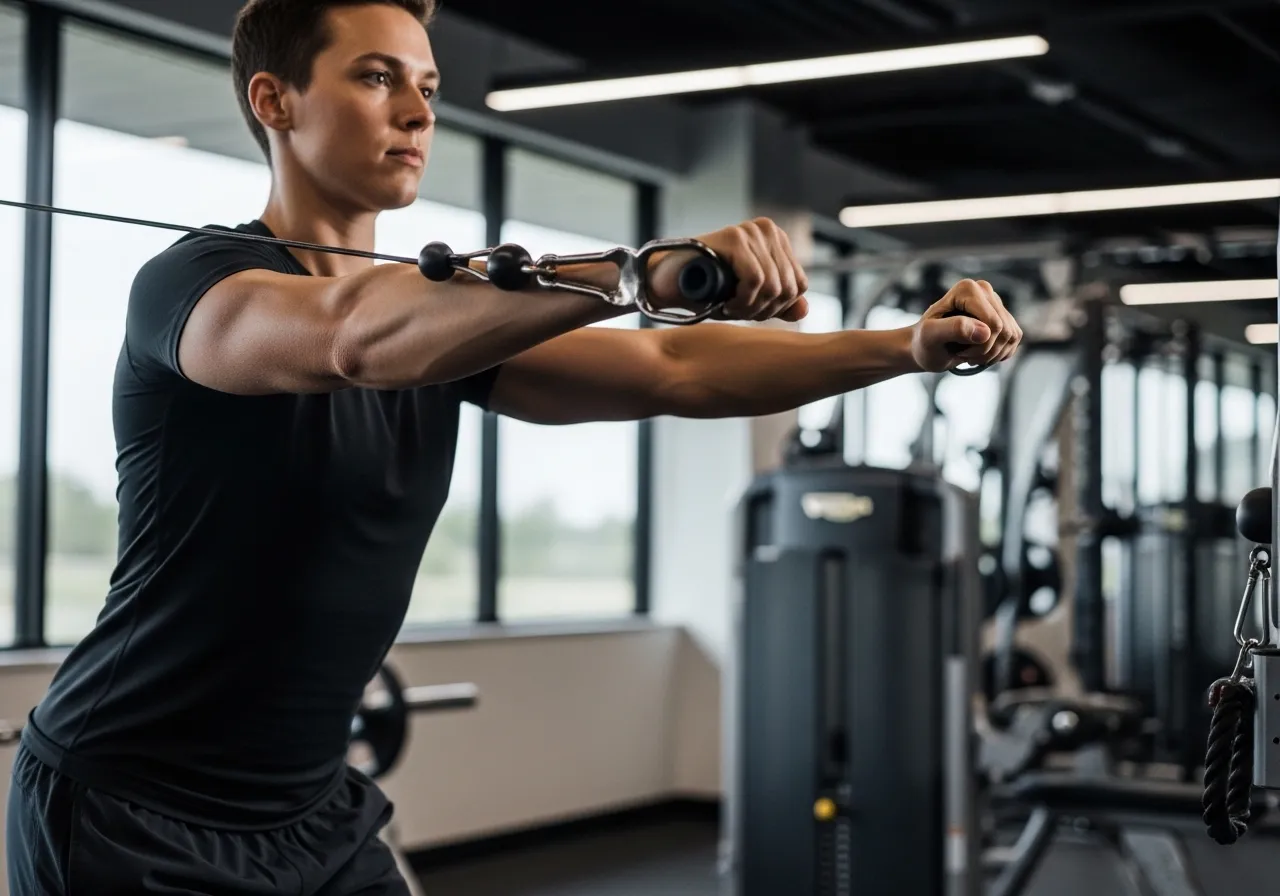
The cable lateral raise changes this equation. Constant tension throughout the range of motion, peak loading at the most mechanically demanding position, and the ability to precisely control resistance profile make it a fundamentally different stimulus than the dumbbell version.
This guide covers what the EMG research shows about deltoid activation, the mechanical differences between cable and dumbbell lateral raises, correct technique, and how to programme lateral raises for genuine medial deltoid development.
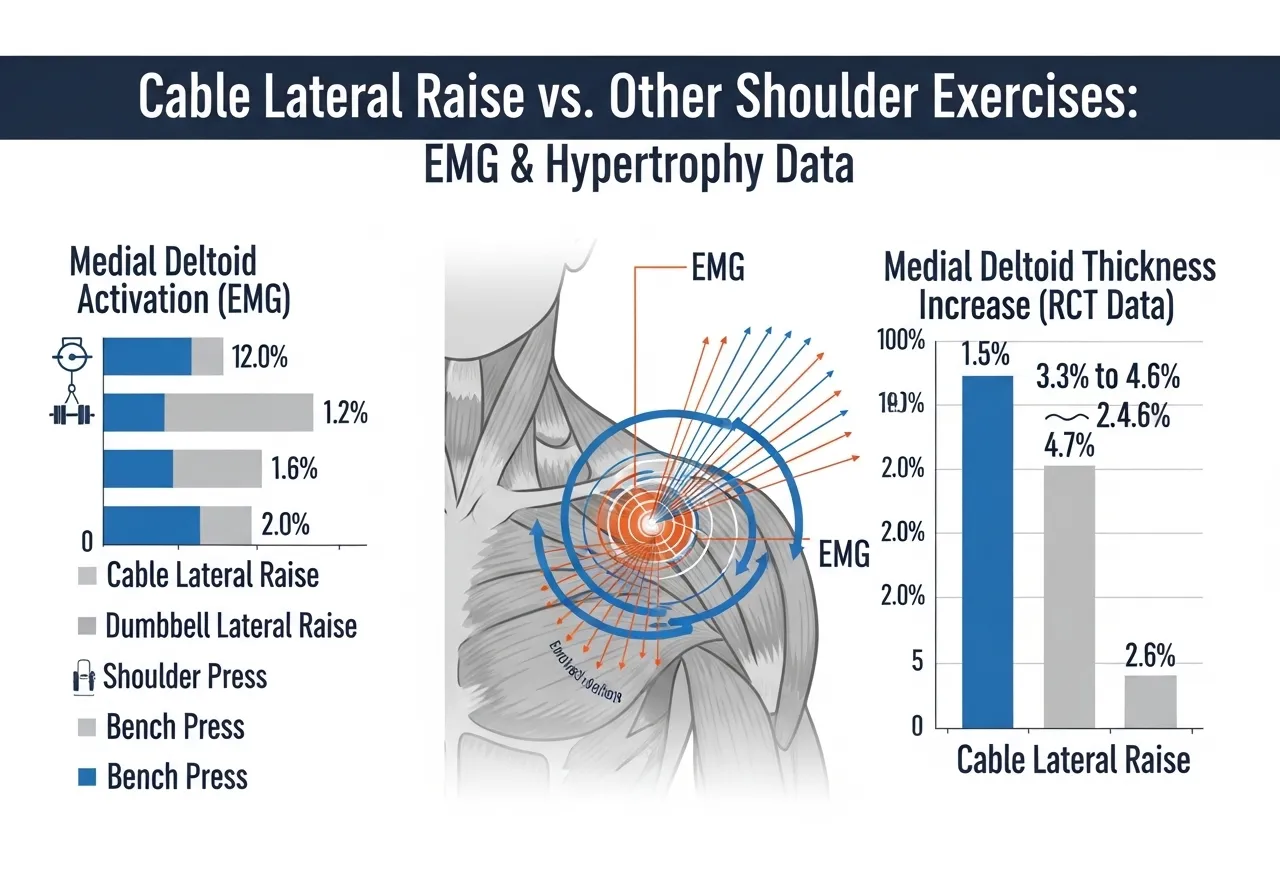
What the EMG Research Shows About Lateral Raise Muscle Activation
Lateral Raise vs Shoulder Press: Which Targets the Medial Deltoid?
📌 Key Finding
The lateral raise produces the highest medial deltoid activation of all four exercises tested including the shoulder press. No pressing variation can substitute for lateral raise work when medial deltoid development is the goal.
📌 Key Finding
The three deltoid heads respond to different exercise stimuli. Anterior deltoid is trained heavily by pressing. Posterior deltoid by rowing and face pulls. Medial deltoid requires direct lateral raise work that pressing movements cannot replace.
Cable vs Dumbbell Lateral Raise: The Hypertrophy Evidence
📌 Key Finding
Cable and dumbbell lateral raises produce equivalent lateral deltoid hypertrophy when range of motion and volume are matched. The cable’s advantage is practical: it allows consistent tension at the bottom position where dumbbells provide near-zero resistance.
Cable vs Dumbbell Lateral Raise: The Mechanical Differences That Matter
The Resistance Profile Problem With Dumbbells
The dumbbell lateral raise creates a resistance curve dictated by gravity. At the bottom of the movement, the arm hangs at the side and the dumbbell provides almost no resistance to the medial deltoid. Resistance increases as the arm rises and peaks when the arm reaches horizontal, then decreases again if the movement continues beyond horizontal.
This means the medial deltoid receives minimal stimulus during the bottom third of the range, where it is at its longest and most stretched position. Most hypertrophy research suggests that training at longer muscle lengths produces equal or superior growth compared to training at shorter lengths. The dumbbell lateral raise structurally underloads the position where the medial deltoid is most stretched.
How Cable Changes the Resistance Curve
A cable set at ankle height or floor level creates a different resistance profile. As the arm rises from the side, the cable angle creates increasing tension throughout the bottom portion of the range. The medial deltoid receives meaningful resistance even at the starting position where the arm hangs at the side.
This is the cable lateral raise’s primary practical advantage: it loads the stretched position of the medial deltoid that the dumbbell version structurally underloads. Whether this produces greater hypertrophy than the dumbbell version when volume is matched is currently inconclusive, as the RCT evidence above shows. The advantage is consistency of stimulus and reduced momentum use, not a definitive hypertrophy superiority.
The Practical Comparison
Factor
Cable
Dumbbell
Resistance at bottom
Moderate (cable tension)
Near zero (gravity)
Resistance at horizontal
High
Peak (maximum)
Momentum control
Easier (cable friction)
Harder (free weight)
Unilateral ease
Excellent
Good
Load increments
Fine (1-2 kg stacks)
Coarser (2-4 kg jumps)
Hypertrophy outcome
Equivalent (RCT evidence)
Equivalent (RCT evidence)
Cross-Body Cable Lateral Raise: The Stretched Position Variation
The cross-body cable lateral raise sets the cable on the opposite side of the body, so the working arm crosses in front of the torso at the starting position. This places the medial deltoid in a maximally stretched position at the bottom of the movement.
This variation is specifically designed to exploit the stretched position advantage that cable training allows. The arm starts crossed in front of the body, the cable pulling across and downward, and raises laterally against this tension. Many trainees find this variation produces a stronger medial deltoid contraction and superior pump compared to standard cable lateral raises, which is consistent with the loaded stretch stimulus that recent hypertrophy research supports.
Cable Lateral Raise Technique: Setup and Execution
⚠️ Shoulder and Elbow Safety Note The lateral raise places the shoulder in abduction with internal rotation, a position that can provoke subacromial impingement in individuals with existing rotator cuff pathology or a narrow subacromial space. If lateral raise movements produce sharp pain rather than a burning sensation in the lateral deltoid, reduce the range of motion, check internal rotation technique, or obtain assessment before continuing. The elbow should remain slightly bent throughout to reduce stress on the elbow joint under load.
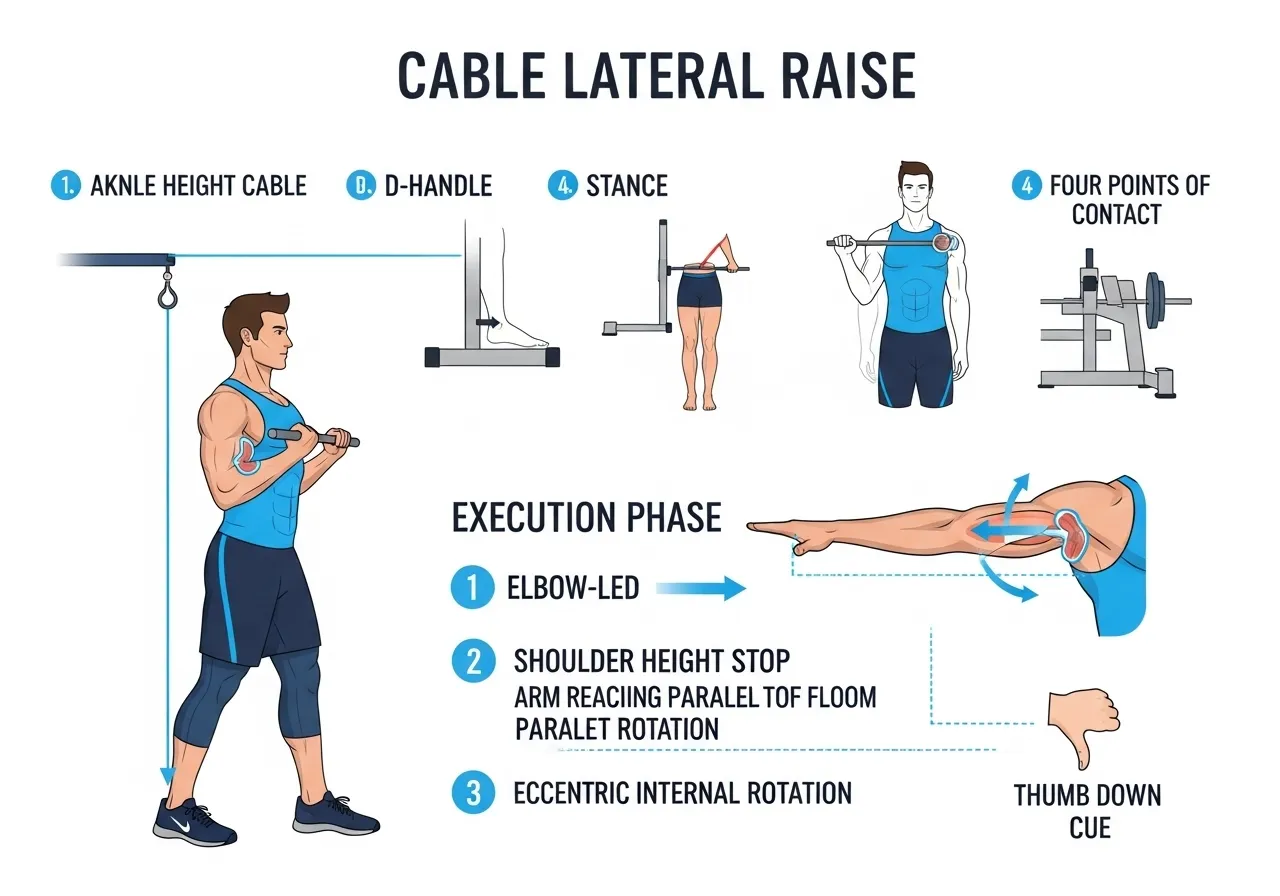
Standard Cable Lateral Raise: Setup
1. Cable height: Set the cable attachment at ankle height or floor level. Higher cable positions reduce the stretch on the medial deltoid at the bottom position. 2. Handle: Use a single D-handle or rope attachment. Stand sideways to the cable stack with the working arm closest to the cable. 3. Starting position: Hold the handle with the arm at the side, elbow slightly bent at approximately 15 to 20 degrees. Do not lock the elbow. The slight bend keeps tension on the deltoid rather than the elbow joint throughout. 4. Stance: Stand far enough from the cable stack to create tension at the starting position. The cable should not be slack at the bottom. Lean slightly away from the cable to increase this initial tension.
The Execution: 3 Technical Points That Determine Whether the Medial Deltoid Works
Lead with the elbow, not the wrist: The medial deltoid abducts the humerus. If the wrist leads the movement, the forearm acts as a lever and the load shifts to the upper trapezius. The elbow should be the highest point throughout the raising portion. Imagine pouring water out of a jug held at the side: the elbow rises and the wrist drops slightly.
Stop at shoulder height: Raising above shoulder height shifts load to the upper trapezius and supraspinatus. The medial deltoid is maximally active at roughly 70 to 90 degrees of shoulder abduction. Stopping at shoulder height keeps the stimulus on the target muscle.
Control the descent: The eccentric phase should take 2 to 3 seconds. Lowering under control rather than dropping the weight back to the start produces more total time under tension and greater hypertrophic stimulus per set.
Internal Rotation: The Technique Detail Most Guides Ignore
At the top of the lateral raise, the thumb should point slightly downward, as if emptying a jug. This internal rotation of the humerus is not a mistake. It is the correct position for medial deltoid activation at the top of the range.
Trainees who perform lateral raises with the thumb pointing up or neutral at the top are performing shoulder abduction with external rotation. This position recruits the supraspinatus more heavily and shifts load away from the medial deltoid. The “thumb down” position at the top maximises medial deltoid activation throughout the raising phase.
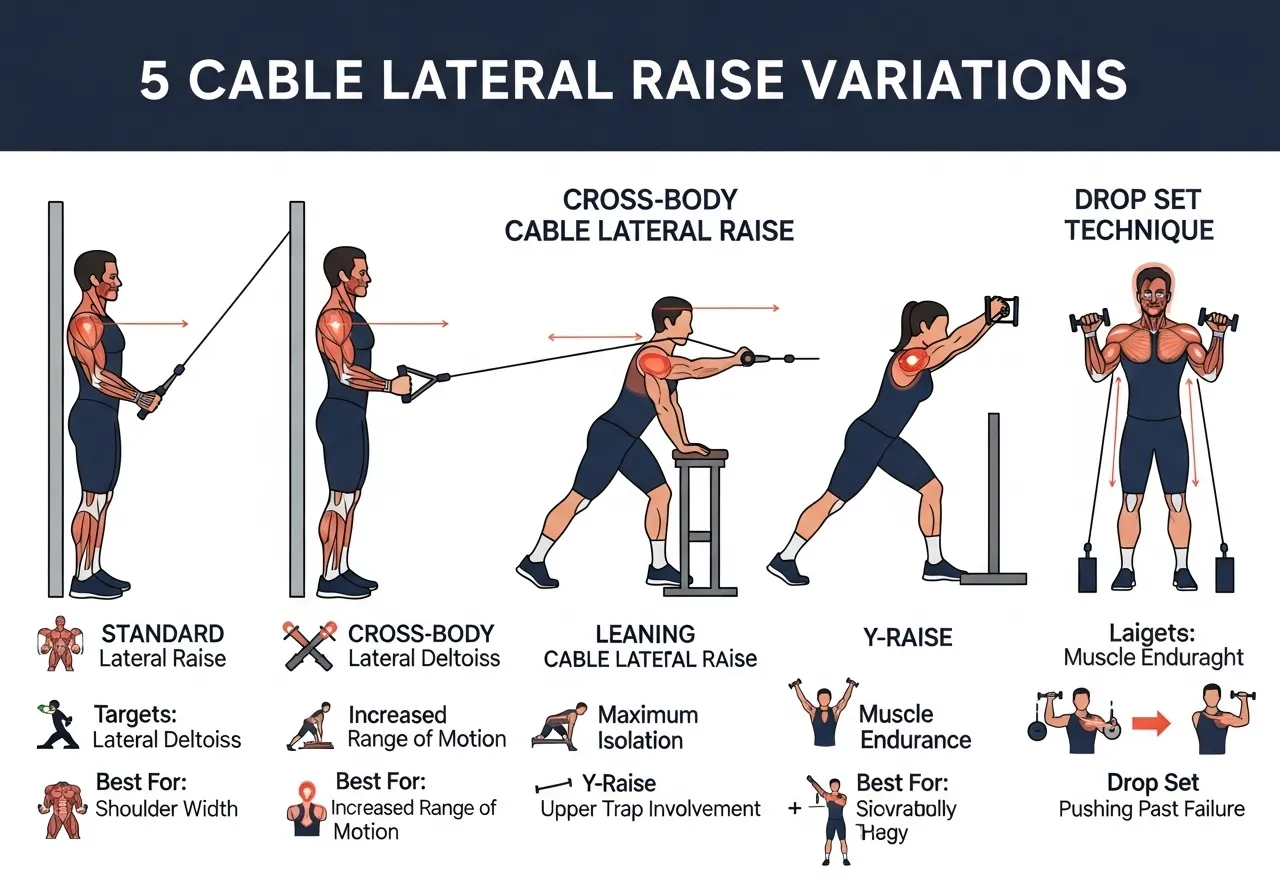
Cable Lateral Raise Variations for Complete Shoulder Development
How: Stand sideways to the cable, cable at ankle height. Raise the working arm laterally to shoulder height with elbow slightly bent. Lower under control over 2 to 3 seconds. Perform all reps on one side before switching.
Best for: Primary medial deltoid development, beginners to cable lateral raises, high-rep volume work at the end of shoulder sessions.
🏋️ 2. Cross-Body Cable Lateral Raise
Target: Medial deltoid, maximised stretched position loading
How: Set cable on the opposite side of the body. Reach the working arm across the torso to hold the handle. Raise laterally from this crossed position, allowing the arm to travel from in front of the opposite hip to shoulder height on the working side.
Best for: Trainees seeking maximum stretched position loading, anyone who finds standard lateral raises produce more trap activation than deltoid activation.
🏋️ 3. Leaning Cable Lateral Raise
Target: Medial deltoid, increased range of motion
How: Hold the cable stack upright with the non-working hand for support. Lean away from the cable stack at 15 to 20 degrees. This increases the effective range of motion at the bottom and allows the arm to travel further below horizontal before tension drops. Perform lateral raises from this leaned position.
Best for: Intermediate to advanced trainees seeking greater range of motion stimulus, adding variety to avoid adaptation plateau.
🏋️ 4. Cable Y-Raise
Target: Lower and middle trapezius, medial deltoid, posterior deltoid
How: Set the cable at floor level. Stand facing the cable stack. Raise both arms simultaneously at a 30-degree angle from the midline, forming a Y shape at the top. This angle engages the lower trapezius and scapular stabilisers more than a pure lateral raise.
Best for: Shoulder health and scapular stability work, face pull alternatives, upper back and deltoid combined stimulus. For a complete face pull programming guide, the face pull guide covers scapular health programming in detail.
🏋️ 5. Cable Lateral Raise Drop Set
Target: Medial deltoid metabolic fatigue, high-rep extended set
How: Perform a working set to near failure, then immediately reduce the weight by 30 to 40% and continue for additional reps. Two to three drop sets can be performed in sequence. The cable stack makes drop sets significantly faster to execute than dumbbell alternatives.
Best for: Final sets of a shoulder session when maximising metabolic stress and time under tension is the goal. Not recommended as the primary training approach due to recovery demands.
The Common Cable Lateral Raise Errors That Shift Load Away From the Medial Deltoid
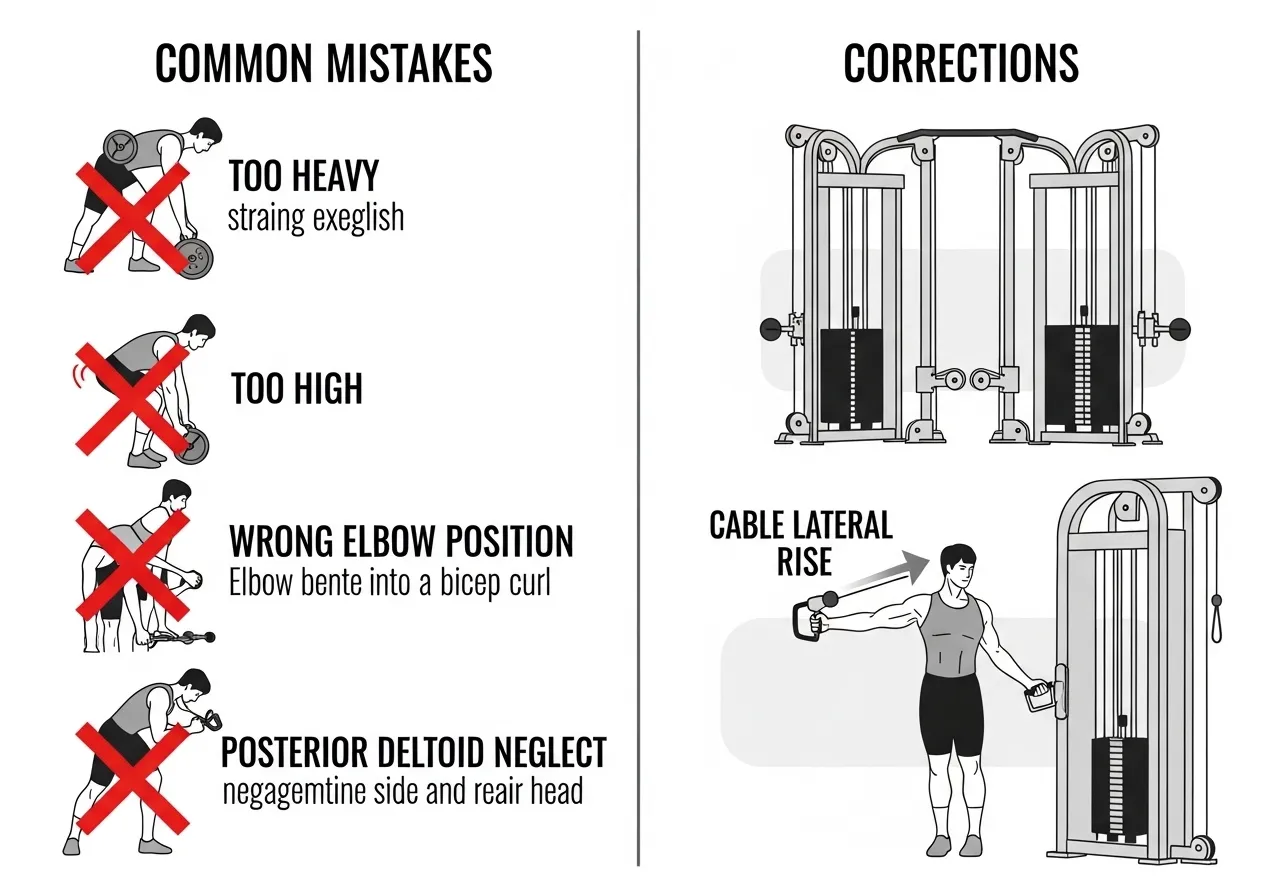
Error 1: Using Too Much Weight
The medial deltoid is a relatively small muscle with a limited moment arm during lateral abduction. The load that produces genuine medial deltoid fatigue across 12 to 15 reps is almost always lighter than trainees expect.
When the weight is too heavy, the movement pattern changes: the torso sways, the upper trapezius shrugs to assist the raise, and the medial deltoid contributes a smaller proportion of the total force. The exercise becomes a trap and upper body rock rather than an isolation movement.
The correct weight for cable lateral raises feels almost embarrassingly light initially. A set of 15 controlled reps where the lateral deltoid burns intensely by rep 12 and genuine failure occurs at rep 15 to 18 is the target. For most trainees, this is significantly less than their intuitive weight selection.
Error 2: Raising the Cable Too High
Raising the arm above shoulder height during a lateral raise is a common error driven by the desire to feel like more work is being done. Above shoulder height, the upper trapezius becomes the primary mover and the medial deltoid is no longer the limiting factor.
The medial deltoid has its peak moment arm at approximately 70 to 90 degrees of shoulder abduction, which corresponds to arm horizontal. Beyond this point, the exercise becomes a trap exercise. Stopping at shoulder height and returning under control produces more medial deltoid stimulus per rep than swinging through a larger range where the target muscle is no longer working hardest.
Error 3: Incorrect Elbow Position
Two elbow errors are common. The first is a fully locked elbow, which transfers load to the elbow joint under the cable tension and risks elbow discomfort. The second is excessive elbow bend, where the elbow is bent to 90 degrees or more, which shortens the moment arm and reduces the load on the medial deltoid per kilogram of cable weight.
The correct elbow position is a fixed, slight bend of approximately 15 to 20 degrees maintained consistently throughout the movement. This protects the elbow joint while keeping the moment arm close to optimal for medial deltoid loading.
Error 4: Neglecting the Posterior Deltoid
Complete shoulder development requires all three deltoid heads: anterior, medial, and posterior. Cable lateral raises address the medial deltoid. Pressing movements address the anterior deltoid. The posterior deltoid requires specific rowing and rear delt fly movements.
Trainees who perform extensive lateral raise work without equivalent posterior deltoid work develop a muscle imbalance that manifests as forward shoulder posture and increased anterior shoulder impingement risk. Face pulls, rear delt cable flies, and high rows are the primary posterior deltoid developers. The overhead press guide covers how pressing volume distributes across all three deltoid heads and how to balance the overall shoulder programme.
Programming Cable Lateral Raises for Shoulder Width Development
Sets, Reps, and Frequency
The medial deltoid responds well to moderate-to-high rep ranges and higher frequency compared to larger muscle groups. The following programming guidelines are based on current hypertrophy research for smaller muscle groups:
Rep range: 12 to 20 reps per set. The medial deltoid is a relatively small muscle that fatigues rapidly under load. Lower rep ranges with heavier weight tend to produce more trap and delt recruitment across the board rather than isolation.
Sets per week: 12 to 20 working sets per week for trainees prioritising shoulder width. Beginners can achieve results with 8 to 12 sets. Advanced trainees may use 16 to 20 sets.
Frequency: 2 to 3 sessions per week. The medial deltoid recovers faster than larger muscle groups. Spreading the weekly volume across two to three sessions produces better results than concentrating it in a single weekly shoulder session.
Where Cable Lateral Raises Fit in a Shoulder Session
Cable lateral raises belong after the primary compound shoulder exercises, specifically after the overhead press and any other multi-joint shoulder pressing work. Performing lateral raises before pressing movements pre-fatigues the medial deltoid and reduces pressing performance without producing additional shoulder development benefit.
A practical shoulder session order: overhead press (compound primary) then cable lateral raises (isolation secondary) then face pulls or rear delt work (posterior deltoid). For complete programming context on how overhead pressing and lateral raise work interact, the dumbbell shoulder press guide covers pressing volume and how to integrate isolation work effectively.
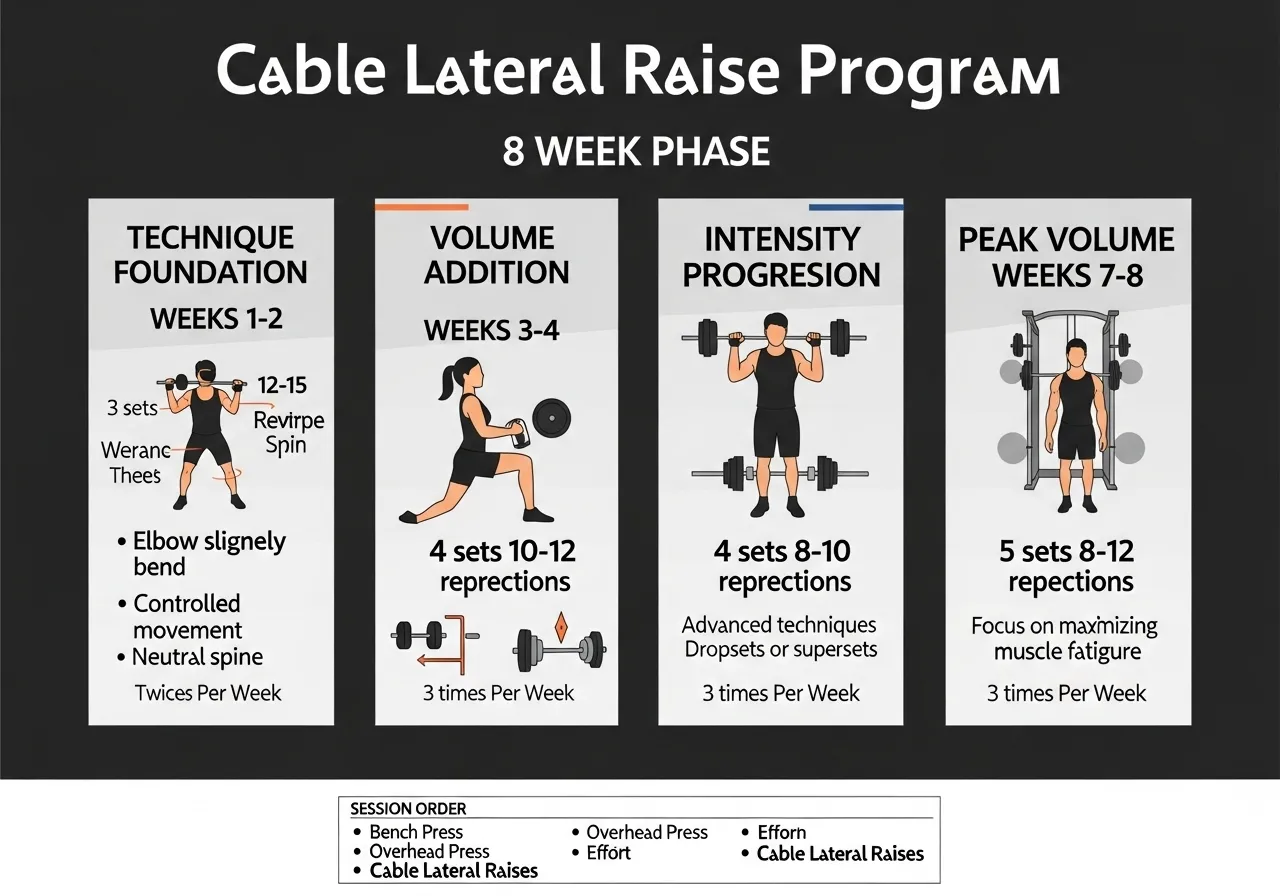
8-Week Cable Lateral Raise Progression
📅 Weeks 1 to 2: Technique Foundation
Standard cable lateral raise: 3 sets of 15 reps per side, controlled tempo
Load: start lighter than feels necessary. Technique first.
📅 Weeks 3 to 4: Volume Addition
Standard cable lateral raise: 4 sets of 15 reps per side
Add cross-body cable lateral raise: 2 sets of 12 per side as second variation
Total lateral raise sets per session: 6
📅 Weeks 5 to 6: Intensity Progression
Standard cable lateral raise: 4 sets of 12 to 15 reps, increase load by 1 to 2 kg from Weeks 3 to 4
Leaning cable lateral raise: 3 sets of 12 per side for extended range stimulus
Add 1 drop set on the final standard set each session
📅 Weeks 7 to 8: Peak Volume
Standard cable lateral raise: 4 sets of 12 to 15 reps
Cross-body cable lateral raise: 3 sets of 12 per side
Cable Y-raise: 3 sets of 15 for posterior deltoid and trap balance
Total working sets per session: 10
Frequently Asked Questions About Cable Lateral Raises
How heavy should I go on cable lateral raises?
Light enough to maintain pure medial deltoid control for 12 to 15 reps without the torso swaying or the upper trapezius shrugging. For most trained individuals, this is 5 to 15 kg on a cable stack for unilateral work.
The correct load produces an intense burning sensation in the lateral deltoid by the final third of the set. If the burning sensation is primarily in the upper trap rather than the lateral deltoid, the weight is too heavy or the technique is breaking down. Reduce the load before continuing.
Are cable lateral raises better than machine lateral raises?
Both produce effective medial deltoid stimulus. The cable provides greater freedom of movement and allows multiple variation options including cross-body and leaning positions. The machine provides a fixed movement path that some trainees find easier to control and reduces the skill requirement of the exercise.
For trainees who struggle to feel the medial deltoid working during free cable lateral raises, the machine can be a useful teaching tool to establish the mind-muscle connection before returning to cable variations. Neither is definitively superior for hypertrophy when volume and proximity to failure are equated.
How do I know if my upper trap is taking over during lateral raises?
The primary indicator is where you feel the exercise. Medial deltoid work produces a burning sensation in the outer middle portion of the shoulder, directly above the lateral edge of the acromion. Upper trap overactivation produces fatigue and pump in the muscle running from the neck to the shoulder tip.
If you feel lateral raises in your neck or the ridge from neck to shoulder rather than the lateral shoulder, the trap is dominating. Common causes are excessive weight, shrugging at the start of the movement, or insufficient shoulder packing before beginning the raise. Depress the shoulder blade actively before each rep to inhibit the upper trap and force the deltoid to initiate the movement.
Can I train lateral raises every day?
Daily lateral raise training is practised by some competitive bodybuilders and produces results at high training frequencies. For recreational trainees, two to three sessions per week with adequate recovery between sessions produces the best combination of stimulus and recovery for most individuals.
If performing lateral raises daily, volume per session must be reduced to prevent cumulative shoulder joint stress. Two to three sets per session daily is manageable. Six to eight sets per session daily accumulates more joint stress than most trainees can recover from without negative effects on shoulder health.
Key Takeaways
The lateral raise produces the highest medial deltoid activation of all shoulder exercises tested, including the shoulder press. No pressing variation substitutes for lateral raise work.
Cable and dumbbell lateral raises produce equivalent lateral deltoid hypertrophy when range of motion and volume are matched. The cable’s practical advantage is constant tension at the bottom and easier load incrementation.
Lead with the elbow, stop at shoulder height, and control the eccentric for 2 to 3 seconds. These three technique points determine whether the medial deltoid or the upper trapezius receives the training stimulus.
The cross-body cable lateral raise maximises stretched-position loading of the medial deltoid and is the preferred variation for trainees who find standard lateral raises produce more trap than deltoid activation.
Programme lateral raises after pressing work, at 12 to 20 reps per set, across 2 to 3 sessions per week for complete medial deltoid development.
⚠️ Health & Fitness DisclaimerThis article is for general educational purposes only and does not replace professional medical advice. If you have any shoulder, back, or joint conditions, please consult a qualified healthcare professional before beginning a Smith machine vs free weights program. The Smith machine — a barbell constrained to a vertical or near-vertical…
Bent-over rows are one of the best back exercises in existence. They are also one of the most commonly cheated exercises in existence. Watch the average trainee perform a set of heavy bent-over rows. The torso rises with each rep. The legs drive at the bottom. The lower back extends to swing the weight through…
The barbell row is the standard back thickness exercise. It allows heavy loading, trains the entire posterior chain, and has decades of proven effectiveness. Most serious lifters include it and most serious lifters plateau with it eventually. The plateau often has a simple mechanical explanation: the pronated (overhand) grip and horizontal torso position of the…
⚠️ Health & Fitness DisclaimerThis article is for general educational purposes only and does not replace professional medical advice. If you have any shoulder, elbow, or back conditions, please consult a qualified healthcare professional before beginning a cable machine mastery guide program. The cable machine is the most versatile piece of resistance training equipment in…
The dumbbell lateral raise is the standard side deltoid exercise for generations. It is available in any gym, requires no special equipment, and has a clear movement pattern that most trainees learn quickly. It also has a fundamental mechanical limitation: the resistance is zero at the bottom of the movement and maximum at the point…
⚠️ Fitness Disclaimer: The information in this article is for general educational purposes only and does not constitute professional fitness or medical advice. Always consult a qualified healthcare professional before starting any new exercise program, especially if you have existing injuries or medical conditions. The Exercise That Changed How I Understood Glute Training For the…