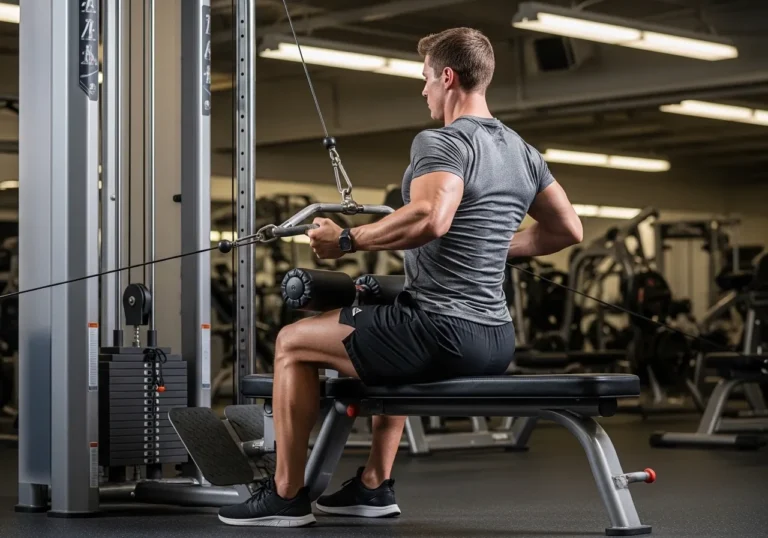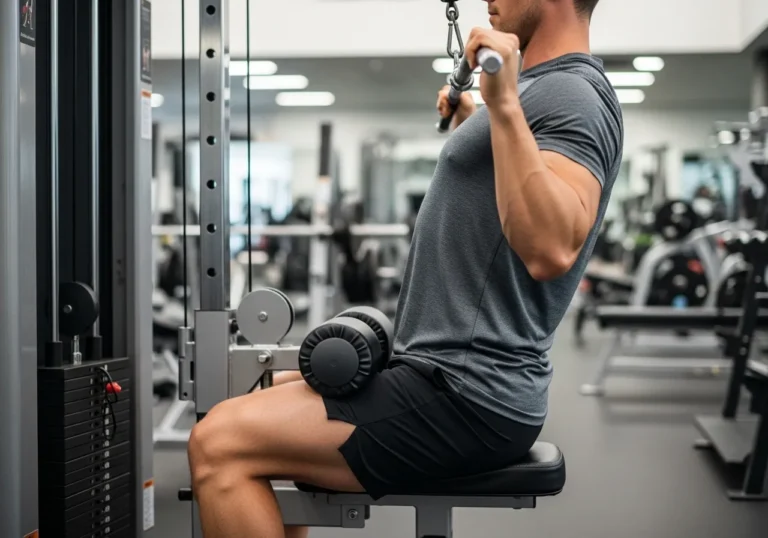
Overhead Tricep Extension: Why the Long Head Needs a Stretched Position and How to Train It at Every Level
Most trainees who train their triceps consistently still have underdeveloped long heads. The side view reveals it: the arm looks defined from the front but lacks the depth and thickness that separates a well-developed tricep from a merely trained one.
The reason is almost always the same. The programme includes pushdowns, close-grip bench press, and dips. These are legitimate tricep exercises. They are also exercises that train the tricep at shortened or neutral muscle length, providing inadequate stimulus to the long head specifically. The long head is the largest of the three tricep heads and the only one that crosses the shoulder joint. This anatomical fact has a direct training implication: the long head only receives maximal stimulus when the arm is elevated and the shoulder joint places the muscle in a lengthened position.
Overhead tricep extensions achieve this. This guide covers what the hypertrophy research shows about overhead versus neutral position training, the anatomy that explains the result, technique for the five most effective variations, and level-by-level programming for beginners, intermediate, and advanced trainees.
The Research: Overhead Position Produces Substantially Greater Tricep Hypertrophy
The Key Study: Overhead vs Neutral Elbow Extension
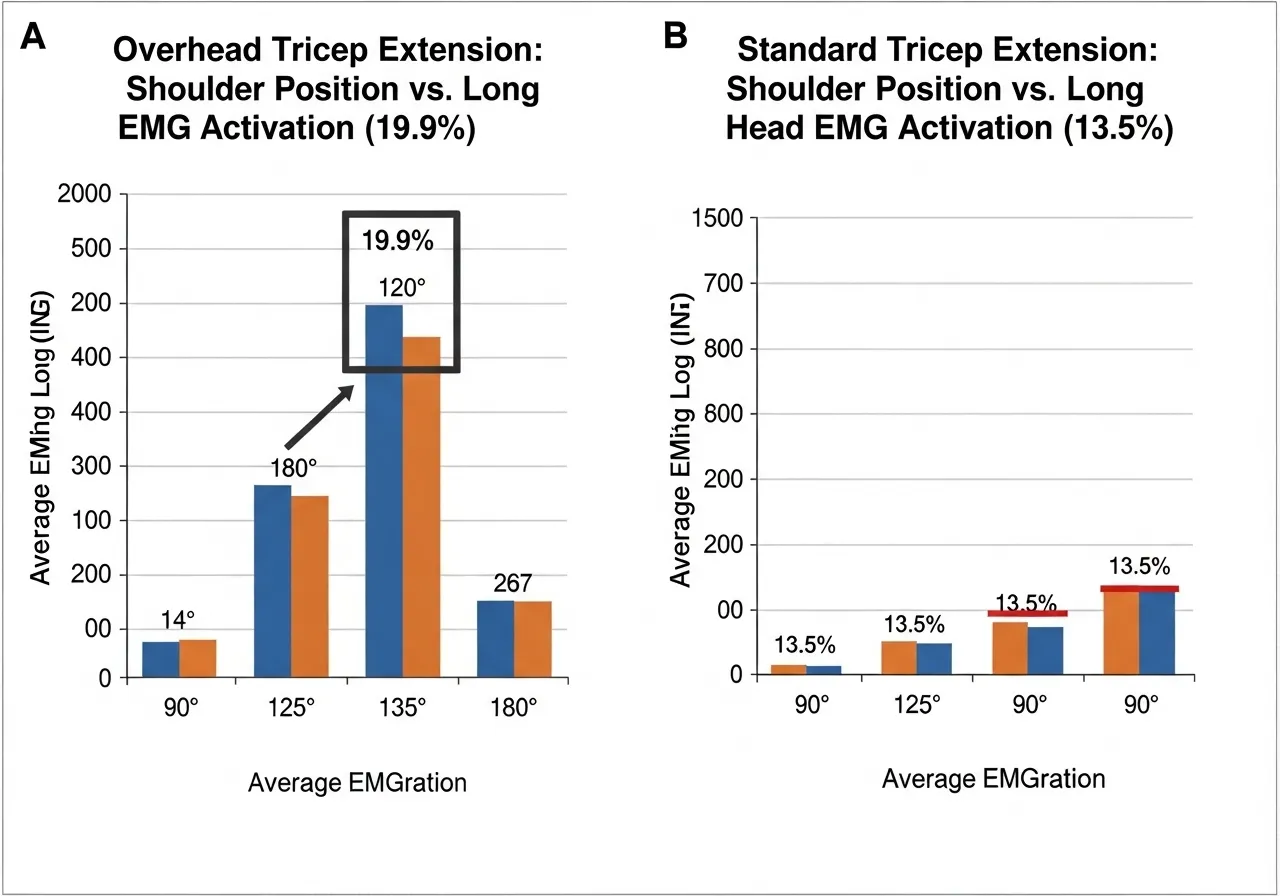
A study comparing tricep brachii hypertrophy after elbow extension training performed in the overhead versus neutral arm position found that elbow extension training with the arm in the overhead position produced substantially greater triceps brachii hypertrophy compared to the neutral arm position, with the overhead group showing overall tricep hypertrophy of 19.9 percent compared to 13.5 percent in the neutral group over 12 weeks, with the long head showing particularly pronounced differences because the biarticular triceps brachii long head is lengthened more in the overhead than the neutral arm position, producing a stretch-mediated hypertrophy stimulus that neutral position training cannot provide.
Overhead position tricep training produced 19.9% hypertrophy vs 13.5% in the neutral position over 12 weeks. The difference is not marginal. Trainees who train triceps exclusively with pushdowns and neutral-position extensions are leaving significant long head development on the table.
Why Shoulder Position Changes Hypertrophy
The tricep long head originates on the infraglenoid tubercle of the scapula, above the shoulder joint. Because it crosses the shoulder joint, its length changes with shoulder position in a way the medial and lateral heads’ lengths do not. When the shoulder is elevated in the overhead position, the long head is stretched across both the shoulder and elbow joints simultaneously, placing it near its maximum length.
Training muscles in their lengthened position produces greater hypertrophy than training at shortened length through two mechanisms. First, the passive elastic tension added by the stretched connective tissue increases total force at the lengthened position, creating a greater mechanical loading stimulus per contraction. Second, the muscle damage associated with eccentric loading under stretch, which occurs during the return phase of an overhead extension, produces a hypertrophy signal that neutral-position training does not generate at the same intensity.
EMG Evidence: Shoulder Position and Long Head Activation
A study comparing electromyographic activity of tricep brachii heads during overhead versus lying dumbbell elbow extension found that the shoulder position significantly affects the electromyographic signal distribution between the long head and lateral head of the triceps brachii during dumbbell elbow extension exercises, with the overhead position eliciting distinct activation profiles across different ranges of motion compared to the lying position, confirming that exercise selection based on shoulder position meaningfully changes which tricep head receives primary stimulus.
Shoulder position measurably changes EMG distribution between the long and lateral tricep heads. The overhead position creates a distinct activation profile favouring the long head that the lying or neutral position cannot replicate.

Beginner Level: Building the Foundation and Learning the Pattern
The Beginner Challenge
Beginning trainees face two challenges with overhead tricep extensions that intermediate and advanced trainees do not. First, shoulder mobility and stability adequate to hold the arms overhead under load may not yet exist. Attempting heavy overhead extension before developing overhead mobility creates shoulder impingement patterns that make the exercise genuinely uncomfortable and reduce the range of motion available.
Second, the mind-muscle connection with the tricep long head is difficult to establish without experience. Beginners consistently feel overhead extensions in the elbows and shoulders before the tricep, because the elbows are working at an unusual angle and the shoulder stabilisers are under novel load. Starting with very light loads and focusing on the tricep sensation rather than the weight moved builds the neural connection that makes heavier loads productive later.
Recommended Beginner Variations
🏋️ Seated Dumbbell Overhead Extension (Both Hands)
Target: Tricep long head, overhead mobility development
How: Sit on a bench with back support. Hold one dumbbell with both hands, palms against the inner plate. Raise the dumbbell overhead with elbows pointing forward. Lower behind the head by bending the elbows to approximately 90 degrees. Return to full extension.
Why for beginners: The bilateral grip stabilises the load and requires less shoulder mobility than single-arm variations. The seated position removes balance demands and allows focus on the movement pattern. Begin at a weight that allows 12 to 15 controlled reps.
Beginner Programming
For beginners adding overhead tricep work to an existing programme: 2 to 3 sets of 12 to 15 reps, twice per week, after primary pressing movements. The low rep ranges and high repetitions build the movement pattern without excessive elbow joint stress. The pressing work that precedes it (bench press, shoulder press, dips) pre-activates the tricep, making the subsequent overhead work feel more connected and productive. The bench press and its tricep contribution relative to chest work is covered in the barbell bench press guide.
Intermediate Level: Adding Cable Variations and Addressing the Weak Points
Why Cable Changes the Stimulus
A study examining electromyographic activity during cable versus dumbbell exercises found that the cable’s posterior anchor point and altered line of resistance changes the shoulder angle and length-tension relationship of the working muscle compared to dumbbell variations where resistance follows a vertical gravitational path, with the cable producing a constant tension throughout the range of motion that gravity-dependent dumbbell resistance cannot provide at certain joint angles.
Cable resistance provides constant tension throughout the full range of motion, including the bottom position where dumbbell resistance is minimal. For overhead tricep extensions, cable variations load the long head at its lengthened position continuously, not just at the top of the movement.
Recommended Intermediate Variations
🏋️ Single-Arm Cable Overhead Extension
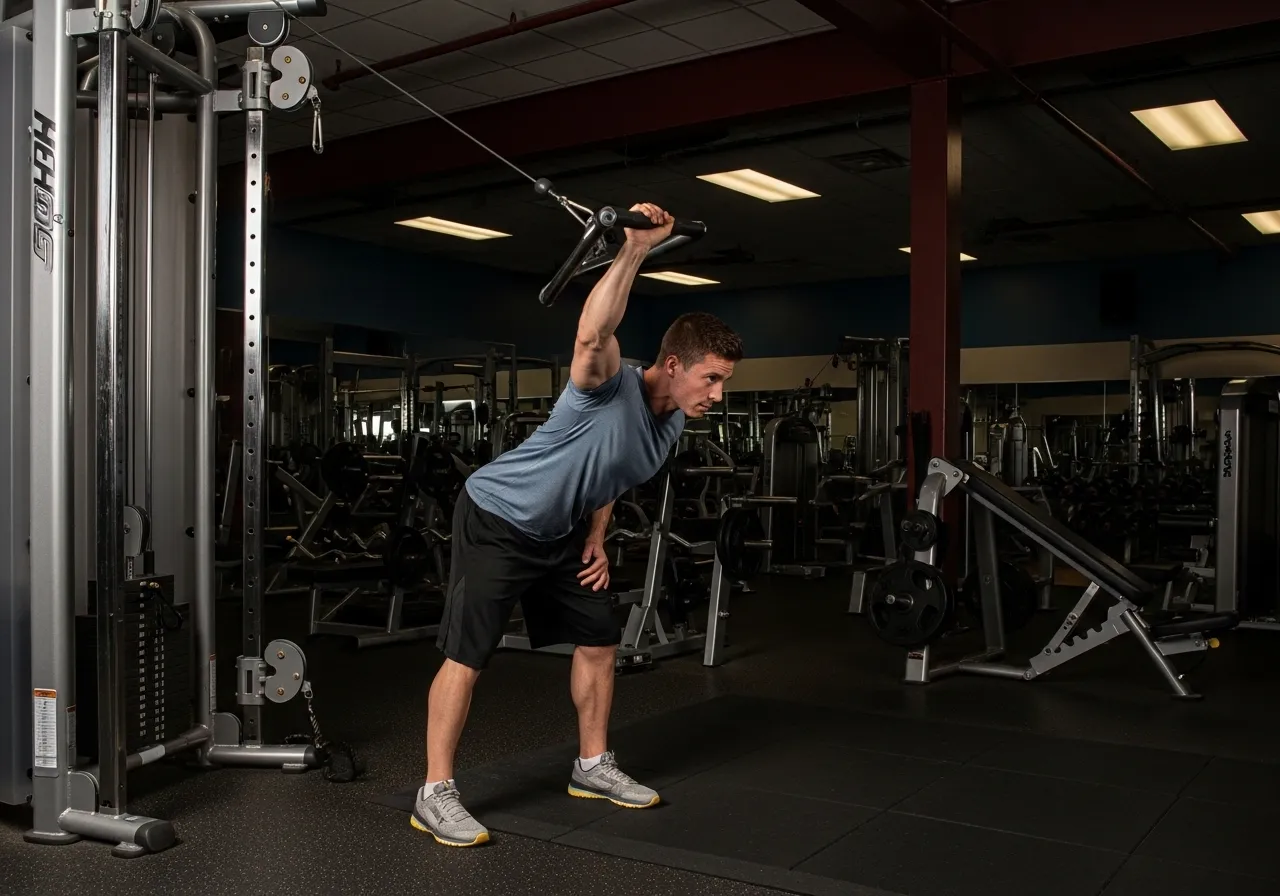
Target: Long head with constant tension, asymmetry detection
How: Set the cable at floor level. Stand facing away from the stack or sideways. Grab the single handle, raise the arm overhead, and extend from 90 degrees to full lockout. Keep the upper arm vertical throughout. Complete all reps on one side before switching.
Key point: The cable angle from below creates loading at the bottom-of-range stretched position that dumbbell variations lack. This makes single-arm cable overhead extensions the most complete long head stimulus available. If one arm consistently fatigues faster at matched loads, a genuine tricep strength asymmetry exists.
🏋️ EZ-Bar Skull Crusher (Lying Overhead Extension)
Target: Long head and all three tricep heads, heavy loading capacity
How: Lie on a flat bench. Hold an EZ-bar with a close, pronated grip directly above the chest. Lower the bar toward the forehead by bending only the elbows, keeping the upper arms vertical. Return to full extension. The EZ-bar reduces wrist stress compared to straight bar variations.
Key point: The skull crusher is the primary heavy loading vehicle for tricep long head development. The lying overhead position places the long head in its lengthened state. Allow progressive load increases across weeks.
Intermediate Programming
For intermediate trainees: 3 to 4 sets of 8 to 12 reps per variation, two variations per session, twice per week. Pair skull crushers as the primary heavy tricep movement with cable overhead extension as the secondary isolation movement. This combination covers both the mechanical stress of heavier loading and the constant-tension stimulus of cable work. The preacher curl and how it complements tricep isolation work for complete arm development is covered in the preacher curl guide.

Advanced Level: Maximising Long Head Development With Positioning and Load
The Advanced Challenge: Diminishing Returns and Stimulus Rotation
Advanced trainees who have trained overhead tricep extensions for years face a different problem than beginners and intermediate trainees. The movement is familiar, the long head is already well developed, and the stimulus from standard overhead extension variations produces less marginal hypertrophy than it once did. Advanced tricep development requires variation in the mechanical stimulus rather than simply adding more sets of the same exercises.
Two strategies extend long head development beyond the intermediate plateau. First, partial range of motion emphasis at the lengthened position, specifically performing reps only in the bottom half of the overhead extension where the long head is most stretched, creates a distinct stimulus from full-range training. Second, pausing at the fully stretched position for 2 seconds before the concentric phase increases the time under tension at the exact position where long head hypertrophy stimulus is greatest.
Advanced Variations
🏋️ Incline Dumbbell Overhead Extension
Target: Maximum long head stretch, shoulder-to-elbow loaded arc
How: Set an incline bench to 30 to 45 degrees. Lie back with the head at the top. Perform single or bilateral dumbbell overhead extensions in this inclined position. The incline increases the overhead position angle relative to gravity, deepening the long head stretch beyond what seated or standing overhead variations achieve.
Key point: The incline position is the most demanding overhead extension variation for the long head. Use it as the primary long head stimulus at lighter loads with controlled tempo rather than a heavy loading vehicle.
🏋️ Cable Rope Overhead Extension (Standing)
Target: Long head with bilateral rope grip, constant cable tension
How: Attach a rope to a low cable pulley. Face away from the stack. Hold the rope behind the head with both hands. Press the rope overhead to full extension, then lower under control to the stretched position. The rope allows the wrists to rotate at the bottom, which reduces forearm discomfort and allows a more comfortable bottom-of-range position.
Key point: The standing cable rope overhead extension allows heavier loads than single-arm cable variations while maintaining the constant tension advantage of cable resistance. For advanced trainees seeking both load and range stimulus simultaneously, this is the primary overhead extension vehicle.
Advanced Programming
For advanced trainees: 4 sets of 6 to 10 reps of skull crushers as the primary heavy stimulus, followed by 3 sets of 10 to 15 reps of a cable overhead variation, with a 2-second pause at the lengthened position on every rep. Weekly volume of 12 to 16 sets distributed across two sessions develops the long head without the elbow tendon overuse that comes from high-volume overhead extension performed without adequate recovery.

Overhead Tricep Extension Technique: The Details That Protect the Elbows and Maximise Long Head Stimulus
Overhead tricep extensions place the elbow joint in a fully flexed position under load at the bottom of the range. Individuals with active medial epicondylitis, olecranon bursitis, or tricep tendinopathy at the elbow should not perform overhead extension movements until symptoms resolve. Elbow pain during overhead extensions that cannot be attributed to unfamiliarity with the movement warrants assessment before continuing. Never lock out the elbow with an aggressive snap at the top of the movement. Control the lockout.
Upper Arm Position: The Most Critical Technical Variable
The upper arm must remain vertical and stationary throughout every rep of an overhead tricep extension. When the elbows flare outward and the upper arms drift away from vertical, two problems occur simultaneously. First, the exercise converts from an elbow extension into a combination of elbow extension and shoulder adduction, reducing the isolated long head stimulus. Second, the lateral stress on the elbow joint increases as the force vector shifts from axial to angular relative to the joint axis.
Keeping a narrow elbow position, elbows pointing toward the ceiling throughout the movement, is the single most important cue for both effectiveness and safety in overhead extension. A useful drill: perform a few reps with the free hand lightly touching the working elbow to provide tactile feedback whenever it flares. This immediate feedback builds the habit faster than visual observation in a mirror alone.
Range of Motion: Full Extension at the Top, Full Stretch at the Bottom
The full range of motion in overhead extension captures the two most productive moments of the exercise: the peak contraction at full elbow extension and the peak stretch of the long head at the bottom.
Cutting the range short at either end removes these key moments. Stopping before full extension at the top, or not allowing the elbows to fully flex at the bottom, removes the stimulus that drives most of the long head hypertrophy the exercise provides.
A common range compromise is stopping short at the bottom to avoid elbow discomfort. If the bottom position is genuinely uncomfortable rather than a stretch sensation, the load is too heavy for the mobility and strength currently available. Reduce the load until the full range is comfortable, then build load progressively from there.
Is the Overhead Extension Better Than Pushdowns for Tricep Development?
What Pushdowns Develop That Overhead Extensions Do Not
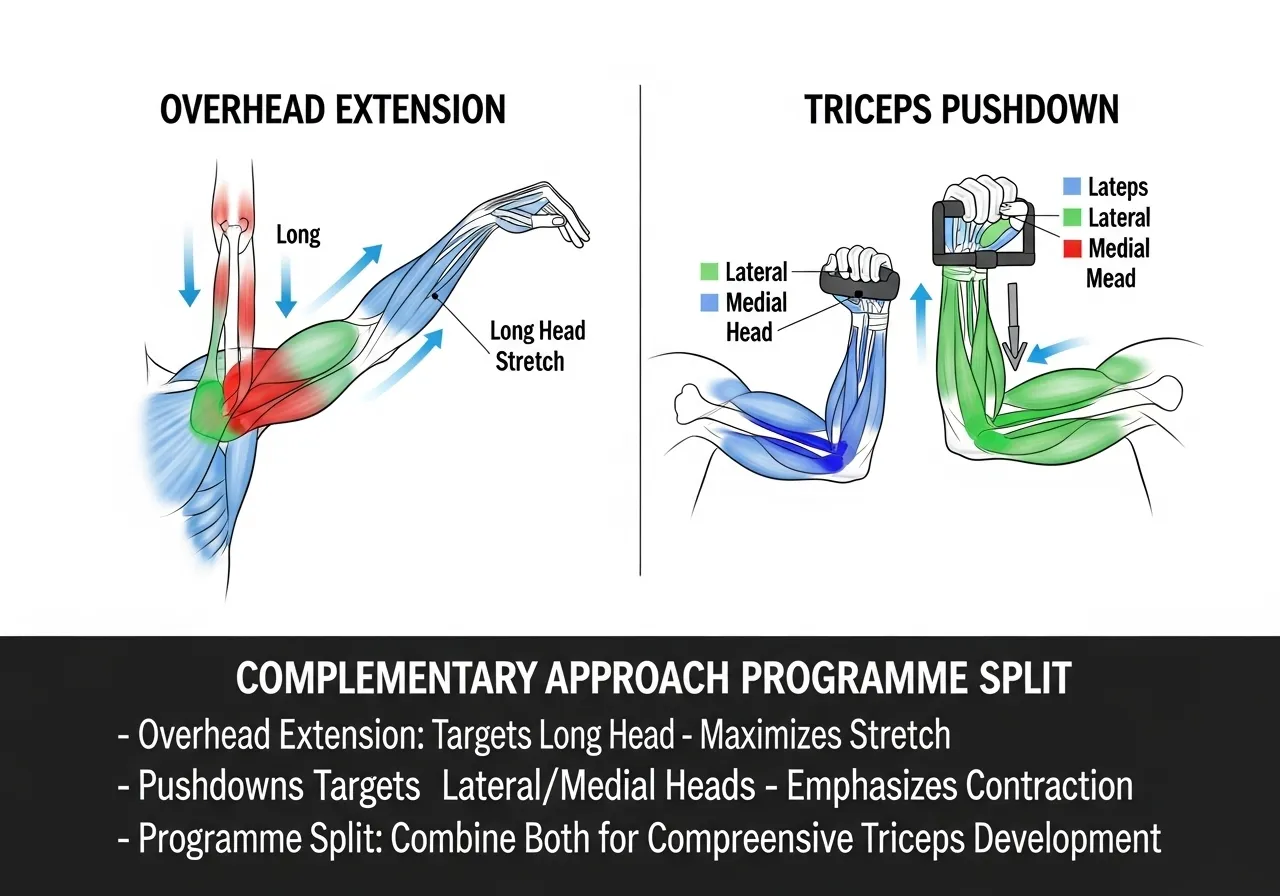
Cable pushdowns train the lateral and medial tricep heads at shortened muscle lengths with high resistance. They allow heavier relative loading than overhead variations because the shoulder is not elevated, the elbow joint position is more stable, and the movement pattern is more mechanically efficient. Pushdowns are the primary tricep strength development exercise for most trainees precisely because they allow the heaviest loads.
Pushdowns provide minimal long head stimulus because the shoulder is in a neutral or slightly extended position throughout, placing the long head at its shortened length where it contributes less to force production. For trainees whose tricep training consists exclusively of pushdowns and close-grip pressing, the long head is consistently undertrained regardless of total tricep training volume.
The Complementary Approach
The research evidence supports a clear conclusion: overhead extensions and pushdowns are not competing for the same adaptation. Overhead extensions develop the long head through stretched-position loading that pushdowns cannot provide. Pushdowns develop all three heads at shortened positions with heavier loads. A complete tricep programme uses both.
The practical split: skull crushers or cable overhead extensions as the primary long head stimulus (2 to 3 sets), followed by cable or rope pushdowns as the secondary all-head stimulus (2 to 3 sets). This combination addresses the full tricep across its range of motion requirements without excessive elbow joint volume from single-exercise overreliance.
Programming the Combination: A Weekly Structure
For trainees performing two tricep-focused sessions per week, the recommended structure alternates the primary overhead extension variation across sessions to reduce elbow tendon fatigue while maintaining stimulus frequency. Session one: skull crushers as the primary movement (4 sets of 6 to 10 reps) followed by rope pushdowns (3 sets of 12 to 15 reps). Session two: cable rope or single-arm overhead extension as the primary movement (3 to 4 sets of 10 to 15 reps) followed by bar pushdowns (3 sets of 10 to 12 reps).
This alternating structure ensures the long head receives direct overhead position stimulus every session through either the skull crusher’s lying overhead position or the cable overhead extension, while the pushdown variations train all three heads at their shortened position. The elbow joint never accumulates two consecutive sessions of the same overhead loading pattern, which is the primary cause of overhead extension-associated elbow tendinopathy in high-volume trainees.
5 Overhead Tricep Extension Variations: Complete Summary
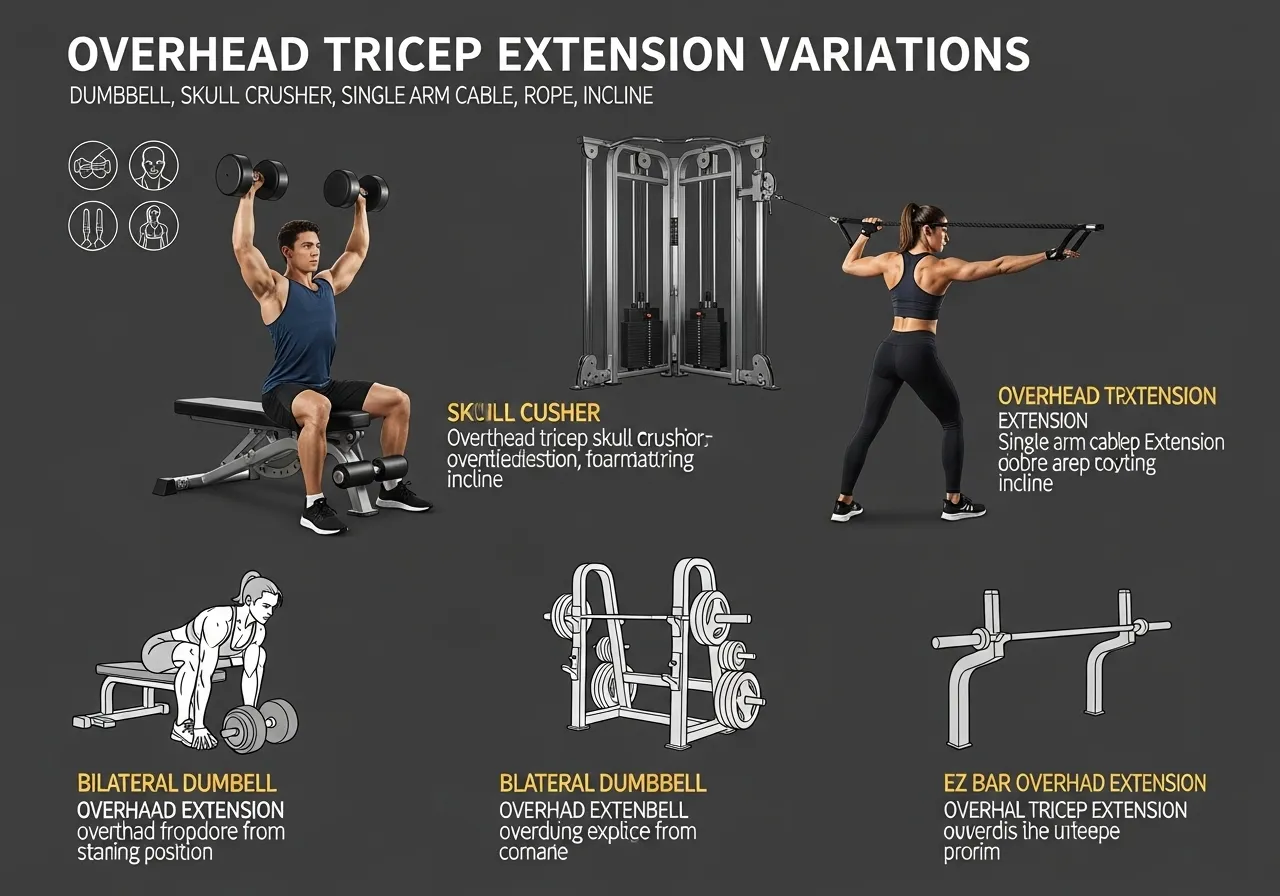
🏋️ 1. Seated Bilateral Dumbbell Overhead Extension
Best for: Beginners, mobility development, stable platform
Load range: 6 to 25 kg depending on strength level. Both hands on one dumbbell, back supported, elbows forward throughout.
🏋️ 2. EZ-Bar Skull Crusher
Best for: Intermediate to advanced, primary heavy loading vehicle
Load range: Start with the EZ-bar alone (typically 6 to 10 kg) and build progressively. Upper arms vertical and fixed throughout. Control the eccentric over 2 to 3 seconds.
🏋️ 3. Single-Arm Cable Overhead Extension
Best for: Intermediate, constant tension, asymmetry detection
Setup: Low cable, single handle. Standing facing away from stack. One arm at a time. Equal sets and loads each side.
🏋️ 4. Cable Rope Overhead Extension
Best for: Advanced, bilateral cable constant tension, comfortable wrist position
Setup: Rope attachment, low cable. Standing facing away. Rope behind head, bilateral press to full extension. Pause 1 to 2 seconds at stretched bottom position.
🏋️ 5. Incline Dumbbell Overhead Extension
Best for: Advanced, maximum long head stretch, specialisation
Setup: 30 to 45 degree incline bench, head at top. Lighter loads than standing/seated versions. Priority: depth of stretch over load.
Frequently Asked Questions About Overhead Tricep Extensions
How many overhead tricep extensions per week is enough?
For most trainees, 8 to 12 working sets per week of overhead tricep extension work provides sufficient long head stimulus without accumulating excessive elbow joint stress. Distribute these sets across two sessions per week rather than performing all volume in a single session.
The elbow joint tolerates overhead extension volume less well than pushdown volume because the overhead position creates a more demanding angle for the elbow tendons. Trainees who perform high weekly volumes of bench pressing, dipping, and pushing movements should keep overhead extension volume at the lower end of the range to manage cumulative elbow tendon load.
Can I do overhead tricep extensions every session?
Overhead tricep extensions can be performed at every training session if volume per session is moderate and the elbow joint receives adequate recovery. Two to three sets of overhead extensions per session, two to three sessions per week, is sustainable for most trainees. More than four sessions per week of overhead extension work accumulates elbow tendon stress that progressively reduces the quality of later sessions and eventually produces medial elbow symptoms.
The elbow’s tolerance for overhead extension volume is lower than its tolerance for pushdown volume because the overhead position creates a more demanding loading angle for the medial elbow tendons. Trainees who bench press three times per week and additionally want to add overhead extensions should monitor medial elbow comfort closely as the total weekly tricep-under-load volume increases beyond what the tendons have adapted to.
Why do I feel overhead tricep extensions in my shoulders instead of my triceps?
Shoulder sensation during overhead extensions almost always indicates that the upper arms are drifting forward or the elbows are flaring outward during the movement. When the upper arms are not vertical, the shoulder joint is asked to stabilise a load at an inefficient angle and receives the sensation that should belong to the tricep.
The fix: reduce the load significantly and focus entirely on keeping the elbows pointing straight up throughout the movement. A lighter weight with correct upper arm position will produce more tricep sensation than a heavier weight with drifting elbows. Once the correct position is established at light load, build load gradually without allowing the position to change.
Is it better to train triceps with heavier weight or lighter weight?
Both produce meaningful hypertrophy when taken close to failure. The research on resistance training load and hypertrophy consistently shows that loads from 30 to 85% of 1RM produce similar muscle growth when matched for proximity to failure. For overhead tricep extensions specifically, moderate loads of 50 to 70% of 1RM allowing 8 to 15 reps are practical for most trainees because they allow full range of motion and controlled eccentric without the elbow stress that very heavy overhead loading creates.
Skull crushers can be trained in lower rep ranges of 6 to 10 with heavier loads. Cable overhead extensions respond well to higher reps of 12 to 20 with lighter loads. Using different load ranges across the two primary overhead extension variations develops the long head through different mechanical environments that complement each other. The broader tricep programming context including how overhead extension integrates with dips is covered in the tricep dip guide.
- Overhead position tricep training produced 19.9% hypertrophy over 12 weeks compared to 13.5% in the neutral position. The long head is the primary beneficiary because it is the only tricep head that crosses the shoulder joint and lengthens with shoulder elevation.
- Trainees who rely exclusively on pushdowns and close-grip pressing consistently underdevelope the long head regardless of total tricep training volume, because neither exercise trains the long head at its lengthened position.
- Cable overhead extensions provide constant tension at the bottom-of-range lengthened position that dumbbell resistance cannot produce. Skull crushers allow the heaviest loading. Both are necessary in a complete programme.
- Keep the upper arms vertical and elbows pointing toward the ceiling throughout every rep. Elbow flare converts the movement from a long head exercise into a shoulder adduction exercise.
- 8 to 12 weekly sets distributed across two sessions provides sufficient long head stimulus. Higher volumes accumulate elbow tendon stress without proportional additional hypertrophy benefit.