The pullover is one of the oldest exercises in strength training. Arnold Schwarzenegger credited it with expanding his ribcage. Arthur Jones built the Nautilus pullover machine around it. Then it largely disappeared from modern programming.
What replaced it were rows, pulldowns, and pressing variations, all excellent exercises. But every one of them trains the lat and chest through a different plane than the pullover. Rows and pulldowns train the lat through shoulder extension from an adducted position. The pullover trains it through shoulder flexion to extension through an arc that begins with the arms overhead.
The overhead position places both the lat and the chest in their maximally stretched position simultaneously. No other single exercise achieves this for both muscles at the same time. This guide covers what the EMG research shows about pullover muscle activation, why the cable version is superior to the dumbbell version for ongoing training stimulus, technique, variations, and how to programme it alongside conventional back and chest work.
What the EMG Research Shows About Pullover Muscle Activation
Pullover vs Straight Arm Pulldown: The Direct Comparison
📌 Key Finding
Pullover and straight arm pulldown exercises produce similar EMG patterns across the lat and chest simultaneously. The cable straight arm pulldown is essentially a standing cable pullover and shares the same muscle activation profile while providing constant tension throughout the arc.
Pectoralis Major and Latissimus Dorsi Simultaneous Activation
📌 Key Finding
The pullover activates both pectoralis major and latissimus dorsi through the same movement arc. No pressing or rowing exercise achieves this bilateral lat-chest co-activation, making the pullover a unique upper body training stimulus.
📌 Key Finding
Rows and pulldowns train the lat from its shortened position at the torso toward its lengthened position in extension. Pullovers do the opposite: they load the lat maximally at its longest overhead position and work it back to its shortest position at the hip. The two movement patterns are complementary, not redundant.
Cable Pullover vs Dumbbell Pullover: Why the Cable Version Produces Better Ongoing Stimulus
The Resistance Curve Problem With Dumbbells
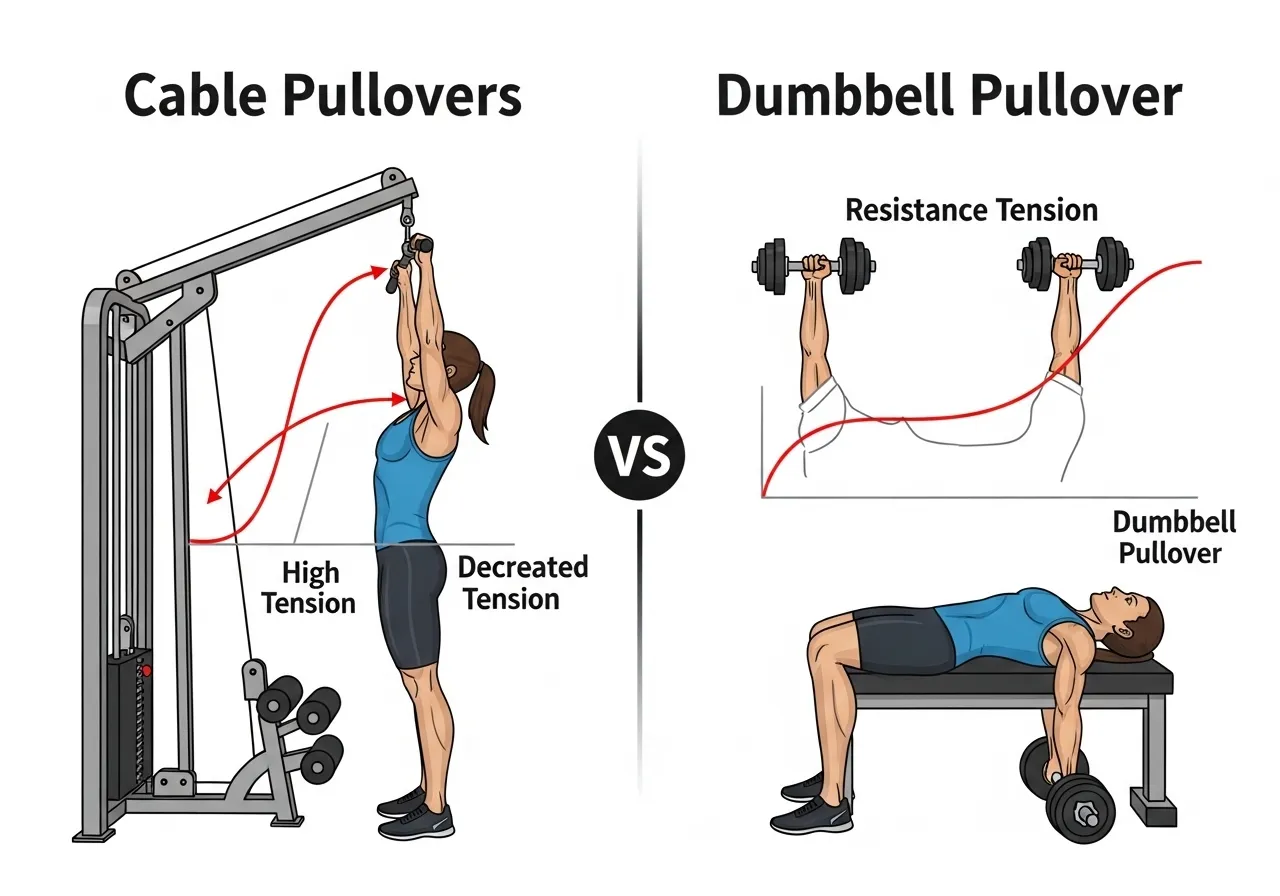
The dumbbell pullover creates a resistance profile driven by gravity. When the arms are overhead at the start position, the dumbbell is near vertical and provides maximum resistance to shoulder extension. As the arms move forward and downward through the arc, the resistance decreases because the lever arm shortens. At the bottom position with the arms at the hips, the dumbbell provides minimal resistance to the lat and chest because gravity is pulling it straight down and the lever arm has shortened to near zero.
This means the dumbbell pullover loads the lat and chest most at the overhead stretched position, and least at the contracted shortened position. Training maximally at the stretched position is valuable for hypertrophy, but having zero resistance at the contracted position means the muscle produces no useful mechanical work across the final third of the movement.
Why Overhead Stretched Position Loading Matters for Hypertrophy
Recent hypertrophy research consistently shows that training muscles at longer muscle lengths produces equivalent or greater muscle growth compared to training at shorter lengths. Both the lat and the chest sternal fibres are at their longest during the overhead position of the pullover. The dumbbell version loads this stretched position maximally, which aligns directly with what the hypertrophy research supports.
The cable version sacrifices some of this stretched-position loading advantage relative to the dumbbell but compensates by providing resistance through the full arc including the contracted position. For trainees whose primary goal is maximum hypertrophy, combining both variations, dumbbell for the stretched position emphasis and cable for the full arc stimulus, provides a more complete pullover training stimulus than either variation alone.
How Cable Changes the Resistance Curve
A cable pullover set with the cable at floor level behind the trainee creates tension that pulls back and downward throughout the arc. As the arms move from the overhead position to the hip position, the cable continues to provide resistance. At the contracted hip position where the lat and chest are at their shortest, the cable tension is still significant because the cable angle creates a genuine resistance that the lat must overcome to maintain the contracted position.
This means the cable provides meaningful resistance at both the stretched overhead position and the contracted hip position. The lat and chest work throughout the full arc rather than only through the first two-thirds of it. For hypertrophy purposes, the cable version provides a superior stimulus over the dumbbell version when performed for equivalent sets and reps.
Factor
Dumbbell Pullover
Cable Pullover
Resistance at overhead (stretched)
Maximum
Moderate to high
Resistance at hip (contracted)
Near zero
High
Full arc muscle stimulus
Upper 2/3 only
Full arc
Load increments
Coarser (2-4kg jumps)
Fine (1-2kg stack)
Best for
Stretched position emphasis
Full arc hypertrophy
Cable Pullover Technique: Setup, Execution, and the Positioning Details That Determine Which Muscle Works
⚠️ Shoulder Safety Note The cable pullover places the shoulder in end-range flexion under load at the overhead starting position. Individuals with active shoulder impingement, rotator cuff tears, SLAP labral pathology, or a history of shoulder dislocation should obtain assessment before performing overhead pullover movements. Begin at light loads and assess shoulder comfort through the full overhead range before progressively loading.
Setup: Cable Height Determines the Resistance Profile
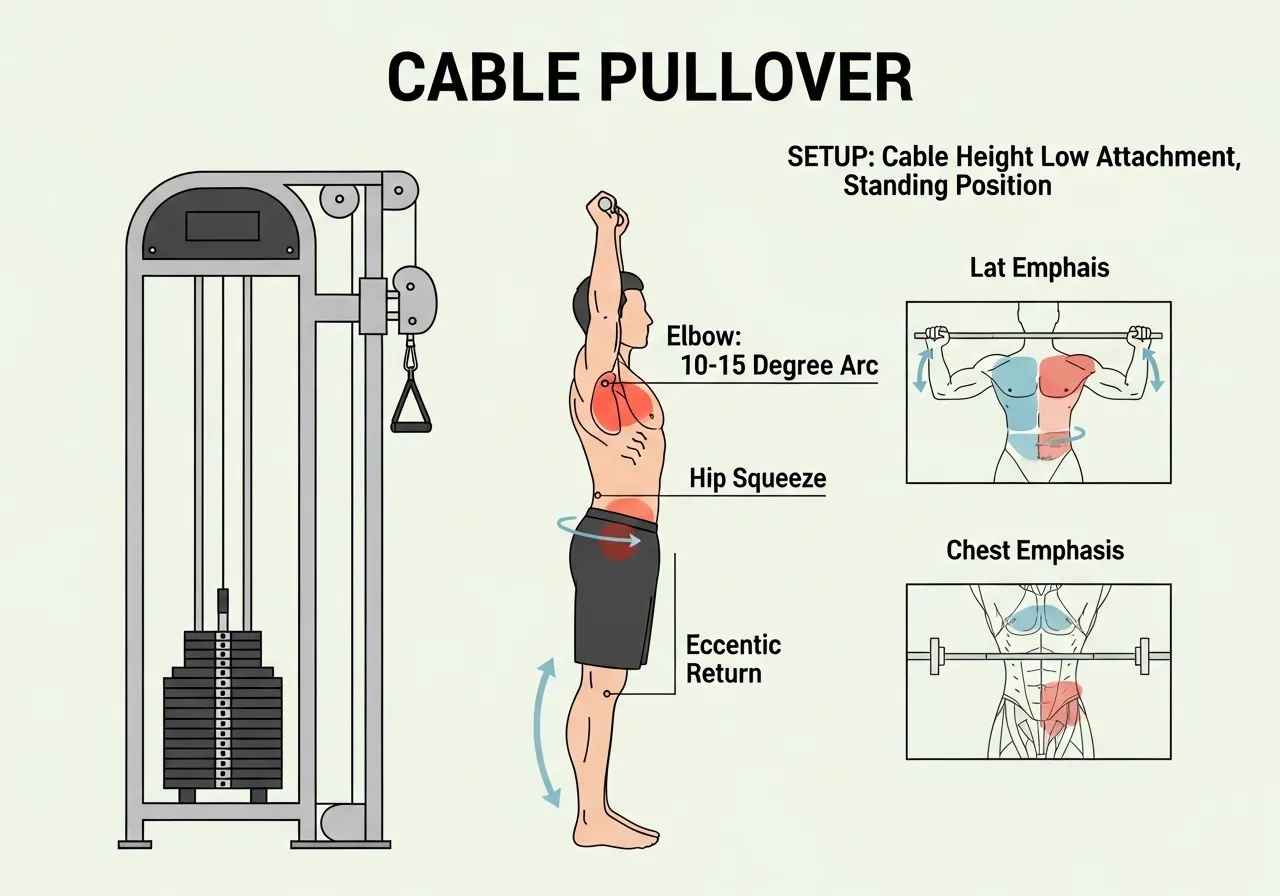
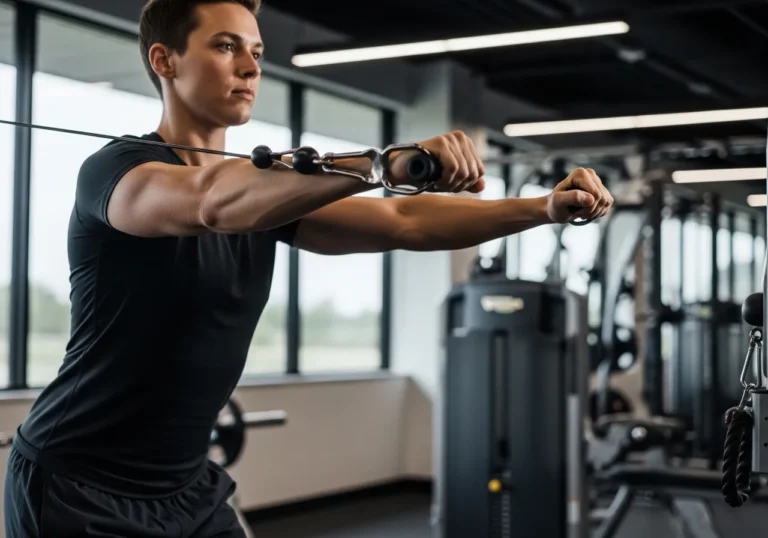
1. Cable height: Set the cable at floor level or ankle height. A lower cable creates greater resistance at the contracted bottom position. A higher cable shifts more resistance toward the stretched overhead position. Floor-level cable is the standard starting point. 2. Attachment: Rope attachment or straight bar. Rope allows slight elbow bend and wrist rotation at the bottom, which is more comfortable for most trainees. Straight bar enforces a fixed wrist position. 3. Starting position: Stand facing away from the cable stack. Hold the attachment with arms overhead and slightly bent elbows (10 to 15 degrees). The cable should be taut at this starting position. 4. Stance: Hip-width stance, slight hip hinge to lean the torso forward approximately 20 to 30 degrees. This forward lean creates a better mechanical angle for the lat-dominant movement.
The Execution: Straight-Arm Arc
Keeping the elbows at a fixed angle of 10 to 15 degrees throughout the movement, pull the cable from the overhead position down and forward in an arc until the hands reach hip level. The movement is driven by the lat initiating shoulder extension, not by the biceps or triceps changing the elbow angle.
At the bottom position, squeeze the lat and lower chest deliberately for 1 second before allowing the arms to return overhead under control over 2 to 3 seconds. The eccentric return is the most important phase for hypertrophy: the lat is resisting the cable’s pull back toward the stack while being stretched back to the overhead position. This controlled eccentric stretch is what produces the deep lat soreness that cable pullovers are known for.
The Elbow Angle Rule: Why Straight Arms Determine Everything
The most important technical rule in cable pullover training is maintaining a fixed elbow angle throughout the entire movement. Most trainees begin with straight arms and then allow the elbows to bend progressively as the weight increases, transforming the pullover into a combination of shoulder extension and elbow flexion.
When the elbows bend, the triceps take over a portion of the movement and the lat’s lever arm shortens. The exercise becomes a hybrid that trains neither the lat nor the triceps optimally. The fixed 10 to 15 degree elbow angle is not a technical nicety. It is the mechanical constraint that makes the movement a lat and chest exercise rather than a triceps exercise with some lat involvement.
A practical check: if the exercise feels primarily in the triceps rather than the lat and lower chest, the elbows are bending too much. Reduce the weight until the movement can be completed with the elbows fixed and the lat clearly working as the primary mover. Most trainees need to reduce their pullover load by 20 to 30% when they first apply this technical constraint correctly.
Is It a Back or Chest Exercise?
This question misses the point of the pullover. The movement trains both the lat and the chest sternal fibres through the same arc. Which feels more prominent depends on the specific shoulder angle, torso position, and where the trainee focuses their attention.
For lat emphasis: keep a slight forward torso lean, initiate the pull with a mental focus on driving the elbows toward the hips. For chest emphasis: maintain a more upright torso, focus on the sternal stretch at the top and the lower chest contraction at the bottom. The complete cable machine exercise library covering all attachment types and shoulder positions is in the cable machine training guide.
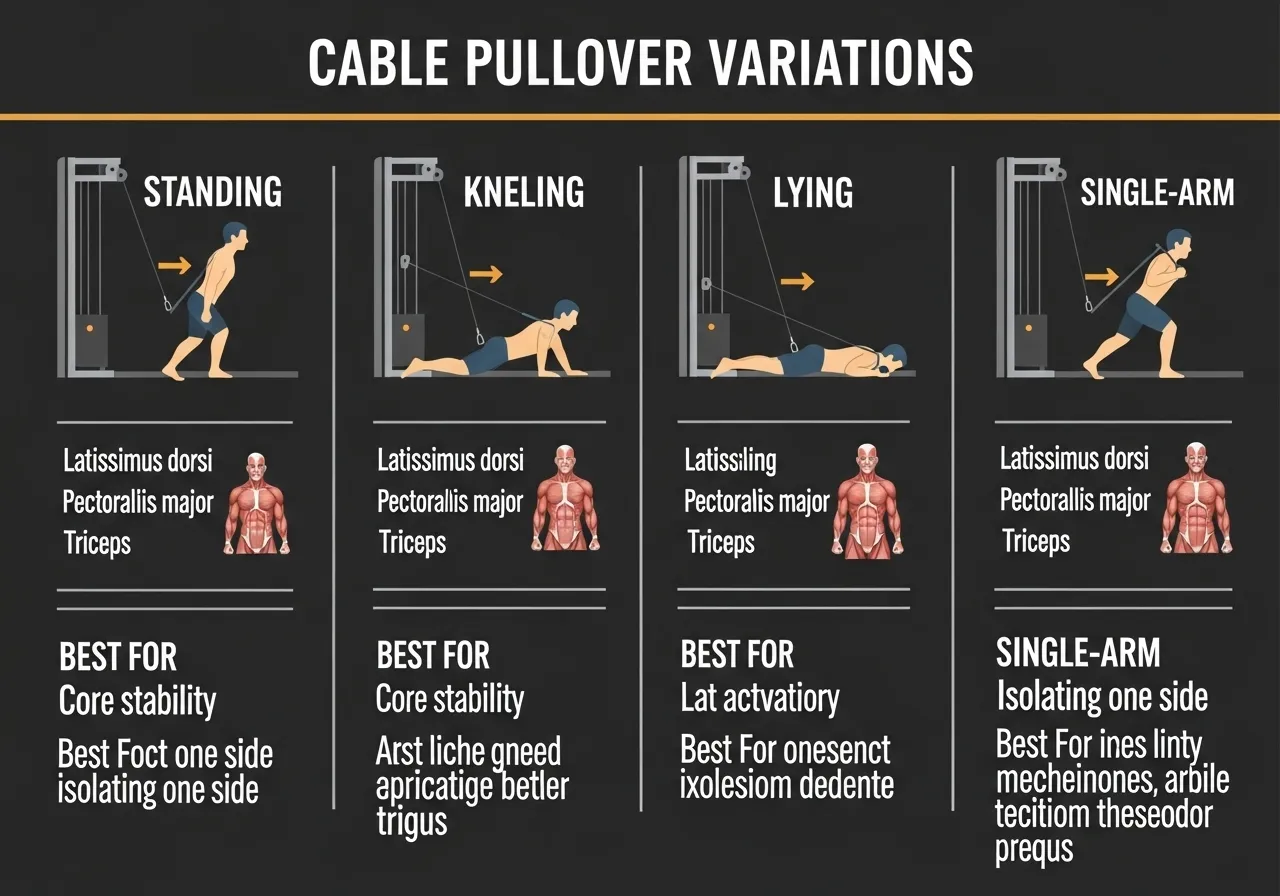
4 Cable Pullover Variations and When Each Fits Into a Programme
🏋️ 1. Standing Cable Pullover (Standard)
Target: Latissimus dorsi, pectoralis major sternal fibres, serratus anterior, triceps long head
How: Stand facing away from the low cable. Arms overhead, slight elbow bend. Pull in an arc to hip level keeping the elbow angle fixed. Squeeze at the bottom, controlled eccentric return.
Best for: Primary cable pullover training. Develops the lat-chest arc that no other standard exercise covers. Works well as the second or third exercise in a back or chest session.
🏋️ 2. Kneeling Cable Pullover
Target: Latissimus dorsi with greater torso stability demand, serratus anterior
How: Kneel facing the high cable pulley. Arms extended forward at shoulder height. Pull the cable downward and forward in an arc toward the thighs. The kneeling position removes leg drive and increases the demand on the core to resist the cable’s forward pull.
Best for: Trainees who struggle to feel the lat in the standing version. The kneeling position changes the force angle and many trainees find lat activation easier to isolate in this variation.
🏋️ 3. Lying Cable Pullover (on Bench)
Target: Lat and chest with maximum overhead stretch, similar to dumbbell pullover position
How: Lie on a flat bench with the head at the cable end. Set the cable low. Hold a rope or bar overhead with slight elbow bend. Pull in the same arc as the standing version, finishing with the hands at hip level. The lying position allows a greater range of motion at the shoulder than the standing version.
Best for: Maximum range of motion stimulus, trainees who want to preserve the stretched-position loading advantage of the dumbbell pullover while adding cable tension at the contracted position.
🏋️ 4. Single-Arm Cable Pullover
Target: Unilateral lat and chest, core anti-rotation, asymmetry identification
How: Same standing setup as the bilateral version but with a single D-handle. Perform the pullover arc with one arm. The unilateral force requires significant core anti-rotation work alongside the lat and chest stimulus. Perform all reps on one side before switching.
Best for: Identifying lat strength asymmetries that bilateral pulling and pushing exercises mask, trainees with shoulder mobility differences between sides, and adding core anti-rotation challenge to the exercise without requiring a separate core movement.
Why Is the Cable Pullover Underused and When Should You Add It?
The “Not a Real Exercise” Problem
The cable pullover occupies an awkward position in most training programmes. It is not heavy enough to feel like a serious compound movement. It does not fit cleanly into the “push/pull/legs” structure that organises most programmes. Many trainees classify it as an isolation exercise and skip it entirely in favour of additional sets of rows, pulldowns, or pressing.
This classification is wrong in a way that costs real development. The pullover is not an isolation exercise in the conventional sense. It trains the lat, chest, serratus anterior, and triceps long head simultaneously through a movement plane that no conventional compound exercise covers. The serratus anterior, the muscle that creates the serrated appearance on the rib cage and protects the shoulder under overhead load, is significantly activated during pullover movements and is chronically undertrained in most programmes.
The Serratus Anterior Connection
The serratus anterior originates on the lateral ribs and inserts on the medial border of the scapula. Its primary function is scapular protraction and upward rotation, actions essential for healthy overhead movement. When the serratus anterior is weak, the scapula cannot upwardly rotate properly during overhead pressing and pulling, which increases anterior shoulder impingement risk.
Pullover movements provide significant serratus anterior stimulus because the overhead starting position requires the muscle to work to maintain the scapula in an upwardly rotated position under load. This functional loading of the serratus anterior during pullover movements provides genuine shoulder health benefit that most trainees’ programmes completely lack. The lat pulldown, rowing, and pressing movements that form most upper body programmes do not load the serratus anterior in this manner.
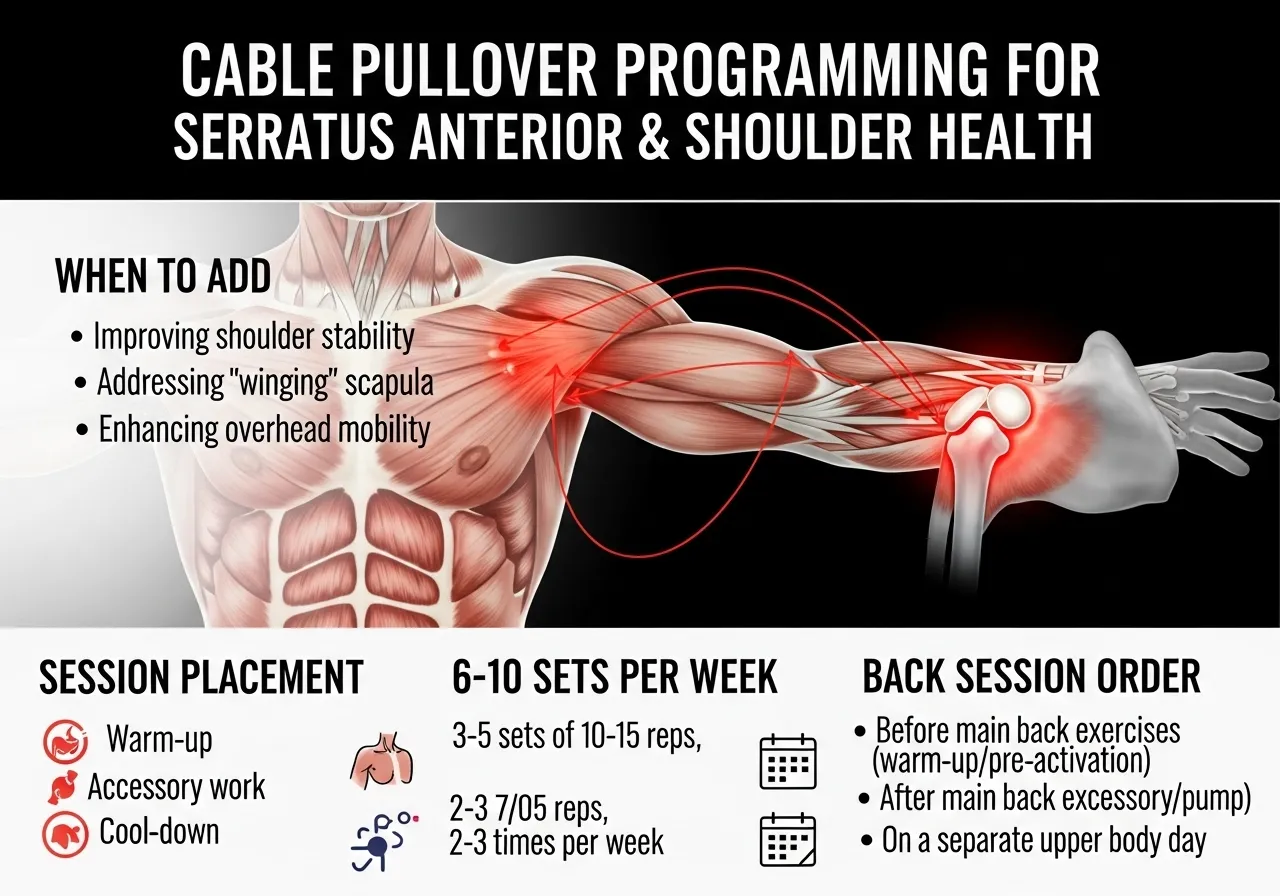
When to Add Cable Pullovers
Cable pullovers belong in a programme when:
Back development has plateaued with consistent row and pulldown work, and a new stimulus is needed
Chest development is missing the lower and inner sternal region that flat and incline pressing underserves
Shoulder impingement or poor overhead movement mechanics suggest serratus anterior weakness
The trainee wants a single exercise that provides lat, chest, and serratus stimulus simultaneously to improve training efficiency
For a complete chest isolation exercise comparison and how cable fly variations compare to pullover movements for chest development, the cable fly guide covers the chest isolation stimulus in detail.
Programming the Cable Pullover: Sets, Reps, and Load
The cable pullover responds well to moderate rep ranges of 10 to 15 per set. Lower rep ranges with heavier loads create excessive elbow extension demand and shift the movement toward triceps dominance as the elbows bend to handle the load. Higher rep ranges of 15 to 20 per set produce excellent metabolic stress and pump in the lat and serratus with lower joint risk.
Three to four sets per session placed after primary compound pulling movements gives the lat a direct stimulus in the pullover plane without accumulating excessive total back volume. The cable pullover is not a primary strength development exercise for most trainees. It fills a training stimulus gap and provides accessory volume in the overhead plane. Treating it as a finisher with lighter loads and controlled tempo produces better results than attempting to progressively overload it to heavy weights at the expense of range of motion and technique quality.
For trainees who want to develop the overhead pulling pattern further, the progression from cable pullover toward the lat pulldown and ultimately the pull-up follows a natural strength development pathway. The complete lat pulldown programming framework including how to progress from cable pullover toward heavier vertical pulling work is in the lat pulldown guide.
Frequently Asked Questions About the Cable Pullover
Is the cable pullover a back or chest exercise?
Both simultaneously. The cable pullover activates the latissimus dorsi and pectoralis major sternal fibres through the same movement arc. Which feels more dominant depends on torso lean, mental focus, and individual anatomy.
For programming purposes, treat the cable pullover as a lat-dominant exercise and place it in back sessions. The chest stimulus is real but secondary to the lat work, and the pullover does not replace dedicated chest isolation work the way pressing and cable fly exercises provide it.
How heavy should I go on cable pullovers?
Lighter than most trainees expect. The cable pullover at full straight-arm extension creates a significant lever arm from the shoulder joint. At 20 kg, the load at the shoulder is substantially greater than 20 kg due to this lever effect. Starting at 10 to 15 kg and prioritising full range of motion with a controlled 2 to 3 second eccentric produces more lat stimulus than using 25 to 30 kg with a shortened range or bent elbows to assist.
The correct weight is one that allows full overhead stretch, full arc through to the hip, a deliberate 1-second squeeze at the bottom, and a controlled eccentric return for all working reps without elbow angle changing significantly. Many trainees find this is 12 to 20 kg on a cable stack.
Where does the cable pullover fit in a session?
After primary compound back movements such as rows and pulldowns, before isolation work. The pullover requires a fresh enough state to maintain the overhead range of motion and elbow stability that the exercise demands. Performing it after heavy deadlifts or rows when the lat is already significantly fatigued compresses the range of motion and reduces stimulus quality.
A practical back session order: primary vertical pull (lat pulldown or pull-up), primary horizontal pull (barbell or cable row), cable pullover, face pulls or rear delt work. The lat pulldown and its activation profiles across grip variations is covered in the lat pulldown guide.
Can I perform cable pullovers on both back and chest days?
Yes, and this dual placement is one of the pullover’s programming advantages. Because it trains both the lat and the chest sternal fibres, it provides relevant stimulus on both training days without being redundant with either pressing or rowing work.
On back days, the pullover adds lat stimulus through the overhead plane that rows and pulldowns do not cover. On chest days, it adds lower chest and sternal fibre stimulus through a different movement pattern than pressing. A trainee who performs cable pullovers on both back and chest days can accumulate 6 to 8 weekly sets easily across the two sessions without adding a dedicated pullover day.
How many sets per week of cable pullovers is appropriate?
Six to ten working sets per week produces adequate lat and chest stimulus from the pullover plane without excessive overlap with the other back and chest work in the programme. Two sessions of 3 to 4 sets each, placed at the end of back sessions, is the most common effective structure.
More than 10 sets per week of pullover work is rarely necessary because the exercise adds a stimulus complementary to rows and presses rather than replacing them. The goal is filling the training plane that other exercises miss, not maximising pullover volume at the expense of the horizontal and vertical pulling volume that remains the primary back development tool.
Key Takeaways
The pullover and straight arm pulldown produce similar EMG activation patterns across the lat and chest simultaneously, training a movement plane that rows and pulldowns cannot replicate.
The cable version provides resistance throughout the full arc including the contracted hip position. The dumbbell version provides near-zero resistance at the contracted position. Cable is superior for ongoing hypertrophy stimulus.
The serratus anterior is significantly activated during pullover movements, providing shoulder health benefit that pressing, rowing, and pulldown programmes do not deliver.
For lat emphasis: slight forward torso lean, initiate with the elbows driving toward the hips. For chest emphasis: upright torso, focus on the sternal stretch and lower chest contraction.
6 to 10 sets per week placed after primary compound back work provides the complementary stimulus that makes the cable pullover a genuine programming addition rather than a redundant isolation movement.
⚠️ Health & Fitness DisclaimerThis article is for general educational purposes only. It does not replace professional medical advice. If you have shoulder, elbow, or wrist conditions, consult a qualified healthcare professional before starting any pressing programme. The flat dumbbell vs barbell bench builds the chest. Everyone knows this. (see also: bench press fixes) (see…
The lateral raise is the only exercise that directly targets the medial deltoid head, the muscle responsible for shoulder width. Every pressing movement loads the anterior deltoid heavily. No pressing movement meaningfully loads the medial deltoid. Yet most trainees perform lateral raises as an afterthought: a few sets of dumbbell swings at the end of…
The Hack Squat: Why This Machine Deserves a Primary Place in Leg Training The hack squat machine sits in the corner of most gyms, largely ignored by serious lifters who dismiss machine exercises as inferior to free weights and embraced primarily by beginners who haven’t yet learned to squat. This dismissal is a training error…
⚠️ Health & Fitness DisclaimerThis article is for general educational purposes only and does not replace professional medical advice. If you have any shoulder, back, or joint conditions, please consult a qualified healthcare professional before beginning a Smith machine vs free weights program. The Smith machine — a barbell constrained to a vertical or near-vertical…
⚠️ Fitness Disclaimer: The information in this article is for general educational purposes only and does not constitute professional fitness or medical advice. Always consult a qualified healthcare professional before starting any new exercise program, especially if you have existing injuries or medical conditions. The Machine That Gym Culture Can’t Seem to Agree On No…
⚠️ Health & Fitness DisclaimerThis article is for general educational and informational purposes only.It does not replace professional medical or fitness advice.If you have any pre-existing condition, injury, or shoulder concern — please consult a qualified healthcare professional or certified personal trainer before starting or modifying any exercise program. The lat pulldown mastery guide is…