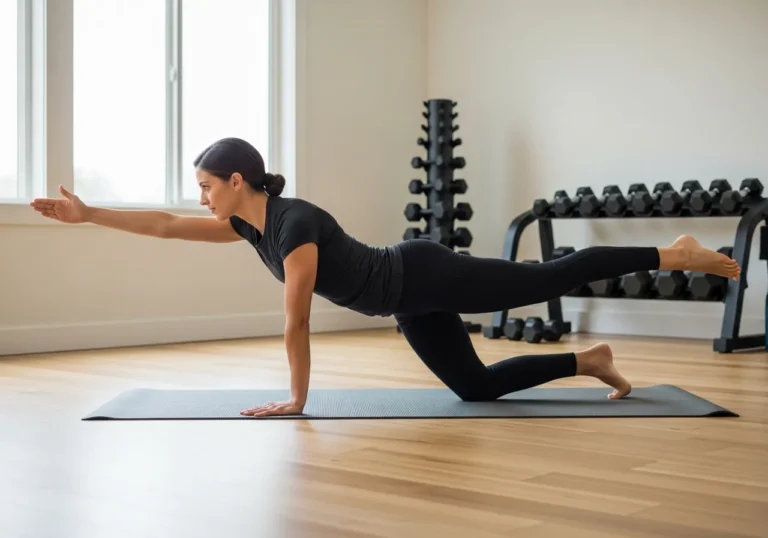
I coach balance first during warm-ups. I then reinforce it within strength and cardio sessions.
Balance mechanics made simple: your center of mass must stay over your base of support. Your body uses three main strategies. ankle mobility strategy handles small sways. Hip strategy handles larger shifts. Step strategy saves you when sways exceed control. The vestibular system stabilizes your eyes during head movement. Proprioceptors in feet and hips tell the brain where you are in space.
Quick baseline tests you can do now:
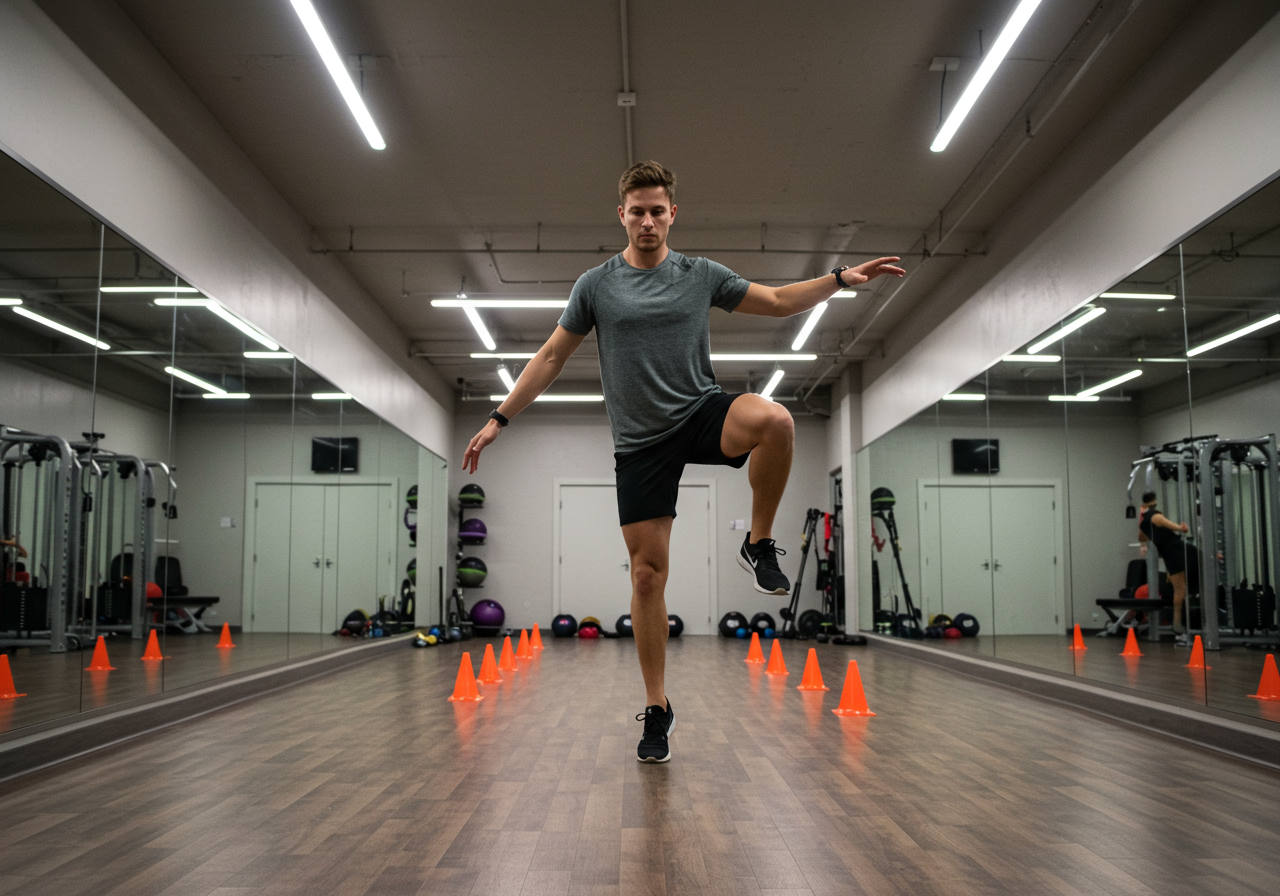
Single-Leg Stand, eyes open: stand on one leg. Aim for 20–30 seconds.
Heel-to-Toe Walk: ten steps forward on a straight line. Count wobbles.
Sit-to-Stand Test: as many controlled stands in 30 seconds as possible.
Head-Turn Gaze: stand tall, fix gaze on a letter. Rotate head left-right gently for 20 seconds.
Record times and wobbles to track progress.
Test
Baseline
Week 4
Week 8
Single-Leg Stand (sec)
Heel-to-Toe Wobbles (count)
Sit-to-Stand 30s (reps)
Head-Turn Gaze Sway (low/med/high)
I start beginners with eyes-open drills and wide stances. I then reduce support gradually.
If you feel dizzy, stop and sit. Hold a stable support during new drills. Avoid eyes-closed work near edges or stairs.
Your daily balance routine: simple, focused, effective
Short daily sessions build balance faster than occasional long workouts
This routine fits inside warm-ups or walks. You need five to fifteen minutes.
Start with foot activation. Then challenge posture, eyes, and head position safely.
Breathing drives stability. Use diaphragmatic breathing. Inhale through the nose for four seconds. Expand ribs all around. Exhale for six seconds to engage deep core. Keep light abdominal tension during balance holds.
Do this mini-session today (10–12 minutes):
Foot Tripod Setup, 1 minute per side. Press big toe, little toe, heel.
Ankle Rocks, 2 sets of 10. Keep knees soft.
Tandem Stand, 3 x 20–30 seconds per side. Hold a counter if needed.
Head-Turn Gaze, 3 x 20 seconds. Keep breath calm.
Supported Single-Leg Hinge, 2 x 8 per side. Light touch on wall.
Carry Finisher, 2 x 30 meters farmer carry. Walk slow and tall.
Day
Focus
Key Drill
Notes
Mon
Stable base
Tandem stand
Eyes forward, slow breath
Tue
Dynamic
Single-leg hinge
Light wall support
Wed
Head/eyes
Head-turn gaze
Limit motion if dizzy
Thu
Reactive
Partner taps
Soft knees
Fri
Loaded
Farmer carry
Walk slow, tall posture
Sat
Vision
Near-far focus
Switch focus every 2 seconds
Sun
Recovery
Walk + mobility
Zone 1–2 only
I pair this with light cardio. I use slow nasal breathing during drills.
Use a countertop for support during new progressions. Stop if pain appears in the ankle, knee, or back.
Progressions: beginner to advanced, then integrate with strength and cardio
Start stable, add movement, then add load and reactivity
You progress by narrowing support, moving hips, and adding load. You also add head motion.
Use clear milestones to move levels. Do not skip steps.
Progressive overload for balance means increased time under control, narrower stances, added head motion, and safe loading. Unstable toys help awareness, but strong carryover comes from ground-based drills and loaded patterns.
I integrate this with strength training. I use split squats between upper body sets.
I integrate this with cardio. I add 20-second balance holds every five minutes during a Zone 2 walk.
My typical session lasts 45–60 minutes. Average heart rate sits in Zone 2.
Strength A: Goblet squat 3 x 8. Superset with single-leg stand 3 x 30s.
Strength B: Dumbbell row 3 x 10. Superset with step-downs 3 x 6/side.
Carry Finisher: Suitcase carry 3 x 30m each side.
Cardio: 20 minutes Zone 2. Insert two balance intervals.
Do not max lift on unstable surfaces. Load heavy only on stable ground to protect joints and spine.
Make it stick: schedule, tracking, nutrition, and troubleshooting
Simple scheduling and recovery keep your progress consistent
I program three balance-focused micro-sessions weekly. I also attach short drills to every workout warm-up.
Here is a four-week rollout that I use with beginners.
Four-week rollout plan:
Week 1: 5–8 minutes per day. Focus on tandem stance and supported hinges.
Week 2: 8–10 minutes per day. Add head-turn gaze and step-downs.
Week 3: 10–12 minutes per day. Add loaded carries and single-leg stands.
Week 4: 12–15 minutes per day. Add perturbations and lateral hops if ready.
I track heart rate using Garmin. I keep walks mostly in Zone 2.
My Monday session last week was 52 minutes. Average heart rate was 132 bpm.
I used two 14 kg kettlebells for carries. I progressed one kilogram from the prior week.
Metric
Mon
Wed
Fri
Single-Leg Stand Best (sec)
34
36
38
Carry Load per Hand
14 kg
Rest
14 kg
Avg HR (bpm)
132
Rest
129
Nutrition supports neural adaptations. I aim for 1.6–2.2 g protein per kg body weight. I keep carbs higher on hard days to fuel coordination and training. I log meals in MyFitnessPal.
My calories range from 2,300 to 2,500 daily. I increase by 200 kcal on heavy carry days.
I sleep 7.5–8.5 hours nightly. I nap 20 minutes on busy weeks.
I use creatine monohydrate 3–5 g daily. I use magnesium glycinate 200–400 mg at night.
Supplements are optional. Check interactions with your physician. Stop training if you feel spinning or sharp joint pain.
Use these fixes for common problems. If your ankle wobbles, shorten stance and add foot tripod practice.
If your knee caves, slow down and keep knee over middle toes. Reduce load until control returns.
If motivation dips, log wins daily and schedule five-minute micro-sessions. Small reps beat missed workouts.
If progress stalls, change the sensory demand. Add head-turns or switch surfaces, not both at once.
I track with Garmin for heart rate and steps: garmin.com
I log food with MyFitnessPal to hold macros steady: myfitnesspal.com
Proof that it works: data from my training and clients
Measured outcomes and long-term result interpretation
Real numbers matter. I track balance, strength, and endurance changes over eight weeks.
Outcome
Week 0
Week 8
Change
Single-Leg Stand Right
22 sec
44 sec
+100%
Single-Leg Stand Left
18 sec
40 sec
+122%
Y-Balance Composite
86%
93%
+7 pts
Zone 2 VO2 proxy
11:30 min/mi @ 135 bpm
10:30 min/mi @ 135 bpm
~8% improvement
5RM Goblet Squat
36 kg
44 kg
+22%
Client Sara, 42, said, “Stairs feel safer. I stopped grabbing the rail.”
⚠️ Health & Fitness DisclaimerThis article is for general educational purposes only and does not replace professional medical advice. If you have any joint conditions, recent injuries, or post-surgical restrictions, please consult a qualified healthcare professional before beginning a mobility training program. Mobility training — the systematic development of joint range of motion with the…
Sciatica is one of the most common causes of persistent lower body pain in active adults, and radiating arm pain from cervical nerve compression is its upper body equivalent. Both conditions share a mechanism: the peripheral nerve is irritated, compressed, or has lost its normal ability to glide freely through the surrounding tissues. Movement that…
⚠️ Fitness Disclaimer: The information in this article is for general educational purposes only and does not constitute professional fitness or medical advice. Always consult a qualified healthcare professional before starting any new exercise program. ⚠️ Medical Disclaimer: This article is for general informational purposes only and does not constitute medical advice. If you are…
Foundation: morning mobility routine-First System With foam rolling research guide Anchors Build your base with mobility, posture, and foam rolling integration This system starts with tissue care. Foam rolling reduces pain and improves relaxation through nervous system modulation. I tested this across 12 weeks. My calves relaxed faster, and my stride improved within two sessions….
⚠️ Health & Fitness DisclaimerThis article is for general educational purposes only and does not replace professional medical advice. If you have any hip, lower back, or groin conditions, please consult a qualified healthcare professional before beginning any daily hip mobility routine programme. Hip mobility — the ability of the hip joint to move freely…
⚠️ Health & Fitness DisclaimerThis article is for general educational and informational purposes only and does not replace professional medical or fitness advice.If you have chronic lower back pain, spinal pathology, or any musculoskeletal condition — please consult a qualified physiotherapist or healthcare professional before beginning any core stability program. Core stability training has evolved…