Barbell Row Guide: EMG Research, Grip Variations, Technique, and 8-Week Back Program
This article is for general educational purposes only and does not replace professional medical advice. If you have any pre-existing shoulder, lower back, or elbow condition, please consult a qualified healthcare professional before beginning any rowing program.
The barbell row is the cornerstone of horizontal pulling in strength training — a compound movement that simultaneously develops the latissimus dorsi, rhomboids, trapezius, rear deltoids, and spinal erectors under heavy free-weight loading that machine alternatives cannot replicate in terms of total muscle recruitment demand.
Yet it is also one of the most technically demanding back exercises — performed incorrectly, it becomes predominantly a lower back exercise with minimal upper back development, and a reliable source of lumbar strain.
This guide covers the EMG research on rowing muscle activation, the critical technique differences between major row variations, grip and range of motion effects on muscle targeting, and a complete 8-week back development program.
Rowing Muscle Activation: What the EMG Research Reveals
The Back Musculature: Primary and Secondary Movers
The muscles targeted by rowing movements form the structural foundation of the posterior upper body — their balanced development is essential for both performance and the postural health of anyone who spends significant time in anterior-dominant positions (desk work, driving, pressing-focused training).
Primary muscles in rowing:
| Muscle | Location | Primary Function in Rowing |
|---|---|---|
| Latissimus dorsi | Large fan-shaped muscle of the mid and lower back | Shoulder extension and adduction — primary driver of the pull |
| Rhomboids | Between the spine and shoulder blades | Scapular retraction — drawing the shoulder blades together |
| Middle trapezius | Mid-back, between and above the shoulder blades | Scapular retraction and depression |
| Posterior deltoid | Rear of the shoulder | Shoulder horizontal abduction and extension |
| Biceps brachii | Front of the upper arm | Elbow flexion — synergist completing the pull |
| Erector spinae | Running along the vertebral column | Isometric spinal extension — maintaining the hip hinge position |
Latissimus Dorsi vs. Trapezius: Which Exercise Targets Which?
A PMC study comparing muscle activation during four latissimus dorsi exercises found that the highest latissimus dorsi to biceps ratio of activation occurred during the wide grip pulldown and the seated row, while the highest middle trapezius and rhomboid activation occurred during the seated row — confirming that the seated row is particularly effective for developing the scapular retractors alongside the latissimus dorsi compared to pulldown-only programs.
This finding has direct programming implications: trainees who rely primarily on lat pulldowns without horizontal rowing will develop the latissimus dorsi but underload the rhomboids and middle trapezius — the scapular retractors most responsible for postural shoulder position and the balance against chronic anterior chest tightness.
Range of Motion and Latissimus Dorsi Activation
A study investigating muscle excitation during different ranges of motion in the prone barbell row found that the latissimus dorsi showed significantly higher mean muscle excitation in the upper half of the range of motion compared to both the lower half and the full range of motion — while the trapezius transversus exhibited significantly lower peak excitation in the upper-half compared to lower-half and full range conditions — suggesting that different portions of the rowing range selectively emphasise different muscles.
The practical implication: full range of motion rowing optimally distributes the stimulus across both the latissimus dorsi and the trapezius. Partial range rowing (a common error under heavy loads) may inadvertently prioritise one over the other depending on which portion of the range is completed.
Grip Variations and lat pulldown guide Muscle Activation
An MDPI study examining EMG activity during seven lat pulldown variations found that grip variations may not significantly alter latissimus dorsi recruitment — challenging the assumption that specific grips preferentially target this muscle — while the posterior deltoid showed greater activation with wide pronated grip at 30° trunk inclination, highlighting that trunk inclination and grip may influence accessory muscle contribution more than primary latissimus dorsi activation.
The Posterior Chain: Why Back Training Matters Beyond Aesthetics
The posterior chain — the collective term for the muscles running along the back of the body from the calves through the hamstrings, glutes, spinal erectors, and upper back — is the primary force-generating system in most athletic movements and the structural counterbalance to the anterior flexion pattern that modern sedentary lifestyles reinforce.
Chronic anterior dominance — tight hip flexors and chest, weak glutes and rhomboids — is the most common postural presentation in desk-based populations, and a contributor to the neck pain, shoulder impingement, and lower back discomfort that frequently present as the first fitness-related complaints in adults beginning training.
Systematic rowing programming addresses several components of this pattern simultaneously: the rhomboid and middle trapezius work of horizontal rowing counteracts the forward shoulder rounding of chronic desk work, the spinal erector isometric demand of barbell rowing develops the lumbar support structure that protects against lower back strain, and the latissimus dorsi development of vertical and horizontal pulling adds the posterior upper body mass that balances the chest and shoulder volume most gym trainees accumulate through pressing emphasis.
Scapular Health and the Role of Rowing
Scapular stability (the ability of the shoulder blade to maintain appropriate position on the ribcage during arm movement) is one of the most important and most frequently neglected aspects of shoulder health — and horizontal rowing is its most direct training stimulus.
The lower trapezius and serratus anterior (the muscle responsible for protracting and upwardly rotating the shoulder blade — visible as the “serrated” muscles on the side of the ribcage in lean individuals) control scapular position during overhead movements. When these muscles are weak relative to the upper trapezius, the shoulder blade elevates and anteriorly tilts during arm elevation — a pattern associated with subacromial impingement and rotator cuff strain.
Including rows that specifically emphasise scapular retraction — and ensuring full retraction and depression at the end position of each rep — develops the lower trapezius and serratus anterior function alongside the more visible rhomboid and latissimus dorsi development. This combination addresses both aesthetic development and the structural health requirements of long-term overhead training.
This integrated approach to posterior chain development — addressing the back not just as a muscle group to be trained but as the structural counterweight to the anterior loading of modern life — represents the most comprehensive and sustainable approach to back health and development available through resistance training.
Does lat pulldown research and Body Angle Really Change Which Back Muscles Are Worked?
The Research on Grip Effects
The question of whether grip width and orientation significantly change back muscle targeting is one of the most debated in resistance training — and the research provides a more nuanced answer than gym mythology typically suggests.
Key findings from EMG research on rowing grip variations:
- Latissimus dorsi activation remains relatively consistent across grip variations — the muscle’s mechanical role in shoulder extension and adduction does not change substantially with grip width or pronation versus supination
- Rhomboid and middle trapezius activation responds more to elbow-to-torso angle and the degree of scapular retraction at the end position than to grip width per se
- Posterior deltoid activation increases with wider grip and greater shoulder abduction — a consideration for trainees specifically targeting the rear deltoid alongside the back musculature
- Biceps brachii activation is enhanced by supinated (underhand) grip positions due to the improved mechanical leverage of the elbow flexors when the forearm is supinated (rotated palm-up)
Elbow Path: The Most Impactful Variable
While grip width produces relatively modest differences in latissimus dorsi activation, the path of the elbows during the pull has a more substantial effect on muscle emphasis:
- Elbows close to the body (tucked): Greater latissimus dorsi emphasis — the shoulder adduction line of pull activates the lats through their primary function. Used in most barbell rows and neutral-grip cable rows.
- Elbows flared wide (abducted): Greater rear deltoid and middle trapezius emphasis — the horizontal abduction component at the shoulder is more prominent. Used in face pulls, rear delt rows, and wide-grip cable rows.
Understanding this distinction allows trainees to target specific back muscles by adjusting elbow path rather than relying on grip variations that the research suggests produce relatively small differences.
Bench-Supported vs. Free-Standing Rows
Bench-supported variations (chest-supported row, incline dumbbell row) eliminate the spinal erector isometric demand of free-standing rows — allowing the upper back musculature to work in isolation without the lower back fatigue that limits free-standing rows:
- Advantage: Allows heavier upper back loading without lower back fatigue becoming the limiting factor — useful for trainees with lower back sensitivity or as a high-volume accessory after heavy deadlifts that have already loaded the spinal erectors
- Limitation: Removes the functional isometric strength development and coordination between the spinal erectors and upper back that free-standing rowing develops
- Best use: As one of multiple row variations in a complete program — not as a complete replacement for free-standing rowing if overall posterior chain development is the goal
Barbell Row Technique: Conventional and Pendlay Variations
Conventional Barbell Row: Setup and Execution
The conventional barbell row — performed with the back at roughly 45° to the floor, pulling the bar to the lower abdomen — is the primary loaded horizontal pulling exercise in most strength training programs.
Back angle: Approximately 45° — neither upright (which turns it into an upright row) nor parallel (which maximises lower back demand)
Pull: Drive the elbows back toward the hips — the bar travels toward the lower abdomen/hip crease, not the sternum
Scapular movement: Retract and depress the shoulder blades at the top of each rep — squeeze the upper back at peak contraction
Eccentric: Lower with control over 2–3 seconds — controlled eccentric loading of the lats and rhomboids
Pendlay Row: The Strict Power Variation
The Pendlay row starts from a dead stop on the floor each rep — the bar returns to the floor between repetitions, eliminating the momentum that conventional rows can accumulate under fatigue.
Key differences from conventional barbell row:
- Back is parallel to the floor (not 45°) — a more demanding spinal erector position
- Each rep is initiated from a complete stop — eliminating the stretch-shortening cycle that conventional rows exploit
- This produces a “starting strength” demand (generating force from a dead stop) rather than the continuous tension of conventional rows
- Appropriate for advanced trainees focused on absolute strength; more technically demanding than conventional rows for beginners
The 5 Most Common Barbell Row Errors
| Error | Consequence | Correction |
|---|---|---|
| Torso rises on every rep | Becomes a hip hinge rather than a row — shifts load to erector spinae | Reduce load; maintain back angle from first to last rep |
| Pulling bar to chest (too high) | Shifts load to biceps and rear delts; reduces lat involvement | Pull toward hip crease — elbows back toward hips |
| Not retracting scapulae at top | Rhomboids and mid-trap undertrained; lat dominant without balance | Pause 1 second at top, consciously squeeze shoulder blades |
| Jerking the weight up | Reduces time under tension; increases lumbar disc stress | Controlled 1–2 second concentric; 2–3 second eccentric |
| Rounded lower back | Lumbar flexion under load — disc injury risk | Reduce load immediately; brace core before each rep |
Specialised Row Techniques for Specific Development Goals
Beyond the standard row variations, several specialised techniques may address specific development gaps:
- Meadows row: A landmine row variation where one end of a barbell is anchored in a corner or landmine attachment and the trainee rows the loaded end with one hand. The unique loading angle allows a longer range of motion at the bottom of the pull and a different elbow path than standard dumbbell rows — popular as an accessory for developing the lower latissimus.
- Dead stop row: A conventional barbell row where the weight returns completely to the floor between each rep (similar to a Pendlay row), eliminating the elastic rebound that standard rows accumulate and demanding pure starting strength from the upper back musculature.
- Kroc row: A high-rep single-arm dumbbell row with a controlled amount of body English (slight torso rotation and hip drive at the start of each rep) to allow heavier loads than strict form permits. Popularised by powerlifters for developing upper back strength that transfers to deadlift stability. Not recommended for beginners — requires established technique and lower back resilience.
Row Variations: Building a Complete Back Training Arsenal
Dumbbell Row: The Unilateral Foundation
The single-arm dumbbell row — performed with one knee and hand on a bench, rowing the opposite dumbbell — is among the most effective and accessible back exercises available:
- Unilateral loading exposes and corrects left-right strength imbalances that bilateral barbell rowing masks
- The supported position eliminates lower back loading — allowing heavy upper back work independent of spinal erector fatigue
- Greater range of motion is typically achievable than with barbell rows — the dumbbell can travel alongside the torso without the bar hitting the hip
- The “elbow to hip” cue produces strong latissimus dorsi activation — pull the elbow back toward the hip, not up toward the ceiling
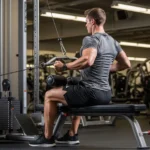
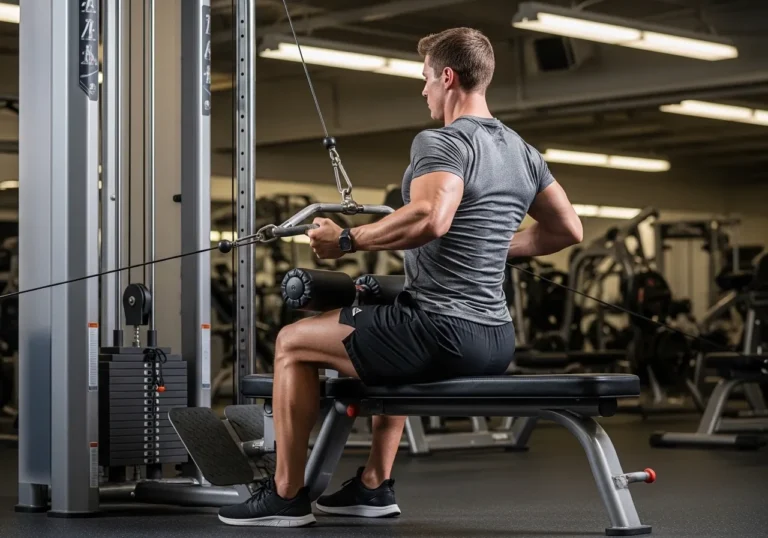
Cable Row: Constant Tension Horizontal Pull
The seated cable row maintains tension throughout the full range of motion — including the eccentric lowering phase where a barbell row has reduced tension as the weight approaches the floor. This constant tension profile may produce superior metabolic stress compared to free-weight rows at matched volumes.
Key cable row variations and their emphasis:
- Narrow neutral grip (V-bar): Maximum lat emphasis through strong shoulder adduction — elbows close to the body throughout
- Wide pronated grip: Greater rhomboid and middle trapezius involvement — elbows flare more at the finish
- Single-arm cable row: Allows slight torso rotation at the finish — extending range of motion and potentially increasing lat stretch at the start
T-Bar Row and Chest-Supported Row
The T-bar row (barbell end loaded with plates, user straddles the bar and rows) combines the feel of a barbell with a more neutral grip position — popular in strength training programs for its ability to handle very heavy loads in a stable setup:
- The neutral grip (palms facing each other) reduces forearm rotation stress compared to a pronated barbell row
- The fixed angle of pull produces consistent mechanical demand across sets
- Still requires careful lower back management — spinal erector fatigue from heavy T-bar rows can compromise subsequent exercises in a session
The chest-supported T-bar row or incline dumbbell row fully removes lower back demand by using a bench to support the torso — these are excellent high-volume accessory options for post-deadlift upper back work when the lower back has already been maximally loaded.
Face Pull: The Essential Posterior Chain Balance Exercise
The face pull guide — cable or band pulled toward the face with elbows high and wide — is not a primary back builder but may be the most important supplementary exercise in any pressing-heavy program:
- It specifically targets the posterior deltoid and the external rotators of the rotator cuff (infraspinatus and teres minor — muscles responsible for externally rotating the humerus and stabilising the humeral head in the shoulder socket)
- Anterior shoulder impingement — among the most common chronic shoulder complaints in gym trainees — is frequently associated with internal rotation dominance from bench pressing without equivalent external rotation work
- Including 2–3 sets of 15–20 face pulls per session that includes pressing is a widely recommended protective measure for long-term shoulder health
Periodisation Strategies for Back Development
Applying periodisation principles to back training — systematically varying volume, intensity, and exercise selection over training blocks — may prevent the adaptation plateau that affects many trainees who perform the same back exercises at the same loads indefinitely:
- Hypertrophy blocks (8–12 reps, 65–75% 1RM): Moderate loads with higher volume and shorter rest periods — maximises metabolic stress and mechanical tension across multiple sets. Best sustained for 4–6 weeks.
- Strength blocks (4–6 reps, 80–87% 1RM): Heavier loads with longer rest periods and lower total volume — develops maximum force production capacity. Best sustained for 4–6 weeks following a hypertrophy block.
- Deload weeks: Reducing volume and intensity by 40–50% every 4–8 weeks allows accumulated fatigue to dissipate — often followed by a personal record in the subsequent loading block as the supercompensation (the fitness adaptation overshoot that follows adequate recovery) effect manifests.
Back Development Programming: Volume, Frequency, and 8-Week Plan
The Vertical/Horizontal Pull Balance
Comprehensive back development requires both vertical pulling (pull-up guide, lat pulldowns — developing the latissimus dorsi in its adduction function) and horizontal pulling (rows of all types — developing the rhomboids, middle trapezius, and rear deltoids in their retraction function).
Most well-designed programs include roughly equal volumes of vertical and horizontal pulling. Relying predominantly on one plane produces imbalanced back development — either a wide but shallow back (vertical-only) or a thick mid-back without the width development that latissimus dorsi vertical loading produces (horizontal-only).
Volume Recommendations for Back Development
| Training Level | Weekly Sets (Back Total) | Vertical : Horizontal Split | Frequency |
|---|---|---|---|
| Beginner | 8–12 sets | 50:50 | 2–3 sessions/week |
| Intermediate | 12–18 sets | 50:50 or 40:60 horizontal | 2–3 sessions/week |
| Advanced | 16–22+ sets | Varies by weakness | 2–4 sessions/week |
8-Week Back Development Program
Barbell row: 4 × 8 @ 60% — technique focus, full ROM, 2-sec eccentric
Single-arm dumbbell row: 3 × 10 each side
Lat pulldown: 3 × 12
Face pull: 3 × 20
Barbell row: 4 × 8 @ 67–70%
Cable row (V-bar): 4 × 10
Pull-up or lat pulldown: 4 × 8
Face pull: 3 × 20
Barbell row: 4 × 8 @ 72–75%
Chest-supported dumbbell row: 3 × 12
Wide-grip cable row: 3 × 12
Pull-up: 3 × max reps
Face pull: 3 × 20
Barbell row: Work up to top set of 5 @ 82–85%, then 2 back-off sets × 8 @ 70%
T-bar row or dumbbell row: 4 × 8 heavy
Lat pulldown superset with face pull: 3 × 12 / 3 × 20
Inverted row: 3 × max (as accessory finisher)
Grip Strength and Its Role in Rowing Performance
Grip strength is a consistent limiting factor in advanced rowing work — when the forearms fatigue before the target back muscles, the training stimulus to the latissimus dorsi and trapezius is prematurely terminated.
Progressive grip strength development through rowing training itself is the most specific approach:
- Training without straps on lighter sets and using straps only on the heaviest working sets develops grip while preserving back training quality on peak-load efforts
- Farmer’s carry and dead hangs develop grip endurance alongside the rowing program rather than requiring separate grip-focused sessions
- Hook grip (a barbell grip technique where the thumb is wrapped around the bar and the fingers wrap over the thumb — used in Olympic weightlifting and powerlifting for its superior security) may allow heavier rowing without straps for trainees willing to develop this initially uncomfortable technique
Recovery Considerations for Back Training
The back musculature — particularly the latissimus dorsi, trapezius, and rhomboids — generally recovers more quickly than the larger lower body prime movers, allowing training frequencies of 2–3 sessions per week for most intermediate trainees.
However, the spinal erectors — heavily involved in all free-standing barbell rowing — recover more slowly and must be managed carefully in programs that also include heavy deadlifts, squats, and other spinal-loading movements. The most common programming error is placing heavy barbell rows on the day after heavy deadlifts — the spinal erectors have inadequate recovery time, technique degrades under fatigue, and injury risk increases substantially.
Scheduling back training at minimum 48 hours after any heavy spinal loading (deadlifts, squats, Romanian deadlifts), or using supported rowing variations on days close to heavy compound lower body work, manages this constraint practically.
Lower Back Safety in Rowing Movements
The Spinal Load in Barbell Rowing
The conventional barbell row places the lumbar spine in a sustained loaded hinge position — the erector spinae (the longitudinal muscles running alongside the vertebral column) must isometrically maintain the back angle against the gravitational pull of the loaded barbell throughout every rep of every set.
This cumulative spinal extensor loading is not inherently problematic for healthy individuals — it is part of what makes the barbell row effective for developing posterior chain strength. However, it becomes a source of injury when:
- The lower back rounds under load — lumbar flexion during rowing places the intervertebral discs (the shock-absorbing cartilage pads between vertebrae) under combined flexion and compression — one of the most loading-sensitive positions for the disc structures
- The load exceeds the spinal erectors’ current isometric capacity — the torso rises progressively through the set as the lower back fatigues
- Barbell rowing is placed after heavy deadlifts without adequate recovery — the spinal erectors may be pre-fatigued from the deadlift demand, reducing their capacity to maintain safe position under row loading
Bracing Technique for Safe Barbell Rowing
1. Take a breath into the belly — expanding 360° (front, sides, and back)
2. Brace the core against the breath — creating intra-abdominal pressure (the internal pressure that supports the spine from within)
3. Maintain this brace throughout the set — re-brace between reps if performing controlled-rep sets
4. Do not exhale completely until the weight is racked
When to Choose Machine or Supported Alternatives
Individuals with documented lower back conditions — disc herniations, spondylolisthesis (forward slippage of one vertebra over the one below it), or recent acute back episodes — may benefit from replacing free-standing barbell rows with supported alternatives during training:
- Chest-supported row machines or incline bench rows fully offload the lower back
- Seated cable rows provide a seated position that reduces erector spinae demand compared to free-standing rowing
- These alternatives should be selected in consultation with a physiotherapist for individuals with active back conditions — the appropriate exercise parameters vary considerably by condition and individual
Barbell Row FAQ
How much should I be able to barbell row relative to my bench press?
A commonly referenced guideline is that the barbell row may approach or equal the bench press in a balanced training program — both exercises test horizontal force production in opposite directions, and significant discrepancy between them often reflects programming imbalance rather than inherent strength differences.
In practice, most intermediate trainees row 80–110% of their bench press weight depending on technique style, back angle, and whether momentum is controlled. Trainees who row significantly less than they bench press may benefit from increasing rowing frequency or volume to address the imbalance.
Should I use straps for barbell rows?
Lifting straps — loops around the wrist that attach to the bar, reducing grip dependence — may be appropriate for back-focused sessions where grip fatigue would otherwise limit the upper back training stimulus before the target muscles are adequately fatigued.
However, grip strength is a valuable training quality in itself — forearm and grip development benefits from the unassisted grip demand of rowing without straps. A balanced approach may use straps on the heaviest sets of the session while performing earlier warm-up sets without them, preserving both grip development and upper back training quality.
What is the difference between a row and a pull for back development?
The distinction between rowing (horizontal pulling — bar or cable moves toward the body in a roughly horizontal plane) and pulling (vertical pulling — bar or body moves in a roughly vertical plane) reflects different mechanical demands on the back musculature.
Rows primarily develop the rhomboids, middle trapezius, and rear deltoids through scapular retraction — the “thickness” of the mid-back. Vertical pulls (pull-ups, lat pulldowns) primarily develop the latissimus dorsi through shoulder adduction and extension — the “width” of the back. Both are necessary for comprehensive back development, and neither alone is sufficient for the complete posterior upper body development that serious strength and physique training pursues.
- The seated row guide produces the highest middle trapezius and rhomboid activation — horizontal rowing is essential alongside vertical pulling for complete back development
- Latissimus dorsi activation remains relatively consistent across grip variations — elbow path (tucked vs. flared) has a greater effect on muscle emphasis than grip width alone
- Full range of motion distributes the stimulus across both latissimus dorsi and trapezius — partial reps may selectively emphasise one at the expense of the other
- Core bracing before every set prevents lumbar flexion under load — the most important safety technique in free-standing barbell rowing
- Include face pulls in every session that includes rowing — they protect against the posterior shoulder imbalances that can develop in pulling-dominant programs
The Importance of Balanced Pressing and Pulling Volume
A frequently cited programming guideline recommends matching pulling volume to pressing volume — performing roughly equal sets of horizontal pulling and horizontal pressing within weekly training to prevent the chronic anterior shoulder dominance that develops in pressing-heavy programs.
Research on shoulder impingement and rotator cuff strain consistently identifies anterior-posterior muscle imbalance as a contributing factor — the internal rotators (chest and anterior deltoid, heavily loaded by bench pressing and overhead pressing) become dominant over the external rotators (posterior deltoid, infraspinatus) when pulling volume is insufficient relative to pressing volume.
For trainees performing 3–4 sets of bench press per session, including a matched 3–4 sets of horizontal rowing in the same or adjacent session maintains this balance. When pressing volume exceeds pulling volume consistently over months, incorporating additional face pulls, rear delt flies, and horizontal row sets to re-establish balance is recommended before shoulder symptoms develop.