⚠️ Elbow and Bicep Tendon Safety Note The preacher curl places the bicep in a fully lengthened position at the start of the movement — a position associated with proximal bicep tendon stress. Individuals with a history of bicep tendon tears, SLAP lesions, or active elbow tendinopathy should obtain medical clearance before heavy preacher curl training. Avoid letting the weight drop rapidly to full extension at the bottom — a controlled 2–3 second eccentric prevents the sudden tensile load that is the primary mechanism of proximal bicep tendon injury during this exercise.
The preacher curl is one of the most misunderstood bicep exercises in gym training.
It is widely believed to isolate the lower bicep, to emphasise the short head, and to produce greater bicep development than standing curls because the arm is supported. The research challenges all three assumptions — and reveals what the preacher curl actually does uniquely well that most bicep programmes underutilise.
This guide covers the EMG evidence on preacher curl muscle activation, the direct comparison between EZ-bar, barbell, and dumbbell preacher curl variations, technique details that determine whether the bicep or the brachialis drives the movement, and an 8-week programme built around the preacher curl’s specific advantages.
What the Preacher Curl Actually Trains — and What It Does Not
The Lengthened Position Advantage
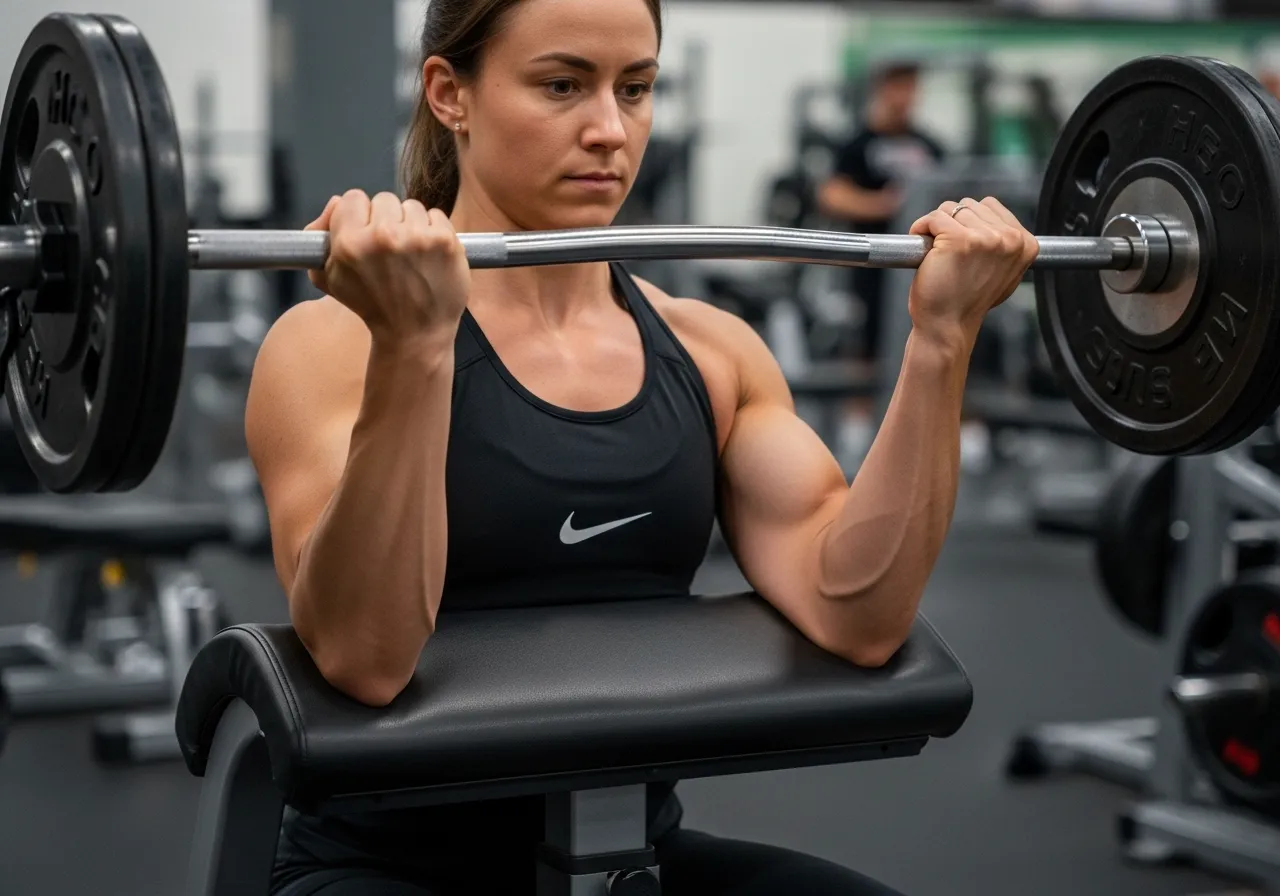
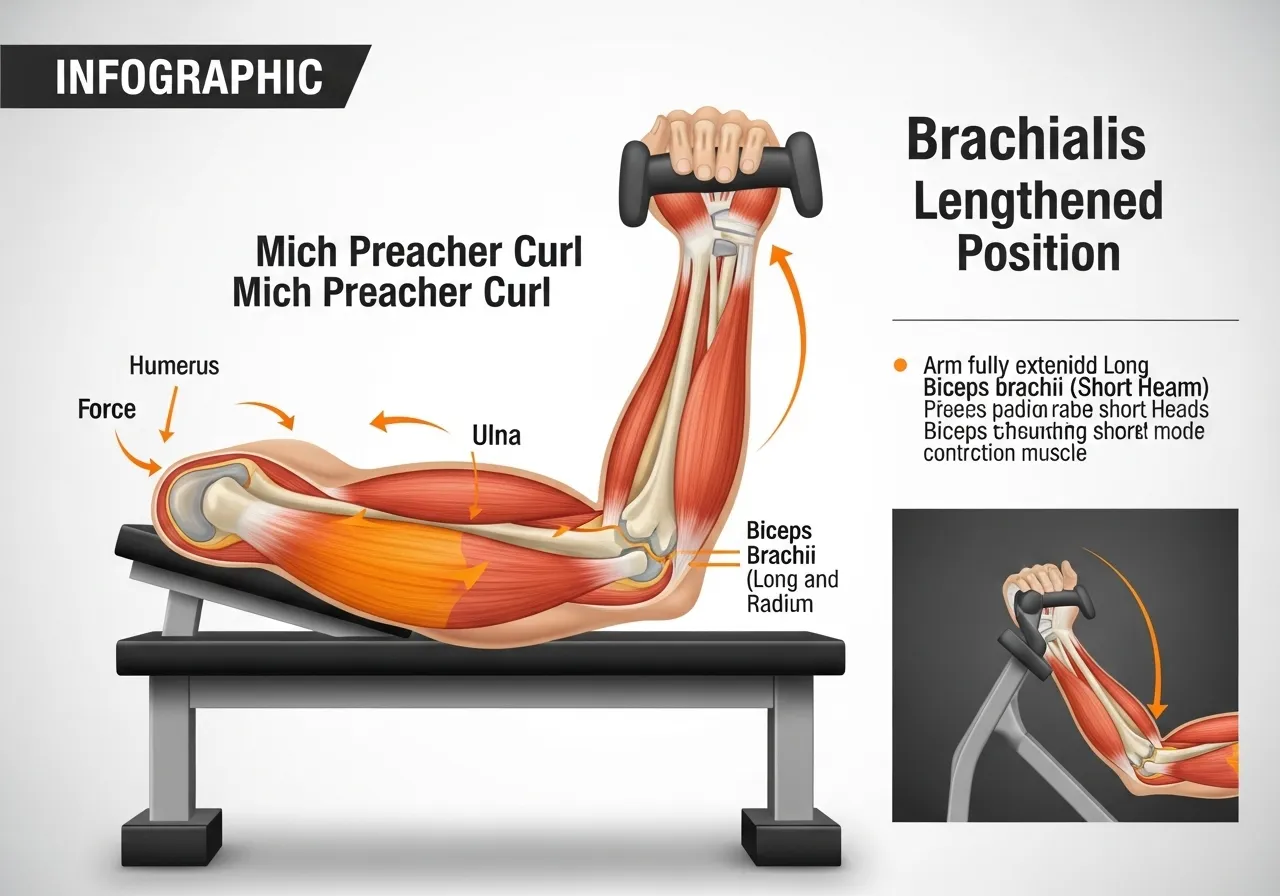
The preacher curl’s defining mechanical characteristic is that the bicep begins each rep in a lengthened (stretched) position — the arm is extended and angled forward over the pad, placing the bicep under load at maximum length before any contraction occurs.
Research on muscle hypertrophy and muscle length at peak load consistently shows that muscles trained at longer lengths produce greater hypertrophic stimulus than muscles trained in shortened positions. For the bicep, this means the lengthened-position load of the preacher curl — where the bicep is on stretch at the bottom of the movement — may produce superior bicep development compared to standing curls where the bicep is never fully loaded in the lengthened position.
The Short Head vs Long Head Myth
The common claim that preacher curls target the short head of the bicep while incline curls target the long head has a plausible anatomical basis but limited direct EMG support. The bicep brachii short and long heads both cross the shoulder joint — the shoulder position during the curl theoretically shifts relative involvement.
In practice, both heads of the bicep activate together during most curl variations. The differences in relative short vs long head activation across curl positions are real but modest in magnitude. The more meaningful distinction is between bicep brachii activation and brachialis activation — a split that depends more on forearm rotation than curl angle.
📌 Key Finding Neutral grip (hammer) preacher curls increase brachialis activation relative to bicep brachii. For trainees wanting arm thickness (brachialis sits under the bicep and pushes it upward), neutral-grip preacher curls are more effective than supinated-grip versions.
The Arm Angle on the Pad: How It Changes the Exercise
Standard preacher benches angle the pad at approximately 45–60° from vertical. This creates moderate shoulder flexion — enough to produce the lengthened-position advantage without the extreme stretch that an incline dumbbell curl provides.
Some specialised preacher benches or arm blaster devices position the arm more vertically. This reduces the lengthened-position stretch at the bottom and produces a movement more similar to a standing curl with arm support. Neither is inherently superior — the standard 45–60° angle provides the best balance of lengthened-position loading and comfortable range for most trainees.
The key variable for the trainee: the shoulder should feel a mild stretch in the bicep at the fully extended bottom position. If there is no stretch sensation, the angle is too vertical. If there is shoulder joint discomfort (not just bicep stretch), the angle may be too horizontal — adjust the pad or choose a different implement.
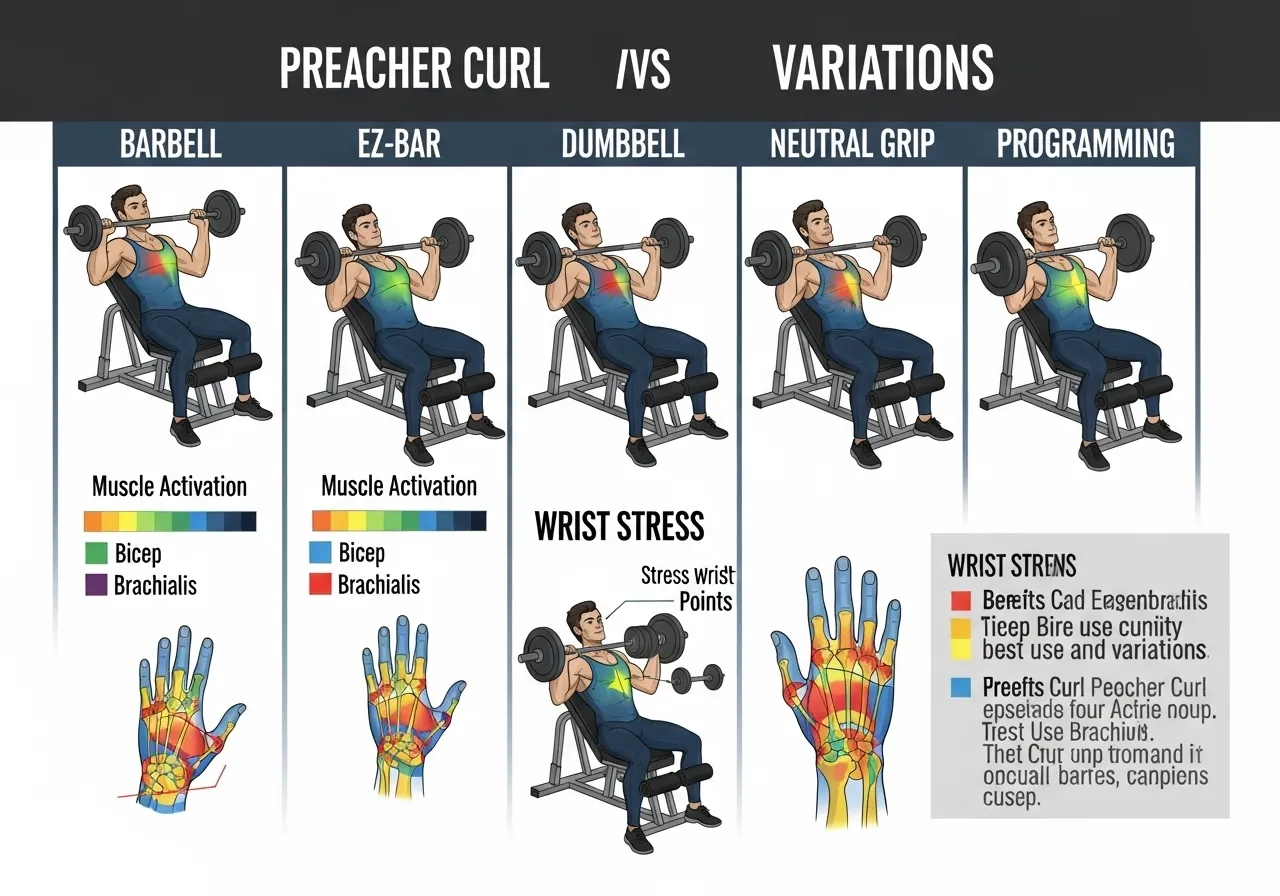
EZ-Bar vs Barbell vs Dumbbell Preacher Curl: The EMG Comparison
EZ-Bar: The Most Common Variation and Its Trade-Offs
The EZ-bar curl uses a cambered bar that places the forearms in a semi-supinated position — between full supination (palms up) and neutral (palms facing each other). This intermediate position reduces wrist stress compared to full supination under heavy load, which is why the EZ-bar is the most common preacher curl implement.
📌 Key Finding
Barbell preacher curl produces 11–14% greater bicep activation than EZ-bar. The EZ-bar’s wrist comfort advantage comes at a measurable cost to bicep recruitment.
Dumbbell Preacher Curl: The Supination Advantage
The dumbbell preacher curl allows full forearm supination throughout the range — and uniquely, allows the forearm to supinate progressively as the curl progresses, matching the bicep’s rotational function. The bicep brachii is both an elbow flexor and a forearm supinator — movements that occur simultaneously during the dumbbell preacher curl but are partially fixed during barbell and EZ-bar versions.
This progressive supination during the curl activates the bicep through both its primary functions simultaneously — producing a fuller contraction than any fixed-grip variation can achieve. The trade-off: dumbbells allow less absolute load than a barbell or EZ-bar, and the unilateral nature means longer total session time.
Head-to-Head Comparison
Variation
Bicep Activation
Brachialis
Wrist Stress
Load Potential
Best For
Barbell
Highest
Moderate
High
High
Max bicep activation, strength focus
EZ-Bar
High (−11–14%)
Moderate-High
Low
High
Wrist-sensitive trainees, heavy loading
Dumbbell
High (supination)
Moderate
Low
Moderate
Supination benefit, asymmetry correction
Neutral grip
Moderate
Highest
Very Low
Moderate
Brachialis development, arm thickness
The Programming Conclusion
No single preacher curl variation is universally superior. The practical approach: rotate between barbell (maximum bicep activation), dumbbell (supination benefit, unilateral), and neutral grip (brachialis emphasis) across training blocks — ensuring complete bicep and brachialis development that a single implement cannot provide. See also: bicep curl guide for standing curl variations that complement preacher work.
Is the Preacher Curl Better Than the Standing Curl for Bicep Growth?
The Lengthened vs Shortened Position Debate
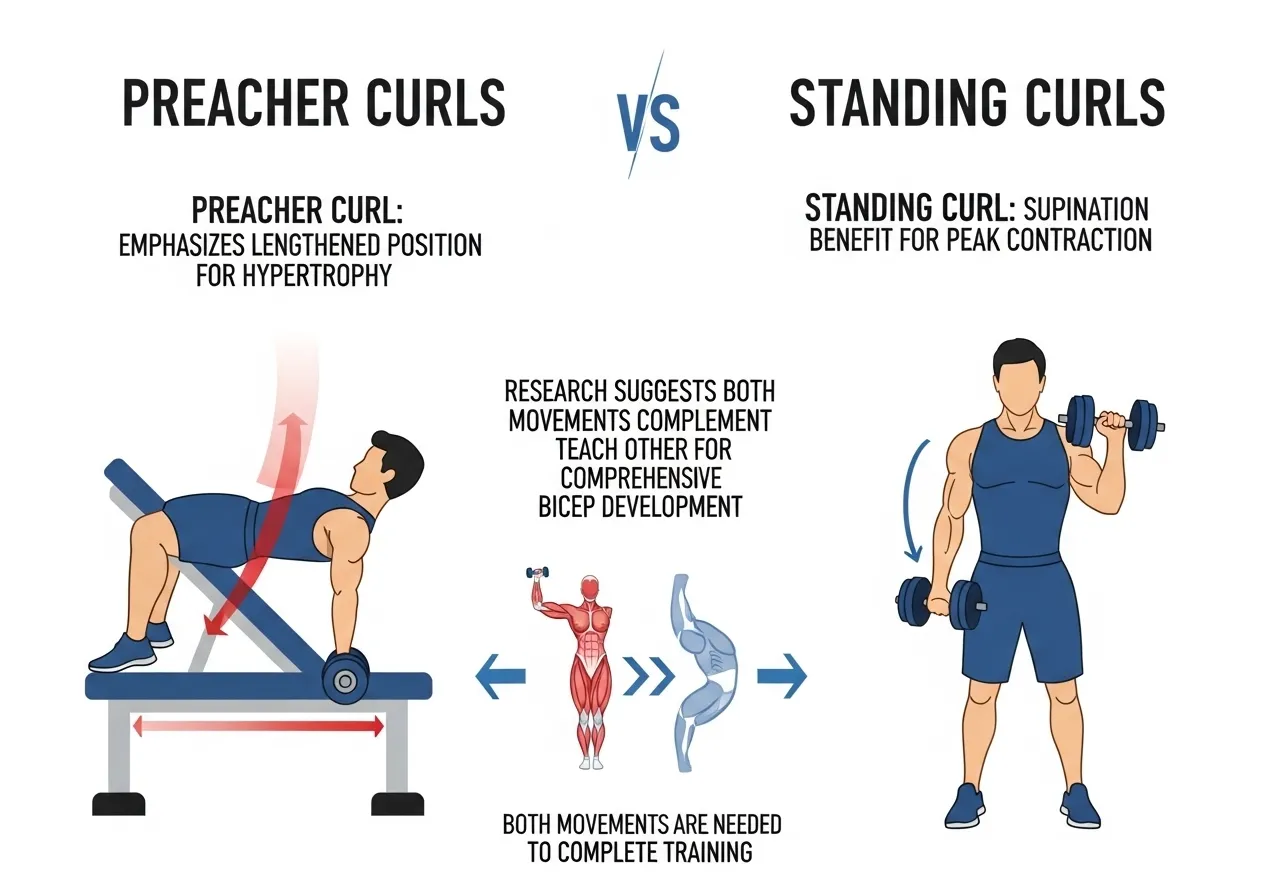
A growing body of research suggests that training muscles at their longest position under peak load produces superior hypertrophy compared to training at shorter muscle lengths. For the bicep, the preacher curl loads the muscle in a lengthened position at the bottom of the movement — while standing curls unload the bicep at the bottom (when the arm is extended, gravity acts downward and the dumbbell/bar weight creates minimal torque on the elbow).
📌 Key Finding
Lengthened-position bicep loading (preacher curl, incline curl) produces comparable or superior hypertrophy to standard standing curls. The position where the muscle is loaded under stretch matters for growth.
What Standing Curls Do That Preacher Curls Cannot
The preacher curl’s pad support, while providing the lengthened-position load advantage, also removes the stabiliser demand of standing curls. The core, shoulder stabilisers, and forearm muscles all contribute to controlling a standing barbell or dumbbell curl — stimulus that the supported preacher position eliminates.
For complete bicep development, both variations provide complementary benefits: preacher curls for lengthened-position hypertrophic stimulus, standing curls for greater total muscle involvement and higher absolute loads. The most complete bicep programmes include both.
The Cheat Curl Question
The standing curl allows a controlled hip drive at the initiation of each rep — the “cheat curl” technique. When performed with deliberate control (minimal hip involvement, maximum eccentric control), cheat curls allow heavier loads that produce a stronger eccentric stimulus as the weight is lowered. The preacher pad physically prevents this technique by fixing the arm position.
This is a genuine advantage of the preacher curl for disciplined training: it eliminates momentum as a compensatory strategy. Every rep is strictly muscle-driven. For trainees who habitually cheat on standing curls and wonder why their biceps are not developing, the preacher curl forces the honesty that produces the stimulus.
Cable Preacher Curl: The Constant Tension Alternative
A cable machine with a low pulley provides a preacher curl variant with constant tension throughout the range — unlike a barbell or dumbbell where resistance drops to near zero at the bottom (when the arm is extended and the bar hangs directly below the elbow).
The cable preacher curl maintains meaningful resistance at the fully extended position, combining the lengthened-position loading of the preacher setup with the constant tension profile of cable exercises. For trainees who have access to a cable station and a preacher bench simultaneously, this variation offers the most complete resistance curve of any preacher curl option.
If a dedicated cable-preacher setup is not available, an effective improvisation: sit sideways on a preacher bench with the inner arm on the pad and hold a cable D-handle attached to a low pulley. The cable runs diagonally across the body — functional though not ideal mechanically. A better alternative for home or limited equipment situations is the incline dumbbell curl, which produces similar lengthened-position loading to the preacher bench via shoulder extension angle. See also: tricep training guide for the antagonist arm programming that balances preacher curl bicep volume.
Preacher Curl Technique: Setup, Execution, and the Eccentric That Matters Most
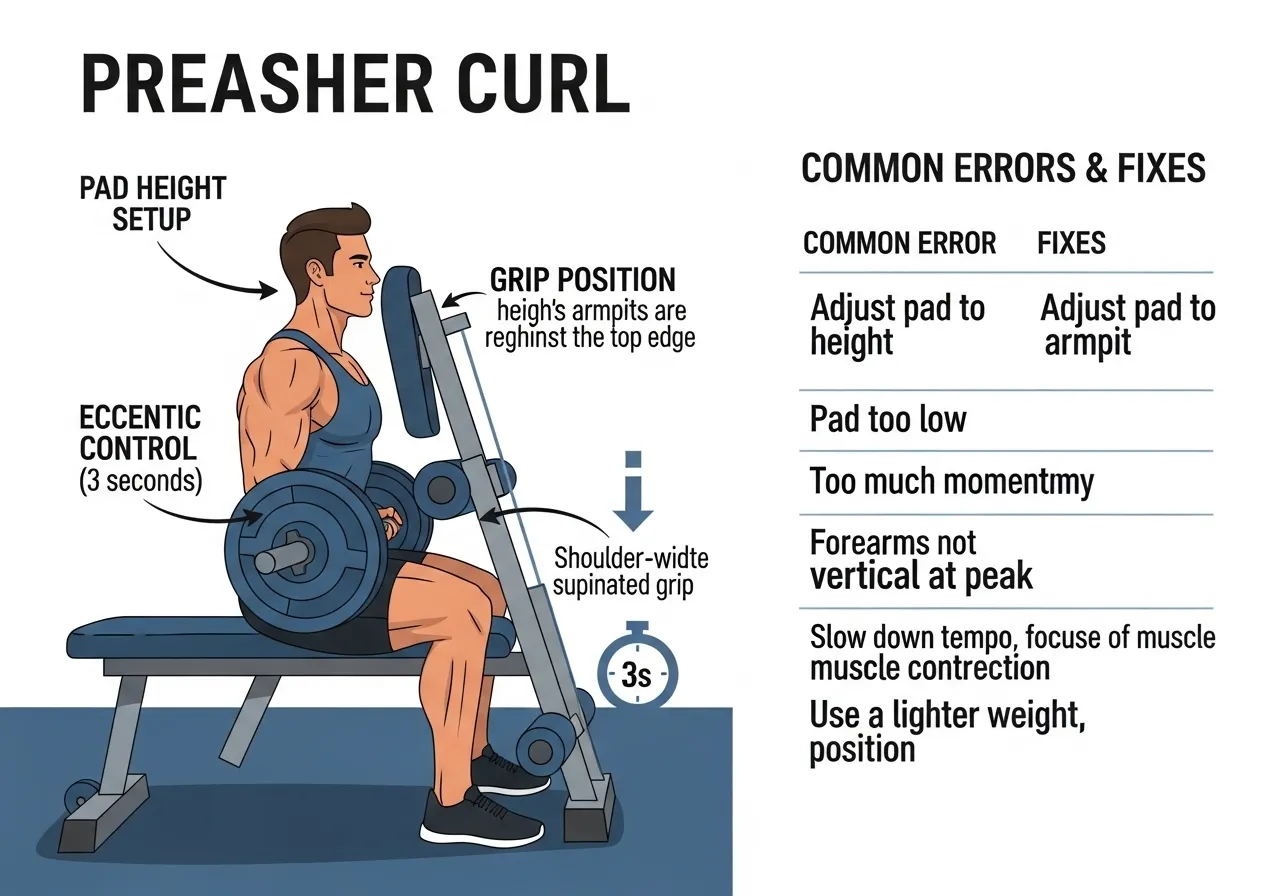
Setup: Pad Height and Arm Position
The most common preacher curl setup error is incorrect pad height. The upper arm should rest on the pad at a position where the armpit sits at or slightly above the top edge of the pad — not in the armpit. If the pad is too high, the tricep contacts the pad and limits elbow flexion range. If the pad is too low, the arm slides down under load and the elbow positioning becomes inconsistent.
The upper arm angle on the pad determines the degree of shoulder flexion during the curl. Most preacher benches angle the pad at approximately 45–60° from vertical. This angle produces the lengthened-position loading advantage — a more vertical arm position (pad nearly vertical) reduces this advantage and approximates a standing curl in the supported position.
Grip and Forearm Position
Barbell/EZ-bar: Grip slightly narrower than shoulder width. Wrists neutral — do not extend or flex the wrist during the curl. Forearms start in the position the bar dictates (supinated for barbell, semi-supinated for EZ-bar).
Dumbbell: Begin with neutral grip (palms facing each other) and progressively supinate (rotate palms up) as the curl progresses. At the top of the movement, palms should face the ceiling with the pinky rotating slightly inward to maximise bicep contraction.
Execution: The Two Phases
Concentric (lifting): Curl the weight from full extension to full elbow flexion — bringing the bar or dumbbells toward the shoulder. Drive the movement from the bicep, not from the shoulder rising off the pad. If the shoulder lifts off the pad during the curl, the weight is too heavy.
Eccentric (lowering): Lower over 3 full seconds back to the starting position. This is the most important technical requirement of the preacher curl. The bottom position — where the bicep is fully lengthened under load — produces the greatest hypertrophic stimulus and the greatest injury risk if the weight is dropped rather than lowered. Never let the weight drop to full extension — the same principle that applies during incline bench press eccentric control applies here at the lengthened position; lower under complete muscular control throughout.
Common Errors
Error
Consequence
Fix
Dropping to full extension
Proximal bicep tendon injury risk
3-sec eccentric, stop 5–10° short of full extension
Reduce load; switch to EZ-bar if wrist pain persists
Not reaching full flexion
Top-range bicep contraction incomplete
Curl to full elbow flexion — upper and lower arm close together
Preacher Curl Mistakes and 8-Week Bicep Programme
Mistake 1: Going Too Heavy on Every Set
The preacher pad fixes the arm position and removes momentum — making the bicep solely responsible for every kilogram lifted. The same trainee who can cheat-curl 25 kg dumbbells standing may find 15 kg on the preacher pad genuinely challenging with strict form. Excessive load on the preacher curl forces the shoulder to rise off the pad, the wrist to break, and the eccentric to be dropped rather than controlled.
Starting lighter than expected and building progressively over weeks produces better results than ego loading from the first session. The eccentric overload opportunity — the specific advantage of the preacher curl — is entirely lost when the weight is dropped rather than lowered.
Mistake 2: Never Using the Dumbbell Variation
EZ-bar preacher curls are comfortable and allow heavy loading. Many trainees use them exclusively for years — never experiencing the supination-through-range benefit that dumbbell preacher curls provide. The dumbbell variation’s progressive supination produces a qualitatively different bicep contraction that the fixed-grip EZ-bar simply cannot replicate.
Mistake 3: Ignoring the Brachialis
The brachialis sits beneath the bicep brachii and, when developed, pushes the bicep upward — creating greater arm height and peak appearance. Most bicep programmes train exclusively with supinated-grip curls and never directly target the brachialis. Adding one set of neutral-grip preacher curls (hammer preacher curl) per session provides direct brachialis stimulus that translates to visible arm development within 8–12 weeks.
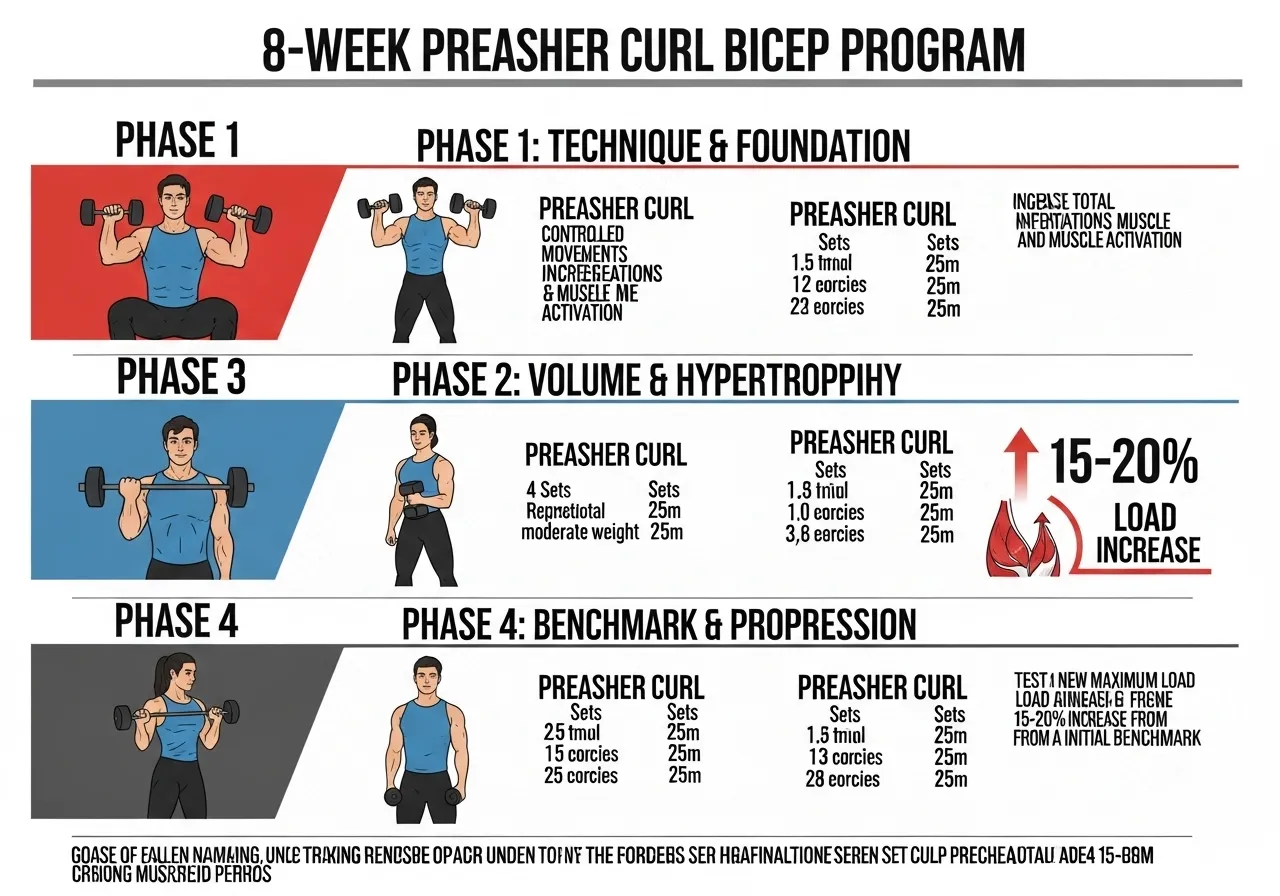
8-Week Preacher Curl Programme
This programme runs two direct bicep sessions per week, each built around a different preacher curl variation as the primary exercise. Rotation prevents adaptation to a single stimulus while systematically addressing all aspects of bicep and brachialis development.
📅 Phase 1 — Weeks 1–2: Technique and Load Calibration
Session A: EZ-bar preacher curl 4×10 (find load where 3-sec eccentric is challenging but controlled) | Neutral grip preacher 3×12
Session B: Dumbbell preacher curl 4×10 each arm (focus on supination at top) | Standing barbell curl 3×10
Focus: Establish correct load for each variation — if the eccentric is dropped, reduce by 10%
Week 8 Benchmark: Retest EZ-bar 10RM vs Week 1. A 15–20% load increase with controlled eccentric maintained is typical. Also note brachialis development — increased arm thickness visible under the bicep confirms neutral grip work is producing results.
Focus: Drop set on Session A forces the bicep to failure — the peak stimulus of the programme
Frequently Asked Questions About the Preacher Curl
Is the preacher curl better than the standing curl for bicep development?
Both produce significant bicep hypertrophy — they complement rather than replace each other. The preacher curl’s lengthened-position loading may produce slightly superior distal bicep development. The standing curl allows heavier absolute loads and greater total upper arm muscle involvement. The most effective bicep programmes include both: preacher curls for lengthened-position stimulus and controlled eccentric training, standing curls for heavier progressive overload and full-range contraction.
Should I use an EZ-bar or dumbbells on the preacher bench?
Use both across different sessions. EZ-bar allows heavier loads with lower wrist stress — ideal for primary strength-focused sets. Dumbbells allow progressive supination through the range — producing a fuller bicep contraction and enabling unilateral work that identifies and corrects bilateral strength asymmetries. If you only ever use one implement, rotate every 4–6 weeks to prevent adaptation to a single resistance profile.
How do I avoid elbow pain during preacher curls?
Elbow pain during preacher curls typically occurs at the bottom of the movement when the weight is dropped to full extension — creating sudden tensile load on the distal bicep tendon and the anterior elbow capsule. Stop the descent 5–10° short of full extension on every rep, lower under a deliberate 3-second eccentric, and never allow the weight to drop. If elbow pain persists with controlled technique, switch to the dumbbell variation (which allows natural forearm rotation that reduces elbow stress) and consult a physiotherapist if symptoms continue. See also: bicep curl guide for the full range of bicep exercise options including lower-stress cable curl alternatives.
Why do I feel preacher curls in my forearm more than my bicep?
Two causes: the load is too heavy (brachioradialis and forearm muscles compensate), or the wrist is breaking under load (bending back or flexing forward, forcing the forearm to stabilise instead of the bicep driving the movement). Reduce load by 20%, focus on keeping the wrist neutral throughout, and use the EZ-bar if wrist extension is the problem. The shift from forearm to bicep stimulus is typically immediate once wrist position is corrected.
How many sets of preacher curls should I do per week?
As part of a complete bicep programme, 6–12 direct preacher curl sets per week (across 2 sessions) is a practical range. The bicep is a relatively small muscle that recovers quickly but also adapts quickly — variation in implement, grip, and rep range across sessions prevents the stagnation that accumulates from identical sets of the same variation week after week.
⚠️ Health & Fitness DisclaimerThis article is for general educational purposes only and does not replace professional medical advice. If you have any shoulder, back, or joint conditions, please consult a qualified healthcare professional before beginning a Smith machine vs free weights program. The Smith machine — a barbell constrained to a vertical or near-vertical…
⚠️ Health & Fitness DisclaimerThis article is for general educational purposes only and does not replace professional medical advice. If you have any pre-existing joint, shoulder, or wrist conditions, please consult a qualified healthcare professional before beginning any dumbbell training programme. Dumbbells are the most underestimated tool in the gym. Most trainees treat them as…
The shoulder press machine gets dismissed in most serious training environments. The reasoning is consistent: it is a machine, which means it does the stability work for you, which means it produces inferior results compared to free weights. This reasoning is correct in one dimension and wrong in another. The machine shoulder press does trade…
The lateral raise is the only exercise that directly targets the medial deltoid head, the muscle responsible for shoulder width. Every pressing movement loads the anterior deltoid heavily. No pressing movement meaningfully loads the medial deltoid. Yet most trainees perform lateral raises as an afterthought: a few sets of dumbbell swings at the end of…
⚠️ Health & Fitness DisclaimerThis article is for general educational and informational purposes only.It does not replace professional medical or fitness advice.If you have any pre-existing knee, hip, or lower back condition — please consult a qualified healthcare professional or certified personal trainer before starting or modifying any resistance training program. The leg press guide…
⚠️ Fitness Disclaimer: The information in this article is for general educational purposes only and does not constitute professional fitness or medical advice. Always consult a qualified healthcare professional before starting any new exercise program, especially if you have existing injuries or medical conditions. The Machine That Gym Culture Can’t Seem to Agree On No…